U.S. Pat. No. 7,771,279
GAME PROGRAM AND GAME MACHINE FOR GAME CHARACTER AND TARGET IMAGE PROCESSING
AssigneeNintendo Co. Ltd.
Issue DateAugust 25, 2004
Illustrative Figure
Abstract
On a display screen, a game image including a plurality of target images and a game character image is displayed. The target images moves so as to pass over the game character image. When an input is provided from a player onto a touch panel, input coordinates are detected. In response, display coordinates of each target image at the time of the input are detected. When display coordinates located within a predetermined range from the input coordinates are present, specified coordinates are determined based on at least one of a position represented by display coordinates and a position represented by the input coordinates. The game character has characteristic parameters which are varied in accordance with a positional relation between the specified coordinates and the game character image.
Description
DESCRIPTION OF THE PREFERRED EMBODIMENTS First Embodiment FIG. 1is an external view of a portable game machine according to one embodiment of the illustrative embodiments. InFIG. 1, a game machine1according to the present embodiment has two liquid crystal displays (hereinafter, “LCDs”)11and12incorporated in a housing18so that these LCDs are disposed at predetermined positions. Specifically, when the first LCD11and the second LCD are vertically disposed, the housing18includes a lower housing18aand an upper housing18b. The upper housing18bis rotatably supported by a part of the upper side of the lower housing18a. The shape of the upper housing18bviewed from the top is slightly larger than that of the second LCD12viewed from the top, and is formed with an opening so as to expose a display screen of the second LCD12on one main surface. The lower housing18ais formed with an opening so as to expose a display screen of the first LCD11at approximately the center position in the horizontal direction. The shape of the lower housing18ais longer in the horizontal direction than that of the upper housing18b. The lower housing18ais formed with sound holes15aof a loudspeaker15on either one of right and left portions sandwiching the first LCD11, and also an operation switch section14is mounted on both of the right and left portions sandwiching the first LCD11. The operation switch section14includes operation switches14aand14bthat are mounted on the one main surface of the lower housing18aat the right side of the first LCD11; and a direction indicating switch14c, a start switch14d, and a select switch14ethat are mounted on the one main surface of the lower housing switch14cmounted on the left side of the first LCD11. The operation switches14aand14bare used to give an instruction for jumping, punching, moving a weapon or the like in an action game, for example, or to get an item, select a weapon or a command, ...
DESCRIPTION OF THE PREFERRED EMBODIMENTS
First Embodiment
FIG. 1is an external view of a portable game machine according to one embodiment of the illustrative embodiments. InFIG. 1, a game machine1according to the present embodiment has two liquid crystal displays (hereinafter, “LCDs”)11and12incorporated in a housing18so that these LCDs are disposed at predetermined positions. Specifically, when the first LCD11and the second LCD are vertically disposed, the housing18includes a lower housing18aand an upper housing18b. The upper housing18bis rotatably supported by a part of the upper side of the lower housing18a. The shape of the upper housing18bviewed from the top is slightly larger than that of the second LCD12viewed from the top, and is formed with an opening so as to expose a display screen of the second LCD12on one main surface. The lower housing18ais formed with an opening so as to expose a display screen of the first LCD11at approximately the center position in the horizontal direction. The shape of the lower housing18ais longer in the horizontal direction than that of the upper housing18b. The lower housing18ais formed with sound holes15aof a loudspeaker15on either one of right and left portions sandwiching the first LCD11, and also an operation switch section14is mounted on both of the right and left portions sandwiching the first LCD11.
The operation switch section14includes operation switches14aand14bthat are mounted on the one main surface of the lower housing18aat the right side of the first LCD11; and a direction indicating switch14c, a start switch14d, and a select switch14ethat are mounted on the one main surface of the lower housing switch14cmounted on the left side of the first LCD11. The operation switches14aand14bare used to give an instruction for jumping, punching, moving a weapon or the like in an action game, for example, or to get an item, select a weapon or a command, or the like in a role playing game (RPG) or a simulation RPG. The direction indicating switch14cis used to indicate a direction on a game screen, such as a direction a player object is to move (or a player character) operable by a player and a direction a cursor is to move. Also, as required, another operation switch may be added, or side switches14fand14gmay be provided at the right and left of the upper surface (the upper-side surface) of the area in which the operation switch section14is mounted on the lower housing18a.
Furthermore, a touch panel13(a dotted area inFIG. 1) is mounted on the surface of the first LCD11. The touch panel13may be any one of a resistive-film type, an optical (infrared) type, and a capacitive type. When a stick16(or a finger) presses, strokes, or moves over the touch panel13, the coordinate position of the stick16is detected for output of coordinate data.
As required, the upper housing18bis formed with an accommodation slit15b(a two-dotted area inFIG. 1) in the vicinity of a side surface for accommodating the stick16for operating the touch panel13. The lower housing18ais formed at a part of a side surface with a cartridge insertion portion (another two-dotted area inFIG. 1) in which a game cartridge17(hereinafter simply referred to as a cartridge17) having incorporated therein a memory that stores a game program (such as ROM) is inserted. The cartridge is an information storage medium for storing a game program, and is typically implemented by a non-volatile semiconductor memory, such as a ROM or a flash memory. The cartridge insertion portion has incorporated therein a connector (refer toFIG. 2) for electrical connection with the cartridge17. Furthermore, the lower housing18a(or the upper housing18b) has accommodated therein an electronic circuit board with various electronic components, such as a CPU, being mounted thereon. The information storage medium for storing a game program is not restricted to the above-stated non-volatile semiconductor memory, but may be a CD-ROM, DVD, or other optical-disk-type storage medium.
Next, with reference toFIG. 2, the internal structure of the game machine1is described.FIG. 2is a block diagram showing the internal structure of the game machine1.
InFIG. 2, the electronic circuit board accommodated in the housing18ahas a CPU core21mounted thereon. The CPU core21is connected to a connector28for connection with the cartridge via a predetermined bus, and is also connected to an input/output interface (I/F) circuit27, a first graphic processing unit (first GPU)24, a second graphic processing unit (second GPU)26, and a working RAM (WRAM)22.
To the connector28, the cartridge17is removably connected. As described above, the cartridge17is a storage medium for storing a game program and, specifically, includes a ROM171for storing a game program and a RAM172for rewritably storing backup data. The game program stored in the ROM171of the cartridge17is loaded to a WRAM22. The game program loaded to the WRAM22is then executed by the CPU core21. The WRAM22stores temporary data and image-generating data obtained by the CPU core21executing the game program.
The I/F circuit27is connected to the touch panel13, the operation switch section14, and the loudspeaker15. The loudspeaker15is disposed at a position inside of the above-described sound holes15.
The first GPU24is connected to a first video RAM (hereinafter, “VRAM”)23, while the second GPU26is connected to a second VRAM25. In response to an instruction from the CPU core21, the first GPU24generates a first game image based on data for generating an image stored in the WRAM22. The generated first game image is then rendered by the first GPU24to the first VRAM23. On the other hand, in response to an instruction from the CPU core21, the second GPU26generates a second game image based on data for generating an image stored in the WRAM22. The generated second game image is then rendered by the second GPU to the second VRAM25.
The first VRAM23is connected to the first LCD11, while the second VRAM25is connected to the second LCD12. In response to an instruction from the CPU core21, the first GPU24outputs the first game image rendered to the first VRAM23to the first LCD11. The first LCD11then displays the first game image output from the first GPU24. On the other hand, in response to an instruction from the CPU core21, the second GPU26outputs the second game image rendered to the second VRAM25to the second LCD12. The second LCD12then displays the second game image output from the second GPU26.
Hereinafter, a game process to be executed on the game machine by the game program stored in the cartridge17is described. Note that, in the present invention, only the first LCD11with its display screen being covered with a touch panel is taken as a display unit. As such, the game machine according to the present invention may be configured not to include the second LCD12. In other words, the game machine according to the present invention can be achieved by a game machine, a PDA, or the like that is configured to include a single display unit.
First, a general outline of a game to be played on the game machine1is described with reference toFIGS. 3A through 9B.FIGS. 3A and 3Bare illustration showing one example of a game image displayed on the display screen of the first LCD11. Any type of game can be played on the game machine according to the illustrative embodiments. In the first embodiment, a role playing game as shown inFIGS. 3A and 3Bis described as an example. This role playing game includes a scene in which a player character operated by the player is traveling on a game map (FIG. 3A) and a scene in which the player character battles against an enemy character (FIG. 3B). In the traveling scene, when predetermined conditions under which the player character meets an enemy character are satisfied, “Here comes the enemy!!” is displayed on the display screen, as shown inFIG. 3A. Then, the game image is switched to a battle scheme as shown inFIG. 3B. Note that, for the game machine having two display units as shown inFIG. 1, the traveling scene may be displayed on the second LCD12, while the battle scene may be displayed on the first LCD11.
In the battle scene as shown inFIG. 3B, the game image including an enemy character31is displayed on display screen of the first LCD11. This game image includes a target image32moving on the display screen. The target image32is an image to which an instruction from the player is targeted. That is, in order to attack the enemy character, the player performs an input operation, which is a game operation, on the touch panel13by touching his or her finger on the target image32. InFIG. 3B, a dotted circle and a dotted line represent the movement of the target image32, and are not actually displayed on the game image.
Also in the display screen illustrated inFIG. 3B, characteristic parameters of the enemy character are displayed. The characteristic parameters are values indicative of characteristics of a game character appearing in the game. Specifically, hit points (HP) and magic points (MG) of the enemy character are displayed on the first LCD11as the characteristic parameters. After the game image is switched to the battle scheme, the player character and the enemy character take turns attacking each other to proceed with the battle.
When the player-character's attacking turn comes during the battle, the player operates a game operation (attacking operation) for attacking the enemy character.FIG. 4Ais an illustration showing one example of a game image when the player performs an attacking operation. As shown inFIG. 4A, the player performs a touch-panel input to specify the target image32. That is, the player performs an input by touching the touch panel13with his or her finger at the position where the target image32is displayed. If the player has successfully specified the target image32, an attack against the enemy character is performed. On the other hand, if the player has not successfully specified the target image32, no attack is performed.
FIG. 4Bis an illustration showing one example of a game image after the player performs an attacking operation. Specifically,FIG. 4Billustrates a game image when the player has successfully specified the target image32. In this case, the game machine1performs the following game process as a process of the player character attacking the enemy character. That is, an attack effect image33, indicative of an attack by the player character against the enemy character, is displayed. Also, a damage image34, indicative of the amount of damage the enemy character suffers from the attack, is displayed. The damage image34shown inFIG. 4Bindicates that the enemy character suffers the amount of damage of 10. Furthermore, the game machine1performs a process of changing the HP of the enemy character31. In the example ofFIG. 4B, the game machine1subtracts 10 points from the HP of the enemy character31. As a result, in a display on the upper-left of the display screen indicative of the characteristic parameters of the enemy character, 10 points are subtracted from the original HP of the enemy character31(represented by “ENEMY A” inFIG. 4B).
The target image32may move in accordance with a rule (movement pattern) set in advance in the game machine1, or may move in a random manner. In the first embodiment, the target image32moves so as to change its moving direction at the edge of the display screen. In another embodiment, the target image32may move so as to change its moving direction at time predetermined intervals or at intervals determined in a random manner. Also, the direction-changing rule is arbitrary. For example, the rule may be such that the moving direction is changed by a predetermined angle or by an angle determined in a random manner.
Also, in the first embodiment, when the player has successfully specified the target image32, the state of display of the target image32is changed. Specifically, the color, shape, or size of the target image32is changed. Here, the state of display of the target image32before change is represented by a hatched circle (FIG. 3B), while the state of display of the target image32after change is represented by a black circle (FIG. 4A). With the state of display of the target image32being changed, the player can visually recognize that the player has successfully specified the target image32. That is, the player can easily recognize that the player has successfully specified the target image32.
Still further, in the first embodiment, the damage given to the enemy character is varied in accordance with the position of the target image32when specified by the player. That is, the game machine1varies the HP of the enemy character in accordance with the relation between the position of the target image32when specified by the player and the position of the enemy character. In the first embodiment, the damage given to the enemy character is varied depending on the position at which the target image32is located when specified by the player, that is, any one of a position of an eye of the enemy character, a position of a shield held by the enemy character, and positions of others (normal positions). For example, inFIG. 4B, the player specifies a normal position. In this case, the damage given to the enemy character is “10”.
FIG. 5Ais an illustration showing one example of a game image when the player performs an attacking operation on an eye of the enemy character. In the first embodiment, the target image32can two-dimensionally move on the display screen, and therefore the player can freely specify any position on the display screen. Thus, for example, as shown inFIG. 5A, the player can also specify the position of an eye of the enemy character, that is, can stop the movement of the target image32at the position of the eye of the enemy character.FIG. 5Bis an illustration showing one example of a game image after the player performs the attacking operation at the position of the eye of the enemy character. As shown inFIG. 5B, when the player specifies the position of the eye of the enemy character, the damage given to the enemy character is “20”. That is, the position of the eye is set as a weak position of the enemy character. The damage given to the enemy character when the weak position is specified by the player is larger than that when a normal position is specified by the player.
FIG. 6Ais an illustration showing a game image when the player performs an attacking operation at the position of the shield held by the enemy character.FIG. 6Bis an illustration showing a game image after the player performs an attacking operation at the position of the shield held by the enemy character. As shown inFIG. 6B, when the position of the shield held by the enemy character is specified by the player, the damage given to the enemy character is “5”. The position of the shield held by the character is set as a position whose defensive power is higher than those of the normal positions. Therefore, the damage given to the enemy character when such a position with a high defensive power is smaller than the damage when any normal position is specified by the player.
FIG. 7Ais an illustration showing one example of a game image when the player performs an attacking operation at a position other than the position of the image of the enemy character. In the first embodiment, the game machine1moves the target image32so that it passes over the image of the enemy character31. Therefore, the target image32is moved not only over the image of the enemy character31but also over images other than the image of the enemy character31. That is, as shown inFIG. 7A, the player can also specify a position away from the enemy character31.FIG. 7Bis an illustration showing one example of a game image after the player performs an attacking operation at a position other than the position of the image of the enemy character. As shown inFIG. 7B, when the player specifies a position away from the enemy character31, no damage is given to the enemy character31.
As described above with reference toFIGS. 4A through 7B, in the first embodiment, the HP of the enemy character is varied in accordance with the relation between the position of the target image32when specified by the player and the position of the enemy character31. Therefore, the player performs an input operation with attention not only to the time when the target image32is specified but also to the position of the target image32when specified. That is, in the game according to the illustrative embodiments, an operation skill of specifying the target image at a suitable position while viewing the moving images reflects on the game. Also, in the first embodiment, the damage given to the enemy character is varied depending on the position of the target image32when specified by the player32. Therefore, the player can also play the game with the aim of finding weak points in the enemy character.
InFIGS. 4A through 7B, one target image32is present. Alternatively, a plurality of target images32may be present.FIG. 8is an illustration showing one example of a game image including a plurality of target images. InFIG. 8, five target images32a,32b,32c,32d, and32eare displayed on the display screen of the first LCD11. In the first embodiment, each of the target images32athrough32emoves with its moving direction being changed at the edge of the display screen. In another embodiment, each of the target images32athrough32emay move in accordance with each different rule, or some of the target images32athrough32emay move in a random manner.
FIG. 9Ais an illustration showing one example of a game image when the player performs an attacking operation with a plurality of target images. With such a plurality of target images as shown inFIG. 9A, the player can specify one or more target images with one attacking operation. Also, in the first embodiment, the game machine1measures an elapsed time from the time when each of the target images32athrough32estarts moving, and receives an input from the player to the touch panel until the elapsed time exceeds a predetermined limit time. That is, the player has to specify any of the target images32within a period from the time when each of the target images32athrough32estarts moving to the limit time. InFIG. 9A, the player has specified four target images (target images32a,32c,32d, and32e).
FIG. 9Bis an illustration showing one example of a game image after the player performs an attacking operation with a plurality of target images. With such a plurality of target images, the game machine1calculates a damage for each of the target images specified by the player. A total damage eventually given to the enemy character is calculated as a sum of damages calculated for the target images32. For example, inFIG. 9B, the damage given by the player specifying the target image32cis calculated as “20”, the damage given by the player specifying the target image32dis calculated as “5”, and the damage given by the player specifying the target image32eis calculated as “10”. Here, the target image32ais not specified on the enemy character31, and therefore the damage given by the player specifying the target image32ais calculated as “0”. As a result, a total damage given to the enemy character31is 20+5+10+0=35. Also, the target image32bwas not specified within the limit time, and therefore no damage is calculated for the target image32b.
As described above with reference toFIGS. 9A and 9B, with a plurality of target images being simultaneously displayed, the player can select one or more target images for attack from among those plurality of target images. The player has to decide which target image passes over the position to be attacked (in the example ofFIG. 4A, the position of the eye of the enemy character31). Therefore, a higher operation skill is required compared with the case where a single target image is displayed. Therefore, with such a plurality of target images, an entertainment aspect of the game can be further increased.
Next, the game process performed by the game machine1is described in detail. First, data stored in the WRAM22at the time of the game process is described.FIG. 10is an illustration showing a memory map of the WRAM22of the game machine1. As shown inFIG. 10, at the time of the game process, enemy character data41is stored in the WRAM22. In the enemy character data41, each enemy character is associated with its related information. With reference toFIG. 11, details of the enemy character data41are described below.
FIG. 11is an illustration showing one example of the enemy character data41. As shown inFIG. 11, in the enemy character data41, each enemy character is associated with its HP, MP, first to third damage areas, and target image information. The HP represents hit points of the enemy character at the start of the battle with the player character. As the battle progresses, the HP of the enemy character data41are decreased and, when the HP become 0, the enemy character is assumed to lose the battle. The MP represents magic points of the enemy character at the start of the battle with the player character.
Also, inFIG. 11, each of the first through third damage areas is an area obtained by dividing an area where the image of the enemy character is displayed on the display screen of the first LCD11. That is, in the area where the image of the enemy character is displayed, a plurality of damage areas (here, three damage areas) are defined in association with the enemy character. For example, the area where the image of the enemy character is displayed is divided into three damage areas, first through third damage areas. In the second damage area, the eye(s) of the enemy character is displayed. In the third damage area, the shield held by the enemy character A is displayed. In the first damage area, parts (normal parts) other than the eye(s) and the shield are displayed. Note that the enemy character A shown inFIG. 11is the enemy character31shown inFIG. 3B. Also, the damage areas are represented by coordinates on the display screen. In the first embodiment, the damage given to the enemy character is varied depending on which damage area includes the position specified by the player on the touch panel13. Here, the first damage area is an area where the enemy character is given an amount of damage equal to a reference amount of damage. The second damage area is an area where the enemy character is given an amount of damage twice as large as the reference amount of damage. The third damage area is an area where the enemy character is given an amount of damage half as much as the reference amount of damage. Also, the reference amount of damage is an amount of damage determined depending on the attack power of the player character calculated with a predetermined scheme.
Furthermore, inFIG. 11, the target image information indicates a size of the target image displayed when the enemy character is displayed on the screen. Here, the target image information is represented as a scaling factor with respect to a predetermined reference value. InFIG. 11, when the enemy character A is displayed on the screen, the size of the target image has a value that is equal to the reference value. Also, when the enemy character B is displayed on the screen, the size of the target image has a value that is twice as large as the reference value. As such, in the first embodiment, the size of the target image is varied depending on the type of the enemy character. In another embodiment, the moving speed of the target image or the moving pattern may be varied.
Returning to the description ofFIG. 10, the WRAM22also has target image data stored therein. Here, pieces of target image data are stored in the WRAM22as many as the number of target images to be simultaneously displayed. The target image data indicates information regarding the display or movement of the target image. Note that only first target image data421and second target image data422are shown inFIG. 10. The first target image data421includes display coordinate data421a, speed vector data421b, size data421c, and initial state data421d. The display coordinate data421aindicates a position (display position) of the target image on the display screen. The display position is represented by coordinate values on the display screen. The speed vector data421bindicates a vector representing the moving speed of the target image and the moving direction. The size data421cindicates the size of the target image. The initial state data421dindicates a display position, moving speed, moving direction, and size of the target image at the start of the battle scene, as well as color and design of the target image. Furthermore, although only the first target image data421is shown in detail inFIG. 10, other pieces of target image data each have a structure similar to that of the first target image data421.
The WRAM22also stores elapsed time data43, input coordinate data44, specified coordinate data45, and damage data46. The elapsed time data43indicates a time elapsed from the start of movement of the target image(s) in a battle scene. The input coordinate data44indicates a position on the display screen specified by the player via the touch panel13. The specified coordinate data45indicates a position on the display screen of at least one target image specified by the player. The input coordinate data44and the specified coordinate data45are represented by coordinate values on the display screen. Also, coordinates indicative of one or more positions specified by the player at one attacking operation are all stored as the specified coordinate data45in the WRAM22. That is, when plural target images are specified at one attacking operation, specified coordinate data45indicative of a plurality of coordinates is stored in the WRAM22. The damage data46is used to calculate a total damage given to the enemy character by the player's attacking operation. When the enemy character receives damage from the plurality of target images specified at one attacking operation, a plurality of pieces of damage data46are stored in the WRAM22.
The WRAM22further stores skill information data47and skill information table48. The skill information data47indicates information (skill information) serving as an index indicative of an operation skill of the player. In the first embodiment, the skill information indicates the number of times the player has successfully specified the target image at one attacking operation. Alternatively, the skill information may indicate a distance between a position specified by the player and a display position of the target image. Also, the skill information may indicate a ratio of the number of times the player has successfully specified the target image with respect to the number of inputs provided onto the touch panel13within the limit time. In the first embodiment, the game machine1changes the moving speed of the target image based on the skill information. The skill information table48is used to perform a process of changing the moving speed of the target image (refer toFIG. 14that will be described further below).
In addition to the data shown inFIG. 10, the WRAM22further stores the game program read from the cartridge17, game image data (such as image data of the enemy character and the target image(s)) and various data for use in a game process (for example, the HP and MP of the player character).
Next, a flow of the game process performed in the game machine1is described with reference toFIGS. 12 through 17.FIG. 12is a flowchart showing a flow of a game process to be performed in the game machine1. When the game machine1is powered on, the CPU core21of the game machine1executes a boot program stored in a boot ROM not shown to initialize the units including the WRAM22. Then, the game program stored in the cartridge17is read in the WRAM22, thereby starting execution of the game program. As a result the game is started, with a game image being displayed on the first LCD11through the first GPU24. The flowchart shown inFIG. 12represents the game process after the game image is switched to a battle scene. That is, when a battle between the player character and an enemy character starts during the game after being started, the process shown in the flowchart ofFIG. 12is started. Note that, in the present embodiment, a game process in states other than the battle scene is not directly related to the present invention, and is therefore not described herein.
InFIG. 12, in step10(in the drawings, “step” is simply denoted as “S”), the image and the characteristic parameters of the enemy character are displayed on the display screen of the first LCD11(refer toFIG. 3B). The HP and the MP are displayed, as the characteristic parameters of the enemy character. Specifically, the CPU core21reads the HP and the MP of the enemy character for display from the enemy character data41in the WRAM22, and then causes the read HP and MP to be displayed as the characteristic parameters on the display screen of the first LCD11.
After step10, it is determined in step11whether the player-character's attacking turn has come. The attacking turn is determined in accordance with a predetermined rule, which may be arbitrary. Here, it is assumed that the player-character's attacking turn and the enemy character's attacking turn come alternately. If it is determined in step11that the player-character's attacking turn has not yet come, a process in step12is performed. That is, in step12, an attack by the enemy character against the player character is performed. Specifically, in response to the attack by the enemy character, the characteristic parameters (HP and MP) of the player character are varied. That is, the characteristic parameters of the player character stored in the WRAM22are updated. After the process in step12is completed, a process in step13is performed.
On the other hand, if it is determined in step11that the player-character's attacking turn has come, an attack by the player character against the enemy character is performed in steps13through21. First in step13, a target image displaying process is performed. In this target image displaying process, the initial display position, moving speed, moving direction, and size of the target image are determined for display on the display screen. Hereinafter, the target image displaying process is described with reference toFIG. 13.
FIG. 13is a flowchart showing a detailed flow of a process in step13. In the target image displaying process, first in step30, the initial position of the target image is determined. Specifically, the CPU core21reads the initial state data421dincluded in the target image data (here, the target image data is assumed to be the first target image data421) stored in the WRAM22. Then, in step31, the moving speed of the target image is determined. This moving speed is determined by using a speed indicated by the initial state data421d, and the above-described skill information data47and skill information table48(refer toFIG. 10). With reference toFIG. 14, a scheme of determining a moving speed of the target image is described below.
In step31, the CPU core21first determines the moving speed indicated by the initial state data421das a reference speed. Next, the reference speed is adjusted based on the skill information data47and the skill information table48, thereby determining the moving speed of the target image.FIG. 14is an illustration showing one example of the skill information table48stored in the WRAM22. The skill information table48is a table in which the skill information is associated with speed adjusting information. Here, the skill information is information indicated by the skill information data stored in the WRAM22in step56, which will be described further below. Also, the speed adjusting information is information indicating a magnification applied for adjusting the reference speed. In order to adjust the reference speed, the CPU core21refers to the skill information table48to determine a magnification corresponding to the number of times the player has successfully specified the target image indicated by the skill information data47. For example, inFIG. 14, when the skill information data47indicates 4, 2× is determined as the magnification. That is, a speed obtained by multiplying the reference speed by 2 is determined as the moving speed of the target image.
In the first embodiment, the skill information is associated with the speed adjusting information in the skill information table48. In another embodiment, the skill information may be associated with the size of the target image. With this, the size of the target image can be varied in accordance with the player's skill. Also, in still another embodiment, the skill information may be associated with the number of target images simultaneously displayed on the display screen or the moving pattern of the target image(s).
Returning to the description ofFIG. 13, in step32, the moving direction indicated by the initial state data421dis determined as the moving direction of the target image. In the next step33, the size of the target image is determined by referring to the target image information (refer toFIG. 11) included in the enemy character data41in the WRAM22. In the example ofFIG. 11, when the enemy character B is to be displayed on the display screen the size of the target image is determined as having a value obtained by multiplying the reference value by 2. Note that the reference value is predetermined in the game machine. In the next step34, the target image is displayed at the position determined in step30. Through steps30to34, one target image is displayed.
After step34, in step35, it is determined whether the target images as many as a defined number have been displayed. In the first embodiment, the defined number is determined in advance by the game program. In another embodiment, the defined number may be varied depending on the type of the enemy character, or may be set by the player directly (such as directly designating a number) or indirectly (such as setting the number depending on the held items). If it is determined in step35that as many as the defined number of target images have been displayed, the CPU core21ends the target image displaying process. On the other hand, if it is determined in step35that as many as the defined number of target images have not yet been displayed, the processes in steps30through34are repeated until as many as the defined number of target images are displayed.
Returning to the description ofFIG. 12, after step13, in step14, time keeping for calculating the amount of time elapsed is started. That is, a time elapsed from step14is stored in the WRAM22as the elapsed time data43for update. In the next step15, it is determined whether the elapsed time exceeds the limit time. This determination is made by determining whether the elapsed time indicated by the elapsed time data43in the WRAM22is larger than the predetermined limit time. If it is determined in step15that the elapsed time exceeds the limit time, a process in step21, which will be described further below, is performed. On the other hand, if it is determined in step15that the elapsed time does not exceed the limit time, a process in step16of controlling the movement of the target image is performed.
In another embodiment, it may be determined in step15whether the number of inputs from the player onto the touch panel13at this attacking operation exceeds a predetermined number of inputs. Here, the number of inputs from the player onto the touch panel13at this attacking operation can be obtained by measuring the number of inputs detected in step18, which will be described further below. Also, the predetermined number of inputs is, for example, set to be equal to the number of target images. Note that, if the limit time is provided as described above, a desired position may be easily specified by the player specifying the same position on the display screen many times. For example, inFIG. 5, even if the player merely keeps pounding an eye of the enemy character without paying attention to the moving target image, the player may eventually be able to specify the target image when the target image moves to the position of the eye. Therefore, even with the limit time being provided, the actual operation skill may not be correctly reflected on the progress of the game. To get around this problem, the number of inputs by the player is limited. With this, the game machine1can encourage the player not to keep pounding a desired position. Thus, the actual operation skill of the player can be correctly reflected on the progress of the game.
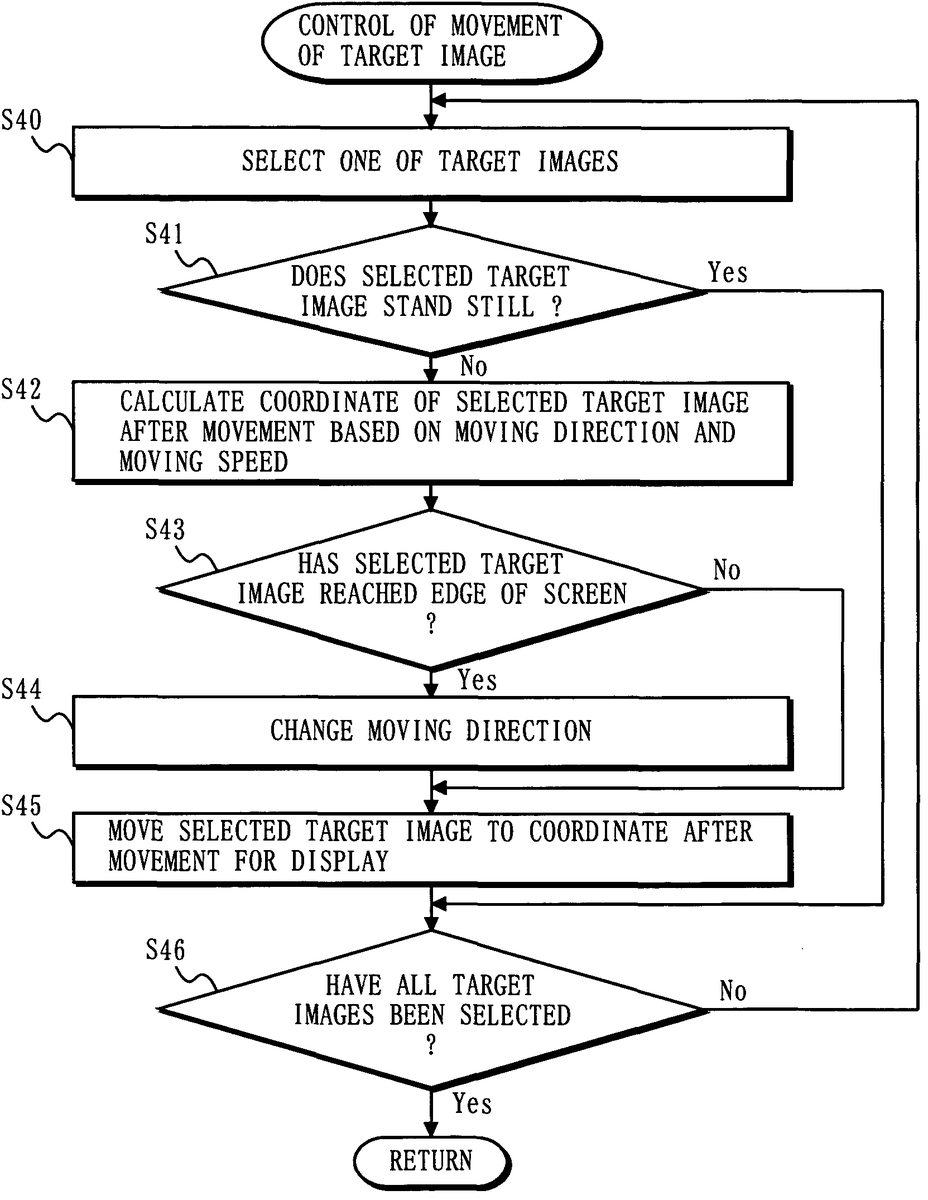
With reference toFIG. 15, a process of controlling the movement of the target images is described below in detail.FIG. 15is a flowchart showing a detailed flow of the process in step16ofFIG. 12. In the process of controlling the movement of the target images, first in step40, one of the target images displayed on the display screen is selected. Note that, in the description ofFIG. 15, the target image selected in step40is referred to as a selected target image. Next, in step41, it is determined whether the selected target image stands still. This determination is made by referring to the speed vector data421bof the target image data corresponding to the selected target image. That is, if the speed vector data421bindicates 0, it is determined that the selected target image stands still. If the speed vector data421bdoes not indicate 0, it is determined that the selected target image does not stand still. Note that the fact that the selected target image stands still means that the selected target image has already been specified. That is, the process in step41is a process of determining whether the selected target image has already been specified by the player.
If it is determined in step41that the selected target image stands still, a process in step46is performed, which will be described below. On the other hand, if it is determined in step41that the selected target image does not stand still, a process in step42is performed. That is, in step42, coordinates of the selected target image are calculated, after movement is calculated based on the moving direction and the moving speed of the selected target image. Specifically, the CPU core21calculates the coordinates of the selected target image after movement based on the direction and speed indicated by the speed vector data421bof the target image data42corresponding to the selected target image. The calculated coordinates after movement are stored in the WRAM22as the display coordinate data421aof the target image data corresponding to the selected target image. That is, the display coordinate data421aof the target image data corresponding to the selected target image is updated to the coordinates after movement calculated in step42.
In the next step43, it is determined whether the selected target image has reached the edge of the display screen. This determination is made by determining whether the coordinates calculated in step42indicate an area of the edge of the display screen. If it is determined in step43that the selected target image has not yet reached the edge of the display screen, the process in step44is skipped, and then a process in step45is performed. On the other hand, if it is determined that the selected target image has reached the edge of the display screen, the process in step44is performed.
In step44, the moving direction of the selected image is changed. Specifically, the value of the speed vector data421bof the target image data42corresponding to the selected target image is updated. In the first embodiment, the updated value of the moving direction of the selected target image is set so that an incident angle and a reflection angle of the selected target image, with respect to one side of the display screen, are equal to each other. In another embodiment, the reflection angle may be determined in a random manner. After step44, a process in step45is performed. In step45, the selected target image is displayed at the coordinates after movement. In the first embodiment, the coordinates after movement are assumed to be the coordinates calculated in step42. In another embodiment, the coordinates after movement may be coordinates obtained by recalculation using the speed vector data421bafter change in step45.
After step45, it is determined in step46whether all target images have been selected. If it is determined in step46that not all target images have been selected, the processes in step40through46are repeated. In step40, a target image that has not yet been selected in a loop of steps40through46is selected. If it is determined in step46that all target images have been selected, the CPU core21ends the process of controlling the movement of the target images. With this movement controlling process, the target images except the target image standing still are moved.
Returning again to the description ofFIG. 12, in step17, an input from the player onto the touch panel13is detected. Specifically, the CPU core12obtains, from the touch panel13, coordinates indicative of the position at which an input from the player has been provided. The obtained coordinates are stored in the WRAM22as the input coordinate data44. If no input has been provided from the player onto the touch panel13by the time of step17, it is assumed that information indicative of no input is obtained from the touch panel13. In the next step18, it is determined whether an input from the player onto the touch panel13is detected. Specifically, it is determined whether the information obtained in step17indicates that no input has been provided. If an input is detected in step18, a process of accepting specifications of target images in step19is performed. With reference toFIG. 16, the process of accepting specifications of target images is described below.
FIG. 16is a flowchart showing a detailed flow of the process in step19ofFIG. 12. In the process of accepting specifications of target images, first in step50, one of the target images on the display screen is selected. Note that, in the description ofFIG. 16, the target image selected in step50is referred to as a selected target image. In the next step51, display coordinates of the selected target image are detected, and then a distance between a point represented by the detected display coordinates and a point represented by the input coordinates is calculated. Here, the display coordinates of the selected target image are derived from the display coordinate data421aof the target image data corresponding to the selected target image. Also, the input coordinates are derived from the input coordinate data44stored in the WRAM22in step17. In the next step52, it is determined whether the distance calculated in step51is equal to or shorter than a predetermined distance. That is, it is determined whether the display coordinates are located within a range having its center at the input coordinates and a radius of the predetermined distance. Note that the predetermined distance is determined in advance in the game machine1. The process of step52is a process for determining whether the player has successfully specified the selected target image.
If it is determined in step52that the distance calculated in step51is longer than the predetermined distance, that means that the player has not yet specified the selected target image or has not successfully specified the selected target image. Therefore, in this case, the processes in steps53and54are skipped, and then a process in step55is performed. On the other hand, if it is determined in step52that the distance calculated in step51is equal to or shorter than the predetermined distance, a process in step53is performed. That is, in step53, the display coordinates of the selected target image are determined as the specified coordinates. Specifically, the coordinates indicated by the display coordinate data421aincluded in the target image data42corresponding to the selected target image are stored in the WRAM22as the specified coordinate data45. These specified coordinates indicate a specified position for attacking by the player against the enemy character. Therefore, the position indicated by the specified coordinate data is hereinafter referred to as an attack point. The process in step53is a process of determining the attack point.
In above step53, the display coordinates of the selected target image are taken as the specified coordinates. Alternatively, the input coordinates may be taken as the specified coordinates. Also, the specified coordinates may be calculated based on the display coordinates of the selected target image and the input coordinates. For example, coordinates indicative of a midpoint between the display coordinates of the selected target image and the input coordinates may be taken as the specified coordinates.
After step53, in step54, the CPU core21stops the movement of the selected target image. That is, the vector indicated by the speed vector data421bincluded in the target image data42corresponding to the selected target image is set to 0. Also, in step54, the display state of the selected target image is changed. After step54, a process in step55is performed.
In step55, it is determined whether all target images have been selected. If it is determined in step55that not all target images have been selected, the processes in steps50through54are repeated. In step50, a target image that has not yet been selected in a loop of steps50through55is selected. If it is determined in step55that all target images have been selected, a process in step56is performed. That is, in step56, the skill information is stored. Specifically, the number of target images that have been specified by the player at this attacking operation is stored in the WRAM22as the skill information. This number is equal to the number of standing-still target images, that is the number of pieces of target image data42whose speed vector data421bindicates 0. Upon completion of step56, the CPU core21ends the process of accepting specifications of the target images.
Returning again to the description ofFIG. 12, after step19, in step20, it is determined whether all target images on the display screen have been specified. This determination is made by determining whether all pieces of speed vector data421bincluded in the image data in the WRAM22indicate 0. That is, if all pieces of speed vector data421bindicate 0, it is determined that all target images on the display screen have been specified, and then a process in step21is performed. On the other hand, if a piece of speed vector data421bindicates a value other than 0, it is determined that at least one target image on the display screen has not yet been specified, and therefore the processes in steps15through20are repeated.
In step21, a damage calculating process is performed. The damage calculating process is a process of calculating the amount of damage dealt to the enemy character.FIG. 17is a flowchart showing a detailed flow of the process in step21ofFIG. 12. In the damage calculating process shown inFIG. 17, first in step60, a damage area corresponding to the attack point determined in step53is determined. Specifically, of the first to third damage areas indicated by the enemy character data41, one that includes the position represented by the specified coordinates determined in step53is determined. If no damage area includes the position represented by the specified coordinates, that is, if the specified coordinates represents a position outside the area where the image data of the enemy character is displayed, no damage area is determined in step60.
After step60, in step61, the amount of damage is calculated based on the damage area determined in step60and the attack power of the player character. Specifically, if the damage area determined in step60is the first damage area, the attack power of the player character is taken as representing the amount of damage. If the damage area determined in step60is the second damage area, a value obtained by multiplying the attack power of the player character by 2 represents the amount of damage. If the damage area determined in step60is the third damage area, a value obtained by multiplying the attack power of the player character by 0.5 represents the amount of damage. Here, it is assumed that the attack power of the player character is calculated with a predetermined scheme based on a capability value of the player character, weapons held by the player character, etc. Also, if no damage area is determined in step60, the amount of damage is taken as 0. The amount of damage calculated in step61is stored in the WRAM22as the damage data46stored in the WRAM22. In step62, an effect image and a damage image which correspond to the amount of damage calculated in the immediately-preceding step61are displayed at the attack point determined in the immediately-preceding steps60and61(refer toFIG. 4B).
In step63, it is determined whether the amount of damage has been calculated for every attack point. If it is determined that an attack point for which the amount of damage has not yet been calculated is present, the processes in steps60and61are repeated. On the other hand, if it is determined that the amount of damage has been calculated for every attack point, a process in step64is performed. That is, in step64, total damage is calculated by adding all damages at all attack points together. Specifically, the CPU core21adds the amounts of damage indicated by the damage data46stored in steps60and61together to calculate a total damage. After the total damage is calculated, the damage data46stored in the WRAM22is deleted.
In the next step65, it is determined whether the total damage calculated in step64is 0. If it is determined that the total damage is 0, a process in step66is performed. That is, in step66, an effect display representing that the attack has been failed is performed, and then the damage calculating process ends. On the other hand, if it is determined in step65that the total damage is not 0, a process in step67is performed. That is, in step67, an attack effect image and a damage image are displayed (refer toFIG. 4B). The amount of damage represented by this damage image is the total amount of damage calculated in step65. Furthermore, in step68, the characteristic parameters of the enemy character are updated based on the total amount of damage calculated in step65. Specifically, the CPU core21subtracts the total amount of damage from the HP of the enemy character data41representing the enemy character displayed on the display screen. In response, the value of the HP of the enemy character displayed on the first LCD11is changed to the value after subtraction.
After step68, it is determined in step69whether the HP of the enemy character is 0. That is, it is determined whether the HP after subtraction in the immediately-preceding step68is 0. If the HP of the enemy character is not 0, the damage calculating process ends. On the other hand, if the HP of the enemy character is 0, a process in step70is performed. That is, in step70, an effect image representing that the enemy character is beaten is displayed. Upon completion of step70, the CPU core21ends the damage calculating process.
In the first embodiment, all attack points are determined in step19, and then in step21, the amount of damage is calculated and the attack effect image is displayed. In another embodiment, the game machine1may calculate the amount of damage every time one attack point is specified, and then display an attack effect image at that attack point.
Returning again to the description ofFIG. 11, after step21, a process in step22is performed. In step22, it is determined whether the battle is over. This determination is made by determining whether either one of the HP of the player character and the HP of all enemy characters is 0. That is, if either one of the HP of the player character and the HP of all enemy characters is 0, it is determined that the battle is over, and then the game process shown inFIG. 11ends. On the other hand, if the HP of the player character is not 0 and the HP of at least one of the enemy characters is not 0, it is determined that the battle is not over, and then the procedure returns to the process in step11. Thereafter, the processes in steps11through22are repeated until it is determined that the battle is over. This is the end of the description of the game process according to the first embodiment.
As described above, according to the first embodiment, the game machine1prompts the player to specify the target image moving around the display screen, thereby allowing the player to perform an attacking operation against the enemy character. Therefore, the player has to perform an input operation by paying attention to when to specify the target image and the position to be specified. That is, the game reflects an operation skill of specifying the target image at appropriate timing and at the appropriate position while viewing the moving image. With this, a game full of entertainment can be provided, compared with conventional games played merely with attention to the timing. Furthermore, with plural target images being displayed and with a limit time being provided to the player's attacking operation, the game can further reflect the player's operation skill.
Alternatively, an exemplary modification of the above-described first embodiment may be used.FIG. 18is an illustration showing one example of a game image according to the exemplary modification of the first embodiment. InFIG. 18, the moving speed of a target image32fpassing over the area of the image of the enemy character is faster than the moving speed of a target image32gpassing over an area other than the area of the image of the enemy character. As such, when the target image passes over the area of the image of the enemy character, the moving speed of the target image may be sped up. With reference toFIGS. 19 and 20, a specific process is described below.
FIG. 19is an illustration showing a table for use in the exemplary embodiment shown inFIG. 18. In the table shown inFIG. 19, each damage area is associated with the moving speed of the target image when the target image passes over the target image. InFIG. 19, the moving speed of the target image when passing over the first damage area is equal to a reference speed. The moving speed of the target image when passing over the second damage area is a speed twice as fast as the reference speed. The moving speed of the target image when passing over the third damage area is a half of the reference speed. Note that the reference speed is determined in advance in the game machine1. InFIG. 19, the table is set such that the moving speed is faster as the attacking effect of the damage area is larger (the amount of damage is larger). With this, the game can further reflect the player's operation skill.
FIG. 20is a flowchart showing a process of controlling the movement of the target image to be performed in the exemplary modification shown inFIG. 18. In this exemplary modification, in place of the processes shown inFIG. 15, processes shown inFIG. 20are performed. InFIG. 20, processes identical to those inFIG. 15are provided with the same step numbers, and are not described herein.
In the processes shown inFIG. 20, if “No” is the determination made in step41, a process in step80is performed. That is, in step80, the area including the selected target image is detected. Here, a possibly-detected area is any one of the first through third damage areas and an area other than the image of the enemy character. In the next step81, the moving speed of the selected target image is adjusted based on the area detected in step80. Specifically, the CPU core21calculates the moving speed by using the table shown inFIG. 19. If the target image is included in the area other than the image of the enemy character, the moving speed is not adjusted. With the process described above, the moving speed can be varied in accordance with the area including the target image. In this exemplary modification, the moving speed of the target image is varied in accordance with the damage area. Alternatively, the moving speed may be made uniform in the area of the image of the enemy character.
Also in another exemplary modification, when the target image passes over the area of the enemy character, the size of the target image may be decreased. Specifically, in the table shown inFIG. 19, the size of the target image is predetermined in place of the moving speed. Then in step81ofFIG. 20, the size of the selected target image may be adjusted based on the area detected in step80.FIG. 21is an illustration showing another example of a game image according to the exemplary modification of the first embodiment. InFIG. 21, a target image32jpassing over the area of the image of the enemy character is displayed as being smaller than target images32hand32ipassing over the area other than the image of the enemy character. As such, while the target image is passing over the area with an attack effect (with damage to be given), the size of the target image is made small. With this, the game can further reflect the player's operation skill. InFIG. 21, the size of the target image may be varied in accordance with the damage area.
Furthermore, in another exemplary modification in which plural target images are displayed, the damage given to the enemy character and the size of the target image may be varied for each selected target image.FIG. 22shows one example of a table for use in such an exemplary modification. In the table shown inFIG. 22, each target image is associated with a reference damage and the size of the target image. In the game process, with reference to this table, the size of the target image is determined. Also with reference to this table, the amount of damage given to the target image is calculated. Specifically, in step23ofFIG. 13, the CPU core21determines the size of the target image based on the table shown inFIG. 22. Also, in step61ofFIG. 17, the amount of damage is calculated by using the table shown inFIG. 22. For example, the amount of damage may be calculated by taking the reference damage in this table as the attack power of the player character.
Also, in another embodiment, the image of the enemy character displayed on the first LCD11may be moved. With this, the degree of difficulty in player's operation of specifying the enemy character can be increased. Here, the process of moving the image of the enemy character is performed, for example, immediately after step16ofFIG. 11. As with the case of moving the target image, the image of the enemy character may be moved by using an algorithm that allows the movement according to a rule preset in the game machine1or the movement in a random manner. Also, in addition to moving the image of the enemy character, the game machine1may vary the size of the image of the enemy character.
Other than the above, various exemplary modifications of the first embodiment can be devised as follows. That is, the size, number, and moving speed of the target images may be varied according to the degree of difficulty in game, the weapons (items) held by the player character, the level of the player character, the strength of the enemy character, or the like. For example, when an item or magic appearing in the game is used, a weak point of the enemy character (the second damage area in the first embodiment) is displayed as being large. This makes it easy for the player to specify that weak point. Also, for example, when the enemy character uses magic, a portion with a high defensive power of the enemy character (the third damage area in the first embodiment) is displayed as being large. This makes it difficult for the player to deal maximum damage to the enemy character.
Also, in the first embodiment, description is exemplarily made to the case where the player character performs an attacking operation for dealing damage to the enemy character. This is not meant to be restrictive, but can be applied to another game process. For example, the game machine1may display an image of a wounded player character. Then, when the player specifies the target image at a wounded part, the game machine1performs a process of causing the player's wound to heal. Also, the attack against the player character is not restricted to the attack that allows the HP to be decreased. For example, when a specific weak point is specified, a special effect (damage) can be given to the enemy character. Specifically, once an eye of the enemy character is successfully attacked (when the target image is specified at the position of an eye of the enemy character), the enemy character may become prone to miss the player character.
Second Embodiment
Next, a second embodiment according to the present invention is described. In the second embodiment, description is made to the case where the present invention is applied to a game that is different from the game according to the first embodiment. Note that the external view and internal structure of a game machine1are the same as those illustrated inFIGS. 1 and 2, and therefore are not described herein.
First, an outline of the game to be performed in the game machine is described with reference toFIGS. 23 and 24Athrough24C.FIGS. 23 and 24Athrough24C are illustrations showing examples of a game image to be displayed on the display screen of the first LCD11. As shown in (a) ofFIG. 23, in the second embodiment, the game machine1causes a game image to be displayed on the display screen of the first LCD11, the game image representing that plural target images are moving. Also, an instruction “Stop the enemy with a regular triangle!!” is displayed on the upper portion of the display screen. Following this instruction, the player specifies target images. That is, the player performs an input operation onto the touch panel13so that the specified positions of the target images form a regular triangle. Hereinafter, a graphic indicated by the game machine1to the player (here, a regular triangle) is referred to as a reference graphic. In (b) ofFIG. 23, a game image is shown when the player's inputs are performed according to the instruction. In this case, the game machine1causes “OK” to be displayed on the display screen to indicate that the game has been successfully played (refer to (d) ofFIG. 23). On the other hand, in (c) ofFIG. 23, a game image is shown when the player's inputs are not performed according to the instruction. In this case, the game machine1causes “NG” to be displayed on the display screen to indicate that the game has been failed (refer to (e) ofFIG. 23).
FIGS. 24A through 24Care illustrations showing game images when an instruction different from that inFIG. 23is provided to the player. InFIGS. 24A through 24C, a cross-shaped guide35is displayed in addition to the target images. Also, an instruction “Stop the enemy along the guide!!” is displayed on the upper portion of the display screen. That is, inFIGS. 24A through 24C, the guide35represents the reference graphic. Following this instruction, the player performs an input operation onto the touch panel13so as to specify the target images on the guide35(FIG. 24B). After the player has performed an input operation according to the instruction, the game machine1causes “OK” to be displayed on the display screen to indicate that the game has been successfully played.
Next, a game process to be executed in the game machine according to the second embodiment is described.FIG. 25is a flowchart showing a flow of the game process to be executed in the game machine according to the second embodiment. The processes from powering-on the game machine to starting the game are identical to those in the first embodiment. The flowchart shown inFIG. 25shows a game process after the game is started.
Once the game process is started, processes of displaying and moving the target images, detecting inputs from the player onto the touch panel13, etc., are first performed. Specifically, the processes in steps13through20shown inFIG. 12according to the first embodiment are performed. Then, processes in step90onward are performed.
In step90, a graphical feature of a graphic (input graphic) formed by a plurality of sets of specified coordinates obtained from the player's inputs is calculated. The graphical feature is an index indicating a feature of the input graphic, and is, for example, the number of vertices of the input graphic (that is, the number of sets of specified coordinates). That is, in step90, the number of vertices of the input graphic is calculated. This makes it possible for the game machine1to determine the input graphic.
In step91, the graphical feature calculated in step90is compared with the graphical feature of the above-described reference graphic. Here, data indicative of the reference graphic is provided in advance in the game machine1. Specifically, the coordinates of vertices of the reference graphic are stored in the WRAM22of the game machine1. In step91, the CPU core21compares the number of sets of specified coordinates with the number of vertices of the reference graphic. In the next step92, it is determined whether the graphical feature calculated in step91coincides with the graphical feature of the reference graphic. That is, it is determined whether the number of sets of specified coordinates coincides with the number of vertices of the reference graphic. This determination makes it possible to determine whether the input graphic is of the same type as that of the reference graphic. In the example ofFIG. 23, it is determined whether the input graphic is a rectangle.
If it is determined in step92that these graphical features do not coincide with each other, a process in step95is performed. That is, in step95, the CPU core21causes “NG” to be displayed so as to indicate that the game has been failed. On the other hand, if it is determined in step92that these graphical features coincide with each other, a process in step93is performed. That is, it is determined whether each set of the specified coordinates is included in a predetermined range surrounding the reference graphic. Here, the predetermined range is defined by a predetermined distance away from each side of the reference graphic. That is, it is determined in step93whether each set of the specified coordinates is included within the predetermined distance away from each side of the reference graphic. Therefore, if all sets of the specified coordinates are located within the predetermined distance away from each side of the reference graphic, the determination in step93is positive. Conversely, if at least one set of specified coordinates is not located within the predetermined distance away from each side of the reference graphic, the determination in step93is negative.
With the above-described steps91through93, it is determined whether the player has performed inputs according to the instruction, that is, whether the input graphic coincides with the reference graphic. A scheme for use in this determination may be arbitrary. For example, in the case where it is determined whether the input graphic is a regular triangle as shown inFIG. 23, it may be determined whether every distance between adjacent sets of the specified coordinates is equal to one another.
If the determination in step93is positive, a process in step94is performed. That is, in step94, the CPU core21causes “OK” to be displayed on the display screen so as to indicate that the game has been successfully performed. On the other hand, if the determination in step93is negative, a process in step95is performed. After the process in step94or95, the CPU core21ends the game process.
As described above, the game according to the second embodiment is played by specifying target images moving on the display screen so that the specified target images have a predetermined positional relation. Also in this game, as with the first embodiment, the player has to perform an input operation with attention not only to the time when the target images are specified but also to the positions of the target images when specified. With this, a game requiring a higher operation skill can be provided, compared with conventional games played merely with attention to the timing. Therefore, a game full of entertainment can be provided.
Also, as with the second embodiment, in the first embodiment, a positional relation between the plural target images specified by the player may be reflected on the game process. That is, the game machine1may vary the characteristic parameters of the enemy character in accordance with the positional relation between the plural target images. For example, when the positions of three target images specified by the player correspond to vertices of a regular triangle, a damage larger than a normal damage may be given to the enemy character.
Here, in the above-described embodiments, as one example of a liquid crystal display unit having two screens, two LCDs11and12vertically disposed (two vertical screens) are exemplarily described. Alternatively, as shown inFIG. 26, the two LCDs11and12for two screens may be horizontally disposed on a horizontally-oblong housing18cwithout including the upper housing18b. In this case, in consideration of the fact that a large majority of users are right-handed, the first LCD11with the touch panel13provided thereon is disposed on the right side, while the second LCD12is disposed on the left side. For portable game machines for left-handed users, the disposition of these LCDs are reversed.
In another exemplary disposition, in place of the disposition in which two physically-separated LCDs11and12are vertically disposed, a single, vertically-oblong LCD11ahaving a height that is twice as long as its width (that is, a physically-integrated LCD having a display area for two screens in the vertical direction) may be used, as shown inFIG. 27. By using such an LCD11, a liquid crystal display unit for two screens in the vertical direction may be disposed for displaying game images for two screens in the vertical direction (that is, two game images are vertically and adjacently displayed without a boundary). Also, as shown inFIG. 28, a single, horizontally-oblong LCD11bhaving a width that is twice as long as its height may be used to horizontally display map images for two screens (that is, two images are horizontally and adjacently displayed without a boundary). That is, in the examples shown inFIGS. 27 and 28, a single physically-integrated screen is divided into two for use, thereby displaying a plurality of game images.
While the invention has been described in detail, the foregoing description is in all aspects illustrative and not restrictive. It is understood that numerous other modifications and variations can be devised without departing from the scope of the invention.
Claims
- A data storage medium having stored therein a game program causing a computer of a game machine, including a display screen for displaying a game image and a touch panel covering the display screen, to perform a method comprising: a display control step of displaying, on the display screen, a game image, including at least one targeting image selectable by a player and indicative of a target to be specified by a player and including a game character image that is different from the at least one targeting image;a movement control step of moving the at least one targeting image substantially independent of the game character image so that the at least one targeting image at least temporarily passes over the game character image;an input coordinate detecting step of detecting, when the player provides an input onto the touch panel, input coordinates indicative of a position of the input on the display screen;a specified coordinate determining step of determining, when display coordinates of any one of the plurality of targeting images, at the time of the input provided from the player onto the touch panel, and the input coordinates are within a predetermined range, that the targeting image has been specified by the player, and determining, based on at least one of a position represented by the display coordinates and a position represented by the input coordinates, specified coordinates indicative of a position specified by the player;and a parameter updating step of varying a characteristic parameter, indicative of a characteristic of a game character represented by the game character image, based on a positional relation between the specified coordinates and the game character image.
- The data storage medium according to claim 1 , wherein the game program further causes the computer to perform a movement stopping step of stopping the movement of the targeting image specified by the player, when the specified coordinates are determined.
- The data storage medium according to claim 1 , wherein in the parameter updating step, when the specified coordinates represent a position on the game character image, the characteristic parameter of the game character represented by the game character image is varied.
- The data storage medium according to claim 3 , wherein an area where the game character image is displayed includes a plurality of decision coordinate areas defined in association with the area, and in the parameter updating step, a degree of variance of the characteristic parameter is changed in accordance with one of the plurality of decision coordinate areas that includes the specified coordinates.
- The data storage medium according to claim 1 , wherein the steps further comprise a time keeping step of keeping an elapsed time from the start of the movement of the plurality of targeting images, and the movement control step, the input coordinate detecting step, the display coordinate detecting step, and the specified coordinate determining step are repeated until the elapsed time exceeds a predetermined limit time.
- The data storage medium according to claim 1 , wherein the steps further comprise a number-of-inputs counting step of counting the number of inputs provided from the player onto the touch panel after the start of the movement of the targeting images, and the movement control step, the input coordinate detecting step, the display coordinate detecting step, and the specified coordinate determining step are repeated until the number of inputs exceeds a predetermined number.
- The data storage medium according to claim 1 , wherein the game character image displayed in the display control step is an image of at least one of a plurality of game characters stored in advance in the game machine, and the steps further comprise a first changing step of changing at least one of a size, a number, a moving pattern, and a moving speed of each of the plurality of targeting images in accordance with a type of the game character.
- The data storage medium according to claim 1 , wherein the steps further comprise: a skill information storing step of storing, as skill information of the player, at least one of the number of points represented by the specified coordinates determined within a predetermined time, a distance between the point represented by the input coordinates and the point represented by the display coordinates, and a ratio of the points represented by the specified coordinates, determined with the predetermined time, with respect to the number of inputs provided onto the touch panel within the predetermined time;and a second changing step of changing, in accordance with the skill information, at least one of a size, a number, a moving pattern, and a moving speed of each of the plurality of targeting images to be displayed after the skill information is stored.
- The data storage medium according to claim 1 , wherein the steps further comprise a character movement control step of moving the game character image when the plurality of targeting images are moved.
- The data storage medium according to claim 1 , wherein the steps further comprise a moving speed changing step of changing a moving speed of the targeting image when the targeting image passes over an entire or part of an area of the game character image.
- The data storage medium according to claim 10 , wherein an area where the game character image is displayed includes a plurality of decision coordinate areas defined in association with the area, in the image display changing step, the moving speed of the targeting image is increased when the targeting image passes over a predetermined one of the plurality of decision coordinate areas, and in the parameter updating step, when the specified coordinates are included in the predetermined decision coordinate area, a degree of variance of the characteristic parameter is increased by a greater amount compared with a case where the specified coordinates are included in one of the decision coordinate areas other than the predetermined decision coordinate area.
- The data storage medium according to claim 1 , wherein the steps further comprise an image display changing step of decreasing a size of the targeting image when passing over an entire or part of the game character image, and in the specified coordinate determining step, a size of the predetermined range is changed in accordance with the size of the targeting image.
- The data storage medium according to claim 12 , wherein an area where the game character image is displayed includes a plurality of decision coordinate areas defined in association with the area, in the moving speed changing step, the size of the targeting image is decreased when the targeting image passes over a predetermined one of the plurality of decision coordinate areas, and in the parameter updating step, when the specified coordinates are included in the predetermined decision coordinate area, a degree of variance of the characteristic parameter is increased by a greater amount compared with a case where the specified coordinates are included in one of the decision coordinate areas other than the predetermined decision coordinate area.
- The data storage medium according to claim 1 , wherein the plurality of targeting images are of types different in appearance, and in the parameter updating step, the characteristic parameter is changed differently in accordance with a type of the targeting image represented by the specified coordinates.
- The data storage medium according to claim 1 , wherein the game character is a player character controlled based on input from the player.
- The data storage medium according to claim 1 , wherein the game image also includes a player character that is controlled based on input from the player, and the game character is an enemy character.
- The data storage medium according to claim 1 , wherein the game character image is movable independent of the at least one targeting image such that the game character image and the at least one targeting image are simultaneously movable.
- A data storage medium having stored therein a game program causing a computer of a game machine, including a display screen for displaying a game image and a touch panel covering the display screen, to perform the steps comprising: a display control step of displaying, on the display screen, a game image, including a targeting image selectable by a player and indicative of a target to be specified by a player and including a game character image that is different from the targeting image;a movement control step of moving the targeting image substantially independent of the game character image so that the targeting image at least temporarily passes over the game character image;an input coordinate detecting step of detecting, when the player provides an input onto the touch panel, input coordinates indicative of a position of the input on the display screen;a specified coordinate determining step of determining, when display coordinates of the targeting image at the time of the input provided from the player onto the touch panel and the input coordinates are within a predetermined range, that the targeting image has been specified by the player, and determining, based on at least one of a position represented by the display coordinates and a position represented by the input coordinates, specified coordinates indicative of a position specified by the player;and a parameter updating step of varying a characteristic parameter, indicative of a characteristic of a game character represented by the game character image, based on a positional relation between the specified coordinates and the game character image.
- The data storage medium according to claim 18 , wherein the game program further causes the computer to perform a movement stopping step of stopping the movement of the targeting image specified by the player, when the specified coordinates are determined.
- The data storage medium according to claim 18 , wherein in the parameter updating step, when the specified coordinates represent a position on the game character image, the characteristic parameter of the game character represented by the game character image is varied.
- The data storage medium according to claim 20 , wherein an area where the game character image is displayed includes a plurality of decision coordinate areas defined in association with the area, and in the parameter updating step, a degree of variance of the characteristic parameter is changed in accordance with one of the plurality of decision coordinate areas that includes the specified coordinates.
- The data storage medium according to claim 18 , wherein the steps further comprise a time keeping step of keeping an elapsed time from the start of the movement of the targeting image, and the movement control step, the input coordinate detecting step, the display coordinate detecting step, and the specified coordinate determining step are repeated until the elapsed time exceeds a predetermined limit time.
- The data storage medium according to claim 18 , wherein the steps further comprise a number-of-inputs counting step of counting the number of inputs provided from the player onto the touch panel after the start of the movement of the targeting image, and the movement control step, the input coordinate detecting step, the display coordinate detecting step, and the specified coordinate determining step are repeated until the number of inputs exceeds a predetermined number of times.
- The data storage medium according to claim 18 , wherein the game character image displayed in the display control step is an image of at least one of a plurality of game characters stored in advance in the game machine, and the steps further comprise a first changing step of changing at least one of a size, a number, a moving pattern, and a moving speed of the targeting image, in accordance with a type of the game character.
- The data storage medium according to claim 18 , wherein the steps further comprise: a skill information storing step of storing, as skill information of the player, at least one of the number of points represented by the specified coordinates determined within a predetermined time, a distance between the point represented by the input coordinates and the point represented by the display coordinates, and a ratio of the points represented by the specified coordinates determined with the predetermined time with respect to the number of inputs provided onto the touch panel within the predetermined time;and a second changing step of changing, in accordance with the skill information, at least one of a size, a number, a moving pattern, and a moving speed of the targeting image to be displayed after the skill information is stored.
- The data storage medium according to claim 18 , wherein the steps further include a character movement control step of moving the game character image when the targeting image is moved.
- The data storage medium according to claim 18 , wherein the steps further comprise a moving speed changing step of changing a moving speed of the targeting image when the target image passes over an entire or part of an area of the game character image.
- The data storage medium according to claim 27 , wherein an area where the game character image is displayed includes a plurality of decision coordinate areas defined in association with the area, in the moving speed changing step, the moving speed of the targeting image is increased when the targeting image passes over a predetermined one of the plurality of decision coordinate areas, and in the parameter updating step, when the specified coordinates are included in the predetermined decision coordinate area, a degree of variance of the characteristic parameter is increased by a greater amount, compared with a case where the specified coordinates are included in one of the plurality of decision coordinate areas other than the predetermined decision coordinate area.
- The data storage medium according to claim 18 , wherein the steps further comprise an image display changing step of decreasing a size of the targeting image when passing over an entire or part of the game character image, and in the specified coordinate determining step, a size of the predetermined range is changed in accordance with the size of the targeting image.
- The data storage medium according to claim 29 , wherein an area where the game character image is displayed includes a plurality of decision coordinate areas defined in association with the area, in the image display changing step, the size of the targeting image is decreased when the targeting image passes over a predetermined one of the plurality of decision coordinate areas, and in the parameter updating step, when the specified coordinates are included in the predetermined decision coordinate area, a degree of variance of the characteristic parameter is increased by a greater amount, compared with a case where the specified coordinates are included in one of the plurality of decision coordinate areas other than the predetermined decision coordinate area.
- The data storage medium according to claim 18 , wherein the game character is a player character controlled based on input from the player.
- The data storage medium according to claim 18 , wherein the game image also includes a player character that is controlled based on input from the player, and the game character is an enemy character.
- The data storage medium according to claim 18 , wherein the game character image is movable independent of the targeting image such that the game character image and the targeting image are simultaneously movable.
- A data storage medium having stored therein a game program causing a computer of a game machine, including a display screen for displaying a game image and a touch panel covering the display screen, to perform a method comprising: a display control step of displaying, on the display screen, a game image, including at least one targeting image selectable by a player and indicative of a target to be specified by a player and including a game character image that is different from the at least one targeting image;a movement control step of moving the at least one targeting image substantially independent of the game character image on the game image;an input coordinate detecting step of detecting, when the player provides an input onto the touch panel, input coordinates indicative of a position of the input on the display screen;a specified coordinate determining step of determining, when display coordinates of any one of the targeting images at the time of the input provided from the player onto the touch panel and the input coordinates are within a predetermined range, specified coordinates indicative of a position specified by the player, based on at least one of a position represented by the display coordinates and a position represented by the input coordinates;and a game image changing step of changing a display state of the game image, based on a positional relation among positions represented by the specified coordinates determined in the specified coordinate determining step.
- The data storage medium according to claim 21 , wherein the game character is a player character controlled based on input from the player.
- The data storage medium according to claim 34 , wherein the game image also includes a player character that is controlled based on input from the player, and the game character is an enemy character.
- The data storage medium according to claim 34 , wherein the game character image is movable independent of the at least one targeting image such that the game character image and the at least one targeting image are simultaneously movable.
- A game machine including a display screen for displaying a game image and a touch panel covering the display screen, comprising: a display controller that displays, on the display screen, a game image, including at least one targeting image selectable by a player and indicative of a target to be specified by a player and including a game character image that is different from the at least one targeting image;a movement controller that moves the at least one targeting image substantially independent of the game character image so that the at least one targeting image at least temporarily passes over the game character image;an input coordinate detector that detects, when the player provides an input onto the touch panel, input coordinates indicative of a position of the input on the display screen;a specified coordinate determining mechanism that determines, when display coordinates of any one of the targeting images at the time of the input provided from the player onto the touch panel and the input coordinates are within a predetermined range, that the targeting image has been specified by the player, and determines, based on at least one of a position represented by the display coordinates and a position represented by the input coordinates, specified coordinates indicative of a position specified by the player;and a parameter updater that varies a characteristic parameter indicative of a characteristic of a game character represented by the game character image, based on a positional relation between the specified coordinates and the game character image.
- The game machine according to claim 38 , wherein the game character is a player character controlled based on input from the player.
- The game machine according to claim 38 , wherein the game image also includes a player character that is controlled based on input from the player, and the game character is an enemy character.
- The game machine according to claim 38 , wherein the game character image is movable independent of the at least one targeting image such that the game character image and the at least one targeting image are simultaneously movable.
- A game machine including a display screen for displaying a game image and a touch panel covering the display screen, comprising: a display controller that displays, on the display screen, a game image, including a game character image and a targeting image selectable by a player and indicative of a target to be specified by a player and including a game character image that is different from the targeting image;a movement controller that moves the targeting image substantially independent of the game character image so that targeting image at least temporarily passes over the game character image;an input coordinate detector that detects, when the player provides an input onto the touch panel, input coordinates indicative of a position of the input on the display screen;a specified coordinate determining mechanism that determines, when display coordinates of the targeting image at the time of the input provided from the player onto the touch panel and the input coordinates are within a predetermined range, that the targeting image has been specified by the player, and determines, based on at least one of a position represented by the display coordinates and a position represented by the input coordinates, specified coordinates indicative of a position specified by the player;and a parameter updater that varies a characteristic parameter, indicative of a characteristic of a game character represented by the game character image, based on a positional relation between the specified coordinates and the game character image.
- The game machine according to claim 42 , wherein the game character is a player character controlled based on input from the player.
- The game machine according to claim 42 , wherein the game image also includes a player character that is controlled based on input from the player, and the game character is an enemy character.
- The game machine according to claim 42 , wherein the game character image is movable independent of the targeting image such that the game character image and the targeting image are simultaneously movable.
- A game machine including a display screen for displaying a game image and a touch panel covering the display screen, comprising: a display controller that displays, on the display screen, a game image including at least one targeting image selectable by a player and indicative of a target to be specified by a player and including a game character image that is different from the at least one targeting image;a movement controller that moves the at least one targeting image substantially independent of the game character image on the game image;an input coordinate detector that detects, when the player provides an input onto the touch panel, input coordinates indicative of a position of the input on the display screen;a specified coordinate determining mechanism that determines, when display coordinates of any one of the targeting images at the time of the input provided from the player onto the touch panel and the input coordinates are within a predetermined range, specified coordinates indicative of a position specified by the player, based on at least one of a position represented by the display coordinates and a position represented by the input coordinates;and a game image changing mechanism that changes a display state of the game image, based on a positional relation among positions represented by the specified coordinates determined by the specified coordinate determining means.
- The game machine according to claim 46 , wherein the game character is a player character controlled based on input from the player.
- The game machine according to claim 46 , wherein the game image also includes a player character that is controlled based on input from the player, and the game character is an enemy character.
- The game machine according to claim 46 , wherein the game character image is movable independent of the at least one targeting image such that the game character image and the at least one targeting image are simultaneously movable.
Disclaimer: Data collected from the USPTO and may be malformed, incomplete, and/or otherwise inaccurate.