U.S. Pat. No. 7,762,890
GAME DEVICE, GAME PROCESSING METHOD AND RECORDING MEDIUM HAVING A PROGRAM RECORDED THEREON
AssigneeSega Corp
Issue DateFebruary 22, 2006
Illustrative Figure
Abstract
An object of this invention is to provide a game device that can add much to the production of the game. The invention is a game device for displaying a game image which expresses a virtual three-dimensional space, which is characterized in that it displays the first action scene between the first player character and the first enemy character and the second action scene between the second player character and the second enemy character based on the predetermined camera angle to project the first player character and the first enemy character related to the predetermined command which is given to the first player character by the player.
Description
DESCRIPTION OF THE PREFERRED EMBODIMENTS Embodiments of the present invention are now explained with reference to the relevant drawings. Embodiment 1 FIG. 1is a block diagram showing the generation of a game device pertaining to the present invention. InFIG. 1, a game device pertaining to the present invention equips a control unit1mainly formed from a CPU101and the like, an input unit2for users to input operational signals into the control unit, an external storage unit3which stores an operating system (“OS”), an application program (game program), etc. and inputs these programs into the control unit if necessary, an output unit4which is composed of a display unit4ato provide images and sounds to users, and a speaker4b. It also equips a communication unit5to send data to and receive them from other computers and other game devices through a telephone line and so forth. In addition, the external storage unit3is not necessarily limited to a CD-ROM as shown. It can be a recording medium and the like, which is capable of writing and retaining data from the control unit1. When the power is turned on in order to start a game, a boot program loader, not shown, loads a boot program (sometimes referred to as initial program) stored on a ROM102into the CPU101and the CPU101executes the boot program. Following this boot program, the CPU101loads all or necessary parts of the OS, which are stored on a CD-ROM, etc., into the main memory103and executes the OS. Under the control of this OS, the CPU101loads all or the necessary parts of the application program (hereinafter sometimes simply referred to as the “program”) into the main memory103and if necessary, it also loads drawing data and image data, which are stored on a CD-ROM, into a graphic memory104. Moreover, it loads sound data into a sound memory105. Under the ...
DESCRIPTION OF THE PREFERRED EMBODIMENTS
Embodiments of the present invention are now explained with reference to the relevant drawings.
Embodiment 1
FIG. 1is a block diagram showing the generation of a game device pertaining to the present invention. InFIG. 1, a game device pertaining to the present invention equips a control unit1mainly formed from a CPU101and the like, an input unit2for users to input operational signals into the control unit, an external storage unit3which stores an operating system (“OS”), an application program (game program), etc. and inputs these programs into the control unit if necessary, an output unit4which is composed of a display unit4ato provide images and sounds to users, and a speaker4b. It also equips a communication unit5to send data to and receive them from other computers and other game devices through a telephone line and so forth. In addition, the external storage unit3is not necessarily limited to a CD-ROM as shown. It can be a recording medium and the like, which is capable of writing and retaining data from the control unit1.
When the power is turned on in order to start a game, a boot program loader, not shown, loads a boot program (sometimes referred to as initial program) stored on a ROM102into the CPU101and the CPU101executes the boot program. Following this boot program, the CPU101loads all or necessary parts of the OS, which are stored on a CD-ROM, etc., into the main memory103and executes the OS.
Under the control of this OS, the CPU101loads all or the necessary parts of the application program (hereinafter sometimes simply referred to as the “program”) into the main memory103and if necessary, it also loads drawing data and image data, which are stored on a CD-ROM, into a graphic memory104. Moreover, it loads sound data into a sound memory105.
Under the control of the OS, the CPU101executes the application program (game program) that is stored in the main memory103. The data accompanied by the execution of the application program are written and referred to when necessary. A backup memory106stores data to retain the former state even if the power is shut off because of the suspension of a game.
Furthermore, in this embodiment, the OS, the application program, etc. are provided by the CD-ROM but they can be provided by, for example, other computers through a ROM or a network.
A video display processor (“VDP”)107reads the drawing data necessary for displaying images stored in the graphic memory104, processes a wide variety of information (the image processing) based on the data or orders from the CPU101that executes the application program and generates image data. For example, texture mapping, light source processing, display preference processing, etc. come under this image processing. The VDP107outputs to an encoder108in order to display the generated image data on the display unit4a. Moreover, the generated image data can be written into, for example, a frame buffer memory and it is possible to read them from this frame buffer memory at a predetermined timing.
A sound processor109reads the sound data stored in the sound memory105, processes a wide variety of information (sound processing) based on the data or orders from the CPU101that executes the application program and generates image data. For example, effect processing, mixing processing, etc. come under this sound processing. The pretreated sound data are converted into analog data by a D/A converter110and output from a speaker.
A bus arbiter111controls the units connected through a data channel (bus, etc.) For example, the bus arbiter111decides the order of priority for the units and assigns a time for the unit which occupies a bus in order to decide which unit occupies the bus.
A role-playing game in which a player develops the scenario by operating the player character of a game device generated as stated above is now explained. To put it more concretely, this role-playing game is a game in which the player characters, including a protagonist character, battle against the enemy characters in order to achieve a predetermined goal, which develops the scenario. The game program calculates parameters based on the commands given by the player and makes game scenes in accordance with the parameters.
FIG. 2is a flowchart explaining the whole operation of a game executed by a game device pertaining to the present embodiment. InFIG. 2, firstly, the game device decides which character makes the next move based on the parameter showing the energy of the characters (STEP201). This energy parameter develops the game scenario in accordance with the energy of each character. In short, the bigger the value of the energy parameter of the character is, the more the character moves. Once the game program chooses one character, it judges whether it is one of the player characters or not (STEP202). When the chosen character turns out to be one of the player characters, it becomes possible to receive commands from the player (STEP203). The player inputs a supposedly appropriate command seeing through the state of the game scenario at that moment. The commands suitable for the game scenario, such as “battle” against the appointed enemy character or “conversation” with the appointed player character, are arranged in advance. The player inputs predetermined commands through a user interface. Considering the value of each parameter at that moment, the game program reruns each parameter regarding the player character based on the input command. As for the enemy character, considering the value of each parameter at that moment, the game program reruns each parameter regarding the character (STEP204). When each parameter in the game is calculated, the game device provides the player with the game image in which the chosen character looks as if it made an action (STEP205). Thereby, the player recognizes that the game scenario has been developed through the game screen. At this time, it would be desirable if the game image of the virtual three-dimensional space is expressed on the game screen based on three-dimensional data. Moreover, the game device judges whether the parameter value calculated in STEP204fulfills the conditions for ending the game (STEP206) and if it does, the game device ends the game by the predetermined processing. On the other hand, if it does not, the game device returns to STEP201and repeats the aforesaid processing.
FIG. 3is a flowchart explaining a battle scene in a game pertaining to the first embodiment. This battle scene is executed when the player inputs the “battle command” or the chosen enemy character selects “battle” in STEP203ofFIG. 2. Now, let it be assumed that the player gives the player character P1“battle command” against the enemy character E1.
The game device firstly displays the game image expressing the beginning of the battle between the player characters and the enemy characters, which are disposed in a virtual three-dimensional space (STEP301). These player and enemy characters are disposed in accordance with the parameter showing the respective positions thereof.FIG. 4is a diagram showing one game image of the beginning of a battle. It shows the game image expressing the virtual three-dimensional space; wherein the camera angle allows the player to see the positions of the player character P1, P2and the enemy character E1, E2, E3. In this case, the enemy character E3is disposed behind the player character P2and the player characters and the enemy characters are jumbled together. The game device displays the game image expressing the characters and so on as three-dimensional, calculates the spatial physical relationship of them in the line of sight from the predetermined viewpoint position, and performs image processing such as rendering, based on the three-dimensional data regarding the objects expressing the characters and the positions where they act.
Now, returning toFIG. 3, the game program secondly displays the movement of the characters given the commands and if necessary, other characters as well (STEP302).FIG. 5shows that the player character P1has moved in order to attack the enemy character E1in the direction of the arrow. The game image provided for the player is the dynamic image that seems as if the characters moved in a virtual three-dimensional space. Returning toFIG. 3, the game program displays the game image expressing the virtual three-dimensional space, wherein the camera work puts stress on the player character P1(STEP303). The camera work is to change the positions and directions of viewpoints in the aforesaid virtual three-dimensional space. On account of that, even if the three-dimensional data themselves do not change, the game image can be changed. In addition, this camera work includes bringing a focal point close (zoom in) and bring it far (zoom out).
By this camera work the game device judges whether the characters unrelated to the command in question are to be displayed or not (STEP304). In short, the game device judges whether the characters other than the player character P1and the enemy character E1, the target for the attack, are to be displayed. When the game device judges that they should be displayed, it displays the attack against the enemy character E1by the player character P1(STEP305) as well as the attack by the characters displayed in the game screen (STEP306). Here, the attack against the enemy character E1by the player character P1is conducted based on the change of the value of the parameter regarding battle commands and in accordance with this change, the damage for the player character P1and/or the enemy character E1is displayed.FIG. 6is a diagram showing one game image showing a battle scene displayed.FIG. 6makes the player character P1and the enemy character E1look large by zooming them in and shows that the player character P1is attacking the enemy character E1. Moreover it shows the battle scene between the player character P2and the enemy character E2behind the player character P1. The battle scene between the player character P2and the enemy character E2is a dummy battle scene, which does not show any damage because the value of the parameter based on the input battle commands does not change. On account of that, all the characters in the game screen move, which makes it possible to provide a more realistic game image.
On the other hand, in STEP304, when it is judged that other characters do not need to be displayed, the game device shows only the battle against the enemy character E1by the player character P1(STEP307).
When the processing for the battle scenes is finished, the game device develops the game scenario in accordance with the value of the parameter at that moment, which is displayed on the game screen.
According to the present embodiment as mentioned above, it is possible to provide a game image that looks as if the characters unrelated to the commands given by the player are also moving.
Embodiment 2
FIG. 7is a flowchart explaining a conversation scene in a game pertaining to the second embodiment. In STEP203ofFIG. 2, this conversation scene is executed when the player inputs “conversation command”. Let it be assumed that the player instructs the player character P1to have a conversation with the player character P2by giving the “conversation command” when the player character P2is moving within the virtual three-dimensional space as shown inFIG. 8. By the way, the game screen as shown inFIG. 8is sometimes called a map screen.
As shown inFIG. 9, when the conversation command is given, the game device firstly displays the game screen zooming in the characters, especially the player character P2that is given the command. Moreover, it displays a game image that looks as if the player character P1moved in from the outside. (STEP701). The characters which cannot be given any commands (in this case, the player character P1) are sometimes called non-player characters (NPC) Secondly, in order to add much to the production of the conversation scene, the game device changes the camera work and displays the game screen as shown inFIG. 10. In short, the game images before and after the conversation scene express the same virtual three-dimensional space and the game device changes the camera work in order to change the game screen. The conversation between the characters can be displayed in a balloon or at the lower part of the game screen. Moreover, it can be displayed as a voice in accordance with the letter display on the game screen. Furthermore, as inFIG. 11, when the conversation is finished, the game device gradually changes the game image shown inFIG. 10into the one which is zoomed out, which makes it look like the player character P1is leaving for the outside (STEP703). After that, the game device zooms out and displays the former game image shown inFIG. 8.
According to the present embodiment as mentioned above, it is possible to provide a game image in which new characters appear or disappear without a sense of incompatibility on the present game screen.
The next embodiment is now explained. The simulation game according to the present invention explained in this embodiment is implemented by using the aforementioned hardware (game device) shown inFIG. 2, and the content of the operation is, as the conventional simulation games, that 3 characters (A, B, C), each on a boat, select a weapon from a plurality of weapons loaded on the boat and respectively conduct attacks and defenses in turn. The purpose is to destroy the boat of the enemy by making attacks in the amount of 3 phases against the enemy character (the enemy boat) in turn. Here, 1 turn consists of 3 phases. The game device implements a game which includes a plurality of turns.
FIG. 12shows the operation screen for a player to give instructions to each character of attacks and defenses. As inFIG. 12, in the lattice of 3×3, which has the types of characters designated in the vertical column adjoining the lattice and each phase is indicated horizontally, the arms and shields mentioned hereafter are located and thus the content of the operation of each character in each phase is set. This operation screen is displayed on the monitor4ain accordance with the game operation program by CPU101's reading the data inside the CD-ROM.
The characters A, B and C are arranged in the vertical column at the left side of the lattice shown inFIG. 12, and if character A makes an attack in phase 1, a weapon (a canon) is arranged in the box of the top left side of the 3×3 lattice as shown inFIG. 13. It is permitted to set a command for attack or defense for 1 character out of the 3 characters in each phase. This makes it impossible to set operations for characters B and C to make attacks or defenses in the phase 1, therefore, the lid-formed images (the shaded part inFIG. 13) are arranged in the middle and bottom left side boxes of phase 1. In phase 2, a command for defense is set for character B. In phase 3, a command for a machine gun (MG) is set for character C.
When the commands for weapons such as a canon or a MG are selected, and when a command for defense is selected, the operation of a character is determined by the data and the game program stored in the ROM. The CPU makes the player characters A, B and C respectively implement the predetermined operation (firing a canon, firing a MG, shielding to prevent enemies' bullets) in accordance with each command.
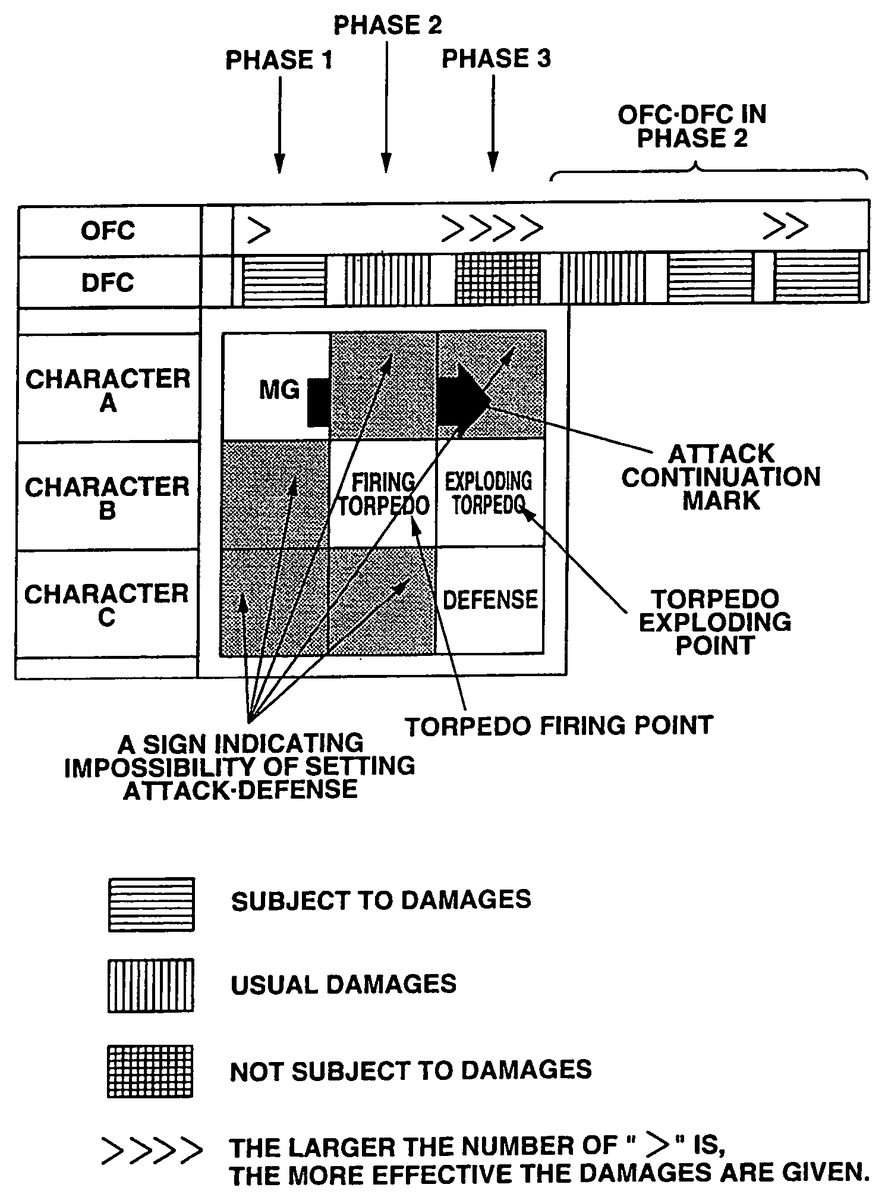
The characteristic of this embodiment is, as shown inFIG. 14, that a defense (DFC) display is included for each phase on the lattice, which shows whether the player characters, each character on each boat, are subject to the attacks from their rivals. This DFC is expressed in colors and patterns, for example, if a phase is expressed as shaded with horizontal lines, it indicates that the player character in the phase has a high durability against the enemy's attacks, if a phase is expressed as shaded with vertical lines, it indicates that the player character in the phase has the usual durability, and if a phase is expressed as shaded with horizontal and vertical lines, then it indicates that the player in the phase has a low durability.
Furthermore, an offense (OFC) display is provided on and parallel to the DFC, which shows in which phase the offensive power of a player character becomes highest. The degree of the offensive power is set by the number of “>” as shown in the diagram. In this embodiment, a player can construct a good operation strategy by referring to the DFC display and OFC display. For example, in a phase where the offensive power is high, a strategy can be taken which attacks by using the arms of high offensive power, and in a phase where the defensive power is low, a strategy can be taken which does not attack but assumes a posture of defense.
However, if a phase of high offensive power and a phase of low defensive power happen to be a same phase in the conventional method, either defense or attack must be chosen, and if attack is chosen, for example, a player can cause great damages to the enemy but suffers from the tremendous damages, therefore the player can not gain a satisfying game result. There is also a defect that the player easily becomes bored because there are less strategic choices. This embodiment can solve such defects.
The characteristics of each phase (the size of the offensive or defensive power, etc.) is stored in ROM beforehand. When displaying the operation screen on the monitor, the CPU displays OFC and DFC and processes the development of a phase in accordance with the program to develop OFC and DFC.
The canons, torpedos, and machine guns (MG) etc. are the kinds of weapons on each boat which characters A, B and C manipulate. These arms are all different from one another, depending on its type, in the offensive power and the number of bullets that can be used in a phase. For example, a canon has the high offensive power but the number of bullets is limited, and a machine gun has the low offensive power but it is permitted to set a large number of bullets.
In addition to the settings described above, this embodiment allows various settings to be made for each weapon, for example, the settings where the attack can last for a fixed period of time (over a plurality of phases) from the beginning of the attack, and the setting where the time required for a bullet to reach its destination can be adjusted.
The setting of each weapon is as follows.
OffensiveLastingpowerpowerTime to impactCanonHighIn 1 phaseIn the same phaseTorpedoMediumIn 1 phaseFrom the same phaseto the next phaseMachineLowIn 1~3 phasesIn the same phase
If a phase of high offensive power and a phase of low defensive power happen to be a same phase, and if it happens in phase 3, the player can set a machine gun for character A so that the character A continues firing the MG against its enemy character during 3 phases. In phase 2, the player can set a torpedo for character B so that the torpedo fired by character B impacts the enemy boat in phase 3. In phase 3, the player can apply a shield to character C so that the boat which these characters are on assumes a posture of defense. This allows the player in phase 3 not only to defend the characters from the attacks of the enemies by assuming a posture of defense but also causes effective damages to the enemies by setting the machine gun to continually fire from phase 1 and by setting the torpedo to fire in phase 2 and to impact the enemy boat in phase 3.
The characteristics of each weapon is stored in a table inside the ROM, and the CPU implements the operation control of each weapon according to the characteristics of these weapons and in accordance with the setting of the aforementioned operation screen. The described DFC and OFC displays continue in the following turns, so when the first turn is over, DFC and OFC of the second turn are shifted to the left for every 3 phases and displayed. This allows the player to make various fighting plans, such as elaborating a plan for the present turn while foreseeing the following turn.
In this embodiment, the attacks and defenses among characters A, B and C and the enemy boats are an example of the control of the relationship between the characters. The images of attacks and defenses are an example of images based on such relationship. The relationship between the characters consist of 3 phases. In short, 1 turn consists of 3 phases. In this embodiment, 1 turn means a period where all the characters, which a player can manipulate, finish the attacks or defenses against the enemy boats. 1 phase means a period where the settings of attacks or defenses can be made to 1 character and the character can implement such attacks and defenses. The contents of defenses differ depending on a weapon which is chosen. OFC and DFC are an example of the characteristics concerning the relationship among the characters which are set for each phase.
These characteristic values are displayed in the display frame for not only the phase presently developing but also the phase which is developed next. The player can check the characteristic values and chooses a predetermined weapon, or choose a defensive mode instead of an attack mode. The CPU produces an image of attacks or defenses according to the input which the player provides to the inputting means for the above choices.
Regarding the conventional game devices, attacks and defenses finish in 1 phase and do not extend to the following phase, however, this embodiment permits, depending on the type of a weapon, the influence of the attacks by the weapons to extend to the following phases. Therefore, the player can adjust the time required for the weapons to impact the enemy boat, and also can continue the attacks for a plurality of phases.
Other Embodiments
Each embodiment as mentioned above is an example that explains the present invention and there is no intention of limiting the present invention to these embodiments. The present invention can be executed in various forms as long as its gist is not deviated. For example, the actions of the means for realizing the aforesaid functions have been sequentially explained. However, it is not limited thereto. Therefore, as long as no contradictions are raised as for the movements, the processing order can be changed or concurrently operated.
According to the present invention, it is possible to provide a game image in which the characters unrelated to the commands given by the player also look as if they are moving.
Moreover, according to the present invention, it is possible to provide a game image in which new characters appear or disappear without a sense of incompatibility on the present game screen.
Furthermore, according to the present invention, there is a variety in the characteristics among the phases, and it is possible to provide an image processing device, particularly a game device, which has a variety in the development of the game scenes by providing the player a variety of responses in 1 phase, for example, the choices of weapons of various characteristics and the choices of attacks or defenses.
Claims
- A game processing method in which a battle form is set in a lattice showing a plurality of phases for each of a plurality of player characters that can be manipulated by a player, wherein: the phases each show a step of reciprocal attacks between an enemy character and each player character;the plurality of phases constitutes 1 turn corresponding to a game stage for successive attacks conducted between the enemy character and each player character;the type of an attack or defense is selectable in each phase in said 1 turn for each player character and displayed on the lattice, and wherein the type of the attack or defense is selectable in one phase for a particular player character to apply continuously into one or more of its following phases according to the type of attack or defense as selected in that one phase;a defense display is provided on the lattice representing a determined defensive characteristic of each of the phases applied to the player characters, and an offense display is provided on the lattice aligned with the defense display representing a determined offensive characteristic of each of the phases applied to the player characters, the defense display and the offense display being determined independent of the player's selectable attack or defense for each player character in each phase;and a computer implements a changing of a degree of an attack or defense which corresponds to each phase in the lattice.
- The game processing method according to claim 1 , wherein when the type of attack or defense is selected in each phase in said 1 turn for each player character, an influence exerted by the type of the attack or defense on a plurality of phases can be set, and the influence exerted is selectable in one phase for a particular player character to extend to one or more of its following phases.
- The game processing method according to claim 1 , wherein an offensive power or a defensive power for all the player characters in each phase is set depending on the type of attack or defense set in each phase in said 1 turn for each player character.
- A storage medium that stores a program for having a computer implement a game processing method in which a battle form is set in a lattice showing a plurality of phases for each of a plurality of player characters that can be manipulated by a player, wherein: the phases each show a step of reciprocal attacks between an enemy character and each player character;the plurality of phases constitutes 1 turn corresponding to a game stage for successive attacks conducted between the enemy character and each player character;the type of an attack or defense is selectable in each phase in said 1 turn for each player character and displayed on the lattice, and wherein the type of the attack or defense is selectable in one phase for a particular player character to apply continuously into one or more of its following phases according to the type of attack or defense as selected in that one phase;a defense display is provided on the lattice representing a determined defensive characteristic of each of the phases applied to the player characters, and an offense display is provided on the lattice aligned with the defense display representing a determined offensive characteristic of each of the phases applied to the player characters, the defense display and the offense display being determined independent of the player's selectable attack or defense for each player character in each phase;and a computer implements a changing of a degree of an attack or defense which corresponds to each phase in the lattice.
- The storage medium that stores a program for having a computer implement the game processing method according to claim 4 , wherein when the type of attack or defense is selected in each phase in said 1 turn for each player character, an influence exerted by the type of the attack or defense on a plurality of phases can be set, and the influence exerted is selectable in one phase for a particular player character to extend to one or more of its following phases.
Disclaimer: Data collected from the USPTO and may be malformed, incomplete, and/or otherwise inaccurate.