U.S. Pat. No. 7,744,467
VIDEO GAME PROGRAM, VIDEO GAME DEVICE, AND VIDEO GAME METHOD
AssigneeKonami Digital Entertainment Co, Ltd.
Issue DateMarch 13, 2006
Illustrative Figure
Abstract
A video game program includes a terminology storing function, a first running commentary function, a running commentary interrupting function, a second running commentary function, a running commentary returning function, and a running commentary continuing function. In the video game implemented with this program, if specific events occur while the video game is in progress and the play-by-play or commentary is interrupted, the system returns from the play-by-play or commentary related to the specific events to the interrupted play-by-play or commentary, after the play-by-play or commentary has been provided for the specific events, and the interrupted play-by-play or commentary is continued.
Description
PREFERRED EMBODIMENTS OF THE INVENTION Constitution and Operation of the Video Game Device FIG. 1shows the basic constitution of the video game device according to a first embodiment of the present invention. This description uses a home video game device as an example of a video game device. The home video game device comprises a home game device body and a home television. A recording medium10can be loaded in the home game device body; game data is appropriately read from the recording medium10and a game is executed. The contents of the game executed in this way are displayed on the home television. The home game device body principally comprises a CPU (Central Processing Unit)7, a signal processor8, a image processor9, a recording medium10, an interface circuit11, RAM (Random Access Memory)12, a speaker13, an amplifier circuit14, a D/A converter (Digital-to-analog converter)15, an interface circuit16, a controller17, an operation information interface circuit18, and an interface circuit19. The home television comprises a television monitor20, an interface circuit21, and a D/A converter22. The game system of the home video game device comprises a control unit1, a storage unit2, an image display unit3, an audio output unit4, and an operation input unit5, each of which is connected over the bus6. This bus6includes an address bus, a data bus, a control bus, and the like. The control unit1is provided mainly to control the progress of the overall game, based on the game program. The control unit1comprises the CPU7, the signal processor8, and the image processor9, for example. The CPU7, the signal processor8, and the image processor9are each connected together over the bus6. The CPU7interprets commands from the game program and performs various data processing and control. For example, the CPU7commands the signal processor8to provide image data to the image processor. The signal processor8mainly performs computations in ...
PREFERRED EMBODIMENTS OF THE INVENTION
Constitution and Operation of the Video Game Device
FIG. 1shows the basic constitution of the video game device according to a first embodiment of the present invention. This description uses a home video game device as an example of a video game device. The home video game device comprises a home game device body and a home television. A recording medium10can be loaded in the home game device body; game data is appropriately read from the recording medium10and a game is executed. The contents of the game executed in this way are displayed on the home television.
The home game device body principally comprises a CPU (Central Processing Unit)7, a signal processor8, a image processor9, a recording medium10, an interface circuit11, RAM (Random Access Memory)12, a speaker13, an amplifier circuit14, a D/A converter (Digital-to-analog converter)15, an interface circuit16, a controller17, an operation information interface circuit18, and an interface circuit19. The home television comprises a television monitor20, an interface circuit21, and a D/A converter22.
The game system of the home video game device comprises a control unit1, a storage unit2, an image display unit3, an audio output unit4, and an operation input unit5, each of which is connected over the bus6. This bus6includes an address bus, a data bus, a control bus, and the like.
The control unit1is provided mainly to control the progress of the overall game, based on the game program. The control unit1comprises the CPU7, the signal processor8, and the image processor9, for example. The CPU7, the signal processor8, and the image processor9are each connected together over the bus6. The CPU7interprets commands from the game program and performs various data processing and control. For example, the CPU7commands the signal processor8to provide image data to the image processor. The signal processor8mainly performs computations in three-dimensional space, position conversion computations from three-dimensional space to an artificial three-dimensional space, light source computation processing, and the generation and processing of image and audio data. The image processor9mainly performs processing to write image data to be rendered to the RAM12based on the computation results and processing results of the signal processor8.
The storage unit2is provided mainly to store program data, various data used in program data, and the like. The storage unit2comprises the recording medium10, the interface circuit11, and the RAM12, for example. The interface circuit11is connected to the recording medium10. The interface circuit11and RAM12are connected via the bus6. The recording medium10has the purpose of recording program data of the operating system, game data comprising image data, audio data, and various program data, and the like. For example, this recording medium10is a ROM (Read Only Memory) cassette, optical disk, flexible disk, or the like; and program data of the operating system, game data, and the like are recorded. Note that the recording medium10also includes card-type memory; this card-type memory is mainly used to store various game parameters at the point of interruption when the game is interrupted. The RAM12is used to temporarily store various data read from the recording medium10, and to temporarily record processing results from the control unit1. In addition to various data, address data showing the memory location of various data is stored in this RAM12; it is possible to specify and read and write.
The image display unit3is provided mainly to output, as images, image data written to the RAM12by the image processor9, image data read from the recording medium10, and the like. The image display unit3comprises a television monitor20, an interface circuit21, and a D/A converter22, for example. The D/A converter22is connected to the television monitor20; and the interface circuit21is connected to the D/A converter22. The bus6is then connected to the interface circuit21. Here, image data is provided to the D/A converter22via the interface circuit21and is there converted to an analog image signal. Then, the analog image signal is output as an image by the television monitor20.
This image data includes polygon data, texture data, and the like, for example. Polygon data is coordinate data of vertices constituting a polygon. Texture data has the purpose of providing texture to the polygon, and comprises texture indicating data and texture color data. The texture indicating data is data for linking a polygon and texture; and texture color data is data for specifying the color of the texture. Polygon address data and texture address data, showing the memory location of each type of data, are linked to the polygon data and texture data. With such image data, the signal processor8performs coordinate conversion and perspective projection conversion, based on the distance data and rotation data of the screen itself (point of view), for the polygon data in three-dimensional space (three-dimensional polygon data) shown by the polygon address data, and replaces the three-dimensional polygon data with polygon data in two-dimensional space (two-dimensional polygon data). A polygon outline is constituted with a plurality of two-dimensional polygon data; and texture data, indicated by the texture address data, is written to the interior of the polygon. In this way, objects with texture applied to each polygon can represent, for example, a coach character, a player character, a referee character, a ball character, and the like.
The audio output unit4is provided mainly to output as sound audio data read from the recording medium10. The audio output unit4comprises a speaker13, an amplifier circuit14, a D/A converter15, and an interface circuit16, for example. The amplifier circuit14is connected to the speaker13; the D/A converter15is connected to the amplifier circuit14; and the interface circuit16is connected to the D/A converter15. The bus6is then connected to the interface circuit16. The audio data is provided to the D/A converter15via the interface circuit16and is converted to an analog audio signal. This analog audio signal is amplified by the amplifier circuit14and output from the speaker13as sound. Audio data includes, for example, ADPCM (Adaptive Differential Pulse Code Modulation) data, PCM (Pulse Code Modulation) data, and the like. In the case of ADPCM data, the sound can be output from the speaker13with the same type of processing method as described above. In the case of PCM data, the PCM data are converted to ADPCM data in the RAM12, and the sound can be output from the speaker13with the same type of processing method as described above.
The operation input unit5comprises mainly a controller17, an operation information interface circuit18, and an interface circuit19. The operation information interface circuit18is connected to the controller17; and the interface circuit19is connected to the operation information interface circuit18. The bus6is then connected to the interface circuit19.
The controller17is an operation device used for the player to input various operation commands and sends operation signals according to the player's operations to the CPU7. The following are provided on the controller17: a first button17a, a second button17b, a third button17c, a fourth button17d, an up key17U, a down key17D, a left key17L, a right key17R, an L1button17L1, an L2button17L2, an R1button17R1, an R2button17R2, a start button17e, a select button17f, a left stick17SL, and a right stick17SR.
The up key17U, the down key17D, the left key17L, and the right key17R are used to provide to the CPU7commands causing the characters and cursor to move up, down, left, or right on the screen of the television monitor20, for example.
The start button17eis used when instructing the CPU7to load the game program from the recording medium10, or the like.
The select button17fis used when indicating various selections to the CPU7, and the like, for the game program loaded from the recording medium10.
The left stick17SL and the right stick17SR are stick-shaped controllers of approximately the same constitution as what is called a joystick. The stick-shaped controller comprises an upright stick. This stick has an inclinable structure, with a range of 360 degrees, including forward, back, left, and right, from the upright position centered on a fulcrum. The left stick17SL and right stick17SR send x and y coordinate values with the origin being the upright position, according to the direction and angle of inclination of the stick, as an operation signal to the CPU7via the operation information interface circuit18and interface circuit19.
According to the game program loaded from the recording medium10, various functions are allocated to the first button17a, the second button17b, the third button17c, the fourth button17d, the L1button17L1, the L2button17L2, the R1button17R1, and the R2button17R2.
Note that each button and each key on the controller17, excluding the left stick17SL and the right stick17SR, are ON/OFF switches which turn ON when depressed from the neutral position with the application of external pressure, and turn OFF upon returning to the neutral position when the pressure is released.
The general operation of the home video game device with the constitution discussed above is described below. When the power switch (not shown) is turned on and the game system1is powered up, the CPU7reads image data, audio data, and program data from the recording medium10, based on the operating system stored in the recording medium10. All or part of the image data, audio data, and program data read is stored in the RAM12. Then, the CPU7issues commands for the image data and audio data stored in the RAM12, based on the program data stored in the RAM12.
In the case of image data, the signal processor8performs position computation and light source computation for characters in three-dimensional space, based on the commands from the CPU7. Next, the image processor9performs the writing and the like of image data to be rendered to the RAM12, based on the computation results from the signal processor8. The image data written to the RAM12are sent to the D/A converter17via the interface circuit13. Here, the image data are converted to an analog video signal with the D/A converter17. Then, the image data are provided to the television monitor20and displayed as an image.
In the case of audio data, the signal processor8performs processing to generate and process audio data based on a command from the CPU7. For example, processing to convert pitch, add noise, set an envelope, set the level, add reverb, and the like is performed for the audio data. Next, the audio data is output from the signal processor8and provided to the D/A converter15via the interface circuit16. Here, the audio data is converted to an analog audio signal. Then, the audio data is output as sound from the speaker13via the amplifier circuit14.
Various Functions in the Video Game Device
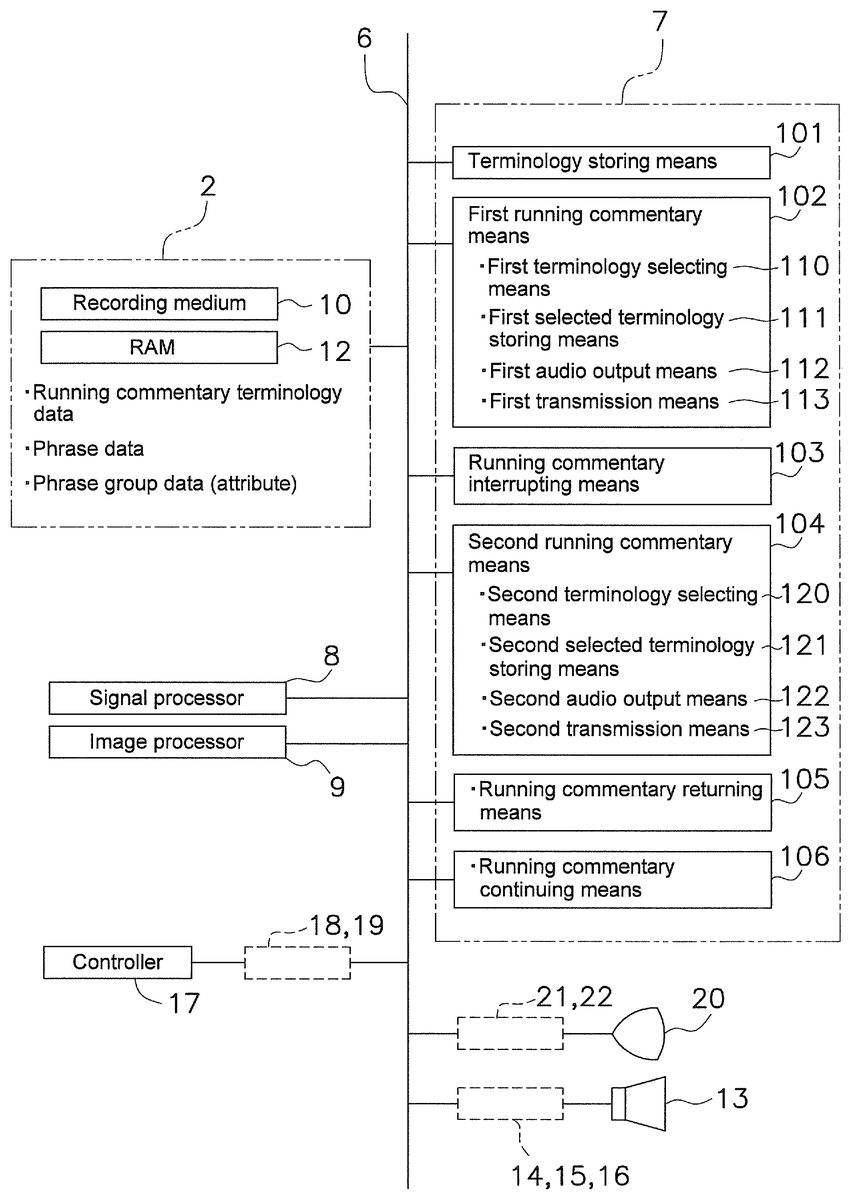
The video game executed in the video game device is, for example, a baseball video game with a running commentary function.FIG. 2is a functional block diagram mainly for describing the functions of the CPU7shown inFIG. 1. The functions of the baseball video game device which play an important role in this invention are described using this functional block diagram.
The baseball video game device is a baseball video game device, which displays player characters on a television monitor20, the operations of the player characters being controlled with the controller17and the control unit1, and which comprises terminology storing means101, first running commentary means102, running commentary interrupting means103, second running commentary means104, running commentary returning means105, and running commentary continuing means106.
The terminology storing means101is a means for storing running commentary terminology data used while the video game is in progress. In the terminology storing means101, the running commentary terminology data are read from the recording medium5and stored in the RAM12by the CPU7. Here, the running commentary terminology data stored in the RAM12are stored in the RAM12in the form of digital audio waveform data.
The first running commentary means102is means for using the running commentary terminology data stored in the RAM12with the terminology storing means101, and providing play-by-play or commentary for various events in the baseball video game. With this first running commentary means102, the play-by-play or commentary for various events in the baseball video game are output as sound from the speaker13, according to the running commentary terminology data stored in the RAM12.
The first running commentary means102comprises first terminology selecting means110, first selected terminology storing means111, first audio output means112, and first transmission means113. With the first terminology selecting means, the running commentary terminology data stored in the RAM12with the terminology storing means101are selected according to various events in the first running commentary means102. At this time, the selected running commentary terminology data are correlated by the CPU7, and various phrase data are formed according to the contents of the play-by-play or commentary.
Then, the various phrase data are collected as phrase group data, for each of the types of content of the play-by-play or commentary, by the CPU7, and attributes are established for the phrase group data. With the first selected terminology storing means111, the running commentary terminology data selected by the first terminology selecting means110, the phrase data, and the phrase group data with set attributes are stored in the RAM12.
With the first transmission means113, the phrase data stored in the RAM12with the first selected terminology storing means111is transmitted from the first selected terminology storing means111to the first audio output means112. With the first audio output means112, the phrase data stored in the RAM12with the first selected terminology storing means111is provided to the D/A converter15via the interface circuit16, and is there converted to an analog audio signal. This analog audio signal is amplified by the amplifier circuit14and output from the speaker13as sound.
The running commentary interrupting means103is a means for interrupting the first running commentary means102when specific events have occurred while the game is in progress. With this running commentary interrupting means103, the details of the specific events are distinguished by the CPU7. Then, according to the details of the specific events, the CPU7determines whether to interrupt the first running commentary means102. In effect, a branching process is executed by the CPU7, this branching process being to interrupt the play-by-play or commentary of the first running commentary means102when the details of the specific events are important, and to continue the play-by-play or commentary of the first running commentary means102when the details of the specific events are not important.
The second running commentary means104is means for performing play-by-play or commentary relating to specific events when the running commentary interrupting means103has been executed. With this second running commentary means104, the play-by-play or commentary relating to the specific events is output as sound from the speaker13when the first running commentary means102has been interrupted by the running commentary interrupting means103.
The second running commentary means104comprises second terminology selecting means120, second selected terminology storing means121, second audio output means122, and second transmission means123. With the second terminology selecting means120, the running commentary terminology data stored in the RAM12in the terminology storing means101are selected according to the details of the specific events. At this time, the selected running commentary terminology data are correlated by the CPU7, and various phrase data are formed according to the contents of the play-by-play or commentary. Then, the various phrase data are collected as phrase group data, for each the types of content of the play-by-play or commentary, by the CPU7, and attributes are established for the phrase group data. With the second selected terminology storing means121, the running commentary terminology data selected by the second terminology selecting means120, the phrase data, and the phrase group data with set attributes are stored in the RAM12. With the second transmission means123, the phrase data stored in the RAM12with the second selected terminology storing means121are transmitted from the second selected terminology storing means121to the second audio output means122. With the second audio output means122, the phrase data stored in the RAM12with the second selected terminology storing means121are provided to the D/A converter15via the interface circuit16, and converted to an analog audio signal. This analog audio signal is amplified by the amplifier circuit14and output from the speaker13as sound.
The running commentary returning means105is means for returning to the first running commentary means102from the second running commentary means104. With this running commentary returning means105, the attributes established for the phrase group data are referenced by the CPU7, and it is determined whether to return from the second running commentary means104to the first running commentary means102.
The running commentary continuing means106is means for continuing the play-by-play or commentary of the first running commentary means102that was interrupted by the running commentary interrupting means103, when the running commentary returning means105has been executed. The running commentary continuing means106causes the continuation of the play-by-play or commentary of the first running commentary means102, based on the running commentary terminology stored in the first selected terminology storing means111of the first running commentary means102. With such running commentary continuing means106, the running commentary terminology data and phrase data, stored in the RAM12with the first selected terminology storing means111of the first running commentary means102, are referenced by the CPU7when the running commentary returning means105has been executed. Then, the play-by-play or commentary of the first running commentary means102is continued after the interruption, based on the running commentary terminology data and phrase data.
Method for Executing the Running Commentary Function of the Baseball Video Game
The method for executing the running commentary function of the baseball video game of this embodiment is described using the flowchart shown inFIG. 3.
In a baseball video game which displays player characters on a monitor and wherein the operations of player characters are controlled with the controller17and the control unit1, when a first running commentary is performed in a first running commentary step (S1), and specific events occur during the game (S2), then it is determined in a running commentary interrupting step whether to interrupt the first running commentary according to the details of the specific events (S3). In this step (S3), the first running commentary continues until the end (S4, S5), when the first running commentary is not interrupted (No in S3). In step (S3), the second running commentary is set and executed according to the details of the specific events in the second running commentary step (S6, S7), if the first running commentary is interrupted (Yes in S3). Then, when the second running commentary is complete (S8), it is determined whether to recall the first running commentary in the running commentary returning step (S9). In this step (S9), if the first running commentary is not recalled (No in S9), the next third running commentary, which depends on various events in the game, is executed (S12). In step (S9), when the first running commentary is recalled (Yes in S9), the play-by-play or commentary of the first running commentary which was interrupted by the running commentary interrupting step is recalled with the running commentary returning step, and the play-by-play or commentary of the first running commentary is continued until the end in the running commentary continuing step (S10, S11). Then, the third running commentary, which is next according to various events in the game, is executed (S12).
Process Overview for the Running Commentary Function of the Baseball Video Game
With the running commentary function, running commentary terminology data are controlled by the control unit1including the CPU7, and is stored in the storage unit2including the RAM12, in the terminology storing means101. These running commentary terminology data are read from the storage unit2by the first and second terminology selecting means110,120, according to the details of the various events in the baseball video game; and various mutually related phrase data are constructed by the control unit1. With the control unit1, various phrase data are collected as phrase group data, for each of the types of content of the various events, and attributes are established for the phrase group data. These running commentary terminology data, phrase data, and phrase group data are controlled by the control unit1and stored in the storage unit2in the first and second selected terminology storing means111,121. In the first and second transmission means113,123, the data are transmitted from the first and second selected terminology storing means111,121to the first and second audio output means112,122, and output as sound. In this way, the details of the various events in the game are presented as play-by-play or commentary by the first and second running commentary means102,104.
The processing executed with the running commentary function of such a baseball video game is described using, as an example, the details of various events in a baseball video game.
In the case of providing batter introductions, for example, the following are used: “bottom”, “top”, “of the (inning number)”, “at bat”, “in the field”, “batting order”, “defensive position”, “player's name”, “of the (team name)”, “uniform number”, “lead”, “This batter”, “is entering”, “the (left/right), “box”, and the like. By combining these running commentary terminology data, play-by-play phrase data are constructed, for example: “In the bottom of the fourth, with team A at bat”, “the lead batter of the fourth inning is player A”, “who is entering the left batter's box”, and the like.
In the case of providing commentary on the details of a pitch, for example, terminology such as the following is used: “commentator's name”, “honorific”, “up to now”, “(player's name)'s”, “pitching”, “how does it look?”, “in the (inning number)”, “after the”, “runs charged to the pitcher”, “looking good”, “appears to be”, “I see”, and the like. Using this running commentary terminology, commentator phrase data is constructed, for example: “Mr. Commentator A, what do you think of player B's pitching up to now?” “After those runs in the first inning, he's been looking good”, “I see”, and the like.
In the case of providing play-by-play of the team at bat, terminology such as the following is used, for example: “first pitch”, “Xth ball”, “a hit”, “hit it”, “great”, “got it”, “is”, “was”, “but”, “foul ball”, “home run”, “hit”, “2 base hit”, “2 runs”, and the like. By combining this running commentary terminology, play-by-play phrase data are constructed, for example: “the first pitch was hit”, “a great hit, but it's a foul ball”, “great hit, home run”, and the like.
In the case of providing play-by-play of the details of the team in the field, terminology such as the following is used, for example: “a catch”, “caught it”, “to first base”, “back home”, “throw”, “out”, “safe”, and the like. Using these running commentary terminology data, play-by-play phrase data are constructed, for example: “that was a catch, nice play, a throw to first, out”, “that was a catch, a throw to home, safe”, and the like.
In the case of providing play-by-play for the change, for example, the following are provided: “bottom”, “top”, “of the (inning number)”, “offense”, “defense”, “is finished”, “it was a shutout”, “it's a come back”, and the like. In the case of providing commentary at the end of the game, for example, the following are provided: “As you can see, today”, “(team name)”, “has won”, and the like.
Note that, if a plurality of running commentary terminology data with the same meanings are provided, the rendering of the play-by-play or commentary can be expanded by selecting running commentary terminology data which is preferable for the situation. For example, by preparing running commentary terminology data such as “a hit” and “hit it”, the play-by-play or commentary can be provided with variations in the phrase data such as “the first pitch was a hit” and “hit it on the first pitch”.
The play-by-play and commentary phrase data shown above is collected into phrase group data according to the contents of the play-by-play or commentary. In the case of player introductions, phrase data items such as “In the bottom of the fourth, team A is at bat”, “the lead batter in the fourth inning is player A” and “entering the left batter's box” are collected as phrase group data (first phrase group data). Also, in the case of providing commentary for the details of a pitch, phrase data items such as “Mr. Commentator A, what do you think of player B's pitching up to now?”, “After those runs in the first inning, he's looking good”, “I see”, for example, are collected as phrase group data (second phrase group data). Furthermore, in the case of providing play-by-play for the details of the offense, phrase data items such as “the first pitch was hit” and “great hit, but it's a foul ball” are collected as phrase group data (third phrase group data). The play-by-play and commentary are executed continuously by combining the first through third phrase group data. For example, when the first through third phrase group data are combined in order, a batter introduction such as the following is made: “It's the bottom of the fourth, team A is at bat”, “the lead batter in the fourth inning is player A”, “who is entering the left batter's box”. Next, the details of the pitching by the other team's pitcher are commented upon with “Mr. Commentator A, what do you think of player B's pitching so far?” “After those runs in the first inning, he's looking good”, “I see”. Finally, the details for the offense are given as a play-by-play with “the first pitch was hit”, “It's a great hit, but it's a foul ball”.
In this way, play-by-play or commentary is made by using various phrase data collected as phrase group data. At this time, when specific events have occurred while the game is in progress and the play-by-play or commentary has been interrupted (Yes in S3inFIG. 3), the contents of the play-by-play or commentary at the time of the interruption can be recognized in the storage unit2as phrase group data units, by the first selected terminology storing means111of the first running commentary means102(S6inFIG. 3). Thereby, when caused to return from the second running commentary means104to the first running commentary means102by the running commentary returning means105(Yes in S9in FIG.3), the play-by-play or commentary can be continued from any phrase data in the interrupted phrase group data (S10inFIG. 3).
Here, it is determined by the running commentary interrupting means103whether to interrupt the play-by-play or commentary with the occurrence of specific events while the game is in progress (S3inFIG. 3). When the details of the specific event are important, the play-by-play or commentary is interrupted by the control unit1(Yes in S3inFIG. 3). However, when the details of the specific event are not important, the play-by-play or commentary is continued with the control unit1(No in S3inFIG. 3). Thus, the branching process for determining whether to interrupt the play-by-play or commentary is executed by the control unit1in the running commentary interrupting means when specific events have occurred while the game is in progress.
Attributes are set in each of the various phrase group data. The attributes established for the phrase group data are used to determine whether to recall the play-by-play or commentary of the first running commentary means102with the running commentary returning means105(S9inFIG. 3), after the play-by-play or commentary relating to the specific events by the second running commentary means104(S7and S8inFIG. 3), when specific events have occurred while the game was in progress and the play-by-play or commentary of the first running commentary means102was interrupted by the running commentary interrupting means103(Yes in S3inFIG. 3, S6). With this running commentary returning means105, the attributes established for the phrase group data are referenced with the control unit1, and it is determined whether to return from the second running commentary means104to the first running commentary means102.
The attributes established for the phrase group data include, for example, normal attribute, recall object attribute, recall execute attribute, and the like. The following is a description of when the running commentary interrupting means103and running commentary returning means105are executed in the state in which such various attributes are set for the phrase group data.
When the normal attribute or recall execute attribute is set for the phrase group data, the phrase group data associated with the phrase data is not recalled when the phrase data is interrupted by the running commentary interrupting means103(Yes in S3, No in S9inFIG. 3). For example, as shown inFIG. 4A, when phrase data in phrase group data having the normal attribute or recall execute attribute is interrupted with phrase group data having the recall execute attribute, play-by-play or commentary using the phrase data of the phrase group data with the recall execute attribute is presented after the interruption. At this time, phrase group data with the normal attribute, associated with the interrupted phrase data, is not recalled. Meanwhile, when the recall object attribute is set for the phrase group data, the phrase group data associated with the phrase data is recalled when the phrase data is interrupted by the running commentary interrupting means103(Yes in S3, Yes in S9inFIG. 3). For example, as shown inFIG. 4B, when the phrase data in the phrase group data having the recall object attribute is interrupted with phrase group data having the recall execute attribute, play-by-play or commentary using the phrase data of the phrase group data with the recall execute attribute is presented after the interruption. At this time, the phrase group data with the recall object attribute associated with the interrupted phrase data is recalled and play-by-play or commentary is presented using the phrase data at the time of the interruption.
Specifically, the following type of play-by-play and commentary is performed if the phrase group data for the batter introduction has the normal attribute, the phrase group data for the pitch details has the recall object attribute, and the phrase group data for the at bat details has the recall execute attribute.
When the phrase data for the batter introduction phrase group data having the normal attribute is interrupted with phrase group data for the at bat details having the recall execute attribute, such play-by-play and commentary is presented as “It's the bottom of the fourth inning and team A is at bat”, “the first batter of the fourth inning . . . (interruption)”, “the first pitch was hit”, “it's a great hit, but it's a foul ball”.
When the phrase data for the pitch details phrase group data having the recall object attribute is interrupted with phrase group data for the at bat details having the recall execute attribute, such play-by-play and commentary is made as “It's the bottom of the fourth inning and team A is at bat”, “the first batter of the fourth inning is player A”, “He's entering the left batter's box”, “Mr. Commentator A, what do you think of player B's pitching up to now?”, “After those runs in the first inning . . . (interruption)”, “the first pitch was hit”, “it's a great hit, but it's a foul ball”, “Well, sorry, Mr. Commentator A, go ahead (recall)”, “After those runs in the first inning, he's looking good”, “I see.”
Other Embodiments
(a) In the foregoing embodiment, an example using a home video game device was shown; however, video game devices can be similarly applied to video game devices for commercial use in which the monitor is integrated, and to personal computers, workstations, or the like, which function as video game devices by executing video game programs, without being limited to the foregoing embodiment.
(b) In the foregoing embodiment, an example using a baseball video game was shown; however, the video game may be any type of game, so long as it is a video game with a running commentary function, without being limited to the foregoing embodiment. For example, the present invention can also be applied to a soccer game or the like, as an example of a video game with a running commentary function.
INDUSTRIAL APPLICABILITY
In the present invention, play-by-play or commentary relating to specific events is performed when specific events have occurred while a video game is in progress and the play-by-play or commentary in progress has been interrupted. The system returns to the interrupted play-by-play or commentary from the play-by-play or commentary related to the specific events, and the interrupted play-by-play or commentary is continued. Thereby, the player can easily grasp various events occurring during the game from the play-by-play or commentary, when such events occur during the game, and experience a sense of realism from the play-by-play or commentary during the game.
Claims
- A video game program for causing a computer to implement a video game which displays a character on a monitor, and in which operation of the character is controlled, the video game program comprising: a terminology storing function for storing running commentary terminology used while the video game is in progress;a first running commentary function for performing play-by-play or commentary relating to the video game using the running commentary terminology, the play-by-play or commentary including various phrases, the phrases being collected as a first phrase group, the phrase of the first phrase group including the running commentary terminology, the play-by-play or commentary being performed with the phrases collected as the first phrase group;a running commentary interrupting function for interrupting phrase of the first phrase group running on the process of the first running commentary function when specific events have occurred while the video game is in progress;a second running commentary function for performing the play-by-play or the commentary relating to the specific events when the process of the running commentary interrupting function has been executed, the play-by-play or commentary including various phrases, the play-by-play or commentary relating to the specific events, the phrases being collected as a second phrase group, the phrase of the second phrase group including the running commentary terminology, the play-by-play or commentary being performed with the phrases collected as the second phrase group;a running commentary returning function for returning from the phrase of the second phrase group performing on the second running commentary function to the phrase of an interruption point in the first phrase group interrupted on the process of the running commentary interrupting function when the specific events have occurred;and a running commentary continuing function for continuing the play-by-play or commentary, the play-by-play or commentary being performed with the phrase of the first phrase group on the basis of running commentary terminology which is included in the phrase of the interruption point in the first phrase group interrupted by the running commentary interrupting function, when the process of the running commentary returning function has been executed.
- The video game program recited in claim 1 , wherein the first running commentary function includes a first terminology selecting function for selecting the running commentary terminology stored in the terminology storing function, a first selected terminology storing function for storing the running commentary terminology selected by the first terminology selecting function, a first audio output function for converting the running commentary terminology to sound, and outputting the running commentary terminology stored in the first selected terminology storing function, and a first transmission function for transmitting the running commentary terminology from the first selected terminology storing function to the first audio output function.
- The video game program recited in claim 2 , wherein the running commentary continuing function continues the play-by-play or the commentary of the first running commentary function, based on the running commentary terminology stored in the first selected terminology storing function of the first running commentary function.
- The video game program recited in claim 1 , wherein the running commentary interrupting function distinguishes the details of the specific events, and determines whether to interrupt the process of the first running commentary function, and interrupts the process of the first running commentary function based on the determination.
- The video game program recited in claim 1 , wherein the second running commentary function includes a second terminology selecting function for selecting the running commentary terminology stored in the terminology storing function, a second selected terminology storing function for storing the running commentary terminology selected by the second terminology selecting function, a second audio output function for converting the running commentary terminology to sound and outputting the running commentary terminology stored in the second selected terminology storing function, and a second transmission function for transmitting the running commentary terminology from the second selected terminology storing function to the second audio output function.
- The video game program recited in claim 1 , wherein attributes are set on the phrase group in the first and second running commentary function, it is determined whether to execute the process of the running commentary returning function based on the attributes, and the process of the running commentary returning function is executed based on the determination.
- A video game device which displays a character in a video game on a monitor and in which the operation of the character is controlled, comprising: terminology storing means for storing running commentary terminology used while the video game is in progress;first running commentary means for performing play-by-play or commentary relating to the video game using the running commentary terminology, the play-by-play or commentary including various phrases, the phrases being collected as a first phrase group, the phrase of the first phrase group including the running commentary terminology, the play-by-play or commentary being performed with the phrases collected as the first phrase group;running commentary interrupting means for interrupting phrase of the first phrase group running on the process of the first miming commentary means when specific events have occurred while the video game is in progress;second running commentary means for performing the play-by-play or the commentary relating to the specific events when the process of the running commentary interrupting means has been executed, the play-by-play or commentary including various phrases, the play-by-play or commentary relating to the specific events, the phrases being collected as a second phrase group, the phrase of the second phrase group including the miming commentary terminology, the play-by-play or commentary being performed with the phrases collected as the second phrase group;running commentary returning means for returning from the phrase of the second phrase group performing on the second miming commentary function to the phrase of an interruption point in the first phrase group interrupted on the process of the miming commentary interrupting function when the specific events have occurred;and running commentary continuing means for continuing the play-by-play or the commentary, the play-by-play or commentary being performed with the phrase of the first phrase group on the basis of miming commentary terminology which is included in the phrase of the interruption point in the first phrase group interrupted by the running commentary interrupting means, when the process of the running commentary returning means has been executed.
- A video game method which displays a character in a video game on a monitor and in which the operation of the character is controlled by a processor, comprising machine implemented steps of: (a) storing running commentary terminology used while the video game is in progress;(b) performing play-by-play or commentary relating to the video game using the running commentary terminology, the play-by-play or commentary including various phrases, the phrases being collected as a first phrase group, the phrase of the first phrase group including the running commentary terminology, the play-by-play or commentary being performed with the phrases collected as the first phrase group;(c) interrupting phrase of the first phrase group running on the step (b) when specific events have occurred while the video game is in progress;(d) performing the play-by-play or the commentary relating to specific events when the step (c) has been executed, the play-by-play or commentary including various phrases, the phrases being collected as a second phrase group, the phrase of the second phrase group including the running commentary terminology, the play-by-play or commentary being performed with the phrases collected as the second phrase group;(e) returning from the phrase of the second phrase group performing on the step (d) to the phrase of an interruption point in the first phrase group interrupted on the step (b) when the specific events have occurred;and continuing the play-by-play or the commentary, the play-by-play or commentary being performed with the phrase of the first phrase group on the basis of running commentary terminology which is included in the phrase of the interruption point in the first phrase group interrupted by the step (c), when the step (e) has been executed.
- A non-transitory computer readable medium storing a computer program for a video game which displays a character on a monitor, the computer program comprising: code for storing running commentary terminology;code for performing a first commentary relating to the video game by using the running commentary terminology, when a first event occurs while the video game is in progress, the first commentary including a first commentary group having various phrases, the first commentary being performed with the phrases of the first phrase group;code for interrupting phrase of the first phrase group, when a second event occurs while the video game is in progress;code for performing a second commentary relating to the second events after interrupting the first commentary, the second commentary including a second commentary group having various phrases, the second commentary being performed with the phrases of the second phrase group;code for returning from the phrase of the second phrase group to the phrase of an interruption point in the first phrase group, when the specific events have occurred;code for performing the first commentary from an interruption point where the first commentary is interrupted, after the retuning from the phrase of the second phrase group to the interruption point.
Disclaimer: Data collected from the USPTO and may be malformed, incomplete, and/or otherwise inaccurate.