U.S. Pat. No. 7,722,467
VIDEO GAME CONTROL SYSTEM AND A VIDEO GAME CONTROL SERVER
AssigneeKabushi Kaisha Square Enix
Issue DateSeptember 14, 2007
Illustrative Figure
Abstract
When usage command information is received from any one of player terminals, an integrated attack determiner determines whether or not an attack action by an attack command is to be an integrated attack action, in which the attack actions by the attack commands included in a usage history are integrated, on the basis of a current position of the user terminal. The integrated attack determiner also determines attack power specification information capable of specifying the attack power in the case where it is determined that the attack action is to be the integrated attack action. An attack instruction information transmitter transmits attack instruction information indicating a determination result of the integrated attack determiner to the player terminal. A usage history information updater updates the usage history information by adding the received usage command information to the usage history of the attack commands.
Description
DETAILED DESCRIPTION OF THE INVENTION Preferred embodiments of a video game control system and a video game control server according to the present invention will now be described in detail with reference to the appending drawings. FIG. 1is a block diagram that illustrates an example of a configuration of a video game delivery system100according to one embodiment of the present invention. As shown inFIG. 1, the video game delivery system100includes the video game control server10, a plurality of player terminals21to2N (“N” is an arbitrary positive integer) and a plurality of base stations31to3N. Each of the video game control server10and the plurality of base stations31to3N is connected to a communication network40such as the Internet. Further, the plurality of player terminals21to2N are respectively connected to the plurality of base stations31to3N with wireless communication. Thus, the plurality of player terminals21to2N are respectively connected to the communication network40via the plurality of base stations31to3N. The video game control server10is managed by a system manager (or administrator) of the video game delivery system100. The video game server10has various functions for providing (or delivering) a video game for each of the player terminals21to2N via the communication network40. The video game control server10is constituted from an information processing apparatus such as a WWW server. The player terminals21to2N are respectively managed by players of the video game. Each of the player terminals21to2N is constituted from a mobile communication terminal in which a network delivery type video game can be played, such as a cellular phone terminal, a personal digital assistant (PDA) and a mobile game device, for example. Each of the player terminals21to2N includes hardware and software for connecting itself to the communication network40via the base stations31to3N. Each of the player terminals21to2N includes a display device inside or outside the player terminal itself. The display device has an image ...
DETAILED DESCRIPTION OF THE INVENTION
Preferred embodiments of a video game control system and a video game control server according to the present invention will now be described in detail with reference to the appending drawings.
FIG. 1is a block diagram that illustrates an example of a configuration of a video game delivery system100according to one embodiment of the present invention. As shown inFIG. 1, the video game delivery system100includes the video game control server10, a plurality of player terminals21to2N (“N” is an arbitrary positive integer) and a plurality of base stations31to3N.
Each of the video game control server10and the plurality of base stations31to3N is connected to a communication network40such as the Internet. Further, the plurality of player terminals21to2N are respectively connected to the plurality of base stations31to3N with wireless communication. Thus, the plurality of player terminals21to2N are respectively connected to the communication network40via the plurality of base stations31to3N.
The video game control server10is managed by a system manager (or administrator) of the video game delivery system100. The video game server10has various functions for providing (or delivering) a video game for each of the player terminals21to2N via the communication network40. The video game control server10is constituted from an information processing apparatus such as a WWW server.
The player terminals21to2N are respectively managed by players of the video game. Each of the player terminals21to2N is constituted from a mobile communication terminal in which a network delivery type video game can be played, such as a cellular phone terminal, a personal digital assistant (PDA) and a mobile game device, for example. Each of the player terminals21to2N includes hardware and software for connecting itself to the communication network40via the base stations31to3N. Each of the player terminals21to2N includes a display device inside or outside the player terminal itself. The display device has an image display screen constituted from a television apparatus or a liquid crystal display. Further, each of the player terminals21to2N includes a position measuring section21a, an operation/control section21band a terminal information processing section21c(seeFIG. 4). The position measuring section21areceives positioning signals (GPS signals) from a plurality of GPS satellites, and measures a current position of each of the player terminals21to2N using the received GPS signals. The operation/control section21bis constructed from operation section including operational buttons operated by the player, for example, and a control section for controlling the whole player terminal21or2N. The terminal information processing section21cdeals with information relating to the player terminal21or2N.
Each of the base stations31to3N is managed by a communication carrier. The base stations31to3N are devices for connecting the player terminals21to2N to the communication network40by executing data communication with the player terminals21to2N positioned within a communicable area with wireless communication.
FIG. 2is a block diagram that illustrates an example of a configuration of the video game control server10. As shown inFIG. 2, the video game control server10includes a control section11, a communication control section12, and a game information memory13.
The control section11executes control processes of the whole video game control server10in accordance with control programs stored in the game information memory13.
The communication control section12has a function to execute communication between the player terminals21to2N, for example, via the communication network40such as the Internet.
The game information memory13is constructed from a database apparatus, for example. Various kinds of data such as a table for a history of usage of battle commands (will be described later) and control programs for the video game are stored in the game information memory13, which is a storage media.
In this regard, the video game delivered in the present embodiment is an RPG including a portion in which the video game proceeds when a plurality of characters, including a player character (that is, a character that moves in accordance with operations of a keypad by a player), moves on a field provided in a virtual three-dimensional space, or executes a battle against an enemy character that thwarts an action of the player character for accomplishment of a predetermined object in the video game. Further, the virtual three-dimensional space in which the field is formed is indicated by coordinates of the world coordinate system.
FIG. 3is an explanatory drawing that shows an example of a table for a history of usage of battle commands.
As shown inFIG. 3, battle command usage history information in which positional data, time data, a player ID, and a command name of a battle command are associated with each other is registered in the battle command usage history table. The positional data indicates a position of corresponding player character21or2N when using a battle command (or attack command: That is a command for specifying an attack contents such as a simple attack, an attack with a tool, an attack with a special technique, an attack with magic. The battle command includes a command for using a special skill such as an attack item and a call for a beast). The time data indicates time when the battle command is used. The player ID is used to uniquely specify the corresponding player terminal21or2N in which the battle command is used. Namely, the battle command usage history information indicating where, when, which battle command, which player uses is registered in the battle command usage history table. In this case, a phone number of a cellular phone terminal that the corresponding player uses as the player terminal or an e-mail address applied to the cellular phone terminal may be utilized as the player ID. Number information of the cellular phone terminal is memorized in a detachable memory medium such as an IC chip, and replacement of the memory chip allows the player to use his or her own personal information such as the number information in another terminal. In such a case, since identification information such as a serial number is applied to the memory medium, the identification information of the memory medium may be used as the player ID.
In this regard, the player ID is not necessarily included in management items of the battle command usage history table described above. However, in the case where the player ID is included in the management items, a predetermined process can be executed. Namely, for example, even when the same battle commands exist within a predetermined geographic and time range, a count can be canceled out in the case where the same player activates the battle commands. Thus, it is desirable that the player ID is included in the management items of the battle command usage history table. This makes it possible to prevent the same player, who wants to activate a fusion attack surely, from sequentially activating the same battle commands in a short time. Therefore, it is possible to properly keep the degree of difficulty for clear of the video game. Further, it is also possible to prevent other player from suffering a harmful influence due to the battle command usage history left by the player who intentionally activated the same battle commands in series.
Whenever a battle command is used in each of the player terminals21to2N, the battle command usage history information relating to the used battle command is registered in the battle command usage history table so as to be added thereto.
The positional data is constituted from coordinates data for specifying a position of the player terminal by means of latitude and longitude, for example. The time data may be data for specifying the time when the battle command is used. The time data may be data representing time (hour and minute information) as illustrated inFIG. 3, data including day information, or data including second information. The player ID is a unique ID that is beforehand applied to each player. The command name is a name of a command that is beforehand set for every battle command, such as a special technique “A”, magic “A” and a daring technique “A”. In this regard, a command ID that is beforehand set for every battle command may be included in the battle command usage history information in place of the command name.
Next, an operation of the video game delivery system100according to the present embodiment will be described.
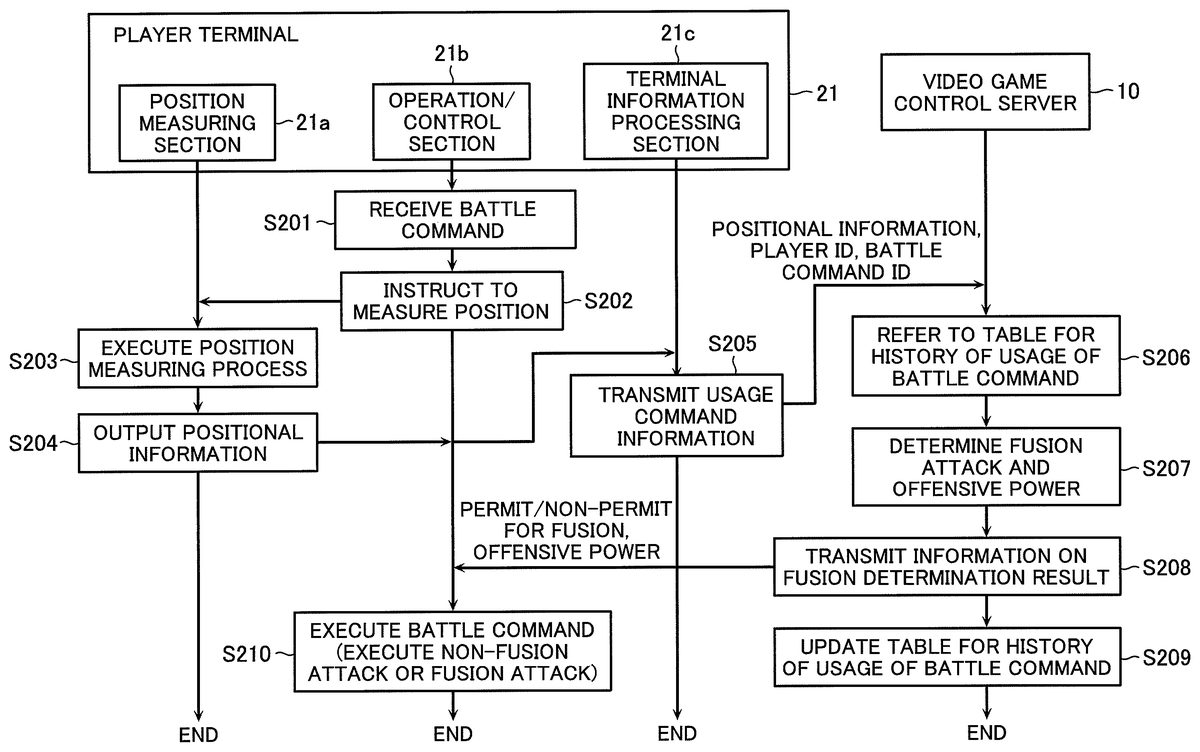
FIG. 4is a flowchart that illustrates an example of a game start process in the video game delivery system100of the present embodiment.FIG. 5is a flowchart that illustrates an example of a fusion attack control process in the video game delivery system100of the present embodiment. Here, in order to simplify the explanation of the game start process and the fusion attack control process, a player P plays a video game G by operating a player terminal21of the player P. Further, in order to explain a process for delivering the video game G to the player terminal21, explanation for any process other than the processes relating to the present invention, in particular, may be omitted.
In the game start process, the operation/control section21bof the player terminal21activates (or starts) a game application for executing the video game G in accordance with an operation of the player P (Step S101). Once the game application is activated, the operation/control section21boutputs an instruction for measurement of a position of the player terminal21to the position measuring section21a(Step S102). The position measuring section21aexecutes a position measuring process for measuring a current position of the player terminal21in response to the instruction for position measurement (Step S103), and then outputs positional information indicating the measurement result (Step S104).
When the positional information is received from the position measuring section21avia the operation/control section21b, the terminal information processing section21ccreates terminal information including the received positional information and a player ID applied to the player P, and then transmits the created terminal information to the video game control server10via the base station31and the communication network40, for example (Step S105).
When the terminal information is received, the video game control server10executes an authentication process using the player ID included in the received terminal information (Step S106). In this case, the authentication process is not limited to one using the player ID, and may be another using other information such as a password or biologic information. In the case where the player P is authenticated, the video game control server10stores the current position of the player P (that is, the player terminal21) by registering the positional information included in the received terminal information in a player position setting table (not shown in the drawings) so that the positional information is associated with the player ID. The video game control server10then transmits a game program (video game program) for delivering the video game G to the player terminal21(Step S107). In this regard, registration information in the player position setting table is to be updated whenever the player terminal21makes an access to the video game control server10for providing the positional information of the player terminal21.
When the game program is received, the operation/control section21bof the player terminal21starts the game application using the received game program, that is, starts to execute the video game G (Step S108). After the video game G is started, the fusion attack control process is executed whenever a battle command is used during execution of the video game G.
In the fusion attack control process, when the operation/control section21bof the player terminal21receives specification of a battle command by means of an operation of the player P (Step S201), the operation/control section21boutputs an instruction for measurement of a position of the player terminal21to the position measuring section21a(Step S202). The position measuring section21aexecutes a position measuring process for measuring a current position of the player terminal21in response to the instruction for position measurement (Step S203), and then outputs positional information indicating the measurement result (Step S204).
When the positional information is received from the position measuring section21avia the operation/control section21b, the terminal information processing section21ccreates usage command information including the received positional information, a battle command ID indicating the battle command received at Step S201by the operation/control section21band a player ID applied to the player P, and then transmits the created usage command information to the video game control server10via the base station31and the communication network40, for example (Step S205). In this case, the terminal information processing section21cobtains the corresponding battle command ID from the operation/control section21bwhen receiving the positional information via the operation/control section21b.
When the usage command information is received, the video game control server10refers to the battle command usage history table (Step S206), and executes a fusion attack determining process and attack power determining process for determining attack power (offensive power) in the case where it is determined to be a fusion attack (Step S207).
Here, the term “fusion attack” in the present embodiment means an integrated attack executed in accordance with a battle command specified by a player in the case where the battle command specified in a player terminal, in which the video game is played at a given place, by the player is the same as the battle command recently specified in another player terminal, in which the same video game is played within a predetermined area such as a neighboring place from the given place by another player. Namely, in the present embodiment, in the case where the battle command is specified multiple times within a predetermined area and in the near term, for example, a fusion attack having high attack power, in which attack power by the one or two or more same battle commands existing within a predetermined geographic and time range and the attack power of the battle command are integrated, is executed in accordance with how many times the specified battle command is used within the predetermined geographic and time range by other player(s).
In the fusion attack determining process at Step S207, the video game control server10determines whether more than a predetermined number (for example, 1 or 2) of battle commands having a command name the same as the command name corresponding to the battle command ID included in the received usage command information and satisfying a fusion determination condition (will be described later) are registered in the battle command usage history table or not. In the case where it is determined that more than the predetermined number of battle commands are registered in the battle command usage history table, the video game control server10determines that the battle command is to be a fusion attack (that is, an integrated battle command).
In the present embodiment, the “fusion determination condition” is a condition used within a predetermined range and within a predetermined period of time. The predetermined range and the predetermined period of time are set in a table for a fusion determination condition as shown inFIG. 6in the present embodiment. The fusion determination condition table is created in advance and stored in the game information memory13. The video game control server10specifies a fusion determination condition by referring to the fusion determination condition table, and then searches a battle command satisfying the fusion determination condition from the registration information of the battle command usage history table.
In this regard, the “fusion determination condition” is a condition used only within a predetermined range. Namely, used period of time is not included in the condition of the “fusion determination condition”.
In the attack power determining process at Step S207, the video game control server10refers to a table for determination of offensive power (attack power) as shown inFIG. 7, for example, and determines a multiplication factor of the attack power (or offensive power) so as to be associated with the number of corresponding battle commands registered in the battle command usage history table. The offensive power determining table is created in advance and then stored in the game information memory13. In the offensive power determining table, the number of corresponding battle command is associated with the multiplication factor of the offensive power for every kind of battle command. In this regard, a value directly indicating offensive power may be set in the offensive power determining table in place of the multiplication factor of the offensive power.
More specifically, in the case where the command name corresponding to the battle command ID included in the received usage command information is a “special technique A” at Step S207, the video game control server10refers to the fusion determination condition table (seeFIG. 6), and confirms that the fusion determination condition of the “special technique A” is a condition that the “special technique A” is used within two hours (for example, if the current time is 18:30, 16:30 to 18:20) and within 500 m (that is, within 500 m from the current position of the player terminal21). The video game control server10then refers to the offensive power determination table (seeFIG. 7) to confirm that the required number for the “special technique A” is two, and refers to the battle command usage history table (seeFIG. 3) to confirm that there are two battle command “special technique A” satisfying the fusion determination condition. The video game control server10refers to the offensive power determination table (seeFIG. 7), and determines that the offensive power of the “special technique A” to be used becomes twice as a normal special technique A because the “special technique A” are used twice by other player(s). Namely, the video game control server10determines to instruct the player terminal to execute a fusion attack in which the offensive power by an attack from the player character in accordance with the “special technique A” is set to twice. The instruction to execute the “special technique A” is made by fusion determination result information (will be described later).
When the fusion attack determining process is executed and the offensive power determining process is also executed if necessary as described above, the video game control server10transmits fusion determination result information to the player terminal21via the base station31and the communication network40(Step S208). The fusion determination result information includes a fusion determination result indicating the determination result (information for specifying allowance or disallowance of the fusion attack, and information capable of specifying the offensive power in the case of allowance). The video game control server10then updates the battle command usage history table by adding each piece of the received usage command information that has been transmitted to the video game control server10from the player terminal21at Step S205thereto as a usage history (Step S209).
At Step S209, the video game control server10creates usage history information including the battle command name of the battle command indicated by the battle command ID included in the usage command information received from the player terminal21, the positional information (positional data) indicated by the positional information included in the received usage command information, the player ID included in the received usage command information and the time data indicating the time determined on the basis of reception of the usage command information, and updates the battle command usage history table by adding the created usage history information.
When the fusion determination result information is received, the operation/control section21bof the player terminal21causes the player character to execute an attack action in accordance with the fusion determination result indicated by the received fusion determination result information (Step S210). More specifically, in the case where the fusion determination result indicates the “fusion attack allowance”, the operation/control section21bof the player terminal21causes the player character to execute the fusion attack action with the offensive power in which normal offensive power by the battle command received at Step S201is increased to the offensive power indicated by the fusion determination result (in the present embodiment, increased with the multiplication factor indicated by the fusion determination result). On the other hand, in the case where the fusion determination result indicates “disallowance of a fusion attack”, the operation/control section21bof the player terminal21causes the player character to execute a normal attack action with normal offensive power by the battle command received at Step S201(non-fusion attack action).
As explained above, in the embodiment described above, the video game control system100is constructed as follows. Namely, the video game control system100includes: the plurality of player terminals21to2N respectively operated by a plurality of players in each of which a video game is played; and a video game control server10for controlling at least part of progress of the video game via the communication network40. Namely, any of the player terminals21to2N receives specification of an attack command (that is, battle command) for specifying an attack action that the player character is caused to execute by means of an attack specification operation by the player; measures a current position of the player terminal21or2N when the specification of the attack command is received; transmits usage command information, including attack command information (battle command ID) indicating the received attack command, current position information indicating the measured current position of the player terminal and player identification information (player ID) for uniquely identifying the player, to the video game control server via the communication network40; and causes the player character to execute the attack action specified on the basis of the received attack command. Further, the video game control server10includes the battle command usage history table for storing usage history information indicating a usage history of attack commands for each of the plurality of player terminals21to2N; when usage command information, including the attack command information and the current position information, is received from the player terminal21, determines whether or not an attack action by an attack command indicated by attack command information is to be a fusion attack action (an integrated attack action), in which the attack actions by the attack commands included in the usage history indicated by the usage history information are integrated, on the basis of a current position of the user terminal indicated by current position information; also determines attack power specification information (for example, information indicating a multiplication factor with respect to normal attack power) capable of specifying the attack power of the fusion attack action in the case where it is determined that the attack action is to be the fusion attack action; transmits attack instruction information (fusion determination result information) indicating the determination result to the player terminal21; and updates the battle command usage history table by adding the received usage command information to the usage history of the attack commands. The player character is caused to execute the fusion attack action when the player terminal21receives from the video game control server10the attack instruction information including information that it is determined that the attack action is to be the fusion attack action, in which the attack power of the attack action indicated by the attack command received from the player is changed into the attack power specified by the received attack power specification information. Since the video game control server10has the configuration described above, it is possible to unpredictably change the contents of a video game using positional information indicating a position of a player. It is also possible to further diversify the game contents in a video game in which the positional information is used. This makes it possible to improve player's interest in play of the video game.
Namely, it is determined whether or not the attack action by the battle command specified by the player himself is to be the fusion attack action on the basis of not only the contents of the player's own specified battle command but also the battle commands that other player(s) used in a region neighboring the current position and the like. Thus, it is possible to unpredictably change the contents of a video game. Therefore, it is possible to add a new idea or plan to the video game, and it is possible to further diversify the game contents in the video game depending on the position of a player even though the game contents are the same.
Further, in the embodiment described above, the video game control server10determines that the attack action is to be the fusion attack action in the case where more than the predetermined number of attack commands, each of which is identical to the battle command notified from the player terminal21, which have been used within a predetermined distance range from the current position of the player terminal21notified from the player terminal21, are included in the usage history indicated by the usage history information; and determines the attack power so that the attack power of the fusion attack action gradually increases in accordance with the number of the included battle commands, which is more than the predetermined number. Thus, for example, it is possible to determine whether or not the attack action by the specified battle command is to be a fusion attack action on the basis of the battle commands that other player(s) playing the video game in the neighborhood have used, and this makes it possible to diversify the game contents in the video game.
Moreover, in the embodiment described above, in the embodiment described above, the video game control server10may determine that the attack action is to be the fusion attack action in the case where more than the predetermined number of attack commands, each of which is identical to the battle command notified from the player terminal21, which have been used within a predetermined distance range from the current position of the player terminal21notified from the player terminal21and within a predetermine period of time, are included in the usage history indicated by the usage history information; and determine the attack power so that the attack power of the fusion attack action gradually increases in accordance with the number of the included battle commands, which is more than the predetermined number. Thus, for example, it is possible to determine whether or not the attack action by the specified battle command is to be a fusion attack action on the basis of the battle commands that other player(s) playing the video game in the neighborhood around the same time have used, and this makes it possible to diversify the game contents in the video game.
Furthermore, in the embodiment described above, the video game control server10determines the attack power specification information using the offensive power determination table (seeFIG. 7) in which the number of the corresponding battle commands are associated with the attack power specification information (for example, a multiplication factor) for specifying the offensive power of the fusion attack action. Thus, it is possible to readily determine the offensive power in the case of the fusion attack. In addition, by changing the registration information of the offensive power determination information, it is possible to readily change the offensive power in the case of the fusion attack. In this case, the offensive power determination table may be one in which the number of the corresponding battle commands is registered so as to be associated with the attack power information (offensive power information) indicating the offensive power itself.
By providing the offensive power determination table as described above, it is possible to provide variation in magnitude of effects for every battle command when executing a fusion attack. For example, in the case of the example shown inFIG. 7, in comparison with a special technique C and magic B, the multiplication factors of the special technique C and the magic B are respectively 2.0 times and 1.8 times in the case where the number of the same command is one. Thus, the effect of the fusion attack for the special technique C is higher than that for the magic B. However, in the case where the number of the same command is two, the multiplication factors of the special technique C and the magic B are respectively 4.0 times and 5.0 times. In this case, it is possible to obtain a very high effect by the magic B. Since such an irregular multiplication factor setup can be made, the player takes into consideration the number of the same battle commands and may select, like a gambling, a battle command heightening a dramatic effect with respect to the number of the same battle commands (for example, the magic B in this case) while expecting that a fusion attack is activated. This makes it possible to add a new idea or plan to the video game.
Further, in the embodiment described above, although the battle command usage history table in which a usage history of the battle commands actually used by the respective player terminals21to2N is registered is utilized, a virtual battle command usage history table in which a usage history of the battle commands virtually created by a system manager (or administrator) is registered may be utilized in place of or in addition to the battle command usage history table. In such a case, a method of selecting one of the battle command usage history table and the virtual battle command usage history table to be referred is not particularly limited. For example, the video game control server10may automatically select one in which a larger amount of information is registered to refer to it, or may always utilize the virtual battle command usage history table only for the player terminal positioned in a predetermined specific area. Since the video game control server10is constructed in this manner, it is possible to purposely adjust frequency of appearance of a fusion attack so that a fusion attack may appear even in a depopulated area in which players playing the video game are very few or the like. Further, when a player utilizes a specific battle command in a specific area, it is possible to purposely adjust frequency of appearance of a fusion attack so that a fusion attack appears with high probability.
Otherwise, for example, in the case where the number of the usage histories of the battle command around the current position of the player registered in the battle command usage history table is less than a predetermined number (for example, 100 times, 1,000 times or 10,000 times), the video game control server10may refer to the virtual battle command usage history table in addition to the battle command usage history table, or refer to the virtual battle command usage history table for shortfall against the predetermined number, or the fusion determination condition may be set so that by gradually relaxing a positional condition and/or a time condition that constitutes a reference range of the usage history until the predetermined number can be ensured, a fusion attack can be activated even in a place (such as a depopulated area) in which players playing the video game are very few. Since the video game control server10is constructed in this manner, the actual (or real) battle command usage history table can be preferentially referred to without using the virtual battle command usage history table as much as possible. This makes it possible to obtain an effect with reality.
In this regard, in the embodiment described above, the offensive power determination table is set, and attack power (offensive power) for each battle command when a fusion attack is activated is irregularly defined depending on how many same battle commands exist within a predetermined positional and time range. However, the attack power of a battle command when a fusion attack is activated may be set to the simple product of the number of battle commands existing within the positional and time range and the offensive power of the corresponding battle command when the battle command itself is separately activated. For example, in the case where the offensive power of “kesagiri” with single activation is set to “50” and five “kesagiri” commands exist within a predefined range, the attack power of the “kesagiri” command when a fusion attack is activated is set to “300” (the product of “50” and “6” times (because activation at this time is to be included)).
Moreover, a motion image of a command prepared for every battle command may be displayed so that an image for the command at single activation is differentiated from an image for the command at fusion activation. Namely, multiple patterns of motion images for every battle command are prepared in accordance with the magnitude of offensive power of a fusion attack, and the video game control server10instructs the corresponding player terminal to display the corresponding motion image in accordance with an activation state of the fusion attack. Since the video game control server10is constructed in this manner, it is possible to display a bright motion image along with the magnitude of an effect of a fusion attack (final offensive power) even for a battle command in which just a somber motion image is displayed when a battle command is separately activated. This makes the player to obtain a great deal of pleasure when a fusion attack is activated.
By constructing the video game control server10in this manner, in the case where a player character of a low level can use a battle command (or a technique) even though the battle command (or technique) is a battle command with weak offensive power when separately used, the probability of activation of a fusion attack may be increased. Thus, this makes it possible to apply a new idea or interest, in which the player may determine to specify a battle command with weak offensive power while expecting that a fusion attack with a larger effect is activated or to ensure reliable offensive power by specifying a battle command with great offensive power without expecting activation of a fusion attack, to the player.
Furthermore, in order to further increase the probability of activation of a fusion attack, it is thought that a plurality of players intentionally get together in the same place to play the same video game at the same time. Thus, since exchange between the players, which has merely been obtained in a virtual world in a conventional online video game, is likely obtained in the real world, the video game control server10of the present invention contributes development of the exchange between the players.
Further, in the embodiment described above, although the video game control system is constructed so that positional information of the player terminal21is to be registered to the video game control server10when the video game is started, the positional information may be transmitted to the video game control server10only when a battle command is used.
Moreover, in the embodiment described above, the video game control system is constructed so that in the case of activating a fusion attack action, the video game control server10determines the attack power specification information (for example, a multiplication factor with respect to normal attack power) capable of specifying the offensive power of the fusion attack action and transmits the offensive power specification information to the corresponding player terminal21. However, the video game control server10may determine the offensive power information (for example, a value directly indicating offensive power such as offensive power “100” or offensive power “150”) indicating offensive power itself of the fusion attack action and transmit the offensive power information to the corresponding player terminal21. By constructing the video game control server10in this manner, it is no need to execute a process to calculate the offensive power in the player terminal21, and this makes it possible to reduce processing load of the player terminal21.
In this regard, although one example of the video game control for the RPG has been explained in the embodiment described above, there is no wonder that the technique of the present invention can be applied to similar video games such as a gun action RPG. In addition, the technique of the present invention can also be applied to other kinds of video games appropriately, as will be readily apparent to those skilled in the art, without departing from the scope of spirit of the present invention.
The present invention can be applied to a video game control system and the like that includes a plurality of player terminals respectively operated by a plurality of players and a video game control server that controls at least part of progress of a video game played in each of the plurality of player terminals in response to an operation by a player. Therefore, the present invention is useful.
Claims
- A video game control system, comprising: a plurality of player terminals respectively operated by a plurality of players, a video game being played on each of the plurality of player terminals;and a video game control server that controls at least part of a progress of the video game via a communication network, wherein each of the plurality of player terminals comprises: an attack command receiver that receives a specification of an attack command that specifies an attack action that a player character is caused to execute against an enemy character by an attack specification operation by a specific player of the plurality of players;a position measurer that measures a current position of a specific player terminal of the specific player when the attack command receiver receives the specification of the attack command;a usage command information transmitter that transmits usage command information to the video game control server from the specific player terminal via the communication network, the usage command information including attack command information indicating an attack command received by the attack command receiver, current position information indicating a current position of the specific player terminal measured by the position measurer and player identification information for uniquely identifying the specific player;and an attack command executor that causes the player character to execute the attack action, specified on the basis of the attack command received by the attack command receiver, against the enemy character, wherein the video game control server comprises: a usage history information memory that stores the usage command information received from each of the plurality of player terminals and that stores a usage history of attack commands for each of the plurality of player terminals, the usage history of attack commands including attack commands executed by the plurality of player terminals;an integrated attack determiner that determines, when usage command information is received from the specific player terminal of the plurality of player terminals, whether the attack command included in the usage command information indicates an integrated attack action;the integrated attack determiner further determining, when it is determined that the attack command indicates the integrated attack action, at least one of attack power information indicating an attack power of the integrated attack action and attack power specification information that specifies the attack power;an attack instruction information transmitter that transmits attack instruction information indicating a determination result of the integrated attack determiner to the specific player terminal which has transmitted the usage command information;and a usage history information updater that updates the usage history information by adding the usage command information received from the specific player terminal to the usage history of the attack commands, wherein the integrated attack determiner determines whether the attack command that specifies the attack action to be executed against the enemy character indicates an integrated attack action by comparing the attack command information and the current position information included in the usage command information transmitted from the specific player terminal to the video game control server with the usage history of attack commands of the plurality of player terminals that are stored in the usage history information memory and that were executed by the plurality of player terminals at a position located within a predetermined distance of the current position of the specific player terminal, and wherein the attack command executor causes the player character controlled by the specific player terminal to execute the integrated attack action against the enemy character when the specific player terminal receives, from the video game control server, the attack instruction information including information that it is determined that the attack action is to be the integrated attack action, the attack power of the integrated attack action being at least one of indicated by the attack power information and specified by the attack power specification information.
- The video game control system according to claim 1 , wherein the integrated attack determiner determines that the attack action is to be the integrated attack action when more than a predetermined number of attack commands, each of which is identical to the attack command indicated by the attack command information included in the usage command information received from the specific player terminal and that have been used within a predetermined distance range from the current position of the specific player terminal indicated by the current position information included in the received usage command information, are included in the usage history indicated by the usage history information, and wherein the integrated attack determiner determines the at least one of the attack power information and the attack power specification information so that the attack power of the integrated attack action gradually increases in accordance with the number of the included attack commands that exceed the predetermined number.
- The video game control system according to claim 2 , wherein the integrated action determiner refers to the usage histories registered in the usage history information other than the usage history of the attack command for the specific player terminal that has transferred the usage command information to the video game control server.
- The video game control system according to claim 2 , wherein the video game control server further comprises a virtual usage history information memory for storing virtual usage history information indicating a usage history of an attack command virtually created, and wherein the integrated attack determiner determines whether the attack action is to be the integrated attack action using the virtual usage history information in place of the usage history information in the case where the current position of the player terminal indicated by the current position information included in the received usage command information is positioned within a specific area.
- The video game control system according to claim 4 , wherein the integrated attack determiner determines whether the attack action is to be the integrated attack action using the usage history in the virtual usage history information in the case where the number of the usage histories of the attack command in the usage history information is less than a predetermined number.
- The video game control system according to claim 2 , wherein the integrated attack determiner determines the at least one of the attack power information and the attack power specification information using a table for determination of attack power specification information in which the number of the corresponding attack commands is associated with the at least one of the attack power information and the attack power specification information.
- The video game control system according to claim 1 , wherein the integrated attack determiner determines that the attack action is to be the integrated attack action when more than a predetermined number of attack commands, each of which is identical to the attack command indicated by the attack command information included in the usage command information received from the specific player terminal and that have been used within a predetermined distance range from the current position of the specific player terminal indicated by the current position information included in the received usage command information and within a predetermined period of time, are included in the usage history indicated by the usage history information, and wherein the integrated attack determiner determines the attack power specification information so that the attack power of the integrated attack action gradually increases in accordance with the number of the included attack commands that exceed the predetermined number.
- The video game control system according to claim 1 , wherein the position measurer measures the current position of the player terminal on the basis of positioning signals from a plurality of positioning satellites.
- The video game control system according to claim 1 , wherein the usage history information includes used attack command information indicating an attack command that has been used, usage position information indicating the position of the player terminal when the attack command is used, usage time information indicating time when the attack command is used, and the player identification information, and wherein the usage history information updater creates additional information to the usage history information by specifying the attack command indicated by the attack command information included in the received usage command information as the used attack command information, specifying the position information indicated by the current position information included in the received usage command information as the usage position information, adding the player identification information included in the received usage command information and determining the usage time information on the basis of reception of the usage command information, and updates the usage history information.
- A video game control server for controlling at least part of a progress of a video game via a communication network, the video game being played on each of a plurality of player terminals, the plurality of player terminals being respectively operated by a plurality of players, the video game control server comprising: a usage history information memory that stores usage history information received from each of the plurality of player terminals and that stores a usage history of attack commands for each of the plurality of player terminals, the usage history of attack commands including attack commands executed by the plurality of player terminals, the attack commands indicating attack actions that player characters executed against enemy characters;an integrated attack determiner that determines, when usage command information is received from a specific player terminal of the plurality of player terminals, whether an attack command that indicates an attack action that a player character is to execute against an enemy character and that is included in the usage command information indicates an integrated attack action, the integrated attack determiner further determining, when it is determined that the attack command indicates the integrated attack action, at least one of attack power information indicating an attack power of the integrated attack action and attack power specification information that specifies the attack power;an attack instruction information transmitter that transmits attack instruction information indicating a determination result of the integrated attack determiner to the specific player terminal which has transmitted the usage command information, so that the player character controlled by the specific player terminal is caused to execute the integrated attack action, in which the attack power of the integrated attack action is at least one of indicated by the attack power information and specified by the attack power specification information, against the enemy character;and a usage history information updater that updates the usage history information by adding the received usage command information to the usage history of the attack commands, wherein the integrated attack determiner determines whether the attack command that specifies the attack action to be executed against the enemy character indicates an integrated attack action by comparing the attack command information and the current position information included in the usage command information transmitted from the specific player terminal to the video game control server with the usage history of attack commands of the plurality of player terminals that are stored in the usage history information memory and that were executed by the plurality of player terminals at a position located within a predetermined distance of the current position of the specific player terminal.
- The video game control server according to claim 10 , wherein the integrated attack determiner determines that the attack action is to be the integrated attack action when more than a predetermined number of attack commands, each of which is identical to the attack command indicated by the attack command information included in the usage command information received from the specific player terminal and that have been used within a predetermined distance range from the current position of the specific player terminal indicated by the current position information included in the received usage command information, are included in the usage history indicated by the usage history information, and wherein the integrated attack determiner determines the at least one of the attack power information and the attack power specification information so that the attack power of the integrated attack action gradually increases in accordance with the number of the included attack commands that exceed the predetermined number.
- The video game control server according to claim 11 , wherein the integrated action determiner refers to the usage histories registered in the usage history information other than the usage history of the attack command for the specific player terminal that has transferred the usage command information to the video game control server.
- The video game control server according to claim 11 , further comprising a virtual usage history information memory that stores virtual usage history information indicating a usage history of an attack command virtually created, wherein the integrated attack determiner determines whether the attack action is to be the integrated attack action using the virtual usage history information in place of the usage history information in the case where the current position of the player terminal indicated by the current position information included in the received usage command information is positioned within a specific area.
- The video game control server according to claim 13 , wherein the integrated attack determiner determines whether the attack action is to be the integrated attack action using the usage history in the virtual usage history information in the case where the number of the usage histories of the attack command in the usage history information is less than a predetermined number.
- The video game control server according to claim 11 , wherein the integrated attack determiner determines the at least one of the attack power information and the attack power specification information using a table for determination of attack power specification information in which the number of the corresponding attack commands is associated with the at least one of the attack power information and the attack power specification information.
- The video game control server according to claim 10 , wherein the integrated attack determiner determines that the attack action is to be the integrated attack action when more than a predetermined number of attack commands, each of which is identical to the attack command indicated by the attack command information included in the usage command information received from the specific player terminal and that have been used within a predetermined distance range from the current position of the specific player terminal indicated by the current position information included in the received usage command information and within a predetermined period of time, are included in the usage history indicated by the usage history information, and wherein the integrated attack determiner determines the attack power specification information so that the attack power of the integrated attack action gradually increases in accordance with the number of the included attack commands that exceed the predetermined number.
- The video game control server according to claim 10 , wherein the position measurer measures the current position of the player terminal on the basis of positioning signals from a plurality of positioning satellites.
- The video game control server according to claim 10 , wherein the usage history information includes used attack command information indicating an attack command that has been used, usage position information indicating the position of the player terminal when the attack command is used, usage time information indicating time when the attack command is used, and the player identification information, and wherein the usage history information updater creates additional information to the usage history information by specifying the attack command indicated by the attack command information included in the received usage command information as the used attack command information, specifying the position information indicated by the current position information included in the received usage command information as the usage position information, adding the player identification information included in the received usage command information and determining the usage time information on the basis of reception of the usage command information, and updates the usage history information.
Disclaimer: Data collected from the USPTO and may be malformed, incomplete, and/or otherwise inaccurate.