U.S. Pat. No. 7,713,126
VIDEO GAME CONTROL PROGRAM AND VIDEO GAME DEVICE
AssigneeSega
Issue DateJuly 6, 2006
U.S. Patent No. 7,713,126: Video game control program and video game device

Summary:
The ‘126 patent allows a player, while playing a video game, to choose between a plurality of paths. The player may select a path in advance, but he has the ability to change the path before the character gets to the selected path. The game described also includes a feature which allows the player to travel forward or backward; this prevents the game from feeling like a linear path where the player has no control
Abstract:
In a video game device which performs a video game wherein a game character or unit moves through a plurality of paths including a plurality of branch points according to an instruction of a player, a first movement control unit displays branch-direction indications enabling the player to select one of a plurality of first branch directions at a branch point on a path in the video game, so that a selected one of the plurality of first branch directions is received from the player. A second movement control unit displays preceding-branch-direction indications enabling the player to select, in advance, one of a plurality of second branch directions at a branch point on a following path in the selected first branch direction, so that a selected one of the plurality of second branch directions is received from the player.
Illustrative Claim:
1. A computer program computer-readably stored in a memory unit which, when executed by a computer having a processing unit, causes the computer having the processing unit to perform a video game control process of a video game wherein a game object moves through a plurality of paths in response to instructions by a player operating an input unit connected to the computer having the processing unit, the video game control process comprising: allowing the player to designate a destination which the player intends to cause the game object to reach; detecting a path from a current location of the game object to the designated destination and controlling the game object to move from the current location of the game object toward the designated destination; if the path detected from the current location of the game object includes a branch, displaying preceding-branch-direction indications in advance before the game object reaches a branch point, and enabling the player to select, in advance before the game object reaches the branch point, one of the preceding-branch directions for the branch point; and when the game object has reached the branch point, controlling the game object to move along the selected branch direction unless an instruction for selecting a branch direction different from the selected branch direction is given by the player for the branch point.
Illustrative Figure
Abstract
In a video game device which performs a video game wherein a game character or unit moves through a plurality of paths including a plurality of branch points according to an instruction of a player, a first movement control unit displays branch-direction indications enabling the player to select one of a plurality of first branch directions at a branch point on a path in the video game, so that a selected one of the plurality of first branch directions is received from the player. A second movement control unit displays preceding-branch-direction indications enabling the player to select, in advance, one of a plurality of second branch directions at a branch point on a following path in the selected first branch direction, so that a selected one of the plurality of second branch directions is received from the player.
Description
DETAILED DESCRIPTION OF PREFERRED EMBODIMENTS A description will now be provided of the preferred embodiments of the present invention with reference to the accompanying drawings. FIG. 1shows the composition of a video game device in an embodiment of the invention. As shown inFIG. 1, the video game device of this embodiment comprises the following units1to8. The input unit1receives directly operation inputted by the player. The input unit1is provided with any of the touch panel, the buttons, the joystick and the like. The touch panel may be provided on a display screen of the image display unit5used as the video monitor. The central processing unit2receives the operation input by the user on the input unit1, and performs the main processing of the video game. The memory3includes a ROM (read-only memory) in which the pre-installed program and data which are used for the processing of the central processing unit2are stored, and a RAM (random access memory) used as the working area in the program execution. The image processing unit4is provided to generate a game-related image according to the processing of the central processing unit2. The image display unit5is provided as the video monitor to display the image generated by the image processing unit4. The audio processing unit6is provided to generate game-related sound according to the processing of the central processing unit2. The audio output unit7is provided with a power amplifier and a loudspeaker to output or reproduce the sound generated by the audio processing unit6. The communication control unit8is provided so that this video game device may communicate with an external video game device via a WAN (wide area network) or LAN (local area network). In the case where it is not necessary to communicate with an external video game device, the communication control unit8may be omitted from the composition of the ...
DETAILED DESCRIPTION OF PREFERRED EMBODIMENTS
A description will now be provided of the preferred embodiments of the present invention with reference to the accompanying drawings.
FIG. 1shows the composition of a video game device in an embodiment of the invention.
As shown inFIG. 1, the video game device of this embodiment comprises the following units1to8.
The input unit1receives directly operation inputted by the player. The input unit1is provided with any of the touch panel, the buttons, the joystick and the like. The touch panel may be provided on a display screen of the image display unit5used as the video monitor.
The central processing unit2receives the operation input by the user on the input unit1, and performs the main processing of the video game. The memory3includes a ROM (read-only memory) in which the pre-installed program and data which are used for the processing of the central processing unit2are stored, and a RAM (random access memory) used as the working area in the program execution.
The image processing unit4is provided to generate a game-related image according to the processing of the central processing unit2. The image display unit5is provided as the video monitor to display the image generated by the image processing unit4.
The audio processing unit6is provided to generate game-related sound according to the processing of the central processing unit2. The audio output unit7is provided with a power amplifier and a loudspeaker to output or reproduce the sound generated by the audio processing unit6.
The communication control unit8is provided so that this video game device may communicate with an external video game device via a WAN (wide area network) or LAN (local area network). In the case where it is not necessary to communicate with an external video game device, the communication control unit8may be omitted from the composition of the video game device inFIG. 1.
FIG. 2shows the functional composition of a movement control unit in the video game device ofFIG. 1. The processing of the movement control unit is essentially realized by the central processing unit (CPU)2and the memory3inFIG. 1. And the functions of the movement control unit may be realized by means of a computer-readable program. When executed by a computer, the computer-readable program causes the computer to perform the processing of the movement control unit of the video game device in one embodiment of the invention.
As shown inFIG. 2, the movement control unit100comprises the following units110,120and130.
The input-item display unit110displays the input items which can be inputted (or selected) as the move command by the player, on the video monitor, based on the branch data D1, the movement data D2, and the free-movement-area data D3.
The move-command processing unit120receives the move command inputted by the player, from the input unit1, and processes the movement of the game character etc. in accordance with the received move command.
The state control unit130performs switching from one of a standby state, a normal movement state, and a free movement state to another, and determines whether the destination of the received move command is reached or not.
The input-item display unit110comprises the following units111to115.
The branch-direction-arrow display unit111displays the branch direction arrows which can be selected by the player at a branch point on a path.
The preceding-branch-direction-arrow display unit112displays the preceding branch direction arrows which can be selected at the branch point (preceding branch point) which exists previously when a branch direction arrow is selected by the player.
The forward/backward arrow display unit113displays the forward/backward direction arrows which indicate the directions of forward/backward movement of the game character or unit (or the group of game characters).
The stop-mark display unit114displays the stop mark which is provided to suspend movement of the game character or unit.
The free-movement-area display unit115displays the free-movement area where the direction of free movement can be inputted by the player if the free movement of the game character or unit is permitted at a place where the path is broad.
The move-command processing unit120comprises the following units121to126.
The move-command input unit121inputs or receives the move command inputted by the user on the input unit1which is provided with any of the touch panel, the buttons, and the joystick.
The branch-select processing unit122performs a predetermined processing when the received move command indicates branch selection.
The preceding-branch-select processing unit123performs a predetermined processing when the received move command indicates preceding branch selection.
The forward/backward select processing unit124performs a predetermined processing when the received move command indicates forward/backward selection.
The stop-select processing unit125performs a predetermined processing when the received move command indicates stop selection (including stop cancellation selection).
The free-movement input processing unit126performs a predetermined processing when the received move command indicates free movement input.
Next,FIG. 3is a flowchart for explaining the processing of the movement control unit in the standby state.
The processing ofFIG. 3is repeatedly performed on the basis of one or several frames of the display screen outputted to the display unit. As previously described, the processing of the movement control unit shown inFIG. 3is essentially realized by the central processing unit (CPU)2and the memory3inFIG. 1.
Suppose that, inFIG. 3, the movement control unit is set in the standby state, and the game character is at a branch point on a path.
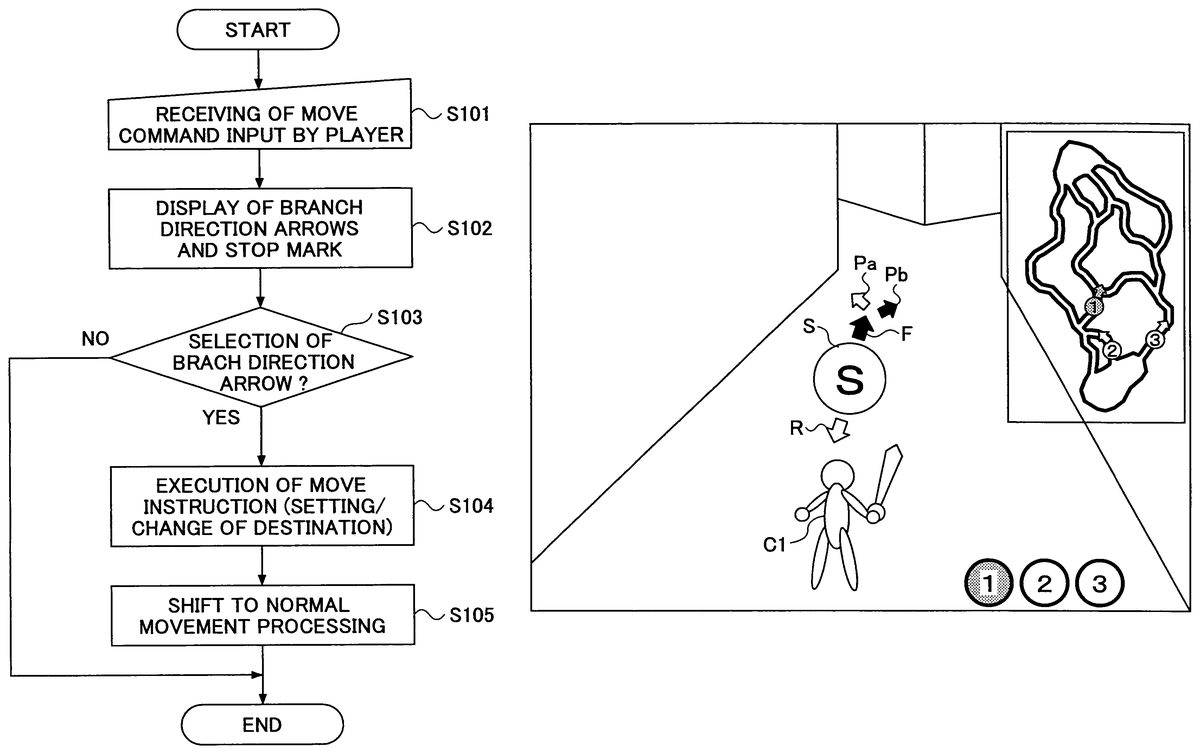
The CPU2receives a move command inputted by the player on the input unit1provided with any of the touch panel, the buttons and the joystick (step S101).
The CPU2displays the branch direction arrows and the stop mark on the video monitor (step S102).
The CPU2determines whether the move command from the player indicates selection of a branch direction arrow (step S103).
When the move command indicates selection of a branch direction arrow, the CPU2executes the move instruction (step S104). At the same time, the CPU2sets up a branch point which is the first occurrence on the following path toward the selected branch direction, as the next destination.
The CPU2at step S105shifts to the processing (FIG. 5) of the normal movement state after execution of the move instruction.
If the CPU2shifts to the processing of the normal movement state from the processing ofFIG. 3, the processing ofFIG. 3is terminated. Otherwise the processing ofFIG. 3is repeated.
FIG. 4shows an example of the display screen in the above-mentioned standby state. As shown inFIG. 4, the game character C1stops at the position P1on the map screen M.
The stop mark S which accepts receiving of a stop instruction (at this time, the stop mark S is deactivated because of the stop condition), and the branch direction arrows Ba-Bd on the circumference of the stop mark, which indicate the path directions which can be selected by the player, are displayed almost in the middle of the display screen.
In addition, the unit selection marks U are provided to enable the player to choose the unit which the game character belongs to, and “1”, “2”, and “3” correspond to the numbers displayed on the map screen M respectively. In this example, it is supposed that the game character C1belongs to the unit represented by the “1”.
If the player in this condition selects one of the branch direction arrows Ba-Bc, then the CPU2shifts to the processing of the normal movement state. The selection by the player in this case is performed by touching the display screen when the input unit is provided with the touch panel, or by clicking it with the mouse when the input unit is provided with the mouse.
FIG. 5is a flowchart for explaining the processing of the movement control unit in the normal movement state. The processing ofFIG. 5is repeatedly performed on the basis of one or several frames of the display screen outputted to the display unit, similar to the processing shown inFIG. 3.
As shown inFIG. 5, the CPU2at step S201receives a move command inputted by the player on the input unit1provided with any of the touch panel, the buttons, and the joystick, as processing of the normal movement state.
The CPU2at step S202displays the forward/backward direction arrows and the stop mark on the video monitor. The CPU2at step S203displays the preceding branch direction arrows on the video monitor.
FIG. 6shows an example of the display screen in the state in which the forward/backward direction arrows, the stop mark, and the preceding branch direction arrow are displayed in the normal movement state. Suppose that, inFIG. 6, the game character C1is at the position P1and moves on the map screen M.
As shown inFIG. 6, the stop mark S which accepts receiving of a stop instruction is displayed ahead of the game character C1. The forward direction arrow F, indicated in the highlight state, which accepts turning of the game character C1to that forward direction, and the backward direction arrow R which accepts turning of the game character C to the opposite direction are also displayed on the circumference of the stop mark S. Moreover, the preceding branch direction arrows Pa and Pb which indicate the path directions at the next branch point that are selectable by the player are displayed ahead of the forward direction arrow F.
Referring back toFIG. 5, the CPU2at step S204determines whether the move command inputted by the player indicates selection of the stop mark as processing of the normal movement state.
When the stop mark is selected during movement, the CPU2at step S205stops the movement. When the stop mark is selected during a stop, the CPU2at step S205restarts the movement.
FIG. 7shows an example of the display screen in the state in which the stop mark is selected in the normal movement state. Selecting the stop mark S by the player causes the stop mark S to be highlighted, and the movement of the game character C1is stopped. The selection by the player is performed by touching the display screen when the input unit is provided with the touch panel, or by clicking it with the mouse when the input unit is provided with the mouse.
During movement, the forward direction arrow F which was highlighted is returned to the normal display indication, and the display indications of the preceding branch direction arrows are eliminated. If the stop mark S in the state shown inFIG. 7is again selected by the player, then the display indication is returned to the movement state shown inFIG. 6.
Referring back toFIG. 5, the CPU2determines whether the move command from the player indicates selection, change or cancellation of a preceding branch direction arrow as processing of the normal movement state (step S206). When the move command indicates selection, change or cancellation of a preceding branch direction arrow, the CPU2at step S207executes the move instruction.
FIG. 8shows an example of the display screen in the state in which the preceding branch direction arrow is selected in the normal movement state. In the state shown inFIG. 8, the preceding branch direction arrow Pb is selected by the player and it is highlighted.
FIG. 9shows an example of the display screen in the state in which selection of the preceding branch direction arrow is changed in the normal movement state. In the state shown inFIG. 9, the preceding branch direction arrow Pa is selected by the player. The previously selected preceding branch direction arrow Pb which was highlighted is returned to the normal display indication, while the newly selected preceding branch direction arrow Pa is highlighted.
FIG. 10shows an example of the display screen in the state in which selection of the preceding branch direction arrow is canceled in the normal movement state. In the state shown inFIG. 10, the previously selected preceding branch direction arrow Pa which was highlighted is selected again by the player, and it is returned to the normal display indication.
Referring back toFIG. 5, the CPU2at step S208determines whether the move command from the player indicates selection of the opposite one of the forward/backward direction arrows to the current movement direction as processing of the normal movement state.
When the move command indicates selection of the opposite one of the forward/backward direction arrows to the current movement direction, the CPU2at step S209cancels the preceding input which was made by the preceding branch direction arrow. The CPU2at step S210executes the move instruction accompanied with the change of the destination.
FIG. 11shows an example of the display screen in the state in which the backward direction arrow is selected in the normal movement state.
Although the game character C1was moving in the direction of the forward direction arrow F, the backward direction arrow R is selected, and the preceding branch direction arrows, which were displayed ahead of the forward direction arrow F, are now canceled and eliminated. At the same time, the backward direction arrow R is newly highlighted, and the preceding branch direction arrows Pc, Pd and Pe, which indicate the path directions at the next branch point that are selectable by the player, are displayed ahead of the backward direction arrow R. In this state, the branch point which will appear for the first time on the path in the direction indicated by the backward direction arrow R is set to the next destination.
When any of the preceding branch direction arrows Pc, Pd and Pe is selected in this state, the corresponding operation is carried out by the CPU2which performs the judgment processing of step S206as to the selection of the preceding branch direction arrow, and performs the processing of step S207which executes the move instruction.
Referring back toFIG. 5, the CPU2at step S211determines whether the current position of the game character or the unit enters the free-movement area (where the game character can move freely) as processing of the normal movement state. When the current position of the game character enters the free-movement area, the CPU2at step S212shifts to the processing (FIG. 16) of free movement state.
The processing of the free movement state will be explained later. When the CPU2shifts to the processing of the free movement state, the processing ofFIG. 5is terminated. Otherwise the processing ofFIG. 5is repeated as described above.
Subsequently, the CPU2at step S213determines whether the current position of the game character or unit reaches the destination as processing of the normal movement state. When the game character reaches the destination, the CPU2at step S214determines whether the preceding input has been performed by any preceding branch direction arrow. When the preceding input has been performed, the CPU2at step S215shifts to the processing (FIG. 3) of the standby state. When the CPU2shifts to the processing of the standby state from the processing ofFIG. 5, the processing ofFIG. 5is terminated. Otherwise the processing ofFIG. 5is repeated.
FIG. 12shows an example of the display screen in the state in which new preceding branch direction arrows are displayed after the destination arrival in the normal movement state progressing from the state ofFIG. 8. Suppose that the game character C1is at the position P1on the map screen M. Even if the game character C1arrives at the destination, the game character C1continues to move in the direction of the highlighted forward direction arrow F according to the preceding input performed by the preceding branch direction arrow. And the preceding branch direction arrows Pa and Pb, which indicate the path directions at the next branch point that are selectable by the player, are displayed ahead of the forward direction arrow F.
FIG. 13shows another example of the display screen in the state in which new preceding branch direction arrows are displayed after the destination arrival in the normal movement state progressing from the state ofFIG. 9. Suppose that the game character C1in this case is moving in the other direction according to the preceding input, from the position P1on the map screen M.
Also in this case, even if the game character C1arrives at the destination, the game character C1continues to move in the direction of the highlighted forward direction arrow F according to the preceding input performed by the preceding branch direction arrow. And the preceding branch direction arrows Pa and Pb which indicate the path directions at the next branch point that are selectable by the player are displayed ahead of the forward direction arrow F.
When either of the preceding branch direction arrows Pa and Pb is selected in this state, the corresponding operation is carried out by the CPU2which performs the judgment processing of step S206as to the selection of the preceding branch direction arrow, and performs the processing of step S207which executes the move instruction.
FIG. 14shows an example of the display screen in the stop state following the destination arrival when any preceding input is not performed in the normal movement state progressing from the state ofFIG. 10. Suppose that the game character C1is at the position P1on the map screen M. Since any preceding input for selecting the next movement direction is not performed by the player, the movement of the game character C1is stopped, and the CPU2shifts to the processing (FIG. 3) of the standby state. And the stop mark S, and the branch direction arrows Ba-Bc on the circumference of the stop mark S which indicate the path directions that are selectable by the player are displayed. However, at this time, the stop mark S is deactivated because of the stop condition.
FIG. 15shows an example of the display screen in the stop state following the destination arrival when any preceding input is not performed in the normal movement state progressing from the state ofFIG. 11. Suppose that the game character C1is at the position P1on the map screen M. Since any preceding input for selecting the next movement direction is not performed by the player, the movement of the game character C1is stopped, and the CPU2shifts to the processing (FIG. 3) of the standby state. And the stop mark S, and the branch direction arrows Ba-Bd on the circumference of the stop mark S which indicate the path directions that are selectable by the player are displayed. However, at this time, the stop mark S is deactivated because of the stop condition.
When any of the branch direction arrows Ba-Bd is selected in this state, the corresponding operation is carried out by the CPU2which performs the processing ofFIG. 3.
FIG. 16is a flowchart for explaining the processing of the movement control unit in a free movement state.
The processing ofFIG. 16is repeatedly performed on the basis of one or several frames of the display screen outputted to the display unit, similar to the processing shown inFIG. 3orFIG. 5.
As shown inFIG. 16, the CPU2at step S301receives a move command inputted by the player on the input unit1provided with any of the touch panel, the buttons, and the joystick, as processing of the normal movement state.
The CPU2at step S302displays the branch direction arrows and the stop mark on the video monitor. The CPU2at step S303displays the free-movement area FR on the video monitor.
FIG. 17shows an example of the display screen in the state in which the branch direction arrows, the stop mark, and the free-movement area are displayed in the free movement state.
The free-movement state takes place at the position that is comparatively broad like the position P1on the map screen M shown inFIG. 17. The stop mark S which accepts receiving of a stop instruction, and the free-movement area FR where a free movement in any direction on the circumference of the stop mark is permitted, are displayed almost in the middle of the display screen ofFIG. 17. In the example ofFIG. 17, a free movement in any direction is permitted, and the circular area is shown as the free-movement area FR. The free-movement area FR may sometimes be in the shape of one or a plurality of sectors. And the branch direction arrows Ba-Bc, which indicate the path directions in the free-movement area FR that are arbitrarily selectable by the player, are displayed on the circumference of the free-movement area FR.
Referring back toFIG. 16, the CPU2at step S304determines whether the move command from the player indicates selection of the stop mark as processing of the free movement state.
When the stop mark is selected during movement, the CPU2at step S305stops the movement of the game character. When the stop mark is selected during a stop, the CPU at step S305restarts the movement of the game character.
Subsequently, the CPU2at step S306determines whether the move command from the player is a free movement input as processing of the free movement state. When the move command is a free movement input, the CPU2at step S307executes the move instruction, so that the game character moves in the direction according to the inputted direction.
FIG. 18shows an example of the display screen in the state in which the free movement input is performed in the free movement state. As shown inFIG. 18, the free-movement direction arrow f within the free-movement area FR, corresponding to the portion inputted by the player, is highlighted, and the game character C1moves in the direction indicated by the free-movement direction arrow f.
The free-movement area may be changed as a result of the movement. Displaying of the changed free-movement area FR in that case is performed by the CPU2which performs the above processing of step S303to display the free-movement area.
FIG. 19shows an example of the display screen in the state in which the boundary where further forward movement is inhibited is reached in the free movement state. In the state ofFIG. 19, the movement of the game character C1is stopped, and a new free-movement area FR and new branch direction arrows Ba-Bc are displayed.
Referring back toFIG. 16, the CPU2at step S308determines whether the move command from the player is a branch input as processing of the free movement state. When the move command is a branch input, the CPU2at step S309executes the move instruction including setting or change of the destination. And the CPU2at step S310displays the preceding branch direction arrows.
Subsequently, the CPU2at step S311determines whether the move command from the player indicates selection, change, or cancellation of a preceding branch direction arrow. When the move command indicates selection, change, or cancellation of a preceding branch direction arrow, the CPU2at step S312executes the move instruction.
Subsequently, the CPU2at step S313determines whether the current position of the game character or unit reaches the destination. When the destination is reached, the CPU2at step S314determines whether the preceding input has been performed by any preceding branch direction arrow. When the preceding input has been performed, the CPU2at step S315shifts to the processing (FIG. 5) of the normal movement state. On the other hand, when the preceding input has not been performed, the CPU2at step S316shifts to the processing (FIG. 3) of the standby state.
When the CPU2shifts from the processing ofFIG. 16to either the processing of the normal movement state or the processing of the standby state, the processing ofFIG. 16is terminated. Otherwise the processing ofFIG. 16is repeated.
In the above-described embodiment, the preceding branch direction arrows are provided as the preceding input for selecting a one-step following branch direction on a following path. However, the present invention is not limited to a particular number of stages for selection of branch directions as the preceding input. It is possible that the preceding branch direction arrows are provided as the preceding input for selecting an arbitrary multiple-step following branch direction on a following path.
As described in the foregoing, according to the present invention, a move instruction for selecting a following branch direction on a following path can be inputted beforehand by performing the preceding input with the easily inputted operation. When compared with the conventional method in which the input operation of the buttons or the like must be continued until the final destination is reached, the present invention does not require any complicated input operation of the buttons or the like. According to the present invention, the input operation of the buttons or the like does not become a serious burden for the player even when performing a video game having a long movement path.
Moreover, when compared with the conventional method in which the next destination is specified on the visual field image or the map image, the present invention does not require the frequently specifying operation of the next destination even when many branch points appear on the movement path. According to the present invention, the input operation by the player becomes very easy.
Moreover, according to the present invention, the preceding input for selecting a following movement path can be performed so as to meet the player's intension. And the player is allowed to freely change or cancel selection of the following movement path. The present invention has no problem that the system automatically sets up an intermediate movement path according to the shortest path method as in the conventional method, and the player can enjoy a game performance satisfactorily.
The present invention is not limited to the above-described embodiments, and variations and modifications may be made without departing from the scope of the present invention.
The present application is based upon and claims the benefit of priority of Japanese patent application No. 2005-197343, filed on Jul. 6, 2005, the entire contents of which are incorporated by reference.
Claims
- A computer program computer-readably stored in a memory unit which, when executed by a computer having a processing unit, causes the computer having the processing unit to perform a video game control process of a video game wherein a game object moves through a plurality of paths in response to instructions by a player operating an input unit connected to the computer having the processing unit, the video game control process comprising: allowing the player to designate a destination which the player intends to cause the game object to reach;detecting a path from a current location of the game object to the designated destination and controlling the game object to move from the current location of the game object toward the designated destination;if the path detected from the current location of the game object includes a branch, displaying preceding-branch-direction indications in advance before the game object reaches a branch point, and enabling the player to select, in advance before the game object reaches the branch point, one of the preceding-branch directions for the branch point;and when the game object has reached the branch point, controlling the game object to move along the selected branch direction unless an instruction for selecting a branch direction different from the selected branch direction is given by the player for the branch point.
- The computer program according to claim 1 , wherein the program is further configured to cause the computer having the processing unit to perform allowing the player to cancel the branch direction already selected in advance and to change to another branch direction.
- The computer program according to claim 1 , wherein the video game control process further comprises displaying forward/backward direction indications;and enabling the player to select one of forward and backward directions of the game object.
- The computer program according to claim 3 , wherein, when one of the forward/backward direction indications opposite to a direction of movement of the game object is selected, the direction of the movement is reversed and the branch direction selected in advance for the branch point on the following path is canceled.
- The computer program according to claim 1 , wherein the video game control process further comprises displaying a stop-mark indication enabling the player to stop and restart movement of the game object.
- The computer program according to claim 1 , wherein the video game control process further comprises displaying a free-movement-area indication enabling the player to control the game object to move toward a selected one of a plurality of free-movement directions in a free-movement area on the path.
- A video game device which is configured to perform a video game control process of a video game wherein a game object moves through a plurality of paths in response to instruction by a player who operates an input means connected to the game device, comprising: allowing the player to designate a destination which the player intends to cause the game object to reach with the input means;detecting a path from a current location of the game object to the designated destination and controlling the game object to move from the current location of the game object toward the designated destination;if the path detected from the current location of the game object includes a branch, displaying preceding-branch-direction indications in advance before the game object reaches a branch point, and enabling the player to select, in advance before the game object reaches the branch point, one of the preceding-branch directions for the branch point;and when the game object has reached the branch point, controlling the game object to move along the selected branch point, controlling the game object to move along the selected branch direction unless an instruction for selecting a branch direction different from the selected branch is given by the player for the branch point.
- A computer program computer-readably stored in a memory unit which, when executed by a computer having a processing unit, causes the computer having the processing unit to perform a video game control process of a video game wherein a game object moves through a path including a plurality of branches in response to instructions by a player who operates an input unit connected to the computer, the video game control process comprising: allowing the player to designate a destination which the player intends to cause the game object to reach;detecting a path from a current location of the game object to the designated destination and controlling the game object to move from the current location of the game object toward the designated destination;if the path detected from the current location of the game object includes a plurality of branches, displaying preceding-branch-direction indications in advance for the respective branches before the game object reaches a branch point;allowing the player to select, in advance before the game object reaches the branch point, one of the preceding-branch directions for the respective branch point;and controlling the game object to move toward the designated destination along the selected preceding-branch direction.
Disclaimer: Data collected from the USPTO and may be malformed, incomplete, and/or otherwise inaccurate.