U.S. Pat. No. 7,695,369
SYSTEMS AND METHODS FOR ACCESSING ONLINE CONTENT DURING ONLINE GAMING
AssigneePlanetwide Games Inc
Issue DateApril 18, 2005
Illustrative Figure
Abstract
Systems and methods for accessing online content during online gaming are disclosed. In one embodiment, online gamers are able to access available online music content while in-game. Player-selected music content may be played and incorporated directly into the online RPG/MMORPG gaming experience. Players desiring to access additional music content to be played while in-game may be directed to a third-party server, from which the desired music content may be selected and/or downloaded. The selected music content may then replace the generic background music to which all other players are limited.
Description
DETAILED DESCRIPTION OF THE EXEMPLARY EMBODIMENTS One aspect of the invention is personalize the audio experience for online RPG/MMORPG gamers, as well as other VWEs. In one embodiment, users are able to access available online music content while in-game or from within a VWE. In one embodiment, users desiring to access additional music content to be played while in the VWE (e.g., in-game) may be directed to a third-party server, from which the desired music content may be selected and/or downloaded. The selected music content may then replace the generic background music to which all other users are limited while in the VWE. The source of the downloaded music or stream could be represented in the game as an avatar or storefront, or outside the VWE as a website. In either representation, audio files may be downloaded to the player's system with the downloaded files being used as a background music source for the VWE. Another aspect of the invention is to enable a gaming host (as known as the “game master” or “game lord”) to customize the audio experience for online gamers. Since MMORPG environments are typically hosted on a remote server maintained by a game host, this game host may selectively stream particular music content to particular groups or sub-groups of online players. The music content can be defined as a single music file or a playlist of music files. This game-host-selected music content may then replace the generic background music to which all other players are limited. It should equally be appreciated that hosts of VWEs other than MMORPGs may similarly select and stream particular music to particular users. The VWE host may also present the user with several “channels” of streaming music from which the group or sub-group of user can choose. In one embodiment, users ...
DETAILED DESCRIPTION OF THE EXEMPLARY EMBODIMENTS
One aspect of the invention is personalize the audio experience for online RPG/MMORPG gamers, as well as other VWEs. In one embodiment, users are able to access available online music content while in-game or from within a VWE. In one embodiment, users desiring to access additional music content to be played while in the VWE (e.g., in-game) may be directed to a third-party server, from which the desired music content may be selected and/or downloaded. The selected music content may then replace the generic background music to which all other users are limited while in the VWE. The source of the downloaded music or stream could be represented in the game as an avatar or storefront, or outside the VWE as a website. In either representation, audio files may be downloaded to the player's system with the downloaded files being used as a background music source for the VWE.
Another aspect of the invention is to enable a gaming host (as known as the “game master” or “game lord”) to customize the audio experience for online gamers. Since MMORPG environments are typically hosted on a remote server maintained by a game host, this game host may selectively stream particular music content to particular groups or sub-groups of online players. The music content can be defined as a single music file or a playlist of music files. This game-host-selected music content may then replace the generic background music to which all other players are limited. It should equally be appreciated that hosts of VWEs other than MMORPGs may similarly select and stream particular music to particular users. The VWE host may also present the user with several “channels” of streaming music from which the group or sub-group of user can choose.
In one embodiment, users may choose to download music content which has been selectively streamed to them by the VWE host while in the VWE (e.g., while in-game). Such content may be stored locally on the user's computer system, or may alternatively be stored on a third-party server for later access by the user.
The number of streams or downloads that are made available to the users can vary. In one embodiment, a user may be “locked” into a single stream or be opened to multiple streams from multiple sources. In order to facilitate the easy selection of files or streams while in-game, the VWE may permit an accelerated command that gives the user an easy method to select from the different audio sources. In one embodiment, the user would press a key combination of “control-key-number” that would quickly move the audio from the current stream to the one identified by “number.” In another embodiment, the player would type in a command (e.g., to a game chat or command line) that would change channels. The command may follow the conventions of other command line commands (commonly called “slash” commands).
Still another aspect of the invention is to provide a quick method of selecting content from a stream while the user is in the VWE (e.g., while a player is in-game). When a user is listening to an audio stream and they are interested in a particular track that is being broadcast on the stream, the user may be given the ability to ‘mark’ that track for later action. In one embodiment, the marking of the track may occur in a way similar to that of the audio channel (or file) selection mentioned above (i.e., a key combination entered by the user). In another embodiment, a command line command may be used to mark a desired audio track. Once the audio track is marked, a client application or server-side script may add the track to a play list and keep the list for the user. Such a list of marked audio tracks may be presented and/or available to the user on demand. In one embodiment, the list can be used to fill a shopping cart for music track purchase. In another embodiment, such a list may represent an on-demand list of music for the next time the user enters the VWE.
When implemented in software, the elements of the invention are essentially the code segments to perform the necessary tasks. The program or code segments can be stored in a processor readable medium or transmitted by a computer data signal embodied in a carrier wave over a transmission medium or communication link. The “processor readable medium” may include any medium that can store or transfer information. Examples of the processor readable medium include an electronic circuit, a semiconductor memory device, a ROM, a flash memory or other non-volatile memory, a floppy diskette, a CD-ROM, an optical disk, a hard disk, a fiber optic medium, a radio frequency (RF) link, etc. The computer data signal may include any signal that can propagate over a transmission medium such as electronic network channels, optical fibers, air, electromagnetic, RF links, etc. The code segments may be downloaded via computer networks such as the Internet, Intranet, etc.
As discussed herein, a “computer” or “computer system” is a product including circuitry capable of processing data. The computer system may include, but is not limited to, general purpose computer systems (e.g., server, laptop, desktop, palmtop, personal electronic devices, etc.), personal computers (PCs), hard copy equipment (e.g., printer, plotter, fax machine, etc.), banking equipment (e.g., an automated teller machine), and the like. In addition, a “communication link” refers to the medium or channel of communication. The communication link may include, but is not limited to, a telephone line, a modem connection, an Internet connection, a digital subscriber line (DSL), an Integrated Services Digital Network (“ISDN”) connection, an Asynchronous Transfer Mode (ATM) connection, a frame relay connection, an Ethernet connection, a coaxial connection, a fiber optic connection, satellite connections (e.g. Digital Satellite Services, etc.), wireless connections, radio frequency (RF) links, electromagnetic links, two way paging connections, etc., and combinations thereof.
The present disclosure relates to any application that renders a VWE, such as an online RPG, MMORPG, or any other form of a virtual environment. Typically the VWE will be experienced by a user through a client application executing on a user computer, such as computer system100. It should be appreciated that computer system100may comprise any personal desktop computer, notebook computer, work station, or other digital computer system that includes a processor or a central processing unit (CPU)110, which may include an arithmetic logic unit (ALU) for performing computations, a collection of registers for temporary storage of data and instructions, and a control unit for controlling operation for the computer system100. In one embodiment, the processor110includes any one of the x86, Pentium™ class microprocessors as marketed by Intel™ Corporation, microprocessors as marketed by AMD™, or the 6×86MX microprocessor as marketed by Cyrix™ Corp. In addition, any of a variety of other processors, including those from Sun Microsystems, MIPS, IBM, Motorola, NEC, Cyrix, AMD, Nexgen and others may be used for implementing processor110. Moreover, the processor100need not be limited to microprocessors but may take on other forms such as microcontrollers, digital signal processors, reduced instruction set computers (RISC), application specific integrated circuits, and the like. Although shown with one processor110, it should equally be appreciated that computer system100may alternatively include multiple processing units.
The processor110is shown as being coupled to random access memory120, which may include synchronous dynamic random access memory (SDRAM). The processor is also coupled to a display device130, which may be a television, monitor, LCD screen or any other display screen capable of displaying rendered graphics and text. Although not shown, user computer may also include a graphics controller, a graphics engine, a video controller and/or video memory.
The processor110is also coupled to non-volatile memory140which may include (but not be limited to) a hard disk, floppy disk, CD-ROM, DVD-ROM, tape, high density floppy, high capacity removable media, low capacity removable media, solid state memory device, etc., and combinations thereof. The network interface150may include a network interface card (NIC), a modem interface, integrated services digital network (ISDN) adapter for high-speed data transmission used to exchange data with other computer systems, including server-side system170, coupled to network160.
The user input device180may include a keyboard, mouse, joystick and the like for enabling a user to interact with and provide commands to the computer system100. Computer system100may further include system firmware, such as system BIOS, for controlling, among other things, hardware devices in the computer system100. The system firmware may include ROM and/or flash (or EEPROM) memory.
As is familiar to those skilled in the art, the computer system100may further includes an operating system (OS) and at least one application program, which in one embodiment, are loaded into RAM120from non-volatile memory140. The OS may include any type of OS including, but not limited or restricted to, DOS, Windows, Unix, Linux, Xenix, etc. The operating system is a set of one or more programs which control the computer system's100operation and the allocation of resources. The application program is a set of one or more software programs that performs a task desired by the user. Additional details of user computers are not required to fully disclose the present invention, since such devices are generally well known to those of ordinary skill in the art.
Typically, a client application (e.g., client app190) that is usable to implement one or more aspects of the invention would be loaded into RAM120from non-volatile memory140(e.g., hard drive, removable floppy disk, CD-ROM, etc.). Once loaded into RAM120, the computer-readable instructions which comprise the client app190may be executed by processor110. The user may then interact with the client app190(and hence the VWE) by providing one or more inputs via the aforementioned user input device180. The client app190may reside completely in RAM120, completely in non-volatile memory140, or may reside partly in RAM120and partly in non-volatile memory140. In one embodiment, client app190is usable to graphically render a VWE that includes various artifacts, objects, avatars, rooms and other virtual representations.
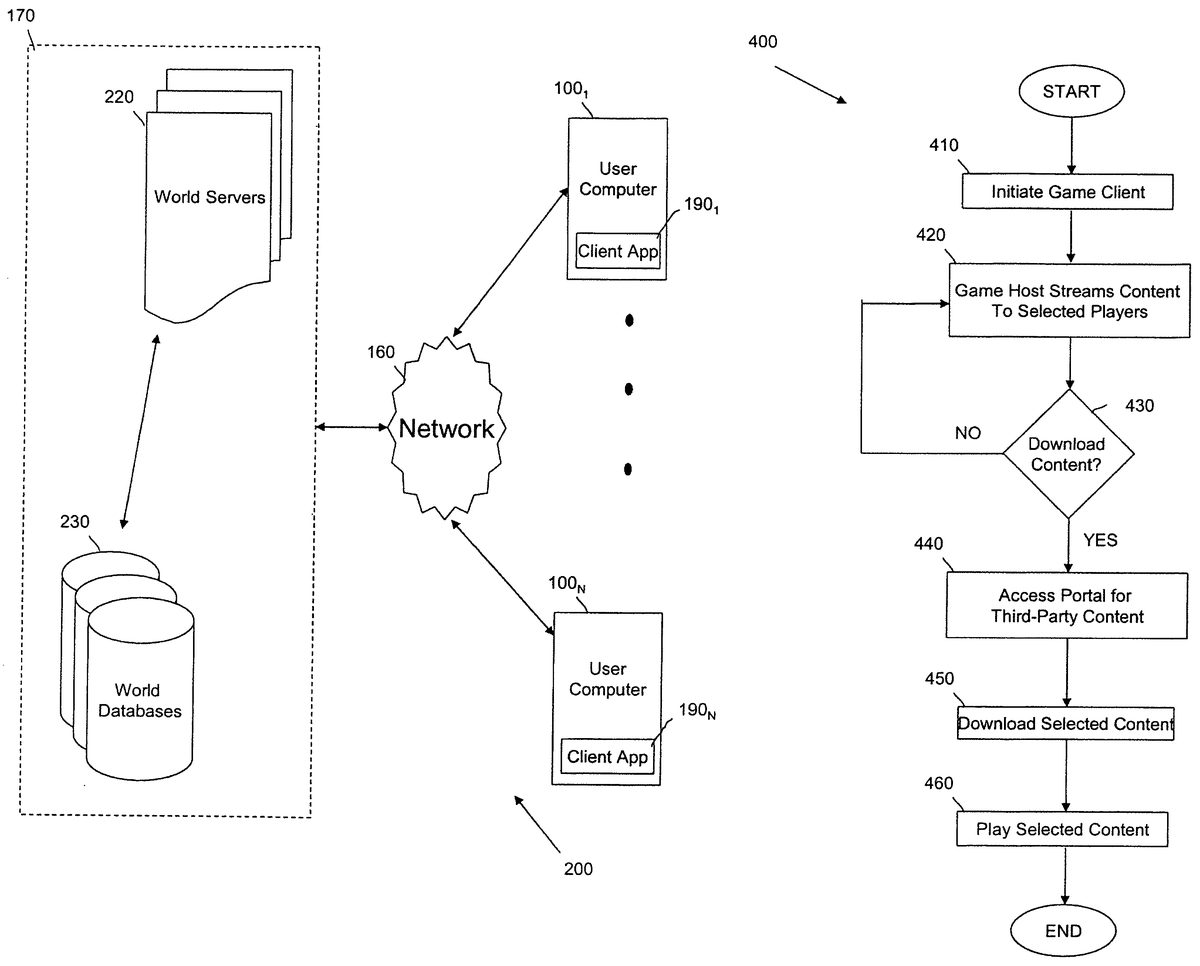
Referring now toFIG. 2, depicted is one embodiment of a client-server system200capable of implementing one or more aspects of the invention. System200includes server-side system170in communication with a plurality of user computers2101-210N(“210”) via network160, as previously described. Server-side system170includes one or more world servers220which continuously update one or more world databases230. In one embodiment, world databases230contain data which can be used to represent the current version of the entire VWE or world.
As previously mentioned, in one embodiment each of the user computers210may each execute a client application1901-190Nthat are usable to access the world servers220and the VWE's they maintain. In addition, each of the user computers may maintain a local database which includes a subset of the information contained in a corresponding world database230. While in one embodiment each of the world servers220may individually be used to serve a VWE, in another embodiment a network of distributed servers may be used to administer the VWE and corresponding world database230.
World servers220may be used to download the client applications190and/or a portion of the VWE's world database230to a large number of individual user computers210. User manipulations of the VWE (e.g., adding, deleting, or moving objects within the VWE) may be handled automatically by the world server220to which the user computer's client application190is connected.
Referring now to FIG.3., depicted is one embodiment of a process300for accessing music content for personalizing the in-game listening experience. While it should be understood that process300may equally be applicable to any type of a VWE other than an online gaming environment, for simplicity the following description is provided in terms of online gaming and personalizing audio content while in-game.
Process300begins at block310where the game and/or gaming client (e.g., client app190) is initiated. It should be appreciated that this may involve varying sign-in and/or game client execution operations. Regardless of the method by which the player enters the online gaming environment, once complete, process300will then continue to block320where a determination is made as to whether the player desires to access available online music content. In one embodiment, this determination involves a player selection of a button, icon, keystroke, etc. while in-game.
Once the player has indicated a desire to download available online music content, process300may continue to block330where a third-party portal may be accessed. In one embodiment, the third-party portal is a web site of a music content provider. It should be appreciated that the third-party portal may be accessible separate from the gaming interface or through a network connection, such that the player remains in-game at all times during the process300. In another embodiment, the third-party portal is accessed using a web browser.
Once at the third-party portal, the player may browse and select from the available music titles. Process300may then continue to block340where the selected content is downloaded by the player. In one embodiment, there may be a fee associated with downloading the content. In another embodiment, rather than downloading the content, the content may be streamed to the player's computer from one of the third-party's servers.
At this point, process300moves to block350where the selected music content (whether downloaded or streamed) is played while the player continues with in-game activities. In one embodiment, the selected music content is incorporated into the gaming experience by replaces the previously played generic background music.
FIG. 4is another embodiment of a process400for how a game host for accessing music content for customizing the in-game listening experience. In this embodiment, process400begins at block410with players entering the game environment, which in one embodiment involves loading a gaming client (e.g., client app190) and entering access information (e.g., username, password, etc.). Once in-game, the game host may desire to stream customized music content to selected in-game players (block420). This content may be representative of the current gaming scenario for the selected players, or may be selected based on any number of other criteria. As the players continue their gaming experience, while listening to the personalized music content provided by the game host, at block430the players may be provided with the opportunity to download the music content while still in-game.
If a player has indicated that they would like to download some or all of the music content being streamed to them by the game host, process400will continue to block440where the player may be able to access a third-party music content portal. In one embodiment, this portal may be a website from which music content may be downloaded, whether for a fee or otherwise. In one embodiment, a user account is accessed prior to being able to download music content, while in another embodiment, the player is able to directly access a sub-page of the music content portal. In any event, once the third-party content portal has been accessed the player may download the selected music content while still in-game at block450. The downloaded selected content may then be played by the user at block460. As with previously described process300, it should be appreciated that process400may be equally applicable to any type of a VWE.
FIGS. 5A-5Bdescribe a process for how streamed content may be marked from within a VWE, such as an online RPG. In one embodiment, an online gamer may use process500to “mark” tracks when selecting to have particular audio streamed to them while in-game, as previously described with reference toFIGS. 3 and 4.
Referring now toFIG. 5A, process500begins at block510with the user entering the VWE (e.g., player entering a game environment), which in one embodiment involves loading a client application on the user's computer system and entering access information. Once the user has entered the VWE, the host (e.g., game host) may desire to stream customized/personalized music content to online users at block520. As the users continue their VWE experience, while listening to the customized music content provided by the VWE host, a determination may be made at block530as to whether the user will be provided with the opportunity to select different music content while still in the VWE. If not, then the host's content selection will continue to be streamed to the user with process500returning to block520. If, on the other hand, the user is to be provided with the ability to customize the content stream, then process500will continue to block340where the user will begin listening to the user-selected content.
Once the user-selected content begins playing, process500will move to block550where a determination is made as to whether the user has indicated (e.g., using a command or keystroke) that they would like to “mark” a particular track from the currently selected audio stream. If the user has marked a particular track, process500will move to block560where the relevant track information may be collected from the metadata or other stream information and put into a play list. This play list may be a locally maintained list or grouping of marked audio tracks, or may alternatively be maintained remotely (e.g., by server-side system170). In one embodiment, whenever a user is in the VWE (e.g., in-game) or when they exit the VWE, the user may be given the opportunity to review their play list and choose from among a plurality of possible actions.
Where the user has not marked a track nor indicated a desire to mark a track, process500continues to block570ofFIG. 5B. At this point, users may be given the ability to review previously marked tracks. While in one embodiment, marked tracks are presented to the user when requested, in another embodiment a marked-tracks list may be automatically presented to the user.
In the event that it is determined at block570that the user is to be presented with the marked-tracks list or play list, process500will continue to block580where the list of “marked” tracks is presented to the user. [WHAT ARE THE POSSIBLE WAYS IN WHICH THESE TRACKS MAY BE PRESENTED?]
Continuing to refer toFIG. 5B, the list of marked tracks may then be used to populate a “shopping list” that can then be sent, for example, to a merchant site (block390). In one embodiment, this may provide the user with an efficient method for listening and “marking” audio tracks while in a virtual environment for later use/purchase. Thereafter, at block595the user is free to visit the merchant site to which the “shopping list” was sent. In one embodiment, the “shopping list” is used to populate or otherwise be added to a list of items designated for purchase from the merchant site. Moreover, it should be appreciated that the user may be automatically directed to the merchant site while in the VWE, may be directed to the merchant site after exiting the VWE, or may be free to manually visit the merchant site at their convenience.
While the invention has been described in connection with various embodiments, it will be understood that the invention is capable of further modifications. This application is intended to cover any variations, uses or adaptation of the invention following, in general, the principles of the invention, and including such departures from the present disclosure as come within the known and customary practice within the art to which the invention pertains.
Claims
- A method for accessing online content during online gaming, the method comprising the steps of: providing, using a server, access to a virtual world environment;determining, using a server, whether a user of a subset of users will be provided with the opportunity to select different music content when the user inputs access information into a user's computer system while the user is in the virtual world environment;streaming, using a server, personalized content to the user of said subset of users who accesses said virtual world environment after the user is provided with the opportunity to select the different music content;allowing the user to select different music content when the user inputs access information into a user's computer system while the user is in the virtual world environment;directing, using a server, the user of said subset of users to a third-party server from which said personalized content is available for download;and enabling, using a server, the user of said subset of users to download said personalized content from multiple sources and select from different music content of said personalized content from said third-party server to the user's computer system while still in said virtual world environment, wherein said personalized content is stored locally on the user's computer system or stored by a third party on said third-party server for access by the user from the third-party server to customize the users virtual world environment experience, and wherein the selected, different music content from the personalized, downloaded content is used to replace the generic background music of the online game while the user is in game.
- The method of claim 1 , wherein providing access to the virtual world environment comprising permitting a client application executing on a user computer to access said virtual game environment over a network connection.
- The method of claim 2 , further comprising generating said virtual game environment by a server-side system that is accessible via said network connection by a plurality of users which includes said subset of users.
- The method of claim 1 , wherein streaming personalized content comprises streaming an audio file to the subset of users and streaming a different audio file to a group of users different than said subset of users.
- The method of claim 1 , wherein streaming personalized content comprises streaming a plurality of channels of audio content from which online users may select a particular channel to listen.
- The method of claim 1 , wherein said virtual world environment is an online role playing game environment.
- The method of claim 1 , further comprising receiving a request from an online user to mark a track of said personalized content.
- The method of claim 7 , further comprising: populating a list with said track, wherein said list is comprised of one or more marked tracks;and sending said list to an online merchant server from which said online user may purchase said one or more marked tracks.
- The method of claim 8 , wherein sending said list comprises automatically populating a virtual shopping cart of said online user for said online merchant server.
- The method of claim 7 , further comprising: computer readable program code to populate a list with said track, wherein said list is comprised of one or more marked tracks;and computer readable program code to send said list to an online merchant server from which said online user may purchase said one or more marked tracks.
- The method of claim 7 , wherein said computer readable program code to send said list comprises computer readable program code to automatically populate a virtual shopping cart of said online user for said online merchant server.
- A system comprising: a network;a plurality of user computers coupled to the network allowing for the plurality of users to simultaneously participate in online game play;a server in communication with said plurality of user computers over said network, wherein said server is configured to: generate a virtual world environment for access by said plurality of user computers;determine whether a user of a subset of users of said plurality of user computers will be provided with the opportunity to select different music content when the user inputs access information into a user's computer system while the user is in the virtual world environment;stream personalized content to the user of said subset of users of said plurality of user computers while the user accesses said virtual world environment after the user is provided with the opportunity to select the different music content so as to customize the user's online game play experience;allow the user to select different music content when the user inputs access information into a user's computer system while the user is in the virtual world environment;direct the user of said subset of users to a third-party server from which said personalized content is available for download;and enable the user of said subset of users to download said personalized content from multiple sources and select from different music content of said personalized content from said third-party server to the user's computer system while still in said virtual world environment, wherein the personalized content is stored on the user's computer system or stored by a third party on said third-party server for later access by the user to customize the users virtual world environment experience while the user is still in said virtual world environment, and wherein the selected, different music content from the personalized, downloaded content is used to replace the generic background music of the online game while the user is in game.
- The system of claim 12 , wherein said plurality of user computers is to access said virtual world environment over said network by executing a client application.
- The system of claim 12 , wherein said server is to stream an audio file to the subset of plurality of user computer and to stream a different audio file to a second subset of said plurality of user computer.
- The system of claim 12 , wherein said server is to further stream a plurality of channels of audio content from which online users may select a particular channel to listen.
- The system of claim 12 , wherein said virtual world environment is an online role playing game environment.
- The system of claim 12 , wherein said server is to further receive a request from an online user to mark a track of said personalized content.
- The system of claim 17 , wherein said server is further to, populate a list with said track, wherein said list is comprised of one or more marked tracks, and send said list to an online merchant server from which said online user may purchase said one or more marked tracks.
- The system of claim 18 , wherein said list is used to automatically populate a virtual shopping cart of said online user for said online merchant server.
Disclaimer: Data collected from the USPTO and may be malformed, incomplete, and/or otherwise inaccurate.