U.S. Pat. No. 7,695,368
GAME PROGRAM, GAME DEVICE, AND GAME METHOD
AssigneeKonami
Issue DateMarch 14, 2007
U.S. Patent No. 7,695,368: Game program, game device, and game method

Summary:
The ‘368 patent describes a method for playing a baseball game on a hand-held game system where the player has control over the swing of the character. The player can rotate their character to produce a swing and, if the timing is right, to produce a hit on the ball. The speed of the bat is determined by the rotational speed the player inputs into the character.
Abstract:
With a game implemented by the present game program, a touch panel type of monitor will be used, and a bat character displayed on the touch panel type of monitor will be rotated by a command means from a first position to a second position while the command means is in contact with the bat character. Then, the bat character will be rotated in reverse from the second position to the first position based upon the characteristics set in the bat character in response to the amount of rotation.
Illustrative Claim:
1. A computer readable medium storing a game program for causing a computer to implement a game in which a rotatable bat character is displayed on a touch panel type of monitor, comprising: code for allowing control unit to recognize a first coordinate of input means which is placed into contact with the monitor, and allowing the control unit to recognize a position of the bat character as a frist position in case that the control unit identifies the first coordinate with at least any one of coordinates in the bat character; code for allowing the control unit to recognize a second coordinate of the input means after movement when the input means has moved in contact with the monitor, displaying the bat character, which is rotated from the first coordinate to the second coordinate around a coordinate of a predetermined point, on the monitor, and allowing the control unit to recognize a position of the bat character after rotation as a second position; code for allowing the control unit to calculate rotation between the first position and the second position when the bat character has rotated from the first coordinate to the second coordinate and allowing the control unit to set the rotational speed of the bat character in response to the amount of the rotation; code for allowing the control unit to issue command to rotate the bat character in reverse from the second position to the first position based upon the rotational speed set in the bat character when the recognition of the second coordinate has stopped; and code for displaying the reverse rotation state of the character on the monitor when the command is issued by the control unit.
Illustrative Figure
Abstract
With a game implemented by the present game program, a touch panel type of monitor will be used, and a bat character displayed on the touch panel type of monitor will be rotated by a command means from a first position to a second position while the command means is in contact with the bat character. Then, the bat character will be rotated in reverse from the second position to the first position based upon the characteristics set in the bat character in response to the amount of rotation.
Description
DETAILED DESCRIPTION OF THE PREFERRED EMBODIMENTS Selected embodiments of the present invention will now be explained with reference to the drawings. It will be apparent to those skilled in the art from this disclosure that the following descriptions of the embodiments of the present invention are provided for illustration only and not for the purpose of limiting the invention as defined by the appended claims and their equivalents. Construction of the Game Device FIG. 1is an external view of a portable game unit (an example of a computer) that can use a game program according to the present invention. In addition,FIG. 2is one example of a control block diagram of the portable game unit. As shown inFIG. 1, the portable game unit1primarily has a main case2, a liquid crystal monitor unit3, an input unit4, a cartridge mounting unit5, and a communication unit (not shown in the drawings). The main case2has an upper case2aand a lower case2b. The upper case2aand the lower case2bare connected to each other such that they can be opened and closed. The liquid crystal monitor unit3comprises an upper liquid crystal monitor3aprovided in the upper case2a, and a lower liquid crystal monitor3bprovided in the lower case2b. Here, for example, the upper liquid crystal monitor3ais a non-touch panel type monitor, and the lower liquid crystal monitor3bis a touch panel type monitor. The non-touch panel type monitor is comprised of a liquid crystal panel, and the touch panel type monitor is comprised of a liquid crystal panel and a touch panel. On the touch panel type monitor, the display surface of the liquid crystal panel and the data input surface of the touch panel are laminated together so as to be integral with each other. The input unit4comprises a cross-shaped directional command button4athat is arranged on the central portion of ...
DETAILED DESCRIPTION OF THE PREFERRED EMBODIMENTS
Selected embodiments of the present invention will now be explained with reference to the drawings. It will be apparent to those skilled in the art from this disclosure that the following descriptions of the embodiments of the present invention are provided for illustration only and not for the purpose of limiting the invention as defined by the appended claims and their equivalents.
Construction of the Game Device
FIG. 1is an external view of a portable game unit (an example of a computer) that can use a game program according to the present invention. In addition,FIG. 2is one example of a control block diagram of the portable game unit.
As shown inFIG. 1, the portable game unit1primarily has a main case2, a liquid crystal monitor unit3, an input unit4, a cartridge mounting unit5, and a communication unit (not shown in the drawings). The main case2has an upper case2aand a lower case2b. The upper case2aand the lower case2bare connected to each other such that they can be opened and closed. The liquid crystal monitor unit3comprises an upper liquid crystal monitor3aprovided in the upper case2a, and a lower liquid crystal monitor3bprovided in the lower case2b. Here, for example, the upper liquid crystal monitor3ais a non-touch panel type monitor, and the lower liquid crystal monitor3bis a touch panel type monitor. The non-touch panel type monitor is comprised of a liquid crystal panel, and the touch panel type monitor is comprised of a liquid crystal panel and a touch panel. On the touch panel type monitor, the display surface of the liquid crystal panel and the data input surface of the touch panel are laminated together so as to be integral with each other. The input unit4comprises a cross-shaped directional command button4athat is arranged on the central portion of the left side of the lower case2b, a select button4band a start button4carranged from left to right on the upper portion of the left side of the lower case2b, command buttons4dthat are arranged in the central portion of the right side of the lower case2b, a power button4ethat is arranged on the upper portion of the right side of the lower case2b, and an L button4fand a R button4garranged on the left and right corners of the lower case2b. The cartridge mounting unit5is provided in the lower portion of the lower case2b. A game cartridge or the like can be mounted in the cartridge mounting unit5. The communication unit is built into the main case2, e.g., the lower case2a. A local wireless network function, internet connection via wireless LAN function, or the like are provided by the communication unit. Note that a sound volume adjustment button, an earphone jack, and the like are provided in the game unit1, but an explanation of these will be omitted.
As shown inFIG. 2, the portable game unit1has a control device10in the interior thereof. A CPU (Central Processing Unit)11which uses a microprocessor, a ROM (Read Only Memory)12as a main storage device, a RAM (Random Access Memory)13, an image processing circuit14, a sound processing circuit15, and a communication control circuit20of the control device10are connected to each other via a bus16.
The CPU11will interpret instructions from a game program, and will perform various types of data processing and control. The ROM12will store programs and the like needed for basic control of the game unit1(e.g., start-up control). The RAM13will maintain a working area for the CPU11. The image processing circuit14controls the liquid crystal monitor unit3in response to rendering commands from the CPU11, and displays predetermined images on at least one of the upper liquid crystal monitor3aand the lower liquid crystal monitor3b. In addition, a touch input detection circuit14ais included in the image processing circuit14. When a command means, e.g., a touch pen, a finger, or the like is brought into direct contact with the touch panel, coordinate date of the contact position will be supplied from the touch input detection circuit14ato the CPU11, and the contact position will be identified by the CPU11. In addition, when the command means is brought into direct contact with the touch panel at the position of a target object displayed on the liquid crystal panel, coordinate data of the target object will be supplied from the touch input detection circuit14ato the CPU11, and the target object will be identified by the CPU. The sound processing circuit15will produce analog audio signals in response to sound generation commands from the CPU11, and will output the same to a speaker22. The communication control circuit20is included in the communication unit, and is employed in order to wirelessly connect the game unit1to another game unit or the like. The communication control circuit20is connected to the CPU11via the bus16. In response to instructions from the CPU11, the communication control circuit20will control and dispatch connection signals for connecting the game unit1to the internet via a local wireless network or a wireless LAN.
An external storage device17that is separate from the control device11is connected to the bus16. For example, the external storage device17is a game cartridge that is removably mounted in the main case2, e.g., the lower case2b. A ROM18as a storage medium, and a memory19as a rewriteable user memory, are provided in the interior of the external storage device17. A game program that causes the game unit1to function as a computer, and various types of data needed in the execution of the game program, are stored in advance in the ROM18. The various types of data include various types of character image data, e.g., various types of panel image data, attribute image data, and the like. Rewriteable memory such as flash memory is used in the memory19. Saved game data or the like will be stored in the memory19in response to need. Note that the storage medium of the external storage device17is not limited to a semiconductor memory element, and various other types of storage media may be used, such as a magnetic storage medium, an optical storage medium, a magneto-optical storage medium, or the like. Note also that an interface circuit is interposed between the bus16and each element, but illustration of these will be omitted here.
With the game unit1constructed as described above, a player can play various game genres on the liquid crystal monitor unit3by loading a game program stored in the ROM18of the external storage device17, and executing the loaded game program with the CPU11. In addition, by connecting the game unit1with another game unit with a wireless network, or connecting the game unit1with another game unit via a communication cable or the like, data can be exchanged with another game unit or a competition type game can be played via the communication control circuit10.
Summary of Various Types of Processes in the Game Device
One game that can be executed in the present game unit1is a baseball game.FIG. 3is a function block diagram for explaining the processes in the present baseball game that will be primarily executed with the control device10shown inFIG. 2. This block diagram will be used to explain the functions of the game unit1that play an essential role in the present invention.
With the present game unit1, a rotatable character will be displayed on a touch panel type of monitor, e.g., the lower monitor3b. The game device1primarily comprises first position identification means50, second position identification means51, rotational characteristics setting means52, reverse rotation means53, and reverse rotation state display means54.
The first position identification means50is implemented by a function that will identify a first position of a character when the command means is placed into contact with the character. With the first position identification means50, when the command means, e.g., a touch pen, a finger, or the like, is brought into contact with the touch panel in the position of the character displayed on the liquid crystal panel, the coordinate data of the contact position of the command means will be supplied from the touch input detection circuit14ato the CPU11, and will be identified by the CPU11. If it is determined by the CPU11that the coordinate data of the contact position is included in the coordinate data of the character display area on the liquid crystal panel used as the touch panel, the position of the character at that time will be identified by the CPU11as the first position.
The second position identification means51is implemented by a function that will identify a second position when the character is rotated around a predetermined point with the command means in contact with the character. With the second position identification means51, if the command means, e.g., a touch pen, a finger, or the like, is moved on the touch panel while the command means is in contact with the touch panel in the character display area of the liquid crystal panel used for the touch panel, the CPU11that identified a change in the coordinate data of the contact position of the command means will rotate the character on the liquid crystal panel used for the touch panel based upon coordinate data that indicates a predetermined pivot position identified in advance by the CPU11. Then, the position of the character after rotation will be identified by the CPU11as the second position.
The rotational characteristics setting means52is implemented by a function that will set the characteristics of the character in response to the amount of rotation when the character is rotated from the first position to the second position. With the rotational characteristics setting means52, the amount of rotation will be calculated by the CPU11when the character identified by the CPU11was rotated from the first position to the second position. Then, the characteristics, e.g., the swing speed, etc., stored in the RAM13from the ROM18will be referenced by the CPU11, and the characteristics of the character corresponding to the calculated amount of rotation will be set to the character by the CPU11.
The reverse rotation means53is implemented by a function that will rotate the character in reverse from the second position to the first position, based upon the characteristics set in the character by the rotational characteristics setting means52. With the reverse rotation means53, command signals for causing the character to rotate in reverse from the second position to the first position, based upon the characteristics set in the character by the rotational characteristics setting means52, will be issued from the CPU11to the image processing circuit14.
The reverse rotation state display means54is implemented by a function that will display the rotational state of the character on the monitor. With the reverse rotation state display means54, the reverse rotation state of the character will be displayed on the monitor3, e.g., the lower monitor3b, by means of the image processing circuit14that received the command signals for rotating the character in reverse from the second position to the first position. More particularly, the reverse rotation state of the character will be displayed on the liquid crystal panel of the touch panel on the lower monitor3b.
Summary of the Baseball Game
Next, the specific content of the baseball game of the present embodiment will be explained.
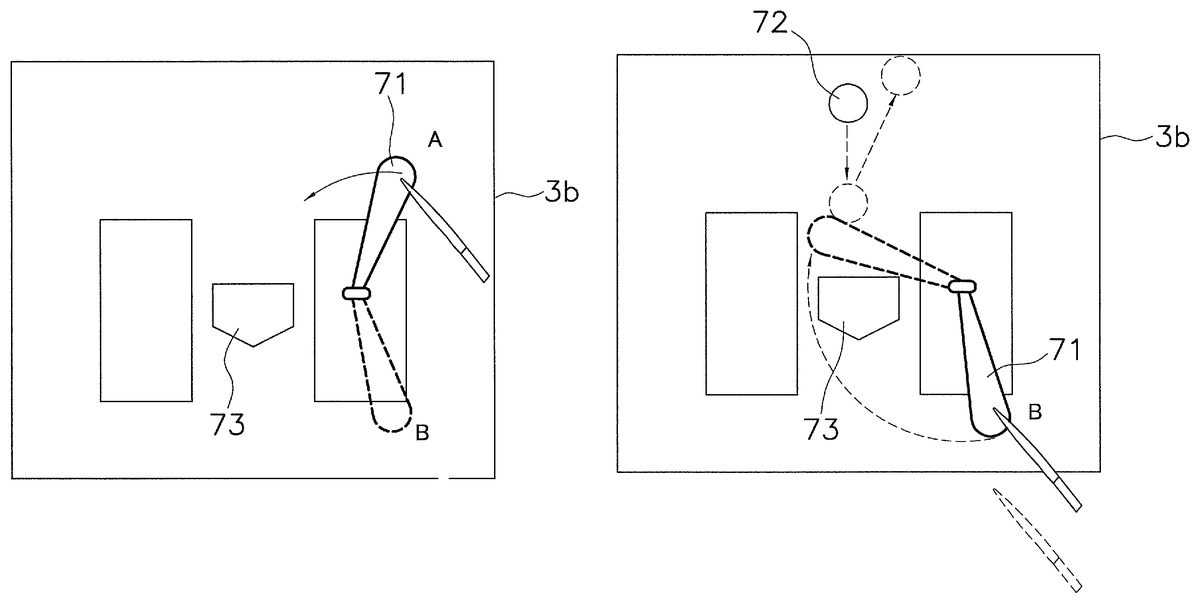
With the present baseball game, as shown inFIGS. 4 and 5, when a player is to operate the batter, fielder characters70, a bat character71, and a ball character72will be primarily displayed on the upper non-touch panel type of monitor. Then, as shown inFIGS. 6 and 7, a home base character73, the bat character71, and the ball character72will be displayed in enlarged format on the lower touch panel type of monitor. The grip portion (the first portion) of the bat character71can be rotated around a pivot point by means of the touch pen.
First, as shown inFIG. 6, the player will place the touch pen in contact with the bat character71. More specifically, the player will place the touch pen in contact with the portion (the second portion) of the bat character71that is away from the grip portion. Then, with the second portion of the bat character71in contact with the second portion, the player will move the touch pen in the counterclockwise direction, and will stop the rotational movement of the touch pen. When this occurs, the bat character71will be rotated from a first position A to a second position B, and the rotational state will be displayed on both the upper monitor and the lower monitor. At this point, the characteristics of the bat character71, e.g., the swing speed and the like, will be set in response to the amount of rotation, e.g., the rotational angle, of the bat character71. Here, the larger the rotational angle is when the bat character71is rotated in the counterclockwise direction, the faster the swing speed will be.
Next, as shown inFIG. 5, when the ball character72is dispatched from the pitcher character to the catcher character, the dispatched ball character72will be displayed on the upper monitor. As shown inFIG. 7, when the ball character72approaches the home base character73, the ball character72will be displayed on the lower monitor. When the ball character72has drawn close to the home base character73, the bat character71will rotate in the clockwise direction at the set swing speed if the player separates the touch pen from the bat character71, and the bat character71will be displayed on the lower monitor rotating in the clockwise direction.
Finally, if the bat character71can be hit by the ball character72, the ball character72will move forward from the position at which it was struck by the bat character71. At this point, the lower monitor will display the ball character72as it is moving toward the home plate character73. In addition, the upper monitor will display the ball character72moving toward the home base73, and its distance from the home base character73. For example, if the ball character72is directly caught by a fielder character70it will be an out, and if the ball character72flies between fielder characters70it will be a hit. In contrast, if the bat character71cannot hit the ball character72, the ball character72will pass over the home base character73and in the direction of the catcher character. At this point, the ball character72passing over the home base character73and in the direction of the catcher character will be displayed on both the upper monitor and the lower monitor. This state corresponds to, for example, a swing and a miss. Note that if the player does not separate the touch pen from the bat character71, the bat character71will not rotate in the clockwise direction. At this point, the ball character72passing over the home base character73and in the direction of the catcher character will be displayed on both the upper monitor and the lower monitor. This state corresponds to, for example, a batter not swinging at the ball.
Flow of each process during bat operation
The flowchart shown inFIG. 8will be used to explain the batting system in the baseball game of the present embodiment.
First, if the touch pen is placed into contact with the bat character (S1), the initial position of the bat character71will be identified as the first position (S2). Then, if the bat character71is rotated in the counterclockwise direction by the touch pen while the touch pen is in contact with the bat character71(S3), the position after rotation of the bat character71will be identified as the second position (S4). When the bat character71is rotated from the first position to the second position in this way, various characteristics, e.g., the swing speed and the like, will be set in the bat character71in response to the amount of rotation, e.g., the rotational angle, with which the bat character71was rotated (S5).
Next, if the ball character72is dispatched from the pitcher character (S6), the ball character72dispatched from the pitcher character will be displayed on the monitor as it is moving toward the home base character73(S7). Then, it will be determined whether or not the touch pen has been separated from the monitor (S8). If it is determined that the touch pen has been separated from the monitor (S8is yes), the bat character71will be rotated in the counterclockwise direction (S9), and the rotational state of the bat character71will be displayed on the monitor (S10). If it is determined that the touch pen has not been separated from the monitor (S8is no), the bat character71will be remain in the second position (S11), and the non-rotational state of the bat character71will be displayed on the monitor (S12). At this point, the ball character72passing over the home base character73and in the direction of the catcher character will be displayed on the monitor (S15).
Finally, it will be determined whether or not the ball character72has been hit by the bat character71(S13). If it is determined that the ball character72was hit by the bat character71(S13is yes), then the ball character72moving forward from the position at which the ball character72was hit by the bat character71will be displayed on the monitor (S14). If it is determined that the ball character72was not hit by the bat character71(S13is no), then the ball character72passing over the home base character73and toward the catcher character will be displayed on the monitor (S15).
Other Embodiments
(a) With the aforementioned embodiment, an example was illustrated in which the portable game unit1was used as an example of a computer that can utilize the game program, however the game device is not limited to the aforementioned embodiment, and can also utilize in the same way a game device formed separately from a monitor, a game device for commercial use that is formed integrally with a monitor, and a personal computer, a workstation, or the like that functions as a game device by executing a game program.
(b) The present invention also includes a program and method for executing the game described above, and a computer readable storage medium on which the program is stored. Other than the cartridge, examples of recording media include computer readable flexible disks, semiconductor memory, CD-ROM, DVD, MO, ROM cassettes, and the like.
(c) With the aforementioned embodiment, an example was illustrated in which the bat character will rotate in reverse in the counterclockwise direction when the command means, e.g., the touch pen, was separated from the monitor. However, the aforementioned embodiment is not limited to a command method that controls the timing at which the bat character is rotated in reverse, and the bat character may be rotated in reverse in the counterclockwise direction when a predetermined button is pushed.
INDUSTRIAL APPLICABILITY
With the present invention, a touch panel type of monitor will be used, and a character will be rotated by the command means from a first position to a second position while command means is in contact with the character displayed on the touch panel type of monitor. Then, the character will be rotated in reverse from the second position to the first position based upon the characteristics set in the character in response to the amount of rotation. In this way, a player can easily rotate a character with a command means. In addition, a player can experience the pleasure of rotating a character with the command means while taking the amount of rotation of the character into consideration.
Claims
- A computer readable medium storing a game program for causing a computer to implement a game in which a rotatable bat character is displayed on a touch panel type of monitor, comprising: code for allowing control unit to recognize a first coordinate of input means which is placed into contact with the monitor, and allowing the control unit to recognize a position of the bat character as a frist position in case that the control unit identifies the first coordinate with at least any one of coordinates in the bat character;code for allowing the control unit to recognize a second coordinate of the input means after movement when the input means has moved in contact with the monitor, displaying the bat character, which is rotated from the first coordinate to the second coordinate around a coordinate of a predetermined point, on the monitor, and allowing the control unit to recognize a position of the bat character after rotation as a second position;code for allowing the control unit to calculate rotation between the first position and the second position when the bat character has rotated from the first coordinate to the second coordinate and allowing the control unit to set the rotational speed of the bat character in response to the amount of the rotation;code for allowing the control unit to issue command to rotate the bat character in reverse from the second position to the first position based upon the rotational speed set in the bat character when the recognition of the second coordinate has stopped;and code for displaying the reverse rotation state of the character on the monitor when the command is issued by the control unit.
- A game device capable of implementing a game in which a rotatable bat character is displayed on a touch panel type of monitor, comprising: first position identification means for allowing control unit to recognize a first coordinate of input means which is placed into contact with the monitor, and allowing the control unit to recognize a position of the bat character as a frist position in case that the control unit identifies the first coordinate with at least any one of coordinates in the bat character;second position identification means for allowing the control unit to recognize a second coordinate of the input means after movement when the input means has moved in contact with the monitor, displaying the bat character, which is rotated from the first coordinate to the second coordinate around a coordinate of a predetermined point, on the monitor, and allowing the control unit to recognize a position of the bat character after rotation as a second position;rotational characteristics setting means for allowing the control unit to calculate rotation between the first position and the second position when the bat character has rotated from the first coordinate to the second coordinate and allowing the control unit to set the rotational speed of the bat character in response to the amount of the rotation;reverse rotation means for allowing the control unit to issue command to rotate the bat character in reverse from the second position to the first position based upon the rotational speed set in the bat character when the recognition of the second coordinate has stopped;and reverse rotation state display means for displaying the reverse rotation state of the character on the monitor when the command is issued by the control unit.
- A game method for implementing a game in which a rotatable bat character is displayed on a touch panel type of monitor, comprising: allowing control unit to recognize a first coordinate of input means which is placed into contact with the monitor, and allowing the control unit to recognize a position of the bat character as a frist position in case that the control unit identifies the first coordinate with at least any one of coordinates in the bat character;allowing the control unit to recognize a second coordinate of the input means after movement when the input means has moved in contact with the monitor, displaying the bat character, which is rotated from the first coordinate to the second coordinate around a coordinate of a predetermined point, on the monitor, and allowing the control unit to recognize a position of the bat character after rotation as a second position;allowing the control unit to calculate rotation between the first position and the second position when the bat character has rotated from the first coordinate to the second coordinate and allowing the control unit to set the rotational speed of the bat character in response to the amount of the rotation;allowing the control unit to issue command to rotate the bat character in reverse from the second position to the first position based upon the rotational speed set in the bat character when the recognition of the second coordinate has stopped;and displaying the reverse rotation state of the character on the monitor when the command is issued by the control unit.
Disclaimer: Data collected from the USPTO and may be malformed, incomplete, and/or otherwise inaccurate.