DETAILED DESCRIPTION OF THE INVENTION Referring to the Figures, wherein like numerals indicate corresponding parts throughout the several views, a patron tracking system is shown generally at10. Referring specifically toFIG. 1, the system10includes an image capture device12for capturing an image associated with a person, e.g., a patron, a player, technician, or other employee. The image can be a portrait or other picture or image of a person, or image of an identification instrument, such as a driver's license, passport, retina, or digitized thumbprint. The image capture device12can be any device capable of taking a photograph, or preferably, a digital photograph. Such image capture devices12include a camera, or a remote device such as a cellular phone or a personal digital assistant (PDA) equipped with a camera. Next, the system10has a text input device14in communication with the image capture device12for creating a text description of the image. The text input device14connects to the image capture device12peripherally, such as a keyboard that plugs into the image capture device12or alternatively, the text input device14is integral with the image capture device12. For example, the text input device14may be a keypad that exists on the cellular phone or the PDA. The text description created by the text input device14can be any textual representation that helps identify the image at a later time. Examples of the text description include the patron's name, a description of the patron's physical appearance, an account number associated with the patron, or any other patron identifier that is used to link the patron to the image. The image capture device12operates a communication software program16that combines the image and the text description into an electronic communication such as an e-mail. In the case of e-mail, the image and the text description are placed in a body of the email, or alternatively, the text ...
DETAILED DESCRIPTION OF THE INVENTION
Referring to the Figures, wherein like numerals indicate corresponding parts throughout the several views, a patron tracking system is shown generally at10. Referring specifically toFIG. 1, the system10includes an image capture device12for capturing an image associated with a person, e.g., a patron, a player, technician, or other employee. The image can be a portrait or other picture or image of a person, or image of an identification instrument, such as a driver's license, passport, retina, or digitized thumbprint.
The image capture device12can be any device capable of taking a photograph, or preferably, a digital photograph. Such image capture devices12include a camera, or a remote device such as a cellular phone or a personal digital assistant (PDA) equipped with a camera.
Next, the system10has a text input device14in communication with the image capture device12for creating a text description of the image. The text input device14connects to the image capture device12peripherally, such as a keyboard that plugs into the image capture device12or alternatively, the text input device14is integral with the image capture device12. For example, the text input device14may be a keypad that exists on the cellular phone or the PDA. The text description created by the text input device14can be any textual representation that helps identify the image at a later time. Examples of the text description include the patron's name, a description of the patron's physical appearance, an account number associated with the patron, or any other patron identifier that is used to link the patron to the image.
The image capture device12operates a communication software program16that combines the image and the text description into an electronic communication such as an e-mail. In the case of e-mail, the image and the text description are placed in a body of the email, or alternatively, the text description is placed in a subject line of the e-mail. In addition, the communication software program16designates an address in which to send the electronic communication. The image capture device12includes a transmitter to wirelessly transmit the electronic communication. Alternatively, the image capture device12connects to a docking station that is in communication with a wired network.
The electronic communication is transmitted via wireless communication or through the wired network to a database18located at the address designated by the communication software program16. A receiver20is in communication with the database18and is used to receive the image and the text description from the image capture device12. The receiver20employs wireless communication as shown inFIG. 1or alternatively the receiver20connects to the image capture device12through the wired network.
The database18stores a plurality of known images and known text descriptions22that represent each existing patron in a group of existing patrons. A comparator24receives the image and the text description from the receiver20and analyzes at least one of the image and the text description to determine whether the patron is one of the existing patrons. An image filer26receives the image from the comparator24and files the image in the database18at a file location depending on the output of the comparator24. If the image or the text description corresponds to one of the existing patrons, then the image filer26stores the image in a patron folder28that relates to the existing patron on the database18. If the image or the text description fails to correspond to one of the existing patrons, then the image filer26stores the image in a temporary folder30on the database18. The temporary folder30holds the image until the patron is identified. After the patron has been identified, a transfer software program32is used by the database18to move the image from the temporary folder30to the patron folder28corresponding with the patron. Alternatively, the temporary folder30is renamed to match the text description of the image to the new patron.
The system10as described is used in various industries. For example, the patron tracking system10may be used in a gaming environment34. In the gaming environment34, a gaming station36is in communication with the database18. The gaming environment34is known by those in the art to include but is not limited to casinos or other locations where gaming occurs. The gaming station36is known by those in the art to include but is not limited to gaming tables for blackjack, craps, roulette, poker, and the like, or stand-alone machines such as a slot machine or an electronic card-playing machine. The gaming station36operates an activity accumulator38that collects activity data about the patron. The activity data includes how much the patron has wagered, the amount of time the patron spent at the gaming station36, and other information relating to the patron's gaming activity. The activity data is transmitted to the database18via wireless communication or through the wired network as depicted inFIG. 1. After being transmitted to the database18, the activity data is stored in the patron folder28along with the image.
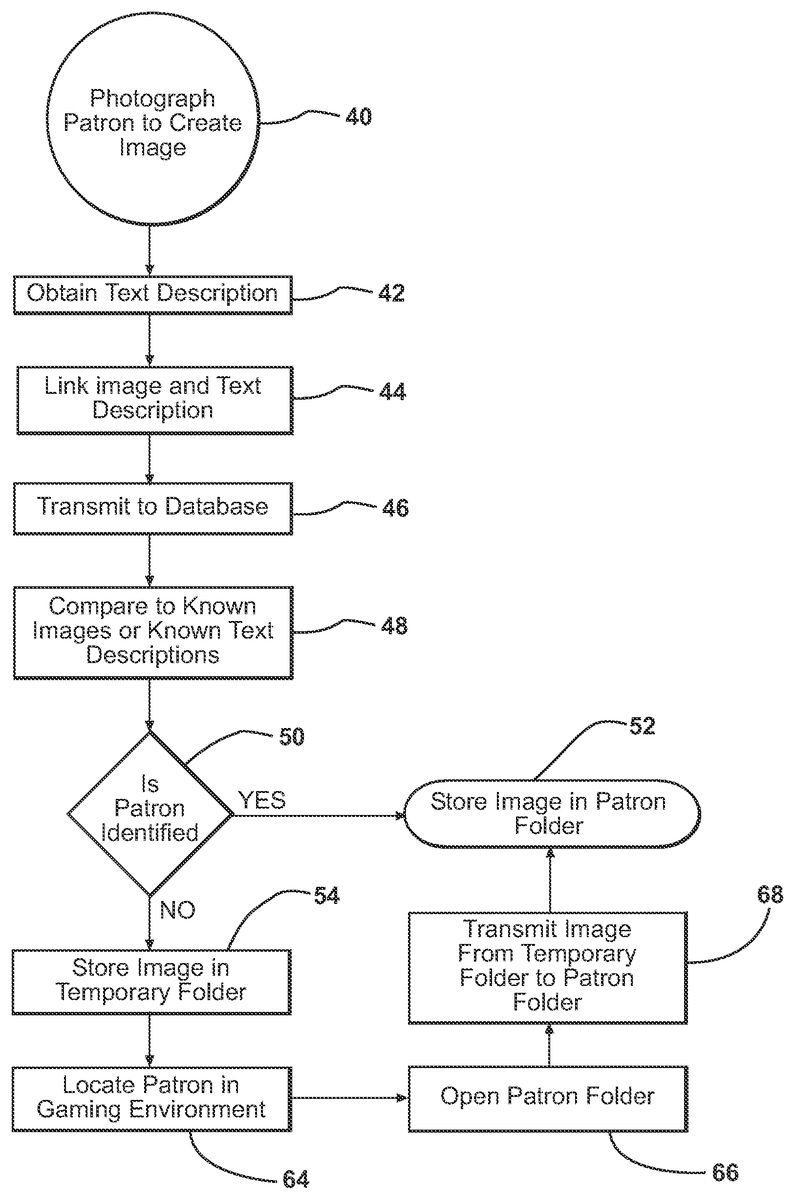
Referring now toFIG. 2, the subject invention also provides for a method of tracking the patron in the gaming environment34to distinguish between existing patrons and new patrons and to track their gaming activities. The method includes a first step40of photographing the patron with the image capture device12to create the image. The patron is photographed remotely within the gaming environment34as previously described using the image capture device12such as the cellular phone or PDA equipped with the camera. Next, in step42, the text description of the patron is obtained using the text input device14. Once the text description has been obtained, the image and the text description are linked together into the electronic communication in step44. When linked, the image and the text description are compiled into the electronic communication and transmitted to the database18using any known transfer protocol in step46.
Once received by the database18, the method further includes a step48of comparing the image or the text description to the plurality of known images and known text descriptions22stored in the database18to determine if the patron is in the group of existing patrons as shown in step50. Then, in steps52and54the image is stored in the patron folder28or the temporary folder30after the image is compared to known images or the text description is compared to known text descriptions to determine whether the image or text description correspond to one of the existing patrons. If the image or the text description corresponds to one of the existing patrons, the image is stored in the patron folder28that corresponds with the existing patron as shown in step52. In one embodiment, as depicted inFIG. 3, the known image corresponding to the existing patron may be overwritten and replaced in the patron folder28with the image as shown in steps56and58. Alternatively, the image is deleted if the known image corresponding to the existing patron is favored over the image as shown in step60. In another embodiment, as depicted inFIG. 4, the known image of the existing patron is favored over the image, so the image is deleted from the database18as soon as the patron is identified as shown in step62. Therefore, if the patron folder28already includes the known image of the existing patron, the image may replace the known image, or both the image and the known image may be stored in the patron folder28. Alternatively, the image may be discarded in favor of the known image so the only image remaining in the patron folder28is the known image. In each embodiment, if the image or text description fails to correspond with one of the existing patrons, the image is deemed to be of a new patron and is stored in the temporary folder30.
Various techniques may be employed to determine whether the image or the text description correspond to one of the existing patrons such as facial recognition techniques to match the image to the plurality of known images. Alternatively, the text description is read from the electronic communication and compared to the known text descriptions stored on the database18. The known text descriptions include any text associated with the patron or the image. For example, if the patron folder28is named after the patron, the known text description is the patron's name, and the text description provided by the text input device14is the name of the patron photographed. By matching the text description to the known text descriptions, the image is placed in the patron folder28having the same name as the patron. It should be understood that the text description could include any other patron identifier besides the patron's name. Also, it should be understood that the patron may be identified using either or both of the techniques described above.
It is advantageous to have the new patron open an account so the method further includes a step64of locating the new patron in the gaming environment34. The new patron is located by determining where inside the gaming environment34the image was captured, or by sending an employee to find the new patron within the gaming environment34using the image of the new patron. Once located, as shown in step66, the patron folder28that corresponds to the new patron is opened in the database18. Then, in step68the image is transferred from the temporary folder30to the patron folder28of the new patron. Activity data collected by the activity accumulator38at the gaming station36stored in the temporary folder30is transferred from the temporary folder30to the patron folder28as well.
Obviously, many modifications and variations of the present invention are possible in light of the above teachings. For example, multiple databases18may be used to store the image and the text description, and any type of image capture device12may be used to capture the image and generate the text description of the image. The invention may be practiced otherwise than as specifically described within the scope of the appended claims.