U.S. Pat. No. 7,686,682
VIDEO GAME FOR TAGGING PHOTOS
AssigneeFuji Xerox Co., Ltd.
Issue DateJanuary 10, 2007
Illustrative Figure
Abstract
A multi-player solitaire or multi-player video game that generates tags for digital images. A tabletop or computer screen video game provides an enjoyable way for collocated players to view, share, talk about and, in the process tag photos. The video games can generate valuable text labels for photos with multiple levels of specificity and named entities. These labels can be used to help manage and index collections of photos for browsing and retrieval.
Description
DETAILED DESCRIPTION FIG. 1depicts an embodiment of the invention implemented as a tabletop system, such as conventional arcade table-top game systems or the m Table of FXPAL described in Implicit Brushing and Target Snapping: Data Exploration and Sense-making on Large Displays, Xiaohua Sun et al., AVI 2006, pp 258-261, which is incorporated herein by reference in its entirety. The embodiment ofFIG. 1is designed for four players; however, other implementations can be made for different number of players. Each player has its own playing area designated by a playing screen100a-100d. At each round of the game, a different, randomly selected picture105a-105dis displayed in each of the playing screens100a-100d. In order for each player to have a good view of each photo during a game round, the four photos rotate around the center of the table every given period, for example, 15 seconds. An area110a-110din each screen100a-100dis designated as a word tag and displays words that the respective player has created and attached to an image (described in more details below). The center of the tabletop displays the letter tray115. The letter tray displays letter tiles120which are selected randomly for each round. While in this embodiment the letter tray has 7×7 letter tiles, other arrangements may also be used. As exemplified in this embodiment, about a quarter of the letter tiles face each player randomly, so as to even the difficulty of reading the tiles. Also, in this embodiment at each round the letters are selected randomly, but at each round a number of letters of the alphabet are missing. That is, in this embodiment the letter tray never includes all of the letters of the alphabet, so as not to make it basically a keyboard. As shown inFIG. 1, in this embodiment some letters may be repeated. Each player has a ...
DETAILED DESCRIPTION
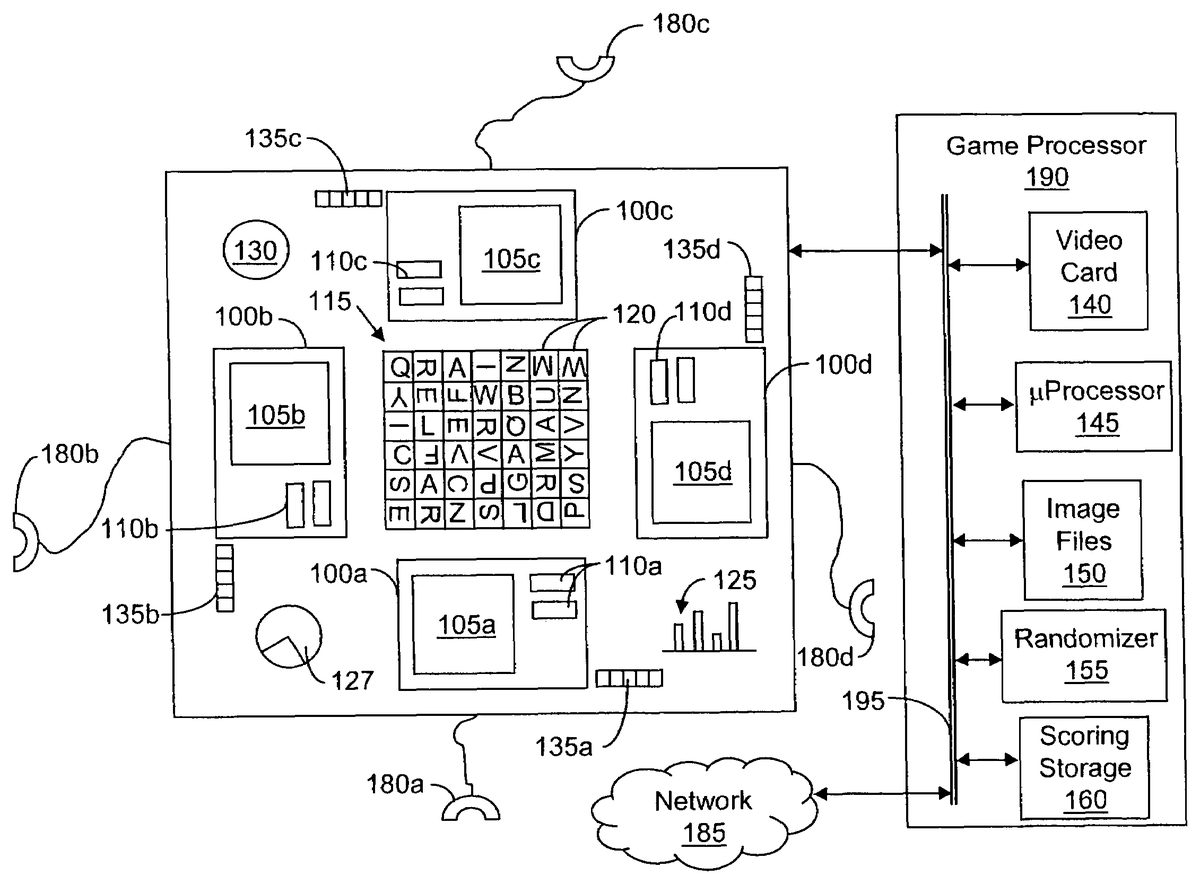
FIG. 1depicts an embodiment of the invention implemented as a tabletop system, such as conventional arcade table-top game systems or the m Table of FXPAL described in Implicit Brushing and Target Snapping: Data Exploration and Sense-making on Large Displays, Xiaohua Sun et al., AVI 2006, pp 258-261, which is incorporated herein by reference in its entirety. The embodiment ofFIG. 1is designed for four players; however, other implementations can be made for different number of players. Each player has its own playing area designated by a playing screen100a-100d. At each round of the game, a different, randomly selected picture105a-105dis displayed in each of the playing screens100a-100d. In order for each player to have a good view of each photo during a game round, the four photos rotate around the center of the table every given period, for example, 15 seconds. An area110a-110din each screen100a-100dis designated as a word tag and displays words that the respective player has created and attached to an image (described in more details below).
The center of the tabletop displays the letter tray115. The letter tray displays letter tiles120which are selected randomly for each round. While in this embodiment the letter tray has 7×7 letter tiles, other arrangements may also be used. As exemplified in this embodiment, about a quarter of the letter tiles face each player randomly, so as to even the difficulty of reading the tiles. Also, in this embodiment at each round the letters are selected randomly, but at each round a number of letters of the alphabet are missing. That is, in this embodiment the letter tray never includes all of the letters of the alphabet, so as not to make it basically a keyboard. As shown inFIG. 1, in this embodiment some letters may be repeated. Each player has a word tray135a-135d, for compiling letter tiles that the user selects from the letter tray115to create words to be linked to images. Provisions may be made to prevent each player from seeing other players' word trays, but this is not necessary.
The tabletop also includes at least one scoring area125indicating the score of each player. Here it is shown in a bar graph format, but other formats may also be used. At least one timer127is also displayed, here it is shown in a pie format, but other formats may be used. Each player has a game controller180a-180d, which may be similar to or adopted from conventionally available game controllers such as Nintendo®, PlayStation®, X-Box®, etc. Additionally, at least one challenge button130is provided, which may be an actual button or just an indicator indicating that one of the players pushed the challenge button on a game controller.
The game is run by a game processor190. The game processor190may be a specifically designed machine or a specially programmed general-purpose computer, such as a PC or Mac. As shown inFIG. 1, the game processor190includes a bus195to which connected a video card140, a microprocessor145, image files storage150, a randomizer155, and a scoring storage160. As can be understood, the video card140conditions the signals to be displayed on the tabletop screen, the microprocessor145performs the calculations necessary to run the game, the image files storage area150contains the images to be tagged. The image file150may be a storage area integral to the system, such as a hard drive, or a reader such as an optical reader or a memory card reader such as a card reader for reading memory cards such as Memory Stick® or SD memory cards. The randomizer155is used to randomly select images from the image files storage area150and to randomly select letters and randomly orient them towards different users. The scoring storage area160is used to store the score of each player. The game processor190may also be connected to a network185, such as an intranet or the Internet. In such a case, additional images may be fetched from other systems connected to the network. For example, a crawler may be provided to crawl the network and fetch images, in a manner well known in the art. The fetched images may be temporarily or permanently stored in the image files150.
The goal for each player is to build words to associate with any of four photos on the table by selecting letter tiles from the grid. Each player has a cursor and letter tray of the same color, so that each player's action can be followed by reference to the player's particular color. The cursor is navigated around tile grid115using the game pad controller180a-180d. A tile under the cursor is selected by pressing the appropriate button in the player's game controller180a-180d. Selected tiles120appear in each player's word tray135a-135d. While the design in this embodiment may have optional barriers to hide the letters from other players, testing suggests that this may not be necessary. Without barriers, even though there is nothing to prevent cheating by looking at the words others are creating; in practice players are extremely focused on the serial search task for letters in the center and rarely looked at the letter trays of others.
When a word has been formed, the player presses the “word” button on the game controller180a-180d. This puts the user into a mode for navigating and selecting a photo105a-105dto which the word will be attached, i.e., tagged. In this example, when the word is attached to a photo, the tiles used in that word are temporarily blocked and remain unavailable to the players for a short period of time (our experience is that 20 seconds is a good duration). Also, in this example tiles may not be repeated in a word so as to make the game more challenging and fun than allowing repeated selection of tiles. That is, once a tile is used in a word, it cannot be used again in that word.
Words attached or tagged to photos remain hidden until the end of a round (e.g., 2.5 minutes) at which time each word is revealed and evaluated collaboratively by the group. If more than one person attaches the same word to the same photo, it is cancelled out and neither player earns points for the word. Words that are cancelled due to duplication are kept as tags to the photos. In fact, their validity as tags is strengthened since these words are used by more than one person to describe the photo. Therefore, according to one embodiment such tags receive higher weight as being validated.
Each player reads off the words they came up with for each photo and if there is consensus in the group that it is a relevant word for the photo, the word earns the player points. The value of the word depends on the value of the individual letters like in Scrabble. Alternatively, a word can be scored by its length like in Boggle. A word can be challenged by any player if its relevance to a photo is questionable or if it is misspelled. Challenge is initiated by hitting the challenge button on the table or the controller, and this puts the game into challenge mode. Each player then inputs his/her vote on the relevance of the word. Input may be handled by “yes” and “no” vote buttons on the game controllers180a-180d. Each “yes” vote increments the relevance by 1 and each “no” vote decreases the relevance by 1. Abstention does not affect the relevance. If the word earns a positive relevance score it is validated and earns the player points. The tagged words are displayed on the word tag area110a-110dof each player. Words that are challenged are kept with their relevance score from the voting to indicate validity. This may be also handled as a form of validation that increases the weight of the tag as being validated. The winner of the game is the first player to pass a given threshold of points. In one embodiment 100 points was used for a regular game and 60 for a short game.
The particular embodiment ofFIG. 1capitalizes on the rich social interaction and group dynamics associated with traditional board games. Collocation of players allows for important interaction properties such as deixis and gesturing, one-to-many verbal communication, non-verbal communication, and mores of group play. In this embodiment these social interactions are achieved by allowing for a significant portion of the game (word relevance determination) to happen through inter-player interaction. A minimal amount of computer mediation for such things as computing scores, challenging words, tallying votes, and building words is needed.
Another aspect of the embodiment ofFIG. 1is the production of storied accounts relating to photos. By allowing players to use their own personal photos in the game, the players may use words (tags) that will trigger or induce increased sharing of stories and background about photos with other players. The desire to share personal photos may also create an additional incentive to play the game and thus generate tags.
FIG. 2is a flow diagram of the general processing performed by the game processor190according to an embodiment implemented for the example ofFIG. 1. The same processing may be performed by the other embodiments described below. InFIG. 2, the game starts at step200, and an image collection is assembled in the image files storage area150at step210. At step220the scores in scoring storage160are initialized. At step230it is determined whether a new round of game is to be played. If not, it is determined whether a new game is to be played (step240). If so, the process reverts to step220to initialize the scores. If no new game is to be played, optionally the image tags are stored in step250and the game is exited in step255. Alternatively, the tags are stored at a later stage, described with respect toFIG. 3, in which case the process simply exits at step255.
On the other hand, if a new round is to be played at step230, at step260four images are randomly selected from the collection in the image files storage area150and displayed on playing screens100a-100dat105a-105d. At step270random letters are selected and displayed on the letter tray115and at step280the timer127is initialized to start the round at step290. The process of playing a round is illustrated in the flow chart ofFIG. 3. After the round is played, the process then circularly reverts to step230.
FIG. 3is a flow diagram illustrating processing performed by the game processor190for a round of game according to an embodiment implemented for the example ofFIG. 1. The round starts at step300and in step305it is determined whether a letter tile120was selected. If so, the letter tile120is placed in the player's word tray135a-135dat step310. The process proceeds to step315(from either step305or step310), wherein it is determined whether a word was formed. If so, the word is linked to an image105a-105din step320and a tag is created in step325. The letters that were selected to form the word are then temporarily disabled in step327and the process proceeds to step330. At step330the timer is interrogated to determine whether the time period for image rotation has been reached. If so, the images105a-105dare rotated in step335and the process proceeds to step340. By rotating the image it is meant, for example, that the image displayed at105awill be displayed at105b, the image displayed at105bwill be displayed at105c, etc. In step340the timer is interrogated to determine whether the time for ending the round has been reached. If so, scoring of the round is performed in step345and the process circularly reverts to step305. Optionally, after step345the process may proceed to Step350where the tags are saved.
FIG. 4is a flow diagram depicting the flow process for scoring according to an embodiment implemented for the example ofFIG. 1. The scoring process begins at step400and at step410repeated words are crossed out. At step420it is determined whether there are more words to score. If not, at step430the tags of the images are updated using the crossed out and the scored words and the process returns at435to step305ofFIG. 3. If there are words to score at step420the process proceeds to step440where the next word to score is highlighted on the display. At step450it is determined whether any player challenged the highlighted word. If so, the process proceeds to step460for a vote and at step470it is determined whether the results of the vote are positive. If so, the score is added to the word in step480and the process circularly reverts to step420. Similarly, if the results of the vote are not positive, the process circularly reverts to step420. When a word is approved and scored, the word is added to the word tag area110a-110dof the respective player.
FIG. 5depicts an embodiment wherein the invention is implemented in the form of multi-players using remotely located stations, such as, e.g., personal computers500a-500n. In the example ofFIG. 5only three computers500are shown, however, the number of computers and the numbers of players can be changed. As shown inFIG. 5, the computers500a-500nare interconnected via a networks520, such as an intranet or the Internet. Additionally, other computing resources may be connected, such as server530and database540. Using this arrangement, the inventive game may be implemented in various manners. For example, the entire game may be run on each computer500a-500nseparately and using the computing resources of each independent computer. On the other hand, the game may be run on server530, while each of computers500a-500nmay run just a client, such as a Java applet. Similarly, the images to be tagged may reside on computers500a-500n, on server530, and or on database540. The processing may be implemented according to the embodiments ofFIGS. 2-4, as explained above.
As shown inFIG. 5, each computer500a-500nincludes a monitor505a-505ndisplaying the game. The format displayed on screen505a-505nmay be similar to that shown inFIG. 1. Alternatively, or selectively, the display on the screen may include only parts of the game relevant to the particular user, while other information is hidden from that user. This is illustrated in the screen of computer500ninFIG. 5. Notably, the image to be labeled by the user is shown at510, while the other images are hidden from this user, but shown at the screens of each other respective user. In the embodiment ofFIG. 1the images were rotated on the same display, while in this example the images are “rotated” among the computers, i.e., each computer displays only a single images, which is changed every given period of time by an image that is displayed on a different computer. Other information is displayed at each screen, such the score511, timer512, challenge513, and letter tiles514. In this embodiment the challenge button need not be an active button, but rather just an indicator to indicate that someone has pressed a challenge button. Alternatively, the challenge button may be an icon that can be activated by a click on a mouse. The game may be controlled using conventional computing input devices, such as keyboard, mouse, trackball, etc. Alternatively, or on addition, specialized gamming input devices may be used, such as joysticks, etc.
As can be understood from the embodiment ofFIG. 5, according to another embodiment the game may be played as a solitary game. In that embodiment the screen may display the game in the format such as shown in screen505a, or such as shown in screen505n. In this embodiment a word speller may be used to invoke a computer generated challenge to selected words when the spelling of the word differs from the speller's spelling. Otherwise, i.e., if no challenge was invoked, the user's selection is accepted. Of course, the spell checker feature may also be used in the other embodiments, either to invoke a challenge or to assist in voting after a challenge was invoked.
The present invention has been described in relation to particular examples, which are intended in all respects to be illustrative rather than restrictive. Those skilled in the art will appreciate that many different combinations of hardware, software, and firmware will be suitable for practicing the present invention. Moreover, other implementations of the invention will be apparent to those skilled in the art from consideration of the specification and practice of the invention disclosed herein. Various aspects and/or components of the described embodiments may be used singly or in any combination. It is intended that the specification and examples be considered as exemplary only, with a true scope and spirit of the invention being indicated by the following claims.
Claims
- A computer game for tagging stored digital images, comprising: a randomizer for selecting: m images of the stored digital images, to be used in a game round, m being an integer larger than zero;and x letters of the alphabet, to be used in the game round, x being an integer larger than zero;an image display for simultaneously displaying n images out of m images, n being an integer larger than zero, wherein said image display comprises a screen having n image display areas defined thereupon and wherein n=m and each of the n images is displayed on one of the display areas;a letter tray for displaying a plurality of letter tiles, each letter tile representing one of the x letters;a highlighter for selectively highlighting one of the letter tiles according to a user pointer;a word tray enabling a user to construct words by selecting letter tiles from the letter tray;a tag generator generating tags linking words constructed in the word tray to corresponding images of the n images;and a timer counting a time period T 1 , wherein after each period T 1 each of the n images is displayed on a different one of the display areas.
- The computer game of claim 1 , wherein n=
- The computer game of claim 2 , further comprising a timer counting a time period T 1 , wherein after each period T 1 a different image of the n images is displayed on the display.
- The computer game of claim 1 , wherein the x letters include duplicate letters but does not include all of the alphabet letters.
- The computer game of claim 1 , wherein the x letter tiles are divided to n groups of randomly selected letter tiles, and wherein the letter tiles of each of the n groups are oriented towards a corresponding one of the display areas.
- The computer game of claim 5 , wherein said timer counts a second time period T 2 , and wherein after each time period T 2 the letter tiles of each group are oriented towards different one of the display areas.
- The computer game of claim 1 , further comprising a timer counting a time period T 3 , wherein each time period T 3 designates a game round, and wherein the tag generator generates the tags only at the end of each time period T 3 .
- The computer game of claim 7 , further comprising a challenge indicator, enabling challenge of words constructed in the word tray.
- The computer game of claim 8 , wherein the challenge indicator is activated by a user, and wherein when a challenge is activated, a voting mechanism is initiated, enabling users to vote on the appropriateness of a challenged word, wherein if the vote is positive, said tag generator generates a tag and if the vote is negative the tag generator does not generate a tag.
- The computer game of claim 8 , further comprising a spell checker, wherein the spell checker verifies each word constructed in the word tray and when a word cannot be confirmed by the spell checker, the challenge indicator initiates a challenge to challenge the word.
- A computer game for tagging stored digital images, comprising: a randomizer for selecting: m images of the stored digital images, to be used in a game round, m being an integer larger than zero;and x letters of the alphabet, to be used in the game round, x being an integer larger than zero;an image display for simultaneously displaying n images out of m images, n being an integer larger than zero, wherein said display comprises n screens and wherein n=m and each of the n images is displayed on one of the screens;a letter tray for displaying a plurality of letter tiles, each letter tile representing one of the x letters;a highlighter for selectively highlighting one of the letter tiles according to a user pointer;a word tray enabling a user to construct words by selecting letter tiles from the letter tray;a tag generator generating tags linking words constructed in the word tray to corresponding images of the n images;and a timer counting a time period T 1 , wherein after each period T 1 each of then images is displayed on a different one of the screens.
- The computer game of claim 11 , wherein the x letter tiles are divided to n groups of randomly selected letter tiles, and wherein the letter tiles of each of the n groups are oriented towards a corresponding one of the screens.
- The computer game of claim 12 , wherein said timer counts a second time period T 2 , and wherein after each time period T 2 the letter tiles of each group are oriented towards different one of the screens.
- The computer game of claim 11 , wherein n=
- The computer game of claim 14 , further comprising a timer counting a time period T 1 , wherein after each period T 1 a different image of the n images is displayed on the display.
- The computer game of claim 11 , wherein the x letters include duplicate letters but does not include all of the alphabet letters.
- The computer game of claim 11 , further comprising a timer counting a time period T 3 , wherein each time period T 3 designates a game round, and wherein the tag generator generates the tags only at the end of each time period T 3 .
- The computer game of claim 17 , further comprising a challenge indicator, enabling challenge of words constructed in the word tray.
- The computer game of claim 18 , wherein the challenge indicator is activated by a user, and wherein when a challenge is activated, a voting mechanism is initiated, enabling users to vote on the appropriateness of a challenged word, wherein if the vote is positive, said tag generator generates a tag and if the vote is negative the tag generator does not generate a tag.
- The computer game of claim 18 , further comprising a spell checker, wherein the spell checker verifies each word constructed in the word tray and when a word cannot be confirmed by the spell checker, the challenge indicator initiates a challenge to challenge the word.
- A method for generating tags for digital images, comprising: for each game round performing the following steps: a. selecting m images of the digital images and displaying the m images on m display areas, wherein m is equal to the numbers of users playing the game round;b. selecting n number of letters of the alphabet, and displaying each of the n letters as a letter tile in a display area defined as a letter tray;c. enabling users to select letter tiles and, when a user selects a letter tile, displaying the letter tile in a user's display area defined as word tray;d. when sufficient letter tiles have been displayed in a word tray to form a word, enabling the user to select one of the m image;e. creating a tag associating the word with the selected image and storing the tag in a storage area so as to enable searching and browsing of the digital images using the tag;and f. counting time periods T 1 and at each end of time period T 1 exchanging the display area for displaying the m images.
- The method of claim 21 , further comprising the step: e.
- when the user selects one of the m images, disabling, for a predetermined period of time, selection of letter tiles that were used to form the word.
- The method of claim 21 , wherein selecting n number of letters at step b comprises including duplicate letters but not including all of the alphabet letters.
- The method of claim 21 , wherein in step a, m is equal to the numbers of users playing the game round.
- The method of claim 21 , further comprising the step: d.
- enabling other users to challenge the word and, if a challenge has been initiated, enabling all users to vote on the challenge.
Disclaimer: Data collected from the USPTO and may be malformed, incomplete, and/or otherwise inaccurate.