U.S. Pat. No. 7,654,901
VIDEO GAME SYSTEM USING BIO-FEEDBACK DEVICES
Issue DateMay 8, 2007
U.S. Patent No. 7,654,901: Video game system using bio-feedback devices

Summary:
The ‘901 patent describes a game system where a player puts on a headset which measures his bio-feedback and displays it for him to see. The headset is designed to measure participant physiological data and incorporate it in real-time into the game. The headset includes a galvanometer which measures skin resistance, an ear piece which transmits audio from the game to the participant, and a microphone which allows verbal communication from the participant. The headset itself is electronically coupled with the handheld video game system. It’s an interesting concept, certainly something Stanley Kubrick would be proud of.
Abstract:
A video game system using one or more bio-feedback devices for the monitor and transmission of physiological data of a participant of the video game system to the video game system where the data, along with conventional controller data is incorporated into game play provided by software through the video game system. A headset electrically coupled to a video game system, the headset including one or more bio-feedback devices for transmitting participant physiological data to the video game system for real-time incorporation into game play.
Illustrative Claim:
1. A headset for use with a video game system, the headset comprising: a first bio-feedback device for transmitting to a video game system physiological data of a participant thereof comprising a respiratory voice sensor, wherein the respiratory voice sensor comprises a thermocouple; one or more second bio-feedback devices for transmitting to a video game system physiological data of a participant thereof, wherein the one or more second bio-feedback devices comprise at least one of an electroencephalogram electrode or a galvanometer; a communication link for electrically coupling the headset and the video game system; and conductive wiring for electrically coupling the first and second bio-feedback devices with the communication link.
Illustrative Figure
Abstract
A video game system using one or more bio-feedback devices for the monitor and transmission of physiological data of a participant of the video game system to the video game system where the data, along with conventional controller data is incorporated into game play provided by software through the video game system. A headset electrically coupled to a video game system, the headset including one or more bio-feedback devices for transmitting participant physiological data to the video game system for real-time incorporation into game play.
Description
DETAILED DESCRIPTION Embodiments of the present invention provide novel systems and methods for the interactive collection of bio-feedback information relating to participants interacting with video game systems. The present invention also provides novel apparatuses and methods for transferring information relating to bio-feedback of participants of video games to video game systems. Reference will now be made in detail to various embodiments that are illustrated in the accompanying drawings, wherein like numerals indicate similar elements throughout the views. One embodiment of the present invention is illustrated inFIG. 1, which depicts a video game controller20for collecting and transmitting physiological data of a participant of the video game system. In one embodiment, the video game controller20comprises a motion controller22, one or more selection buttons24, and a communication link30that can be connected to the video game system. The motion controller22allows a participant to manipulate and move items for a video game. The selection buttons24allow a participant to choose different options offered when playing a video game. In addition, the video game controller20(as depicted inFIG. 2), further includes one or more components, such as a photoelectric plethysmography35, a galvanometer40, or a thermocouple50. In one embodiment, the video game controller20, further comprises a processor60. The processor60, for example, may have a set of executable instructions such as in the form of software, routines, programs, algorithms, code and the like, which would inter alia, measure a participant's bio-feedback at any given time. The video game controller20may be electrically coupled with the video game system via the communication link30. As used herein, “electrically coupled” means to be in electrically powered communication such that data or other information may be transmitted and exchanged between the components in communication. This coupling may be achieved with hardwired or wireless technology. For example, but not by way of limitation, the communication link30may ...
DETAILED DESCRIPTION
Embodiments of the present invention provide novel systems and methods for the interactive collection of bio-feedback information relating to participants interacting with video game systems. The present invention also provides novel apparatuses and methods for transferring information relating to bio-feedback of participants of video games to video game systems. Reference will now be made in detail to various embodiments that are illustrated in the accompanying drawings, wherein like numerals indicate similar elements throughout the views.
One embodiment of the present invention is illustrated inFIG. 1, which depicts a video game controller20for collecting and transmitting physiological data of a participant of the video game system. In one embodiment, the video game controller20comprises a motion controller22, one or more selection buttons24, and a communication link30that can be connected to the video game system. The motion controller22allows a participant to manipulate and move items for a video game. The selection buttons24allow a participant to choose different options offered when playing a video game. In addition, the video game controller20(as depicted inFIG. 2), further includes one or more components, such as a photoelectric plethysmography35, a galvanometer40, or a thermocouple50. In one embodiment, the video game controller20, further comprises a processor60. The processor60, for example, may have a set of executable instructions such as in the form of software, routines, programs, algorithms, code and the like, which would inter alia, measure a participant's bio-feedback at any given time.
The video game controller20may be electrically coupled with the video game system via the communication link30. As used herein, “electrically coupled” means to be in electrically powered communication such that data or other information may be transmitted and exchanged between the components in communication. This coupling may be achieved with hardwired or wireless technology. For example, but not by way of limitation, the communication link30may be a token ring, ethernet, telephone modem connection, radio or microwave connection, parallel cables, serial cables, telephone lines, universal serial bus “USB”, Firewire, Bluetooth, fiber optics, infrared “IR”, radio frequency “RF”, or combinations thereof.
In accordance with another embodiment, depicted inFIG. 2, the video game controller20further comprises at least one finger pressure cuff55. The finger pressure cuff55may be configured to allow insertion of a digit (human finger) into at least a portion of the finger pressure cuff55. An exemplary view of the finger pressure cuff55is depicted inFIGS. 3A and 3B. Once a digit is inserted into the finger pressure cuff55, compressed air inflates an inflatable bladder to create a pressure change on the inserted digit in the finger pressure cuff55. As depicted inFIG. 4, the inflated bladder presses the tissue of the digit against the photodiode57and LED58allowing the two to function as a photoelectric plethysmography by capturing reflected infrared light from the LED58at the photodiode58.
In accordance with another embodiment, an LED and photodiode are present without a pressure cuff. In this embodiment, blood volume pulse may be obtained by low pass filtering of the signal (to eliminate noise) and high pass filtering (eliminate continuous component). A LED/photodiode can also be used to measure heart rate. The signal is first high pass filtered to remove high frequency elements and then amplified by a three stage operational amplifier. Respiration can also be obtained from fluctuations of the signal from baseline due to pulse paradoxes or baseline changes in diastolic and systolic blood pressure due to respiration.
In accordance with another embodiment, the video game controller20further comprises at least one digit retention ring80located adjacent to a galvanometer40and thermocouple50, as depicted inFIG. 2. The digit retention ring80is configured to allow the insertion of a digit through at least a portion of the digit retention ring80and places the digit in communication with the thermocouple50and galvanometer40. The galvanometer40is configured to measure a change in resistance across two electrodes in physical communication with a digit. The galvanometer40electrodes measure general skin conductivity of the digit. For example, skin conductivity is altered due to perspiration by the participant. Thus, changes in the conductivity of a galvanometer electrode can be interpreted as changes in perspiration by the processor60. These changes in perspiration can then be communicated to the video game system through the communication link30. In one exemplary embodiment, utilizing four silver electrodes and two or more wires, the voltage can be measured to monitor for changes in skin conductivity and allow a one lead ECG, as shown inFIG. 2B. One skilled in the art will appreciate that any conventional galvanometer could be used.
In another exemplary embodiment, a game controller comprises multiple pulse-pressure detectors (photoelectric plethysmography). The participant, after grasping the controller, may be instructed to insert one of their digits, usually their middle finger, into at least one of the pulse-pressure detectors finger pressure cuffs. In one exemplary embodiment, at the proximal end of the finger pressure cuff are two wires which run lengthwise along the cuff into the controller. The cuff is attached to the controller by flexible plastic that is reinforced and continuous with the bladder inside the cuff. One skilled in the art will appreciate that a multitude of flexible materials may be utilized to form the inflatable bladder and the finger pressure cuff. At the end of one of the wires running lengthwise along the cuff is an LED probe that emits infrared light into the tissue of the digit. Part of the light is reflected back to a photodiode connected to the other wire running lengthwise along the cuff, and the reflected light may be substantially filtered and converted to an electrical signal that is transmitted back to the processor and ultimately to the video game system through the communication link. The finger pressure cuff can be adjusted to maintain a continuous blood volume in the tissue of the digit through a servo-control mechanism. The pressure needed to maintain a transmural pressure of approximately “0” is known as the pulse pressure. Such a device is manufactured by Finapress as well as Ohmeda Monitoring Systems and is known to one skilled in the art. This information may be useful to programmers who add custom features to the software invention.
In accordance with yet another embodiment, the game controller20comprises a thermocouple50, as shown inFIG. 2A. The thermocouple50is configured to measure changes in temperature of the tissue of the digits. Conventional thermocouples known to one skilled in the art may be utilized for measuring the temperature of the digits. Exemplary thermocouples include K type thermocouple “alumuel-chromel” by Omega Engineering and J, K, T, E thermocouples from Io Tech. Thermistors typically give a more imprecise measurement of temperature but can also be utilized on the game controllers20. Yellow Springs manufactures a thermistor that would be suitable.
FIG. 5is an exemplary side view of the video game controller20in which the finger pressure cuff55and digit retention ring80are shown adjacent to each other in an exemplary layout.
The game controller body and other conventional aspects may be constructed from materials known to one skilled in the art. For example, the game controller body may be constructed from polycarbonate, polystyrene, polyvinyl chloride, and the like.
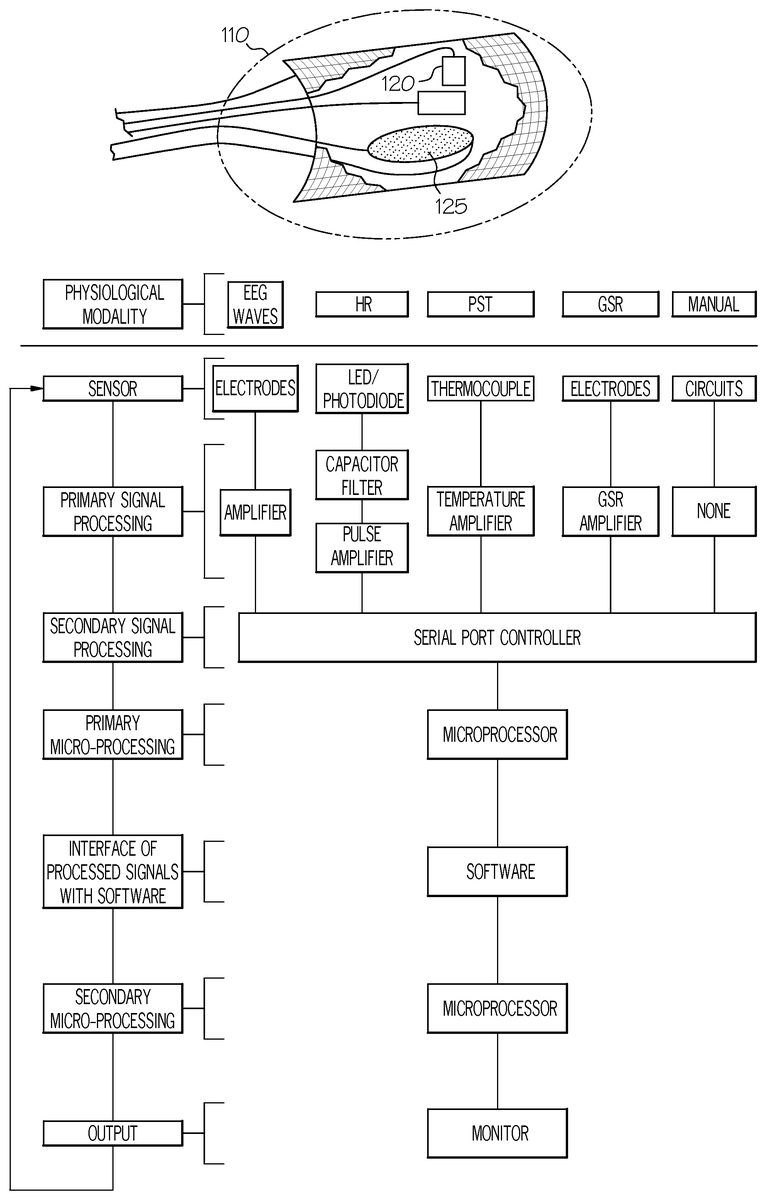
Another embodiment of the present invention, depicted inFIG. 6, is a bio-feedback ear piece100for a video game system. The bio-feedback ear piece100comprises a speaker105, a communication link108and a respiratory voice-sensor110. The speaker105and the respiratory voice sensor110are electrically coupled with the communication link108. As shown in this exemplary embodiment, the respiratory voice sensor110comprises a polyvinylidine fluoride thermocouple120. It measures voltage changes between the two layers of the thermocouple120that arises from the temperature differences between inhaled and exhaled air. This signal can then be processed with the processor60into waveform to give a snapshot of the participant's inspiration/expiration rate. The ear piece100further comprises a microphone sensor125located adjacent to the thermocouple120. Thermocouple120and microphone sensor125are located at the distal end of the ear piece100. In an embodiment, the ear piece100is made of material such as a bendable metal or polymer so the microphone sensor125and thermocouple120may be placed directly in front of the mouth of a human in order to better detect respirations and communication from the participant. In an alternative embodiment, capnography or a non-invasive infrared CO2measuring and recording apparatus could be used to reveal information about respiratory rate. The proximal end of the ear piece100comprises a speaker105, through which the video game system may play audio or instructions for the participant.
FIGS. 18A-21illustrate an embodiment of a headset700for transmitting to a video game system physiological data of a participant thereof.FIG. 18Adepicts one embodiment of a video game system. More particularly,FIG. 18Aillustrates a headset700worn on the head of the participant and a game controller20, both electrically coupled through respective communication links30to a control deck910of the video game system, which is electrically coupled to a display device (e.g., a monitor720). The headset700generally comprises one or more bio-feedback devices, such as those represented by references110,730,732,734,736,738,740,742,744,746, and748, for transmitting to the video game system physiological data of the participant. These bio-feedback devices generally comprise at least one of an EEG electrode, a galvanometer, or a thermocouple. The headset700generally further comprises a communication link30for electrically coupling the headset700and the video game system and conductive wiring712, which can be seen more clearly inFIG. 20) for electrically coupling the bio-feedback devices with the communication link30.
The bio-feedback capabilities of the galvanometer and the thermocouple, as applied to the headset700, are identical to those described above with respect to the controller and the ear piece. The headset700, however, has the added capability of monitoring EEG waves of the participant. More particularly, one or more EEG electrodes are configured to measure the aggregate electrical activities of surface cortical neurons and in turn monitor widths and frequencies of EEG waves of a participant of the video game system. The participant's EEG waves are likely to adjust according to game play. As such, the monitoring the EEG waves and their transmittance to the video game system by the headset700serves as another approach to incorporating the participant's physiological data into game play of the software operated on the video game system.
The bio-feedback devices of the headset700generally are exposed on the interior surface of the headset700only such that the devices may be in physical communication with the skin of the participant. Such physical communication often is necessary for the monitoring and transmitting of physiological data to the video game system. The bio-feedback devices are visible on the exterior surface760of the headset700inFIGS. 18A,18B, and21for illustrative purposes only.FIG. 20depicts a cross-sectional side view of the headset700for appropriate visualization of the bio-feedback devices and the conductive wiring712.
Generally, the bio-feedback devices are positioned within the headset at orientations appropriate for attaining physical communication with the skin of the participant's head and for monitoring physiological data. As shown inFIGS. 18A and 18B, there may be frontal electrodes730,732that are positioned in areas corresponding with the frontal lobe of the participant; temporal frontal electrodes734,736that correspond with the temporal frontal region; temporal parietal electrodes738,740that correspond with the temporal parietal region; occipital parietal electrodes742,744that correspond with the occipital parietal region; and mandibular electrodes746,748that correspond with the mandible. It is contemplated that bio-feedback devices may be oriented in a variety of other positions about the head of the participant according to what physiological conditions are being monitored.
In the embodiment of a headset700as illustrated inFIGS. 18A and 21, the headset700includes eight EEG electrodes730,732,734,736,738,740,742, and744positioned within the interior surface of the headset700such that when the headset700is worn by a participant, the eight EEG electrodes may monitor accurately the electrical activity of surface neurons (emitted in the form of EEG waves) from those respective areas of the participant's brain. The headset700also has two galvanic electrodes746,748, one positioned on each lateral side of the headset700such that the electrodes746,748may come into physical communication with the mandible, as shown inFIGS. 18A and 18B. These galvanic electrodes746,748may monitor the general skin conductivity, altered by perspiration, of the participant in the mandibular area. Further, the headset700has a polyvinylidine fluoride thermocouple120(shown inFIG. 20) that may monitor the respiratory rate of the participant. The headset700may transmit, via the conductive wiring712and the communication link30, the EEG waves, the skin conductivity, and the respiratory rate to the video game system for processing into a form easily utilized by the software operated through the video game system. It is contemplated that additional and/or other bio-feedback devices may be incorporated into the headset700to monitor other physiological variables.
Similar to the ear piece100described above, the headset700may further comprise an ear piece comprising a speaker for transmitting audio from the video game system to the participant. In addition, the headset may comprise a microphone for transmitting verbal communication from the participant to the video game system. As shown inFIG. 20, the microphone125may be incorporated into a respiratory voice sensor110where the microphone125is adjacent to a thermocouple120for detecting respirations from the participant. This embodiment is described in greater detail above with respect to the ear piece100.
In accordance with another embodiment, a video game system comprises a video game processor, a computer readable medium containing executable instructions for providing a video game, and a game controller. In accordance with another embodiment, a video game system includes a video game processor, a computer readable medium containing executable instructions for providing a video game, a game controller, and a headset. The video game system may further include a network connection for electrically coupling multiple video game systems such that participants of the multiple video game systems may engage in simultaneous, interactive game play through their respective video game systems.
With respect to an embodiment comprising both a controller and a headset, it is contemplated any arrangement of incorporation of bio-feedback devices into the controller and/or the headset may be provided. For example, but not by way of limitation, the controller may comprise multiple pulse-pressure detectors and a galvanometer, while the headset may comprise one or more EEG electrodes and a thermocouple. In an embodiment comprising both a controller and a headset, the controller and the headset may interact simultaneously with the video game system such that various forms of data, conventional, physiological, and otherwise, may be processed by the video game system at the same time.
Often computers communicate with each other and share information, invention, and/or services. Sometimes in this setting, the various computers are referred to as nodes, which is a generic term referring to access points in an interconnected system. One type of computer network employs a client-server architecture. The portions of network inventions that interact with participants typically are separated from the portions of network inventions that process requests and information. Often, the portions of an invention that interact with participants or access network resources are called client inventions or client software and portions of an invention that processes requests are called server inventions or server software. Client machines tend to run client software and server machines tend to run server software, however, a server can be a client as well.
In accordance with one embodiment, the video game system typically will be provided on a client machine, while the software containing the computer instruction that comprises the instructions to collect and measure the bio-feedback from the participant may be located on the client computer or the server computer, separate of the client machine. As used herein, “software” means a computer readable medium comprising executable instructions for providing a video game operable through a video game system, or component thereof.
FIG. 8schematically illustrates a sample client-server network235that might be employed to implement an embodiment of the present invention. As one with ordinary skill in the art will readily appreciate, a client-server network is only one type of network and a variety of other configurations, such as peer-peer connections, are also considered networks that may be used with embodiments of the present invention. In a client-server network235, a plurality of nodes are interconnected to various nodes that send and receive information to/from one another. As shown here, a server node238is interconnected with a plurality of client nodes240using a connection239, such as a token ring, ethernet, telephone modem connection, radio or microwave connection, parallel cable, serial cables, telephone lines, universal serial bus “USB”, Firewire, Bluetooth, fiber optics, infrared “IR”, radio frequency “RF”, and the like, or combinations thereof.
As one skilled in the art can appreciate, the video game system may be connected to other video game systems or servers that further process and/or distribute the bio-feedback information and similarly send instructions back to the video game system in order to respond to the bio-feedback measurements of the participant. Likewise, one skilled in the art will appreciate, an embodiment of a video game controller could act as a client computer itself and be connected through a communication link to a server node.
The general structure of a control deck910of the video game system can be observed inFIG. 9. As one skilled in the art will appreciate, the structure may comprise a multitude of various arrangements. On the front panel, facing the viewer are two controller adapters920,922that may interface with game controllers20and/or headsets700(such as those shown inFIG. 18A). It is contemplated that more than two controller adapters920may be incorporated into the front panel, or other area, of the control deck910so as to interface with multiple game controllers20and/or headsets700, or combinations thereof. A game port940may be visualized on the top, rear of the control deck910that allows for the interface of the control deck910and the software. Also, on the top of the control deck910is an on/off switch930and a reset button932that interrupts the running of the software and returns to the beginning of the software program. As visible inFIG. 10, on the back of the control deck910is an A/C power supply port950that connects an outside power source to a circuit board of the control deck910. Also, located on the back of the control deck910is a connector952that allows the processed data from the software to be transferred and displayed on a monitor via an audio/video cable.
An inside view of the control deck910is depicted inFIG. 10. Positioned within the control deck910is a circuit board960. Attached to the circuit board960on the front face are the controller adapters920,922that interface with the controllers20and headsets700(such as those shown inFIG. 18A). Two distinct data types are sent to the circuit board960via the controllers20and headsets700. The first is data resulting from the manual manipulation of the controller20, which is also referred to herein as conventional controller data, that is inputted by the participant of the video game system. The second data type is the unprocessed physiological data that also is transmitted back to the circuit board960. Both data types undergo multi-level micro-processing, separately, on the circuit board960where that processed data eventually is transmitted to the software. One skilled in the art will appreciate that the physiological data and the conventional controller data may be processed together. The port940for interface between the software and the circuit board960can be visualized on the back of the circuit board960. The data may be stored and accessed by the software and incorporated into the program in real-time, after which the output is sent back to the circuit board960where it is further processed and delivered to a display device, such as a video monitor, via the connector port952. The A/C current is delivered to the circuit board960via the A/C power supply port950located on the rear of the circuit board960.
FIG. 11details an embodiment illustrating a progression of signals as they are processed in a video game system. The game controller20and the headset700(as shown inFIG. 18A) have the ability, through internal circuitry and electrical impulses, to monitor various phenomena including, but not limited to, GSR (electrodes), temperature (thermocouple), heart rate (LED/photoreceptor), and EEG waves (EEG electrodes) (specific to the headset) of the participant as well as the conventional controller data inputted by the participant. This raw physiological data generally undergoes a primary processing. For example, in monitoring a participant's heart rate, the signal received back from the photodiode first can be high pass filtered to remove high frequency elements from the signal and, then, is amplified, in one embodiment, using a three stage operational amplifier. Another example is in monitoring a participant's GSR and temperature, where the initial signal transmitted across the electrodes can be amplified using a GSR and temperature signal amplifier, respectively. The processing of signals are commonplace and known to one skilled in the art.
In the embodiment shown inFIG. 11, four physiological variables are addressed. As alluded to before, a multitude of physiological variables can be obtained through the controller20and the headset700including, but not limited to, respiration rate (LED/photoreceptor or polyvinylidine fluoride thermocouple), blood volume pulse (LED/photoreceptor), digital arterial pressure (LED/photoreceptor with cuff and servo control mechanism), P-R interval (four silver electrode system), and EEG waves (EEG electrodes). The physiological data transmitted to the video game system typically undergoes unique and separate primary processing, but subsequent transformations are identical to the processing modalities discussed above. Conventional controller data generally does not undergo primary processing.
Primary processing may occur in the controller20, in the control deck910of the video game system, or elsewhere depending on the particular embodiment of the invention. As shown inFIG. 22, all data, including the conventional controller data, undergoes secondary processing at a serial port controller. The function of this serial port is to sync the data together and to transform the synced data into forms easily recognized by a computer. Thereafter, the data is converted from analog to digital form. The digitized data is then delivered to shift registers that pass the data to a serial to parallel converter. Once in digital, parallel form, the data has completed secondary processing and is transmitted to a data bus for primary micro-processing.
The processed EEG data stream may require further processing, different than that of the other physiological variables, after being converted to digital form by the microprocessor. The control deck may comprise a program configured to analyze the processed EEG data by analyzing the characteristics and frequency of the types of waves present. For example, Attention Deficit Hyperactivity Disorder has been associated with increased theta waves on EEG. Programs could be incorporated into the control deck that measure the number and amplitude of theta waves over a time period and convert the data into mean values and then the specific data points into “z” values. Exemplary embodiments of utilizing this approach are referred to in Horowitz (Alternative and Complementary Therapies, December 2006, pp. 275-281) and Loo et al. (Applied Neuropsychology, 2005, Vol. 12, No. 12, 64-76). The software could then utilize these “z” values to incorporate the participant's ability to alter the number and amplitude of theta waves present into outcomes of the game in real-time, as is described herein with other physiological variables. It is contemplated, however, that other devices, programs, or methods may be utilized to further process the EEG data into a meaningful form that can easily be utilized by the video game system and the software operated thereon as one skilled in the art can readily appreciate that multiple combinations and permutations of information can be obtained from the complex waveforms of EEG's.
In accordance with one embodiment, the microprocessor transmits the data to a ROM unit that stores the processed data. Then, a RAM unit accesses the data stored in the ROM unit and calculates a mean, standard deviation, running mean, running standard deviation, and a “z” value. The “z” value represents the number of standard deviations the physiological data xi, is away from the running mean on a second to second basis. The “z” values from all the separate physiological variables are transmitted to shift registers and the streams of data are converted from serial to parallel form. The parallel data is then transmitted to a data bus that transmits the data to the software to be stored and read. The result is a multi-level micro-processing system that collects the streams of physiological data and sends the data in a form that can be easily utilized by the software.
The conventional controller data is processed in a manner similar to that of the physiological data, without the primary processing described above. Here, the conventional controller data is transmitted to the circuit board in the control deck of the video game system. The conventional controller data then bypasses the primary processing of the physiological data and proceeds to the serial port where the conventional controller data is converted from analog to digital form. Thereafter, the digitized conventional controller data is converted into serial form by shift registers and later converted to parallel form. This procedure is well documented in the art of video game manufacturing and well known to one skilled in the art. Next, the digital, parallel form conventional controller data is transmitted to a distinct multi-level micro-processing unit and then transmitted to the ROM to be stored and read. The conventional controller data is processed separately from the physiological data of the controller and the headset.
In accordance with one embodiment, two types of data are transmitted to the software: the processed conventional controller data and the processed physiological data. The software is able to respond to both types of data during the progression of the game provided by the software that is operated on the video game system. After integrating the two types of data into game play, the software transmits output in response to the two types of processed data to the control deck where the software output undergoes multi-level processing before it is sent to a video monitor for viewing by the participant operating the video game system.
FIG. 12illustrates an exemplary set of executable instructions for the primary micro-processing in accordance with one embodiment. The micro-processing processes physiological data and transmits it to the software so that the software can react to the ability of the participant to alter his physiology based on changes in the participant's physiological variables. In one embodiment, the primary microprocessor has RAM and ROM capability so that it may not only store incoming physiological data streams, but it also may perform mathematical transformations of such streams.FIG. 12is an example of one such transformation. In this particular embodiment, all physiological data (in digital/parallel form) is sampled approximately every second. This sample of data initially is stored in memory. The first 120 seconds serve as an initialization period. While the physiological data is being transmitted and stored, no calculations are made of data specific each physiological variable. After the first 120 seconds pass, a mean and standard deviation are calculated. In the subsequent 120 seconds, these values will represent the running means and running standard deviations and will be utilized to calculate “z” values for their respective physiological variable. So each physiological variable, such as heart rate, will have a unique running mean and running standard deviation. The “z” value calculated for heart rate, for example, will be delivered to the software as a stream along with “z” values for other physiological variables being monitored.
After the second time period of 120 seconds has passed, a new mean and standard deviation will be calculated for the second time span. The result will be averaged into the running mean and running standard deviation to update these values and the new running mean and running standard deviation will be used to calculate “z” values for the next 120 seconds. The running mean and running standard deviation is updated on a continual basis every 120 seconds as long as game play continues uninterrupted. The “z” values for each of the physiological variables are transmitted continuously to the software, which is referred to as the signal/software interface inFIG. 11.
The components of the video game system (i.e., circuit boards, power supply, RAM and ROM, display adapter, etc.) are easily obtainable by one of ordinary skill in the art. The circuit board in one exemplary embodiment comprises a microprocessor, which may comprise executable instructions.
An example of how a software programmer may utilize the incoming streams of “z”−values is depicted inFIG. 13. The programmer is able to utilize processed physiological data to incorporate outcomes within the game based on the participant's then current physiological variables and the participant's ability to modify those physiological variables being monitored by the video game system. The programmer may incorporate the physiological data into game play using the participant's degree of success so that the outcome in the game depends on how well the participant is able to alter his physiology. Alternatively, the programmer may use arbitrary cutoff values for the physiological variables in devising all-or-nothing outcomes for the game.
In the embodiment shown inFIG. 13, specific examples of how a software programmer may utilize processed physiological data in the video game system to enhance game play are depicted. A hypothetical case is provided to better explain the capabilities and features of this video game system using a participant's physiological conditions to alter the scenarios or outcomes of a game. In accordance with one embodiment, a participant turns on a monitor and a video game system. The participant inserts a fantasy game into the control deck and, as instructed, places a headset on his head and places his hands around the controller, inserting his second and third digits into the retention rings. The controller is equipped with a thermocouple, a silver electrode system, and a LED/photoreceptor to measure peripheral skin temperature (PST), galvanic skin resistance (GSR), and heart rate, respectively, while the headset comprises one or more EEG electrodes to monitor EEG waves. The PST, GSR, heart rate, and EEG waves are transmitted and processed as described above and as illustrated inFIGS. 11 & 12. After 120 seconds of initialization, “z” values are calculated for each physiological variable on a second to second basis and transmitted to the software.
Following the initialization period, the participant starts off on a journey through a fantasy world of dragons and sorcerers. Since, the “z” values are updated and transmitted continuously to the software, the software programmer may utilize the ability of the participant to alter his physiological variables to change outcomes of the game. For example, as illustrated inFIG. 13, if the “z” values for PST becomes greater than one (change in temperature recorded from a hand or finger of the participant greater than one standard deviation over running mean), the software programmer may provide the participant with the ability to shoot fireballs. If the values for “z” are −1<“z”<1, the programmer may provide the participant with no change in game play. If “z”0.5, then the programmer may program that there is no change in game play for the participant. If, however, −0.5<“z”<0.5 for heart rate, the programmer may provide the participant with a force field strength of 25%; if −1<“z”<−0.5, then the programmer may provide the participant with a 50% force field strength; if −1.5<“z”<−1, then the programmer may provide the participant with a 75% force field strength; and if “z”<−1.5, then the programmer may provide the participant with a 100% force field strength. One skilled in the art could conceive of a program designed specifically to create a continuum of effects over a range of “z” values. These scenarios are provided by way of example only and it is contemplated that different ranges, values of “z” may translate into any variety of features or changes in game play.
In accordance with another embodiment, a handheld video game system is depicted inFIGS. 14 and 15.FIG. 14illustrates a front view of a handheld video game system. A directional keypad520is located adjacent to function buttons A & B522,524. A select game button526and a start button528also are depicted inFIG. 14.FIG. 15depicts a back view of a handheld video game system. As shown inFIG. 15, a game port530may be provided on the back of the handheld game system. Generally, three finger wells550,552,554are provided beneath the game port on the back of the handheld game system. It is contemplated that there may be more or less than three finger wells550,552,554provided to the shell of the handheld game system. The three or more basic sensors for monitoring physiological variables are located within the wells. The finger wells generally are configured to ensure contact between the sensors of the wells and the 2nd, 3rd, and 4thfingers of the participant. Each sensor may monitor a different physiological condition in each finger. For example,FIG. 15illustrates an LED/photodiode540unit in the first well550. As described above, the LED/photodiode540may monitor blood volume pulse, peripheral pulse, and respiration. A silver four electrode unit542is illustrated in the second well552. This silver four electrode unit may monitor GSR and a one-lead ECG. The third well554may comprise a thermocouple544. The thermocouple544may monitor peripheral skin temperature. A compartment560, also shown inFIG. 15, allows for utilization of a portable power source, such as batteries.
In accordance with another embodiment, a handheld video game system includes a shell, a video display, a game port, a processor, and one or more bio-feedback devices for transmitting to the processor physiological data of a participant of the handheld video game system, wherein the bio-feedback devices are incorporated into the shell of the handheld video game system and into a headset electrically coupled with the handheld video game system. The headset may have one or more bio-feedback devices comprising at least one of an EEG electrode, a galvanometer, or a thermocouple, while the bio-feedback devices incorporated into the shell of the handheld video game system comprise at least one of a photoelectric plethysmography, a galvanometer, or a thermocouple. It is contemplated that additional or other bio-feedback devices may be incorporated into the shell and/or the headset. The handheld video game system may further comprise a network connection for electrically coupling multiple handheld video game systems such that participants of the multiple handheld video game systems may engage in simultaneous, interactive game play through their respective handheld video game systems.
FIGS. 16 and 17illustrate an embodiment of a circuit board for a handheld video game system. As shown inFIG. 16, a video display510may be attached to the top of the circuit board. The physiological data monitored by the sensors in the finger wells and the EEG electrodes, and/or other bio-feedback devices, in the headset generally is transmitted unprocessed back to the circuit board590, but as one skilled in the art can appreciate, primary processing could also occur in the controller. At the circuit board, the physiological data undergoes multi-level processing before being transmitted, in processed form, to the software via the software-circuit board interface570. In accordance with one embodiment, the multi-level processing may be the same as that described above with respect to the video game system. Once the processed physiological data is transmitted to the software, it may be stored so that it can be accessed at a later time. The data resulting from the manual manipulation of the buttons and the keypad of the handheld video game system also may be relayed back to the circuit board610where this data may undergo its own unique multi-level processing before it being transmitted to the software-circuit board interface570. Once delivered to the software, the manual manipulation data also may be stored for later use. Both types of processed data, physiological and manual manipulation, are stored and accessed by the software and incorporated into the video game program provided by the software in real-time. The output from the software then may be sent back to the circuit board where it is further processed and delivered to the video display.
It is noted that recitations herein of a component of the present invention being “configured” to embody a particular property, function in a particular manner, etc., are structural recitations, as opposed to recitations of intended use. More specifically, the references herein to the manner in which a component is “configured” denotes an existing physical condition of the component and, as such, is to be taken as a definite recitation of the structural characteristics of the component.
It is noted that terms like “generally,” “commonly,” and “typically” are not utilized herein to limit the scope of the embodiments of the claimed invention or to imply that certain features are critical, essential, or even important to the structure or function of the claimed invention. Rather, these terms are merely intended to highlight alternative or additional features that may or may not be utilized in a particular embodiment.
The foregoing description of the various embodiments and principles of the present application has been presented for the purposes of illustration and description. It is not intended to be exhaustive or to limit the invention to the precise forms disclosed. Many alternatives, modifications, and variations will be apparent to those skilled in the art. Moreover, although multiple inventive concepts have been presented, such aspects need not be utilized in combination, and various combinations of the inventive aspects are possible in light of the various embodiments provided above. Accordingly, the above description is intended to embrace all possible alternatives, modifications, combinations, and variations that have been discussed or suggested herein, as well as all others that fall within the principles, spirit, and broad scope of the invention as defined by the claims.
Claims
- A headset for use with a video game system, the headset comprising: a first bio-feedback device for transmitting to a video game system physiological data of a participant thereof comprising a respiratory voice sensor, wherein the respiratory voice sensor comprises a thermocouple;one or more second bio-feedback devices for transmitting to a video game system physiological data of a participant thereof, wherein the one or more second bio-feedback devices comprise at least one of an electroencephalogram electrode or a galvanometer;a communication link for electrically coupling the headset and the video game system;and conductive wiring for electrically coupling the first and second bio-feedback devices with the communication link.
- The headset of claim 1 , wherein the electroencephalogram electrode is configured to measure the electrical activity of surface cortical neurons emitted by a participant of the video game system.
- The headset of claim 1 , wherein the thermocouple comprises a polyvinylidine fluoride thermocouple.
- The headset of claim 1 , wherein the galvanometer comprises at least two conductors configured to measure a change in resistance of skin of a participant of the video game system, wherein the at least two conductors are in physical communication with the skin.
- The headset of claim 1 , wherein the headset further comprises: an ear piece comprising a speaker for transmitting an audio component from the video game system to the participant;and a microphone for transmitting verbal communication from the participant to the video game system.
- A video game system comprising: a) a control deck;b) a headset configured to transmit a first set of physiological data of a participant, wherein the headset is electrically coupled with the control deck;and c) a controller configured to transmit conventional controller data inputted by the participant and a second set of physiological data of the participant, wherein the controller is electrically coupled with the control deck;and wherein the control deck comprises: a circuit board for directing the processing of the data transmitted by the headset and the controller;an analog to digital converter electrically coupled with the circuit board;a serial to parallel converter electrically coupled with the circuit board;a software input module;and a microprocessor electrically coupled with the circuit board and the software input module, wherein the microprocessor comprises executable instructions to alter game play of the video game based on the physiological data of the participant.
- The video game system of claim 6 , wherein: the video game system further comprises software;and the software is a computer readable medium comprising executable instructions for providing a video game operable through the control deck.
- The video game system of claim 7 , wherein the headset and the controller transmit data to the control deck for processing into a form interpreted by the software such that the processed data may alter the participant's game play of the video game.
- The video game system of claim 6 , wherein the headset comprises one or more bio-feedback devices comprising at least one of an electroencephalogram electrode, a galvanometer, or a respiratory voice sensor comprising a thermocouple.
- The video game system of claim 9 , wherein the headset further comprises: a communication link for electrically coupling the headset and the control deck;and conductive wiring for electrically coupling the bio-feedback devices with the communication link.
- The video game system of claim 6 , wherein the software input module is located on a client computer or a server computer.
- The video game system of claim 6 , wherein the video game system further comprises a network connection for electrically coupling multiple video game systems such that participants of the multiple video game systems may engage in simultaneous, interactive game play through their respective video game systems.
- A video game system comprising: a) a video game processor;b) software;c) a microprocessor electrically coupled with the video game processor;and d) one or more bio-feedback devices electrically coupled with the microprocessor, wherein the bio-feedback devices are incorporated into a headset or a video game controller, or both, wherein the bio-feedback devices transmit data from at least two data types, wherein the at least two data types comprise physiological data from a participant and conventional controller data inputted by the participant, and wherein the microprocessor comprises executable instructions for dynamically determining a “z” value that represents the number of running standard deviations the physiological data is away from a calculated running mean of the physiological data;and wherein the executable instructions further comprises transmitting the “z” value dynamically to the video game processor;and wherein the video game processor comprises executable instructions for comparing the “z” value against pre-determined “z” value thresholds and altering output of the video game based on such comparison.
- The video game system of claim 13 , wherein the video game system is a handheld video game system, the handheld video game system further comprises: a shell;a video display;and a game port;wherein the one or more bio-feedback devices are incorporated into the shell of the handheld video game system or a headset electrically coupled with the handheld video game system.
- The video game system of claim 14 , wherein the bio-feedback devices are incorporated into the shell of the handheld video game system and the headset electrically coupled with the handheld video game system.
- The video game system of claim 14 , wherein the headset comprises one or more bio-feedback devices comprising at least one of an electroencephalogram electrode, a galvanometer, or a respiratory voice sensor comprising a thermocouple.
- The video game system of claim 14 , wherein the bio-feedback devices incorporated into the shell of the handheld video game system comprise at least one of a photoelectric plethysmography, a galvanometer, or a respiratory voice sensor comprising a thermocouple.
- The video game system of claim 14 , wherein the handheld video game system further comprises a network connection for electrically coupling multiple handheld video game systems such that participants of the multiple handheld video game systems may engage in simultaneous, interactive game play through their respective handheld video game systems.
- A method of providing physiological data of a participant of a video game system to a software input module of the video game system, wherein the method comprises: a) receiving unprocessed physiological data through a bio-feedback device electrically coupled with the video gaming system, wherein the bio-feedback device transmits the unprocessed physiological data to the video game system;b) converting the unprocessed physiological data from an analog form to a digital form;c) collecting the digitally converted physiological data on a shift register, wherein the digitally converted physiological data is collected serially;d) converting the serially collected digitally converted physiological data into parallel form;e) delivering the parallel form of the digitally converted physiological data to parallel a data bus;f) transferring the parallel form of the digitally converted physiological data on the parallel data bus to a microprocessor;g) relaying the parallel form of the digitally converted physiological data to a ROM unit, wherein the ROM unit stores the parallel physiological data;h) accessing the ROM unit utilizing a RAM unit to perform pre-defined calculations of the parallel form of the digitally converted physiological data;i) dynamically calculating a “z” value for the parallel physiological data utilizing a running mean and running standard deviation of the parallel form of the digitally converted physiological data;j) transferring the “z” value to a shift register in a serial manner;k) converting the serial “z” value to a parallel form of the ““z”” value;l) transferring the parallel form “z” value to a microprocessor;and m) relaying the parallel form “z” value from the microprocessor to the software input module.
- The method of claim 19 , wherein the relaying of the parallel form “z” value from the microprocessor to the software module is performed on a client computer or a server computer.
- The method of claim 19 , wherein the bio-feedback device is incorporated into a headset worn by the participant of the video game system.
Disclaimer: Data collected from the USPTO and may be malformed, incomplete, and/or otherwise inaccurate.