U.S. Pat. No. 7,637,812
ELECTRONIC GAME HAVING AN AUTOMATIC CONTINUE FEATURE
AssigneeAMI Entertainment Network LLC
Issue DateMarch 3, 2008
Illustrative Figure
Abstract
An amusement device includes a display having a touchscreen and an input component to receive value in order to establish one or more playable credits. The amusement device also includes a controller configured to select and play at least one electronic game. The at least one electronic game is playable by a player to score a plurality of amusement points. The one or more playable credits are used to permit play of the at least one electronic game, and are different than and not based on the amusement points. The at least one electronic game also has a continue feature that provides the player of the amusement device with an option to automatically continue play of the at least one electronic game. The at least one electronic game is configured to require player input during play of the at least one electronic game in order to score amusement points.
Description
DETAILED DESCRIPTION OF THE INVENTION Certain terminology is used in the following description for convenience only and is not limiting. The words “right”, “left”, “lower”, and “upper” designate directions in the drawings to which reference is made. The words “inwardly” and “outwardly” refer to directions toward and away from, respectively, the geometric center of the amusement device and designated parts thereof. The terminology includes the above-listed words, derivatives thereof, and words of similar import. Additionally, the words “a” and “an”, as used in the claims and in the corresponding portions of the specification, mean “at least one.” Further, the terms “coin” or “currency” should not be construed as limiting and can be used herein to mean all forms of coin and paper currency from any country as well as proprietary tokens, game cards, credit cards, debit cards, chits, or other representative forms of credit and/or payment. Referring to the drawings in detail, wherein like reference numerals indicate like elements throughout, there is shown inFIG. 1Aa first preferred embodiment of an amusement device10A. The amusement device10A includes a controller U1and a memory U2. The memory U2can be any known or suitable memory device such as random access memory (RAM), read only memory (ROM), flash RAM, hard disk, optical disk, or the like. The amusement device10A further includes a video display12A that is operatively connected to the controller U1. The amusement device10A also includes at least one input component14A that receives value in order to establish one or more playable credits. The value received may be at least one of currency, coins, tokens, chits, credits, credit cards/debit cards or the like. Although only one input component14A is shown, the amusement device10A may include more than one input component14A to give a user an option for payment, for permitting multiple players, or the ...
DETAILED DESCRIPTION OF THE INVENTION
Certain terminology is used in the following description for convenience only and is not limiting. The words “right”, “left”, “lower”, and “upper” designate directions in the drawings to which reference is made. The words “inwardly” and “outwardly” refer to directions toward and away from, respectively, the geometric center of the amusement device and designated parts thereof. The terminology includes the above-listed words, derivatives thereof, and words of similar import. Additionally, the words “a” and “an”, as used in the claims and in the corresponding portions of the specification, mean “at least one.” Further, the terms “coin” or “currency” should not be construed as limiting and can be used herein to mean all forms of coin and paper currency from any country as well as proprietary tokens, game cards, credit cards, debit cards, chits, or other representative forms of credit and/or payment.
Referring to the drawings in detail, wherein like reference numerals indicate like elements throughout, there is shown inFIG. 1Aa first preferred embodiment of an amusement device10A. The amusement device10A includes a controller U1and a memory U2. The memory U2can be any known or suitable memory device such as random access memory (RAM), read only memory (ROM), flash RAM, hard disk, optical disk, or the like. The amusement device10A further includes a video display12A that is operatively connected to the controller U1. The amusement device10A also includes at least one input component14A that receives value in order to establish one or more playable credits. The value received may be at least one of currency, coins, tokens, chits, credits, credit cards/debit cards or the like. Although only one input component14A is shown, the amusement device10A may include more than one input component14A to give a user an option for payment, for permitting multiple players, or the like. Preferably, the amusement device10A is made operable upon actuation of the input component14A, for example, the user may only select and play an electronic game once value is received at the input component14A and/or one or more playable credits are issued to the user. However, free selections may be offered at the discretion of an operator of the amusement device10A.
FIG. 1Bshows another or second amusement device10B in accordance with a second preferred embodiment of the present invention. The second amusement device10B also includes a controller U1, a memory U2, a display12B, and an input component14B. Preferably, the video displays12A,12B are touchscreen video displays configured to accept touch input. The first amusement device10A is a free-standing or floor-standing apparatus, whereas the second amusement device10B is a table-top or counter-top apparatus. However, the amusement devices10A,10B may be arranged in any configuration including table mount, wall mount, pole mount, and the like without departing from the invention.
For convenience, the amusement devices10A,10B will be referred to hereinafter simply as “amusement device10.”
Turning now to the operation of the amusement device10, the memory U2stores one or more electronic games and a system control program. However, the one or more electronic games may also be stored remotely. The controller U1controls the touchscreen display12based upon the system control program retrieved from the memory U2and based upon inputs from the touchscreen display12. As used herein, the system control program refers to all of the software functions outside of the electronic game files including an operating system, display control, input control, sound drivers, and the like. Other input devices which may be connected to the amusement device10include a pushbutton(s), a track-ball or touchpad, a mouse, a joy-stick, a foot-pedal, a voice recognition system, a keypad or keyboard, and the like. But, preferably, the input device is the touchscreen display12.
The amusement device10includes an operating mode and a setup mode. When the operating mode is selected, a player or user is selectively permitted to play electronic games. When the setup mode is selected, the owner/operator is permitted to make system setup adjustments. To switch from the operating mode to the setup mode, a mode selector pushbutton (hardware not shown) is provided that is typically concealed from the users. The mode selector pushbutton may be implemented as a hidden software feature, but preferably the mode selector pushbutton is a simple pushbutton that is disposed inside a housing of the amusement device10. In the setup mode, the owner/operator may also make adjustments to the game features as will be described in greater detail hereinafter.
In the preferred embodiments of the present invention, the controller U1controls the display12based upon the system control program retrieved from the memory U2and based upon inputs of the user. The controller U1is configured to select and play at least one electronic game.FIG. 2shows a screenshot100of an example of a game that may be played on the amusement device10. For example, a user establishes one or more playable credits by entering value into the input component14and is granted a time duration for playing the game. In the example ofFIG. 2, a timer102in the form of a chain is shown on the left-hand side of the display12. The timer102indicates to the user the amount of time remaining within which the user may play the game.
The electronic game is playable by a user to score or accumulate amusement points. The number of amusement points scored by the user may be displayed in score indicator150. The game is preferably configured to require player input during play of the game in order to score amusement points. In other words, no amusement points accrue if the user does not actively participate in the outcome of the game by, for example, actuating the input device(s) such as the touchscreen display12.
In addition, the one or more playable credits necessary to permit play are different than and not based on the amusement points. For example, the total number of amusement points are not used to award additional playable credits. However, the amusement device10may offer a bonus round or replay to a user for achieving a high score. The free bonus round differs from a playable credit in that the user does not have a choice of game or the ability to reclaim value. The bonus round is simply another chance to play the same game without having to input a playable credit. The conditions for awarding a bonus round are preferably set by an operator when the amusement device10is in the setup mode.
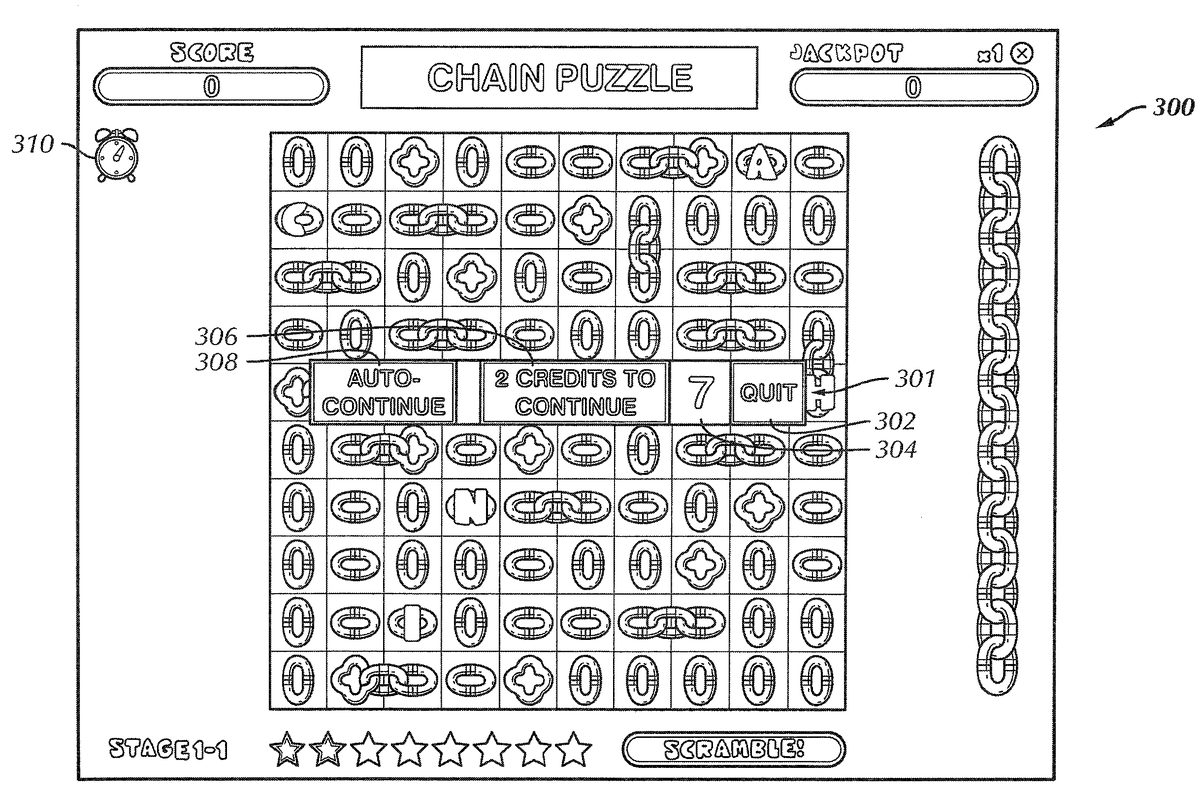
FIG. 3shows a similar screenshot200of the same game ofFIG. 2, but here the timer202is nearly expired. At the expiration of the time duration, a user will be prompted with options for proceeding. For example,FIG. 4shows a screenshot300where a prompt menu301is displayed to the user. The user may choose the “quit” option302, wherein any unused playable credits are made available to the user to play another game, or the unused playable credits may be returned to the user. The user may also choose the “continue” option306, wherein a new block of time will be granted in exchange for one or more playable credits. In the example ofFIG. 4, the prompt menu301indicates that two playable credits are required to continue the game. If the user has sufficient unused playable credits remaining in the amusement device10and chooses to continue, the amusement device10will deduct two credits from that amount. If there are insufficient credits available, the user will be required to enter more value into the input component14to establish the necessary number of playable credits.
Prompt menu301also presents a third option to the user, an option for “auto-continue”308. When a user selects “auto-continue”308, the game will continue as with the standard “continue” option306. However, upon the next expiration of the timer310, the game will automatically continue and the prompt menu301will not be presented to the user. Preferably, after a user has selected the “auto-continue” option308, the game continues automatically after each expiration of timer310until there are insufficient playable credits available in the amusement device10. In an alternative embodiment, the amusement device10does not display the prompt menu301to the user. The game instead automatically continues provided there are sufficient playable credits available in the amusement device10. Only after the playable credits are depleted to a level insufficient to proceed in the game is the user prompted to establish more credits to continue.
Prompt menu301may also include a continue clock304, which limits the time a user has to make a decision. After the continue clock304expires, the game may automatically quit and return to a main menu. Alternatively, if sufficient playable credits are still available in the machine, the game may automatically continue at the expiration of the continue clock304.
The continue features of the game are preferably operator configurable in the set-up mode.FIG. 5shows a screenshot400of an exemplary set-up menu presented to an operator of the amusement device10. The operator may choose the option402to allow game continues generally by placing a check in box403. As a subset of the general game continue ability, the operator may enable the “auto-continue” option404by placing a check in box405. A help button406is also provided in this example, which provides information about the option to the operator.FIG. 6shows a screenshot500including a help window502that is displayed upon the actuation of help button406(FIG. 5) by the operator.
Embodiments of the present invention also include methods of playing an amusement device10as described above.
The amusement device10may also include other functionality and features such as music jukebox, video jukebox, multimedia player, Internet browsing, broadcast media viewing, time based rental mode, non-prize tournaments, prize-based tournaments, head-to-head competitions, prize-based lotteries, ticket dispensing, prize dispensing, debit/credit card charging, phone card dispensing, e-mail, photography, placing customer orders, communicating with other amusement devices, and the like.
The amusement device10may also provide for remote or local access for accounting and/or bookkeeping purposes. The amusement device10may include a local connector for uploading to a hand-held or portable computer or removable memory for receiving accounting or other data. The amusement device10may include accounting and bookkeeping screens accessible by an operator through set up screens and/or through password protection.
From the foregoing, it can be seen that embodiments of the present invention comprise an amusement device having a game with an automatic continue feature. It will be appreciated by those skilled in the art that changes could be made to the embodiments described above without departing from the broad inventive concept thereof. It is understood, therefore, that this invention is not limited to the particular embodiments disclosed, but it is intended to cover modifications within the spirit and scope of the present invention as defined by the appended claims.
Claims
- An amusement device comprising: (a) a display having a touchscreen;(b) an input component that receives value in order to establish one or more playable credits;and (c) a controller configured to select and play at least one electronic game, the at least one electronic game being playable by a player to score a plurality of amusement points, the one or more playable credits being different than and not based on the amusement points, the one or more playable credits being used to permit play of the at least one electronic game, the at least one electronic game also having a continue feature, the controller being further configured to present a prompt on the display providing the user with a first option to automatically continue play of the at least one electronic game when a continue is required by the at least one electronic game and a second option to manually determine whether to continue play of the at least one electronic game when a continue is required by the at least one electronic game, the at least one electronic game being configured to require player input during play of the at least one electronic game in order to score amusement points.
- The amusement device of claim 1 , wherein the prompt is displayed upon the first requirement of a continue by the at least one electronic game.
- The amusement device of claim 2 , wherein the prompt offers a single continue option.
- The amusement device of claim 2 , wherein unused playable credits are available to the player when the player opts not to continue.
- The amusement device of claim 1 , wherein a timer is provided on the display, the timer indicating a time period until the next continue.
- The amusement device of claim 1 , wherein the continue feature is operator configurable.
- The amusement device of claim 1 , wherein the value received by the input component is at least one of currency, coins, tokens, chits, credits, and credit cards/debit cards.
Disclaimer: Data collected from the USPTO and may be malformed, incomplete, and/or otherwise inaccurate.