DESCRIPTION OF THE PREFERRED EMBODIMENT
An embodiment of the invention is now explained, referring to appended drawings.
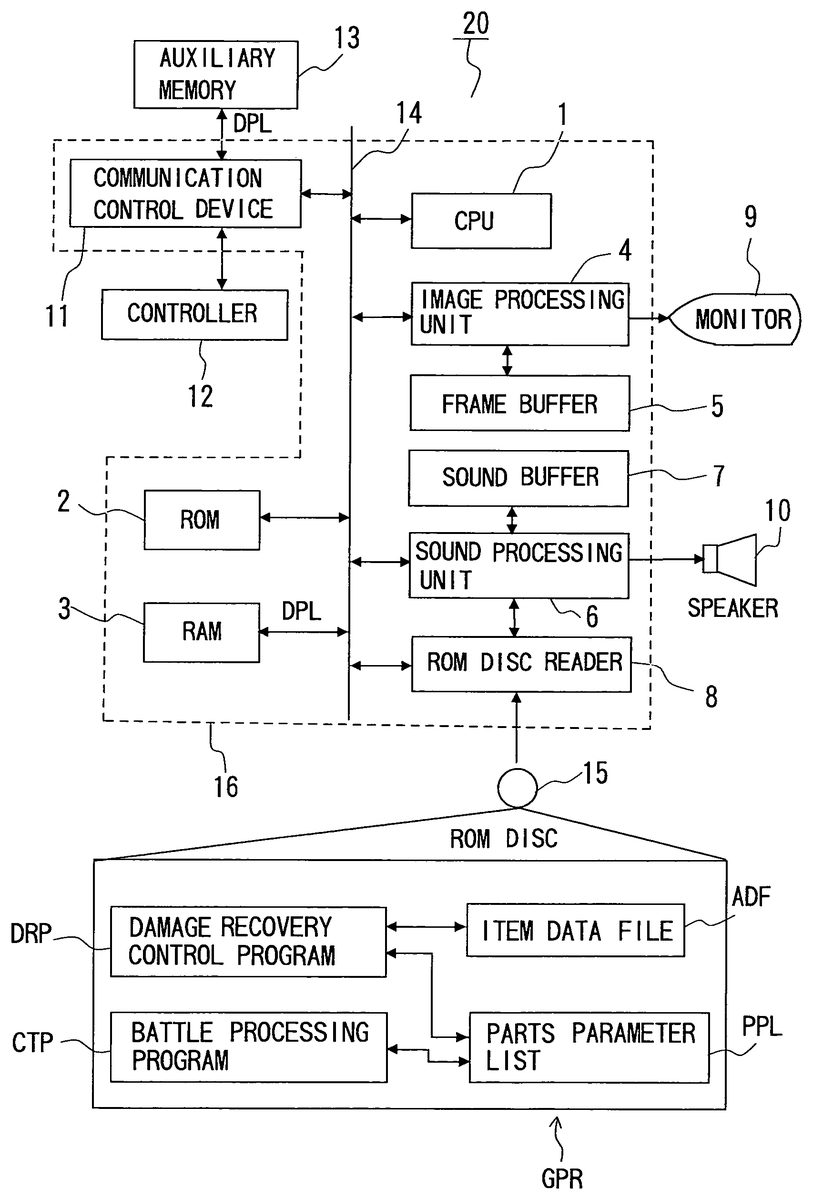
A game machine20is one for executing a predetermined game according to program for game which is stored in a ROM disc15as a storage medium, such as an adventure game, as shown inFIG. 1. The game machine20has a CPU1, main body of which is a microprocessor, a ROM2and a RAM3as main memories with respect to the CPU1, an image processing unit4and a sound processing unit6, and buffers5,7with respect to both units, and a ROM disc reader8. An operating system which is program necessary for controlling the whole operations in the game machine is written in the ROM2. In the RAM3, program and data for game read from the ROM disc15as a storage medium are stored according to its necessity. And, the image processing unit4receives image data from the CPU1, and draws a game picture on the frame buffer5, and converts the data of the drawn image into predetermined video regenerative signal, and outputs the signal to a monitor9with a predetermined timing. The sound processing unit6copies data of voice or sound, and data of the sound source which are read out from the ROM disc15and stored in the sound buffer7, and gets a speaker10to output. The ROM disc reader8reads program and data which are stored in the ROM disc15according to an instruction from the CPU1, and outputs a signal corresponding to the read contents. Program and data necessary for execution of the game are stored in the ROM disc15. As the monitor9and the speaker10, a home television receiver and a built-in speaker of the television receiver are generally used.
A communication control device11is connected with the CPU1through a bus14, and a controller12as an input device and an auxiliary memory13are attachably and detachably connected with the device11through proper connection ports. The controller12functions as an input device, and has operation members, such as an operation key, for receiving the operation by a player. The communication control device11scans the state of the operation of the controller12at predetermined cycles (at sixty cycles per a second, for instance), and outputs the signal corresponding to the scanned result to the CPU1. The CPU1judges the state of the operation of the controller12on the basis of the signal. A plurality of the controllers12and the auxiliary memories13may be connected with the communication control device11in parallel.
The components in the above-mentioned structure excluding the monitor9, the speaker10, the controller12, the ROM disc15, and the auxiliary memory13are stored together in a predetermined housing so as to comprise a machine body16. This machine body16functions as a computer.
Game program GPR through which a game, such as an action game, a role playing game, and an adventure game, proceeds according to a predetermined scenario, is stored in the ROM disc15.
In the game machine20, the CPU1firstly executes a predetermined initialization process according to the program of the ROM2after a predetermined initialization operation (the operation of turning the power on, for instance). When the initialization finishes, the CPU1starts to read the game program GPR which is stored in the ROM disc15, and starts game processing according to the program. When a player executes a predetermined game start operation on the controller12, the CPU1starts various processing necessary for the execution of the game according to the routines of the game program GPR on the basis of the instruction.
Thereafter, the game machine20executes predetermined processes according to the read game program GPR, controls to display the picture on the monitor9, and controls so that a predetermined scenario can proceed.
In the middle of the progress of the game, many scenes of battle where the operated character which is operated by a player or another character fights against an enemy character in a game world are set by the game program GPR. In such a battle, the character may generally receive damage by the attack of the enemy character. In such a case, the game program GPR executes arithmetic processing for subtracting a value of life power parameter which is set on the character and is stored in a proper memory, such as the RAM3, according to volume of received damage in order to obtain the renewal value, changes the former life power parameter value in the memory into the subtracted life power parameter value for its renewal, and displays the renewed value of life power parameter on the monitor9as a gauge or a numerical value through the image processing unit4on the basis of battle processing program CTP which is stored in the game program GPR.
A scene where each character CR receives damage on the life power parameter may also appear in an event in the game world, the event being set according to some development of the scenario in the game program GPR, in addition to in battle.
A predetermined value of life power parameter LP is set for each character CR. The life power parameter in an initial state is a full parameter value FV. The value of the life power parameter reduces when receiving an attack from the enemy character in a battle, as mentioned before. And, the value of the life power parameter is controlled to increase when executing some recovery procedure on the basis of an instruction from a player through the controller12or on the basis of damage recovery control program DRP mentioned hereinafter which is stored in the game program GPR.
Each character CR can take an action within the bounds of the life power parameter which is set on the character in the game world on the basis of the game program GPR, and such action is displayed as an image of the corresponding character CR on the monitor9through the CPU1and the image processing unit4.
If the value of the life power parameter becomes zero (0), the game program GPR processes for removing the character from members for battle in producing the scene of battle through the image processing unit4. In the concrete, the character CR image is written in the frame butter5in order to display the character CR laying himself or herself in a stationary state on a field where a battle occurs, and such image is displayed on the monitor9.
A parts parameter list PPL in the game program GPR stores the volume of damage which each character CR receives in a battle, as shown inFIG. 3. The battle processing program CTP gets the CPU to judge as to whether or not the character CR received damage from the enemy character in a battle scene. If yes, the battle processing program CTP judges which parts of the character CR the enemy character attacked through the CPU1, and the result is temporarily stored in a memory, such as the RAM3. Subsequently, the program CTP reads out damage data DD which is set for each parts of each character CR, showing volume of damage, referring to the parts parameter list PPL.
The game program GPR stores the parts parameter list PPL in the RAM3from the ROM disc15at a proper point of time after game start, and then, the respective damage data DD are read out of the parts parameter list PPL stored in the RAM3. But, such data may be directly read out of the ROM15without storing the list PPL in the RAM3.
As shown inFIG. 3, the parts parameter list PPL stores the volume of damage when receiving the attack from the enemy character for each parts PT of a body of each character CR as the damage data DD. If it is necessary to differentiate one character CR from another, each character CR is shown with the character CR attaching a numeral thereto, such as character CR1, CR2. . . CRn. But, if not, it is shown with only “character CR”. The battle processing program CTP reads out the damage parts PT of the character CR which is temporarily stored in the memory if the character CR received damage from the enemy character in the scene of a battle, refers to the read damage parts PT and the parts parameter list PPL, reads out the damage data DD which is set on the parts PT of the character CR which received damage, and determines the volume of damage which the character CR received. The battle processing program CTP thus subtracts the determined volume of damage from the value of the life power parameter of the character CR which is stored in the memory so as to renew the value.
The value of the damage data DD for each parts PT shown in the parts parameter list PPL is exemplary, and can be optionally set. Besides, the damage data DD may be also set for each enemy character.
The battle processing program CTP produces a damage parts list DPL as shown inFIG. 4in the memory, such as the RAM3if each character CR receives damage from the enemy character in the scene of a battle in order to store parts DP which was damaged for each character CR. The damage parts list DPL memorizes and stores the damaged parts DP for each character CR1, CR2, . . . . The damaged parts DP stored in the damage parts list DPL includes the parts damaged by the enemy character in the past battle which has not yet been recovered (“recovery” is explained hereinafter) without being deleted in addition to the parts damaged in this time of battle.
For instance, the character CR1has damages in right hand and left foot, as shown inFIG. 4, and these damages have not yet been recovered at present. And, the character CR2has damage in head, and the damage has not yet recovered at present.
When the game is over in the middle thereof, the CPU1stores this damage parts list DPL as save data in the auxiliary memory13on the basis of the saving procedure which is stored in the game program GPR with the instruction from a player through the controller12.
The battle processing program CTP always watches the value of the life power parameter of each character entering in the battle, which is stored in the memory through the CPU1. The program CTP takes a procedure for writing a flag showing incapability of fight at a corresponding address position of the memory, such as the RAM3which stores the information concerning the character when judging that the value of the life power parameter becomes zero (0) or lower (the battle processing program CTP generally fixes the value of the life power parameter in the memory as zero (0), thinking that the character is impossible to fight if the value of the life power parameter is under zero (0)), and for removing the character from the members entering in the battle.
When thus finishing the battle, the battle processing program CTP takes a procedure for recovering the life power parameters of the respective characters excluding the character who is impossible to fight on the basis of the damage recovery control program DRP which is stored in the game program GPR.
That is, if the player instructs the CPU1to recover the damage through the controller12at a proper point of time after finish of the battle and the instruction is outputted to the CPU1, the CPU1reads the damage recovery control program DRP out of the game program GPR and takes a procedure for recovering the value of the life power parameter of each character on the basis of the damage recovery control program DRP.
When the value of the life power parameter of some character was changed from full state FL as shown inFIG. 2(a) into a state as shown inFIG. 2(c) where predetermined volume M1is subtracted from the full state FL due to the battle with the enemy character, that is, when some character received M1of damage due to the battle, the value of the life power parameter in the memory is the value P1obtained by subtracting M1from the full state FL, as mentioned before. The game program GPR produces a life power parameter gauge PG and the present parameter value P1and displays both on the monitor9through the image processing unit4and the frame buffer5which is an image memory on the basis of the parameter value P1, as shown inFIG. 2(c).
The life power parameter gauge PG is shown with a graph in the shape of a strip wherein the full state FL is the whole length L1. The present value of the life power parameter of the character is shown with an area defined by length L2between a position shifted predetermined volume M1to the right side from the full state FL and a state ZP where the value of the parameter is zero (0).
How to display the life power parameter gauge PG is optional, and the gauge PG may be displayed with a graph, a numeric value or another proper one.
Then, the player instructs the damage recovery control program DRP to recover the damage of each character CR through the operation of the controller12through the CPU1. Eve if no damage recovery is instructed by the player, the damage recovery control program DRP gets the CPU1to watch elapsed time T after battle, and takes procedure for recovering the damage of each character CR according to the elapsed time T.
That is, the damage recovery control program DRP controls to naturally recover the life power parameter P1of each character CR at a natural recovery velocity, which is set for each damage parts PT, for the full state FL according to the elapsed time T after battle. In this natural recovery control, the damage recovery control program DRP thus gradually recovers the life power parameter value P1of each character CR on the basis of a natural recovery velocity NRV which is set for the parts PT of each character CR, referring to the parts parameter list PPL as shown inFIG. 3. This action is done in such a manner that the CPU1computes the life power parameter value of each character CR stored in a memory so as to increase it on the basis of the natural recovery velocity NRV as shown in the parts parameter list PPL at a predetermined cycle, and renews the former life power parameter value so as to become the computed life power parameter value.
The natural recovery velocity NRV is set for each damaged parts PT of each character CR in the parts parameter list PPL as shown inFIG. 3. The more important parts, such as waist, head and body, it is, the lower the natural recovery velocity NRV thereof is. On the contrary, the more peripheral parts, such as hand, arm and foot, it is, the higher the natural recovery velocity NRV thereof is. Each numeric value as shown in the natural recovery velocity NRV is exemplary and is used only for showing relative magnitude. These numeric values may be optionally set.
If the character CR receives the damage in a battle, so that the life power parameter value is reduced up to the parameter value P1as shown inFIG. 2(c), the damage recovery control program DRP sets the value of the life power parameter reduced up to the parameter value P1as a standard parameter value P1, and stores it in a memory, such as the RAM3. The standard parameter value P1is controlled to be renewed so as to be gradually increased for the full state FL with the passage of time after battle as shown inFIG. 2(d) and (e). Such state that a human being is hurt and naturally recovers with a passage of time can thus appear in the game, so that realistic development of the game is possible.
That is, a basic action set for recovering the life power parameter of each character CR in the game program GPR is a recovery state on the basis of the natural recovery velocity NRV with the damage recovery control program DRP, and another recovery of the parameter by using a recovery item with the instruction of the player through the controller12is dealt with as a temporary recovery action.
Each character CR has the standard parameter value P1lower than the full parameter value FV in the full state FL of the life power parameter which is set for the character, the standard parameter value P1being renewed according to the basic recovery action, and the state of the standard parameter value P1shows so called “wounded state”. The “wounded state” continues till the recovery of the standard parameter value of the character CR up to the full state FL by the natural recovery velocity NRV which is set in the damage recovery control program DRP. The standard parameter value P1is stored in a memory, such as the RAM3, for each character CR. When temporarily finishing the game, the standard parameter value P1is stored in the auxiliary memory13as a part of save data by the CPU1with the instruction from the player through the controller12.
When the standard parameter value P1is naturally recovered up to the life power parameter value which is set as the full state FL of the life power parameter for the character CR (referred to as only “full parameter value FV”) and the correspondence between the standard parameter value P1and the full parameter value FV is judged with comparison and computing by the damage recovery control program DRP, complete recovery of the damage on the damaged parts DP is judged.
In this case, the character CR gets rid of “wounded state”, and the damaged portion DP which has been stored for the character CR is erased from the damage parts list DPL.
When judging that the character CR is in “the wounded state”, that is, that the standard parameter value of some character CR does not reach the full state FL of the life power parameter which is set for the character CR, the damage recovery control program DRP stores a flag showing “wounded state” for the character CR in a memory, such as the RAM3, corresponding to the character CR. The damage parts list DPL for each character CR as shown inFIG. 4may be substituted for this flag. That is, the damage recovery control program DRP judges that the character CR having some damaged parts DP in the damage parts list DPL is in “wounded state”.
If some character CR is in “wounded state” and a player instructs use of an item for temporarily recovering the value of the life power parameter, such as a recovery item, through the operation of the controller12, the damage recovery control program DRP reads the value of the life power parameter through which the character can recover (referred to as only “recovery parameter value VL” hereinafter), the value being set as a parameter for the recovery item the use of which was instructed, out of an appropriate item data file ADF in the game program GPR (or reads the value out of the RAM3which stores the item data file ADF read out of the ROM disc15), and computes the value of the life power parameter of the character CR, adding the value corresponding to a recovery parameter value VL which is shown in the item data file ADF to the present standard parameter value P1, and renews the value of the life power parameter of the corresponding character CR in the memory (at this time, the standard parameter value P1which is stored in another address position in the memory is unchanged).
In result, the value of the life power parameter of the corresponding character CR in the memory becomes temporarily bigger than the standard parameter value by the value corresponding to the recovery parameter value VL, and the life power parameter gauge PG is displayed on the monitor9as shown inFIG. 2(b), extending for the left hand in the figure from the standard parameter value P1by the recovery parameter value VL.
Then, the recovery control program DRP judges as to whether or not the present parameter value P1of the character CR who recovered with the use of the recovery item by the instruction of the player is smaller than the full parameter value FV of the character CR, that is, the character is in “wounded state”, by referring to the damage parts list DPL in the RAM3. As already mentioned, the character CR having some damaged parts DP in the damage parts list DPL is judged as being in “wounded state” where the present parameter value P1is smaller than the full parameter value FV since the character received damage in the past battle and has not yet recovered. The recovery control program DRP reads out the damaged parts DP which the corresponding character CR has at present, and stores it in an appropriate buffer memory.
Subsequently, the recovery control program DRP refers to the parts parameter list PPL, so that the parameter reduction velocity PRV of the parts PT corresponding to the damaged parts DP of the character CR who is judged to be in “wounded state”, the damaged parts DP being stored in the buffer memory, is read out of a table of parameter reduction velocity PRV which is set for the character CR.
As shown inFIG. 3, a table of the parameter reduction velocity PRV stores the parameter reduction velocity PRV when using means for temporarily recovering the life power parameter, such as the recovery item, on each parts PT of each character CR being in “wounded state”.
Physical strength of the character CR being in “wounded state” has not fully recovered due to the wound, and the recovery of the physical strength exceeding a natural recovery state with the recovery item invites such a state where the physical strength of the character CR is consumed. Such a state often appears in a usual life. Then, such a state that the character CR goes against nature with the physical strength at the present point of time (the standard parameter value P1) can be expressed in the game program GPR according to the invention.
That is, when the value of the life power parameter of the character CR reaches a value PV exceeding the standard parameter value P1with the use of means for temporarily recovering the life power parameter, such as the recovery item, through the instruction from a player as shown inFIG. 2(b), the recovery control program DRP computes through the CPU1so as to reduce the recovery parameter value VL exceeding the standard parameter value P1with the passage of time on the basis of the parameter reduction velocity PRV, and starts to process for reducing the value of the life power parameter of the character CR in the memory from the value PV to the standard parameter value P1so as to renew the value.
The more important, such as waist, head and body, the parts is, the higher the preset value of the parameter reduction velocity PRV as shown in the table of the parameter reduction velocity PRV ofFIG. 3is. The more important the damaged parts DP of the character CR which is stored in the damage parts list DPL is, the sooner the value of the life power parameter returns to the standard parameter value P1even if it is recovered with the recovery item. That is, the effects of the recovery operation with the recovery item is little.
Then, the value of the life power parameter temporarily recovered exceeding the standard parameter value P1with the recovery item is controlled to be renewed, reducing for the standard parameter value P1at a predetermined parameter reduction velocity PRV. So, the character CR can take an action with the value of the life power parameter increased with the recovery item only at the beginning of a battle scene, but hard fight is forced on the character CR with the passage of time because of reduction of the life power parameter by damage received from the enemy character and the life power parameter reduced at the parameter reduction velocity PRV, so that the real battle scene can appear.
Each numeric value as shown in the table of the parameter reduction velocity PRV ofFIG. 3is exemplary, and is used for only showing its relative magnitude. So, these numeric values can be optionally set.
The damage recovery control program DRP always watches the value of the life power parameter which reduces at the parameter reduction velocity PRV with the passage of time, and the program DRP stops a procedure for subtracting the life power parameter on the basis of the parameter reduction velocity PRV when the renewed value of the life power parameter of the character CR which is stored in the memory becomes equal to the standard parameter value P1of the character CR at this point of time. Then, the value of the life power parameter of the character CR is controlled so as not to fall below the standard parameter value P1as long as the character CR does not receive new damage due to battle.
The damage recovery control program DRP continues through the CPU1to compute recovery of the standard parameter value P1on the basis of the natural recovery velocity NRV for each character CR being in “wounded state” having the damaged parts DP in the damage parts list DPL even during processing for reducing the life power parameter at the parameter reduction velocity PRV. Then, the standard parameter value P1of each character CR recovered due to natural recovery and the value of the life power parameter changing by the procedure for reducing on the basis of the parameter reduction velocity PRV are separately stored and controlled in a memory, such as the RAM3.
The damage parts list DPL may have damage image data DID representing concrete position of body which received damage on image of human body for each character CR in addition to the damaged parts DP, and the damage image data DID is stored in the frame buffer5which is an image memory through the CPU1and the image processing unit4so as to display it on the monitor9according to an instruction of a player through the controller12, so that the player can perceive the wounded state of each character CR as an image.
Besides, the damage image data DID may be stored as “old wound”, attaching an proper flag thereto without deleting even after each damage parts DP of each character CR as shown in the damage parts list DPL recovers naturally, and the “old wound” which finished recovery and the present damaged parts DP are written in the frame buffer5through the image processing unit4so as to differentiate both from each other by color and form of displaying according to the instruction of a player through the controller12, and they are displayed on the monitor9. With this procedure, the player can confirm the damaged parts DP received by a character operated by the player in the past battle on a scope, and thus becomes attached to the character CR, so that the fun of the game can be increased.
Furthermore, a method of recovery of the standard parameter value P1of each character CR is not limited to one with the natural recovery velocity NRV as shown in the parts parameter list PPL, but is set in the game program GPR, relating to an event, such as “Operation” and “Medical treatment” set in the game. Then, a player may select the method of recovery of the standard parameter value P1out of recovery procedure menu which the game program GPR displays on the monitor9through the CPU1and the image processing unit4.
In this case, the damage recovery control program DRP reads out through the CPU1the recovery velocity of the standard parameter value P1which is set in an appropriate file in the game program GPR according to the recovery procedure menu selected by the player through the controller12, and computes for recovering the standard parameter value P1of the character CR on the basis of the read recovery velocity.
In the above-mentioned embodiment, the CPU1comprises a game control unit, and the combination of the CPU1and specific software comprises various kinds of means of the game control unit, but at least a part of these means may be replaced by a logical circuit. Besides, the invention may be comprised as variously scaled game systems in addition to as a game system for home use.
The present invention has been explained on the basis of the example embodiments discussed. Although some variations have been mentioned, the embodiments which are described in the specification are illustrative and not limiting. The scope of the invention is designated by the accompanying claims and is not restricted by the descriptions of the specific embodiments. Accordingly, all the transformations and changes within the scope of the claims are to be construed as included in the scope of the present invention.