U.S. Pat. No. 7,632,186
SPECTATOR MODE FOR A GAME
AssigneeMicrosoft Corporation
Issue DateNovember 21, 2005

Summary:
The ‘186 patent provides for a system which allows a player to observe other game sessions without participating. The invention monitors the gameplay and allows the player to access game stats (score, time, etc .) in order to follow alongside the game. The invention is intended to allow novice players the chance to watch other players and learn moves or tactics which will help in their progression. Since different players advance through the game at different paces, this observation mode allows a player to learn without being disadvantaged while playing.
Abstract:
Methods and systems for broadcasting game sessions to be viewable by spectators are disclosed. In addition to sending telemetry data to other game clients participating in a game session, one or more game clients in the game session also sends the game telemetry data to a title server for the video game being played. The title server analyzes and repackages the received telemetry data and rebroadcasts the repackaged telemetry as a spectator feed to non-participant spectator client devices for viewing by users of the spectator client devices. Each spectator client device can analyze and manipulate the received telemetry data using a copy of the video game executing on the spectator client device, or may simply playback the feed when the feed includes a complete audiovisual file.
Exemplary Claim:
1. One or more computer storage media storing computer executable instructions for performing a method of distributing game telemetry data corresponding to a game session of a video game to a spectator client to allow a user of the spectator client to spectate the game session, said method comprising steps of: receiving at a network location not joined in the game session, game telemetry data generated by one or more participant clients of the game session of the video game, each participant client executing the video game under the control of a corresponding participant player; the network location creating a spectator feed by aggregating the received game telemetry data; receiving a request for the spectator feed from a spectator client not participating in the game session; the network location sending the spectator feed over the computer network to the spectator client; executing the video game on the spectator client using the received game telemetry data wherein the game telemetry data comprises projectile information and wherein the executing step comprises: establishing a ghost character representation for the spectator at the camera position; and applying the received game telemetry data against the ghost character wherein the applying step comprises the ghost character taking damage as a result of being hit by a projectile.
Illustrative Figure
Abstract
Methods and systems for broadcasting game sessions to be viewable by spectators are disclosed. In addition to sending telemetry data to other game clients participating in a game session, one or more game clients in the game session also sends the game telemetry data to a title server for the video game being played. The title server analyzes and repackages the received telemetry data and rebroadcasts the repackaged telemetry as a spectator feed to non-participant spectator client devices for viewing by users of the spectator client devices. Each spectator client device can analyze and manipulate the received telemetry data using a copy of the video game executing on the spectator client device, or may simply playback the feed when the feed includes a complete audiovisual file.
Description
DETAILED DESCRIPTION In the following description of the various aspects, reference is made to the accompanying drawings, which form a part hereof, and in which is shown by way of illustration various features described herein may be practiced. It is to be understood that other embodiments may be used and structural and functional modifications may be made. FIG. 1illustrates an example of a suitable gaming system environment100on which computer games, video games, and or other electronic games (collectively referred to herein as computer or video games) may be played. The gaming system environment100is only one example of a suitable computing environment and is not intended to suggest any limitation as to the scope of use or functionality of the features described herein. Neither should the gaming system environment100be interpreted as having any dependency or requirement relating to any one or combination of components illustrated in the illustrative operating gaming system environment100. Aspects described herein are operational with numerous other general purpose or special purpose computing system environments or configurations. Examples of well known computing systems, environments, and/or configurations that may be suitable for use include, but are not limited to, personal computers; server computers; portable and hand-held devices such as personal digital assistants (PDAs), tablet PCs or laptop PCs; multiprocessor systems; microprocessor-based systems; set top boxes; programmable consumer electronics; network PCs; minicomputers; mainframe computers; electronic game consoles, distributed computing environments that include any of the above systems or devices; and the like. Aspects herein may be described in the general context of computer-executable instructions, such as program modules, being executed by a computer. Generally, program modules include routines, programs, objects, components, data structures, etc. that perform particular tasks or implement particular abstract data types. The features described herein may also be practiced in distributed computing environments where tasks are performed ...
DETAILED DESCRIPTION
In the following description of the various aspects, reference is made to the accompanying drawings, which form a part hereof, and in which is shown by way of illustration various features described herein may be practiced. It is to be understood that other embodiments may be used and structural and functional modifications may be made.
FIG. 1illustrates an example of a suitable gaming system environment100on which computer games, video games, and or other electronic games (collectively referred to herein as computer or video games) may be played. The gaming system environment100is only one example of a suitable computing environment and is not intended to suggest any limitation as to the scope of use or functionality of the features described herein. Neither should the gaming system environment100be interpreted as having any dependency or requirement relating to any one or combination of components illustrated in the illustrative operating gaming system environment100.
Aspects described herein are operational with numerous other general purpose or special purpose computing system environments or configurations. Examples of well known computing systems, environments, and/or configurations that may be suitable for use include, but are not limited to, personal computers; server computers; portable and hand-held devices such as personal digital assistants (PDAs), tablet PCs or laptop PCs; multiprocessor systems; microprocessor-based systems; set top boxes; programmable consumer electronics; network PCs; minicomputers; mainframe computers; electronic game consoles, distributed computing environments that include any of the above systems or devices; and the like.
Aspects herein may be described in the general context of computer-executable instructions, such as program modules, being executed by a computer. Generally, program modules include routines, programs, objects, components, data structures, etc. that perform particular tasks or implement particular abstract data types. The features described herein may also be practiced in distributed computing environments where tasks are performed by remote processing devices that are linked through a communications network. In a distributed computing environment, program modules may be located in both local and remote computer storage media including memory storage devices.
FIG. 1shows an exemplary gaming system100. Gaming system100may include a game console102and one or more handheld controllers, as represented by controllers104(1) and104(2). The game console102may be equipped with an internal or external hard disk drive and a portable media drive106that supports various forms of portable storage media as represented by optical storage disc108. Examples of suitable portable storage media include DVD, CD-ROM, game discs, and so forth.
Game console102may have a number of slots110on its front face to support up to four controllers, although the number and arrangement of slots may be modified. A power button112and an eject button114are also positioned on the front face of the game console102; The power button112switches power to the game console and the eject button114alternately opens and closes a tray of the portable media drive106to allow insertion and extraction of the storage disc108.
Game console102may connect to a television or other display (not shown) via AN interfacing cables120. A power cable122provides power to the game console. Game console102may further be configured with broadband network capabilities, as represented by the cable or modem connector124to facilitate access to a network, such as the Internet. Connector124may also be fitted with a wireless adapter to connect to one or more wireless networks.
Each controller104may be coupled to the game console102via a wire or wireless interface. In the illustrated implementation, the controllers are USB (Universal Serial Bus) compatible and are connected to the console102via USB cables130. Controller102may be equipped with any of a wide variety of user interaction mechanisms. As illustrated inFIG. 1, each controller104may be equipped with two thumbsticks132(1) and132(2), a D-pad134, buttons136(e.g., ‘A’, ‘B’, ‘X’, ‘Y’), and two triggers138. The thumbsticks132may be analog directional control units, and may include analog potentiometers to detect a degree of position in the X- and Y-coordinates. D-pad134may be a directional pad, with inputs for entering directional commands such as up, down, left and right, or combinations of these directions (e.g., upper-left). D-pad134may also be analog, and may provide input as to a degree of pressure used to press in a particular direction. These mechanisms are merely representative, and other known gaming mechanisms may be substituted for or added to those shown inFIG. 1.
A memory unit (MU)140may be inserted into the controller104to provide additional and portable storage. Portable memory units enable users to store game parameters and user accounts, and port them for play on other consoles. In the described implementation, each controller is configured to accommodate two memory units140, although more or less than two units may be employed in other implementations. A headset142may be connected to the controller104or game console102to provide audio communication capabilities. Headset142may include a microphone for audio input and one or more speakers for audio output.
Gaming system100is capable of playing, for example, games, music, and videos. With the different storage offerings, titles can be played from the hard disk drive or the portable medium108in drive106, from an online source, or from a memory unit140. For security, in some embodiments executable code can only be run from the portable medium108. A sample of what gaming system100is capable of playing include game titles played from CD and DVD discs, from the hard disk drive, or from an online source; digital music played from a CD in the portable media drive106, from a file on the hard disk drive (e.g., “WINDOWS™” Media Audio (WMA) format), or from online streaming sources; and digital audio/video played from a DVD disc in the portable media drive106, from a file on the hard disk drive (e.g., Active Streaming Format), or from online streaming sources.
FIG. 2shows functional components of the gaming system100in more detail. The game console102has a central processing unit (CPU)200and a memory controller202that facilitates processor access to various types of memory, including a flash ROM (Read Only Memory)204, a RAM (Random Access Memory)206, a hard disk drive208, and the portable media drive106. The CPU200is equipped with a level 1 cache210and a level 2 cache212to temporarily store data and hence reduce the number of memory access cycles, thereby improving processing speed and throughput.
The CPU200, memory controller202, and various memory devices are interconnected via one or more buses, including serial and parallel buses, a memory bus, a peripheral bus, and a processor or local bus using any of a variety of bus architectures. By way of example, such architectures can include an Industry Standard Architecture (ISA) bus, a Micro Channel Architecture (MCA) bus, an Enhanced ISA (EISA) bus, a Video Electronics Standards Association (VESA) local bus, and a Peripheral Component Interconnects (PCI) bus also known as a Mezzanine bus.
As one suitable implementation, the CPU200, memory controller202, ROM204, and RAM206are integrated onto a common module214. In this implementation, ROM204is configured as a flash ROM that is connected to the memory controller202and a ROM bus (not shown). RAM206is configured as multiple DDR SDRAM (Double Data Rate Synchronous Dynamic RAM) that are independently controlled by the memory controller202via separate buses (not shown). The hard disk drive208and portable media drive106are connected to the memory controller via the PCI bus and an ATA (AT Attachment) bus216.
A 3D graphics processing unit220and a video encoder222form a video processing pipeline for high speed and high resolution graphics processing. Data is carried from the graphics processing unit220to the video encoder222via a digital video bus (not shown). An audio processing unit224and an audio codec (coder/decoder)226form a corresponding audio processing pipeline with high fidelity and stereo processing. Audio data is carried between the audio processing unit224and the audio codec226via a communication link (not shown). The video and audio processing pipelines output data to an A/V (audio/video) port228for transmission to the television or other display. In the illustrated implementation, the video and audio processing components220-228are mounted on the module214.
Also implemented on the module214are a USB host controller230and a network interface232. The USB host controller230is coupled to the CPU200and the memory controller202via a bus (e.g., PCI bus) and serves as host for the peripheral controllers104(1)-104(4). The network interface232provides access to a network (e.g., Internet, home network, etc.) and may be any of a wide variety of various wire or wireless interface components including an Ethernet card, a modem, a Bluetooth module, a cable modem, and the like.
The game console102has two dual controller support subassemblies240(1) and240(2), with each subassembly supporting two game controllers104(1)-104(4). A front panel I/O subassembly242supports the functionality of the power button112and the eject button114, as well as any LEDs (light emitting diodes) or other indicators exposed on the outer surface of the game console. The subassemblies240(1),240(2), and242are coupled to the module214via one or more cable assemblies244.
Eight memory units140(1)-140(8) are illustrated as being connectable to the four controllers104(1)-104(4), i.e., two memory units for each controller. Each memory unit140offers additional storage on which games, game parameters, and other data may be stored. When inserted into a controller, the memory unit140can be accessed by the memory controller202.
A system power supply module250provides power to the components of the gaming system100. A fan252cools the circuitry within the game console102.
The game console102implements a uniform media portal model that provides a consistent user interface and navigation hierarchy to move users through various entertainment areas. The portal model offers a convenient way to access content from multiple different media types—game data, audio data, and video data—regardless of the media type inserted into the portable media drive106.
To implement the uniform media portal model, a console user interface (UI) application260is stored on the hard disk drive208. When the game console is powered on, various portions of the console application260are loaded into RAM206and/or caches210,212and executed on the CPU200. The console application260presents a graphical user interface that provides a consistent user experience when navigating to different media types available on the game console.
The gaming system100may be operated as a standalone system by simply connecting the system to a television or other display. In this standalone mode, the gaming system100allows one or more players to play games, watch movies, or listen to music. However, with the integration of broadband connectivity made available through the network interface232, the gaming system100may further be operated as a participant in a larger network gaming community. This network gaming environment is described next.
FIG. 3shows an exemplary network gaming environment300that interconnects multiple gaming systems100(1), . . . ,100(g) via a network302. The network302represents any of a wide variety of data communications networks. It may include public portions (e.g., the Internet) as well as private portions (e.g., a residential Local Area Network (LAN)), as well as combinations of public and private portions. Network302may be implemented using any one or more of a wide variety of conventional communications media including both wired and wireless media. Any of a wide variety of communications protocols can be used to communicate data via network302, including both public and proprietary protocols. Examples of such protocols include TCP/IP, IPX/SPX, NetBEUI, etc.
In addition to gaming systems100, one or more online services304(1), . . . ,304(s) may be accessible via the network302to provide various services for the participants, such as hosting online games, serving downloadable music or video files, hosting gaming competitions, serving streaming audio/video files, and the like. The network gaming environment300may further involve a key distribution center306that plays a role in authenticating individual players and/or gaming systems100to one another as well as online services304. The distribution center306distributes keys and service tickets to valid participants that may then be used to form games amongst multiple players or to purchase services from the online services304.
The network gaming environment300introduces another memory source available to individual gaming systems100—online storage. In addition to the portable storage medium108, the hard disk drive208, and the memory unit(s)140, the gaming system100(1) can also access data files available at remote storage locations via the network302, as exemplified by remote storage308at online service304(s).
FIG. 4is a block diagram of another illustrative online gaming environment400, e.g. “XBOX™ LIVE™” by Microsoft Corporation of Redmond, Wash. Multiple game consoles402(1),402(2), . . . ,402(n) are coupled to a security gateway404via a network406. Each game console402can be, for example, a game console102ofFIG. 1orFIG. 2. Network406represents any one or more of a variety of conventional data communications networks. Network406will typically include packet switched networks, but may also include circuit switched networks. Network406can include wire and/or wireless portions. In one exemplary implementation, network406includes the Internet and may optionally include one or more local area networks (LANs) and/or wide area networks (WANs). At least a part of network406is a public network, which refers to a network that is publicly-accessible. Virtually anyone can access the public network.
In some situations, network406includes a LAN (e.g., a home network), with a routing device situated between game console402and security gateway404. This routing device may perform network address translation (NAT), allowing the multiple devices on the LAN to share the same IP address on the Internet, and also operating as a firewall to protect the device(s) on the LAN from access by malicious or mischievous users via the Internet.
Security gateway404operates as a gateway between public network406and a private network408. Private network408can be any of a wide variety of conventional networks, such as a local area network. Private network408, as well as other devices discussed in more detail below, is within a data center410that operates as a secure zone. Data center410is made up of trusted devices communicating via trusted communications. Thus, encryption and authentication within secure zone410is not necessary. The private nature of network408refers to the restricted accessibility of network408—access to network408is restricted to only certain individuals (e.g., restricted by the owner or operator of data center410).
Security gateway404is a cluster of one or more security gateway computing devices. These security gateway computing devices collectively implement security gateway404. Security gateway404may optionally include one or more conventional load balancing devices that operate to direct requests to be handled by the security gateway computing devices to appropriate ones of those computing devices. This directing or load balancing is performed in a manner that attempts to balance the load on the various security gateway computing devices approximately equally (or alternatively in accordance with some other criteria).
Also within data center410are: one or more monitoring servers412; one or more presence and notification front doors414, one or more presence servers416, one or more notification servers418, and a profile store428(collectively implementing a presence and notification service or system430); one or more match front doors420and one or more match servers422(collectively implementing a match service); and one or more statistics front doors424and one or more statistics servers426(collectively implementing a statistics service). The servers416,418,422, and426provide services to game consoles402, and thus can be referred to as service devices. Other service devices may also be included in addition to, and/or in place of, one or more of the servers416,418,422, and426. Additionally, although only one data center is shown inFIG. 4, alternatively multiple data centers may exist with which game consoles402can communicate. These data centers may operate independently, or alternatively may operate collectively (e.g., to make one large data center available to game consoles102,402).
Game consoles402are situated remotely from data center410, and access data center410via network406. A game console402desiring to communicate with one or more devices in the data center logs in to the data center and establishes a secure communication channel between the console402and security gateway404. Game console402and security gateway404encrypt and authenticate data packets being passed back and forth, thereby allowing the data packets to be securely transmitted between them without being understood by any other device that may capture or copy the data packets without breaking the encryption. Each data packet communicated from game console402to security gateway404, or from security gateway404to game console402can have data embedded therein. This embedded data is referred to as the content or data content of the packet. Additional information may also be inherently included in the packet based on the packet type (e.g., a heartbeat packet).
The secure communication channel between a console402and security gateway404is based on a security ticket. Console402authenticates itself and the current user(s) of console402to a key distribution center432and obtains, from key distribution center432, a security ticket. Console402then uses this security ticket to establish the secure communication channel with security gateway404. In establishing the secure communication channel with security gateway404, the game console402and security gateway404authenticate themselves to one another and establish a session security key that is known only to that particular game console402and the security gateway404. This session security key is used to encrypt data transferred between the game console402and the security gateway cluster404, so no other devices (including other game consoles402) can read the data. The session security key is also used to authenticate a data packet as being from the security gateway404or game console402that the data packet alleges to be from. Thus, using such session security keys, secure communication channels can be established between the security gateway404and the various game consoles402.
Once the secure communication channel is established between a game console402and the security gateway404, encrypted data packets can be securely transmitted between the two. When the game console402desires to send data to a particular service device in data center410, the game console402encrypts the data and sends it to security gateway404requesting that it be forwarded to the particular service device(s) targeted by the data packet. Security gateway404receives the data packet and, after authenticating and decrypting the data packet, encapsulates the data content of the packet into another message to be sent to the appropriate service via private network408. Security gateway404determines the appropriate service for the message based on the requested service(s) targeted by the data packet.
Similarly, when a service device in data center410desires to communicate data to a game console402, the data center sends a message to security gateway404, via private network408, including the data content to be sent to the game console402as well as an indication of the particular game console402to which the data content is to be sent. Security gateway404embeds the data content into a data packet, and then encrypts the data packet so it can only be decrypted by the particular game console402and also authenticates the data packet as being from the security gateway404.
Although discussed herein as primarily communicating encrypted data packets between security gateway404and a game console402, alternatively some data packets may be partially encrypted (some portions of the data packets are encrypted while other portions are not encrypted). Which portions of the data packets are encrypted and which are not can vary based on the desires of the designers of data center410and/or game consoles402. For example, the designers may choose to allow voice data to be communicated among consoles402so that users of the consoles402can talk to one another—the designers may further choose to allow the voice data to be unencrypted while any other data in the packets is encrypted. Additionally, in another alternative, some data packets may have no portions that are encrypted (that is, the entire data packet is unencrypted). It should be noted that, even if a data packet is unencrypted or only partially encrypted, all of the data packet can still be authenticated.
Each security gateway device in security gateway404is responsible for the secure communication channel with typically one or more game consoles402, and thus each security gateway device can be viewed as being responsible for managing or handling one or more game consoles. The various security gateway devices may be in communication with each other and communicate messages to one another. For example, a security gateway device that needs to send a data packet to a game console that it is not responsible for managing may send a message to all the other security gateway devices with the data to be sent to that game console. This message is received by the security gateway device that is responsible for managing that game console and sends the appropriate data to that game console. Alternatively, the security gateway devices may be aware of which game consoles are being handled by which security gateway devices—this may be explicit, such as each security gateway device maintaining a table of game consoles handled by the other security gateway devices, or alternatively implicit, such as determining which security gateway device is responsible for a particular game console based on an identifier of the game console.
Monitoring server(s)412operate to inform devices in data center410of an unavailable game console402or an unavailable security gateway device of security gateway404. Game consoles402can become unavailable for a variety of different reasons, such as a hardware or software failure, the console being powered-down without logging out of data center410, the network connection cable to console402being disconnected from console402, other network problems (e.g., the LAN that the console402is on malfunctioning), etc. Similarly, a security gateway device of security gateway404can become unavailable for a variety of different reasons, such as hardware or software failure, the device being powered-down, the network connection cable to the device being disconnected from the device, other network problems, etc.
Each of the security gateway devices in security gateway404is monitored by one or more monitoring servers412, which detect when one of the security gateway devices becomes unavailable. In the event a security gateway device becomes unavailable, monitoring server412sends a message to each of the other devices in data center410(servers, front doors, etc.) that the security gateway device is no longer available. Each of the other devices can operate based on this information as it sees fit (e.g., it may assume that particular game consoles being managed by the security gateway device are no longer in communication with data center410and perform various clean-up operations accordingly). Alternatively, only certain devices may receive such a message from the monitoring server412(e.g., only those devices that are concerned with whether security gateway devices are available).
Security gateway404monitors the individual game consoles402and detects when one of the game consoles402becomes unavailable. When security gateway404detects that a game console is no longer available, security gateway404sends a message to monitoring server412identifying the unavailable game console. In response, monitoring server412sends a message to each of the other devices in data center410(or alternatively only selected devices) that the game console is no longer available. Each of the other devices can then operate based on this information as it sees fit.
Presence server(s)416hold and process data concerning the status or presence of a given user logged in to data center410for online gaming. Notification server(s)418maintains multiple notification queues of outgoing messages destined for a player logged in to data center410. Presence and notification front door414is one or more server devices that operate as an intermediary between security gateway404and servers416and418. One or more load balancing devices (not shown) may be included in presence and notification front door414to balance the load among the multiple server devices operating as front door414. Security gateway404communicates messages for servers416and418to the front door414, and the front door414identifies which particular server416or particular server418the message is to be communicated to. By using front door414, the actual implementation of servers416and418, such as which servers are responsible for managing data regarding which users, is abstracted from security gateway404. Security gateway404can simply forward messages that target the presence and notification service to presence and notification front door414and rely on front door414to route the messages to the appropriate one of server(s)416and server(s)418.
Match server(s)422hold and process data concerning the matching of online players to one another. An online user is able to advertise a game available for play along with various characteristics of the game (e.g., the location where a football game will be played, whether a game is to be played during the day or at night, the user's skill level, etc.). These various characteristics can then be used as a basis to match up different online users to play games together. Match front door420includes one or more server devices (and optionally a load balancing device(s)) and operates to abstract match server(s)422from security gateway404in a manner analogous to front door414abstracting server(s)416and server(s)418.
Statistics server(s)426hold and process data concerning various statistics for online games. The specific statistics used can vary based on the game designer's desires (e.g., the top ten scores or times, a world ranking for all online players of the game, a list of users who have found the most items or spent the most time playing, etc.). Statistics front door426includes one or more server devices (and optionally a load balancing device(s)) and operates to abstract statistics server(s)426from security gateway404in a manner analogous to front door414abstracting server(s)416and server(s)418.
Thus, it can be seen that security gateway404operates to shield devices in the secure zone of data center410from the untrusted, public network406. Communications within the secure zone of data center410need not be encrypted, as all devices within data center410are trusted. However, any information to be communicated from a device within data center410to a game console402passes through security gateway cluster404, where it is encrypted in such a manner that it can be decrypted by only the game console402targeted by the information.
FIG. 4illustrates a single data center410(1) in detail. However, multiple data centers410(1) . . .410(n) may be used. For example, a first data center410(1) may be used to manage an online gaming network such as XBOX® LIVE, while another data center may be used to manage similar functions for a specific game title, e.g., HALO® 2. A data center specific to a game title may be alternatively referred to as a title server. A game console may obtain an address, e.g., an IP address, of a title server from key distribution center432upon authentication and identification of the game title presently being played on the game console. Alternatively, the game console may obtain the address of a title server from a title database434of the data center410.
One or more features described herein may be embodied in computer-executable instructions (i.e., software) stored in RAM memory206, non-volatile memory108,208,308, or any other resident memory on game console102. Generally, software modules include routines, programs, objects, components, data structures, etc. that perform particular tasks or implement particular abstract data types when executed by a processor in a computer or other device. The computer executable instructions may be stored on a computer readable medium such as one or more hard disks208, removable storage media108(e.g., CD-ROM, DVD, disk, etc.), solid state memory, RAM206, etc. The functionality of the software modules may be combined or distributed as desired in various embodiments. In addition, the functionality may be embodied in whole or in part in firmware or hardware equivalents such as application specific integrated circuits (ASIC), field programmable gate arrays (FPGA), and the like.
Aspects herein are not limited to console computing environments. Indeed, these aspects may also be implemented in video games that operate on personal computers (PC).FIG. 5illustrates an example of a suitable computing system environment500on which the features described herein may be implemented. The computing system environment500is only one example of a suitable computing environment and is not intended to suggest any limitation as to the scope of use or functionality of the features described herein. Neither should the computing environment500be interpreted as having any dependency or requirement relating to any one or combination of components illustrated in the exemplary operating environment500.
The features herein are operational with numerous other general purpose or special purpose computing system environments or configurations. Examples of well known computing systems, environments, and/or configurations that may be suitable for use include, but are not limited to, personal computers, server computers, hand-held or laptop devices, multiprocessor systems, microprocessor-based systems, set top boxes, programmable consumer electronics, network PCs, minicomputers, mainframe computers, distributed computing environments that include any of the above systems or devices, and the like.
The features herein may be described in the general context of computer-executable instructions, such as program modules, being executed by a computer. Generally, program modules include routines, programs, objects, components, data structures, etc., that perform particular tasks or implement particular abstract data types. The features may also be practiced in distributed computing environments where tasks are performed by remote processing devices that are linked through a communications network. In a distributed computing environment, program modules may be located in both local and remote computer storage media including memory storage devices.
In its most basic configuration, computing device500typically includes at least one processing unit502and memory504. Depending on the exact configuration and type of computing device, memory504may be volatile (such as RAM), non-volatile (such as ROM, flash memory, etc.) or some combination of the two. This most basic configuration is illustrated inFIG. 5by dashed line506. Additionally, device500may also have additional features/functionality. For example, device500may also include additional storage (removable and/or non-removable) including, but not limited to, magnetic or optical disks or tape. Such additional storage is illustrated inFIG. 5by removable storage508and non-removable storage510. Computer storage media includes volatile and nonvolatile, removable and non-removable media implemented in any method or technology for storage of information such as computer readable instructions, data structures, program modules or other data instructing a device to operate as described herein. Memory504, removable storage508and non-removable storage510are all examples of computer storage media. Computer storage media includes, but is not limited to, RAM, ROM, EEPROM, flash memory or other memory technology, CD-ROM, digital versatile disks (DVD) or other optical storage, magnetic cassettes, magnetic tape, magnetic disk storage or other magnetic storage devices, or any other medium which can be used to store the desired information and which can accessed by device500. Any such computer storage media may be part of device500.
Device500may also contain communications connection(s)512that allow the device to communicate with other devices. Communications connection(s)512is an example of communication media. Communication media typically embodies computer readable instructions, data structures, program modules or other data in a modulated data signal such as a carrier wave or other transport mechanism and includes any information delivery media. The term “modulated data signal” means a signal that has one or more of its characteristics set or changed in such a manner as to encode information in the signal. By way of example, and not limitation, communication media includes wired media such as a wired network or direct-wired connection, and wireless media such as acoustic, RF, infrared and other wireless media.
Computer500may include a variety of computer readable media. Computer readable media can be any available media that can be accessed by computer500and includes both volatile and nonvolatile media, removable and non-removable media. By way of example, and not limitation, computer readable media may comprise computer storage media and communication media. Computer storage media includes both volatile and nonvolatile, and removable and non-removable media implemented in any method or technology for storage of information such as computer readable instructions, data structures, program modules or other data. Computer storage media includes, but is not limited to, RAM, ROM, EEPROM, flash memory or other memory technology, CD-ROM, digital versatile disks (DVD) or other optical disk storage, magnetic cassettes, magnetic tape, magnetic disk storage or other magnetic storage devices (in the singular or the plural), or any other medium which can be used to store the desired information and which can accessed by computer500. Communication media typically embodies computer readable instructions, data structures, program modules or other data in a modulated data signal such as a carrier wave or other transport mechanism and includes any information delivery media. The term “modulated data signal” means a signal that has one or more of its characteristics set or changed in such a manner as to encode information in the signal. By way of example, and not limitation, communication media includes wired media such as a wired network or direct-wired connection, and wireless media such as acoustic, RF, infrared and other wireless media. Combinations of the any of the above should also be included within the scope of computer readable media.
Device500may also have input device(s)514such as keyboard, mouse, pen, voice input device, touch input device, etc. Output device(s)516such as a display, speakers, printer, etc. may also be included. All these devices are well know in the art and need not be discussed at length here.
Illustrative Embodiments
By way of introduction, one or more features and/or aspects described herein cause a game console to send intra-game data for a video game to a server that is capable of rebroadcasting the intra-game data to non-participants of the video game. The intra-game data may include positional telemetry and other game-state data (like controller buttons pushed or other user input) that is monitored and exchanged throughout a multiplayer game session. In real-time, or shortly thereafter, the telemetry data can be rebroadcast to and manipulated and re-rendered by non-participant's game consoles or other data processing devices. The rendering may be done by the same game engine that would run on a participating client, but instead running on a spectating client or on a server. When run on a server, the output may be sent to a video capture, which allows video clips to be available to all devices (not just game consoles) of the multiplayer game session.
FIG. 6illustrates a network architecture600that may be used to allow non-participants to spectate a game being played by one or more video game participants according to one or more illustrative aspects of the invention. Connections between components and nodes inFIG. 6illustrate logical connections. Each connection may pass through one or more networks, such as the Internet. Where a line terminates inFIG. 6at a broken line box surrounding multiple nodes or components, that line is considered to connect to each node or component within the broken line box. WhileFIG. 6identifies particular connections that may be useful according to various aspects of the invention,FIG. 6is not limiting and should not be interpreted to imply that other devices are not or cannot be communicatively connected. That is, each device and node is connected to one or more networks, and may communicate with each other device and node as necessary. The nodes within title server605represent logical network nodes, and multiple nodes may be implemented within the same physical server, combined with other network nodes, and/or performed by the same executable code or application service.
Each participant601plays a video game via game console602(1) . . .602(4), or some other data processing device on which the video game can be played, each referred to as a game client or participant client. A user of a participant client is referred to as a participant player. Each non-participant client603(also referred to as a spectator client) may include a video game console602(5) . . .602(8), or some other device which has not joined the multiplayer game session and is capable of receiving data from feed distributors617, further described below. While four participant clients and four spectator clients are illustrated inFIG. 6, the number of participant clients and spectator clients are not so limited, as discussed further below. A spectator client may include game consoles or any other devices which may be used to spectate a game session, and from which the participant clients of the game session have no present expectation of receiving game telemetry data. That is, each spectator client has not “joined” the multiplayer game being spectated.
A participating client may refer to any client joined to a multiplayer game session, regardless of a status of a character controlled by the participant player (e.g., regardless of whether the character is “alive,”0“dead,” “active,” or “inactive” in the multiplayer game session). The distinction as to whether a client has joined a multiplayer game session or not may vary from game to game. While the expectation of receiving game telemetry data may be used as an indication of whether a game client has joined a game session, other metrics may be used as well. In some games, participants may include players who control actions of one or more characters appearing at any time during the current and/or immediately successive game session, while spectators cannot control the actions of any characters appearing in the game session. In other games, a participant may include any game client directly connected to at least one of game client of the game session. As another example, one or more controller commands may be available to participants, while not being available to spectators. In some games, participants may include players for whom scoring data is kept for the session, such as total score, hit/miss ratio, favorite weapon, etc., while spectators have no such scoring data. The above metrics are not mutually exclusive, and combinations of them may be used by a game to determine whether a game client is a participant in the game session.
Each game console602communicates with key distribution server432to authenticate itself and obtain an address, e.g., and IP address, to a title server605corresponding to the video game. As discussed above, each video game title may have a dedicated title server developed and/or maintained by a developer of the video game title, or each video game title may share a title server with other commonly developed or similar video games. A title server provides all game specific services after the video game console authenticates itself to the network via key distribution center432. Title server may be protected by a secure gateway604, similar to secure gateway404(FIG. 4). Title server605may include a topology server/service607, broadcast service609, web service gateway611, and feedback server613.
Topology server607may act as an initial point of contact for each game console602(n), based on key distribution server432providing the address for topology server607as the address for title server605. Alternatively, the IP address provided for title server605may resolve or redirect to topology server607. Topology server607then provides each game console602(n) with an IP address for a requested service. For example, participant clients602(1) . . .602(4) might request the address of broadcast service609so that participant clients602(1) . . .602(4) each know where to send game telemetry data for rebroadcasting. Similarly, spectator clients602(5) . . .602(8) might request the address of feed distributors617so that the spectator clients602(5) . . .602(8) know from which server to request a video game feed for spectating. Topology server607points clients to a currently appropriate location for a requested resource, thereby maximizing the availability and quality of service. Where a spectator feed is relayed by two or more broadcast servers, the topology server, at any instant in time, redirects clients to the server with least load to offer the best quality of service. The topology server thus enables robustness in the system by handling redundancy requirements.
Web service gateway611acts as an interface through which game consoles or other devices can register games to be spectated. Web services server621(e.g., an IIS server) communicates with database server623, e.g., an SQL database server, to monitor games available for spectating, as well as how many spectators are presently spectating each game. The web service getaway611enhances scalability and manageability, by implementing the caching of requests, retries in case of failures, and distribution of work among several IIS servers when applicable. The web service gateway611may also keeps track of and manage contextual information (after authenticating the client). The web service server621then executes the requests that require database access based on instructions received from the web service gateway611.
Feedback server613may receive feedback from participant clients601and spectator clients603, and provide that feedback to participant clients601. Feedback to participant clients may include, e.g., an indication of how many spectators are watching the game session. Such an indication may be included on or near a score table, e.g., by showing a small camera followed by the total or estimated number of spectators. The title server also enables spectators to affect the game world for live feeds by enabling them to provide live feedback. Live feedback may include any information collected on a spectator client and sent to the title server. The title server may process and aggregate feedback prior to sending the feedback to the broadcast clients (participant clients), or the title server may simply forward feedback without altering its content. The participant clients can then use the feedback data according to their design. For example, spectator clients may be able to provide feedback indicating applause or clapping. The title server might aggregate applause feedback from all spectator clients, and send an indication to the participant client(s) of the amount of applause or percentage of spectators providing applause feedback. The participant client might use that indication, e.g., to determine the energy of the simulated spectator crowd in a sports game, to award bonus points, or perform some other action.
As indicated above, broadcast service server609receives game telemetry data from participant clients601. The game telemetry data provided by each participant client602(1) . . .602(4) as a result of participating in the video game is determined by each video game, and may, e.g., be the same or similar game telemetry data sent by each participant client602(1) . . .602(4) to each other participant client602(1) . . .602(4) as part of a multiplayer game. That is, whatever data each participant client602(1) . . .602(4) is required to transmit to each other participant client602(1) . . .602(4) by virtue of participating in the multiplayer game, may further be sent to broadcast service server609. Alternatively, a specific participant client may be designated as a game session host and may assemble the data for all participant clients and send the assembled data to the broadcast service server609. The game telemetry data may include, e.g., positional and movement information, participant identification information, game session identification information, descriptive information, and the like.
Broadcast service server609forwards all received game telemetry data to one or more filter servers615. Each filter server analyzes the received data and processes and/or conglomerates the data into a single stream of data, referred to as a spectator feed. That is, where each participant client sends an individual stream of game telemetry data for the players of that participant client, the filter server615analyzes the data received from each participant client, and assembles the data in chronological order according to a game timestamp within each data stream. That is, the individual streams of data may be received in an order other than in which the game events occur. The filter server reassembles the individual streams (or reorders the single stream received from the game session host) from the order in which they were received into game time chronological order, as necessary (i.e., performs time synchronization of the received data). Once reassembled, the filter server sends the spectator feed to a feed distributor617for further distribution to spectators. Where the telemetry data received from participant clients is suitable for direct transmission as a spectator feed, the filter server may get bypassed, and broadcast service servers may forward the game telemetry data directly to one or more feed distributors for transmission to spectator client. Feed distributors are likewise optional, as a single broadcast service server may provide the spectator feed transmissions where a single server has the resources to accommodate all the spectators.
FIG. 15conceptually illustrates data analysis and reassembly in the title server. InFIG. 15, title server605receives three game session telemetry data files1501,1503,1505, corresponding to player1(P1), player2(P2), and player3(P3), respectively. Title server605(e.g., at filter server615) analyzes the data files, optionally confirms that all data appears accurate (e.g., timestamps and kills match—player3should not report an extra kill when neither player1nor player2report having been killed that extra time), and outputs the processed data1507. Processed data1507includes, for example, a timestamp of an event, and the event data. Here, the event data includes an identification of a player character that killed another player character, the location of the killing player character at the indicated time, an identification of the killed (victim) player character, and the location of the killed player character at the indicated time. The single game session file907may further include movement telemetry data (player movements), action telemetry data (player actions and/or object movement, e.g., firing weapons, driving vehicles, falling rocks, dust particle information, etc.), and objective data, e.g., bomb or flag carrying information, when the multiplayer game type so provides.
Filter servers615may embed game checkpoints within the spectator feed. That is, if the filter servers provided spectator feeds that only include updated or incremental game telemetry data, which includes positional and input updates, new spectators might not be able to begin spectating after the beginning of the game because the spectator client might not know the initial state from which to apply the game telemetry data. Thus, each filter server may periodically embed a checkpoint in the spectator feed, from which any spectator can begin viewing the game feed, and from which point the spectator client may apply the newly received game telemetry data. A checkpoint includes complete game state data at a given point in the game, e.g., all game state data necessary to begin spectating a game, such as map name, current locations of all pertinent players, objects, etc. Checkpoint data might also include metadata indicating that a noteworthy event is occurring within the video game, which may be used to create a subsequent highlight reel (discussed further below). Checkpoint metadata may further include an indication of weapons or equipment being used within a video game, so that spectators can learn what they need to accomplish similar tasks. Filter server615may establish a checkpoint periodically, e.g., every 10 seconds, or on demand whenever the participant client(s) send complete game state data to the title server605. Video game developers may further include instructions in a video game title to send checkpoint data to title server605at specific intervals or when specific events occur within a game session. When a spectator requests to begin spectating mid-game, the title server (e.g., feed distributor617described below) may begin serving a game feed from the last checkpoint and then send all data since the last checkpoint.
Each title server may have one or more filter servers615, depending on how many spectator feeds the title server desires to provide for spectating. For example, a single spectator feed might be provided where only a single game is available for spectating.FIG. 6illustrates architecture600with two filter servers615(X) and615(Y). Each filter server may provide a different spectator feed, and spectators can select which spectator feed to view, as further described below. Any number of filter servers615may be individually configured at the title server, and each filter server615registers with web services621to identify available spectator feeds for a video game. There need not be a separate filter server for each spectator feed, as a single filter server615may be able to accommodate multiple spectator feeds.
Upon creation of a particular feed, each feed server615(X),615(Y) outputs the spectator feed to a corresponding feed distributor617(X),617(Y) for further transmission to spectator clients602(5) . . .602(8). Each feed distributor617(or filter server615, or some other node in the title server) may optionally insert an artificial delay in the rebroadcast for spectators so as to prevent cheating. For example, each feed distributor may insert a delay, e.g., of at least 5, 10, 30 or so seconds (this setting may optionally be user configurable at participant clients), so that a participant player cannot spectate on a second machine while playing in the game session on a first machine. Alternatively, the delay may be indicated by an embedded value in the spectator feed, and each spectator client might handle the delay by buffering the received spectator feed for the specified amount of time before outputting the feed on a connected display for viewing.
In the example ofFIG. 6, a first group619(X) of spectator clients602(5) and602(6) have registered and receive the feed created by filter server615(X) and distributed by feed distributor617(X), and a second group619(Y) of spectator clients602(7) and602(8) have registered and receive the feed created by filter server615(Y) and distributed by feed distributor617(Y).
In the architecture600ofFIG. 6, each spectator client602(5) . . .602(8) might be required to have the video game title executing in order to spectate a game, e.g., because the feed distributors are providing the same game telemetry data that game consoles provide to each other during a game session. The game telemetry data might only contain positional and action information, and might not include an entire video stream such as an MPEG or other movie or audiovisual data file. The spectator game consoles thus use the video game executing on each game console to render and display the game feed using the same video game engine being used by the participant clients602(1) . . .602(4). In an alternative embodiment of architecture600, feed distributors617(or some intermediate node between filter servers615and feed distributors617) may include one or more game consoles or other computers, servers, or the like executing the video game engine based on the telemetry data output by the filter server(s)615. The video output of the executing video game may be captured and streamed by feed distributors617as an audiovisual file (e.g., WMA, MOV, etc.) for subsequent receipt and processing by any spectator client data processing device capable of handling such a data file. Thus, a spectator client could receive an audiovisual file depicting a feed of a video game for which the spectator client is not independently executing the video game.
Using the above or similar architecture, a title server605may, in addition to broadcasting spectator feeds, maintain statistics of spectator feed broadcasts that can be communicated back to the spectators or the broadcasters. For example, participant and spectator clients can know how many people are currently watching, how many watched over time, and optionally even who are the spectators. That information can be further exploited through the game user interface or in the game play itself.
FIG. 7illustrates a method for a participant client or clients to register a game available for spectating to a title server. In step701each participant client, or user of each participant client, attaches to or logs in to a gaming network, e.g., the XBOX® Live network, via key distribution server432and data center410(1) (FIG. 4). In step703the participant clients are matched into an online multiplayer session of a particular video game being run by each participant client. Once matched, the participant clients optionally select one of the participant clients to act as a game session host in step705. The game session host then provides initial game session information to broadcast service server609(FIG. 6) in step707. The initial game session information may include, e.g., a game type (e.g., slayer, capture the flag, etc.), participant information (e.g., gamertags of the participants, skill levels or ranks of the participants, etc.), an identification of a game level or map, and other descriptive information regarding the game session. The initial game session information may also include an indication that the participant players have selected an option to allow the game to broadcast, if selected. That is, there may be a participant configurable setting to keep the game private, and not allow rebroadcasting for spectators.
In step709the title server determines whether or not to broadcast the video game to non-participants. For example, there are routinely over 500,000 game sessions per day for the game title HALO® 2 on the XBOX® Live network. During testing, a 1.5 Gb/sec connection serves approximately 900,000 player spectators (PxS). One PxS refers to one spectator watching one game with one player in the game. Thus, 1,000 spectators watching a 64-player game uses 64,000 PxS of bandwidth. The selection of how many games is thus limited by available bandwidth accordingly. If a title server cannot simultaneously broadcast every game session, e.g., due to lack of sufficient computer and/or bandwidth resources, the title server uses some logic to identify which game sessions to broadcast.FIG. 8, described below, describes one such methodology which may optionally be used. If in step709the game session is not selected for broadcast, the title server notifies the session host (or all participant clients in the game session) that they should not transmit game telemetry data to broadcast service server609. Alternatively, broadcast service server might simply ignore data received regarding that game session if participant clients do send game telemetry data to title server605.
If the game session is selected for broadcast in step709, then in step711the title server optionally notifies the game session host (or all participant clients in the game session) to provide game telemetry data to broadcast service server609, or notifies broadcast service server609not to ignore received data corresponding to that game session. In step713broadcast service server609begins receiving and processing the received game telemetry data, as described above.
FIG. 8illustrates a sample method which may be used to select which game sessions to rebroadcast for spectating. The methodology ofFIG. 8is but one example, however, and other methodologies may be used. Initially, in step801, a title server (e.g., through broadcast service server609or web services server621, selects all game sessions from official tournaments, such as tournaments sponsored by the publisher of the video game, by the provider of the gaming network, or by some other official sponsor.
In steps803-805, if there is PxS bandwidth remaining and the number of broadcast game sessions has not yet reached an administratively defined maximum number (e.g., 50), the title server selects one or more game sessions from hourly or mini-tournaments. For example, the title server might always select the top game or games in the tournament, and select lower games where a particularly interesting participant player is participating (e.g., a highly ranked player).
In steps807-809, if there is PxS bandwidth remaining and the number of broadcast game sessions has not yet reached the administratively defined maximum number, the title server selects one or more game sessions from player created tournaments where a particularly interesting participant player is participating (e.g., a highly ranked player). In steps811-813, if there is PxS bandwidth remaining and the number of broadcast game sessions has not yet reached the administrative defined maximum number, the title server selects one or more game sessions from group matches where a particularly interesting group of players is participating (e.g., a highly ranked group). Group matches refer to matchups of two organized groups of players, and may include, e.g., clan matches in Halo® 2, car club matches in Forza Motorsport®, and the like.
In steps815-817, if there is PxS bandwidth remaining and the number of broadcast game sessions has not yet reached the administratively defined maximum number, the title server selects one or more game sessions from individual matchups where a particularly interesting participant player is participating (e.g., a highly ranked player).
Various modifications and alternatives are also possible in selecting matches. For example, a title server might always want at least a minimum number (e.g., 25) of game sessions available for spectating, while never exceeding a maximum value (e.g., 50), and may set criteria accordingly. For example, when selecting matchups to make available for spectating based on the ranking of participant players in the game sessions, the title server may adjust the minimum required player rank so as to provide a number of game sessions between the minimum and maximum numbers. In one variation, a player's rank must be in the top 25% of all players within the last 24 hours in order to qualify to have his or her matchup or game session made available for spectating. In another variation, when at least 25 games are being broadcast for spectating, any new player might be required to be better than all players in a predetermined ranked game, e.g., in the 10thhighest-ranked game being broadcast, before that player's game session will be included for spectator broadcast. Similar logic can be used for group matchups. Other variations are of course possible as well.
The title server may also adjust the number of game sessions available for spectating based on the number of active spectator clients. When fewer people are spectating, and thus using fewer PxS, the title server may make more game sessions available for spectating. For example, the title server may use a PxS bandwidth meter to determine criteria new games must meet in order to be selected for spectator broadcast. As the bandwidth meter goes up, the criteria goes up for new games to qualify to be available for spectators. For example, at up to 50% PxS (i.e., the PxS value is presently 50% or below of the maximum sustainable PxS), the title server might not implement stricter controls or selection criteria than noted above. However, as the bandwidth meter climbs above 50% PxS, the minimum required ranking may increase. For example, at 80% PxS, the title server might block any new games from being broadcast other than Official or hourly tournament games. At 95% PxS all new games and/or spectators may be blocked, except optionally Official tournament games or a championship game.
According to a variant of the game session selection criteria and methodology, a player or group may purchase PxS bandwidth or a guarantee to ensure that a game session will be made available for rebroadcast. For example, a player or group may pay a nominal broadcast or booking fee via a marketplace incorporated into the online network over which the game is to be played, thereby reserving PxS bandwidth or otherwise ensuring that their game session is broadcast for spectators. Such a marketplace is incorporated in the XBOX® Live network. The booking fee may vary, depending on the PxS purchased. For example, a 10 credit or $0.10 booking fee might be required to guarantee 256 PxS for a single game session, thereby allowing up to 16 spectator client for a single 16-player game. Alternatively, the PxS purchase might be for an allotted period of time or for a specified number of game sessions.
FIG. 9illustrates a method for a spectator to select a game session to spectate. Initially, in step901, the user of a potential spectator client selects a spectator mode option from a menu. Upon selection of spectator mode, the potential spectator client queries the title server, via web services server621, for game sessions being broadcast for spectating. Upon receiving the query response, the potential spectator client in step905may optionally automatically request, or the web services server621may automatically notify a feed distributor617to initiate, a default spectator feed, e.g., a presently highest ranked broadcast game and/or a game that has started within some recent period of time. The game console in step907may overlay a menu over the default spectator feed, thereby providing the user a list of one or more additional spectator feeds available for spectating from which the user of the spectator client can choose. The user in step909selects a different spectator feed for spectating, and in step911the spectator client requests the different game feed via web services server621, which in turn notifies a corresponding feed distributor617to provide the spectator feed to the requesting spectator client.
Because the spectator feed may include the same telemetry data as is provided to participant clients, when the spectator client is executing the video game title, the spectator client may provide a variety of visual modes for spectating. For example, the spectator client may output video in a first or third person point of view, the spectator client may follow a particular participant or switch among participants (Player Cam), the spectator client may rotate through pre-positioned cameras within the simulated environment in which the video game is being played (Level Cam—the prepositioning may be performed by the game title developers and be embedded within the game map or level files), the spectator client may allow a spectator user to freely navigate the simulated environment while the game is being spectated (Ghost Cam), etc. Any actions by the spectator client and/or spectator user do not affect the ongoing game because no telemetry data is sent from spectator clients back to the participant clients. Thus, the spectator client's capabilities and views are limited only by the capabilities developed and provided in the video game title. For example, a video game title may include a Crossfire Spectator mode, in which a virtual player of a spectator user in Ghost Cam mode may be “injured” by gunfire and other dangerous events in the game being viewed according to the damage model of the game engine of the video game title. If the virtual player “dies” the spectator may respawn at any available spawn point built into the game being viewed.
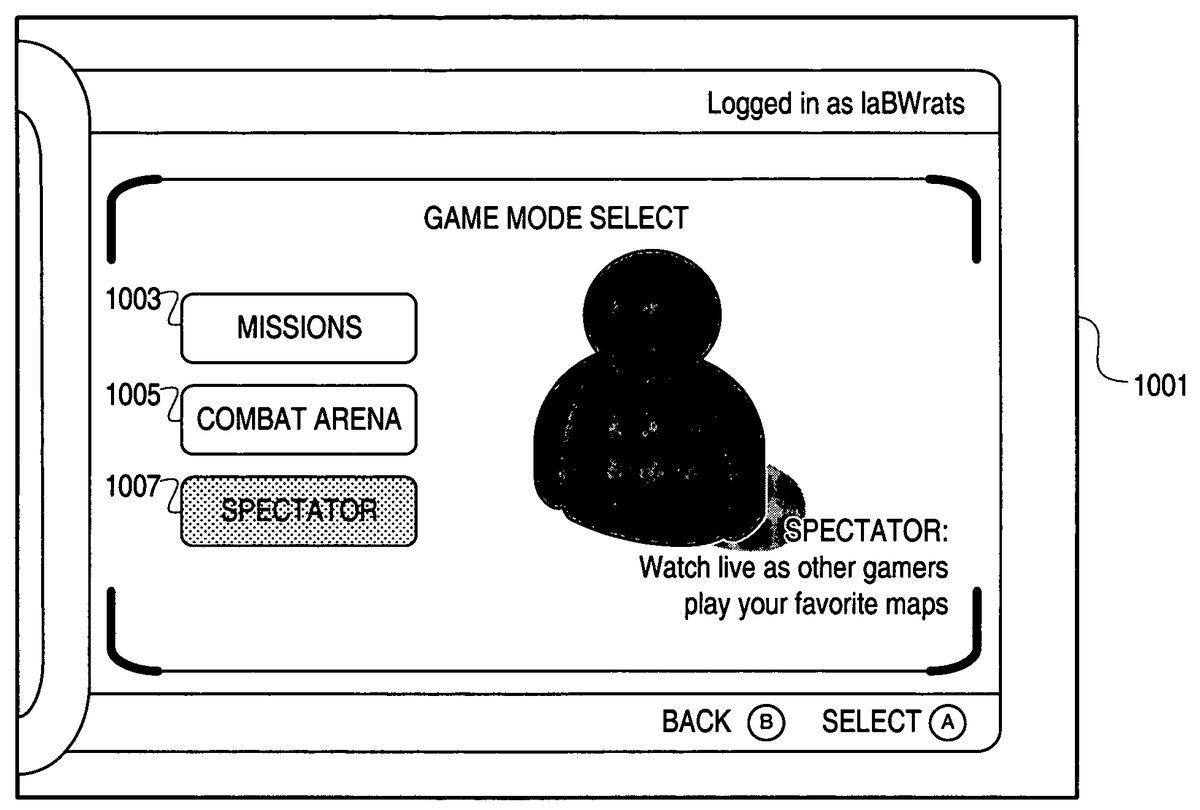
An illustrative system using various aspects described herein is illustrated with respect toFIGS. 10-14.FIG. 10illustrates a menu screen1001of a video game title, through which a user (here, a player having the GamerTag “laBWrats”) selects whether to play a single player game using option button1003, multiplayer game using option button1005, or enter a spectator mode using option button1007. The user may use a game controller thumbstick or D-pad to navigate choices, an ‘A’ button on the game controller to select a choice, and a ‘B’ button on the game controller to go back a menu. In the example ofFIG. 10, the user has highlighted Spectator option1007, and presses the ‘A’ button to enter spectator mode.
Upon entering spectator mode,FIG. 11illustrates screen1101in which a default game session1103has been selected and initiated for spectating. A menu1105may be overlaid over a portion of screen1101, or the user may call up the menu1105upon activation of a predetermined control on a game controller or other control device communicately connected to the spectator client. An enlarged view1107of menu1105is also provided for clarity inFIG. 11. View1107illustrates that menu1105may include channel information1109, game session information1103, and various control options. Control options may include a selection button1111for selecting a Player Cam view, a selection button1113for selecting a Level Cam view, and a selection button1115for selecting a Ghost Cam view. Menu1105may further provide control information1117, e.g., indicating that the D-pad may be used to swap Player Cams (e.g., follow a different player in Player Cam mode), change from first to third person views (and vice versa) while in Player Cam mode, and change cameras in Level Cam mode. The spectator may also be able to pan, tilt, and zoom cameras using the thumbstick controls. The spectator can view a profile of a current player (e.g., a GamerCard) in Player Cam mode by providing predefined input.
From screen1101, when the user selects the option to change channels, e.g., by pressing the ‘X’ button on a game controller, screen1201ofFIG. 12may be displayed. The spectator feed on screen1201may be displayed with a slightly blurred appearance to provide focus to feed list menu1203. A portion of menu1203is shown in the enlarged view1205. As indicated in the lower right of screen1201, a user may use the up and down controls of the D-pad to select a spectator feed within a current channel1209selected from the available channels1207. The user may change channels using the right and left controls on the D-pad. Upon selection of another channel in channel list1209, feed list menu1203automatically updates to display the feeds available within the newly selected channel. Upon selecting a new feed, the game console sends the selection to web services server611, which in turn instructs a corresponding feed distributor server to begin sending the spectator feed to the spectator client, and the screen display goes back to an appearance similar to that inFIG. 11, while displaying the new spectator feed.
Game feeds may be organized into one or more channels1209based on one or more channel criteria to provide a sorting mechanism and refer to the type of games included in that channel. For example, a Best Players or Heroes channel may list game feeds for the highest ranking players presently playing game sessions which are open to spectators; a Friends channel may list any available game feeds in which at least one player on a Friends List of the spectator is competing; a Clans (or Groups) channel may list game feeds for the highest ranking groups presently playing game sessions which are open to spectators; and a Tournament channel may list game feeds for ongoing tournament matches. Other channels may include a Learning channel (e.g., with feeds providing hints, cheats, walk-throughs, etc.), a Highlights channel (e.g., with clips from the days best matches), and/or an Archives channel (e.g., with previously distributed and/or recorded spectator feeds). A separate channel and/or the channel listings described above may include listings for previously played (recorded) game sessions, game sessions that are currently playing (e.g., “live” games), or game sessions that are scheduled to be played at a future time.
As illustrated inFIG. 13, when a user selects a predetermined input, e.g., the ‘B’ button, while watching a spectator feed the game console may display menu1301through which the user can quit spectator mode using selection button1303, in which case the game console may return to screen1001. If the user qualifies according to a predetermined metric, the game console may also provide the user an option1305to join the game being viewed. For example, the user might be given the option to join the game if the game is an open game for which the user does not need to separately qualify, and the user has a ranking meeting some predefined criteria, such as a ranking commensurate with the current participants in the game being spectated.FIG. 14illustrates a state diagram of user input controls and transitions between screens and menus provided thereon, as illustrated inFIGS. 10-13.
Various modifications or alternatives may be made without departing from the spirit and scope of the invention. For example, a filter server615may create a highlights reel and provide the highlights reel as a separate spectator feed which a spectator client may request and display for viewing. Additionally, filter servers may record entire game sessions for distribution as spectator feeds at a later time, such as game sessions where a player accomplished a particularly difficult achievement, performed particularly well (e.g., the championship match of an official tournament), or otherwise performed in a noteworthy fashion. The title server may optionally charge a spectator to view pre-recorded game sessions. For example, the spectator could pay 25 credits or $0.25 through the integrated marketplace, and in exchange receive a “hint” spectator feed which teaches the spectator user how to accomplish a certain feat or goal within a video game title. The title server may further customize such “hint” spectator feeds by overlaying a picture of a game controller on the screen to guide the spectator user through the particularly difficult task.
Thus, using various features and aspects described above, a video game publisher or developer may provide a system through which more players than can participate in a video game can spectate a game session of the video game, optionally regardless of whether the spectator client is also executing the spectated game title. Illustrative aspects described herein may be applied to both single-player and/or multiplayer games. For example, a player may use spectator mode to review game feeds to analyze problems and difficulties for that player in a single-player mode of a game. Various inputs, functions, modules, procedures, servers, and/or other mechanisms may be used to perform features described herein. The present application includes any novel feature or combination of features disclosed herein either explicitly or any generalization thereof. While the features have been described with respect to specific examples including presently preferred modes of carrying out the invention, there are numerous variations and permutations of the above described systems and techniques. Thus, the spirit and scope of the invention should be construed broadly as set forth in the appended claims.
Claims
- One or more computer storage media storing computer executable instructions for performing a method of distributing game telemetry data corresponding to a game session of a video game to a spectator client to allow a user of the spectator client to spectate the game session, said method comprising steps of: receiving at a network location not joined in the game session, game telemetry data generated by one or more participant clients of the game session of the video game, each participant client executing the video game under the control of a corresponding participant player;the network location creating a spectator feed by aggregating the received game telemetry data;receiving a request for the spectator feed from a spectator client not participating in the game session;the network location sending the spectator feed over the computer network to the spectator client;executing the video game on the spectator client using the received game telemetry data wherein the game telemetry data comprises projectile information and wherein the executing step comprises: establishing a ghost character representation for the spectator at the camera position;and applying the received game telemetry data against the ghost character wherein the applying step comprises the ghost character taking damage as a result of being hit by a projectile.
- The computer storage media of claim 1 , wherein the one or more participant clients and the spectator client each comprise a game console.
- The computer storage media of claim 1 , wherein creating the spectator feed comprises chronologically synchronizing the received game telemetry data when there are more than one participant clients.
- The computer storage media of claim 1 , wherein creating the spectator feed comprises capturing a video output from a game engine executing a copy of the video game based on the received game telemetry data.
- The computer storage media of claim 1 , wherein the received game telemetry data comprises a game checkpoint comprising a complete game state.
- The computer storage media of claim 5 , wherein the complete game state comprises metadata describing an event occurring in the video game at a time of the complete game state.
- The computer storage media of claim 6 , further comprising, prior to sending the spectator feed, verifying that the spectator client is authorized to receive the spectator feed.
- The computer storage media of claim 7 , wherein the verifying step comprises verifying that the spectator client submitted payment for the spectator feed.
- The computer storage media of claim 1 , wherein the at least one of the participant clients and the spectator client comprises a game console, and at least one other of the participant clients and the spectator client comprises a desktop computer.
- The computer storage media of claim 1 , wherein the game session comprises a multiplayer game session, and wherein the one or more participant clients comprise a plurality of participant clients.
- One or more computer storage media storing computer executable instructions for performing a method for a non-participating spectator client to spectate a multiplayer game session of a video game title, said method comprising steps of: the spectator client sending over a computer network to a title server corresponding to the video game title a request to spectate the game session;receiving from the title server over the computer network, game telemetry data corresponding to a plurality of participant clients in the multiplayer game session;and executing the video game title on the spectator client using the received game telemetry data, wherein the executing step comprises: establishing a ghost character representation for the spectator at the camera position;and applying the received game telemetry data against the ghost character wherein the game telemetry data comprises projectile information, and wherein the applying comprises the ghost character taking damage as a result of being hit by a projectile.
- The computer storage media of claim 11 , wherein the executing step comprises outputting for display a rendering of the video game title following a location of a participating player of the game session.
- The computer storage media of claim 11 , wherein the executing step comprises outputting for display a rendering of the video game title according to one or more prepositioned cameras in a simulated environment defined by the video game title.
- The computer storage media of claim 11 , wherein the game telemetry data comprises projectile information, and wherein the applying step comprises the ghost character taking damage as a result of being hit by a projectile.
- The computer storage media of claim 12 , wherein the participating player is selectable by a user of the spectator client.
- The computer storage media of claim 12 , said rendering being selectable by a user of the spectator client to be in either of a first-person and third-person perspective.
- The computer storage media of claim 12 , further comprising providing a user of the spectator client profile information corresponding to the participating player upon receiving predefined input from the user of the spectator client.
- The computer storage media of claim 11 , the method further comprising steps of: receiving a request from a user of the spectator client to join the game session;and joining the spectator device to the game session.
- The computer storage media of claim 11 , wherein the executing step comprises outputting for display a rendering of the video game title according to a camera position selected by a user of the spectator client, the camera position in a simulated environment defined by the video game title.
- The computer storage media of claim 11 , wherein the executing step comprises receiving movement input from the user of the spectator client, and wherein the method further comprises moving the camera position based on the received movement input.
Disclaimer: Data collected from the USPTO and may be malformed, incomplete, and/or otherwise inaccurate.