U.S. Pat. No. 7,614,955
METHOD FOR ONLINE GAME MATCHMAKING USING PLAY STYLE INFORMATION
AssigneeMicrosoft Corporation
Issue DateMarch 1, 2004
U.S. Patent No. 7,614,955: Method for online game matchmaking using play style information

Summary:
The ‘955 patent describes a method for accumulating data in order to successively match users during online gaming. One way players are matched together is based upon their style of play. The system attempts to match players who are looking for similar game styles, have similar skill levels, and have similar reputations. The invention uses measurements for several different characteristics before it matches up players, including: aggressiveness, playing likeability, and trash talking. After analyzing the several factors, the system matches players based upon its determination of whether the first player is a good match for the second player.
Abstract:
A method and system for accumulating data to match and matching a user, based upon a play style and/or personal attribute, in an online gaming environment is described. One aspect of the invention provides a matchmaking system that matches players based upon a play style of the players. The system matches players who are looking for games with players who prefer similar play styles. Similarly the system can match players based upon a personal attribute of the player. The system can be built into existing general skill level and technical capabilities based matchmaking systems to provide more user desired matchmaking parameters, allowing a user to choose based upon play style, personal attribute, general skill level, and/or technical capabilities.
Illustrative Claim:
1. A method for matching users over a network in an online gaming environment, the method comprising steps of: entering a user into a first online game available over the network; receiving from the user by way of the network at least one response to at least one query to the user about the first online game experience following completion of the first online game by the user; determining a play style parameter of a requesting user based on the at least one response, the determined play style parameter for being employed to connect the requesting user to a second online game available over the network, the second game being different from the first online game; and connecting the requesting user to the second online game based at least in part on the determined play style parameter; the connecting being based at least in part on a collaborative filtering method that aids the requesting user in the selection of the second online game based upon evaluations of the second online game made by other users.
Illustrative Figure
Abstract
A method and system for accumulating data to match and matching a user, based upon a play style and/or personal attribute, in an online gaming environment is described. One aspect of the invention provides a matchmaking system that matches players based upon a play style of the players. The system matches players who are looking for games with players who prefer similar play styles. Similarly the system can match players based upon a personal attribute of the player. The system can be built into existing general skill level and technical capabilities based matchmaking systems to provide more user desired matchmaking parameters, allowing a user to choose based upon play style, personal attribute, general skill level, and/or technical capabilities.
Description
DETAILED DESCRIPTION OF ILLUSTRATIVE EMBODIMENTS In the following description of various illustrative embodiments, reference is made to the accompanying drawings, which form a part hereof, and in which is shown by way of illustration various embodiments in which the invention may be practiced. It is to be understood that other embodiments may be utilized and structural and functional modifications may be made without departing from the scope of the present invention. Terms Game category—a division within a system of classification of games including multiple game types. A game category includes sports-based games, football-based games, first person shooter-based games. Game type—a particular manufacturer's game. A game type includes Halo™ by Microsoft® Corporation of Redmond, Wash., Unreal® Championship by Epic Games, Inc. of Raleigh, N.C., and SEGA GT 2002™ by SEGA of America, Inc. of San Francisco, Calif. Game—a particular game in which to participate. A game includes a four player Halo™ game hosted by Robert Jenkins in which the objective is capture the flag. Parameter—an identifier that can be utilized by a matchmaking system to match a user to a game category, game type, and/or a user. Parameters include play style parameters, personal attribute parameters, general skill level parameters, and technical capability parameters. Play style parameter—an identifier representative of a style of play of a user. A play style parameter may be specific to a particular game category, game type, game, and/or it may be general to the player. Play style parameters include a competitiveness parameter, an honesty/trustworthy parameter, an aggressiveness parameter, a trash talking parameter, and a profanity parameter. Personal attribute parameter—an identifier representative of an attribute of a player's life. Personal attribute parameters include income, age, gender, characteristics of physical appearance (eye color, body type, hair color), occupation, and educational background. General skill level parameter—an identifier representative of the ...
DETAILED DESCRIPTION OF ILLUSTRATIVE EMBODIMENTS
In the following description of various illustrative embodiments, reference is made to the accompanying drawings, which form a part hereof, and in which is shown by way of illustration various embodiments in which the invention may be practiced. It is to be understood that other embodiments may be utilized and structural and functional modifications may be made without departing from the scope of the present invention.
Terms
Game category—a division within a system of classification of games including multiple game types. A game category includes sports-based games, football-based games, first person shooter-based games.
Game type—a particular manufacturer's game. A game type includes Halo™ by Microsoft® Corporation of Redmond, Wash., Unreal® Championship by Epic Games, Inc. of Raleigh, N.C., and SEGA GT 2002™ by SEGA of America, Inc. of San Francisco, Calif.
Game—a particular game in which to participate. A game includes a four player Halo™ game hosted by Robert Jenkins in which the objective is capture the flag.
Parameter—an identifier that can be utilized by a matchmaking system to match a user to a game category, game type, and/or a user. Parameters include play style parameters, personal attribute parameters, general skill level parameters, and technical capability parameters.
Play style parameter—an identifier representative of a style of play of a user. A play style parameter may be specific to a particular game category, game type, game, and/or it may be general to the player. Play style parameters include a competitiveness parameter, an honesty/trustworthy parameter, an aggressiveness parameter, a trash talking parameter, and a profanity parameter.
Personal attribute parameter—an identifier representative of an attribute of a player's life. Personal attribute parameters include income, age, gender, characteristics of physical appearance (eye color, body type, hair color), occupation, and educational background.
General skill level parameter—an identifier representative of the expertise of a player for a game category, game type, and/or game. General skill levels include novice, advanced, expert, and win/lose ratio.
Technical capability parameter—an identifier representative of the technical characteristics of the electronic equipment associated with the player. Technical capability parameters include network connection speed and operation speed of the player's computer.
General Computing Platforms
FIG. 1illustrates an example of a suitable computing system environment100on which the invention may be implemented. The computing system environment100is only one example of a suitable computing environment and is not intended to suggest any limitation as to the scope of use or functionality of the invention. Neither should the computing system environment100be interpreted as having any dependency or requirement relating to any one or combination of components illustrated in the exemplary computing system environment100.
The invention is operational with numerous other general purpose or special purpose computing system environments or configurations. Examples of well known computing systems, environments, and/or configurations that may be suitable for use with the invention include, but are not limited to, personal computers, server computers, hand-held or laptop devices, multiprocessor systems, microprocessor-based systems, set top boxes, programmable consumer electronics, network PCs, minicomputers, mainframe computers, distributed computing environments that include any of the above systems or devices, and the like.
The invention may be described in the general context of computer-executable instructions, such as program modules, being executed by a computer. Generally, program modules include routines, programs, objects, components, data structures, etc. that perform particular tasks or implement particular abstract data types. The invention may also be practiced in distributed computing environments where tasks are performed by remote processing devices that are linked through a communications network. In a distributed computing environment, program modules may be located in both local and remote computer storage media including memory storage devices.
With reference toFIG. 1, an exemplary system for implementing the invention includes a general-purpose computing device in the form of a computer110. Components of computer110may include, but are not limited to, a processing unit120, a system memory130, and a system bus121that couples various system components including the system memory to the processing unit120. The system bus121may be any of several types of bus structures including a memory bus or memory controller, a peripheral bus, and a local bus using any of a variety of bus architectures. By way of example, and not limitation, such architectures include Industry Standard Architecture (ISA) bus, Micro Channel Architecture (MCA) bus, Enhanced ISA (EISA) bus, Video Electronics Standards Association (VESA) local bus, and Peripheral Component Interconnect (PCI) bus also known as Mezzanine bus.
Computer110typically includes a variety of computer readable media. Computer readable media can be any available media that can be accessed by computer110and includes both volatile and nonvolatile media, removable and non-removable media. By way of example, and not limitation, computer readable media may comprise computer storage media and communication media. Computer storage media includes volatile and nonvolatile, removable and non-removable media implemented in any method or technology for storage of information such as computer readable instructions, data structures, program modules or other data. Computer storage media includes, but is not limited to, random access memory (RAM), read only memory (ROM), electronically erasable programmable read only memory (EEPROM), flash memory or other memory technology, CD-ROM, digital versatile disks (DVD) or other optical disk storage, magnetic cassettes, magnetic tape, magnetic disk storage or other magnetic storage devices, or any other medium which can be used to store the desired information and which can accessed by computer110. Communication media typically embodies computer readable instructions, data structures, program modules or other data in a modulated data signal such as a carrier wave or other transport mechanism and includes any information delivery media. The term “modulated data signal” means a signal that has one or more of its characteristics set or changed in such a manner as to encode information in the signal. By way of example, and not limitation, communication media includes wired media such as a wired network or direct-wired connection, and wireless media such as acoustic, RF, infrared and other wireless media. Combinations of the any of the above should also be included within the scope of computer readable media.
The system memory130includes computer storage media in the form of volatile and/or nonvolatile memory such as ROM131and RAM132. A basic input/output system133(BIOS), containing the basic routines that help to transfer information between elements within computer110, such as during start-up, is typically stored in ROM131. RAM132typically contains data and/or program modules that are immediately accessible to and/or presently being operated on by processing unit120. By way of example, and not limitation,FIG. 1illustrates operating system134, application programs135, other program modules136, and program data137.
The computer110may also include other removable/non-removable, volatile/nonvolatile computer storage media. By way of example only,FIG. 1illustrates a hard disk drive141that reads from or writes to non-removable, nonvolatile magnetic media, a magnetic disk drive151that reads from or writes to a removable, nonvolatile magnetic disk152, and an optical disc drive155that reads from or writes to a removable, nonvolatile optical disc156such as a CD ROM or other optical media. Other removable/non-removable, volatile/nonvolatile computer storage media that can be used in the exemplary operating environment include, but are not limited to, magnetic tape cassettes, flash memory cards, digital versatile disks, digital video tape, solid state RAM, solid state ROM, and the like. The hard disk drive141is typically connected to the system bus121through a non-removable memory interface such as interface140, and magnetic disk drive151and optical disc drive155are typically connected to the system bus121by a removable memory interface, such as interface150.
The drives and their associated computer storage media discussed above and illustrated inFIG. 1, provide storage of computer readable instructions, data structures, program modules and other data for the computer110. InFIG. 1, for example, hard disk drive141is illustrated as storing operating system144, application programs145, other program modules146, and program data147. Note that these components can either be the same as or different from operating system134, application programs135, other program modules136, and program data137. Operating system144, application programs145, other program modules146, and program data147are given different numbers here to illustrate that, at a minimum, they are different copies. A user may enter commands and information into the computer110through input devices such as a digital camera163, a keyboard162, and pointing device161, commonly referred to as a mouse, trackball or touch pad. Other input devices (not shown) may include a microphone, joystick, game pad, satellite dish, scanner, or the like. These and other input devices are often connected to the processing unit120through a user input interface160that is coupled to the system bus121, but may be connected by other interface and bus structures, such as a parallel port, game port or a universal serial bus (USB). A monitor191or other type of display device is also connected to the system bus121via an interface, such as a video interface190. In addition to the monitor, computers may also include other peripheral output devices such as speakers197and printer196, which may be connected through an output peripheral interface195.
The computer110may operate in a networked environment using logical connections to one or more remote computers, such as a remote computer180. The remote computer180may be a personal computer, a server, a router, a network PC, a peer device or other common network node, and typically includes many or all of the elements described above relative to the computer110, although only a memory storage device181has been illustrated inFIG. 1. The logical connections depicted inFIG. 1include a local area network (LAN)171and a wide area network (WAN)173, but may also include other networks. Such networking environments are commonplace in offices, enterprise-wide computer networks, intranets and the Internet.
When used in a LAN networking environment, the computer110is connected to the LAN171through a network interface or adapter170. When used in a WAN networking environment, the computer110typically includes a modem172or other means for establishing communications over the WAN173, such as the Internet. The modem172, which may be internal or external, may be connected to the system bus121via the user input interface160, or other appropriate mechanism. In a networked environment, program modules depicted relative to the computer110, or portions thereof, may be stored in the remote memory storage device. By way of example, and not limitation,FIG. 1illustrates remote application programs185as residing on memory device181. It will be appreciated that the network connections shown are exemplary and other means of establishing a communications link between the computers may be used.
It will be appreciated that the network connections shown are exemplary and other means of establishing a communications link between the computers can be used. The existence of any of various well-known protocols such as TCP/IP, Ethernet, FTP, HTTP and the like is presumed, and the system can be operated in a client-server configuration to permit a user to retrieve web pages from a web-based server. Any of various conventional web browsers can be used to display and manipulate data on web pages.
Although not required, many embodiments are described in the general context of computer-executable instructions, such as program modules, being executed by a personal computer. Generally, program modules include routines, programs, objects, components, data structures, etc. that perform particular tasks or implement particular abstract data types. Moreover, those skilled in the art will appreciate that various aspects may be practiced with other computer system configurations, including hand-held devices, multiprocessor systems, microprocessor-based or programmable consumer electronics, game consoles, network PCs, minicomputers, mainframe computers, and the like. In accordance with at least one aspect of the present invention, in distributed computing environments tasks may be performed by remote processing devices that are linked through a communications network. In a distributed computing environment, program modules may be located in both local and remote memory storage devices.
Matchmaking Process
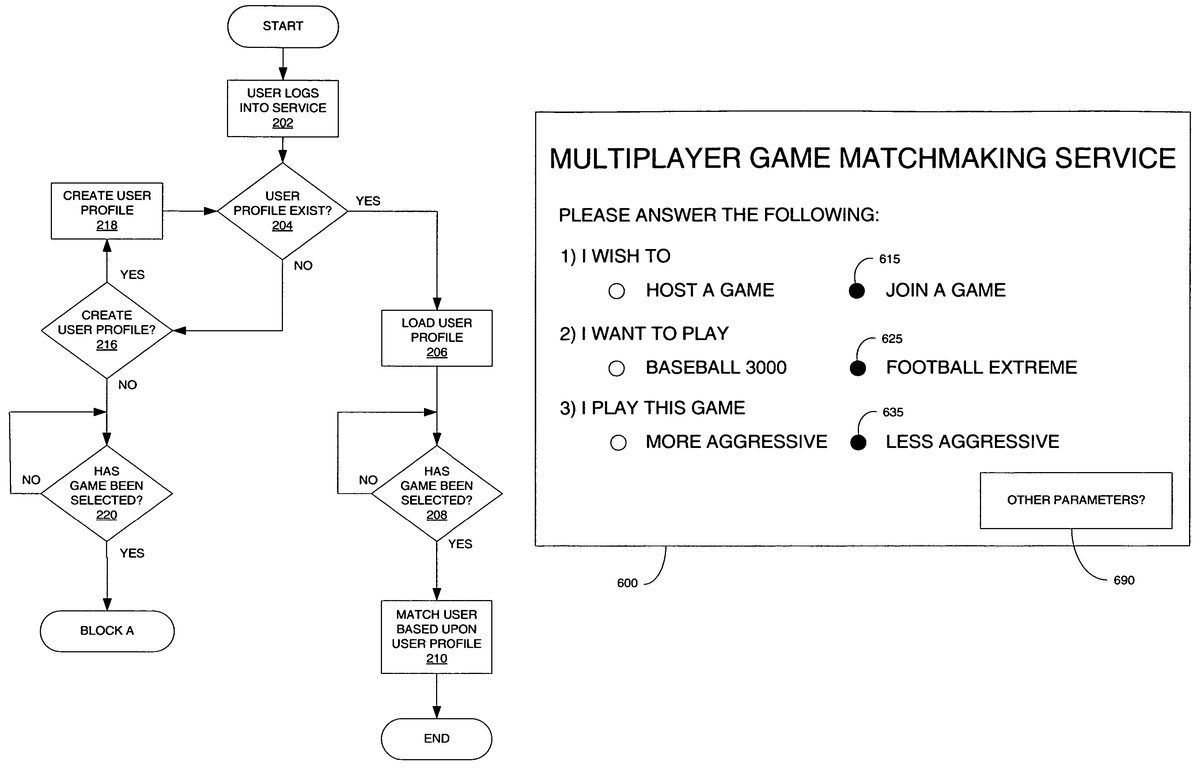
FIGS. 2A and 2Bshow a flow chart of an illustrative method for matching users to other users in an online gaming environment in accordance with one aspect of the present invention. The exemplary method begins inFIG. 2Awhen a user/player logs into a matchmaking service provider for an online gaming experience at step202. There are a number of different ways in which a user may connect to an online service for matching purposes, including dialing into the service via a modem and telephone line and/or connecting via a high speed Ethernet connection. Also, there are a number of different ways in which a user may log into such a service. For example, the matchmaking service may require the user to enter a valid name or identification and associated password. The user may be required to have a valid account with the matchmaking service provider. Once a user has logged into the matchmaking service, at step204, a determination is made as to whether a profile exists for the user.
A profile for a user can be any type of a number of different parameters associated with the user. For example, the profile may contain technical capabilities of the user (such as computer speed and connection speed), general skill level information of the user (such as novice in one game while expert in another), play style information of the user (such as competitiveness, aggressiveness, profanity), and/or personal attributes of the player (such as age, income, educational background, occupation, home state). Further examples of play style information and personal attributes are described below. In response to determination step204, if a profile is found to exist for the user, the profile is loaded at step206. A determination is made as to whether a game category, game type, and/or game has been selected by the user and/or whether the system has automatically selected a game category, game type, and/or game at step208and, if so, the user is matched to other users/players to play a game of the game category, a game of the game type, or the game based at least in part upon the profile of the user at step210. It should be understood by those skilled in the art that other classifications may be utilized within the matchmaking process and that the present invention is not limited to game categories, game types, and games as defined herein. Any classification could have a sub-classification. For example, a game category may be sports-based games, while a sub game category may include football based games and baseball based games. Further, an additional sub category under the football based sub category may include professional team based games, collegiate team based games, and street based games. Further, sub game types may include different versions of the same manufactured game, such as “FOOTBALL EXTREME” and “FOOTBALL EXTREME SPECIAL EDITION”. Any number of different classification systems may be utilized in accordance with the present invention.
If a profile is found not to exist for a user at step204, a further determination is made as to whether the user wishes a new profile to be created for the user at step216. Such a determination may be an inquiry by the matchmaking service to the user and receiving a response from the user acknowledging the desire of the user to have a profile created. If there is a request to create a user profile, the process proceeds to step218where a user profile is created. With the user profile created in step218, the process returns to step204. However, if the user does not want a profile created at step216, at step220, a determination is made as to whether a game category, game type, and/or game has been selected by the user. If a game category, game type, and/or game has been selected at step220, the process continues to step230inFIG. 2B.
At step230, a determination is made as to whether all parameter(s) have been selected by the user and/or whether all parameter(s) required by the system have been selected. If all parameter(s) have been selected, the process proceeds to step232where the user is matched to other users/players to play a game based at least in part upon the selected parameter(s). If all parameter(s) have not been selected at step230, the process proceeds to step240where a determination is made as to whether a parameter has been selected. If a parameter has been selected at step240, the process proceeds to step242where a determination is made as to whether the selected parameter is a skill level parameter of the user. If the answer is yes, the method identifies the skill level as the selected parameter at step244and then the process returns to step230. If skill level is not the selected parameter in step240, the process proceeds to step252where a determination is made as to whether the selected parameter is a technical capability of the user's computer and/or connection speed. If the answer is yes, the method identifies the technical capability as the selected parameter in step254and them the process returns to step230. If technical capability is not the selected parameter at step252, the process proceeds to step262where the method identifies play style as the selected parameter and the process returns to step230. Under such a system, a user/player can be matched in a game with other users/players based upon conventional parameters such as general skill level and technical capabilities as well as play style information associated with and/or chosen by the user/player. Although not shown in this example, a user may be connected by personal attribute parameters in the alternative or as well.
FIG. 3is a flow chart of an illustrative method for creation and/or modification of a profile of a user/player for matching with other users/players in an online gaming environment in accordance with at least one aspect of the present invention. The process starts at step302where a matchmaking system receives the name of the user/player and proceeds to step304where the system receives a preferred controller configuration for gaming purposes. An example of a preferred controller configuration for gaming purposes includes a predefined setting on the controller for the buttons and operations of inputs, such as in flight simulation games, pushing up on a joystick will lower the nose of the plane compared to a different configuration where pushing up on the joystick will lift the nose of the plane. An example matchmaking service may request and/or receive the general skill level parameter of the user, whether for a particular game and/or for anything. At step308, a determination is made as to whether all parameter(s) have been selected by the user and/or all parameter(s) required by the system have been selected. Although the matchmaking system may be configured to allow for a user to be matched based upon a play style parameter, a user may want to immediately to be connected to a game with no more than the general skill level as the filtering parameter. If all parameter(s) have been selected at step308, the process proceeds to step310where the parameter(s) are stored in a profile of the user.
In the alternative, if all parameter(s) have not been selected at step308, the process proceeds to steps320-360. For each of steps320-360, if applicable, the system receives the corresponding play style or personal attribute parameter and the process returns to step308. For example, responsive to the user and/or system selecting a level of online aggressiveness, at step320, the system receives the level of online aggressiveness parameter, and returns to step308. Level of online aggressiveness may be an indicator of the amount of risk that a player will take during a game. The level of online aggressiveness parameter may be the level that the user would like to play with/against or it may be the level of the user herself, e.g., whether the user herself is very aggressive. Responsive to the user and/or system selecting a level and/or allowance of trash talking, at step325, the system receives the trash talking parameter and returns to step308. The level and/or allowance of trash talking parameter may be the level and/or allowance that the user would like to play with/against or it may be the level and/or allowance of the user herself, e.g., whether the user herself trash talks. Responsive to the user and/or system selecting a level and/or allowance of profanity, at step330, the system receives the profanity parameter and returns to step308. The level and/or allowance of profanity parameter may be the level and/or allowance that the user would like to play with/against or it may be the level and/or allowance of the user herself, e.g., whether the user herself uses profanity. Responsive to the user and/or system selecting a playing likeability factor for another player and/or the playing likeability factor of the user herself, at step335, the system receives the playing likeability parameter and returns to step308. Other play style parameters not shown may include a competitiveness parameter, e.g., whether the player plays to win or plays for fun, a role play parameter, e.g., how much the player assumes the role of the character during the game, and a honesty/trustworthy parameter, e.g., whether a player tends to deceive others during the game.
Responsive to the user and/or system selecting a desired age of another player and/or the age of the user herself, at step340, the system receives the age parameter and returns to step308. Responsive to the user and/or system selecting a desired gender of another player and/or the gender of the user herself, at step345, the system receives the gender parameter and returns to step308. Responsive to the user and/or system selecting a desired occupation of another player and/or the occupation of the user herself, at step350, the system receives the occupation parameter and returns to step308. Responsive to the user and/or system selecting a level and/or minimum/maximum amount of education for another player and/or for the user herself, at step355, the system receives the education parameter and returns to step308. Responsive to the user and/or system selecting a level and/or allowance of income of another player and/or the income of the user herself, at step360, the system receives the income parameter and returns to step308. Other personal attribute parameters not shown may include a home state parameter, a physical appearance characteristic parameter (such as eye color, hair color, body shape), and a leisure activity parameter, e.g., whether a player participates in a certain type of leisure activity.
Play style parameters may be associated with a particular game as well. In one example, a user may have a more aggressive play style parameter for a first game, but then also have a less aggressive play style parameter for a second game. A play style parameter for a particular game may include whether the user prefers to play the game to win or play the game for fun, e.g., a competitiveness parameter. A play style parameter may be associated with a characteristic of the user for a particular game only, such as being a team player for one game while being a saboteur or trash talking for another. Examples of play style parameters include, but are not limited to whether the user: is honesty/trustworthy, is a team player, is a committed gamer, plays to win vs. plays for fun, enacts the role in the game (takes on the purpose of the character, e.g., performs the purpose of a sniper in a team combat game), meets a desired playing likeable, is aggressive, and is a trash talker. Play style parameters can be determined based upon data received from other players and/or the user, such as the playing likeability, trash talking, and honesty/trustworthy parameters. It should be understood by those skilled in the art that play style parameters may be determined by the user herself and/or by the matchmaking system, such as by use of a collaborative filtering method described below.
A personal attribute parameter may be associated with a characteristic of the user that is not game specific, such as the age, income, educational background, occupation, family status (such as mother, grandmother, oldest sibling, divorcee) of the player. A personal attribute parameter may also be a voice recording of the user. Examples of personal attribute parameters include, but are not limited to whether the user: meets an educational background requirement, meets an income requirement, meets a physical appearance requirement, meets a friendliness requirement, is humorous, meets an age requirement, meets a gender requirement, meets a home state requirement, meets an occupation requirement, and meets a leisure activity requirement. Personal attribute parameters can be determined based upon data received from other players and/or the user.
FIG. 4is a flow chart of an illustrative method for matching guests to a host game in an online gaming environment in accordance with at least one aspect of the present invention. At step402, a user initiates a host game. There are many ways in which a user may initiate a host game in an online gaming environment and the present invention is not restricted to any one method. At step404, the user identifies and/or selects play style and/or personal attribute parameters for the host game. In this step, the user may choose that only people willing to hear trash talk are allowed to participate and/or only people that live in the New England area, that are female, and that are college educated are allowed to participate. Although not shown in this example, the user could also choose other parameters, such as technical capabilities of another player and/or general skill level of another player. In this example, if a user chooses to participate in a checkers game type, the user may have to allow for trash talking and/or be a college educated female that resides in the New England area.
At step406, a guest selects entry into the host game of the user. At step408, a determination is made as to whether the guest profile matches the play style and/or personal attribute parameters required to participate in the host game. For example, a guest profile might be required to show that the guest is from the New England area, that she is female, and that she is college educated. If the guest profile does not match the play style and/or personal attribute parameters required to participate in the host game, the guest cannot be matched to participate in the host game and the process concludes. Alternatively, if the guest profile does match in step408, the process proceeds to step410where the guest is entered into the host game. The process proceeds to step412where a determination is made as to whether all player spots have been filled for the multiplayer host game. If yes, the process is concluded. If no, the process returns to step406to await more guests to participate. Although not shown in this example, the host game of the matchmaking system also may require that the guest profile match a general skill level parameter and/or a technical capability parameter.
FIG. 5is an exemplary schematic block diagram of a network layout500utilizing matchmaking in accordance with at least one aspect of the present invention. As shown inFIG. 5, online game matchmaking environment500includes a communication medium, such as the Internet510, a matchmaking server520, and player computers531-540. Under the system500, a user can connect via player computer531to the matchmaking server520via the Internet510. The Internet510is but one method for online gaming capabilities over a network. Other similar modes for data transmission can be utilized in its place. Once connected to the matchmaking server520, the user can request to be matched to a particular game in accordance with a profile of the user and/or answering questions to filter the process. Examples of such are described above with reference toFIG. 2AtoFIG. 4.
A user at player computer538, also connected through the Internet510, may have a host game awaiting other players to join. Matchmaking server520can compare the profile of the user at player computer531to see if it meets the requirements for the host game of the user at player computer538. If so, matchmaking server520can match the user at player computer531to the host game of the user at player computer538.
FIGS. 6A and 6Bare example graphical user interfaces for matching users/players in an online gaming environment in accordance with at least one aspect of the present invention.FIG. 6Ashown an example screen600that may be displayed to a user having logged into the matchmaking service. As shown inFIG. 6A, a question or set of questions can be displayed for the user to respond answer. In this example, the system requests three answers. First, the system asks whether the user wishes to host a game or join a game type. In this example, the user has selected to join a game type by clicking the check box615beside that entry. Second, the system asks the user which available game type the user wishes to join. In this example, there are two available games, “BASEBALL 3000” and “FOOTBALL EXTREME”. The user has selected “FOOTBALL EXTREME” as shown by checked box625. Finally, the system asks a play style question, whether the user plays more aggressive or less aggressive. The user has selected less aggressive as shown by checked box635. If desired, although not shown, a user could choose the other parameters? button690to allow the user to select other parameters for matchmaking purposes. The other parameters can be play style parameters, personal attribute parameters, general skill level parameters, and/or technical capability parameters.
FIG. 6Bshows another graphical user interface after the user has answered all of the questions presented inFIG. 6A. As shown inFIG. 6B, example screen605displays the results. The matchmaking system has found four current open games that the user can join because the play style and/or personal attribute parameters within the user's profile match the requirements of the host game and/or because the play style and/or personal attribute parameters of all of the other participants in the open games or the open game play style and/or personal attribute parameters match the requirements/desires of the user. For example, each game shown on screen605may require a user that plays the game less aggressively as a play style parameter. Alternatively, every open game may be a less aggressive game as desired by the user. The user can select to filter the number of open game choices by choosing the other parameters? button695to filter by more parameters, whether play style parameters, personal attribute parameters, general skill level parameters, and/or technical capabilities parameters. As shown inFIG. 6B, the user has selected the game entitled, “MIKE'S BEARS VS. PACKERS FOREVER GAME” as shown by checked box660. By checking box660, the user has completed the matchmaking process to be connected to a particular game based upon a play style and/or personal attribute.
FIGS. 7A and 7Bare example graphical user interfaces for matching players in an online gaming environment in accordance with at least one aspect of the present invention.FIGS. 7A and 7Bmay be screens700and705respectively displayed to a user if the user decides to further filter the matchmaking process by other parameters. Such a case may occur when the user presses the other parameters? button690or695. As shown inFIG. 7A, the user is given a list of possible additional parameters that may be used to further filter the matchmaking process. As shown on screen700, the user can check a box or boxes that correspond to the desired parameter. For example, multiple play style and personal attribute parameters are shown on screen700for basing a match with the user, including income, age, home state of the other player, whether trash talking is allowed/accepted by the user, and even a physical appearance characteristic of the other player. As shown inFIG. 7A, the user has checked the physical appearance characteristic box715indicating that she wishes to be matched to another user in for an online gaming experience based upon some characteristic of the physical appearance of the other player. For instance, a characteristic of the physical appearance of the other player may be a picture, a video segment, and/or textual information, such as hair color, eye color, and/or height.
As shown inFIG. 7B, screen705may be displayed when the user has checked the physical appearance characteristic box715shown onFIG. 7A. Screen7B shows a picture of four available other players that the user can choose between to be matched up for an online gaming experience. Because players can interact direct by two way audio in some online gaming systems, and further because many individuals are playing online games for social rather than mere competitive reasons, a user may want to be playing with/against someone based upon a characteristic of his/her physical appearance. As shown inFIG. 7B, the user has selected the individual picture shown in the lower right corner by checking box765. As such, the user may be matched with the individual associated with the picture shown to an online gaming experience. Still further, at any point in this process, the user can select the still other parameters? button790and/or795to see even more possible parameters to choose from for matchmaking purposes. A user may desire to be matched with a user for an online gaming experience based at least in part on a physical appearance characteristic of another player for certain game categories, game types, or games. For example, a player may wish to participate in an interactive social lifestyle game type such as the SIMS™ series of games developed by Electronic Arts™, Inc. of Redwood City, Calif. In such a game type, a user may be able to place an image of a physical appearance characteristic of a real life person onto a body of a character within the game to interact with. As such, the physical appearance characteristic of a person may be a desired parameter to choose from.
FIGS. 8A and 8Bare example graphical user interfaces for accumulating data from players in an online gaming environment in accordance with at least one aspect of the present invention. Profile information for a user can be generated by the user herself and/or by accumulation of data based upon information received from and/or about the user. Collaborative filtering methods can be used to accumulate the data necessary for matchmaking purposes based upon play style personal attribute, technical capability, and/or general skill level parameters and for matching players to game categories, game types, and/or games. For example, playing likeability, competitive, and honesty/trustworthy play style parameters may be determined either partially or entirely through collaborative filtering methods. Similarly, personal attribute parameters can be used by a collaborative filtering method to match users. Collaborative filtering is the process of aiding a person in the selection of an item based upon the evaluations made by others and/or the person and others. Collaborative filtering methods help to reduce the information overload that the person may encounter in a matchmaking environment system. Collaborative filtering methods employ and/or produce ratings, e.g., an evaluation of an individual, a game, and/or an experience. Collaborative filtering may be based on computation of various types of information, such as responses received from a user after a game has been played. Based upon the information received by means of collaborative filtering methods, a player can be matched to a certain game and/or recommended game. Collaborative filtering methods for document retrieval, product purchases, and/or product recommendations are well known in their respective arts.
The graphical user interfaces shown in screen800and805ofFIGS. 8A and 8Brespectively illustrate example screens that may be displayed to the user upon completion and/or ending of an online game experience.FIGS. 8A and 8Billustrate an example multiplayer game in which four individuals participated. As part of the post game analysis shown inFIG. 8A, the system asks the user to answer a few questions. The responses to these questions may be used to assign play style parameters to a user and/or other people. InFIG. 8A, the system asks the user to answer whether she enjoyed the game itself, e.g., whether the selected game, “FOOTBALL EXTREME”, was enjoyable. The user has responded by checking the no box815. For a collaborative filtering method, the question may be how much the user enjoyed the game on a scale of 1-10. Next, the system asks the user whether she enjoyed playing with the people in the multiplayer game, Bob, Mike, and Jim. As shown, the user has checked the yes box825. Then the system asks the user to state who her favorite person was to play with/compete against. The user has selected Bob by checking box835. Finally, the system asks the user to select the person that she did not like to play with/compete against and/or the least favorite person that she played with/competed against. In this example, the user has selected Mike by checking box845. If the user so desires, she may answer further questions and/or provide comments or other data by pressing the other questions? button890.
FIG. 8Bmay be displayed to the user responsive to the answers she submitted inFIG. 8A. The first questions presented may be in response to how she answered the first question inFIG. 8A. Specifically, in this example, the system asks the user to indicate specific information about the game just played. In this example, the user has checked the boxes indicating that the game, “FOOTBALL EXTREME”, was too violent865and too difficult867for the user. The system next asks the user to evaluate player Bob. Because the user indicated that Bob was her favorite player to play with in the game as shown inFIG. 8A, the system can configure the choices for the user to choose from based upon previous responses received. As such, in this example, the user has selected the checked box785indicating that she felt that Bob was friendly to participate with in the game, but that he was not very good at the game itself. Next, the system asks the user to evaluate player Mike. Because the user indicated that Mike was her least favorite player to play with in the game as shown inFIG. 8A, the system can configure the choices for the user to choose from based upon the previous responses received. As such, in this example, the user has selected the checked box885indicating that she felt that Mike was good at the game itself, but not very friendly to participate with in the game. Again, if the user so desires, she may answer further questions and/or provide comments or other data by pressing the other questions? button895.
Based upon the responses received from the user and/or the other participants in the game, the matchmaking system can set certain play style and/or personal attribute parameters of an individual in the individual's profile. For example, if three of the four participants indicated that Mike was not friendly to participate with in the game, the personal attribute parameter associated with friendliness for Mike may be modified in response. Any of a number of other methods may be used to modify a profile of an individual. Such methods may be used in conjunction with a collaborative filtering method for future matchmaking. For example, if an individual, such as Mike, has been identified by a number of gamers as a person that should not be matched with those gamers, the play style parameter “playing likeability” may be changed for Mike's profile to indicate that Mike has a low playing likeability rating. Therefore, in future matchmaking processes, users that want an individual with a high playing likeability rating will not be matched with a player like Mike having a low playing likeability rating. Any parameter, whether technical capability, general skill level, personal attribute, or play style, may be modified in response to the data received.
Collaborative filtering allows the matchmaking system to match a user to a particular game and/or player based upon the response received from others and the user that are associated with the user. For example, if user I has indicated in the past that she like to participate in sports games with Mike, and user2has indicated in the past that she likes to participate in sports games with user1, the matchmaking system, by collaborative filtering, can match user2into a sports game with Mike based upon the associated connection with user1. This is but one example of a relatively simple collaborative filtering method. In actual practice, there may be thousands of users and associations with different degrees of relevance and/or factoring. Under another collaborative filtering method the determination to match a user may be based upon the desires of the user herself as well as other players. For example, if user1is a more aggressive player, her preferences based on a one way collaborative filtering process may be to play against a less aggressive player. In a one way filter determination, user1may seem to be an accurate match with player2. However, player2may dislike participating against more aggressive players in a gaming environment and may be a comparatively low probability collaborative filtering match with user1. A two way collaborative filtering method may include a two way analysis to consider the weighted likelihood of enjoyment for both user1and player2. In response, the matchmaking system with a two way collaborative filtering method may not match user1with player2. U.S. Pat. Nos. 6,353,813 and 6,092,049 describe collaborative filtering methods that may be used with the present application. U.S. Pat. Nos. 6,353,813 and 6,092,049 are herein incorporated by reference.
In operation for one example, a collaborative filtering method may be used as follows with reference toFIG. 9. Within a single game type (CHECKERS EXTREME), if Player A enjoyed playing with Players B, C, and D, but did not enjoy playing with Players E, F, and G, in a future matchmaking occurrence, the system may decide to match Player A with players that Players B, C, and/or D enjoyed playing (such as Players H, L, and P) and with players that enjoyed playing with Players B, C, and/or D (such as Players J, M, and R). The matchmaking system may decide to not match Player A with players that B, C, and/or D did not enjoy playing (such as Players I and O) and with players that did not enjoy playing with Players B, C, and/or D (such as Players K, N, and Q). Further, the matchmaking system may decide to not match Player A with players that enjoyed playing with Players E, F, and/or G (such as Players S, U, and W) and with players that Players E, F, and/or G enjoyed playing (such as Players T and V). However, the matchmaking system may decide to match Player A with players that did not enjoy playing with Players E, F, and/or G (such as Player X). In each of the above described matching decisions, the matchmaking system can determine a likelihood of whether one player is a good match for another player (such the likelihood that Player A is a good match for Player H, but is not likely to be a good match for Player S). The determining of likelihood data can be maintained within a database included within and/or separate to the matchmaking system. The data associated with the likelihood of being a good match may be based on a scale, such as 1-10 and/or some other of a number of different ranking systems. The matchmaking system may also take into account a player's behavior across games. Thus, if Player A enjoyed playing team oriented games with Players B, C, and D, enjoyed playing sports games with Players B and C, but did not enjoy playing a team game on the same team with Players B and D, in a matchmaking process, Player A may be matched with Players B, C, and D in a team oriented sports game in which Player A is on the same team as Player C, while Players B and D are on the opposite team.
As described above,FIG. 5is an exemplary schematic block diagram of a network layout500utilizing matchmaking in accordance with at least one aspect of the present invention. Network layout500may include a database920coupled to the matchmaking server520. Under the system500, a user can connect via player computer531to the matchmaking server520via the Internet510. Once connected to the matchmaking server520, the user can request to be matched to a particular game in accordance with a profile of the user and/or answering questions to filter the process. The profile of the user may be stored at database920and/or another location.
A user at player computer538, also connected through the Internet510, may have a host game awaiting other players to join. Matchmaking server520can compare the profile of the user at player computer531to see if it meets the requirements for the host game of the user at player computer538. A profile of a player can be stored locally at the player computer, at database920of the matchmaking server520, and/or at another external database. If the profile matches the requirements, matchmaking server520can match the user at player computer531to the host game of the user at player computer538. Upon completion of the game, the user at player computer531can provide data that can be stored in database920and/or processed by the matchmaking server520and then stored in database920. It should be understood by one skilled in the art that the data may be processed in a computer external to the matchmaking server520and/or the database920. The data may allow the matchmaking server520to more accurately match users into games fitting their desired requirements.
In operation, a user may Want to participate in a four player sports game in which trash talking and profanity are allowed. Further, the user may want to participate against someone of the same sex, age, occupation, and skill level (such as novice) for the game. The user can log onto the matchmaking service provider for online gaming. The user may enter her identification and password for authentication. The user may then choose to see available game categories. Since she wants to try a sports game, she chooses a sports game category. The system then may provide a listing of game types under the sports game category. The user then chooses a particular game category, such as “FOOTBALL EXTREME”. In response, the matchmaking system may provide a listing of parameters with which the user may choose to filter the matchmaking process. Alternatively, the matchmaking system may access the profile of the user to determine the parameters for matching. The user chooses a four player game in which trash talking and profanity are allowed as well as limiting to game with players who are female, of the same age and occupation as the user, and whose skill level is novice. In response, the system provides a list of available open games that meet the criteria of the user. Alternatively, the system may automatically match the user based at least in part on the selected parameters. Once the user chooses a particular game from the list, the system connects the user to the game. Once complete, the matchmaking system can use responses received from the user for evaluation of the game and/or other participants to be used for future matchmaking processes for the user and/or others.
While illustrative systems and methods as described herein embodying various aspects of the present invention are shown, it will be understood by those skilled in the art, that the invention is not limited to these embodiments. Aspects of the present invention may be included into existing matchmaking systems and/or methods. Modifications may be made by those skilled in the art, particularly in light of the foregoing teachings. For example, each of the elements of the aforementioned embodiments may be utilized alone or in combination or subcombination with elements of the other embodiments. It will also be appreciated and understood that modifications may be made without departing from the true spirit and scope of the present invention. The description is thus to be regarded as illustrative instead of restrictive on the present invention.
Claims
- A method for matching users over a network in an online gaming environment, the method comprising steps of: entering a user into a first online game available over the network;receiving from the user by way of the network at least one response to at least one query to the user about the first online game experience following completion of the first online game by the user;determining a play style parameter of a requesting user based on the at least one response, the determined play style parameter for being employed to connect the requesting user to a second online game available over the network, the second game being different from the first online game;and connecting the requesting user to the second online game based at least in part on the determined play style parameter;the connecting being based at least in part on a collaborative filtering method that aids the requesting user in the selection of the second online game based upon evaluations of the second online game made by other users.
- The method of claim 1 , wherein the determining step comprises the steps of: receiving a profile of the requesting user;and identifying the play style parameter of the requesting user in the profile.
- The method of claim 1 , wherein the connecting step includes the step of determining whether the determined play style parameter matches a play style parameter requirement for the second online game.
- The method of claim 1 , further comprising the steps of: providing a list of online games with a play style parameter requirement that matches the determined play style parameter of the requesting user;and receiving a selection signal representative of the second online game from the list of online games.
- The method of claim 1 , wherein the determining step comprises the steps of: providing a list of play style parameters;and receiving a selection signal representative of the play style parameter from the list of play style parameters.
- The method of claim 1 , further comprising the steps of: receiving a request to initiate a matchmaking service for the requesting user;receiving identification data of the requesting user;and retrieving a profile of the requesting user.
- The method of claim 1 , wherein the play style parameter comprises one of: a competitive parameter, a profanity parameter, a trash talking parameter, and an aggressiveness parameter.
- The method of claim 1 , further comprising the steps of: determining whether a profile exists for the requesting user;and loading the existing profile of the requesting user.
- The method of claim 1 , further comprising the steps of: determining whether to create a new profile of the requesting user;and creating the new profile of the requesting user.
- The method of claim 9 , wherein the step of creating the new profile comprises the steps of: receiving at least one parameter for the requesting user;and storing the at least one parameter in the new profile.
- The method of claim 10 , wherein the at least one parameter includes the play style parameter of the requesting user.
- The method of claim 1 , further comprising the steps of: determining whether a profile of the requesting user is to be modified;and modifying the profile of the requesting user.
- The method of claim 12 , wherein the step of determining whether the profile of the requesting user is to be modified includes a step of receiving data from a collaborative filtering process.
- The method of claim 1 , wherein the at least one query includes a question as to whether the user enjoyed playing the first online game.
- The method of claim 1 , wherein the user is the requesting user.
- The method of claim 1 , wherein the first online game is a multi-player game including the user and at least one other player and wherein the at least one query includes a question as to whether the user enjoyed playing the at least one other player in the first online game.
- The method of claim 16 , wherein the at least one query includes a question as to whether the user enjoyed playing the first online game.
- The method of claim 1 , further comprising the steps of: receiving a request to host the second online game;receiving at least one parameter requirement for the second online game, the at least one parameter requirement includes a play style parameter requirement;and determining whether the play style parameter of the requesting user matches the at least one parameter requirement for the second online game.
- A computer-readable medium having computer-executable instructions for matching users over a network in an online gaming environment, the method comprising steps of: entering a user into a first online game available over the network;receiving from the user by way of the network at least one response to at least one query to the user about the first online game experience following completion of the first online game;determining a play style parameter of a requesting user based on the at least one response, the determined play style parameter for being employed to connect the requesting user to a second online game available over the network, the second game being different from the first online game;and connecting the requesting user to the second online game based at least in part on the determined play style parameter and on a collaborative filtering method that aids the requesting user in the selection of the second online game based upon evaluations of the second online game made by other users.
- The computer-readable medium of claim 19 , the method further comprising steps of: receiving a request to host the second online game;receiving at least one parameter requirement for the second online game, the at least one parameter requirement includes a play style parameter requirement;and determining whether the play style parameter of the requesting user matches the at least one parameter requirement for the second online game.
- A matchmaking system for matching users over a network in an online gaming environment, the matchmaking system comprising: a matchmaking server configured to connect a user to a first online game available over the network, to receive from the user by way of the network at least one response to at least one query to the user about the first online game experience following completion of the first online game, to determine a play style parameter of a requesting user based on the at least one response, the determined play style parameter for being employed to connect the requesting user to a second online game available over the network, the second game being different from the first online game, and to connect the requesting user to the second online game based at least in part upon the determined play style parameter of the requesting user and on a collaborative filtering method that aids the requesting user in the selection of the second online game based upon evaluations of the second online game made by other users;and a database configured to store a profile of the requesting user, the profile including the play style parameter of the requesting user.
- The matchmaking system of claim 21 , further comprising a computer configured to process data based upon a collaborative filtering process.
- The matchmaking system of claim 22 , wherein the matchmaking server includes the computer.
- The matchmaking system of claim 22 , wherein the computer is further configured to modify the profile of the requesting user responsive to the processed data.
- The matchmaking system of claim 21 , wherein the play style parameter of the requesting user comprises one of: aggressiveness, playing likeability, enacting the role, and trash talking.
- The matchmaking system of claim 21 , wherein the play style parameter comprises one of: technical capability and general skill level.
- The matchmaking system of claim 21 , wherein the play style parameter of the requesting user is associated with a particular online game.
- A method for matching a first player with a second player over a network in an online gaming environment, the method comprising steps of: entering a user into a first online game available over the network;receiving from the user by way of the network at least one response to at least one query to the user about the first online game experience following completion of the first online game;storing the at least one response in a database;receiving a request to initiate a matchmaking service for the first player;receiving identification data of the first player;retrieving a profile of the first player;determining a play style parameter of the first player based on the at least one response, the determined play style parameter for being employed to connect the requesting user to a second online game available over the network, the second game being different from the first online game;applying a collaborative filtering method that aids the requesting user in the selection of the second online game based upon evaluations of the second online game made by other users;and connecting the first player and the second player to the second online game based at least in part on the determined play style parameter.
- The method of claim 28 , wherein the step of determining includes the step of determining a likelihood of whether the second player is a good match for the first player.
- The method of claim 29 , wherein the step of determining further includes the step of determining a likelihood of whether the first player is a good match for the second player.
- The method of claim 28 , wherein the step of determining is based at least in part upon a play style parameter of the second player.
- The method of claim 28 , wherein the step of determining is based at least in part upon data representative of a previous response of the second player.
- The method of claim 28 , wherein the step of determining is based at least in part upon the data representative of a previous response of a third player.
- The method of claim 33 , wherein the previous response is an evaluation of the second player.
- The method of claim 33 , wherein the previous response is an evaluation of the second online game.
- The method of claim 28 , wherein the step of determining is based upon an evaluation of the first player made by others following a previous online game.
Disclaimer: Data collected from the USPTO and may be malformed, incomplete, and/or otherwise inaccurate.