U.S. Pat. No. 7,591,728
ONLINE GAMING SYSTEM CONFIGURED FOR REMOTE USER INTERACTION
AssigneeMGT INTERACTIVE LLC
Issue DateJuly 1, 2005
Illustrative Figure
Abstract
The present invention provides systems and methods relating to a physical gaming system that may host remote players. According to one embodiment of the invention, physical cards are utilized in a gaming environment that may be played remotely over a network. The cards include at least one identifier that may be read upon the card being dealt. The identifier may contain information that is remotely communicated to a player. In one embodiment, a video image of the card is shown to a player. The “cards” of the present invention are not limited to traditional playing cards, but rather may be of any shape and/or three-dimensional, such as circular balls.
Description
DETAILED DESCRIPTION OF THE INVENTION Introduction FIG. 1illustrates one exemplary method of playing a card game according to one aspect of the present invention. As one skilled in the art will appreciate, the exemplary method may be performed with a variety of gaming systems; however, to aid the reader in understanding the invention, the method of playing the exemplary card game will be illustrated by way of illustrating the exemplary embodiments disclosed inFIGS. 2-4. Moreover, the disclosed method may comprise more or fewer steps, as it is understood the exemplary steps illustrate one embodiment. As shown inFIG. 1, a plurality of cards are shuffled in step102. Step102involves the physical movement of a plurality of cards, such as deck of cards202. Step102may be performed through mechanical or electrical mechanisms; however, the cards are physically shuffled. Therefore, the final order of the cards is not determined solely by a random number generator or algorithm. One skilled in the art will realize that one or more embodiments may utilize an algorithm to determine the longevity of the shuffle or the like, however, the final order of the cards cannot be accurately predicted upon applying one predetermined algorithm. Shuffling device204illustrates one exemplary automatic shuffling device according to one embodiment of the present invention that may be used to perform step102. In one embodiment, the shuffling device204is configured to house a plurality of gaming cards, such as standard poker playing cards. In other embodiments, the shuffling device is configured to house odd shaped or three-dimensional “cards”, such as balls. Indeed, one embodiment of the invention may utilize a chamber to house the cards, wherein pressurized air is introduced into the chamber having the plurality of cards. The pressurized air will alter the arrangement of the plurality of cards in a random fashion. This method of ...
DETAILED DESCRIPTION OF THE INVENTION
Introduction
FIG. 1illustrates one exemplary method of playing a card game according to one aspect of the present invention. As one skilled in the art will appreciate, the exemplary method may be performed with a variety of gaming systems; however, to aid the reader in understanding the invention, the method of playing the exemplary card game will be illustrated by way of illustrating the exemplary embodiments disclosed inFIGS. 2-4. Moreover, the disclosed method may comprise more or fewer steps, as it is understood the exemplary steps illustrate one embodiment.
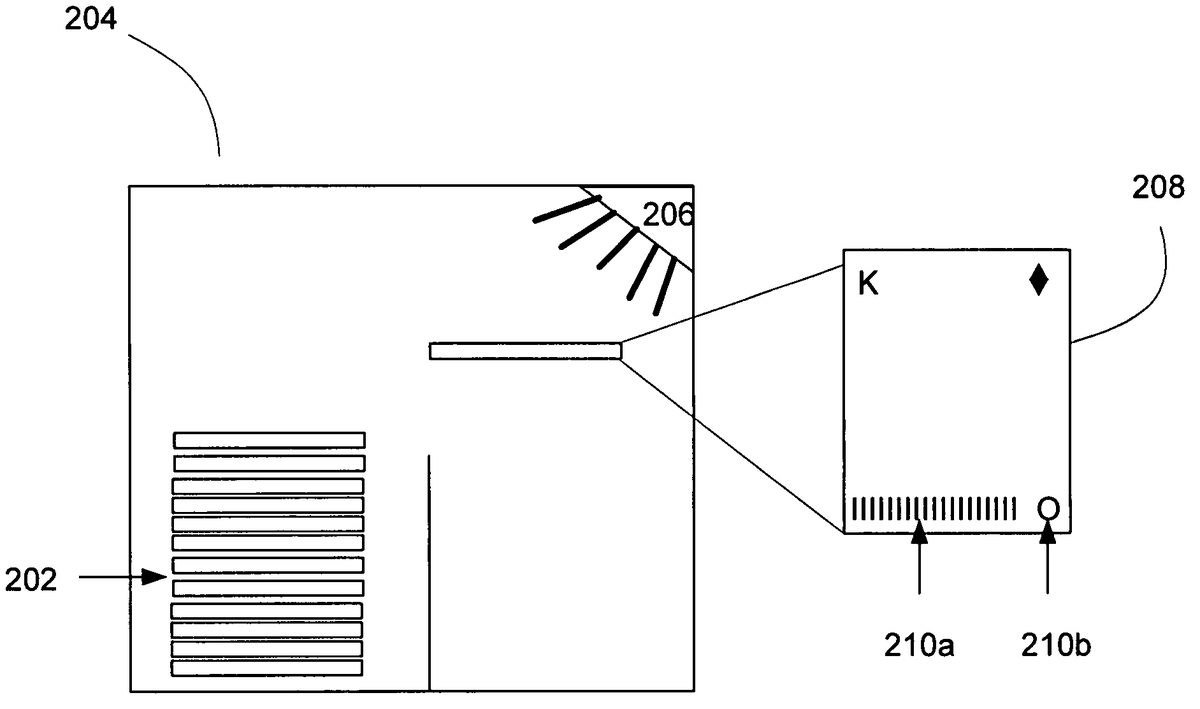
As shown inFIG. 1, a plurality of cards are shuffled in step102. Step102involves the physical movement of a plurality of cards, such as deck of cards202. Step102may be performed through mechanical or electrical mechanisms; however, the cards are physically shuffled. Therefore, the final order of the cards is not determined solely by a random number generator or algorithm. One skilled in the art will realize that one or more embodiments may utilize an algorithm to determine the longevity of the shuffle or the like, however, the final order of the cards cannot be accurately predicted upon applying one predetermined algorithm. Shuffling device204illustrates one exemplary automatic shuffling device according to one embodiment of the present invention that may be used to perform step102. In one embodiment, the shuffling device204is configured to house a plurality of gaming cards, such as standard poker playing cards. In other embodiments, the shuffling device is configured to house odd shaped or three-dimensional “cards”, such as balls. Indeed, one embodiment of the invention may utilize a chamber to house the cards, wherein pressurized air is introduced into the chamber having the plurality of cards. The pressurized air will alter the arrangement of the plurality of cards in a random fashion. This method of shuffling is especially advantageous when utilizing three-dimensional cards, such as balls. In one embodiment, the cards are shuffled for a predetermined length of time, whereas in another embodiment, a user input may determine the longevity of the shuffle. A remote user can provide an electronic or mechanical input that controls the physical shuffling of the deck of cards as described in more detail below. Indeed, while the embodiment involves a physical deck of cards, remote users may take part in the game.
One embodiment of the invention allows remote players to participate in the physical game through a network, such as the World Wide Web.FIG. 3illustrates one possible network configuration (300) having a client/server network setup. In the network configuration300, clients302(1)-302(N) can each request information from a host computer304across a network306. (N represents a whole number.) The client302(1), for example, may send a request across the network306to join a game session. In one embodiment, the request may arrive at the host computer306at a network interface card (NIC)308. From the NIC308, the request can travel along an input/output (I/O) bus310and through a network stack312to a web server314running web server software. The web server may also comprise software to allow game play or be electronically connected to a computer-readable medium having the necessary software to allow game play.
The web server314handles the request (including any necessary connection setup and information retrieval) and, if necessary, reads information from a local storage mechanism316such as a buffer or a data cache. The web server314may then return any content requested by the client302(1) to the client302(1), with the content traveling through the network stack312, the I/O bus310, the NIC308, and the network306. Likewise, clients302(1)-302(N) can each send and receive information to each other, such as for example, chatting and/or card information.
In some card games, it is customary to allow at least one player to cut the deck, therefore optional step104may be implemented to determine if the game allows reshuffling or rearrangement of the cards by a user. If the employed embodiment permits a user to cut the deck, step106receives an input from a user regarding the reshuffling the deck of cards.FIG. 4shows one exemplary method of allowing a user to shuffle or otherwise rearrange the arrangement of the cards. A graphical representation of the deck of cards, such as representation402can be displayed on an output device, such as monitor404operatively connected to a client302(1)-(N). The user may provide an input through an input device to select a location to “cut” the deck. For example, arrow406may be positioned to select a specific card within the graphical representation of the deck of cards402. The user may be allowed to choose any individual card within the graphical representation402which corresponds to a physical card or sections of cards within the deck of cards202. Once selected, the input is transmitted through the network, for example as described in relation toFIG. 3, to the shuffling device204, where the deck202is physically “cut” according to the user input. In other embodiments, shuffling device204may shuffle the deck202until a user input is received. For example, step102could be repeated.
In step108, a card is physically dealt from the deck of cards202. In one embodiment, the top card of the deck will be dealt; however, one skilled in the art will appreciate that other embodiments may draw a card at random. For example, embodiments having balls in a pressurized chamber may be randomly selected. While the cards are physically dealt, select embodiments may not remove the card from the shuffling device. Indeed, in one embodiment, the card is merely transferred to another section or compartment of the shuffling device204. Yet in other embodiments, the card is dealt from a device that is separate from the shuffling device204. In step110, the identity of the dealt card is determined. In one embodiment, steps108and110may occur substantially simultaneously, wherein the identity of the card is determined as it is physically dealt.
As shownFIG. 2, the shuffling device may also comprise a card reader, such as card reader206. Yet in other embodiments, the card reader is external to the shuffling device. The card reader may determine the dealt card's identity based on the presence of at least one identifier. As shown inFIG. 2, dealt card has208a plurality of identifiers210a,210b.As used herein, an identifier can be any marking, attribute, and/or property of a card used in conjunction with the card reader206to identify the card. In one embodiment, the identifier contains information such as a source code for determining which deck or subset of cards the card originated from. For example, identifier210amay comprise a scannable code, such as a bar code that is readable by card reader206. Yet in other embodiments, reader206may be an RFID reader configured to read identifier210b.In still yet other embodiments, the identifier210amay comprise at least one physical alteration to the card, such as for example, a notch, groove, or extrusion, that may be used with card reader206to identify the card.
The identifiers210a,210bmay comprise a plurality of information, such as but not limited to: a numerical value of the card and the “suit” (i.e., club, spade, heart) or other subset classification of the card. Indeed, in one embodiment, the identifier210amay also aid in ensuring the fairness and accuracy of the game. For example, identifier210amay also comprise information regarding the origination of the dealt card. This would be especially advantageous for games utilizing multiple decks. For example, if 3 decks are utilized for a particular game, one identifier, for example, identifier210a,may comprise information regarding which deck the card originated from to ensure more or less than 3 decks were not being used and/or became improperly combined. In such embodiments, optional step112may be implemented to ensure validity of the cards. For example, if a game is utilizing decks001,002, and003, the card reader206may be configured to discard any card not from decks001,002, and003. In yet another embodiment, the detection not belonging to decks001,002, and003may cause the termination of the current game and a new deck or decks of cards will be shuffled to initiate a new game. In still yet another embodiment, the identity information retrieved from an identifier, such as identifier210amay be stored in an electronic medium for later analysis. For example, if the odds of dealing an ACE of HEARTS is 1/52, but the card reader has detected that particular card has been dealt 5 times in the last 10 deals, an optional step may be implemented to require inspection of the card reader206and/or the card shuffler204before more games are conducted.
In yet another embodiment, conventional attributes of typical playing cards may be used as identifiers. For example, the card reader206may comprise a video camera that identifies the card based on at least one visual representation. In the illustrated embodiment, visual identifiers may comprise the “K” representing the card is a “KING” and a visual representation of a “Diamond”, thereby the card will be interpreted by the card reader to be a “King of Diamonds”. In yet another embodiment utilizing conventional attributes of cards, a card reader, such as reader206may further comprise a video camera operatively coupled to a computer to further identify the dealt card208. For example, in one embodiment the reader is a camera coupled to a computer having software to recognize the characters or letters on the card208, such as Optimal Character Recognition (“OCR”) or the like.
While step210has been described in relation to the dealing of one card, one skilled in the art will recognize that the dealing of multiple cards to one or more players is within the scope of the invention. Moreover, one in the art will understand that a plurality of identifiers, such as identifiers210a,210bmay be used simultaneously to identify a card. This may be especially advantageous in embodiments attempting to simulate the “real feel” of a live game while increasing the accuracy and efficiency of administering the game. For example, identifier210bmay be used to electronically track the game while a still or video camera may be used to capture the actual card dealt to increase the realistic gaming experience.
In step114, the identity of the dealt card is transmitted to at least one user. Transmission may be performed through a variety of mediums, such as the network environment illustrated inFIG. 3. When and to which players the identity of a particular card is transmitted to may be determined according the preset rules in the game play. For example, in one embodiment employing a “Blackjack”-style game, the identity of at least one of the dealts cards, such as the face-down card dealt to the dealer will not be revealed to a player, until a player's turn has ended. In one such embodiment, step116may be implemented before step114to allow the player to provide an input, for example, to instruct the computer that the player does not wish to be dealt another card. As step118indicates, game play will continue according to the type of game being administered. If, however, the player does provide an input in step120, step122maybe implemented to determine if the input request additional cards to be dealt. In one embodiment, if additional cards are to be dealt, step108may be re-implemented. Returning to step118, game play will resume until it is determined at step124that the game is over. As one skilled in the art will understand, step118may incorporate any of the preceding steps or optional additional steps to continue to the game, such as for example, redealing cards, shuffling additional cards as needed, determining when and to whom the dealt cards are displayed to.
Step118will depend on the type of game implemented. For example, in Draw Poker, the conventional poker hand rankings that are winning combinations are a Royal Flush, a Straight Flush, a Four of a Kind, a Full House, a Flush, a Straight, a Three of a Kind, a Two Pair and a Pair of Jacks or Better, wherein a payout table is established based on the number of coins wagered by the player and the type of poker hand achieved. One skilled in the art will understand there are many poker formats used in poker. These poker game formats include, but are not limited to: Jacks (or even Tens) or Better Draw Poker, Bonus Poker, Double Bonus Poker, Double Double Bonus Poker, Super Double Bonus Poker, Triple Bonus Poker, Deuces Wild Poker, Jokers Wild Poker, Deuces and Jokers Wild Poker, Texas Holdem Poker, Omaha Hi Poker, Omaha Hi Lo Poker, Stud Poker Hi, and Stud Poker Hi Lo. One skilled in the art will realize that these and other games of the present invention may be played with a wagering system, wherein the wagering system may vary, such as limited and no limit stakes.
In yet other embodiments, other traditional card games may be employed, such as Black Jack, Caribbean Stud, or the like. In one embodiment, the system is configured to allow a user to choose among numerous game formats. The player may then make a wager based on upon that choice of game format. Once is it is determined game play has ended, step126may compare the identity of each card dealt to determine at least one winner.
While the exemplary embodiment has been discussed in broad terms of a networking environment, the invention, however, may be configured for personal gaming systems, such as Sony® Playstation® or Microsoft® Xbox®, handheld systems such as a Palm® or Treo®, among others, for example, cellular-based applications. In still yet further embodiments, the invention is configured for web-based applications that may be incorporated within or independent of cellular-based applications.
Claims
- A computer-readable medium comprising computer-executable instructions that when executed perform the steps of: receiving a first electronic signal from one of a plurality of remote users, wherein the first electronic signal is configured to physically randomize a plurality of cards at a card shuffling device without the utilization of a random number generator, and wherein each card has at least one identifier;receiving a second electronic signal configured to physically deal at least one card from the plurality of cards;determining, with a computer device, the identity of the at least one card dealt by determining the at least one identifier of the at least one card;transmitting a third electronic signal including identity information of the at least one card dealt through a network to at least one of the remote users;and receiving a fourth electronic signal from one of the plurality of remote users, the fourth signal electronically indicating a physical location within the plurality of cards to cut the plurality of cards, wherein the plurality of cards are physically cut at the location indicated.
- The computer-readable medium of claim 1 , wherein the at least one identifier is selected from the group consisting of: a barcode, an alteration of the surface of the card, RFID, and combinations thereof.
- The computer-readable medium of claim 1 , wherein the identity information is selected from the group consisting of: a unique card identifier, a source code, an image, a graphical representation of the card, and combinations thereof.
- The computer-readable medium of claim 1 , further comprising the step of: receiving a fifth electronic signal from one of the plurality of remote users configured to cause the physical arrangement of some or all of the plurality of cards within control of the card shuffling device.
- The computer-readable medium of claim 4 , wherein the physical arrangement comprises dealing at least one card from the plurality of cards.
- The computer-readable medium of claim 4 , wherein the physical arrangement comprises collecting the at least one card dealt.
- The computer-readable medium of claim 4 , wherein the physical arrangement comprises shuffling at least a portion of the plurality of cards.
- The computer-readable medium of claim 1 , further comprising the step of: comparing the transmitted identity information to the user with the at least one identifier on at least one card dealt to verify the accuracy of the game.
- The computer-medium of claim 8 , further comprising the steps of: based on the result of comparing the transmitted identity information with the at least one identifier on the plurality of cards, automatically removing at least a portion of the plurality of cards in the card shuffling device;and introducing a second plurality of cards into the card shuffling device.
- The computer-readable medium of claim 1 , further comprising the steps of: transmitting through the network to at least one of the plurality of remote users a fifth electronic signal configured to provide a graphical display of the plurality of cards to the at least one remote user, wherein the graphical display provides a representation of actual cards in the plurality of cards such that each card displayed to the remote user represent a physical card from the plurality of cards;and receiving through the network a sixth electronic signal including a selection of one card from the plurality of cards.
- The computer-readable medium of claim 10 , further comprising the step of: physically cutting the plurality of cards at the card that represents the card selected by the remote user.
- A computer-readable medium comprising computer-readable instructions that when executed perform the steps of: receiving a first electronic signal from one of a plurality of remote users, wherein the first signal causes the physical randomization of a plurality of cards at a card shuffling device without the utilization of a random number generator, wherein each card has at least one identifier;receiving a second electronic signal configured to physically deal at least one card from the plurality of cards;determining, with a computer device, the identity of the at least one card dealt by determining the at least one identifier on the at least one card;transmitting a third electronic signal including identity information of the at least one card dealt through a network to at least one of the remote users;requiring receipt of a fourth electronic signal through the network from at least one of the plurality of remote users to prevent utilization of remote automated programs, wherein the signal comprises a user input selected from the group consisting of: (i) a user input configured to physically cut the plurality of cards, thereby indicating the initiation point for distribution of cards to be physically dealt to one or more of the plurality of remote users;and (ii) a user input configured to indicate the at least one remote users does not wish to cut the plurality of cards;and initiating a game according to pre-defined rules that include the distribution of information of at least two cards of the plurality of cards in sequential order to one or more of the plurality of remote users.
Disclaimer: Data collected from the USPTO and may be malformed, incomplete, and/or otherwise inaccurate.