U.S. Pat. No. 7,576,739
STORAGE MEDIUM HAVING GAME PROGRAM STORED THEREIN, AND GAME APPARATUS AND GAME PROCESSING METHOD THEREFOR
AssigneeNintendo Co., Ltd.
Issue DateAugust 23, 2006
Illustrative Figure
Abstract
An area, in a virtual game world, for arranging a plurality of objects and a minimum allowed distance between objects to be arranged therein are set. A position of an object is changed for temporarily arranging the object to an arbitrary position in the area set in the virtual game world until arrangement of the object is finalized, and the distance between the temporarily arranged object and an object whose arrangement in the area is completed is calculated. When the calculated distance is equal to or greater than the minimum allowed distance, arrangement of the temporarily arranged object is finalized and a plurality of objects whose arrangement is finalized are displayed on a display screen.
Description
DESCRIPTION OF THE PREFERRED EMBODIMENTS With reference toFIG. 1, a game system1according to an embodiment of the present invention is described.FIG. 1is an external view of the game system1ofFIG. 1. Hereinafter, a stationary game apparatus using the game system1of the present invention is used as an example. InFIG. 1, the game system1is configured such that a CRT (Cathode Ray Tube) display (herein after, referred to as a “monitor”)2having speakers2aof a home-use television receiver or the like is connected to a stationary game apparatus (herein after, simply referred to as a “game apparatus”)3via a connection code. The game apparatus3includes a controller6and an optical disk4, the controller6being connected to the game apparatus3via a connection code and the optical disk4, as an example of an information storage medium, being exchangeably used with respect to the game apparatus3. Also, an external memory card5is detachably attached to the game apparatus3, as necessary. The external memory card5has a backup memory or the like mounted thereon for fixedly storing save data or the like. The game apparatus3executes a game program stored in an optical disk4and displays the result on the monitor2as a game image. Also, the game apparatus3can reproduce a state of a game played in the past using save data stored in the external memory card5and display the game image on the monitor2. A player playing with the game apparatus3can enjoy the game by operating the controller6while watching a game image displayed on the monitor2. When a plurality of players play a game together, they respectively operate a plurality of controllers6while watching a game image displayed on the monitor2, so that they can enjoy the game. As described above, the controller6is connected to the game apparatus3via the connection code. The connection code is detachable to the game apparatus3. The controller6is a means to operate a player ...
DESCRIPTION OF THE PREFERRED EMBODIMENTS
With reference toFIG. 1, a game system1according to an embodiment of the present invention is described.FIG. 1is an external view of the game system1ofFIG. 1. Hereinafter, a stationary game apparatus using the game system1of the present invention is used as an example.
InFIG. 1, the game system1is configured such that a CRT (Cathode Ray Tube) display (herein after, referred to as a “monitor”)2having speakers2aof a home-use television receiver or the like is connected to a stationary game apparatus (herein after, simply referred to as a “game apparatus”)3via a connection code. The game apparatus3includes a controller6and an optical disk4, the controller6being connected to the game apparatus3via a connection code and the optical disk4, as an example of an information storage medium, being exchangeably used with respect to the game apparatus3. Also, an external memory card5is detachably attached to the game apparatus3, as necessary. The external memory card5has a backup memory or the like mounted thereon for fixedly storing save data or the like. The game apparatus3executes a game program stored in an optical disk4and displays the result on the monitor2as a game image. Also, the game apparatus3can reproduce a state of a game played in the past using save data stored in the external memory card5and display the game image on the monitor2. A player playing with the game apparatus3can enjoy the game by operating the controller6while watching a game image displayed on the monitor2. When a plurality of players play a game together, they respectively operate a plurality of controllers6while watching a game image displayed on the monitor2, so that they can enjoy the game.
As described above, the controller6is connected to the game apparatus3via the connection code. The connection code is detachable to the game apparatus3. The controller6is a means to operate a player object appearing in a game space displayed mainly on the monitor2and includes a plurality of operation buttons, keys, and input sections for a stick and the like. Specifically, the controller6is formed with grip sections to be gripped by each hand of a player. Additionally, the controller6includes a main stick61and a cross key67, a C stick68, an A button62, a B button63, an X button64, a Y button65, and a start-pause button69, the cross key67being operable by the thumb or the like of the left hand of the player and the Y button65being operable by the thumb or the like of the right hand of the player. Further additionally, the controller6includes an R button66aand an L button66brespectively operable by the left and right index fingers of the player. Note that although these input sections are used in accordance with a progress of a game later described, a detailed description therefor is omitted since the input sections are not directly involved with the description of the present invention.
The optical disk4stores a game program which is a group of instructions and a group of data in a format executable by a computer, especially by a CPU30(described later), of the game apparatus3. This game program is appropriately read into a main memory33for execution. In the below description, described is an example of executing a game program stored in the optical disk4.
Next, with reference toFIG. 2, a configuration of the game apparatus3is described.FIG. 2is a functional block diagram of the game apparatus3.
As shown inFIG. 2, the game apparatus3includes, for example, a risk (RISC) CPU (central processing unit)30for executing various types of programs. The CPU30executes a start program stored in a boot ROM not shown to, for example, initializes memories including the main memory33, and then executes a game program stored in the optical disk4for performing a game process in accordance with the game program. To the CPU30, a GPU (Graphics Processing Unit)32, the main memory33, a DSP (Digital Signal Processor)34, and an ARAM (Audio RAM)35are connected via a memory controller31. To the memory controller31, a controller I/F (interface)36, a video I/F37, an external memory I/F38, an audio I/F39, and a disk I/F41are connected via a predetermined bus. The controller I/F (interface)36, the video I/F37, the external memory I/F38, the audio I/F39, and the disk I/F41are respectively connected to the controller6, the monitor2, the external memory card5, the speakers2a, and the disk drive40.
The GPU32performs image processing based on an instruction from the CPU30. The GPU includes a semiconductor chip for performing calculation processing necessary for displaying 3D graphics, for example. The GPU32performs the image processing by using a memory (not shown) dedicated for image processing and a portion of a storage area of the main memory33. Through using such memories, the GPU32generates game image data to be displayed on the monitor2, and appropriately outputs the generated data to the monitor2via the memory controller31and the video I/F37.
The main memory33is a storage area used by the CPU30and appropriately stores a game program, game data, or the like necessary for processing performed by the CPU30. For example, the main memory33stores a game program read out from the optical disk4by the CPU30, various types of data, or the like. The game program, various types of data, or the like stored in the main memory33are executed by the CPU30.
The DSP34processes sound data or the like generated by the CPU30during the execution of the game program. The DSP34is connected to the ARAM35for storing the generated sound data or the like. The ARAM35is used when the DSP34performs predetermined processing (for example, storage of the game program or sound data already read out). The DSP34reads out the sound data stored in the ARAM35and outputs the sound data to speakers2aincluded in the monitor2via the memory controller31and the audio I/F39.
The memory controller31comprehensively controls data transfer, and is connected to the above-described various I/Fs. The controller I/F36includes, for example, four controller I/Fs36a,36b,36c, and36d, and communicably connects the game apparatus3to an external device which is engageable via connectors of the controller I/Fs36athrough36d. For example, the controller6is engaged with such a connecter and is connected to the game apparatus3via the controller I/F36. The monitor2is connected to the video I/F37. The external memory I/F38is connected to the external memory card5and is accessible to a backup memory or the like provided in the external memory card5. To the audio I/F39, the speakers2abuilt in the monitor2are connected, enabling sound data read out from the ARAM35by the DSP34or sound data directly outputted from the disk drive40to be outputted from the speakers2a. The disk drive40is connected to the disk I/F41. The disk drive40reads out data stored at a predetermined reading position of the optical disk4and outputs to the bus of the game apparatus3or the audio I/F39.
Note that the game program of the present invention may not only be supplied to the game apparatus3via an external storage medium such as the optical disk4or the like, but also be supplied via a wired or a wireless communication line. Also, the game program may be previously stored in a nonvolatile storage apparatus inside the game apparatus3. The information storage medium storing the game program is not limited to a CD-ROM, a DVD, or one of storage media of an optical disk type, and may be a nonvolatile semiconductor memory.
The main memory33appropriately stores a game program, such as described above, necessary for the process of the CPU30. The main memory33includes a game program, various types of data, and the like read out from the optical disk4by the CPU30. Hereinafter, with reference toFIG. 3, described is an example of data stored in the main memory33when a game program of the present invention is executed. Note thatFIG. 3is an outline of a memory map for illustrating the example of data stored in the main memory33.
The main memory33has a program storage area and a data storage area, butFIG. 3shows only the data storage area used in an operation for an object arrangement in an embodiment of the present invention. Specifically, the data storage area of the main memory33generally stores arrangement condition data D1, arrangement state data D2, arrangement object data D3, and the like.
The arrangement condition data D1indicates conditions for arranging a plurality of objects. The arrangement condition data D1includes reference point coordinate data D1a, arrangement area data D1b, scheduled arrangement number data D1c, maximum arrangement trial number data D1d, minimum arrangement distance data D1e, arrangement time limit data D1f, object-to-be-arranged data D1g, and the like. The reference point coordinate data D1ais coordinate data of a reference point when an object is arranged in a virtual game world, and the reference point is a reference position in an area where the object is arranged and is defined by three dimensional game space coordinates on a game field, for example. Hereinafter, an area where an object is allowed to be arranged is referred to as an “arrangement area”. The arrangement area data D1bindicates an area used when objects are arranged in a virtual game world. Example of such an arrangement area is a circle area, with a predetermined radius, whose center is the above-described reference point. The scheduled arrangement number data D1cindicates the maximum number (a scheduled arrangement number Nmax) of objects to be arranged in the arrangement area. The maximum arrangement trial number data D1dindicates, when an object is to be arranged in the arrangement area, a maximum number (a maximum arrangement trial number Smax) of times a position of the object is allowed to be changed until arrangement conditions are met. The minimum arrangement distance data D1eindicates a minimum distance (a minimum arrangement distance Lmin) between arranged objects. The arrangement time limit data D1findicates a time limit (an arrangement time limit Tmax; an example thereof is a time period of one frame) during which an operation of arranging objects is continued. The object-to-be-arranged data D1gindicates various types of objects to be selected for arrangement.
The arrangement state data D2includes arrangement number data D2a, arrangement trial number data D2b, elapsed arrangement time period data D2c, and the like. The arrangement state data D2indicates an arrangement state appropriately updated each time an arrangement of an object occurs. The arrangement number data D2aindicates the number of objects (an arrangement number N) whose arrangements are completed when a plurality of objects are arranged. The arrangement trial number data D2bindicates the number of position changes (the arrangement trial number S) made in arranging a selected object in the arrangement area. The elapsed arrangement time period data D2cindicates a time period elapsed (an elapsed arrangement time period T) in arranging objects.
The arrangement object data D3indicates an object arranged in a virtual game world, and, for arranged objects, first object data D31, second object data D32, and soon until M-th object data D3M are respectively set. The object data D31through D3M respectively includes object class data D31athrough D3Ma, arrangement coordinate data D31bthrough D3Mb, arrangement orientation data D31cthrough D3Mc, and the like. Objects are classified into a class based on a type, a size, or the like, and the object class data D31athrough D3Ma each indicates a class of an object to be arranged. The arrangement coordinate data D31bthrough D3Mb each indicates a position of an object arranged in the virtual game world and is defined by three dimensional game space coordinates, on a game field, of the center of the object, for example. The arrangement orientation data D31cthrough D3Mc each indicates an orientation of an object arranged in the virtual game world, and is defined by an angle of the arranged object with respect to a predetermined reference direction or by vector data.
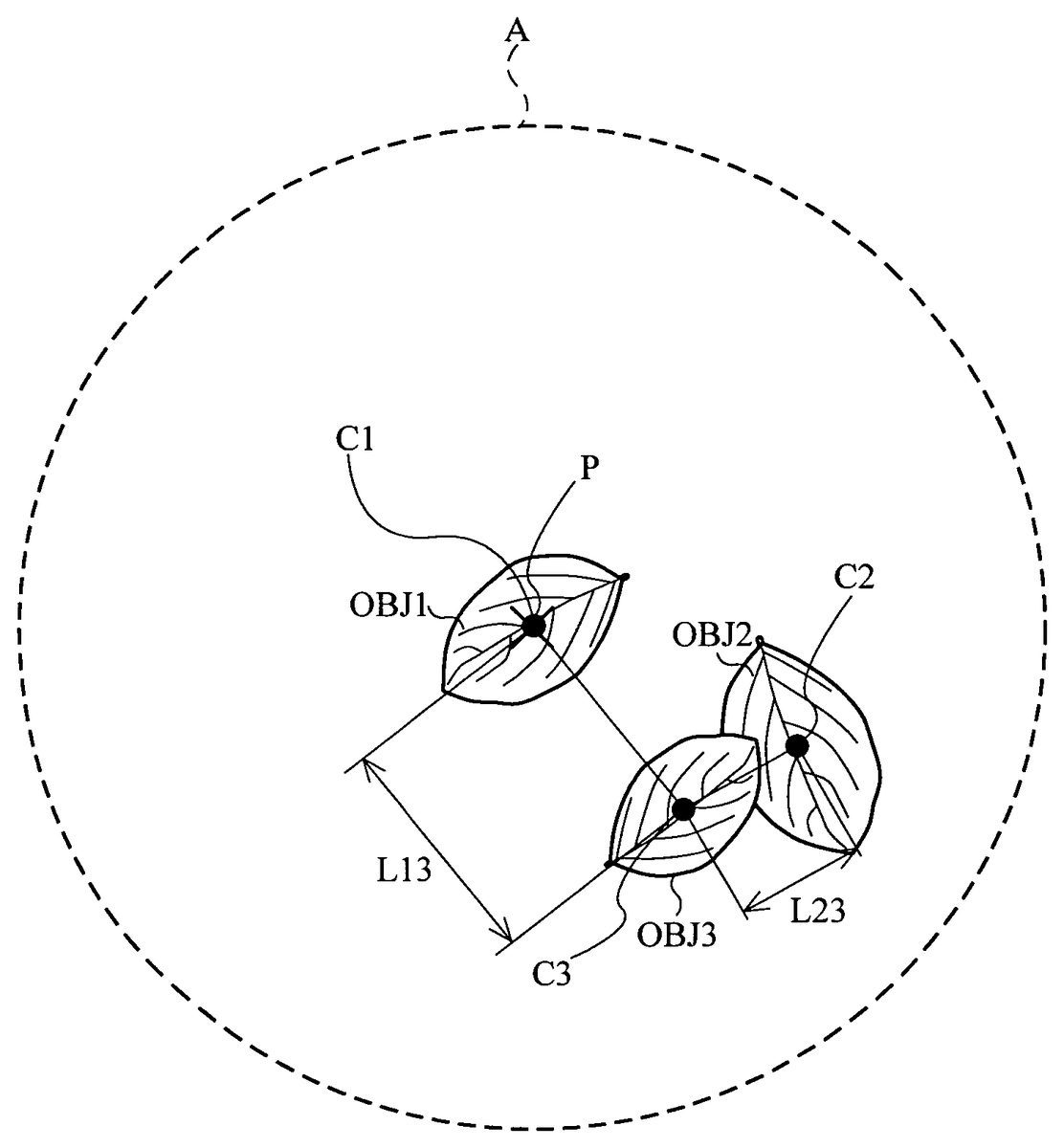
Next, with reference toFIGS. 4 to 10, a game process executed by the game apparatus3is described.FIG. 4is a flowchart showing a game process executed by the game apparatus3when an object is arranged.FIG. 5is a diagram for illustrating a center position C and an arrangement orientation θ of an object OBJ to be arranged.FIG. 6is a diagram for illustrating a reference point P and an arrangement area A.FIG. 7is a diagram showing a state of a first object OBJ1being arranged on the reference point P.FIG. 8is a diagram showing a distance L12, between the first object OBJ1and a second object OBJ2, determined when the second object OBJ2is arranged.FIG. 9is a diagram showing distances L13and L23determined when a third object OBJ3is arranged, the distance L13being a distance between the first object OBJ1and the third object OBJ3and the distance L23being a distance between the second object OBJ2and the third object OBJ3.FIG. 10is a diagram showing an example of a state in which arranging a plurality of objects OBJs is completed through the process of the flowchart ofFIG. 4. Note that, in the flowchart shown inFIG. 4, a game process for an object arrangement is described, and a detailed description for another game process not directly relating to the present invention is omitted. InFIG. 4, each step executed by the CPU30is referred to with “S”.
When the power to the game apparatus3is turned on, the CPU30of the game apparatus3executes a start program stored in the boot ROM not shown, and units such as the main memory33or the like are initialized. Then, a game program stored in the optical disk4is read into the main memory33, and the CPU30executes the game program and displays a game image on the monitor2, and thereby starting a game.
InFIG. 4, the CPU30sets arrangement conditions when a plurality of objects OBJs are to be arranged to predetermined positions in the virtual game world (step51). For example, the CPU30sets, to the arrangement condition data D1, arrangement conditions such as positions (reference points Ps) in the virtual game world where a plurality of objects are to be arranged, an area (arrangement area A) used for arrangement, a scheduled arrangement number Nmax, a maximum arrangement trial number Smax, a minimum arrangement distance Lmin, and an arrangement time limit Tmax. Typically, in accordance with, e.g., the positions of objects to be in the virtual game world, the CPU30acquires previously set arrangement conditions for setting the arrangement condition data D1. Then, the CPU30initializes the arrangement number to be N=1 and an elapsed arrangement time period to be T=0 for updating the arrangement state data D2(step52). Then, the process proceeds to the next step. Note that the elapsed arrangement time period T is automatically updated as appropriate.
Next, the CPU30sets a reference point P and an arrangement area A in the virtual game world (e.g., on a game field) (step53), and the process proceeds to the next step. A reference point P is set on the game field, and then a circle, with a predetermined radius, whose center is the reference point P is set as an arrangement area A, as shown inFIG. 6, for example.
Next, the CPU30arranges an object OBJ on the reference point P and writes the arrangement object data D3indicating the arrangement of the object (step54), and the process proceeds to the next step. As shown inFIG. 5, a state (position and orientation) of an object OBJ to be arranged in the virtual game world is determined by coordinates, in the virtual game world, of a center position C and an arrangement angle θ, the center position C (e.g., a center of gravity of the object OBJ) being a reference position for the object OBJ and the arrangement angle θ being an angle for the object OBJ with respect to a predetermined reference direction. In step54, the CPU30selects an object class from among selectable classes (e.g., a fallen leaf) indicated in the object-to-be-arranged data D1g, and arranges an object OBJ belonging to the selected object class such that the center position C thereof corresponds to the reference point P, as shown inFIG. 7. Then, the CPU30determines an arrangement angle θ of the object OBJ in, for example, a random manner. In order to distinguish the object arranged in step54from other objects OBJs described later, the object arranged in step54is referred to as a first object OBJ1having a center position C1been set.
Next, the CPU30initializes the arrangement trial number to be S=1 for updating the arrangement state data D2(step55). Then, the CPU30selects an object class from among selectable classes indicated in the object-to-be-arranged data D1gand sets (in, for example, a random manner) an arrangement angle θ of an object OBJ belonging to the selected object class (step56), and the process proceeds to the next step.
Next, the CPU30temporarily arranges the object OBJ selected in step56to an arbitrary position in the arrangement area A (step57). Then, the CPU30determines whether or not the distance between the temporarily arranged object OBJ and an object OBJ whose arrangement is completed is within a predetermined range (step58). Specifically, the CPU30calculates a distance L between the center position C of the temporarily arranged object OBJ and a center position C of the object OBJ whose arrangement is completed and determines whether or not the distance L is equal to or greater than the minimum arrangement distance Lmin. Suppose a second object OBJ2is temporarily arranged in step57as shown inFIG. 8. In this case, a distance L12between the center position C1of the first object OBJ1and a center position C2of the second object OBJ2is calculated and whether or not the distance L12is equal to or greater than the minimum arrangement distance Lmin is determined. Also, suppose a third object OBJ3is temporarily arranged in step57after the first and second objects OBJ1and OBJ2are arranged, as shown inFIG. 9. In this case, a distance L13between the center position C1of the first object OBJ1and a center position C3of the third object OBJ3and a distance L23between the center position C2of the second object OBJ2and the center position C3of the third object OBJ3are calculated, and whether or not the distances L13and L23are equal to or greater than the minimum arrangement distance Lmin is determined. When distances Ls between all arranged objects OBJs are respectively equal to or greater than the minimum arrangement distance Lmin, the CPU30proceeds with the process to next step59. On the other hand, when a distance L between a temporarily arranged object and an object OBJ whose arrangement is completed is smaller than the minimum arrangement distance Lmin, the CPU30proceeds with the process to next step63.
In step59, the CPU30determines that arrangement of the object OBJ temporarily arranged in the virtual game world in step57is to be finalized and writes the arrangement object data D3indicating the arrangement of the object. Through step59, arrangement of one object OBJ is finalized. Next, the CPU30updates the arrangement state data D2by adding one to the arrangement number N (step60) and determines whether or not the arrangement number N having been updated has reached a scheduled arrangement number Nmax (step61). When the arrangement number N has not reached the scheduled arrangement number Nmax, the CPU30proceeds with the process to next step62. On the other hand, when the arrangement number N has reached the scheduled arrangement number Nmax, the CPU30determines that arrangement of the object is performed the scheduled number of times and proceeds with the process to step66.
In step62, the CPU30determines whether or not an elapsed arrangement time period T is within an arrangement time limit Tmax. When the elapsed arrangement time period T is within the arrangement time limit Tmax, the CPU30returns the process back to step55to repeat the process. On the other hand, when the elapsed arrangement time period T has reached the arrangement time limit Tmax, the CPU30determines that a time limit allowed for arranging objects is passed and proceeds with the process to step66.
When it is determined in step58that the distance between a position of the temporarily arranged object and an object whose arrangement is completed is smaller than the minimum arrangement distance Lmin, the CPU30determines whether or not the arrangement trial number S has reached a maximum arrangement trial number Smax (step63). When the arrangement trial number S has reached the maximum arrangement trial number Smax, the CPU30proceeds with the process to step59. On the other hand, when the arrangement trial number S has not reached the maximum arrangement trial number Smax, the CPU30proceeds with the process to next step64.
In step64, the CPU30determines whether or not the elapsed arrangement time period T is within the arrangement time limit Tmax. When the elapsed arrangement time period T is within the arrangement time limit Tmax, the CPU30updates the arrangement state data D2by adding one to the arrangement trial number S (step65) and returns the process back to step57to repeat the process. On the other hand, when the elapsed arrangement time period T has reached the arrangement time limit Tmax, the CPU30determines that the time limit allowed for arranging objects is passed and proceeds with the process to step66.
In step66, the CPU30displays, on the monitor2, a plurality of objects OBJs whose arrangement is finalized in step59and whose data have been written into the arrangement object data D3, and the process of the flowchart is ended.
Here, described is a situation where it is determined that the arrangement trial number S has reached the maximum arrangement trial number Smax in step63. As clearly shown in the flowchart ofFIG. 4, when it is determined as “Yes” in step63, temporary arrangement for the object has been performed up to the maximum arrangement trial number Smax and yet the distance between the temporarily arranged object OBJ and an object whose arrangement is completed is smaller than the minimum arrangement distance Lmin (namely, objects OBJs are closer in distance than the minimum allowed distance). When step59is executed subsequent to the determination of “Yes” in step63, arrangement of the temporarily arranged object OBJ is finalized such that the distance between arranged objects is smaller than the minimum arrangement distance Lmin. In other words, after arrangement is tried the number of set times (Nmax), even when the distance between a temporarily arranged object and an object whose arrangement is completed is smaller than the minimum allowed distance, arrangement of the temporarily arranged object is finalized, though probability of this occurrence is relatively low.
Through performing the process of the above-described flowchart, a plurality of objects OBJs are arranged in the arrangement area A, as shown inFIG. 10. Specifically, random arrangement of an object OBJ is repeated within the scheduled arrangement number Nmax, the random arrangement of objects is repeated within the arrangement time limit Tmax, and, as the result of the above-described process, objects OBJs are randomly arranged with the distances there between being basically equal to or greater than the minimum arrangement distance Lmin. Additionally, objects OBJs in some cases are arranged such that the distances there between are smaller than the minimum arrangement distance Lmin, as described above; however, a probability of such an occurrence is low. Accordingly, while a space between arranged objects OBJs is controlled to some extent, the set number of objects OBJs can be arranged to random positions.
Here, described is setting of the arrangement condition data D1. In the minimum arrangement distance data D1e, the minimum arrangement distance Lmin is set to a large value when a space between objects OBJs is desired to be large, and, the minimum arrangement distance Lmin is set to a small value when a space between objects OBJs is desired to be small so that overlapping each other is allowed. In the maximum arrangement trial number data D1d, the maximum arrangement trial number Smax is set to a small value when it is desired to increase the number of objects OBJs whose distance to another object is smaller than the minimum arrangement distance Lmin, and the maximum arrangement trial number Smax is set to a large value when it is desired to decrease the number of objects OBJs whose distance to another object is smaller than the minimum arrangement distance Lmin. In the scheduled arrangement number data D1c, the scheduled arrangement number Nmax is set to a large value when a large number of objects OBJs are desired to be arranged in the arrangement area A, and the scheduled arrangement number Nmax is set to a small value when a small number of objects OBJs are desired to be arranged in the arrangement area A.
Accordingly, when a plurality of objects are arranged in a predetermined area, the objects are arranged in a well-balanced, random manner, whereby natural representation of the plurality of objects can be possible. For example, when a plurality of matters (e.g., floating weeds growing in crowds) which float on a predetermined area of a water surface or the like and which infrequently overlap each other in the real world are to be represented with a plurality of objects OBJs in a virtual game world, a value of the minimum arrangement distance Lmin is set such that overlapping of the objects OBJs is not allowed, and the maximum arrangement trial number Smax is set to a large value. Through setting the arrangement condition data D1as described above, for example, floating weeds growing in crowds on a water surface in an infrequently overlapping manner can be naturally represented by arranging a plurality of objects OBJs, as shown inFIG. 11.
On the other hand, when a plurality of matters (e.g., fallen leaves around a deciduous tree) on a predetermined area of the ground in an overlapping manner in the real world are to be represented with a plurality of objects OBJs in a virtual game world, a value of the minimum arrangement distance Lmin is set such that overlapping the objects OBJs is allowed, and the maximum arrangement trial number Smax is set to a small value. Through setting the arrangement condition data D1as described above, for example, fallen leaves overlapping each other on the ground can be naturally represented by arranging a plurality of objects OBJs, as shown inFIG. 12. In both cases, a plurality of objects are randomly arranged in a predetermined area whenever the objects are rearranged, whereby, while following a rule that each of the objects is arranged in the predetermined area, an image suitable for a game can be generated such that the objects arranged in the predetermined area appear natural.
Note that, in the above description, an arrangement area A is set on a two dimensional surface such as the ground or a water surface and a plurality of objects OBJs are arranged therein, but it is not limited thereto, and a three dimensional space may be used. For example, when an arrangement space is set in a virtual three dimensional space and objects OBJs are arranged therein in a similar manner as described above, the present invention is similarly applicable.
Also, in the above description, although an arrangement area A which is a circle area whose center is a reference point P is used for description, an arrangement area of another shape may be used. For example, an arrangement area A may be an area whose center is a reference point P and shape is a rectangle, polygon, ellipse, or a frame having an empty enclosed area. These shapes of the arrangement area A may be appropriately set in accordance with a state of a virtual game world to which arrangement is desired.
The storage medium having a game program stored therein, and the game apparatus and game processing method therefor according to the present invention can be used to arrange a plurality of objects in a virtual game world such that the objects appear natural, and are useful in representing various objects or the like appearing in a game.
While the invention has been described in detail, the foregoing description is in all aspects illustrative and not restrictive. It is understood that numerous other modifications and variations can be devised without departing from the scope of the invention.
Claims
- A storage medium having stored therein a game program executed in a computer of a game apparatus for displaying, on a display screen, a game image showing at least a portion of a virtual game world showing a plurality of objects, the game program causing the computer to execute: an arrangement condition setting step of setting an area for arranging the plurality of objects in the virtual game world and a minimum allowed distance between the objects to be arranged therein;an object temporary arrangement step of changing a position of an object for temporarily arranging the object to an arbitrary position in the area set in the virtual game world until an arrangement of the object is finalized;a distance-between-objects calculation step of calculating a distance between the object temporarily arranged in the object temporary arrangement step and an object whose arrangement in the area is completed;an object arrangement finalization step of finalizing the arrangement of the temporarily arranged object when the distance calculated in the distance-between-objects calculation step is equal to or greater than the minimum allowed distance;and a display control step of displaying, on the display screen, a plurality of objects whose arrangement is finalized in the object arrangement finalization step.
- The storage medium having the game program stored therein according to claim 1 , wherein a maximum number for limiting a number of changes performed, in the object temporary arrangement step, for a position of the object for temporarily arranging the object is further set in the arrangement condition setting step, and, when the number of temporary arrangements performed for the object in the object temporary arrangement step reaches the maximum number, the arrangement of the temporarily arranged object is finalized in the object arrangement finalization step even when the distance calculated in the distance-between-objects calculation step is smaller than the minimum allowed distance.
- The storage medium having the game program stored therein according to claim 1 , wherein an arrangement number for limiting a number of the objects to be arranged in the area is further set in the arrangement condition setting step, and the game program causes the computer to repeatedly execute an arrangement process performed in the object temporary arrangement step, the distance-between-objects calculation step, and the object arrangement finalization step until a number of objects whose arrangements are finalized in the object arrangement finalization step reaches the arrangement number.
- The storage medium having the game program stored therein according to claim 1 , wherein a time limit for arranging the object in the area is further set in the arrangement condition setting step, and the game program causes the computer to repeatedly execute an arrangement process performed in the object temporary arrangement step, the distance-between-objects calculation step, and the object arrangement finalization step until the time limit is reached.
- The storage medium having the game program stored therein according to claim 1 , wherein, each time an arrangement of an object is finalized, the game program causes the computer to further execute an object selection step of selecting a next object to be temporarily arranged in the object temporary arrangement step from an object group having a plurality of classified classes of objects.
- The storage medium having the game program stored therein according to claim 5 , wherein an arrangement orientation for the selected object is arbitrarily set in the object selection step, and, in the object temporary arrangement step, the selected object is temporarily arranged in accordance with the arrangement orientation.
- A game apparatus for displaying, on a display screen, a game image representing at least a portion of a virtual game world showing a plurality of objects, comprising: arrangement condition setting means for setting an area for arranging the plurality of objects in the virtual game world and a minimum allowed distance between the objects to be arranged therein;object temporary arrangement means for changing a position of an object for temporarily arranging the object to an arbitrary position in the area set in the virtual game world until an arrangement of the object is finalized;distance-between-objects calculation means for calculating a distance between the object temporarily arranged by the object temporary arrangement means and an object whose arrangement in the area is completed;object arrangement finalization means for finalizing the arrangement of the temporarily arranged object when the distance calculated by the distance-between-objects calculation means is equal to or greater than the minimum allowed distance;and display control means for displaying, on the display screen, a plurality of objects whose arrangement is finalized by the object arrangement finalization means.
- The game apparatus according to claim 7 , wherein the arrangement condition setting means further sets a maximum number for limiting a number of changes performed, by the object temporary arrangement means, for a position of the object for temporarily arranging the object, and the object arrangement finalization means finalizes, when a number of temporary arrangements performed for the object by the object temporary arrangement means reaches the maximum number, the arrangement of the temporarily arranged object is finalized even when the distance calculated in the distance-between-objects calculation means is smaller than the minimum allowed distance.
- The game apparatus according to claim 7 , wherein the arrangement condition setting means further sets an arrangement number for limiting a number of the objects to be arranged in the area, and the game apparatus repeatedly executes an arrangement process performed by the object temporary arrangement means, the distance-between-objects calculation means, and the object arrangement finalization means until a number of objects whose arrangements are finalized by the object arrangement finalization means reaches the arrangement number.
- The game apparatus according to claim 7 , wherein the arrangement condition setting means further sets a time limit for arranging the object in the area, and the game apparatus repeatedly executes an arrangement process performed by the object temporary arrangement means, the distance-between-objects calculation means, and the object arrangement finalization means until the time limit is reached.
- The game apparatus according to claim 7 , further comprising an object selection means for selecting, each time an arrangement of an object is finalized, a next object to be temporarily arranged by the object temporary arrangement means from an object group having a plurality of classified classes of objects.
- The game apparatus according to claim 11 , wherein the object selection means arbitrarily sets an arrangement orientation of the selected object, and the object temporary arrangement means temporarily arranges the selected object in accordance with the arrangement orientation.
- A game processing method for displaying, on a display device screen receiving a game image generated by a game apparatus including a game computer and a storage media on which is stored a game program, the game image representing at least a portion of a virtual game world generated be the game computer showing a plurality of objects, wherein the method includes steps comprising: an arrangement condition setting step, performed by the game computer executing the game program by accessing the storage media, of setting an area for arranging the plurality of objects in the virtual game world and a minimum allowed distance between the objects to be arranged therein;an object temporary arrangement step, performed by the game computer executing the game program by accessing the storage media, of changing a position of an object for temporarily arranging the object to an arbitrary position in the area set in the virtual game world until an arrangement of the object is finalized;a distance-between-objects calculation step, performed by the game computer executing the game program by accessing the storage media, of calculating a distance between the object temporarily arranged in the object temporary arrangement step and an object whose arrangement in the area is completed;an object arrangement finalization step, performed by the game computer executing the game program by accessing the storage media, of finalizing the arrangement of the temporarily arranged object when the distance calculated in the distance-between-objects calculation step is equal to or greater than the minimum allowed distance;and a display control step performed by the computer displaying, on the display device screen, a plurality of objects whose arrangement is finalized, by the game computer executing the game program by accessing the storage media, in the object arrangement finalization step.
- The game processing method according to claim 13 , wherein, a maximum number for limiting a number of changes performed, in the object temporary arrangement step, for a position of the object for temporarily arranging the object is further set, by the game computer executing the game program by accessing the storable media, in the arrangement condition setting step, and, in the object arrangement finalization step, when a number of temporary arrangements performed for the object in the object temporary arrangement step reaches the maximum number, the arrangement of the temporarily arranged object is finalized, by the game computer executing the game program by accessing the storage media, even when the distance calculated in the distance-between-objects calculation step is smaller than the minimum allowed distance.
- The game processing method according to claim 13 , wherein an arrangement number for limiting a number of the objects to be arranged in the area is further set, by the game computer executing the game program by accessing the storage media, in the arrangement condition setting step, and an arrangement process performed by the game computer in the object temporary arrangement step, the distance-between-objects calculation step, and the object arrangement finalization step is repeated, by the game computer executing the game program by accessing the storage media, until a number of objects whose arrangements are finalized in the object arrangement finalization step reaches the arrangement number.
- The game processing method according to claim 13 , wherein a time limit for arranging the object in the area is further set by the game computer in the arrangement condition setting step, and an arrangement process performed in the object temporary arrangement step, the distance-between-objects calculation step, and the object arrangement finalization step is repeated, by the game computer executing the game program by accessing the storage media, until the time limit is reached.
- The game processing method according to claim 13 , further comprising an object selection step, performed by the game computer executing the game program by accessing the storage media, of selecting, each time an arrangement of an object is finalized, a next object to be temporarily arranged in the object temporary arrangement step from an object group having a plurality of classified classes of objects.
- The game processing method according to claim 17 , wherein an arrangement orientation for the selected object is arbitrarily set, by the game computer executing the game program by accessing the storage media, in the object selection step, and, in the object temporary arrangement step, the selected object is temporarily arranged in accordance with the arrangement orientation.
Disclaimer: Data collected from the USPTO and may be malformed, incomplete, and/or otherwise inaccurate.