U.S. Pat. No. 7,503,006
VISUAL INDICATION OF CURRENT VOICE SPEAKER
AssigneeMicrosoft Corporation
Issue DateSeptember 25, 2003
U.S. Patent No. 7,503,006: Visual indication of current voice speaker

Summary:
The ‘006 patent provides a method for visually indicating a voice speaker during an online game. The method provides for indication symbols to be visible whenever two players meet during the game. Thus, whenever two players approach each other in the game a text or a symbol will be located above them notifying the other player whether or not the other person is capable of voice communication. One benefit of this invention is that a player has the ability to identify the speaker and subsequently privately communicate or even block the other user if he so desires.
Abstract:
Visually identifying one or more known or anonymous voice speakers to a listener in a computing session. For each voice speaker, voice data include a speaker identifier that is associated with a visual indicator displayed to indicate the voice speaker who is currently speaking. The speaker identifier is first used to determine voice privileges before the visual indicator is displayed. The visual indicator is preferably associated with a visual element controlled by the voice speaker, such as an animated game character. Visually identifying a voice speaker enables the listener and/or a moderator of the computing session to control voice communications, such as muting an abusive voice speaker. The visual indicator can take various forms, such as an icon displayed adjacent to the voice speaker’s animated character, or a different icon displayed in a predetermined location if the voice speaker’s animated character is not currently visible to the listener.
Illustrative Claim:
1. A method for visually indicating a voice speaker to a listener in a context of a computing session, comprising the steps of: (a) obtaining a speaker identifier, the speaker identifier including a user name gamertag, from voice data transmitted by the voice speaker; (b) associating the speaker identifier with a visual indicator used for indicating voice speakers; (c) selectively and temporarily, when the voice speaker is speaking, displaying the visual indicator and selectively and temporarily, when the voice speaker is speaking, displaying the user name gamertag, and when the visual indicator and the user name gamertag are displayed, displaying the visual indicator and the user name adjacent to one another, on the display to indicate that the voice speaker is speaking; (d) receiving user input selecting a players tab view that provides information on players in a current game session and in response to receiving user input selecting a players tab view: displaying a player’s list including a player ID column listing gamertags for players in a current game session, and displaying a voice communication column capable of selectively displaying for each of the players in the player ID column each of: a muted icon that indicates that a local listener has muted voice communication from a selected player, a persistent bidirectional mute icon that indicates that the local listener or the network gaming service has prohibited the corresponding player from speaking to the listener and hearing any voice communication from the listener, a null icon that indicates that a corresponding player does not have a voice communicator, and a hear-only icon that indicates that a corresponding player can hear voice communication but does not have a microphone for speaking to other players.
Illustrative Figure
Abstract
Visually identifying one or more known or anonymous voice speakers to a listener in a computing session. For each voice speaker, voice data include a speaker identifier that is associated with a visual indicator displayed to indicate the voice speaker who is currently speaking. The speaker identifier is first used to determine voice privileges before the visual indicator is displayed. The visual indicator is preferably associated with a visual element controlled by the voice speaker, such as an animated game character. Visually identifying a voice speaker enables the listener and/or a moderator of the computing session to control voice communications, such as muting an abusive voice speaker. The visual indicator can take various forms, such as an icon displayed adjacent to the voice speaker's animated character, or a different icon displayed in a predetermined location if the voice speaker's animated character is not currently visible to the listener.
Description
DESCRIPTION OF THE PREFERRED EMBODIMENT A preferred embodiment of the present invention is described below in regard to an exemplary use in providing visual indications of voice speakers for an electronic gaming system that is designed to execute gaming software in coordination with a network gaming service. Those skilled in the art will recognize that the present invention may also be implemented for other anonymous or semi-anonymous voice communications between speakers engaged in a common session. The invention may also be practiced on a variety of computing machines such as a personal computer (PC), a set-top box, an arcade game, a hand-held device, a high fidelity system, and other related systems. Exemplary Operating Environment As shown inFIG. 1, an exemplary electronic gaming system100that is suitable for practicing the present invention includes a game console102and support for up to four user input devices, such as controllers104aand104b. Game console102is equipped with an internal hard disk drive (not shown in this Figure) and an optical media drive106that reads various forms of portable optical storage media, as represented by an optical storage disc108. Examples of suitable portable storage media include digital versatile discs (DVDs) and compact disk-read only memory discs (CD-ROMs). In this gaming system, game programs are preferably distributed for use with the game console on DVD discs, but it is also contemplated that other storage media might instead be used on this or other types of systems that employ the present invention. On a front face of game console102are four slots110for connection to supported controllers, although the number and arrangement of the slots may be modified as needed to support more or fewer controllers. A power button112, and an eject button114are also positioned on the front face of game console102. Power button112controls application of electrical power to the game console, and eject ...
DESCRIPTION OF THE PREFERRED EMBODIMENT
A preferred embodiment of the present invention is described below in regard to an exemplary use in providing visual indications of voice speakers for an electronic gaming system that is designed to execute gaming software in coordination with a network gaming service. Those skilled in the art will recognize that the present invention may also be implemented for other anonymous or semi-anonymous voice communications between speakers engaged in a common session. The invention may also be practiced on a variety of computing machines such as a personal computer (PC), a set-top box, an arcade game, a hand-held device, a high fidelity system, and other related systems.
Exemplary Operating Environment
As shown inFIG. 1, an exemplary electronic gaming system100that is suitable for practicing the present invention includes a game console102and support for up to four user input devices, such as controllers104aand104b. Game console102is equipped with an internal hard disk drive (not shown in this Figure) and an optical media drive106that reads various forms of portable optical storage media, as represented by an optical storage disc108. Examples of suitable portable storage media include digital versatile discs (DVDs) and compact disk-read only memory discs (CD-ROMs). In this gaming system, game programs are preferably distributed for use with the game console on DVD discs, but it is also contemplated that other storage media might instead be used on this or other types of systems that employ the present invention.
On a front face of game console102are four slots110for connection to supported controllers, although the number and arrangement of the slots may be modified as needed to support more or fewer controllers. A power button112, and an eject button114are also positioned on the front face of game console102. Power button112controls application of electrical power to the game console, and eject button114alternately opens and closes a tray (not shown) of optical media drive106to enable insertion and extraction of storage disc108, so that the digital data on it can be read for use by the game console.
Game console102connects to a television121or other display monitor or screen via audio/visual (A/V) interface cables120. A power cable plug122conveys electrical power to the game console when connected to a conventional alternating current line source (not shown). Game console102includes an Ethernet data connector124to transfer and receive data over a network (such as through a connection to a hub or a switch (not shown), or over the Internet, for example, through a connection to an xDSL interface, a cable modem, or other broadband interface (not shown). Other types of game consoles that implement the present invention may be coupled together or to a remote server, by communicating using a conventional telephone modem.
Each controller104aand104bis coupled to game console102via a lead (or alternatively through a wireless interface). In the illustrated implementation, the controllers are USB compatible and are connected to game console102via USB cables130; however, it is contemplated that other types of data interfaces may instead be employed. Game console102may be equipped with any of a wide variety of user devices for interacting with and controlling the game software. As illustrated inFIG. 1, each controller104aand104bis equipped with two thumbsticks132aand132b, a D-pad134, buttons136, and two triggers138. These controllers are merely representative, and other gaming input and control devices may be substituted for or added to those shown inFIG. 1for use with game console102.
A removable function unit140can optionally be inserted into each controller104aand104bto provide additional features and functions. For example, a portable memory unit (MU) enables users to store game parameters and port them for play on other game consoles, by inserting the portable MU into a controller connected to the other game console. Another removable functional unit comprises a voice communication unit that enables a user to verbally communicate with other users locally and/or over a network. Connected to the voice communication unit is a headset142, which includes a boom microphone144. The circuitry of the voice communication unit may alternatively be integrated into the controller, and a headset with boom microphone may be removably or permanently connected to the controller. Preferably, each controller is configured to accommodate two removable function units, although more or fewer than two removable function units or modules may instead be employed.
Gaming system100is capable of playing, for example, games, music, and videos. It is contemplated that other functions can be implemented using digital data stored on the hard disk drive or read from optical storage disc108in drive106, or using digital data obtained from an online source, or from a MU. For example, gaming system100is potentially capable of playing:Game titles stored on CD and DVD discs read by the optical media drive, stored on the hard disk drive, or downloaded from an online source;Digital music stored on a CD ready by optical media drive106, in a file on the hard disk drive (e.g., WINDOWS MEDIA AUDIO™ (WMA) format), or derived from online streaming sources on the Internet or other network; andDigital A/V data stored on a DVD disc read by optical media drive106, or in files stored on the hard disk drive (e.g., in an Active Streaming Format), or accessed from online streaming sources over the Internet or other network.
FIG. 2shows functional components of gaming system100in greater detail. Game console102includes a CPU200, a memory controller202that facilitates CPU access to a read-only memory (ROM)204, a random access memory (RAM)206, a hard disk drive208, and portable optical media drive106. CPU200is equipped with a level 1 cache210and a level 2 cache212to temporarily store data so as to reduce the number of memory access cycles required, thereby improving processing speed and throughput of the gaming system. CPU200, memory controller202, and various memory devices are interconnected via one or more buses, including serial and parallel buses, a memory bus, a peripheral bus, and a processor or local bus using any of a variety of bus architectures. By way of example, such architectures can include an Industry Standard Architecture (ISA) bus, a micro channel architecture (MCA) bus, an enhanced ISA (EISA) bus, a Video Electronics Standards Association (VESA) local bus, and a peripheral component interconnect (PCI) bus.
As an example of one suitable implementation, CPU200, memory controller202, ROM204, and RAM206are integrated onto a common module214. In this implementation, ROM204is configured as a flash ROM that is connected to memory controller202via a PCI bus and a ROM bus (neither of which are shown). RAM206is configured as multiple double data rate synchronous dynamic RAM modules (DDR SDRAM modules) that are independently controlled by memory controller202via separate buses (not shown). Hard disk drive208and optical media drive106are connected to the memory controller via the PCI bus and an advanced technology attachment (ATA) bus216.
A 3D graphics processing unit (GPU)220and a video encoder222form a video processing pipeline for high-speed and high-resolution graphics processing. Data are conveyed from GPU220to video encoder222via a digital video bus (not shown). An audio processing unit224and an audio encoder/decoder (CODEC)226form a corresponding audio processing pipeline for high fidelity and stereo audio data processing. Audio data are conveyed between audio processing unit224and audio CODEC226via a communication link (not shown). The video and audio processing pipelines output data to an A/V port228for transmission to the television or other display monitor. In the illustrated implementation, video and audio processing components220-228are mounted on module214.
Also implemented on module214are a USB host controller230and a network interface232. USB host controller230is coupled to CPU200and memory controller202via a bus (e.g., the PCI bus), and serves as a host for peripheral game controllers104a-104d. Network interface232provides access to a network (e.g., the Internet, home network, etc.) and may include any of a wide variety of various wire or wireless interface components, including an Ethernet card, a telephone modem interface, a Bluetooth module, a cable modem interface, an xDSL interface, and the like.
Game console102has two dual controller support subassemblies240aand240b, and each subassembly supports two of game controllers104a-104d. A front panel input/output (I/O) subassembly242supports the functionality of power button112and eject button114, as well as any light-emitting diodes (LEDs) or other indicators exposed on the outer surface of the game console. Subassemblies240a,240b, and242are coupled to module214via one or more cable assemblies244.
Eight function units140a-140hare illustrated as being connectable to four controllers104a-104d, i.e., two function units for each controller. Each function unit offers additional functionality or storage for games, game parameters, and other data. When an MU is inserted into a controller, the MU can be accessed by memory controller202.
A system power supply module250provides power to the components of gaming system100. A fan252cools the components and circuitry within game console102.
To implement the present invention, a game software application260comprising machine instructions stored on a DVD or other storage media (or downloaded over the network) is loaded into RAM206and/or caches210and/or212for execution by CPU200. Portions of software application260may be loaded into RAM only when needed, or all of the software application (depending on its size) may be loaded into RAM206. Software application260and the relevant functions that it performs to implement the present invention are described below in greater detail.
Gaming system100may be operated as a stand-alone system by simply connecting the system to a television or other display monitor. In this standalone mode, gaming system100enables one or more users to play games, watch movies, or listen to music. However, with connectivity to the Internet or other network, which is made available through network interface232, gaming system100may be further operated as a component of a larger network gaming community, to enable online multiplayer interaction in games that are played over the Internet or other network with players using other gaming systems. Gaming system100can also be coupled in peer-to-peer communication with another gaming system using the network interface and an appropriate cable (not shown).
Network System
FIG. 3shows an exemplary network gaming environment300that interconnects multiple gaming systems10a, . . .100nvia a network302. Preferably, each gaming system includes at least one corresponding headset142a, . . .142nand corresponding microphone144a, . . .144nfor voice communication between players. Network302represents any of a wide variety of data communication networks and may include public portions (e.g., the Internet), as well as private portions (e.g., a residential or commercial local area network (LAN)). Network302may be implemented using any one or more of a wide variety of conventional communication configurations, including both wired and wireless types. Any of a wide variety of communications protocols can be used to communicate data via network302, including both public and proprietary protocols. Examples of such protocols include TCP/IP, IPX/SPX, NetBEUI, etc.
In addition to gaming systems100a, . . .100n, one or more online services304a, . . .304sare accessible via network302to provide various services for the participants, such as serving and/or hosting online games, serving downloadable music or video files, hosting gaming competitions, serving streaming A/V files, enabling exchange of email or other media communications, and the like. Network gaming environment300may further employ a key distribution center306that plays a role in authenticating individual players and/or gaming systems100a, . . .100nfor interconnection to one another, as well as to online services304a, . . .304s. Distribution center306distributes keys and service tickets to valid participants that may then be used to form game playing groups including multiple players, or to purchase services from online services304a, . . .304s.
Network gaming environment300introduces another memory source available to individual gaming systems100a, . . .100n, i.e., online storage. In addition to accessing data on optical storage disc108, hard disk drive208, and function unit140, gaming systems100a, . . .100ncan also access data files available at remote storage locations via network302, as exemplified by remote storage308at online service304s.
Network gaming environment300further includes a developer service309with which developers can produce media effects, updated media data, game code, and other services. Such services can be distributed between the online services and the producers of games for the gaming systems, and between other devices within, and outside of network gaming environment300. It should be noted that the network gaming environment can be a closed network, providing only access to other gaming systems and the gaming environment, using for example, communication through virtual private network tunnels to provide enhanced security and limit access by other computing devices.
Exemplary Process
A preferred embodiment of the present invention is directed to displaying a visual indication to identify a voice speaker in a multiplayer game session.FIG. 4illustrates an exemplary scene350from a multiplayer network game session. Scene350includes a listener's vehicle352that is controlled by a human player through a local gaming system. Scene350also includes a non-speaking opponent's vehicle354that is controlled by a human player through a remote gaming system. The player using the remote gaming system is not currently using a voice communicator to communicate with the local listener. Also visible in scene350is a speaking opponent's vehicle360that is controlled by a human player that is currently speaking through a voice communicator attached to another remote gaming system. When the speaking player begins speaking, a speaker icon362is displayed over speaking player's vehicle360to identify the current speaker. Preferably, a player ID364(e.g., a Gamertag) is also displayed along with speaker icon362to associate the speaker with the speaking player's vehicle360. Those skilled in the art will recognize that many other visual displays indicative of the player who is speaking may be provided, such as highlighting the speaker's vehicle, providing an image away from the speaker's vehicle, illuminating a spot next to a speaker's name, or using some other visual indication.
Other indications can be provided to show that other players are speaking while their corresponding vehicles are not visible in the current scene. For example, an off screen speaker icon370can be displayed when another remote player is speaking, but the remote player's corresponding vehicle is not visible to the local listener on the local listener's display. Preferably, the off screen speaker's icon also includes a player ID or Gamertag to identify the off screen speaker. Optionally, a muted player's icon372can be displayed when an undesired remote speaker is speaking, but the listener has muted that undesired speaker's voice communication. Muted speaker's icon372can serve to remind the listener of those players who have been muted. Other indications can optionally be used by the gaming service to indicate those players who may be subject to some form of global voice sanction. For example, a censored speaker icon374can indicate that a particular player is temporarily prohibited from using voice communication. A player can be temporarily or permanently prohibited from using voice communication and/or from hearing voice communication from the local player. This censoring can be invoked by the network gaming service or by the local player. For example, the local player may wish to prohibit voice communication to and from any player other than team members. The gaming service can prohibit voice communication for an infraction of gaming service rules, as a result of an event during the game, or for other reasons.
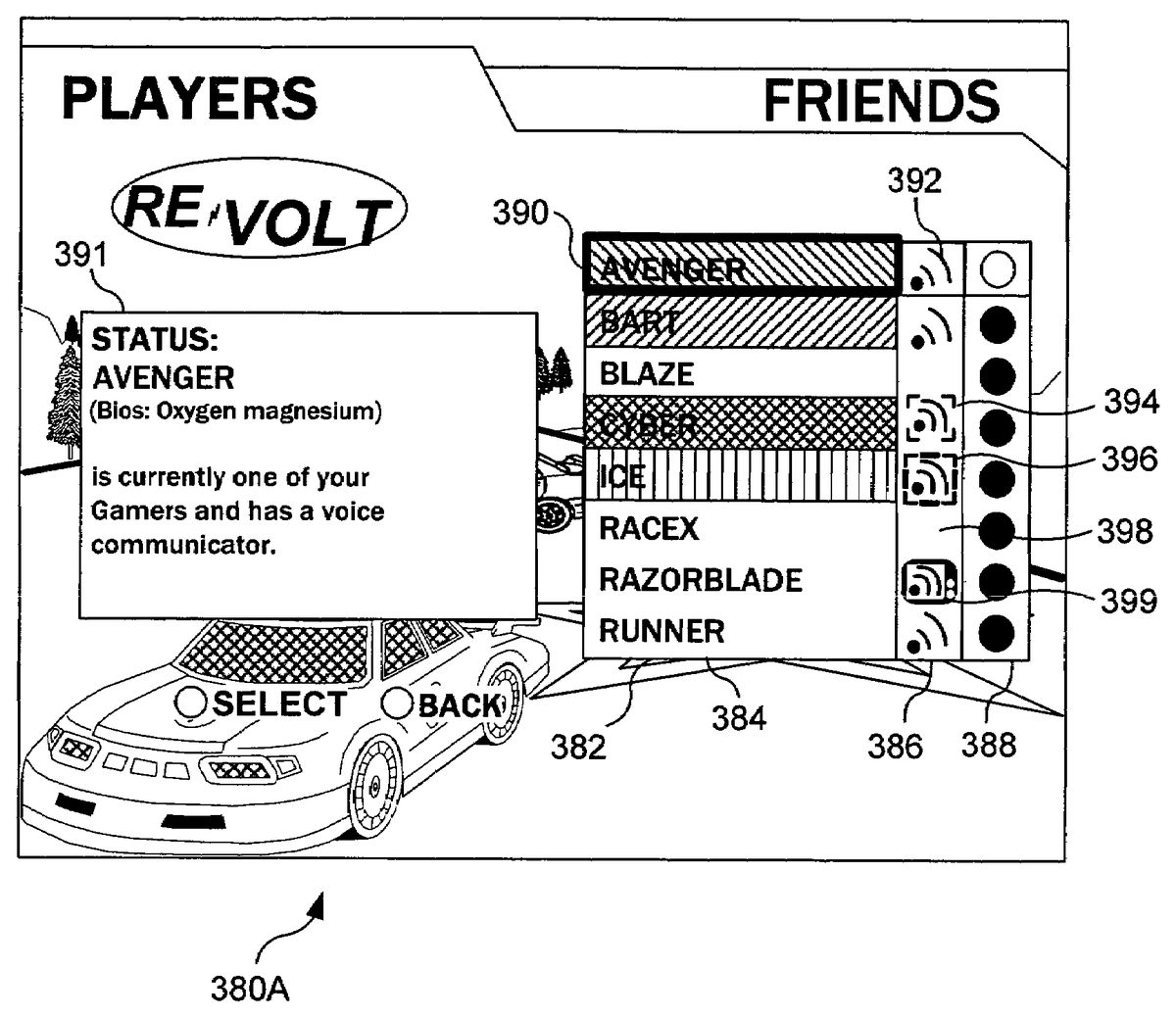
A current speaker can also be visually indicated on a players list along with more detailed information regarding each player's voice communication status. For example,FIG. 5Ais an exemplary screen of a players tab view380A that provides information on players in the current game session. A player's list382includes a player ID column384, a voice communication status column386and a friend status column388. A current speaker's player ID390can be highlighted or otherwise visually indicate that a remote player is speaking. A corresponding talk enabled icon392indicates that the corresponding player has an active voice communicator. A muted icon394indicates that the local listener has muted voice communication from a selected player. A persistent bidirectional mute icon396indicates that the local listener or the network gaming service has prohibited the corresponding player from speaking to the listener and hearing any voice communication from the listener. A null icon398indicates that a corresponding player does not have a voice communicator. A hear-only icon399indicates that a corresponding player can hear voice communication but does not have a microphone for speaking to other players. Further explanation about a selected player's voice communication capability is preferably provided in a player's status box391.
A listener (i.e., a local player) can change local listening settings for each player.FIG. 5Bis an exemplary screen of a players tab view380B that includes a dialog box400for changing a local listening setting402for a selected player. For example, dialog box400can be used to mute a selected player.
FIG. 6is a flow diagram illustrating the logic for processing voice communication received by a listening player's gaming system. At a step410, the listener's gaming system receives a data packet that includes voice communication data and may include game data. At a step412, the gaming system decodes the received packet to obtain a speaker ID from the received packet. The gaming system determines, at a decision step414, whether the listener has chosen, or is permitted to hear the voice data from the speaker. Further detail regarding this determination is described below with regard toFIG. 7. If the listener's gaming system determines that the listener should not hear the voice data from the speaker, control returns to step410to await another data packet.
However, if the listener's gaming system determines that the listener should hear the voice data from the speaker, the listener's gaming system decodes and decompresses the encoded voice data of the data packet at a step415and associates the decoded speaker ID with a visual indicator, at a step416. For example, the listener's gaming system can associate the decoded speaker ID with the speaker's corresponding vehicle or display icon.
At a decision step418, the listener's gaming system determines whether the speaker's vehicle, animated character, or other control game element is visible to the listener on the listener's display. If the speaker's character is currently visible to the listener, the listener's gaming system highlights the speaker's character in the display, at a step420. For example, a speaker icon and player ID will be displayed over the speaker's character. As indicated above, other indications can include increasing the intensity of the speaker's character, causing the speaker's character's lips to move, providing a bubble over the character with or without a text version of the speaker's voice communication, or other indications associated with the speaker's character. In addition to highlighting the speaker's character, or if the speaker's character is not currently visible to the listener, the gaming system activates an alternate visual indicator at a step422. For example, a separate icon may be displayed at one edge of the listener's display screen. Alternatively, the speaker's player ID can be highlighted in the player list.
At an optional step424, the listener's gaming system can adjust the voice data or perform other audio processing. For example, the speaker's voice data may be adjusted to sound like an elf, sound like a preselected gender which may be the same or different than that of the speaker, or have other characteristics that alter the sound of the speaker's voice. Alternatively, or in addition, the volume of the speaker's voice data may be adjusted to reflect the proximity of the speaker's character to the listener's character in the gaming virtual environment. Further, the speaker's voice data can be buffered to prevent jitter or other undesirable effects. The speaker's voice data can also be mixed with voice data from other speakers so that the listener hears multiple voices at the same time. These multiple voices can include the listener's own voice if the listener is also speaking. Once any desired adjustments to the sound characteristics are made, the listener's gaming system plays the voice data through the listener's headphones or fixed speakers, at a step426. Control then returns to step410to await another data packet.
FIG. 7is a flow diagram illustrating the logic for performing a number of hearing checks to determine whether the listener should hear the received voice data.FIG. 7provides further detail for decision step414inFIG. 6. At a decision step430inFIG. 7, the listener's gaming system determines whether the speaker is trusted. For example, the listener may selectively choose to hear voice communications only from players that are on the listener's team. Alternatively, or in addition, the listener may selectively choose to receive voice communications only from those speakers who have obtained a special voice communication certificate from the network gaming service's key distribution center, or from a trusted third party. If the listener's gaming system determines that the speaker is not trusted, control passes to a step432to prevent further processing of the speaker's voice data. Additional processes can include reporting the speaker's attempted communication, providing an automatic message to the speaker, or error processing.
If the speaker is trusted, the listener's gaming system determines, at a decision step434, whether the speaker was muted by the listener or by the gaming service. If so, the listener's gaming system ignores the speaker's voice data or performs other non-audio processing at step432. For example, the listener's gaming system can display an icon corresponding to the speaker ID to indicate that the speaker is trying to communicate with the listener. However, the voice data will not be routed to the listener's headset or fixed speakers.
At a decision step436, the listener's gaming system can optionally determine whether the speaker has communicated over an acceptable channel. For example, a team of players may select a channel for secure voice communications. If the speaker is not communicating over the secure channel, the listener's gaming system processes the speaker's voice data at step432.
The listener's gaming system can also optionally determine, at a decision438, whether the speaker's character, vehicle, or other controlled game element is within a sufficient hearing distance of the listener's controlled game element. For example, if the speaker's animated character is in a different building of the gaming environment than the listener's character, and the characters are not in radio communication, the speaker's voice data are blocked and not heard by the listener. As discussed above, the speaker's voice data can alternatively be varied in volume as a function of the distance between the speaker and the listener characters. Similarly, at a decision step440, the listener's gaming system optionally determines whether the speaker or listener are otherwise restricted by the game. For example, the speaker's character or the listener's character might be in a penalty box or a silence booth as part of the game play. In that case, the listener's gaming system prevents the listener from hearing the speaker or performs other non-audio processing at step432. However, if the above decisions indicate that the listener should hear the speaker, the listener's gaming system enables the listener to hear the speaker's voice data at a step442. Those skilled in the art will recognize that other decision steps can be included and the decision steps discussed above may be arranged in other logical configurations other than the indicated straight sequential order.
Although the present invention has been described in connection with the preferred form of practicing it and modifications thereto, those of ordinary skill in the art will understand that many other modifications can be made to the present invention within the scope of the claims that follow. For example, speakers can be visually identified within a local network of gaming systems independent of a networked gaming service. Accordingly, it is not intended that the scope of the invention in any way be limited by the above description, but instead be determined entirely by reference to the claims that follow.
Claims
- A method for visually indicating a voice speaker to a listener in a context of a computing session, comprising the steps of: (a) obtaining a speaker identifier, the speaker identifier including a user name gamertag, from voice data transmitted by the voice speaker;(b) associating the speaker identifier with a visual indicator used for indicating voice speakers;(c) selectively and temporarily, when the voice speaker is speaking, displaying the visual indicator and selectively and temporarily, when the voice speaker is speaking, displaying the user name gamertag, and when the visual indicator and the user name gamertag are displayed, displaying the visual indicator and the user name adjacent to one another, on the display to indicate that the voice speaker is speaking;(d) receiving user input selecting a players tab view that provides information on players in a current game session and in response to receiving user input selecting a players tab view: displaying a player's list including a player ID column listing gamertags for players in a current game session, and displaying a voice communication column capable of selectively displaying for each of the players in the player ID column each of: a muted icon that indicates that a local listener has muted voice communication from a selected player, a persistent bidirectional mute icon that indicates that the local listener or the network gaming service has prohibited the corresponding player from speaking to the listener and hearing any voice communication from the listener, a null icon that indicates that a corresponding player does not have a voice communicator, and a hear-only icon that indicates that a corresponding player can hear voice communication but does not have a microphone for speaking to other players.
- The method of claim 1 , wherein prior to the step of displaying, further comprising the step of determining whether the listener has elected to hear voice communications from the voice speaker.
- The method of claim 2 , wherein the step of determining comprises at least one of the steps of: (a) determining whether the listener has muted voice communications from the voice speaker;and (b) determining whether the voice speaker provided evidence that the voice speaker is trusted by the listener, so that voice communications from the voice speaker are allowed to be heard by the listener.
- The method of claim 1 , wherein prior to the step of displaying, further comprising the step of determining whether the listener is prohibited from hearing voice communications from the voice speaker.
- The method of claim 4 , wherein the step of determining comprises at least one of the steps of: (a) determining whether the voice speaker has been muted in the computing session;and (b) determining whether the voice speaker is restricted from voice communication as a result of one of an event occurring in the computing session and a status of the computing session.
- The method of claim 1 , further comprising modifying the voice data as a function of a status of at least one of the voice speaker and the listener in the computing session.
- The method of claim 1 , further comprising the step of mixing the voice data from the voice speaker with voice data from another voice speaker to provide the listener with a multi-voice communication.
- The method of claim 1 , further comprising modifying the voice data as a function of a predefined characteristic selected by the voice speaker.
- The method of claim 8 , wherein modifying the voice data as a function of a predefined characteristic selected by the voice speaker comprises adjusting the voice data to sound like an elf.
- The method of claim 8 , wherein modifying the voice data as a function of a predefined characteristic selected by the voice speaker comprises adjusting the voice data to sound like a preselected gender.
- The method of claim 1 , further comprising changing the appearance of a visual element that is controlled by the voice speaker in the computing session by moving a mouth on a character controlled by the voice speaker.
- The method of claim 1 , further comprising displaying to the listener a muted speaker identifier when an undesired voice speaker is speaking and when the undesired voice speaker's voice communication has been muted with respect to the listener.
- The method of claim 1 , further comprising displaying to the listener an indicator that a player is prohibited from speaking to the listener or hearing any voice communication from the listener.
- The method of claim 1 , further comprising displaying an indicator indicating that a participant does not have a voice communicator.
- The method of claim 1 , further comprising displaying an indicator indicating that a participant can hear voice communications, but does not have a microphone.
- A memory medium on which are stored machine instructions for carrying out the following acts: (a) obtaining a speaker identifier, the speaker identifier including a user name gamertag, from voice data transmitted by the voice speaker;(b) associating the speaker identifier with a visual indicator used for indicating voice speakers;(c) selectively and temporarily, when the voice speaker is speaking, displaying the visual indicator and selectively and temporarily, when the voice speaker is speaking, displaying the user name gamertag, and when the visual indicator and the user name gamertag are displayed, displaying the visual indicator and the user name adjacent to one another, on the display to indicate that the voice speaker is speaking;(d) receiving user input selecting a players tab view that provides information on players in a current game session and in response to receiving user input selecting a players tab view: displaying a player's list including a player ID column listing gamertags for players in a current game session, and displaying a voice communication column capable of selectively displaying for each of the players in the player ID column each of: a muted icon that indicates that a local listener has muted voice communication from a selected player, a persistent bidirectional mute icon that indicates that the local listener or the network gaming service has prohibited the corresponding player from speaking to the listener and hearing any voice communication from the listener, a null icon that indicates that a corresponding player does not have a voice communicator, and a hear-only icon that indicates that a corresponding player can hear voice communication but does not have a microphone for speaking to other players.
- A system for visually indicating a voice speaker to a listener in a context of a computing gaming session, comprising: (a) a processor;(b) a display in communication with the processor;and (c) a memory in communication with the processor, said memory storing machine instructions that cause the processor to carry out a plurality of functions, including: (i) obtaining a speaker identifier, the speaker identifier including a user name gamertag, from voice data transmitted by the voice speaker;(ii) associating the speaker identifier with a visual indicator used for indicating voice speakers;(iii) selectively and temporarily, when the voice speaker is speaking, displaying the visual indicator and selectively and temporarily, when the voice speaker is speaking, displaying the user name gamertag, and when the visual indicator and the user name gamertag are displayed, displaying the visual indicator and the user name adjacent to one another, on the display to indicate that the voice speaker is speaking;(iv) receiving user input selecting a players tab view that provides information on players in a current game session and in response to receiving user input selecting a players tab view: displaying a player's list including a player ID column listing gamertags for players in a current game session, and displaying a voice communication column capable of selectively displaying for each of the players in the player ID column each of: a muted icon that indicates that a local listener has muted voice communication from a selected player, a persistent bidirectional mute icon that indicates that the local listener or the network gaming service has prohibited the corresponding player from speaking to the listener and hearing any voice communication from the listener, a null icon that indicates that a corresponding player does not have a voice communicator, and a hear-only icon that indicates that a corresponding player can hear voice communication but does not have a microphone for speaking to other players.
- The system of claim 17 , wherein prior to displaying the visual indicator, the machine instructions further cause the processor to carry out the function of determining whether the listener has elected to hear voice communications from the voice speaker.
- The system of claim 18 , wherein the machine instructions further cause the processor to carry out at least one of the functions of: (a) determining whether the listener has muted voice communications from the voice speaker;and (b) determining whether the voice speaker provided evidence that the voice speaker is trusted by the listener, so that voice communications from the voice speaker are allowed to be heard by the listener.
- The system of claim 17 , wherein prior to displaying the visual indicator, the machine instructions further cause the processor to carry out the function of determining whether the listener is prohibited from hearing voice communications from the voice speaker.
- The system of claim 20 , wherein the machine instructions further cause the processor to carry out at least one of the functions of: (a) determining whether the voice speaker has been muted in the computing session;and (b) determining whether the voice speaker is restricted from voice communication as a result of one of an event occurring in the computing session and a status of the computing session.
- The system of claim 17 , wherein the machine instructions further cause the processor to modify the voice data as a function of a status of at least one of the voice speaker and the listener in the computing session.
- The system of claim 17 , wherein the machine instructions further cause the processor to carry out the function of mixing the voice data from the voice speaker with voice data from another voice speaker to provide the listener with a multi-voice communication.
- The system of claim 17 , wherein the machine instructions further cause the processor to the voice data as a function of a predefined characteristic selected by the voice speaker.
Disclaimer: Data collected from the USPTO and may be malformed, incomplete, and/or otherwise inaccurate.