U.S. Pat. No. 7,497,779
VIDEO GAME INCLUDING TIME DILATION EFFECT AND A STORAGE MEDIUM STORING SOFTWARE FOR THE VIDEO GAME
AssigneeNintendo Co., Ltd.
Issue DateMay 10, 2005
U.S. Patent No. 7,497,779: Video game including time dilation effect and a storage medium storing software for the video game

Summary:
The ‘779 patent describes a feature used in the Max Payne series of video games—the ability to change the laws of physics depending on the state of the game character. In these games the player has the ability to slow down the game world in order to provide his character with special abilities. Generally, when this invention has been implemented, the camera shifts to the first-person view of the character while the time is slowed. This gives the player the feeling of actually being the character as opposed to just controlling a figure on the screen.
Abstract:
The passage of time and/or the laws of physics may be changed depending on the state of a game character. For example, the slowing down of the game world may provide the game character with special abilities move quickly in a very short period of “game world” time.
Illustrative Claim:
1. A video game comprising: a ghost game character capable of possessing and dispossessing a plurality of different host game characters during game play wherein a game world view shifts to a view of a possessed host game character; and a time change effect for changing the rate at which time passes in the game world between a first rate when the ghost game character possesses one of the host game characters and a second rate when the ghost game character dispossesses one of the host game characters, wherein the changing between the first and second rates occurs gradually.
Illustrative Figure
Abstract
The passage of time and/or the laws of physics may be changed depending on the state of a game character. For example, the slowing down of the game world may provide the game character with special abilities move quickly in a very short period of “game world” time.
Description
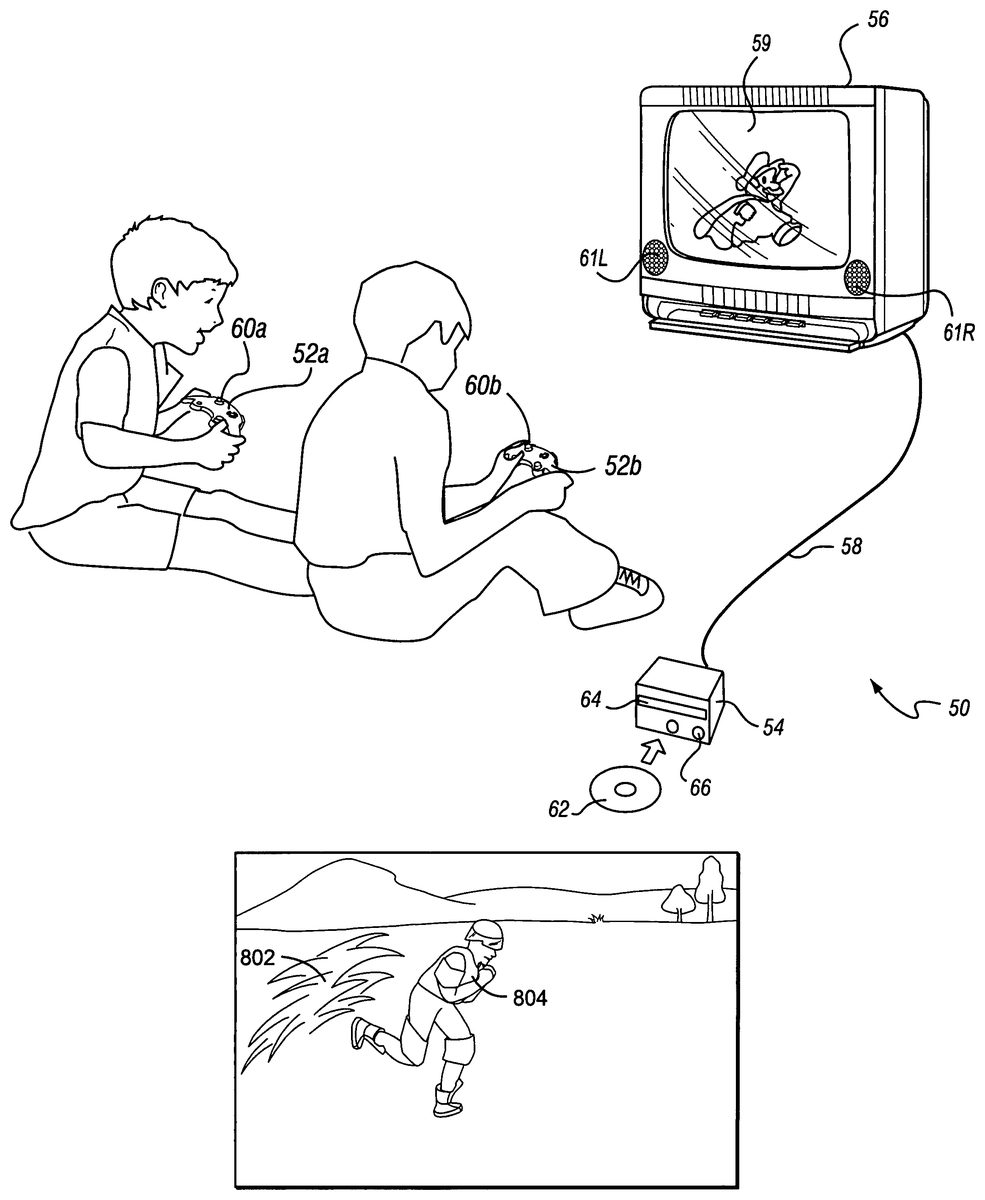
DETAILED DESCRIPTION OF EXAMPLE EMBODIMENTS FIG. 1shows an example interactive 3D computer graphics system50on which the video game described herein may be played. System50can be used to play interactive 3D video games with interesting stereo sound. It can also be used for a variety of other applications. In this example, system50is capable of processing, interactively in real time, a digital representation or model of a 3D world. System50can display some or all of the world from any arbitrary viewpoint. For example, system50can interactively change the viewpoint in response to real time inputs from handheld controllers52a,52bor other input devices. This allows the game player to see the world through the eyes of someone within or outside of the world. System50can be used for applications that do not require real time 3D interactive display (e.g., two-dimensional (2D) display generation and/or non-interactive display), but the capability of displaying quality 3D images very quickly can be used to create very realistic and exciting game play or other graphical interactions. To play a video game or other application using system50, the user or player first connects a main unit54to his or her color television set56or other display device by connecting a cable58between the two. Main unit54produces both video signals and audio signals for controlling color television set56. The video signals control the images displayed on the television screen59, and the audio signals are played back as sound through television stereo loudspeakers61L,61R. The user also needs to connect main unit54to a power source. This power source may be a conventional AC adapter (not shown) that plugs into a standard home electrical wall socket and converts the house current into a lower DC voltage signal suitable for powering the main unit54. Batteries could be used in other implementations. The user may use hand-held controllers52a,52bto supply inputs to ...
DETAILED DESCRIPTION OF EXAMPLE EMBODIMENTS
FIG. 1shows an example interactive 3D computer graphics system50on which the video game described herein may be played. System50can be used to play interactive 3D video games with interesting stereo sound. It can also be used for a variety of other applications. In this example, system50is capable of processing, interactively in real time, a digital representation or model of a 3D world. System50can display some or all of the world from any arbitrary viewpoint. For example, system50can interactively change the viewpoint in response to real time inputs from handheld controllers52a,52bor other input devices. This allows the game player to see the world through the eyes of someone within or outside of the world. System50can be used for applications that do not require real time 3D interactive display (e.g., two-dimensional (2D) display generation and/or non-interactive display), but the capability of displaying quality 3D images very quickly can be used to create very realistic and exciting game play or other graphical interactions.
To play a video game or other application using system50, the user or player first connects a main unit54to his or her color television set56or other display device by connecting a cable58between the two. Main unit54produces both video signals and audio signals for controlling color television set56. The video signals control the images displayed on the television screen59, and the audio signals are played back as sound through television stereo loudspeakers61L,61R.
The user also needs to connect main unit54to a power source. This power source may be a conventional AC adapter (not shown) that plugs into a standard home electrical wall socket and converts the house current into a lower DC voltage signal suitable for powering the main unit54. Batteries could be used in other implementations.
The user may use hand-held controllers52a,52bto supply inputs to main unit54. Controls60a,60bcan be used, for example, to specify the direction (up or down, left or right, closer or further away) that a character displayed on television56should move within a 3D world. Controls60a,60bcan also be used to provide input for other applications (e.g., menu selection, pointer/cursor control, etc.). Controllers52can take a variety of forms. In this example, controllers52each include controls60such as joysticks, push buttons and/or directional switches. Controllers52may be connected to main unit54by cables or wirelessly via electromagnetic (e.g., radio or infrared) waves.
Each controller52may also contain one or more vibration devices (not shown) that are selectively driven in accordance with control signals from main unit54. When driven, these vibration units produce vibrations that are transmitted to the hand(s) of the player holding the controller. In this way, tactile sensations may be provided to players when vibration generating events occur during game play. Examples of vibration generating events include collisions, movement over a rough surface, accelerations, etc. Additional details of example controllers using vibration devices may be found in U.S. Pat. No. 6,676,520 and application Ser. No. 09/814,953, the contents of which are incorporated herein in their entirety.
To play an application such as a game, the user selects an appropriate storage medium62storing the video game or other application he or she wants to play, and inserts that storage medium into a storage medium receiving portion64in main unit54. Storage medium62may, for example, be a specially encoded and/or encrypted optical and/or magnetic disk. Of course, in other implementations of the graphics system other memory devices such as semiconductor memories may be used. In still other implementations, the user may connect over a communication network such as the Internet to a remote computer storing game software. In theFIG. 1implementation, the user may operate a power switch66to turn on main unit54and cause the main unit to begin running the video game or other application based on the software stored in the storage medium62. The user may operate controllers52to provide inputs to main unit54. For example, operating a control60may cause the game or other application to start. Moving other controls60can cause animated characters to move in different directions or change the user's point of view in a 3D world. Depending upon the particular software stored within the storage medium62, the various controls60on the controller52can perform different functions at different times.
Example Electronics of Overall System
FIG. 2shows a block diagram of example components of system50. The primary components include a main processor (CPU)110, a main memory112and a graphics and audio processor114. In this example, main processor110(e.g., an enhanced IBM Power PC 750) receives inputs from hand-held controllers52(and/or other input devices) via graphics and audio processor114. Main processor110interactively responds to user inputs, and executes a video game or other program supplied, for example, by external storage media62via a mass storage access device106such as an optical disk drive. As one example, in the context of video game play, main processor110can perform collision detection and animation processing in addition to a variety of interactive and control functions.
In this example, main processor110generates 3D graphics and audio commands and sends them to graphics and audio processor114. The graphics and audio processor114processes these commands to generate interesting visual images on display59and interesting stereo sound on stereo loudspeakers61R,61L or other suitable sound-generating devices.
Example system50includes a video encoder120that receives image signals from graphics and audio processor114and converts the image signals into analog and/or digital video signals suitable for display on a standard display device such as a computer monitor or home color television set56. System50also includes an audio codec122that compresses and decompresses digitized audio signals and may also convert between digital and analog audio signaling formats as needed. Audio codec122can receive audio inputs via a buffer124and provide them to graphics and audio processor114for processing (e.g., mixing with other audio signals the processor generates and/or receives via a streaming audio output of mass storage access device106). Graphics and audio processor114in this example can store audio related information in an audio memory126that is available for audio tasks. Graphics and audio processor114provides the resulting audio output signals to audio codec122for decompression and conversion to analog signals (e.g., via buffer amplifiers128L,128R) so they can be reproduced by loudspeakers61L,61R.
Graphics and audio processor114has the ability to communicate with. various additional devices that may be present within system50. For example, a parallel digital bus130may be used to communicate with mass storage access device106and/or other components. A serial peripheral bus132may communicate with a variety of peripheral or other devices including, for example a programmable read-only memory and/or real time clock134, a modem136or other networking interface (which may in turn connect system50to a telecommunications network138such as the Internet or other digital network from/to which program instructions and/or data can be downloaded or uploaded), and flash memory140.
A further external serial bus142may be used to communicate with additional expansion memory144(e.g., a memory card) or other devices. Connectors may be used to connect various devices to busses130,132,142.
Example Graphics and Audio Processor
FIG. 3is a block diagram of an example graphics and audio processor114. Graphics and audio processor114in one example may be a single-chip ASIC (application specific integrated circuit). In this example, graphics and audio processor114includes a processor interface150, a memory interface/controller152, a 3D graphics processor154, an audio digital signal processor (DSP)156, an audio memory interface158, an audio interface and mixer160, a peripheral controller162, and a display controller164.
3D graphics processor154performs graphics processing tasks. Audio digital signal processor156performs audio processing tasks. Display controller164accesses image information from main memory112and provides it to video encoder120for display on display device56. Audio interface and mixer160interfaces with audio codec122, and can also mix audio from different sources (e.g., streaming audio from mass storage access device106, the output of audio DSP156, and external audio input received via audio codec122). Processor interface150provides a data and control interface between main processor110and graphics and audio processor114.
Memory interface152provides a data and control interface between graphics and audio processor114and memory112. In this example, main processor110accesses main memory112via processor interface150and memory interface152that are part of graphics and audio processor114. Peripheral controller162provides a data and control interface between graphics and audio processor114and the various peripherals mentioned above. Audio memory interface158provides an interface with audio memory126.
Example Graphics Pipeline
FIG. 4shows a more detailed view of an example 3D graphics processor154. 3D graphics processor154includes, among other things, a command processor200and a 3D graphics pipeline180. Main processor110communicates streams of data (e.g., graphics command streams and display lists) to command processor200. Main processor110has a two-level cache to minimize memory latency, and also has a write-gathering buffer for uncached data streams targeted for the graphics and audio processor114. The write-gathering buffer collects partial cache lines into full cache lines and sends the data out to the graphics and audio processor114one cache line at a time for maximum bus usage.
Command processor200receives display commands from main processor110and parses them—obtaining any additional data necessary to process them from shared memory112. The command processor200provides a stream of vertex commands to graphics pipeline180for 2D and/or 3D processing and rendering. Graphics pipeline180generates images based on these commands. The resulting image information may be transferred to main memory112for access by display controller/video interface unit164—which displays the frame buffer output of pipeline180on display56.
FIG. 5is a logical flow diagram of graphics processor154. Main processor110may store graphics command streams210, display lists212and vertex arrays214in main memory112, and pass pointers to command processor200via bus interface150. The main processor110stores graphics commands in one or more graphics first-in-first-out (FIFO) buffers210it allocates in main memory110. The command processor200fetches: (1) command streams from main memory112via an on-chip FIFO memory buffer216that receives and buffers the graphics commands for synchronization/flow control and load balancing, (2) display lists212from main memory112via an on-chip call FIFO memory buffer218, and (3) vertex attributes from the command stream and/or from vertex arrays214in main memory112via a vertex cache220.
Command processor200performs command processing operations200athat convert attribute types to floating point format, and pass the resulting complete vertex polygon data to graphics pipeline180for rendering/rasterization. A programmable memory arbitration circuitry130(seeFIG. 4) arbitrates access to shared main memory112between graphics pipeline180, command processor200and display controller/video interface unit164.
FIG. 4shows that graphics pipeline180may include: a transform unit300, a setup/rasterizer400, a texture unit500, a texture environment unit600, and a pixel engine700.
Transform unit300performs a variety of 2D and 3D transforms and other operations300a(seeFIG. 5). Transform unit300may include one or more matrix memories300bfor storing matrices used in transformation processing300a. Transform unit300transforms incoming geometry per vertex from object or model space to homogenous eye space using a Modelview Matrix, and (after clipping300din clip space if desired) performs perspective scaling and screen coordinate conversion to provide resulting screen space (x, y, z) triplets for rasterization. Transform unit300also transforms incoming texture coordinates and computes projective texture coordinates (300c). Lighting processing300ealso performed by transform unit300bprovides per vertex lighting computations for up to eight independent lights in one example embodiment. Transform unit300can also perform texture coordinate generation (300c) for embossed type bump mapping effects.
Setup/rasterizer400includes a setup unit which receives vertex data from transform unit300and sends triangle setup information to one or more rasterizer units (400b) performing edge rasterization, texture coordinate rasterization and color rasterization.
Texture unit500(which may include an on-chip embedded DRAM texture memory (TMEM)502) performs various tasks related to texturing including for example: retrieving color and z textures504from main memory112; texture processing (500a) including, for example, multi-texture handling, post-cache texture decompression, texture filtering (e.g., resampling to provide non-uniform and/or non-linear texture mapping), embossing, shadows and lighting through the use of projective textures, and BLIT with alpha transparency and depth; bump map processing for computing texture coordinate displacements for bump mapping, pseudo texture and texture tiling effects (500b); and indirect texture processing (500c). Generally speaking, texturing modifies the appearance of each location of a surface using some image, function or other data. As an example, instead of precisely representing the geometry of each brick in a brick wall, a two-dimensional color image of a brick wall can be applied to the surface of a single polygon. When the polygon is viewed, the color image appears where the polygon is located.
Texture unit500outputs filtered texture values to the texture environment unit600for texture environment processing (600a). Texture environment unit600blends polygon and texture color/alpha/depth, and can also perform texture fog processing (600b) to achieve inverse range based fog effects. Texture environment unit600can provide multiple stages to perform a variety of other interesting environment-related functions based for example on color/alpha modulation, embossing, detail texturing, texture swapping, clamping, and depth blending. Briefly, texture environment unit600in the example embodiment combines per-vertex lighting, textures and constant colors to form the pixel color and then performs fogging and blending including z blending for z textures. In an example embodiment, the color and alpha components have independent texture environment unit circuitry with independent controls. One set of texture environment color/alpha-combiners implemented in hardware can be reused over multiple cycles called texture environment stages (each having independent controls) to implement multi-texturing or other blending functions.
Pixel engine700stores color and depth data into an embedded (on-chip) DRAM (1TSRAM) frame buffer memory702including a color frame buffer and a depth buffer. Pixel engine700performs depth (z) compare (700a) and pixel blending (700b). Z compares700a′ can also be performed at an earlier stage in the graphics pipeline180(i.e., before texturing) depending on the rendering mode currently in effect (e.g., if alpha thresholding is not required). However, it is desirable, although not necessary, to provide z buffering at the end of the pipeline. The pixel engine700includes a copy operation700cthat periodically writes on-chip frame buffer702to main memory112for access by display/video interface unit164. This copy operation700ccan also be used to copy embedded frame buffer color or z information to textures in the main memory112for dynamic color or z texture synthesis. Anti-aliasing and other filtering can be performed during the copy-out operation. The color frame buffer output of graphics pipeline180(which is ultimately stored in main memory112) is read each frame by display/video interface unit164. Display controller/video interface164provides digital RGB pixel values for display on display102.
Additional details of example graphics system50may be found in U.S. Pat. Nos. 6,707,458 and 6,609,977, the contents of each of which are incorporated herein in their entirety.
Example Video Game
The discussion below is in the context of an example first person ghost game that may be played using example graphics system50. In an illustrative embodiment, the executable instructions (program) for this video game are stored on a storage medium62that is operatively coupled to graphics system50. Of course, the techniques and methods described herein are not limited to the example ghost game or the example graphics system and it will be readily recognized that these techniques and methods are readily applicable to many different types of video games and graphics systems. For example, the graphics systems are not limited to console systems as shown inFIG. 1and may include hand-held devices, personal computers and emulators running on hand-held devices or personal computers. For example, an emulator may provide a hardware and/or software configuration (platform) that is different from the hardware and/or software configuration (platform) of graphics system50. The emulator system might include software and/or hardware components that emulate or simulate some or all of hardware and/or software components of the system for which the application software was written. For example, the emulator system could comprise a hand-held device or a general purpose digital computer such as a personal computer which executes a software emulator program that simulates the hardware and/or firmware of graphics system50.
The example ghost game is a first person game in which the player plays the game as if looking out of his or her own eyes. In the example ghost game, players search for a physical body, which is mysteriously being kept alive somewhere in an enormous compound. Players can explore the compound as a ghost which can travel through the human world virtually unseen, using its abilities to slip through cracks, interfere with electronics, move objects and the like. The ghost can “possess” a plurality of different characters or objects (“hosts”), thereafter using the hosts' weapons, equipment, skills, and even memories, to complete the goals. For example, the ghost may possess a soldier character in order to fight other characters or may possess an animal such as a dog or mouse to gain access to areas that might be inaccessible to human characters. The ghost may also possess game objects such as weapons or machine controls so that these objects can be controlled to achieve game objectives. Thus, in the example game, the player is a ghost and the ghost “possesses” or inhabits hosts such as game characters and game objects in order to accomplish game objectives. When the ghost possesses a host, the game view is shifted to the view of the possessed host.
Generally speaking, the ghost may possess a host when the host has a predetermined “aura.” In the case of game characters, these auras indicate the emotional state(s) of the characters. In the example game, when the player is in ghost form, the ghost can see the emotional states of potentially possessible characters by the colors of their auras. Auras visually surround at least part of a possessible host.FIG. 6Ashows a character602having a white aura604;FIG. 6Bshows a character612having a yellow aura614; andFIG. 6Cshows a character622having a red aura624. As noted above, the color of a character's aura indicates the emotional state of that character. For example, the white aura604indicates that character602has a confident emotional state. The yellow aura614indicates that character612has a wary emotional state. The red aura624indicates that character622has a frightened emotional state.
Of course, these colors and emotional states are provided by way of example, not limitation. In addition, although three emotional states are described, different numbers of emotional states may be used. For example, characters may be limited to having either confident or frightened emotional states and auras of two different colors may be used to represent these two different emotional states. Alternatively, in the case of two different emotional states, an aura may be provided only when the character is in one or the other of the emotional states. In a still further example, different characters may have different numbers and/or types of auras.
The ghost can posses a host by frightening the potential character to change its aura from white or yellow to red. By way of example, the potential host may be character612shown inFIG. 6Bwho may initially have a white (confident) aura. The ghost may cause steam to be emitted from a steam pipe as shown inFIG. 6Bby, for example, possessing or inhabiting the steam pipe. This will cause the aura of character612to become yellow, indicating that the character is now in a wary emotional state. The inability of the character to stop the steam emission or escape from the chamber in which the steam is being emitted may subsequently cause the aura to become red, at which point the ghost may possess the character. By way of further example, a potential host may be a character may be typing at a laptop computer. The unseen ghost may, for example, possess or inhabit the laptop and thereafter close or turn off the laptop while the character is typing, frightening the character and changing the color of the character's aura from white to yellow. The character may then try to escape from the room in which the character was working. If the ghost has locked the door, the character's aura may change from yellow to red. At this point, the ghost may posses the character.
The character preferably maintains a yellow or red aura only for a predetermined period of time. For example, if the steam emission were to be stopped after the aura of character612turned yellow, the aura would preferably revert to white after some predetermined time period (e.g., ten seconds). Similarly, a red aura would revert back to a yellow aura after a predetermined period of time.
As noted above, objects such as weapons, computers, steam meters, etc. may be possessed in order to frighten potential host characters. In some cases, these objects may always be possessible, in which case they could always have a red aura or could have no aura at all. In other cases, certain objectives and/or goals may need to be achieved in order to make an object possessible. In this case, the aura of the object may be changed from one color (e.g., white) to another color (e.g., red) to indicate that the object is possessible after the objectives or goals are attained. Thus, in the case of objects, auras would not typically be indicative of an “emotional state”, but rather whether the object was possessible or not.
Possession may be accomplished in one example implementation by selecting the character to be possessed using the positioning controls of the controller52to position a cursor or other indicator on the character and then pressing a “possess” key of the controller. As shown inFIG. 6C, for example, the upper right-hand portion of the game display may provide guidance information which indicates that pressing the “A” key on the controller52will cause the ghost to possess character622. Guidance information may be context sensitive so that it is relevant to actions currently available to the player. Thus, guidance information for possessing a host may be displayed when there is a host capable of being possessed. Guidance information for “dispossessing” a host may be displayed when a host is possessed.
As noted above, during game play, a player may be in ghost form or may possess various hosts. In the example video game, when the ghost has possessed a host, time passes normally in the game world. However, when the player is in ghost form, time is slowed down in the game world except for the ghost. This enables the ghost to, among other things, move faster than the others characters in the game. This slowing down of time can be practically implemented by scaling time change values provided to the parts of the game program code other than those parts that generate the display of the ghost character.
The slowing down of time will be further explained with reference toFIGS. 7A-7D. InFIGS. 7A and 7B, the ghost has possessed host character802. Consequently, as noted above, time passes normally in the game world. Thus, inFIG. 7A, possessed character802is chasing character804and at some time T later inFIG. 7B, character802has still not caught up with character804. InFIGS. 7C and 7D, character802is a ghost and the ghost is chasing character804. However, because time is slowed down in the real world, ghost802is able to catch up to and pass character804(seeFIG. 7D) by the time character804reaches the same point as inFIG. 7B. By way of example, the time change value for character804may be scaled so that ghost802moves at twice the speed of character804. Of course, this particular example of scaling is provided by way of example, not limitation.
Thus, as seen by the ghost, the game world runs slowly. In one example implementation, when a ghost dispossesses a host, the slowing of time does not occur abruptly, but rather slows down at a predetermined rate. Similarly, when a ghost possesses a host, time does not speed up abruptly, but rather speeds up at a predetermined rate. By way of example, not limitation, these predetermined rates may be determined so that the time speeds up or slows down over a period of about 1 to about 10 seconds. These predetermined rates are adjustable so that the slowing down and/or speeding up of time may be quite jarring or so that the slowing down and/or speeding up is relatively smooth.
The slowed down game world can be incorporated into game play. For example, the ghost may possess a host (such as an inanimate object) in order to scare a character. As a result of being scared, the character may begin to run, for example, down a hallway. If the player were to continue to possess a host while the character is running, the character might leave the scene and not be caught in time to be possessed. However, in the example video game described herein, as soon as the ghost leaves the possessed host, time slows down and the ghost can then catch up with and/or pass the running character and then, for example, possess the character.
Another illustrative use of the time dilation feature involves possessing projectiles. For example, a player possessing a host could fire a weapon and then thereafter dispossess the host. Because time in the real world is slowed down after dispossession, the ghost can actually catch up to and possess the projectile fired from the weapon (assuming the projectile is defined by the game program as being a possessible host). Once the projectile is possessed, it might then be steered and controlled by the player, allowing for more accurate aim. Indeed, the projectile could even be steered so as to be aimed at the host that fired the weapon.
In the example video game, game world time is slowed down when the ghost possesses a host. In an alternative implementation, game world time may be sped up when the ghost is in ghost form so that ghost moves slower than other characters. It is also possible that the game world time may speed up when the ghost is in ghost form at certain points in the game and that game world time may slow down when the ghost is in ghost form at certain other points in the game. These different points may, for example, be at different game levels.
In addition to time running more slowly, the “laws of physics” may be dependent at least in part on whether a player is viewing the world in ghost form or via a possessed host. For example, when the player views the world in ghost form, an explosion may cause an object or character to be propelled further and/or higher than the object or character would be propelled if the player were viewing the world via a possessed host. The changing of the laws of physics when the player views the world in ghost form enables better visual effects during game play. Of course, it will be apparent that the change in the laws of physics may be used for purposes other than simply providing better visual effects. For example, the changes can be integrated into the game play so that a player can accomplish objectives as a ghost using these changed laws that cannot be accomplished (or can accomplished only with great difficulty) when the ghost possesses a host. Thus, for example, a ghost in ghost form may be able to shoot weapons at an enemy over a longer distance than is possible when the ghost possesses a host.
With respect to the laws of physics, the game program may include instructions and parameters that fix the laws in the world as viewed in ghost form and the world as viewed via a possessed host. For example, motion as viewed via a posssessed host may be governed by the normal Newtonian laws of motion. However, motion as viewed in ghost form may be governed by modified laws of motion in order to produce the effects described above and other effects. For example, the gravitational constant in the equations for projectile motion may be scaled to be ⅔ of its normal value so that projectiles will reach higher heights and/or go greater distances. Alternatively, the projectile may be given greater energy when the ghost is in ghost form than when the ghost possesses a host. This greater energy will also enable the projectile to reach greater heights and/or go further distances.
In the example embodiment, the rates at which time speeds up and slows down when a player dispossesses and possesses a character are determined in accordance with parameters and instructions in the video game program. However, the video game is not limited in this respect and these slow down/speed up rates may be user configurable. In addition, the speed up/slow down rates need not be equal to each other and may differ for each host, if desired.
Similarly, in the example embodiment, the laws of physics in the slowed down world are determined in accordance with parameters and instructions in the game program. Here again, these parameters and instructions for the laws of physics may be user configurable.
While the invention has been described in connection with what is presently considered to be the most practical and preferred embodiment, it is to be understood that the invention is not to be limited to the disclosed embodiment, but on the contrary, is intended to cover various modifications and equivalent arrangements included within the spirit and scope of the appended claims.
Claims
- A video game comprising: a ghost game character capable of possessing and dispossessing a plurality of different host game characters during game play wherein a game world view shifts to a view of a possessed host game character;and a time change effect for changing the rate at which time passes in the game world between a first rate when the ghost game character possesses one of the host game characters and a second rate when the ghost game character dispossesses one of the host game characters, wherein the changing between the first and second rates occurs gradually.
- A video game comprising: a ghost game character capable of possessing and dispossessing a plurality of different host game characters during game play wherein a game world view shifts to a view of a possessed host game character;and a physics change effect for changing the laws of physics in the game world in dependence on whether the ghost game character possesses or dispossesses one of the host game characters.
- The video game according to claim 1 , wherein the first rate is greater than the second rate.
- A storage medium storing video game instructions executable by a graphics system to play a video game, the video game comprising: a ghost game character capable of possessing and dispossessing a plurality of different host game characters during game play wherein a game world view shifts to a view of a possessed host game character;and a time change effect for changing the rate at which time passes in the game world between a first rate when the ghost game character possesses one of the host game characters and a second rate when the ghost game character dispossesses one of the host game characters, wherein the changing between the first and second rates occurs gradually.
- The storage medium according to claim 4 , wherein the video game instructions are executable by a hand-held graphics system.
- The storage medium according to claim 4 , wherein the video game instructions are executable by a video game console.
- The storage medium according to claim 4 , wherein the video game instructions are executable by a personal computer.
- The storage medium according to claim 4 , wherein the video game instructions are executable by a personal computer running an emulator program.
- A storage medium storing video game instructions executable by a graphics system to play a video game, the video game comprising: a ghost game character capable of possessing and dispossessing a plurality of different host game characters during game play wherein a game world view shifts to a view of a possessed host game character;and a physics change effect for changing the laws of physics in the game world in dependence on whether the ghost game character possesses or dispossesses one of the host game characters.
- The storage medium according to claim 4 , wherein the first rate is greater than the second rate.
- A video game method comprising: controlling a ghost game character to possess host game characters during game play wherein a game world view shifts to a view of a possessed host game character;gradually speeding up the rate at which time passes in the game world when the ghost game character possesses one of the host game characters;controlling the ghost game character to dispossess the one of the host game characters;and gradually slowing down the rate at which time passes in the game world when the ghost game character dispossesses the one of the host game characters.
- A video game method comprising: controlling a ghost game character to possess host game characters during game play wherein a game world view shifts to a view of a possessed host game character;setting first laws of physics in the game world when the ghost game character possesses one of the host game characters;controlling the ghost game character to dispossess the one of the host game characters;and setting second laws of physics in the game world when the ghost game character dispossesses the one of the host game characters.
Disclaimer: Data collected from the USPTO and may be malformed, incomplete, and/or otherwise inaccurate.