U.S. Pat. No. 7,497,776
MULTIPLAYER GAME MODE WITH PREDATOR FEATURE
AssigneeMicrosoft Corporation
Issue DateJanuary 21, 2004
U.S. Patent No. 7,497,776: Multiplayer game mode with predator feature

Summary:
The ‘776 patent provides a new multiplayer feature for the user. One of the users has a car different from the others (for example, player 1 can be a cop car while the other players are sports cars). All the cars are designed, when playing this mode, to have the same features so that no car has an unfair speed advantage over the other cars. The user who starts as a different cop is the ‘predator’ whose goal is to catch the other players (the prey). A prey is caught whenever his car is run into by a predator, which then turns the prey into another predator to help hunt the remaining prey. The last player to remain as prey is the winner.
Abstract:
Methods and systems for administering and playing a multi-player computer game are disclosed. During the multi-player computer game, players are either identified as a predator or as prey. The predator players attempt to catch the prey, and the prey-players attempt to evade the predator(s). When a prey is caught, the caught prey becomes an additional predator. During game play, predator players’ display screens may display a directional arrow indicating the direction of the closest prey, and may also display a map indicating a position of each remaining prey. Predators may be displayed on each participants display screen with a first graphically depicted appearance (e.g., a police car), while prey may be depicted having a second graphically depicted appearance (e.g., a sports car). The game ends when no prey remain, and the last caught prey is the winner.
Illustrative Claim:
1. A computer-implemented method for playing a multiplayer computer game comprising an automobile driving simulation, comprising steps of: a computer identifying at least one player on a first team and a plurality of players on a second team, each player corresponding to a different automobile in a graphically depicted simulated driving environment in which the multiplayer computer game is played, wherein the at least one player on the first team has at least a first corresponding automobile with a first graphically depicted appearance and all of the players on the second team have automobiles that are graphically distinguished from the at least first corresponding automobile, and wherein each automobile of the at least one player on the first team is given enhanced capabilities so as to always have at least a same speed and capabilities as a fastest and strongest automobile corresponding to all of the plurality of players on the second team and regardless of any type of automobile that is being driven by the at least one player on the first team; initiating game play, during which each player on the first team tries to catch any player on the second team in the graphically depicted simulated driving environment, wherein a player on the second team is caught when a player on the first team drives the at least first corresponding automobile into an automobile that corresponds to the player on the second team; when any player on the first team catches any player on the second team by driving the at least first automobile into the automobile corresponding to the player on the second team, reassigning the caught second team player to the first team by at least changing an appearance attribute of the automobile corresponding to the caught second team player to reflect that the second team player is assigned to the first team and such that the automobile corresponding to the caught second team player has a changed graphically depicted appearance that is graphically similar to the first graphically depicted appearance of the at least first corresponding automobile; and ending game play when a predetermined event occurs.
Illustrative Figure
Abstract
Methods and systems for administering and playing a multi-player computer game are disclosed. During the multi-player computer game, players are either identified as a predator or as prey. The predator players attempt to catch the prey, and the prey-players attempt to evade the predator(s). When a prey is caught, the caught prey becomes an additional predator. During game play, predator players' display screens may display a directional arrow indicating the direction of the closest prey, and may also display a map indicating a position of each remaining prey. Predators may be displayed on each participants display screen with a first graphically depicted appearance (e.g., a police car), while prey may be depicted having a second graphically depicted appearance (e.g., a sports car). The game ends when no prey remain, and the last caught prey is the winner.
Description
DETAILED DESCRIPTION OF THE INVENTION In the following description of the various embodiments, reference is made to the accompanying drawings, which form a part hereof, and in which is shown by way of illustration various embodiments in which the invention may be practiced. It is to be understood that other embodiments may be utilized and structural and functional modifications may be made without departing from the scope of the present invention. FIG. 1illustrates an example of a suitable gaming system environment100on which computer games, video games, and or other electronic games (collectively referred to herein as computer games) may be played. The gaming system environment100is only one example of a suitable computing environment and is not intended to suggest any limitation as to the scope of use or functionality of the invention. Neither should the gaming system environment100be interpreted as having any dependency or requirement relating to any one or combination of components illustrated in the illustrative operating gaming system environment100. The invention is operational with numerous other general purpose or special purpose computing system environments or configurations. Examples of well known computing systems, environments, and/or configurations that may be suitable for use with the invention include, but are not limited to, personal computers; server computers; portable and hand-held devices such as personal digital assistants (PDAs), tablet PCs or laptop PCs; multiprocessor systems; microprocessor-based systems; set top boxes; programmable consumer electronics; network PCs; minicomputers; mainframe computers; electronic game consoles, distributed computing environments that include any of the above systems or devices; and the like. The invention may be described in the general context of computer-executable instructions, such as program modules, being executed by a computer. Generally, program modules include routines, programs, objects, components, data structures, etc. that perform particular tasks or implement particular abstract data types. The invention may also ...
DETAILED DESCRIPTION OF THE INVENTION
In the following description of the various embodiments, reference is made to the accompanying drawings, which form a part hereof, and in which is shown by way of illustration various embodiments in which the invention may be practiced. It is to be understood that other embodiments may be utilized and structural and functional modifications may be made without departing from the scope of the present invention.
FIG. 1illustrates an example of a suitable gaming system environment100on which computer games, video games, and or other electronic games (collectively referred to herein as computer games) may be played. The gaming system environment100is only one example of a suitable computing environment and is not intended to suggest any limitation as to the scope of use or functionality of the invention. Neither should the gaming system environment100be interpreted as having any dependency or requirement relating to any one or combination of components illustrated in the illustrative operating gaming system environment100.
The invention is operational with numerous other general purpose or special purpose computing system environments or configurations. Examples of well known computing systems, environments, and/or configurations that may be suitable for use with the invention include, but are not limited to, personal computers; server computers; portable and hand-held devices such as personal digital assistants (PDAs), tablet PCs or laptop PCs; multiprocessor systems; microprocessor-based systems; set top boxes; programmable consumer electronics; network PCs; minicomputers; mainframe computers; electronic game consoles, distributed computing environments that include any of the above systems or devices; and the like.
The invention may be described in the general context of computer-executable instructions, such as program modules, being executed by a computer. Generally, program modules include routines, programs, objects, components, data structures, etc. that perform particular tasks or implement particular abstract data types. The invention may also be practiced in distributed computing environments where tasks are performed by remote processing devices that are linked through a communications network. In a distributed computing environment, program modules may be located in both local and remote computer storage media including memory storage devices.
FIG. 1shows an exemplary gaming system100. Gaming system100may include a game console102and up to four controllers, as represented by controllers104(1) and104(2). The game console102is equipped with an internal hard disk drive and a portable media drive106that supports various forms of portable storage media as represented by optical storage disc108. Examples of suitable portable storage media include DVD, CD-ROM, game discs, and so forth.
Game console102has four slots110on its front face to support up to four controllers, although the number and arrangement of slots may be modified. A power button112and an eject button114are also positioned on the front face of the game console102. The power button112switches power to the game console and the eject button114alternately opens and closes a tray of the portable media drive106to allow insertion and extraction of the storage disc108.
Game console102may connect to a television or other display (not shown) via A/V interfacing cables120. A power cable122provides power to the game console. Game console102may further be configured with broadband network capabilities, as represented by the cable or modem connector124to facilitate access to a network, such as the Internet.
Each controller104may be coupled to the game console102via a wire or wireless interface. In the illustrated implementation, the controllers are USB (Universal Serial Bus) compatible and are connected to the console102via serial cables130. Controller102may be equipped with any of a wide variety of user interaction mechanisms. As illustrated inFIG. 1, each controller104is equipped with two thumbsticks132(1) and132(2), a D-pad134, buttons136, and two triggers138. These mechanisms are merely representative, and other known gaming mechanisms may be substituted for or added to those shown inFIG. 1.
A memory unit (MU)140may be inserted into the controller104to provide additional and portable storage. Portable memory units enable users to store game parameters and port them for play on other consoles. In the described implementation, each controller is configured to accommodate two memory units140, although more or less than two units may be employed in other implementations.
Gaming system100is capable of playing, for example, games, music, and videos. With the different storage offerings, titles can be played from the hard disk drive or the portable medium108in drive106, from an online source, or from a memory unit140. A sample of what gaming system100is capable of playing include game titles played from CD and DVD discs, from the hard disk drive, or from an online source; digital music played from a CD in the portable media drive106, from a file on the hard disk drive (e.g., Windows Media Audio (WMA) format), or from online streaming sources; and digital audio/video played from a DVD disc in the portable media drive106, from a file on the hard disk drive (e.g., Active Streaming Format), or from online streaming sources.
FIG. 2shows functional components of the gaming system100in more detail. The game console102has a central processing unit (CPU)200and a memory controller202that facilitates processor access to various types of memory, including a flash ROM (Read Only Memory)204, a RAM (Random Access Memory)206, a hard disk drive208, and the portable media drive106. The CPU200is equipped with a level 1 cache210and a level 2 cache212to temporarily store data and hence reduce the number of memory access cycles, thereby improving processing speed and throughput.
The CPU200, memory controller202, and various memory devices are interconnected via one or more buses, including serial and parallel buses, a memory bus, a peripheral bus, and a processor or local bus using any of a variety of bus architectures. By way of example, such architectures can include an Industry Standard Architecture (ISA) bus, a Micro Channel Architecture (MCA) bus, an Enhanced ISA (EISA) bus, a Video Electronics Standards Association (VESA) local bus, and a Peripheral Component Interconnects (PCI) bus also known as a Mezzanine bus.
As one suitable implementation, the CPU200, memory controller202, ROM204, and RAM206are integrated onto a common module214. In this implementation, ROM204is configured as a flash ROM that is connected to the memory controller202via a PCI (Peripheral Component Interconnect) bus and a ROM bus (neither of which are shown). RAM206is configured as multiple DDR SDRAM (Double Data Rate Synchronous Dynamic RAM) that are independently controlled by the memory controller202via separate buses (not shown). The hard disk drive208and portable media drive106are connected to the memory controller via the PCI bus and an ATA (AT Attachment) bus216.
A 3D graphics processing unit220and a video encoder222form a video processing pipeline for high speed and high resolution graphics processing. Data is carried from the graphics processing unit220to the video encoder222via a digital video bus (not shown). An audio processing unit224and an audio codec (coder/decoder)226form a corresponding audio processing pipeline with high fidelity and stereo processing. Audio data is carried between the audio processing unit224and the audio codec226via a communication link (not shown). The video and audio processing pipelines output data to an A/V (audio/video) port228for transmission to the television or other display. In the illustrated implementation, the video and audio processing components220-228are mounted on the module214.
Also implemented on the module214are a USB host controller230and a network interface232. The USB host controller230is coupled to the CPU200and the memory controller202via a bus (e.g., PCI bus) and serves as host for the peripheral controllers104(1)-104(4). The network interface232provides access to a network (e.g., Internet, home network, etc.) and may be any of a wide variety of various wire or wireless interface components including an Ethernet card, a modem, a Bluetooth module, a cable modem, and the like.
The game console102has two dual controller support subassemblies240(1) and240(2), with each subassembly supporting two game controllers104(1)-104(4). A front panel I/O subassembly242supports the functionality of the power button112and the eject button114, as well as any LEDs (light emitting diodes) or other indicators exposed on the outer surface of the game console. The subassemblies240(1),240(2), and242are coupled to the module214via one or more cable assemblies244.
Eight memory units140(1)-140(8) are illustrated as being connectable to the four controllers104(1)-104(4), i.e., two memory units for each controller. Each memory unit140offers additional storage on which games, game parameters, and other data may be stored. When inserted into a controller, the memory unit140can be accessed by the memory controller202.
A system power supply module250provides power to the components of the gaming system100. A fan252cools the circuitry within the game console102.
The game console102implements a uniform media portal model that provides a consistent user interface and navigation hierarchy to move users through various entertainment areas. The portal model offers a convenient way to access content from multiple different media types-game data, audio data, and video data-regardless of the media type inserted into the portable media drive106.
To implement the uniform media portal model, a console user interface (UI) application260is stored on the hard disk drive208. When the game console is powered on, various portions of the console application260are loaded into RAM206and/or caches210,212and executed on the CPU200. The console application260presents a graphical user interface that provides a consistent user experience when navigating to different media types available on the game console. The UI application and exemplary screen displays it presents are described below in more detail beneath the headings “Uniform Media Portal” and “Operation”.
The gaming system100may be operated as a standalone system by simply connecting the system to a television or other display. In this standalone mode, the gaming system100allows one or more players to play games, watch movies, or listen to music. However, with the integration of broadband connectivity made available through the network interface232, the gaming system100may further be operated as a participant in a larger network gaming community. This network gaming environment is described next.
FIG. 3shows an exemplary network gaming environment300that interconnects multiple gaming systems100(1), . . . ,100(g) via a network302. The network302represents any of a wide variety of data communications networks. It may include public portions (e.g., the Internet) as well as private portions (e.g., a residential Local Area Network (LAN)), as well as combinations of public and private portions.
Network302may be implemented using any one or more of a wide variety of conventional communications media including both wired and wireless media. Any of a wide variety of communications protocols can be used to communicate data via network302, including both public and proprietary protocols. Examples of such protocols include TCP/IP, IPX/SPX, NetBEUI, etc.
In addition to gaming systems100, one or more online services304(1), . . . ,304(s) may be accessible via the network302to provide various services for the participants, such as hosting online games, serving downloadable music or video files, hosting gaming competitions, serving streaming audio/video files, and the like. The network gaming environment300may further involve a key distribution center306that plays a role in authenticating individual players and/or gaming systems100to one another as well as online services304. The distribution center306distributes keys and service tickets to valid participants that may then be used to form games amongst multiple players or to purchase services from the online services304.
The network gaming environment300introduces another memory source available to individual gaming systems100—online storage. In addition to the portable storage medium108, the hard disk drive208, and the memory unit(s)140, the gaming system100(1) can also access data files available at remote storage locations via the network302, as exemplified by remote storage308at online service304(s).
The uniform media portal model accommodates the network gaming environment. As an example, when a user purchases a game, the model can provide the user with navigation points for downloading upgrades for that game and viewing high scores online specific to the game title.
ILLUSTRATIVE EMBODIMENTS OF THE INVENTION
One or more aspects of the invention may be embodied in computer-executable instructions (i.e., software), such as in a multi-player game administrator software module of a computer game (collectively referred to herein as a multi-player game administrator, or MPGA) stored in RAM memory206or any non-volatile memory108,208,308. Generally, software modules include routines, programs, objects, components, data structures, etc. that perform particular tasks or implement particular abstract data types when executed by a processor in a computer or other device. The computer executable instructions may be stored on a computer readable medium such as a hard disk208, removable storage media108, solid state memory, RAM206, etc. As will be appreciated by one of skill in the art, the functionality of the software modules may be combined or distributed as desired in various embodiments. In addition, the functionality may be embodied in whole or in part in firmware or hardware equivalents such as integrated circuits, field programmable gate arrays (FPGA), and the like.
FIG. 4illustrates a method for administrating a multi-player computer game according to one or more aspects of an illustrative embodiment of the present invention. During the multi-player game, players are either identified as a predator or as prey. The predator players attempt to catch the prey-players, and the prey-players attempt to evade or otherwise not be caught by the predator(s). The last remaining prey may be declared the winner of the game, as further described below. It will be appreciated to one of ordinary skill in the art that, while the multiplayer game mode is described in terms of predators and prey for ease of description, the inventive methods and systems are just as applicably described in terms of two teams, where each team competes to convert the other team's players to their own team.
Initially, in step401, the MPGA identifies the predator(s) and the prey from a predetermined group of players. The predetermined group of players may be identified as a group of players connected to the same game server on gaming network300, as a group of players who have selected similar gaming options on gaming network300, or as a group of players whose computers (or other gaming devices) are otherwise interconnected for multi-player game play.
In one illustrative embodiment, one player is identified as the sole initial predator, while the remaining players are identified as prey. In an alternative embodiment, multiple players may start the game as predators. In another alternative embodiment, one player may be identified as a predator for each n players in the predetermined group, e.g., one predator for every ten players. Other values for n may be used. The initial predator(s) may be randomly picked, or may be picked based on some predetermined criteria, e.g., based on a character corresponding to the host user of the game. Alternatively, the user participants may select the initial hunter(s) and prey.
After the predator(s) and prey have been identified, the MPGA starts game play in step403. During game play (steps405-415), predators search for and attempt to catch prey, while the prey attempt to avoid predators. In step405, predators interact with the simulated environment in search of prey. In step407, the MPGA determines whether a predator has caught one of the prey.
When a prey is caught by a predator, the MPGA identifies the caught prey as a new predator in addition to the preexisting predator(s), in step409. That is, the caught prey becomes a predator and the predator that caught the prey remains a predator. In step411, the MPGA may display or cause the gaming system100to display a status message to one or more of the players indicating that a player has become an additional predator. In step413, the MPGA may change or cause to be changed one or more characteristics of the caught prey's graphically depicted appearance.
Next, in step415, the MPGA determines if there enough remaining prey. In one embodiment of the invention, the game ends when the last prey is caught. In another embodiment, the game may end when only one prey remains or when a predetermined amount of time has elapsed since game play started. If there are enough remaining prey in step415, the multi-player game mode returns to step405where predator(s) continue to attempt to catch prey. If there is not enough remaining prey, game play ends in step417.
After game play has ended, the MPGA, in step419, may display or cause to be displayed the winner(s) names on users' displays. In one embodiment of the invention, where the game ends when the last prey is caught, the last caught prey may be declared the winner. In another embodiment, where the game ends when only one prey remains, the last remaining prey may be declared the winner. In yet another embodiment, where the game ends when a predetermined amount of time has elapsed even if all prey have not been caught, all remaining prey may be declared winners. In some embodiments, the predator that caught the most prey during the game may be declared the or an additional winner.
The above method may be applied to any of various types of computer games. In one embodiment of the invention, each player controls an automobile and drives around a graphically depicted virtual city. Predators catch prey by driving their automobiles into prey automobiles. Alternatively, the multiplayer game method described inFIG. 4may be used with first person shooter (FPS) and/or other types of games as well, e.g., bicycling games, skiing games, snowboarding games, in-line skating games, jet-skiing games, flight simulation games, and others. In a flight simulation game, a predator might catch a prey by hitting the prey with a weapon, crashing the predator's plane into the prey's plane, or by destroying the prey's plane. In a first person shooter game, the predator may catch the prey by tagging the prey, hitting the prey with a weapon or ammunition, or by completing some other task that corresponds to the theme of the game, e.g., a vampire (predator) biting a non-vampire (prey), a zombie (predator) touching a human (prey), etc. Regardless of the game theme, the term “catch” as used herein refers to the manner in which a predator turns a prey into an additional predator.
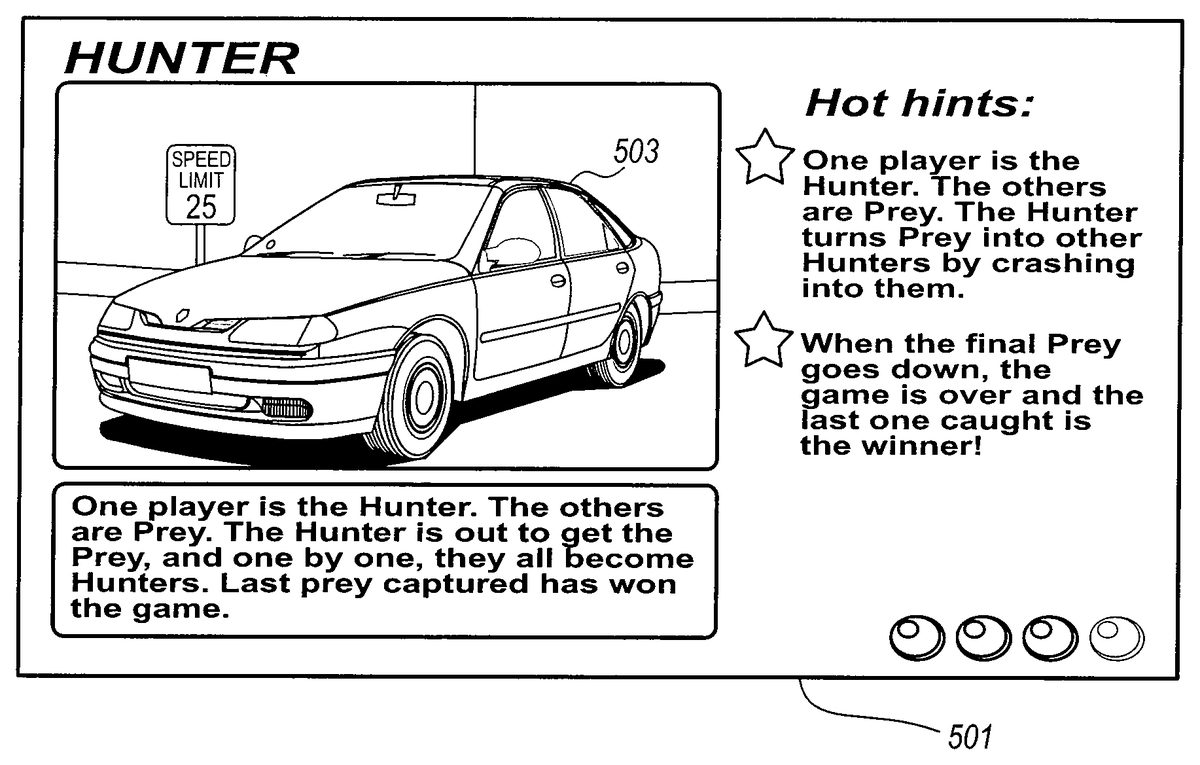
The MPGA may apply any of various modifications and additions to the above method while administering the multi-player game mode. In some embodiments, the MPGA may display an instruction screen501to the game participants, such as is illustrated inFIG. 5, prior to starting game play in step403. This serves to instruct the participants of the general rules of game play, and may be provided by the MPGA while the game is loading or otherwise preparing for game play.
When game play is about to start or has started, the MPGA may display a message601,701indicating to players who the starting predator(s) is/are, such as is illustrated inFIG. 6andFIG. 7. The MPGA may also provide one or more instruction messages801,901to participants, illustrated inFIG. 8andFIG. 9, depending on whether the participant is a prey603or a predator703, respectively, instructing each user how to proceed. For example, the MPGA may instruct the gamer with the GamerTag™ ID “Aviator,” who starts as a predator, to crash into prey, as is illustrated inFIG. 9. During game play, predators may have a first graphical depiction, e.g., a police car703(FIG. 7), while prey may have a second graphical depiction, e.g., a sports car503(FIG. 5), a trendy car, or a slow and/or large automobile (bus, garbage truck, fire engine, etc.) depending on a game difficulty level or other user or game settings. When the prey is caught the MPGA may change or cause to be changed a physical characteristic of the prey's graphically depicted appearance, e.g., changing the prey to appear as a police car to coincide with the prey changing to a predator. Alternatively, the MPGA may change or cause to be changed some other appearance attribute, such as a colored halo, skin color, airplane markings, vehicle markings, clothing, etc.
The MPGA may provide one or more update messages1001informing users when prey have been caught and turned into a predator, such as is illustrated inFIG. 10. In addition, the MPGA may display a status list1005to each user. The status list1005may indicate time elapsed, which players are presently predators, which players are presently prey and, for those players that are predators that started as prey, how long each player evaded the predator(s).
The MPGA may provide hunting tools to predators during game play, such as are illustrated inFIG. 11. The MPGA (or any other module within the compute game) may provide a directional arrow1101that always points in the direction of the closest prey to the predator's current position in the simulated environment. In addition, the MPGA (or any other module) may provide an on-screen map1103indicating the predator's current position1105in relation to prey and/or other predator positions1107.
The MPGA may provide the same or similar tools or prey, depending on whether the MPGA desires to make the game easier for prey or easier for predators, or evenly matched. That is, prey might not receive the directional arrow on their screens, thus making it more difficult to avoid predators. In addition, while characters playing as prey may have an on-screen map1003(FIG. 10) as do predators, the prey's on-screen map might only indicate the position of other prey and not indicate the positions of predators. In some embodiments, the MPGA may flash the predators' positions on the on-screen map1003only at predetermined intervals. Similar on-screen map characteristics may be used for predators as well, i.e., predators' on-screen maps only display prey at predetermined times or in predetermined intervals.
Prey may also have capabilities that predators do not have. For example, while playing a game where it is nighttime in the simulated environment, prey may be able to turn off the headlights of their respective cars in order to camouflage themselves into the darkness of the simulated environment. Prey may have other camouflage abilities as well, or other camouflage capabilities more particularly suited to other types of the game genres (e.g., camouflage apparel on a graphically depicted character, etc.).
The MPGA may alter predator and prey directional arrows and on-screen maps each game depending on the capabilities of the predator and prey. For example, in an embodiment where the predators and prey are represented by automobiles, the predator may receive more tools than the prey when the prey's automobiles are faster than the predators' automobiles (e.g., predator is police car, prey is Corvette), and the prey may receive more tools than the predators when the predators automobiles are faster than the prey's automobiles (e.g., predator is police car, prey is a garbage truck or bus).
In some embodiments, the predators might always have at least the same capabilities as the fastest/strongest prey. For example, in the above-described embodiment where predators are depicted as police cars and prey are depicted as some other type of automobile, predators' cars might be given the same capabilities as the fastest prey. Thus, if the prey are depicted as and have the in-game capabilities of a sports car, e.g. a Corvette, then the police cars may also be given the ability to drive as fast as the Corvette, while not changing the physical appearance of the predators from police cars to Corvettes. That is, there is no change in appearance of the predators to indicate that the MPGA has enhanced their capabilities, there is only a change in the in-game capabilities and physics to match that of the fastest and/or strongest prey, thus avoiding seemingly endless games where prey can always simply drive, run, fly, swim, ski, etc., faster than the predators.
Depending on the size of the simulated environment, also referred to as a game map, in which the multiplayer game is being played, the game may take longer or shorter amounts of time as players search for and catch each other. In order to speed up game times, the MPGA may use a subset of a preexisting map that is used for another single or multiplayer game type. For example, the MPGA may set the game map size smaller when 5 characters are playing than when 15 characters are playing. In addition, the MPGA might not allow players to hide out in locations in the game map that are otherwise extremely difficult to find. For example, in some simulated environments, the game map might include subways in the city of Paris, France. However, during a game being played according to the multiplayer game mode described herein, the MPGA may cordon off or close the subway areas of the map so that players cannot drive into the subways and “hide out” for an indefinite period of time.
When the last prey has been caught, the MPGA may display a message1201indicating the winner of the game, such as is illustrated inFIG. 12. The MPGA may further display a scoreboard1301, such as is illustrated inFIG. 13. The scoreboard1301may indicate the names of all players in a first column1303, and their respective scores in a second column1305. Each player's score may comprise the amount of time that each particular player evaded the predator(s), and the player who evaded the predators the longest (i.e., was the last caught), wins the game. The MPGA may display one or more notice messages1307on the scoreboard1301indicating to players when the next game will begin.
While the above description describes a general method and some variations for playing a multiplayer game mode, those of skill in the art will appreciate that endless variations are possible while not departing from the genus of the invention. For example, one variation might require multiple catches of prey before the prey is changed to a predator. In another variation, upon the occurrence of the predetermined condition or action, a predator might change back into a prey (e.g., a human prey changes into a zombie predator when touched by the zombie, but can change back to a human upon having a certain spell cast on the character during game play; in a FPS game, shooting a prey by a predator might change the prey into a predator, while shooting a predator by a prey might change the predator into a prey). In still other variations, there may be non-player characters controlled by the MPGA or another module of the computer game. That is, one or more characters (predator and/or prey) may be computer controlled according to artificial intelligence programmed into the computer game.
While the invention has been described with respect to specific examples including presently preferred modes of carrying out the invention, those skilled in the art will appreciate that there are numerous variations and permutations of the above described systems and techniques. Thus, the spirit and scope of the invention should be construed broadly as set forth in the appended claims.
Claims
- A computer-implemented method for playing a multiplayer computer game comprising an automobile driving simulation, comprising steps of: a computer identifying at least one player on a first team and a plurality of players on a second team, each player corresponding to a different automobile in a graphically depicted simulated driving environment in which the multiplayer computer game is played, wherein the at least one player on the first team has at least a first corresponding automobile with a first graphically depicted appearance and all of the players on the second team have automobiles that are graphically distinguished from the at least first corresponding automobile, and wherein each automobile of the at least one player on the first team is given enhanced capabilities so as to always have at least a same speed and capabilities as a fastest and strongest automobile corresponding to all of the plurality of players on the second team and regardless of any type of automobile that is being driven by the at least one player on the first team;initiating game play, during which each player on the first team tries to catch any player on the second team in the graphically depicted simulated driving environment, wherein a player on the second team is caught when a player on the first team drives the at least first corresponding automobile into an automobile that corresponds to the player on the second team;when any player on the first team catches any player on the second team by driving the at least first automobile into the automobile corresponding to the player on the second team, reassigning the caught second team player to the first team by at least changing an appearance attribute of the automobile corresponding to the caught second team player to reflect that the second team player is assigned to the first team and such that the automobile corresponding to the caught second team player has a changed graphically depicted appearance that is graphically similar to the first graphically depicted appearance of the at least first corresponding automobile;and ending game play when a predetermined event occurs.
- The method of claim 1 , wherein players on the first team comprise predators, and players on the second team comprise prey.
- The method of claim 1 , wherein each automobile of the at least one player on the first team is faster than all automobiles corresponding to the plurality of players on the second team.
- The method of claim 1 , further comprising: providing, on the display screens of all players participating in the game, an on-screen graphical display of a status list which is continuously displayed during game play, wherein the graphically displayed status list includes a time elapsed and two listings of players, wherein the first listing is a list of status information of all of the players on the second team and the second listing is a listing of status information of all players on the first team, and wherein the status information of each player comprises a name of the player, an indication of whether each of the players is currently on the first team or the second team, and, for each player that began the game play on the first team and that was subsequently caught and thereby changed to the second team, a duration of time that the player lasted on the first team before being caught;moving a player from the first listing to the second listing when the player is caught by a member of the first team and thereby reassigned to the first team;and displaying, next to the caught player that was moved from the first listing to the second listing, the time that the player was on the first team before being caught.
- The method of claim 1 , further comprising: displaying, temporarily on the display screens of all players participating in the game, when a particular player on the second team has been caught and thereby changed affiliation to the first team, an on-screen graphical indicator indicating a name associated with the particular player that was caught and indicating that the player has become a member of the first team.
- The method of claim 1 , wherein each predator is graphically depicted as a police car.
- The method of claim 1 , further comprising the step of determining a user corresponding to the last player on team two to be a winner of the game.
- The method of claim 1 , wherein at least one player is computer-controlled.
- The method of claim 1 , wherein, upon the occurrence of a predetermined criteria, a player on the first team changes to be a player on the second team.
- The method of claim 1 , further comprising: sending directional arrow data to a computing system corresponding to a player on the first team, said data defining a direction of a directional arrow displayed on a display screen corresponding to the relative directional location from the player on the first team to a closest player on the second team such that the directional arrow always points in the direction of the closest player on the second team.
- The method of claim 1 , wherein one or more of the players have a visual display of an on-screen map that is depicted in the graphically depicted simulated driving environment during play of the computer game, wherein the on-screen map displays location information of the automobiles of one or more other players of the computer game, the method further comprising: sending map data to a computing system corresponding to a player identified as a player on the first team, said map data defining a position of each remaining player on the second team, said position of each remaining player on the second team to be displayed on the on-screen map of the player identified as a player on the first team.
- The method of claim 1 , further comprising the step of notifying each remaining player(s) on the second team when any player on the first team catches any player on the second team.
- The method of claim 1 , wherein the predetermined event comprises a predetermined amount of time elapsing.
- The method of claim 1 , wherein the predetermined event comprises a last player on the second team being caught by any player on the first team.
- The method of claim 1 , wherein the computer identifies a plurality of players on the first team prior to initiating game play.
- The method of claim 1 , wherein the computer identifies one player on the first team one for every n total players prior to initiating game play, wherein n is a positive integer.
- The method of claim 1 , further comprising, during game play, continuously providing a graphical display of status list data, wherein the graphically displayed status list data comprises a time elapsed, a name of each of the players, and whether each of the players is currently on the first team or the second team.
- The method of claim 17 , wherein said list data further indicates, for each team one player that started the game as a team two player, how long the each player was a team two player.
- A computer-readable storage medium comprising stored computer-executable instructions for implementing the method recited in claim 1 .
- The computer-readable medium of claim 19 , wherein players on the first team comprise predators, and players on the second team comprise prey.
- The computer-readable medium of claim 20 , wherein each predator is graphically depicted as a police car.
- The computer-readable medium of claim 19 , wherein the computer executable instructions further comprise the step of determining a user corresponding to the last player on team two to be a winner of the game.
- The computer-readable medium of claim 19 , wherein at least one player is computer-controlled.
- The computer-readable medium of claim 19 , wherein, upon the occurrence of a predetermined criteria, a player on the first team changes to be a player on the second team.
- The computer-readable medium of claim 19 , wherein the computer executable instructions further comprise: receiving directional arrow data defining a direction of a directional arrow displayed on a display screen corresponding to the relative directional location from a player on the first team to a closest player on the second team.
- The computer-readable medium of claim 19 , wherein the computer executable instructions further comprise: receiving map data defining a position of each remaining player on the second team, said position of each remaining player on the second team to be displayed on an on-screen map on a display screen corresponding to any player on the first team.
- The computer-readable medium of claim 19 , wherein the computer executable instructions further comprise the step of notifying each remaining player(s) on the second team when any player on the first team catches any player on the second team.
- The computer-readable medium of claim 19 , wherein the predetermined event comprises a predetermined amount of time elapsing.
- The computer-readable medium of claim 19 , wherein the predetermined event comprises a last player on the second team being caught by any player on the first team.
- The computer-readable medium of claim 19 , wherein the computer identifies a plurality of players on the first team prior to initiating game play.
- The computer-readable medium of claim 19 , wherein the computer identifies one player on the first team one for every n total players prior to initiating game play, wherein n is a positive integer.
- The computer-readable medium of claim 19 , wherein the computer executable instructions further comprise, during game play, providing a graphical display of status list data, the list data comprising a time elapsed, a name of each of the players, and whether each of the players is currently on the first or second team.
- The computer-readable medium of claim 32 , wherein said list data further indicates, for each team one player that started the game as a team two player, how long the each player was a team two player.
- The method of claim 11 , further comprising: in addition to sending map data to a computing system corresponding to a player identified as a player on the first team, sending map data to computing systems corresponding to each player on the second team and wherein the on-screen maps of each player on the second team continuously indicate the positions of each player on the second team.
- The method of claim 34 , wherein the on-screen maps of each player on the second team flashes the positions of the at least one player on the first team at periodic intervals.
- The method of claim 10 , wherein the directional arrow data is only provided to some of the players.
Disclaimer: Data collected from the USPTO and may be malformed, incomplete, and/or otherwise inaccurate.