U.S. Pat. No. 7,491,123
VIDEO GAME VOICE CHAT WITH AMPLITUDE-BASED VIRTUAL RANGING
AssigneeNintendo Co. Ltd.
Issue DateJuly 29, 2004
U.S. Patent No. 7,491,123: Video game voice chat with amplitude-based virtual ranging

Summary:
The ‘123 patent describes a system during online multiplayer games where a player’s voice varies depending on the distance between the two characters. Thus, whenever a player’s character is in the immediate vicinity of his teammate, that teammate will be heard loud and clear. But as the distance between the two characters grows, the voice will quiet and become less clear. This invention helps the game feel more life-like in that voices vary much like they would in person.
Abstract:
The amplitude of a video game player’s voice determines how far his or her message is carried to other players in the game. The range a message carries is based on the relative virtual proximity of avatars associated with said players within the virtual game environment.
Illustrative Claim:
1. A video game system comprising: an audio transducer that receives acoustical information including speech; an amplitude detector that detects the amplitude of said received acoustical information; and a messaging arrangement that selectively messages other players of said video game as a function of (a) said received acoustical information, (b) said detected amplitude, and (c) the respective relative virtual proximity of avatars within said video game that represent said players.
Illustrative Figure
Abstract
The amplitude of a video game player's voice determines how far his or her message is carried to other players in the game. The range a message carries is based on the relative virtual proximity of avatars associated with said players within the virtual game environment.
Description
DETAILED DESCRIPTION FIG. 1shows an example schematic implementation of an illustrative non-limiting exemplary virtual distance ranging chat system for video games and other applications. In the example shown, an avatar labeled “me” speaks into a microphone to provide voice chat. An amplitude detector automatically detects how loud the human player is speaking. If the human player controlling the “me” avatar is speaking at a low amplitude (e.g., a whisper), then only those human players (player A) whose avatars are within a limited virtual range within the game will be able to hear or see the chat. This is indicated by the inner circle C1. If the “me” player speaks a bit louder, then the higher detected speech amplitude will allow the chat message to be carried to a further, more extensive virtual distance range within the game so that both player A and player B (but not player C) will be able to hear the message. This is indicated by the outer circle C2shown inFIG. 1. If the “me” player speaks still louder (e.g., by shouting), the higher detected amplitude will allow the message to be carried outside of the C2circle to each player C in addition to player B and player A. The location of a human players' avatars within the game may for example have no relationship to physical locations of the human players who are controlling those avatars. For example, human players controlling avatars A and C could be in the same apartment building in Seattle whereas the human player controlling avatar B could be in Washington D.C. To game players immersed in the game, the in-game locations of their avatars, characters or other objects are quite real, so therefore exemplary illustrative non-limiting implementations of the technology herein use these “in-game” locations and distances for sound/text chat ...
DETAILED DESCRIPTION
FIG. 1shows an example schematic implementation of an illustrative non-limiting exemplary virtual distance ranging chat system for video games and other applications. In the example shown, an avatar labeled “me” speaks into a microphone to provide voice chat. An amplitude detector automatically detects how loud the human player is speaking. If the human player controlling the “me” avatar is speaking at a low amplitude (e.g., a whisper), then only those human players (player A) whose avatars are within a limited virtual range within the game will be able to hear or see the chat. This is indicated by the inner circle C1. If the “me” player speaks a bit louder, then the higher detected speech amplitude will allow the chat message to be carried to a further, more extensive virtual distance range within the game so that both player A and player B (but not player C) will be able to hear the message. This is indicated by the outer circle C2shown inFIG. 1. If the “me” player speaks still louder (e.g., by shouting), the higher detected amplitude will allow the message to be carried outside of the C2circle to each player C in addition to player B and player A.
The location of a human players' avatars within the game may for example have no relationship to physical locations of the human players who are controlling those avatars. For example, human players controlling avatars A and C could be in the same apartment building in Seattle whereas the human player controlling avatar B could be in Washington D.C. To game players immersed in the game, the in-game locations of their avatars, characters or other objects are quite real, so therefore exemplary illustrative non-limiting implementations of the technology herein use these “in-game” locations and distances for sound/text chat attenuation calculations. Thus, in the illustrative example shown, the distances are the virtual distances of characters within a virtual 2D or 3D video game environment. For example, in the game, the “me” player and player A might be located within the same room, landscape, level or other virtual physical proximity to one another. Player B might be located in a different room, a different part of the landscape, on a different level, etc. Player C may be located in a still further virtual location such as in a different building, a different virtual location altogether, etc. The proximity calculations and analysis may in general depend on and be specific to the particular virtual game environment of the game.
FIG. 2schematically shows an example non-limiting illustrative implementation of a multi-player gaming system10. In the example implementation shown, video game player12(1) plays a video game against another video game player12(2) (any number of players can be involved).
In one example illustrative implementation, video game players12(1) and12(2) may be remotely located, with communications being provide between them via a network14such as the Internet or any other signal path capable of carrying game play data or other signals. In the example system10shown, each game player12has available to him or her electronic video game playing equipment16. In the example shown, video game playing equipment16may comprise for example a home video game platform such as a NINTENDO GAMECUBE system connected to a handheld game controller18and a display device20such as a home color television set. In other examples, game playing equipment16could comprise a handheld networked video game platform such as a NINTENDO DS or GAMEBOY ADVANCE, a personal computer including a monitor and appropriate input device(s), a cellular telephone, a personal digital assistant, or any other electronic or other appliance.
In the example system10shown, each of players12has a headset22including earphones24and a microphone26. Earphones24receive audio signals from game playing equipment16and play them back into the player12's ears. Microphone26receives acoustical signals (e.g., speech spoken by a player12) and provides associated audio signals to the game playing equipment16. In other exemplary implementations, microphone26and earphones24could be separate devices or a loud speaker and appropriate feedback-canceling microphone could be used instead. In the example shown inFIG. 2, both of players12(1) and12(2) are equipped with a headset22, but depending upon the context it may be that only some subset of the players have such equipment.
In the example system10shown, each of players12interacts with video game play by inputting commands via a handheld controller18and watching a resulting display (which may be audio visual) on a display device20. Software and/or hardware provided by game playing platforms16produce interactive 2D or 3D video game play and associated sound. In the example shown, each instance of game playing equipment16provides appropriate functionality to produce local video game play while communicating sufficient coordination signals for other instances of the game playing equipment to allow all players12to participate in the “same” game.
Generally, in one exemplary illustrative non-limiting implementation, each human player is represented by an avatar or game character. For example, in a “dungeons and dragons” type role playing game, one player could be represented by a wizard avatar (i.e., a character who has the appearance and characteristics of a wizard), another player might be represented by a knight avatar, yet another player might be represented by an elf character, etc. In a sports game, one player might be represented by a basketball player on a first team, and another player might be represented by a basketball player on another team. Generally, the human player controls his or her avatar by operating a handheld game controller18. In some contexts, the video game could be a multiplayer first person shooter, driving, sports or any other genre of video game wherein each of players12can manipulate an associated character or other display object by inputting commands via handheld controllers18. For example, in a sports game, one player12(1) could control the players of one team, while another player12(2) could control the players on an opposite team. In a driving game, each of players12(1),12(2) could control a respective car or other vehicle. In a flight or space simulation game, each of players12may control a respective aircraft. In a multi-user role playing game, each of players may control a respective avatar that interacts with other avatars within the virtual environment provided by the game. Any number of players may be involved depending upon the particular game play.
As will be seen inFIG. 2, a game server28may optionally be provided to coordinate game play. For example, in the case of a complex multiplayer role playing game having tens or even hundreds of players12who can play simultaneously, a game server28may be used to keep track of the master game playing database and to provide updates to each instance of game playing equipment16. In other game playing contexts, a game server28may not be necessary with all coordination being provided directly between the various instances of game playing equipment16.
In the particular example system10shown inFIG. 2, a voice-to-voice text chat capability is provided. As can be seen, player12(1) in this particular example is speaking the following words into his or her microphone26:
“I'm going to blast you.”
In response to this statement, game playing equipment16and/or game server28converts the spoken utterance into data representing associated text. The text can be used by itself or in conjunction with the digitized voice to provide a text chat or text-and-voice chat. In another exemplary illustrative implementation, only voice chat is provided and the speech-to-text conversion is not used.
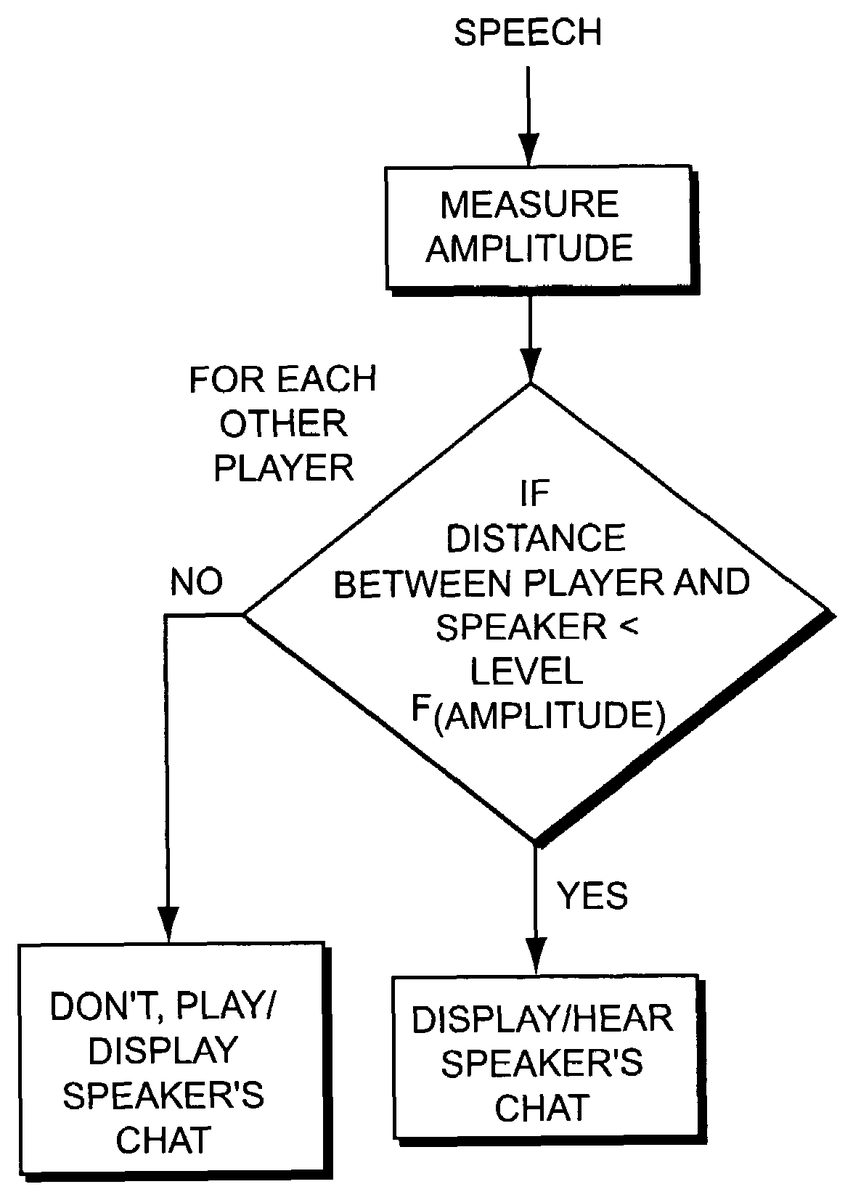
FIG. 3shows an example illustrative non-limiting flowchart. In the example shown, speech uttered by one of the players is analyzed and its amplitude is determined. In one illustrative exemplary non-limiting implementation, the amplitude detection is performed by using an analog-to-digital converter to convert the speech (which may be inputted via a microphone) into a digital signal, and the amplitude of the resulting digital signal may be measured and averaged. The measured amplitude is then tested to determine if the distance between the speaking player and an additional speaker is less than a level function which is a function of the amplitude. If the distance is below this calculated value, then the speech is passed to the human player that is controlling player C, e.g., by providing a streaming voice chat audio signal to that human player and/or by displaying a voice-to-text conversion of the message to that player. If the virtual distance between the speaking player and the other player in question is not less than the calculated level, then the message is not passed or provided to that other player.
More complex, dynamic ranging calculations based on actual in-game distances as compared with a logarithmic or other functions modeling the attenuation of sound in various media (air, water, etc.) could be used. Factors that could be taken into account in determining virtual chat range could include for example:ambient sound level within game environmentambient acoustical reflection, diffraction and/or absorption within game environmenttemperature gradients within game environmentwind velocity within game environmenthumidity within game environmentproximity to virtual water surface within game environment (sound carries longer distances over water)sound pitchechoes and reverberation within game environmentcharacteristics of avatars (e.g., dog avatars may have more sensitive hearing than human avatars, and wizard or other magical avatars may hear more than non-magical avatars)direction speaking avatar is facing when speakingavailability of any “power up” capabilities to speaking avatar (e.g., virtual megaphone, virtual amplified microphone, virtual radio communications devices, virtual telepathy, etc.)
See for example Ballou, Handbook for Sound Engineers (3d Ed. Focal Press) and JBL Sound System Design Reference Manual for various physical sound propagation behaviors that can be modeled in the context of a video game and the technology herein. Further, such sound attenuation modeling functions could be used to distort or otherwise render messages only partially intelligible just like in real life.
Note that in a multi-player game environment, the process shown inFIG. 3may be performed for each of the various characters or avatars based upon their own virtual distance within the gaming environment from the player who is speaking. In one exemplary illustrative non-limiting implementation, software associated with every player calculates the sound function and makes the comparison whenever any other player is speaking. In the example shown, the level is a function of the amplitude but of course other calculations (e.g., fixed thresholds, etc.) could be used instead. The calculation, as mentioned above, could in some implementations take into account additional factors of the virtual game environment such as for example, obstructions between the players such as walls or floors, ambient game noise, or any other desired factor.
While the description above refers to virtual distance within a game environment, it would be possible to use actual physical distance between human communicators. For example, if the communications platforms were cellular, it would be possible using GPS or other technology to calculate how much distance lies between the different users' physical locations.
Each of the publications mentioned above are incorporated herein by reference.
While the technology herein has been described in connection with exemplary illustrative non-limiting embodiments, the invention is not to be limited by the disclosure. The invention is intended to be defined by the claims and to cover all corresponding and equivalent arrangements whether or not specifically disclosed herein.
Claims
- A video game system comprising: an audio transducer that receives acoustical information including speech;an amplitude detector that detects the amplitude of said received acoustical information;and a messaging arrangement that selectively messages other players of said video game as a function of (a) said received acoustical information, (b) said detected amplitude, and (c) the respective relative virtual proximity of avatars within said video game that represent said players.
- A video game playing method comprising: receiving acoustical information including speech;detecting the amplitude of said received acoustical information;and selectively messaging other players of said video game as a function of (a) said received acoustical information, (b) said detected amplitude, and (c) the respective relative virtual proximity of avatars within said video game representing said players.
- A multiplayer video game play system comprising: means for receiving acoustical information including speech;means for detecting the amplitude of said received acoustical information;and means for selectively messaging other players of said video game as a function of (a) said received acoustical information, (b) said detected amplitude, and (c) the respective relative virtual proximity of avatars within said video game representing said players.
- A storage medium comprising: a first storage area that stores instructions for receiving acoustical information including speech;a second storage area that stores instructions for detecting the amplitude of said received acoustical information;and a third storage area that stores instructions for selectively messaging other players of said video game as a function of (a) said received acoustical information, (b) said detected amplitude, and (c) the respective relative virtual proximity of avatars within said video game representing said players.
Disclaimer: Data collected from the USPTO and may be malformed, incomplete, and/or otherwise inaccurate.