U.S. Pat. No. 7,435,178
TREMOLO BAR INPUT FOR A VIDEO GAME CONTROLLER
AssigneeActivision Publishing, Inc.
Issue DateApril 12, 2006
Illustrative Figure
Abstract
A video game controller and a method of operating the controller are provided. The controller includes: a guitar-shaped housing comprising a body portion and a neck portion; a console interface for coupling with a game console; a tremolo arm extending from the body portion of the housing, said tremolo arm being rotatable about a first axis; and an angular detector coupled to the console interface for detecting angular rotation of the tremolo arm.
Description
DETAILED DESCRIPTION In the following description, reference is made to the accompanying drawings which illustrate several embodiments of the present invention. It is understood that other embodiments may be utilized and mechanical, compositional, structural, electrical, and operational changes may be made without departing from the spirit and scope of the present disclosure. The following detailed description is not to be taken in a limiting sense, and the scope of the embodiments of the present invention is defined only by the claims of the issued patent. FIG. 1is a perspective view of a video game controller in a guitar-shaped housing, in accordance with embodiments of the present invention. In this embodiment, the game controller100comprises a guitar-shaped housing102having a cord104for connection with a video game console (not shown). The housing102may come in a variety of shapes, but in this embodiment is styled after the SG guitar by Gibson USA. The housing102includes a body portion106, a neck portion108, and a head portion110. The body portion106comprises a pickguard116, a strum interface120, a tremolo bar202, and a pair of control buttons122a-122b. The control buttons122a-122bmay correspond to “Start” and “Select” for controlling the operation of a video game. A pair of strap buttons124may be provided for connection with a strap (not shown) for supporting the controller100from a user's neck. The neck portion108comprises a fretboard interface112including a plurality of fret buttons114(five buttons114are provided in the illustrated embodiment). Embodiments of the game controller100may be utilized in conjunction with any of a variety of video game systems. In one embodiment, the game controller100is configured for use with the PlayStation 2 video game console by Sony Computer Entertainment America, Inc. FIG. 5is a block diagram of a video game system500, in accordance with embodiments of the present invention. In this embodiment, the cord104terminates at a standard console connector (not shown) ...
DETAILED DESCRIPTION
In the following description, reference is made to the accompanying drawings which illustrate several embodiments of the present invention. It is understood that other embodiments may be utilized and mechanical, compositional, structural, electrical, and operational changes may be made without departing from the spirit and scope of the present disclosure. The following detailed description is not to be taken in a limiting sense, and the scope of the embodiments of the present invention is defined only by the claims of the issued patent.
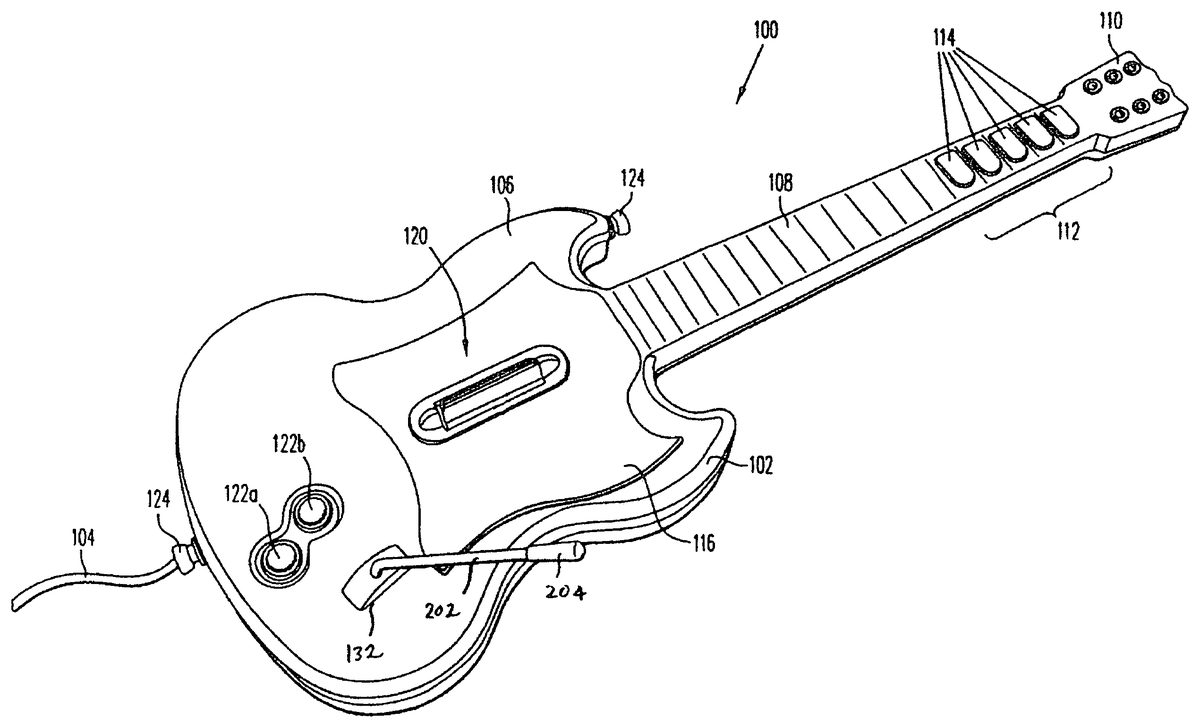
FIG. 1is a perspective view of a video game controller in a guitar-shaped housing, in accordance with embodiments of the present invention. In this embodiment, the game controller100comprises a guitar-shaped housing102having a cord104for connection with a video game console (not shown). The housing102may come in a variety of shapes, but in this embodiment is styled after the SG guitar by Gibson USA.
The housing102includes a body portion106, a neck portion108, and a head portion110. The body portion106comprises a pickguard116, a strum interface120, a tremolo bar202, and a pair of control buttons122a-122b. The control buttons122a-122bmay correspond to “Start” and “Select” for controlling the operation of a video game. A pair of strap buttons124may be provided for connection with a strap (not shown) for supporting the controller100from a user's neck. The neck portion108comprises a fretboard interface112including a plurality of fret buttons114(five buttons114are provided in the illustrated embodiment).
Embodiments of the game controller100may be utilized in conjunction with any of a variety of video game systems. In one embodiment, the game controller100is configured for use with the PlayStation 2 video game console by Sony Computer Entertainment America, Inc.
FIG. 5is a block diagram of a video game system500, in accordance with embodiments of the present invention. In this embodiment, the cord104terminates at a standard console connector (not shown) which is removably couplable with a controller port512on the PlayStation 2 video game console510. Control logic550is provided in the game controller100for generating control signals to be transmitted to the video game console510in response to detection of a user's interaction with the fretboard interface112, the strum interface120, the control buttons122a-122b, and the tremolo arm130. The connector, the control logic550, and the signals transmitted by the game controller100to the game console510via the cord104may be defined by standards established by the video game console manufacturer. The video game console510, in turn, includes audio and video outputs for connection with a television530or other display. Typically, the display will include both a video display and an audio output, such as speakers. In some cases, the audio output will be provided by a separate sound system.
In contrast with actual guitars, the guitar controller100does not include strings. Instead, the musician's fingering of the strings on the fretboard is simulated by the pressing of the fret buttons114and the strumming of the strings is simulated by the strumming of the strum interface120. A suitable guitar controller100is described in greater detail in co-pending patent application entitled, “STRUM INPUT FOR A VIDEO GAME CONTROLLER”, by Jamie J. Yang and Johnnie Tam, filed on Apr. 12, 2006, the contents of which are incorporated herein in its entirety.
FIG. 2is a bottom view of a tremolo arm assembly200, in accordance with embodiments of the present invention.FIG. 3is a bottom perspective view of the tremolo arm assembly200, andFIG. 4is an exploded view of the tremolo arm assembly200.
The tremolo arm assembly200comprises a tremolo bar202mounted to a semicircular base210. The tremolo bar202and a portion of the semicircular base210extend through an opening132in the body portion106of the controller100. The distal end of the tremolo bar202extending out of the body portion106is covered with a rubber tip204to improve the ease with which the user may grip and manipulate the tremolo bar202.
The tremolo arm assembly200further comprises an angular position detector240. In this embodiment, the angular detector240comprises a dial-control potentiometer250having a shaft252and three output leads254. A frame230has an opening232which receives the shaft252. A return assembly220comprises a pair of arms222,224, which include openings228through which the shaft252is received. Finally, the distal end of the shaft252is coupled to an opening212in the semicircular base210such that rotation of the base210about the primary axis P causes the shaft252to rotate together with the base210.
The angular position of the tremolo bar base210about the primary axis P is detected by the angular detector240. In particular, rotation of the shaft252effects a change in the resistance of the potentiometer250. In this embodiment, a power supply in the video game console510supplies a voltage to the potentiometer250via the cord104. The angular position of the shaft252determines the resistance of the potentiometer250, thereby altering the current through the circuit. The video game console510includes an analog-to-digital converter to convert the analog signal from the potentiometer250into a digital signal which can be processed by the control circuitry of the video game console510.
In accordance with other embodiments, the detection of the angular position of the tremolo arm assembly200may be accomplished in other ways. For example, the analog-to-digital converter may be provided in the controller100so that the controller100provides digital signals to the video game console510corresponding to the angular position of the tremolo arm base210. In yet other embodiments, the angular position may be detected using mechanisms other than a potentiometer. For example, digital position sensors, such as optical sensors, may be used to detect the position of the tremolo arm base210. These optical sensors can provide an indication of angular position and/or angular velocity with a high level of granularity, similar to an analog potentiometer-based detector but with increased accuracy. Thus, the angular position of the tremolo arm base210about the primary axis P can be both detected digitally and communicated digitally to the video game console510.
The return assembly220works in conjunction with the frame230to limit the range of motion of the tremolo bar202and to provide a return force so as to return the tremolo bar202to the default position when moved by the user. In addition, the return assembly220provides resistance to the rotation of the tremolo bar202so as to better simulate the actual operation of a tremolo arm in an electric guitar.
In this embodiment, the return assembly220comprises a first arm222, a second arm224, and a spring226. The first and second arms222,224are aligned to provide an opening228through which the potentiometer shaft252is received. The spring226connects the distal ends of the first and second arms222,224.
The frame230includes a tab238which is received between the arms222,224and a pair of projections234,236which are configured to limit the movement of the arms222,224. The base210includes a flange214, which is also received between the arms222,224adjacent the tab238to set the default position of the arms222,224.
When the tremolo arm202is rotated about the primary axis P, the flange214presses against one of the arms222,224(e.g., first arm222) so as to cause the arm to rotate about the primary axis P as well. As described above, the spring226connects the distal ends of the arms222,224. However, as the first arm222rotates, the second arm224is prevented from rotating with the first arm222by the tab238. Thus, the spring226will expand as the distal ends of the arms222,224separate by an increasing distance. This provides a counterforce against the rotation of the tremolo bar202by the user, so as to provide the user with a sense of resistance to the movement. This simulates the resistance provided when a musician operates a tremolo arm in an actual guitar in order to vary the tension in the strings. The user will be able to continue to rotate the tremolo arm202until the first arm222contacts the first projection234. The first projection234limits the extent to which the first arm222may rotate, thereby limiting the range of rotation for the tremolo arm202.
If the user holds the tremolo arm202in the fully rotated position, the spring226will continue to apply a return force urging the tremolo arm202back into the default position, as shown inFIGS. 3-4. Once the user releases the tremolo arm202, the spring226will contract to bring the distal ends of the arms222,224together, thereby returning the arm202to the default position.
Similarly, if the tremolo arm202is rotated in the opposite direction, the second arm224will rotate until the second arm224contacts the second projection236, and when the tremolo arm202is released, the spring226will return the arm202to the default position.
In the illustrated embodiment, the tremolo bar202has a proximal end206which is rotatably mounted to the base210so that the tremolo bar202may be freely rotated about the axis defined by the proximal end206(shown inFIGS. 3-4as secondary axis S). In this embodiment, the rotation of the tremolo bar202about the proximal end axis is not detected by the controller100and therefore does not cause a control signal to be transmitted to the video game console510. Only rotation about the primary axis P is detected by the controller100and communicated to the video game console510. Thus, the rotation about the proximal end axis has no effect on gameplay. This is similar to the operation of a tremolo arm in an actual electric guitar. This design enables the tremolo arm to be adjusted to the most comfortable position for use by the user and to be rotated out of the way so as not to interfere with strumming. This also enables the user to operate the tremolo arm with an increased visual flourish by moving the tremolo arm about in a dramatic fashion. If the tremolo arm was constrained to movement about a single axis, the user would be much more limited in how the tremolo arm could be manipulated.
In operation, the controller100will typically be used in conjunction with a compatible video game running on the video game console. This game will generally provide cues to the user to indicate when and how the user should interact with the controller100. For example, the video game software running on the console may cause the display to depict colors and/or shapes to indicate which fret buttons114to hold down while strumming on the strum interface120, and the movement of these colors and/or shapes on the display will indicate the timing of the strumming. Points or other incentives are provided each time the user holds down the appropriate fret button114while strumming on the strum interface120at the appropriate time.
At certain points during the game, the display may indicate to the user that after strumming the strum interface120, the user should manipulate the tremolo bar202. When one or more fret buttons114are held down and the strum interface120is strummed, the software will generate a note or chord to be played by the audio system (e.g., the television530). Then, when the tremolo arm202is rotated about the primary axis P, the software will modulate the pitch of the note or chord being played.
The tremolo arm202may be manipulated in a variety of ways to produce a modified pitch. In contrast with a typical controller button, which provides a binary “on/off” signal, the angular detector240is configured to detect a plurality of different positions of the tremolo bar202. As a result, the extent and speed with which the tremolo bar202is rotated can be used to determine nature of the sound modulation. For example, the extent to which the tremolo bar202is rotated may determine the extent to which the pitch of the sound is varied, such that a small movement of the tremolo arm202would result in a small change in pitch, while a large movement of the tremolo arm202would result in a large change in pitch. In addition, the speed with which the tremolo bar202is rotated can be used to control the modulation of sound. For example, if the tremolo bar202is quickly moved to the fully rotated position (e.g., until the arm222contacts the projection234), the change in pitch will be sudden, and if the tremolo bar202is slowly moved to the fully rotated position, the change in pitch will be gradual.
In addition, the user's manipulation of the tremolo arm assembly200can be used to sustain the last note or chord played. The software may operate such that the user must rotate the tremolo bar202a certain distance or at a certain speed in order to maintain the sound and thereby score points.
Embodiments of the present invention may provide various advantages not provided by prior art systems. The controller can provide a more realistic hardware interface to video game software running on the video game console. For example, the use of the tremolo arm assembly200enables an analog detection of movement of the tremolo bar202. The detection of both the extent of rotation and speed of rotation can be used to produce differing results in the videogame. This type of rotational and velocity detection would normally not be detectable using a standard binary switch.
While the invention has been described in terms of particular embodiments and illustrative figures, those of ordinary skill in the art will recognize that the invention is not limited to the embodiments or figures described. For example, in the embodiments described above, the movement of the tremolo arm202is only detected about a single axis. In other embodiments, movement of the tremolo arm202in other directions or about other axes may be detected and used by the video game software to modulate or otherwise control the sound being produced. In addition, the precise shape, size, and arrangement of the tremolo arm interface may vary.
Therefore, it should be understood that the invention can be practiced with modification and alteration within the spirit and scope of the appended claims. The description is not intended to be exhaustive or to limit the invention to the precise form disclosed. It should be understood that the invention can be practiced with modification and alteration and that the invention be limited only by the claims and the equivalents thereof.
Claims
- A video game controller comprising: a guitar-shaped housing comprising a body portion and a neck portion;a console interface for coupling with a game console;an arm assembly comprising a bar extending from a base, the base including at least a semicircular part, the bar and a portion of the base about the extending portion of the bar extending from an opening in the body portion, said bar being rotatable about a first axis, the first axis being parallel to a surface of the body portion and said arm being rotatable about a second axis, the second axis being normal to the surface of the body portion;and an angular detector coupled to the console interface, said angular detector for detecting angular rotation of the bar about the first axis.
- The video game controller of claim 1 , wherein: said angular detector comprises a potentiometer for generating an analog signal corresponding to an angular position of the bar about the first axis.
- The video game controller of claim 1 , wherein: said angular detector comprises an optical sensor for generating a signal indicating a plurality of angular positions of the bar about the first axis.
- The video game controller of claim 1 , further comprising: a strum input provided on the body portion of the housing and coupled to the console interface, said strum input for detecting strumming motion by a user;and a fretboard input provided on the neck portion of the housing and coupled to the console interface, said fretboard input for detecting fretboard fingering by the user.
- The video game controller of claim 4 , wherein: the neck portion of the housing extends along a neck axis;and the strum input comprises a flange configured to rotate about a strum axis substantially parallel to the neck axis.
- The video game controller of claim 4 , wherein: the fretboard input comprises at least five buttons.
- The game controller of claim 1 , wherein the console interface comprises a control logic.
- The game controller of claim 1 , wherein the angular detector is configured to provide a digital signal indicative of the angular rotation of the bar.
- The game controller of claim 8 , wherein the angular detector comprises a digital position sensor.
- The game controller of claim 1 , wherein the angular detector is configured to provide an analog signal indicative of the angular rotation of the bar.
- A video game controller, comprising: a guitar-shaped housing comprising a body portion and a neck portion;a console interface for coupling with a game console;an arm assembly including a bar mounted to a semicircular base, a portion of the semicircular base extending through an opening in the body portion of the housing, said bar rotatable about a first axis, the first axis being parallel to a surface of the body portion;said bar rotatable about a second axis, the second axis being normal to the surface of the body portion;and an angular detection means, coupled to the console interface, for detecting angular rotation of the bar.
- The video game controller of claim 11 , wherein: said angular detection means comprises a potentiometer for generating an analog signal corresponding to an angular position of the bar about the first axis.
- The video game controller of claim 11 , wherein: said angular detection means comprises an optical sensor for generating a signal indicating a plurality of angular positions of the bar about the first axis.
- The video game controller of claim 11 , further comprising: a strum input provided on the body portion of the housing and coupled to the console interface, said strum input for detecting strumming motion by a user;and a fretboard input provided on the neck portion of the housing and coupled to the console interface, said fretboard input for detecting fretboard fingering by the user.
- The video game controller of claim 14 , wherein: the neck portion of the housing extends along a neck axis;and the strum input comprises a flange configured to rotate about a strum axis substantially parallel to the neck axis.
- The game controller of claim 11 , wherein the console interface comprises a control logic.
- Apparatus for video game play, comprising: a video game controller comprising: a guitar-shaped housing comprising a body portion and a neck portion with a plurality of buttons on the neck portion;a rotatable base rotatably coupled along a first axis to the body portion of the guitar-shaped housing, a portion of the rotatable base extending through an opening in the guitar-shaped housing;a bar extending from and rotatably coupled along a second axis to the rotatable base, the bar extending from the portion of the rotatable base extending through the opening in the guitar-shaped housing;a spring to bias the rotatable base to a default position;a detector for detecting position of the bar;and control logic for generating signals for transmission to a video game console in response to a user's interaction with the buttons on the neck portion and the bar.
- The apparatus of claim 17 further comprising the game console, the game console configured to run a video game for providing cues to the user to indicate interaction with the video game controller and to provide points for interaction in accordance with the cues.
- The game controller of claim 17 , further comprising: a flange on the rotatable base;and a first arm coupled to the spring, the first arm positioned in a travel path of the flange upon rotation of the rotatable base, the first arm rotatable about the first axis.
- The game controller of claim 19 , further comprising: a second arm positioned in the travel path of the flange upon rotation of the rotatable base and coupled to the spring, the second arm rotatable about the first axis;and a frame mounted to the body portion, the frame having one or more protrusions, the one or more protrusions positioned to limit the range of motion of at least one of the first arm and the second arm.
- The game controller of claim 20 : wherein the bar comprises a proximal section having a proximal end and a distal section having a distal end, the proximal end being mounted to the rotatable base;and wherein the bar is shaped such that the proximal section makes an obtuse angle with the distal section.
- The game controller of claim 21 , wherein: the proximal section comprises a cylindrical rod shape having a first diameter;the distal section comprises a cylindrical rod shape having a second diameter;the second diameter is greater than or equal to the first diameter;the rotatable base includes a cylindrical opening configured to receive the proximal end of the bar, the second axis being located along the center line of the cylindrical opening;and the bar is rotatably mounted within the cylindrical opening.
- The game controller of claim 22 , wherein the bar is configured to rotate 360 degrees within the cylindrical opening.
- A video game controller, comprising: a guitar-shaped housing;a semicircular base extending through an opening in the housing;a bar extending from the semicircular base, the arm rotatably coupled to the housing so as to be rotatable about a primary axis and a secondary axis;means for detecting angular position of the bar along the primary axis;control logic for generating signals to be transmitted to a video game console indicative of angular position of the bar along the primary axis;and means for providing a counterforce against rotation of the bar about the primary axis.
Disclaimer: Data collected from the USPTO and may be malformed, incomplete, and/or otherwise inaccurate.