U.S. Pat. No. 7,427,980
GAME CONTROLLER SPATIAL DETECTION
AssigneeInternational Business Machines Corporation
Issue DateMarch 31, 2008
Illustrative Figure
Abstract
A method of identifying a specific object representation in a computer simulation is presented. A computer simulation of a physical room is generated and displayed by a game console. A game controller is integrated with a laser rangefinder to create a laser-integrated game controller that is capable of determining and transmitting, to the game console, a real-time location and spatial orientation of a real physical object that is represented by a computer-generated object representation in the computer simulation. The game controller and laser-integrated game controller are able to identify a specific object representation, which corresponds with the real physical object, based on the real-time location of the laser-integrated game controller, the spatial orientation of the laser-integrated game controller, and the range signal from the laser rangefinder in the laser-integrated game controller to the real physical object.
Description
DETAILED DESCRIPTION OF THE PREFERRED EMBODIMENT With reference now toFIG. 1, there is depicted a block diagram of an exemplary computer102in which the present invention may be implemented. Some or all of the architecture shown for computer102may be utilized by a software deploying server150and/or a game controller214(shown below inFIG. 2). Computer102includes one or more processors104that are coupled to a system bus106. A video adapter108, which drives/supports a display110, is also coupled to system bus106. System bus106is coupled via a bus bridge112to an Input/Output (I/O) bus114. An I/O interface116is coupled to I/O bus114. I/O interface116affords communication with various I/O devices, including a keyboard118, a Short Range Wireless Transceiver120, a Compact Disk-Read Only Memory (CD-ROM) drive122, and a flash drive memory126. Keyboard118may be a standard keyboard (e.g., QWERTY style or similar), or a condensed alphanumeric keypad. The format of the ports connected to I/O interface116may be any known to those skilled in the art of computer architecture, including but not limited to Universal Serial Bus (USB) ports. Short Range Wireless Transceiver120utilizes short range wireless electromagnetic signals (e.g. wireless spread spectrum, radio frequency (RF), infrared (IR)) to allow Computer102to transmit and receive data, including range-finding signals, with a device such as the laser-integrated game controller210depicted below inFIG. 2. Computer102is able to communicate with a software deploying server150via a network128using a network interface130, which is coupled to system bus106. Network interface130may utilize wired or wireless technology such as a cellular broadcast to connect with Network128. Network128may be an external network such as the Internet, an internal network such as an Ethernet or a Virtual Private Network (VPN), and/or a wireless cellular telephone network. Note again the software deploying server150may utilize a same or substantially similar architecture as computer102. A hard drive interface132is also coupled to system bus106. Hard drive interface132interfaces with a hard drive134. ...
DETAILED DESCRIPTION OF THE PREFERRED EMBODIMENT
With reference now toFIG. 1, there is depicted a block diagram of an exemplary computer102in which the present invention may be implemented. Some or all of the architecture shown for computer102may be utilized by a software deploying server150and/or a game controller214(shown below inFIG. 2). Computer102includes one or more processors104that are coupled to a system bus106. A video adapter108, which drives/supports a display110, is also coupled to system bus106. System bus106is coupled via a bus bridge112to an Input/Output (I/O) bus114. An I/O interface116is coupled to I/O bus114. I/O interface116affords communication with various I/O devices, including a keyboard118, a Short Range Wireless Transceiver120, a Compact Disk-Read Only Memory (CD-ROM) drive122, and a flash drive memory126. Keyboard118may be a standard keyboard (e.g., QWERTY style or similar), or a condensed alphanumeric keypad. The format of the ports connected to I/O interface116may be any known to those skilled in the art of computer architecture, including but not limited to Universal Serial Bus (USB) ports. Short Range Wireless Transceiver120utilizes short range wireless electromagnetic signals (e.g. wireless spread spectrum, radio frequency (RF), infrared (IR)) to allow Computer102to transmit and receive data, including range-finding signals, with a device such as the laser-integrated game controller210depicted below inFIG. 2.
Computer102is able to communicate with a software deploying server150via a network128using a network interface130, which is coupled to system bus106. Network interface130may utilize wired or wireless technology such as a cellular broadcast to connect with Network128. Network128may be an external network such as the Internet, an internal network such as an Ethernet or a Virtual Private Network (VPN), and/or a wireless cellular telephone network. Note again the software deploying server150may utilize a same or substantially similar architecture as computer102.
A hard drive interface132is also coupled to system bus106. Hard drive interface132interfaces with a hard drive134. In a preferred embodiment, hard drive134populates a system memory136, which is also coupled to system bus106. System memory is defined as a lowest level of volatile memory in computer102. This volatile memory includes additional higher levels of volatile memory (not shown), including, but not limited to, cache memory, registers and buffers. Data that populates system memory136includes operating system (OS)138and application programs144.
OS138includes a shell140, for providing transparent user access to resources such as application programs144. Generally, shell140is a program that provides an interpreter and an interface between the user and the operating system. More specifically, shell140executes commands that are entered into a command line user interface or from a file. Thus, shell140(also called a command processor) is generally the highest level of the operating system software hierarchy and serves as a command interpreter. The shell provides a system prompt, interprets commands entered by keyboard or other user input media, and sends the interpreted command(s) to the appropriate lower levels of the operating system (e.g., a kernel142) for processing. Note that while shell140is a text-based, line-oriented user interface, the present invention will equally well support other user interface modes, such as graphical, voice, gestural, etc.
As depicted, OS138also includes kernel142, which includes lower levels of functionality for OS138, including providing essential services required by other parts of OS138and application programs144, including memory management, process and task management, disk management, and mouse and keyboard management.
Application programs144include a browser146. Browser146includes program modules and instructions enabling a World Wide Web (WWW) client (i.e., computer102) to send and receive network messages to the Internet using HyperText Transfer Protocol (HTTP) messaging, thus enabling communication with software deploying server150.
Application programs144in system memory136(as well as software of deploying server150system memory) also include a Simulation/Reality Coordination Logic (SRCL)148. SRCL148includes code for implementing the processes described inFIGS. 2-4. In one embodiment, computer102is able to download SRCL148from software deploying server150, including in an “on demand” basis. Note further that, in one embodiment of the present invention, software deploying server150performs all of the functions associated with the present invention (including execution of SRCL148), thus freeing computer102from having to use its own internal computing resources to execute SRCL148.
The hardware elements depicted in computer102are not intended to be exhaustive, but rather are representative to highlight essential components required by the present invention. For instance, computer102may include alternate memory storage devices such as magnetic cassettes, Digital Versatile Disks (DVDs), Bernoulli cartridges, and the like. These and other variations are intended to be within the spirit and scope of the present invention.
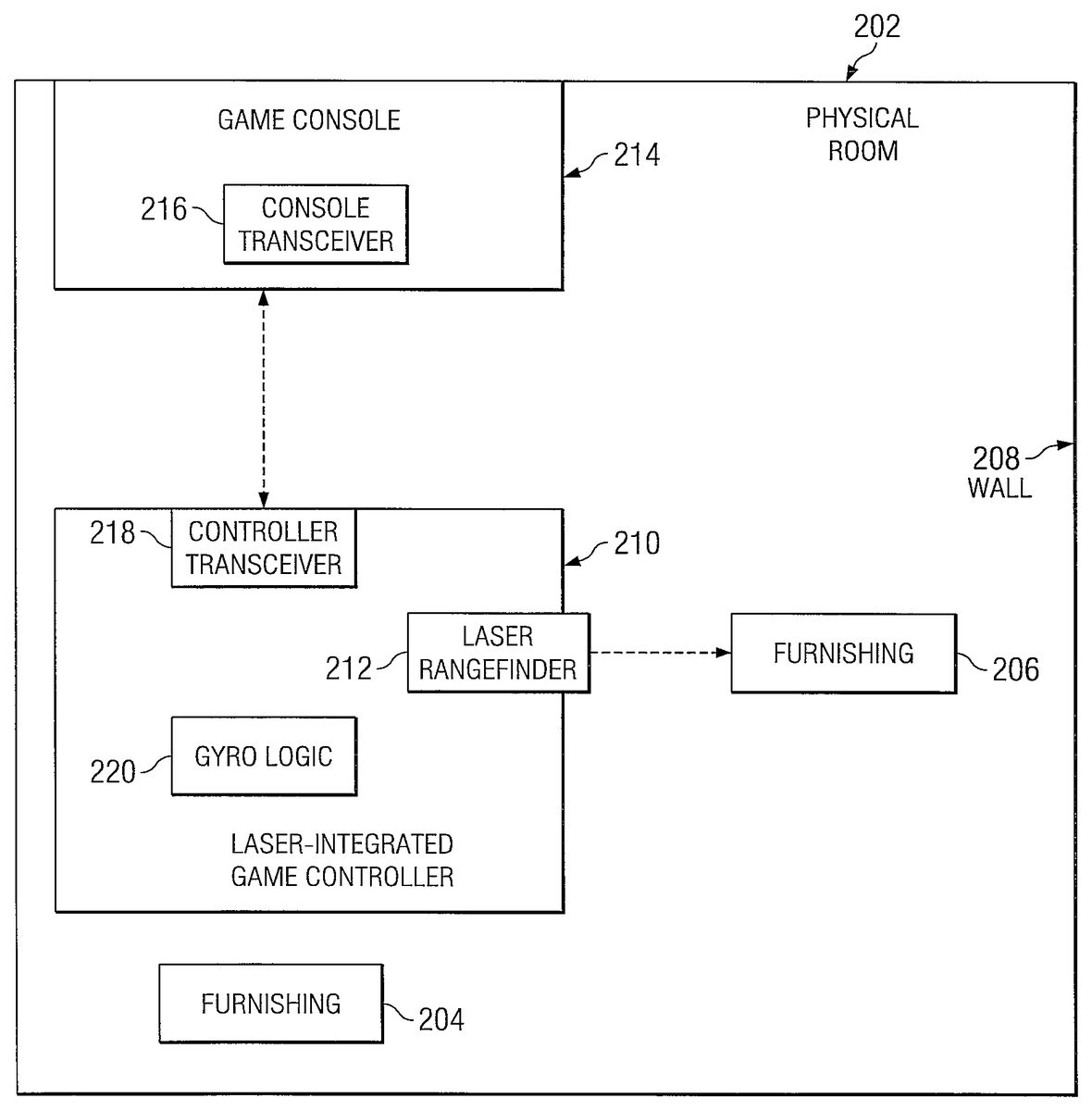
With reference now toFIG. 2, a physical room202contains a real furnishing204, a real furnishing206, and a real physical wall208. These items, and their physical positions within the physical room202, have previously been simulated by a computer to create a room simulation302, shown inFIG. 3. This simulation can be performed using any simulation process, including “drag-and-drop” movement of representations, computer animation, laser-scanning, etc.
As shown inFIG. 2, a laser-integrated game controller210incorporates the use of an integrated laser rangefinder212. This laser rangefinder212is able to determine the distance between the laser-integrated game controller210and any object within the physical room202. The game console214is able to determine the position, movement and spatial orientation of the laser-integrated game controller210through the use of interrogation signals between a console transceiver216and a controller transceiver218. These interrogation signals include both a real-time rangefinder signal (e.g., a laser signal) between the laser-integrated game controller210and the game console214, as well as orientation signals from a gyroscopic logic220that describe a three-axis orientation of the laser-integrated game controller210in real time.
Note that, as shown inFIG. 2, the laser rangefinder212is depicted as transceiving a range-interrogation signal to the furnishing206. This results in the room simulation302(shown inFIG. 3) highlighting the corresponding furnishing representation306, without changing the appearance or highlight of the furnishing representation304and/or the wall representation308. That is, by pointing and clicking the laser rangefinder212at a particular real object in the physical room, whatever object is being pointed at (and identified by the rangefinder distance) has a corresponding representation on the room simulation302change appearance. This change in appearance may be a simple highlighting (as shown inFIG. 3), or the detailed appearance of the object may be changed, using a color pallet or other icon (not shown) in the room simulation302. For example, by highlighting the furnishing representation306, which may be an upholstered chair, the type and color of upholstery depicted in the furnishing representation306may be selectively changed by the user of the laser-integrated game controller210(e.g., by typing in a selection on the game console214). Similarly, if the user had been pointing the laser rangefinder212at the wall208, the user may have been able to change the color of the wall representation308in the room simulation302. Thus, the system depicted allows a user to point to and identify a real object in the room, in order to identify, highlight and/or change a corresponding representation in a simulation of that room.
Referring now toFIG. 4, a high-level flow chart of exemplary steps taken to identify a specific object representation in a computer simulation is presented. After initiator block402, a computer simulation of a physical room is generating and displaying on a video display (block404). The physical room may contain/include real objects, such as a wall and a furnishing. The computer simulation includes object representations, such as a wall representation of the wall and a furnishing representation of the furnishing. As described in block406, a laser rangefinder is integrated into a game controller to create a laser-integrated game controller. The laser-integrated game controller is signal-coupled to a game console (block408). The laser-integrated game controller is capable of determining and transmitting, to the game console, a real-time location and spatial orientation of the laser-integrated game controller within the physical room. Furthermore, the laser rangefinder is capable of determining and transmitting, to the game console, a range signal that describes a distance from the laser-integrated game controller to one of the real objects in the physical room.
As described in block410, the game console receives the real-time location and spatial orientation of the laser-integrated game controller. The game console also receives the range signal from the laser rangefinder (block412). This range signal is generated when the laser rangefinder is pointed at a specific real object selected from the real objects in the physical room. The game console then identifies the specific real object in the physical room based on the real-time location of the laser-integrated game controller, the spatial orientation of the laser-integrated game controller, and the range signal from the laser rangefinder in the laser-integrated game controller (block414). A specific object representation, from the object representations in the computer simulation, is identified (block416). This specific object representation corresponds with the specific real object identified by the game console. The game console (or other associated logic found in a computer such as computer102shown inFIG. 1) can then receive an appearance feature selection for the specific object representation (block418). The game console can then alter, according to the appearance feature selection, an appearance of a specific object representation (block420). The process ends at terminator block422.
While the present invention has been particularly shown and described with reference to a preferred embodiment, it will be understood by those skilled in the art that various changes in form and detail may be made therein without departing from the spirit and scope of the invention. For example, while the present description has been directed to a preferred embodiment in which custom software applications are developed, the invention disclosed herein is equally applicable to the development and modification of application software. Furthermore, as used in the specification and the appended claims, the term “computer” or “system” or “computer system” or “computing device” includes any data processing system including, but not limited to, personal computers, servers, workstations, network computers, main frame computers, routers, switches, Personal Digital Assistants (PDA's), telephones, and any other system capable of processing, transmitting, receiving, capturing and/or storing data.
Claims
- A method of identifying a specific object representation in a computer simulation, the method comprising: generating and displaying a computer simulation of a physical room, wherein the physical room comprises real objects that comprise a wall and a furnishing, and wherein the computer simulation comprises object representations that comprise a wall representation of the wall and a furnishing representation of the furnishing;integrating a laser rangefinder into a game controller to create a laser-integrated game controller;signal-coupling the laser-integrated game controller to a game console, wherein the laser-integrated game controller is capable of determining and transmitting, to the game console, a real-time location and spatial orientation of the laser-integrated game controller within the physical room, and wherein the laser rangefinder is capable of determining and transmitting, to the game console, a range signal that describes a distance from the laser-integrated game controller to one of the real objects in the physical room;receiving, at the game console, the real-time location and spatial orientation of the laser-integrated game controller;receiving, at the game console, the range signal from the laser rangefinder, wherein the range signal is generated when the laser rangefinder is pointed at a specific real object selected from the real objects in the physical room;identifying, by the game console, the specific real object in the physical room based on the real-time location of the laser-integrated game controller, the spatial orientation of the laser-integrated game controller, and the range signal from the laser rangefinder in the laser-integrated game controller;and identifying a specific object representation, from the object representations in the computer simulation, that corresponds with the specific real object identified by the game console.
- The method of claim 1 , further comprising: receiving an appearance feature selection for the specific object representation;and altering, according to the appearance feature selection, an appearance of a specific object representation.
Disclaimer: Data collected from the USPTO and may be malformed, incomplete, and/or otherwise inaccurate.