U.S. Pat. No. 7,419,159
METHOD FOR PLAYING VIDEO GAMES WITH IMPROVED PLAYER INTEREST
AssigneeGametech International
Issue DateAugust 17, 2005
Illustrative Figure
Abstract
An improved video draw poker game is disclosed that deals a player an initial five card draw poker hand plus an additional match hand of cards. After the player has held and replaced cards to obtain a final hand of cards from which draw poker winnings are determined in a conventional manner, the final hand of cards is compared to the match hand of cards to determine additional winnings based on face value and suit matches between cards in the draw hand and in the match hand. The match concept is also disclosed as used with a game played on a video slot machine.
Description
DETAILED DESCRIPTION The present invention combines the most desirable features of draw poker and gaming machines such as slot machines with a novel improvement that gives a player more sense of participation and control, reasonable odds of winning, and what the players perceive is a chance to beat odds that are normally in favor of casino. For poker the result is a more desirable draw poker game called “Match Poker”. The more desirable version on a slot machine is called “Match Slots”. For Match Poker the improvement is achieved by initially dealing a player a five card draw poker hand plus an additional five card match hand that may yield the player additional game winnings. A player selects cards to be held, and non-held cards are replaced in a conventional fashion during a draw step to get a final five card draw poker hand that determines what winnings the player has achieved. The player may achieve the additional game winnings in the following manner. The cards of the final five card draw poker hand are compared to the cards of the additional match hand for matches of face value and suit. That is, the first card in the final draw poker hand is compared to the first card in the match card hand, the second card in the draw card poker hand is compared to the second card in the match card hand, and so on to the fifth card in the draw poker hand being compared to the fifth card in the match card hand. Additional game winnings are achieved for each match in face value and in suit. When in each comparison the suit is the same there is an additional winning of one credit. When in each comparison the face value is the same there is an ...
DETAILED DESCRIPTION
The present invention combines the most desirable features of draw poker and gaming machines such as slot machines with a novel improvement that gives a player more sense of participation and control, reasonable odds of winning, and what the players perceive is a chance to beat odds that are normally in favor of casino. For poker the result is a more desirable draw poker game called “Match Poker”. The more desirable version on a slot machine is called “Match Slots”.
For Match Poker the improvement is achieved by initially dealing a player a five card draw poker hand plus an additional five card match hand that may yield the player additional game winnings. A player selects cards to be held, and non-held cards are replaced in a conventional fashion during a draw step to get a final five card draw poker hand that determines what winnings the player has achieved. The player may achieve the additional game winnings in the following manner. The cards of the final five card draw poker hand are compared to the cards of the additional match hand for matches of face value and suit. That is, the first card in the final draw poker hand is compared to the first card in the match card hand, the second card in the draw card poker hand is compared to the second card in the match card hand, and so on to the fifth card in the draw poker hand being compared to the fifth card in the match card hand. Additional game winnings are achieved for each match in face value and in suit. When in each comparison the suit is the same there is an additional winning of one credit. When in each comparison the face value is the same there is an additional winning of two credits. When in each comparison both the face value and the suit are the same there is an additional winning of three credits. This novel game play is called “Match Poker”. This embodiment of the invention is shown and described with reference toFIGS. 4-7.
In an alternative embodiment of the draw poker version of the invention two initial five card draw poker hands are dealt plus the additional five card match hand. The two five card draw poker hands are played one after the other. The conventional draw poker winnings are determined for each of the two draw poker hands, and the additional five card match hand is compared to the each of the two initial five card draw poker hands to determine suit and face value matches between the hands for additional game winnings. This alternative embodiment of the invention is shown and described with reference toFIGS. 8-13.
In another embodiment of the invention implemented with a video slot machine, a player places their bet(s) and actuates the spin of video slot reels in a manner well known in the art. One or more conventional rows of slot symbols are displayed, plus another match row of slot symbols used to implement the match concept of the present invention. The conventional rows of slot symbols are analyzed for winnings in a well known manner. Then the conventional rows of slot symbols are each compared to the match row of slot symbols to determine any matches which indicate additional game winnings. This embodiment of the invention is shown and described with reference toFIG. 17.
InFIG. 1is shown a display screen10of a computer controlled video implementation of the novel Match Poker game for playing a single poker hand in accordance with the teaching of the present invention. Some standard features of a slot machine that are well known in the art are deliberately not shown inFIG. 1to avoid detracting from the teaching of the present invention and to avoid cluttering the drawing.
Typically there is a slot for inserting coins or tokens to place a number of wagers or bets for a round of game play. In addition, there may be a slot for the insertion of a debit card from which the game debits the number of wagers or bets placed by a player, and to which the game credits any winnings. Such wagers or bets from a debit card are often referred to as credits and this is the term used throughout this detailed description. These slots are shown as Money/Card Sensor54inFIG. 16. Also, when there is a slot for insertion of coins or tokens there will be a tray into which winnings in the form of coins or tokens are dispensed. In addition, if there is a slot for inserting a debit card to bet on a round of game play that same slot is used to credit winnings to the debit card. Those slots and tray are shown as Payoff Device56inFIG. 16. The video screen display51may include information such as, but not limited to, copyright and trademark notices, manufacturer of equipment, name of game, and fancy graphics.FIG. 16is described in detail further in this detailed description. There may be a flashing light on the top of the game housing to announce a winning jackpot; and there may be other controls. Also included on the front panel of the game housing may be game instructions to instruct a player as to how to play the Match Poker game and preferably instructions on the video display screen10indicating what action is required by the player at particular times during game play. The Match Poker game instructions may also be called up and displayed by touching an on-screen button (not shown). These other elements form no specific part of the present invention.
InFIG. 1there are shown five card display positions11a-11ein which cards are dealt to play the novel Match Poker version of draw poker. These five card positions are also referred to in this Detailed Description as Hand1. There are also five additional card display positions19a-19cin which five additional cards are dealt to implement the matching card aspect of the present invention. These five card positions are also referred to in this Detailed Description as Match Hand19. There are four on-screen buttons shown. There is a Bet Max button13which a player will touch to indicate the maximum possible number of bets on a round of game play. There is a Bet Up button14that a player will touch to incrementally increase their bets prior to the start of game play. There is a Bet Down button15that a player will touch to incrementally decrease their bets prior to the start of game play. There is also a DEAL button16that a player touches to commence Match Poker game play after they have placed their bets. Other commonly shown buttons are not shown because they are well known in the prior art and to avoid detracting from the description of the invention. InFIG. 1only the backs of cards are shown in card positions11a-11ebecause a player has not yet placed any bets and touched DEAL button16.
There is also an on-screen display58of the number of credits a player has to play, and an on-screen display59of the number of bets a player is placing on each round of game play. Finally, there is an on-screen display57of the number of additional credits a player may win when there is a match between the face value and suit of the dealt cards displayed in positions11a-11e(Hand1) and the match cards that are dealt into display positions19a-19e(Match Hand). To determine match winnings the face value and suit of the final card dealt or drawn into position11ais compared to the face value and suit of the match card dealt into match card display position19aand so forth to the face value and suit of the card dealt or drawn into position11ebeing compared to the face value and suit of the match card dealt into card display position19e. As shown in display57when there is a match in the suit (hearts, diamonds, spades or clubs) of a card in one of positions11a-11e(Hand1) and a corresponding one of the cards in positions19a-19e(Match Hand19) an additional winning of one credit is achieved. Similarly, when there is a match in the face value of a card in one of positions11a-11eand a corresponding one of the match cards in positions19a-19ean additional winning of two credits is achieved. Finally, when there is a match in both the suit and the face value of a card in one of positions11a-11eand a corresponding one of the match cards in positions19a-19ean additional winning of 3 credits is achieved. Alternatively, the same number or a different number of credits may be won for each face value or suit match. The match hand credit payout may be also be determined differently, such as being a multiplier of the winnings from the pay table inFIG. 3.
InFIG. 2is shown the display screen10of a computer controlled video implementation of the novel Match Poker game as played on a video slot machine when two poker hands are sequentially played in accordance with the teaching of an alternative embodiment of the invention. As described above some standard features typically displayed on display screen10are not shown to avoid detracting from the teaching of the present invention and to avoid cluttering the drawing.
A player may place a bet of up to 10 credits on each of Hand1and Hand2inFIG. 2. When a player touches Bet Up button14to place a number of bets between one and ten, the video screen will appear as inFIG. 1. When the player touches Bet Up button14an eleventh time video screen10changes to appear as inFIG. 2and display a second hand—Hand2. As shown inFIG. 2, at the left of hands11and12is an indication that the hand is either Hand1or Hand2and the number of bets placed on each hand. InFIG. 2the player has placed a total of 12 bets, the maximum number of ten of which are placed on Hand1and the remaining two bets are placed on Hand2. As each bet is placed one credit is deducted from the number of player credits displayed at position58. The total number of bets placed by a player, twelve in this example, is displayed at position59. InFIG. 2only the backs of cards are shown in card positions11a-11eand19a-19ebecause a player has not yet placed any bets and touched DEAL button16. In variant games a player may choose to place less than ten bets on the first hand of cards11a-11eand then choose to place any number of bets on the second hand of cards12a-12e.
InFIG. 3is shown a typical pay table showing the credit winnings a player may achieve for different winning hands of cards based on the number of bets placed on a hand of cards. For example, inFIG. 1, the player has placed a total of 10 bets on Hand1. If the player in this a round of game play gets a full house the player will win a total of seventy credits. Each hand of cards will have its own winnings apart from the match winnings described briefly above and in more detail hereinafter.
First Round of Game Play
FIGS. 4 and 5are utilized to illustrate a first round of game play in accordance with the teaching of the invention, but game play actually begins inFIG. 1with the placing of bets and touching DEAL button16. After DEAL button16is touched, buttons13-16inFIG. 1are deleted and are replaced by STAND button17and DRAW button18inFIG. 4to be used in the next step of game play. For this first round of game play only a single bet is placed by a player as indicated by “Bet 1” in display area59. Each bet is equal to one credit. Bet1is also displayed at the left side of Hand1. With only one bet being placed the player's credits are reduced from 1000 to 999 as indicated at position58. After the player touches on-screen Bet Up button14inFIG. 1once to place the one bet, and then touches on-screen button DEAL16, a hand of cards is randomly dealt into positions11a-11eas shown inFIG. 4. In addition, in accordance with the teaching of the invention, an additional hand of five cards is dealt into Match Hand19display positions19a-19eas shown inFIG. 4. The Match Hand cards are used to determine additional winnings for a player per Match Values table57.
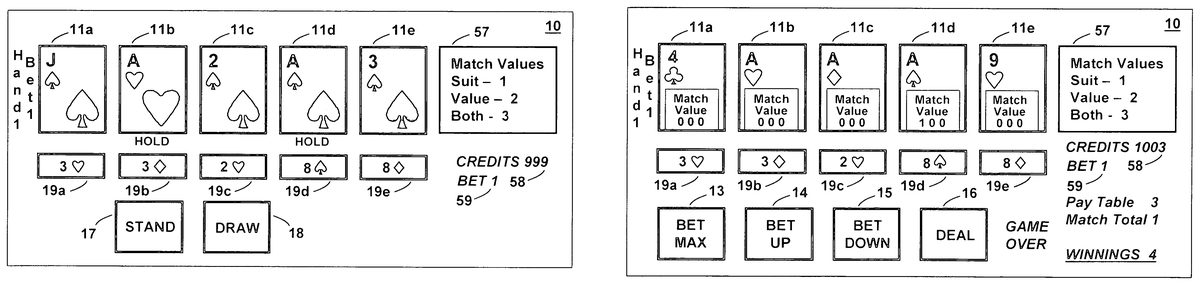
The initial Hand1of five cards dealt into card display positions11a-11einFIG. 4are analyzed by the player to determine what cards are to be held and what cards are to be disposed of and replaced. In this first round of game play the player chooses to hold the ace of hearts in position11band the ace of spades in position11d. The player selects these two cards by touching them on display screen10which is equipped with touch screen technology that is well known in the art. Responsive to being touched the word HOLD is displayed under the aces in display positions11band11d. The player may change their mind and retouch either or both of the two aces to remove the held status, and then touch other cards to be held. If the player wishes to hold all cards they can just touch STAND button17and the game play progresses to analyzing the cards in Hand1for winnings.
After the player is finished holding cards they touch DRAW button18. Immediately after a player placed bets and touched DEAL button16inFIG. 1, buttons13-16are replaced by STAND button17and DRAW button18as shown inFIG. 4. Responsive to DRAW button18being touched the non-held cards in positions11a,11cand11eare replaced as shown inFIG. 5. The player's final Hand1is shown inFIG. 5and comprises three aces, a four and a nine. Per the pay table shown inFIG. 3, with one bet placed, three of a kind wins three credits. The final hand of cards in Hand1are then analyzed using the pay table inFIG. 3and the number of bets placed by the player to determine what the winnings are.
At this point in game play buttons17and18disappear and are replaced by buttons13-16on display10inFIG. 5in preparation for a second round of game play. A second round of game play with one hand is described with reference toFIGS. 6 and 7.
In accordance with the teaching of the invention the final step in a round of game play of the novel Match Poker game is to determine any match winnings for the first round of game play using the additional five cards dealt into Match Hand19(positions19a-19e). The match process consists of comparing cards in positions11a-11ewith cards in positions19a-19e. More particularly, inFIG. 5the card displayed in position11ais compared with the card in position19a, the card displayed in position11bis compared with the card displayed in position19b, and so forth to the card displayed in position11ebeing compared to the card displayed in position19e.
More particularly, in comparing the five cards of Hand1and Match Hand19it is determined if there is a suit or face value match between the cards displayed in positions11aand19a, if there is a suit or face value match between the cards displayed in positions11band19b, if there is a suit or face value match between the cards displayed in positions11cand19c, if there is a suit or face value match between the cards displayed in positions11dand11d, and if there is a suit or face value match between the cards displayed in positions11eand19e. There is an ace of spades in position11dand an eight of spades in position19d. Thus, there is only one suit match. There are no face value matches between the cards in the two hands11and19. Per the Match Values table57each suit match wins one credit. Thus, the player has won one additional credit for the first round of game play. In total, the player has won a total of four credits, three credits per the pay table inFIG. 3for the three aces, and one credit for having one suit match. These winnings are shown in the lower right corner of display10ofFIG. 5as “Winnings 4”. The player's credit total in position58is increased by four from 999 to 1003 as shown inFIG. 5to reflect these winnings. The first round of game play is completed.
To display the match information to the player a small window is displayed in the bottom portion of each of card positions11a-11eas shown inFIG. 5. Each of these small windows is entitled Match Value and a three digit number is displayed under the title. The first digit indicates if there is a suit match, the second digit indicates if there is a face value match, and the third digit indicates if there is both a suit and face value match. The value of a digit indicates the number of additional credits won. Per table57each suit match yields one additional credit, each value match yields two additional credits, and both a suit and value match yields three additional credits. Accordingly, with no suit or face value match for the cards displayed in positions11aand12athe three numbers are “000”. The same applies to the small window displayed in positions11b,11cand11e. In position lid the number “100” is displayed reflecting that there is a suit match of spades. A suit match receives only one credit. If “020” is displayed it would indicate a face value match because face value matches are displayed in the second position, and a face value match receives two credits as indicated in table57. This is shown inFIG. 7for the match winnings for a second round of game play. If “003” is displayed it would indicate both a face value and suit match because both face value and suit matches are displayed in the third position, and receive three credits as indicated in table57.
Second Round of Game Play
FIGS. 6 and 7are utilized to illustrate a second round of game play in accordance with the teaching of the invention in which only a single bet is placed by a player as indicated by “Bet 1” in display area59and at the left of Hand1. The second round of game play actually commences using on-screen buttons13-16displayed inFIG. 5. The player will select the number of bets they wish to place on the second round of game play in one of two ways. They may use Bet Max button13, Bet Up button14and Bet Down button15in a well known manner. Alternatively, if the player does not use bet buttons13-15and touches DEAL button16the game program assumes that the player wishes to repeat the number of bets placed on the previous round of game play into the present round of game play. That is the case described for the second round of game play. The player touches DEAL button16inFIG. 15and starts the second round of game play without increasing or decreasing their bets. Whichever way the number of bets are determined for the second round of game play, inFIG. 6the number of bets is displayed at location59. With one bet being placed the player's credits are decreased from the 1003 shown inFIG. 5at the end of the first round of game play to the 1002 credits shown in space58inFIG. 6.
InFIG. 6, for the second round of game play the five cards shown in Hand1are dealt into positions11a-11eand the match cards are dealt into Match Hand19as shown. As previously described the player analyzes Hand1to determine what cards they want to hold and what cards they want to discard and replace. In this example the player chooses to hold only the queen of spades in position11bso the player touches position11band the word “HOLD” is displayed under the queen of spades as shown. The player may alternatively decide to hold all their cards and they will touch STAND button17. In that instance no cards are discarded and replaced and game play progresses to determine any winnings from the pay table inFIG. 3, and then to determine any match winnings.
After the player elects to hold only the queen of spades in position11bthey touch DRAW button18to replace the non-held, discarded cards in the other positions. The display changes to that shown inFIG. 7. Buttons17and18disappear and are replaced by buttons13-16. This is done in preparation for the next round of game play. As shown inFIG. 7the discarded seven of clubs in position11aofFIG. 6is replaced by the eight of diamonds, the discarded four of hearts in position11cofFIG. 6is replaced by the jack of clubs, the discarded five of spades in position11dofFIG. 6is replaced by the jack of diamonds, and the discarded jack of hearts in position11eofFIG. 6is replaced by the five of clubs.
The game program analyzes the final five cards in Hand1ofFIG. 7to determine if there is a winning hand. In this case there is a pair of jacks which is jacks or better and, per the pay table inFIG. 3, yields a winning of one credit for a bet of one credit. This is displayed in the lower right corner of display10as “Pay Table—1”
the game program then determines if there are any match winnings for the second round of game play using the additional five match cards dealt into Match Hand19(positions19a-19e). This match process consists of comparing cards of Hand1in positions11a-11ewith corresponding cards in positions19a-19eas previously described with reference to the first round of game play. In comparing the five cards in Hand1and Match Hand19it is determined if there is a suit or face value match between the cards displayed in positions11aand19a, if there is a suit or face value match between the cards displayed in positions11band19b, if there is a suit or face value match between the cards displayed in positions11cand19c, if there is a suit or face value match between the cards displayed in positions11dand19d, and if there is a suit and face value match between the cards displayed in positions11eand19e.
There is an eight of diamonds in position11aand an eight of hearts in position19a. Thus, there is a face value match which, per the Match Values table57, wins two credits. In addition, there is a jack of clubs in position11cand a king of clubs in position19cwhich yields an additional winning of 1 credit per table57due to the match in card suit. Also, there is a jack of diamonds in position11dand a nine of diamonds in position19dwhich also yields an additional winning of 1 credit per table57due to the match in card suit. Thus, the player has won four additional credits due to matches. These are displayed in the lower right corner of display10as “Match Total—4”.
In total, the player has won a total of five credits for the second round of Match Poker game play, one credit for the pair of jacks or better, two credits for having one face value match, and two credits for having two suit matches. These winnings are shown in the lower right corner of display10ofFIG. 7as “Winnings 5”. The player's credit total in position58is increased by five from 1002 to 1007 inFIG. 7to reflect these winnings.
To display the match information to the player a small window is displayed in the bottom portion of each of card positions11a-11eas shown inFIG. 7. Each of these small windows is entitled Match Value and a three digit number is displayed under the title. The first number indicates if there is a suit match, the second number indicates if there is a face value match, and the third number indicates if there is both a suit and face value match. Accordingly, with no suit or face value match for the cards displayed in positions11band12band in positions11eand12ethe three numbers displayed in positions11band11eare “000”. In position11athe number “020” is displayed reflecting that there is a face value match of eight which receives two credits as indicates in table57. The two is displayed in the second position of the three digit number. In positions11cand19cthere is a suit match of clubs, and in positions11dand19dthere is a suit match of diamonds. Per Match Values table57this results in receiving two more credits. The second round of game play is completed.
Third Round of Game Play
FIGS. 8 through 10are utilized to illustrate a third round of game play in which eleven bets are placed by a player as indicated by “Bet 11” in display area59. Since only a maximum of ten bets may be played on a single hand, ten bets are placed on Hand1and a second hand is displayed entitled Hand2on which the eleventh bet is placed. If the player had placed fifteen bets there would be ten bets on Hand1and five bets on Hand2. The number of bets placed on each hand is displayed just to the left of each hand. To the left of Hand1is displayed “Bet 10” and to the left of Hand2is displayed “Bet 1”. In an alternative embodiment of the invention the same number of bets may be placed on each of the two hands11and12.
The third round of game play commences using on-screen buttons displayed inFIG. 7at the end of the second round of game play. Those are buttons13-16that are re-displayed on display10inFIG. 7after DRAW button18is touched inFIG. 6. The player selects the number of bets they wish to place on the third round of game play in one of two ways. They may use Bet Max button13, Bet Up button14and Bet Down button15in a well known manner and as previously described for the first and second round of game play. Alternatively, if the player does not use buttons13-15and touches DEAL button16inFIG. 7the game program assumes that the player wishes to repeat the number of bets placed on the previous round of game play into the present round of game play. The player touches DEAL button16inFIG. 7and starts the third round of game play. Whichever way the number of bets are determined for the third round of game play, inFIG. 8the number of bets is displayed to the left of Hand1and Hand2and in location59. With eleven bets being placed the player's credits displayed at location58are decreased from the 1007 shown inFIG. 7at the end of the second round of game play to the 996 credits shown in location58inFIG. 8.
InFIG. 8, for the third round of game play the five cards shown in Hand1are dealt into positions11a-11e, the five cards shown in Hand2are dealt into positions12a-12eand the match cards shown are dealt into Match Hand positions19a-19e. Hands1and2are played sequentially so the display of Hand2is initially suppressed or grayed somewhat as depicted inFIG. 8to indicate to the player that Hand2is presently not in play. The player analyzes Hand1to determine what cards they want to hold and what cards they want to discard and replace. In this example the player chooses to hold the ace of spades in position11bso the player touches position11binFIG. 8and the word “HOLD” is displayed under the ace of spades as shown. The player may alternatively decide to hold all cards and touch STAND button17. In that instance no cards are discarded and replaced and game play progresses to the next step as displayed inFIG. 9.
After electing to hold the ace of spades the player touches DRAW button18to discard and redraw cards and the game program displays screen10as shown inFIG. 9. The cards in display positions11a,11c,11dand11eof Hand1inFIG. 8are replaced as shown inFIG. 9. In addition, the Match Value windows are displayed in the lower portion of each of positions11a-11e.
The game program analyzes the final five draw poker cards in Hand1ofFIG. 9to determine if there is a winning hand. In this case there is only a pair of tens so there are no draw poker game winnings for Hand1. This is reflected in the lower right area of display10by the words “Pay Table Hand 1-0”.
The game program then determines if there are any match winnings for Hand1in the third round of game play using the additional five cards dealt into Match Hand19(positions19a-19e). This match process consists of comparing cards of Hand1in positions11a-11ewith corresponding cards in positions19a-19eas previously described.
For Hand1in the third round of game play there are no face value matches but there are three suit matches. There is: (a) a ten of hearts in position11aand a two of hearts in position19a, (b) a three of diamonds in position11cand a ten of diamonds in position19c, and (c) a ten of spades in position11dand a jack of spades in position19d. Per Match Value table57three suit matches yields additional winnings of three credits for the player. Accordingly, the numbers displayed in the Match Value windows in positions11a,11cand11dread “100”. In addition, at the lower right corner of display10is now displayed pay table winnings of zero as the words “Match Total Hand 1-3”. Since only game play for Hand1has been completed thus far in the third round of game play only the winnings for Hand1, as described above, are displayed. Since Hand2has not yet been played no winnings are displayed for that hand.
Since game play is completed for Hand1, and Hand2is now to be played, the suppression or graying of display position12a-12eof Hand2, as depicted inFIG. 9, is removed indicating that Hand2is now in play and, instead, display positions11a-11eof Hand1are suppressed or grayed indicating that Hand1is no longer in game play.
Game play now progresses to play Hand2and this is now described with reference toFIGS. 9 and 10. The player must initially analyze Hand2to determine what cards they want to hold and what cards they want to discard and replace. In this example the player chooses to hold the ace of hearts in position12cso the player touches position12con display10inFIG. 9and the word “HOLD” is displayed under the ace of hearts as shown. The player then touches DRAW button18to discard and redraw cards that are shown inFIG. 10. The player may alternatively decide to hold all cards and touch STAND button17. In that instance no cards are discarded and replaced and game play would progress to the next step.
InFIG. 10it is seen that a king of diamonds is drawn into position12a, a king of spades is drawn into position12b, a king of diamonds is drawn into position12d, and an eight of hearts is drawn into position12eof Hand2. This definitely improved Hand2. The game program analyzes the final five cards in Hand2ofFIG. 10to determine if there is a winning hand. There are three kings in positions12a,12band12d. Per the pay table inFIG. 3three of a kind with a bet of one wins three credits. This winning is displayed in the lower right corner of display10as “Pay Table Hand 2-3”.
The game program then determines if there are any match winnings for Hand2in the third round of game play using the additional five match cards dealt into Match Hand19(positions19a-19e). This match process consists of comparing cards of Hand1in positions11a-11ewith corresponding cards in positions19a-19eas previously described.
For Hand2in the third round of game play there are no face value matches but there is one suit match. There is an eight of hearts in position12eand a five of hearts in position19e. Per Match Value table57one suit match yields a winning of one credit. Accordingly, the numbers displayed in the Match Value window in position11ereads “100”. The Match Value window for positions12a,12b,12cand12dread “000”. The match value winning is displayed in the lower right corner of display10as “Match Total Hand 2-1”. The third round of game play is now over and the total game winnings are also displayed in the lower right corner of display10as “Winnings 7”. The player's credits in position58are incremented by four additional credits from 999 to 1003.
Fourth Round of Game Play
FIGS. 11 through 13are utilized to illustrate a fourth round of game play of Match Poker in which twelve bets are placed by a player as indicated by “Bet 12” in location59. Since eleven bets had been placed on the third round of game play the player has to touch Bet Up button14inFIG. 10once after the third round of game play is over to increase the bets by one to twelve. Since only a maximum of ten bets may be played on a single hand, ten bets are placed on Hand1and the other two bets are placed on Hand2. The number of bets placed on each hand is displayed just to the left of each hand. To the left of Hand1is displayed “Bet 10” and to the left of Hand2is displayed “Bet 2”.
The fourth round of game play commences using on-screen buttons13-1616displayed inFIG. 10at the end of the third round of game play. The bets are changed, such as described in the previous paragraph, using buttons13-15. InFIGS. 11-13the number of bets are displayed to the left of the display of Hand1and Hand2and in location59. With twelve bets being placed the player's credits displayed at location58are decreased from the1003shown inFIG. 10at the end of the third round of game play to the 991 credits shown in location58inFIG. 11. The player then touches DEAL button16inFIG. 10to start the fourth round of game play.
InFIG. 11, for the fourth round of game play the five cards shown in Hand1are dealt into positions11a-11e, the five cards shown in Hand2are dealt into positions12a-12eand the match cards shown are dealt into Match Hand19(positions19a-19e). Hands1and2are played sequentially in that order so the display of Hand2is initially suppressed or grayed somewhat as depicted inFIG. 11to indicate to the player that Hand2is presently not in play. The player analyzes Hand1to determine what cards they want to hold and what cards they want to discard and replace. In this example the player chooses to hold the jack of spades in position11band the jack of clubs in position11eso the player touches positions11band11einFIG. 11and the word “HOLD” is displayed under these two positions as shown. The player may change their HOLD selections by retouching a position to remove the HOLD. Under different circumstances the player may alternatively decide to hold all cards and touch STAND button17. In that instance no cards are discarded and replaced and game play progresses to the next step as displayed inFIG. 12.
After electing to hold the two jacks in positions11band11ethe player touches DRAW button18inFIG. 11and the game program displays screen10as shown inFIG. 12. The cards in display positions11a,11cand11dof Hand1inFIG. 11are replaced as shown inFIG. 12with the king of clubs, the nine of clubs and the five of clubs. In addition, the Match Value windows are displayed in the lower portion of each of positions11a-11einFIG. 12.
The game program analyzes the final five cards in Hand1ofFIG. 12to determine if there is a winning match poker hand. In this case there is a pair of jacks so there are winnings for jacks or better in Hand1. Per the pay table inFIG. 3jacks or better with ten bets wins ten credits. These ten credits are displayed in the lower right corner of display10as “Pay Table Hand 1-10”.
The game program then determines if there are any match winnings for Hand1in the fourth round of game play using the additional five cards dealt into Match Hand19(positions19a-19e). This match process consists of comparing cards of Hand1in positions11a-11ewith corresponding cards in positions19a-19eof Match Hand19for face value and suit matches as previously described.
For Hand1in the third round of game play there are three suit matches in positions11a,11band11d. Per Match Values table57three suit matches yields winnings of three credits for the player. Accordingly, the numbers displayed in the Match Value windows in positions11a,11band11dread “100”. There are no face value matches. In addition, at the lower right corner of display10is now displayed match winnings for Hand1as “Match Total Hand 1-3”. Since only game play for Hand1has been completed thus far in the fourth round of game play only the winnings for Hand1are displayed.
Since game play is completed for Hand1, and Hand2is now to be played, the suppression or graying of display position12a-12eas depicted inFIG. 11is removed inFIG. 12indicating that Hand2is now in play and, instead, display positions11a-11eare suppressed or grayed indicating that Hand1is no longer in game play.
Game play now progresses to play Hand2and this is now described with reference toFIGS. 12 and 13. The player must initially analyze Hand2to determine what cards they want to hold and what cards they want to discard and replace. In this example the player chooses to hold the eight of clubs in position12a, the nine of diamonds in position12c, the five of clubs in position12dand the seven of spades in position12ein the hope of achieving a straight. The player touches these positions on display10inFIG. 12and the word “HOLD” is displayed under the positions as shown. The player then touches DRAW button18to discard and redraw cards and the final draw poker hand is shown inFIG. 13. Under different circumstances the player may have alternatively decided to hold all cards and touched STAND button17. In that instance no cards are discarded and replaced and game play would progress to the next step shown inFIG. 13.
InFIG. 13it is seen that a six of spades is drawn into position12b. The game program analyzes the final five cards in Hand2ofFIG. 13to determine if there is a winning hand. It can be seen inFIG. 13that a straight has been achieved. Per the pay table inFIG. 3a straight with a bet of two wins eight credits. This winning is displayed in the lower right corner of display10as “Pay Table Hand 2-8”.
The game program then determines if there are any match winnings for Hand2in the fourth round of game play using the additional five cards dealt into Match Hand19(positions19a-19e). The match process consists of comparing cards of Hand1in positions11a-11ewith corresponding cards in positions19a-19eas previously described.
For Hand2in the fourth round of game play there are five suit matches for five credits. There is: (a) an eight of clubs in position12aand a six of clubs in position19a, (b) a six of spades in position12band a seven of spades in position19b, (c) a nine of diamonds in position12cand a jack of diamonds in position19c, (d) a five of clubs in position12dand a three of clubs in position19d, and (e) a seven of hearts in both of positions12eand19e. There is one face value match. In position12ethere is a seven and in position19ethere is a seven for two credits. There is also one match of both face value and suit in positions12eand19efor three more credits. Accordingly, the numbers displayed in the Match Value window displayed in positions11a-11dreads “100”, and the numbers displayed in the Match Value window displayed in positions11ereads “123”. The total match value winnings for Hand2is displayed in the lower right corner of display10as “Match Total Hand 2-10”. The third round of game play is now over as indicated by the words “Game Over” displayed at the bottom of display10. The total game winnings are displayed in the lower right corner of display10as “Winnings 31”.
Flow Chart
InFIGS. 14 and 15is shown a block diagram flow chart showing the steps of game play for the novel Match Poker game.FIG. 14shows a first portion of the flow chart andFIG. 15shows the remainder of the flow chart for the novel Match Poker game. The two figures are joined by leads designated A, B, C and D. InFIG. 14the game commences at START at the top of the figure. The first step in the game is at block21where the display shown inFIG. 1is displayed. That is, Hand1(positions11a-11e), the Match Hand (positions19a-19e), buttons13-16and game play information is displayed in display locations57-59.
At decision block22the game program awaits a player to place one or more bets to play a game of Match Poker. As long as no best are placed the program exits decision block22at No and cycles back to the input of block22to await bets to be placed by the player. When a bet is placed by the player the game exits block22at Yes and progresses to block23where the bet(s) made by the player is/are read and displayed. Initially, this will be one bet or the maximum number of bets. A second or subsequent bets are also sensed and displayed as described hereinafter. The program then progresses to decision block24where it is determined how many bets have been made by the player. As long as ten or fewer bets are made by the player the program exits decision block24at No and progresses to decision block25where the program watches for the player to touch DEAL button16. As long as DEAL button16is not touched the program exits decision block25at No and cycles back to the input of decision block22to continue waiting for additional bets to be placed followed by DEAL button16to be touched. When a player has placed all their bets, and the total is less than ten, and then touches DEAL button16the program exits block25at Yes and progresses to block26where the program causes five cards to be dealt into display position11a-11eof Hand1and five cards to be dealt into Match hand display positions19a-19eas shown inFIGS. 4 and 6.
At block27the program watches for the player to touch ones of display positions11a-11ein Hand1indicating cards that are to be held and the remainder of the cards to be discarded and redrawn. The game program progresses to decision block28where the program watches for on-screen DRAW button18to be touched indicating that the player has finished holding cards and non-held cards are to be replaced. As long as DRAW button18is not touched the program exits block28at No and cycles back to the input of block27to watch for any other cards to be held as indicated by the player touching the card display positions.
When DRAW button18is touched by the player the program exits decision block28at Yes and progresses to block29where all non-held cards are replaced with new cards. At the exit of block29there is a path marked by the letter “A” that goes to a path marked by the same letter “A” inFIG. 15. Now that all final cards have been dealt into Hand1the program progresses to block39inFIG. 15where the final cards in Hand1are analyzed for a winning hand, to determine any winnings from the pay table shown inFIG. 3according to the numbers of best made by the player, and to display the winnings. The winnings are displayed at the lower right corner of display10inFIGS. 5 and 7. InFIG. 5the winnings are displayed as “Pay Table—3”.
The next step in the game program is at block40where the face values and suits of the cards in display positions (11a-11e) of Hand1are compared to the face value and suit of the match cards dealt into the display positions19a-19eof Match Hand19at the beginning of the game. At block41any such Match winnings are displayed such as shown at the lower right corner of display10inFIGS. 5 and 7. InFIG. 5the display is “Match Total—1”. At this point game play is over and at block42the program causes the words “Game Over” to be displayed to the right of DEAL button16inFIGS. 5 and 7. The program then cycles back via lead C toFIG. 14to the input of decision block22to await a player touching ones of buttons13-15to change the bets placed. It is assumed by the program that if none of these buttons is touched that the number of bets remains the same as in the prior round of game play.
The above paragraph completes the description of the steps performed for a round of game play in which ten or less bets are made and only a single hand of cards (Hand1) are dealt and played. The program steps are different if more than ten bets have been placed on a round of game play. InFIG. 14, at decision block24, the program determines if more than ten bets have been made by the player on a round of game play. If the decision is No the program exits the block at No as previously described and a single hand of cards is played. If the decision is Yes, the program exits block24at Yes and progresses to block30where Hand2card display positions12a-12eare placed on display10as shown inFIG. 2. In the even that a player has placed more than ten bets in a previous round of game play and both Hands1and2are displayed, and the player decreases their bets below ten, Hand2is removed from display10. Even if a player has increased their bets above ten and Hand2is then added to the display and the player changes their mind and reduces their bets below ten, the display positions12a-12efor Hand2are removed from display10.
After the display positions12a-12efor Hand2are displayed when more than ten bets have been placed, the program progresses to decision block31to watch for the player to touch DEAL button16. As long as the player doesn't touch DEAL button31the program exits block31at No and cycles back to the input of block31to continue waiting for the player to touch DEAL button16. The player may change the bets that they have made. When the player touches DEAL button31they are through placing bets and the program exits block31at Yes and progresses to block32. At block32the program deals new hands of cards into Hand1, Hand2and Match Hand19. Hands1and2are played sequentially so the display of Hand2is initially suppressed or grayed somewhat as depicted inFIG. 8to indicate to the player that Hand2is presently not in play.
The program then progresses to block33where the program watches for the player to touch ones of display positions11a-11ein Hand1indicating cards that are to be held and the remainder of the cards in Hand I are to be discarded and redrawn. The game program progresses to decision block34where the program watches for DRAW button18to be touched indicating that the player has finished holding cards and non-held cards in Hand1are to be replaced. As long as DRAW button18is not touched the program exits decision block34at No and cycles back to the input of block33to watch for any other cards to be held as indicated by the player touching the card display positions.
When DRAW button18is touched by the player the program exits decision block34at Yes and progresses to block35where all non-held cards in Hand1are replaced with new cards. Now that all final cards are in Hand1the program progresses to block36where the final cards in Hand1are analyzed for a winning hand, to determine the winnings from the pay table shown inFIG. 3according to the numbers of best made by the player, and to display the winnings. The winnings are displayed at the lower right corner of display10inFIGS. 10 and 13. InFIG. 10the winnings are displayed as “Pay Table Hand 1-0”.
The next step in the game program is at block37where the face value and suit of the cards in display positions11a-11eof Hand1are compared to the face value and suit of the cards dealt into the display positions19a-19eof Match Hand19. At block38any such Match winnings are displayed such as shown at the lower right corner of display10inFIGS. 10 and 13. InFIG. 10the display is “Match Total Hand 1-3”. At this point game play for Hand1is over and the game program progresses to block43inFIG. 15via lead B to play the cards of Hand2.
At block43Hand2is enabled. Since game play is completed for Hand1, and Hand2is now to be played, the suppression or graying of display position12a-12eas depicted inFIG. 9is removed indicating that Hand2is now in play and, instead, display positions11a-11eare suppressed or grayed indicating that Hand1is no longer in game play.
At block44the game program watches for the player to touch ones of display positions12a-12ein Hand2indicating ones of the cards that are to be held and the remainder of the cards are to be discarded and redrawn. The game program progresses to decision block45where the program watches for on-screen DRAW button18to be touched indicating that the player has finished holding cards and non-held cards are to be replaced. As long as DRAW button18is not touched the program exits block45at No and cycles back to the input of block44to watch for any other cards to be held as indicated by the player touching the card display positions.
When DRAW button18is touched by the player the program exits decision block45at Yes and progresses to block46where all non-held cards in Hand2are replaced with new cards. Now that all final cards are in Hand2the program progresses to block47where the final cards in Hand2are analyzed for a winning hand, to determine any winnings from the pay table shown inFIG. 3according to the numbers of best made by the player, and to display the winnings. The winnings are displayed at the lower right corner of display10inFIGS. 10 and 13. InFIG. 10the winnings are displayed as “Pay Table Hand 2-3”.
The next step in the game program is at block48where the face value and suit of the cards in the display positions (12a-12e) of Hand2are compared to the face value and suit of the match cards dealt into the display positions19a-19eof Match Hand. At block49any such match winnings for Hand2are displayed such as shown at the lower right corner of display10inFIGS. 10 and 13. InFIG. 10the display is “Match Total Hand 2-1”. At this point game play is over and at block50the program causes the words “Game Over” to be displayed to the right of DEAL button16such as shown inFIGS. 10 and 13. The program then cycles back via lead D toFIG. 14to the input of decision block22to await a player touching ones of buttons13-15to change the bets placed. It is assumed that if none of these buttons is touched that the number of bets remains the same as in the prior round of game play.
The above paragraph completes the description of the program steps performed for a round of game play in which more than ten bets are made and two hands of cards (Hand1and Hand2) are dealt and played.
Block Diagram
InFIG. 16is shown a general block diagram of the electronic hardware used to implement a computer controlled implementation of the novel Match Poker game incorporating the teaching of the present invention. The heart of the computer controlled slot machine is a central processor unit (CPU)52running the Match Poker program that is stored in memory53. The basic operations of a conventional draw poker game are well known in the art and are not repeated here for the sake of brevity. Responsive to the Match Poker game program CPU52causes a display on display51, such as shown inFIGS. 1,2and5-13. Coupled with display51is touch screen apparatus55that is well known in the art and indicates to CPU52when and where a player has touched ones of the on-screen buttons displayed on display51as previously described with reference toFIGS. 4-13.
The Match Poker game may have a slot for inserting coins or tokens for placing a number of wagers or bets for each round of game play. Alternatively, there may be a slot for the insertion of a debit card from which CPU52debits the number of credits or bets placed by a player, and to which CPU52credits any winnings. These monetary functions are shown at the box entitled Money/Card Sensor54which is connected to CPU52to receive indications of coin or token insertions, and to read and write a debit card under control of CPU52. Also, when there is a slot for insertion of coins or tokens there will be a tray into which winnings in the form of coins or tokens are dispensed. This tray is shown as Payoff Device56which is controlled by CPU52to dispense winnings in the form of coins or tokens.
Using touch screen55CPU52monitors a player touching on-screen buttons described with reference toFIGS. 4-13and responds accordingly to implement game functions as previously described.
In the third and fourth rounds of game play described hereinabove one deck of cards is used to deal hands11a-11e,12a-12eand19a-19e. However, different decks of cards can be used to deal each hand of cards. In addition, while a maximum of two hands11a-11eand12a-12emay be played, depending on the number of hands chosen to be played by the player, the player may be permitted to play more than two hands of cards and have them each compared to the match hand19a-19efor additional winnings.
In the four rounds of game play described hereinabove the player is dealt a match hand19a-19efor every round of game play, and they get the match hand for no additional wagered credits. In a variant of the novel match poker game a player may have to wager a separate bet in order to get a match hand19a-19e, and for additional bets the player may get additional match hands to compare against final hands of cards.
In other variants of the novel match poker game a player may receive a match hand for free, but dependent on a triggering event such as having a full house hand of cards. The triggering event may be the player paying a fee to obtain a match hand. In addition, the number of match hands may vary dependent on different triggering events. For example, depending upon one or more triggering hand of cards being present the player may receive a match hand for the particular round of game play, or may receive a plurality of match hands to be use
InFIG. 17is shown a display screen60of a computer controlled video game implementing the novel match concept in a slot machine in accordance with the teaching of the present invention. Some standard features of a slot machine that are well known in the art are deliberately not shown inFIG. 17to avoid detracting from the teaching of the present invention and to avoid cluttering the drawing.
In a conventional video slot gaming device a 3×5 matrix (3 rows by 5 columns) called a “five reel slot” is utilized. These are represented inFIG. 17as Rows1-3and Columns1-5. Rows1and3of the three rows are used to display five slot symbols in a conventional manner, depending on the number of bets placed. A player may select to play only Row1or both Rows1and3. Row2is the match row and is used to implement the match concept. A player utilizes Bet Max button13, Bet Up button14and Bet Down button15to place a number of bets in a manner known in the art. Following the place of bets the player touches Deal button16to commence a round of game play. In a manner known in the art slot symbols are displayed in all fifteen positions of the 3×5 matrix.
The slot symbols in Row1are analyzed for any winnings. As shown in Row1there are three strawberries and a pay table (not shown) is used to determine the winnings for three of a kind. The slot symbols in Row3are then analyzed for any winnings. As shown in Row3there are two of a kind, two watermelons, and a pay table (not shown) is used to determine any winnings for two of a kind.
Then the slot symbols displayed in Match Row2are compared to the slot symbols in Rows1and3to determine any additional winnings for the game. When comparing Rows1and2it can be seen that there is a slot symbol match in column2. When comparing Rows2and3it can be seen that there are slot symbol matches in columns2,3and5. These slot symbol matches yield extra winnings to the player. The amount of the winnings may vary but in the example described herein each slot symbol match yields one credit to the player. In addition to the winnings by having three strawberries in Row1the player also gains one extra credit by having strawberries in Column2of both Rows1and2. In addition to any winnings, if any, by having two watermelons in Row3the player gains three extra credits by having slot symbol matches in Columns2,3and5of both Rows2and3.
While what has been described hereinabove are several examples of Match Poker game play per the preferred embodiment of the invention, and a number of alternatives, it should be understood that numerous changes maybe made without departing from the spirit and scope of the invention. Following are some examples of changes. At the conclusion of each round of game play, played hand cards that have face value and suit value matches with the match hand will be grayed or otherwise highlighted. In another variant as the hands of cards are dealt they may be dealt sequentially or concurrently. In yet another variant a player will initially indicate the number of bets they wish to play and they will commence automatic game play of a plurality of rounds of game play. Cards to be held are automatically determined for each round of game play and rounds of game play are automatically, sequentially played until the player stops game play. In still another variant the results of face value and suit matches with the match hand of cards are displayed one card at a time rather than concurrently. Different ones of these variants may also be combined.
Claims
- A method of playing a modified draw poker game using a deck of cards wherein a player has a chance to hold cards and to reject and replace other cards during the course of game play, the method comprising the steps of: (a) dealing an initial hand of cards to a player, the initial hand of cards being initially dealt face up to the player;(b) dealing an second hand of cards to a the player at the same time the initial hand of cards are dealt to the player, the second hand of cards being initially dealt face up to the player;(c) drawing replacement cards for cards rejected by the player from the initial hand of cards to achieve a final hand of cards;(d) determining if the player's final hand of cards is a winning hand of cards and awarding winnings to the player for a winning hand of cards;(e) comparing the second hand of cards to the final hand of cards to determine matches in predetermined characteristics between the cards in the second hand of cards and the final hand of cards;and (f) awarding winnings to the player for each match in the predetermined characteristics between the second hand of cards and the final hand of cards.
- The method of playing a modified draw poker game in accordance with claim 1 wherein step (e) comprises the steps of comparing the face value and/or suit of the cards in the second hand of cards to the final hand of cards and awarding the winnings in step (f) based upon matches in the face value and the suit of the cards.
- The method of playing a modified draw poker game in accordance with claim 2 further comprising the steps of: (g) selecting a plurality of hands of cards to be played prior to performing step (a);(h) performing steps (a) through (f) for a first of the plurality of hands of cards selected to be played in step (g);and (i) sequentially repeating steps (a) through (f) for a second and all other of the plurality of initial hands of cards selected to be played in step (g).
- The method of playing a modified draw poker game in accordance with claim 1 further comprising the step: (g) selecting a plurality of hands of cards to be played prior to performing step (a);(h) performing steps (a) through (f) for a first of the plurality of hands of cards selected to be played in step (g);and (h) sequentially repeating steps (a) through (f) for a second and all other of the plurality of initial hands of cards selected to be played in step (g).
- A method of playing a modified draw poker game using a deck of cards wherein a player has a chance to hold cards and to reject and replace other cards during the course of game play, the method comprising the steps of: (a) a player selecting a plurality of hands of cards to be played;(b) dealing an initial hand of cards for each of the plurality of hands of cards selected to be played in step (a), each initial hand of cards being initially dealt face up to the player;(c) dealing a match hand of cards to the player at the same time the plurality of initial hands of cards are dealt to the player in step (b), the match hand of cards being initially dealt face up to the player;(d) sequentially drawing replacement cards for cards rejected by the player from each of the plurality of initial hands of cards dealt in step (b) to achieve final hands of cards;(e) determining if each of the player's plurality of final hands of cards in step (d) is a winning hand of cards and awarding winnings to the player for each winning final hand of cards;(f) comparing the match hand of cards dealt in step (c) to each of the final hands of cards of step (d) to determine matches in predetermined characteristics between the cards;and (g) awarding winnings to the player for each match of predetermined characteristics determined in step (f).
- The method of playing a modified draw poker game in accordance with claim 5 wherein the predetermined characteristics of the cards are the face value and/or suit of the cards and step (f) comprises comparing the face value and suit of the cards in the match hand of cards to the final hand of cards and awarding the winnings of step (g) based upon matches in the face value and suit of the cards.
- The method of playing a modified draw poker game in accordance with claim 6 wherein the dealing of a match hand of cards to a player in step (b) is dependent upon the occurrence of a triggering event.
- The method of playing a modified draw poker game in accordance with claim 5 wherein the dealing a match hand of cards to a player in step (b) is dependent upon the occurrence of a triggering event.
Disclaimer: Data collected from the USPTO and may be malformed, incomplete, and/or otherwise inaccurate.