U.S. Pat. No. 7,399,224
METHOD OF GAME CHARACTER MOVEMENT CONTROL IN GAME SPACE
AssigneeNamco Bandai Games Inc.
Issue DateApril 16, 2004
Illustrative Figure
Abstract
Provided is a game performing method for executing a given game by controlling movements of characters in a game space. The generated image of the game space has a set plurality of sample points in the game space; calculated positions of the characters; calculated arrival times of the characters; recognized areas pertaining to power of the character group; and controlled movements of the characters on positions and/or magnitudes of the recognized areas in the game space.
Description
PREFERRED EMBODIMENTS OF THE INVENTION First Embodiment: Next,FIGS. 1-17will be referred to while a case where a soccer game is executed by means of a household game apparatus is described as a first embodiment to which the present invention is applied. [Descriptions of Configuration] FIG. 1is a view showing an example of a configuration in the case where the present invention is applied to a household game apparatus. As shown in the same drawing, the household game apparatus1200is provided with game controllers1202, a main unit1210, and a display1220equipped with speakers1222. The game controllers1202are connected to the main unit1210, and the main unit1210and the display1220are connected to each other with cables1201capable of transmitting image signals, sound signals and the like. The game controllers1202are each provided with a direction key1204and button switches1206for a player to input game operations, and the game controllers1202output operation input signals to the main unit1210. The main unit1210is provided with an arithmetic processing unit such as a central processing unit (CPU), and a reader of an information storage medium such as a compact disk read-only memory (CD-ROM)1212. The main unit1210performs the arithmetic processing of various game processes on game information read from the CD-ROM1212or the like and operation signals from the game controllers1202, and generates image signals of game screens and sound signals of game sounds. The main unit1210outputs the generated image signals and the sound signals to the display1220to make the display1220display game images and to make the speakers1222output game sounds. The player observes the game screens displayed on the display1220while operating the game controllers1202to enjoy the soccer game. Incidentally, the game information, which is the information such as programs and data, which are necessary for the main unit1210to execute the game processes, is stored in, for example, the CD-ROM1212, an integrated circuit (IC) memory1214, a memory ...
PREFERRED EMBODIMENTS OF THE INVENTION
First Embodiment:
Next,FIGS. 1-17will be referred to while a case where a soccer game is executed by means of a household game apparatus is described as a first embodiment to which the present invention is applied.
[Descriptions of Configuration]
FIG. 1is a view showing an example of a configuration in the case where the present invention is applied to a household game apparatus. As shown in the same drawing, the household game apparatus1200is provided with game controllers1202, a main unit1210, and a display1220equipped with speakers1222. The game controllers1202are connected to the main unit1210, and the main unit1210and the display1220are connected to each other with cables1201capable of transmitting image signals, sound signals and the like.
The game controllers1202are each provided with a direction key1204and button switches1206for a player to input game operations, and the game controllers1202output operation input signals to the main unit1210.
The main unit1210is provided with an arithmetic processing unit such as a central processing unit (CPU), and a reader of an information storage medium such as a compact disk read-only memory (CD-ROM)1212. The main unit1210performs the arithmetic processing of various game processes on game information read from the CD-ROM1212or the like and operation signals from the game controllers1202, and generates image signals of game screens and sound signals of game sounds.
The main unit1210outputs the generated image signals and the sound signals to the display1220to make the display1220display game images and to make the speakers1222output game sounds. The player observes the game screens displayed on the display1220while operating the game controllers1202to enjoy the soccer game.
Incidentally, the game information, which is the information such as programs and data, which are necessary for the main unit1210to execute the game processes, is stored in, for example, the CD-ROM1212, an integrated circuit (IC) memory1214, a memory card1216and the like, which are information storage media capable of being freely attached to and detached from the main unit1210. Alternatively, the game information is obtained from external devices by the connection of the main unit1210with communication lines1230through a communication device1218installed in the main unit1210. The communication lines1230hereupon indicate communication paths capable of transferring data. That is, the communication lines1230include communication networks such as telephone communication networks, cable networks and the Internet as well as local area networks (LAN's) such as private lines (private cables) for direct connection and Ethernet (registered trademark). Moreover, the communication system of the communication lines1230hereupon does not care whether the communication system is a wired system or whether the communication system is a radio system.
FIG. 2is a view showing an example of the game screen in the present embodiment. In the same drawing, the athletes of a player team operated by a player and the athletes of a COM team operated by the computer are displayed in different display mode, and the player team is attacking from the right side to the left side on the screen.
In the present embodiment, objects such as a pitch Fp corresponding to a court of soccer, a ball B, and soccer athletes (hereinafter simply referred to as “athletes”) corresponding to a player character PC and non-player characters NPC are arranged in an object space. The images of the object space are generated as game images with a given virtual camera to be displayed on the display1220. Hereupon, the pitch Fp corresponds the court of soccer, and is a range enclosed by touchlines and goal lines.
Any one of the athletes of the player team is arbitrarily selected by the player or is automatically switched according to the whereabouts of the ball B to be the player character (operation athlete) PC which the player operates with the game controllers1202. The actions of the player character PC such as the movements thereof, passes and shots are controlled in accordance with operation inputs from the game controllers1202. On the other hand, the athletes other than the player character PC are set as the non-player characters NPC, which are automatically controlled by the computer. In the present embodiment, the movement control of the non-player characters NPC on the offensive side is performed on the basis of the geographical power distributions in the game space.
[Descriptions of Principle]
Next, the principle of the movement control of the non-player characters NPC in the present embodiment will be described.
FIG. 3is a schematic view showing a state of the pitch Fp, which is a soccer court, as seen from a just upper position. InFIG. 3, athletes C are denoted by triangular marks in display modes different by the team, and the attacking directions of the athletes are denoted by the lateral directions of the triangular marks.
In the same drawing, because the player team, which the player operates, attacks from the right side to the left side in the screen, the player team is on the offensive side, and the own position of the player team is the right side. The competitor's position is the left side. Because the COM team attacks from the left side to the right side in the screen, the own position of the COM team is the left side, and the competitor's position is the right side. Because the player character PC keeps the ball B, the player team is on the offensive side and the COM team is on the defensive side.
Each region of the pitch Fp is called by being distinguished as a front board, a middle board and a rear board in the long side direction of the pitch Fp in the order of ranges nearer to the goal of the competitor's position on the basis of the attacking direction, and by being distinguished as sides on both sides and the center in the short side direction of the pitch Fp. For example, when a range of the pitch Fp positioned at the upper left in the screen shown in the same drawing as seen from the player team is appointed, the range is appointed as a range in the “front board” in the “right side”.
Mesh-shaped areas AR are set in the pitch Fp arranged in the object space (virtual space). For example, when the long side direction of the pitch Fp is supposed to be an X-axis coordinate and the short side direction is supposed to be a Z-axis coordinate, the areas AR are set on the whole in a matrix along the directions of the X-axis and the Z-axis. Each of the areas AR is identified by a representative point Q having X, Z-coordinate values. A concrete size ratio of each of the areas AR is, for example, one such that each of the areas AR has four sides of about 2 m to the pitch Fp sized in 105 m by 68 m in reduced actual sizes. Each of the representative points Q is set at, for example, almost the position of the center of gravity of each of the areas AR, but the positions of the representative points Q may be appropriately set as long as each of the representative points Q is within a range included in each of the areas AR.
In the present embodiment, the non-player characters NPC are controlled in order that the representative points Q of the areas AR may be movement target points. Then, when which area AR is determined to be a movement target point, space evaluation points are set to be utilized as geographical power information. The space evaluation points are index values indicating the validity of the areas AR as the so-called “spaces”.
When an arrival time T for the player character PC or a certain non-player character NPC to reach a certain area AR is equal to a prescribed threshold value or more, the area AR is regarded as a “space”.
FIGS. 4A and 4Bare conceptual views showing a calculation method of the arrival times T of a certain non-player character NPC up to areas AR in the present embodiment.
As shown inFIG. 4A, a virtual movement point P in the case where it is supposed that the non-player character NPC has started a uniform motion at the present velocity Vn of the non-player character NPC from the present position coordinates of the non-player character NPC in the pitch Fp as a starting point and has continued the uniform motion for a prescribed time (e.g. 0.5 seconds) is first obtained. Then, the areas AR the representative points Q of which are included in a prescribed arrival time calculation range AC around the virtual movement point Pare selected. The areas AR will be hereinafter referred to as the “areas AR included in the arrival time calculation range AC”. As the arrival time calculation range AC, for example, a range expressed by the X, Z-coordinate values or the polar coordinate values of a range within a radius of 15 m in reduced actual size from the virtual movement point P of an athlete M is set.
Next, the distance PQ from the virtual movement point P to the representative point Q of each of the areas AR included in the arrival time calculation range AC is divided by an ability speed Va, which is one of ability parameters set to each athlete in advance, and the quotient is set as the arrival time T to the area AR. To put it more concretely, for example, the differences of the coordinate values from the virtual movement point P to the representative points Q are reduced to actual distances (by the meter) on the ratios between the size of the actual pitch of 105 m by 68 m and X, Z-coordinate values, and the reduced differences are divided by the ability speed Va (for example, the maximum velocity of the athlete expressed by the m/s). Thereby, the arrival times T are calculated.
When the arrival times T of a certain character C are examined, for example, as shown inFIG. 4B, the arrival times T (each digit in the drawing indicates the rough number of seconds of the arrival time T of the area AR) can be obtained around the virtual movement point P almost in concentric circles.
FIG. 5is a conceptual view for illustrating a calculation method of space evaluation points in the present embodiment. In the present embodiment, the areas AR at which the arrival times T of the non-player character NPC are larger than a prescribed power sphere judging time t0 (for example, five seconds in the same drawing) are judged as spaces, and the areas AR at which the arrival times T are equal to or less than the power sphere judging time t0 are judged to be within a dominant range of the team of the non-player character NPC.
To put it concretely, a subtraction result of the power sphere judging time t0 from the arrival time T to a certain area AR is set as a space evaluation point. Then, the areas AR at which the space evaluation points are positive values are regarded as spaces. For example, when the arrival time T to an area AR-6is “6.0 seconds”, the space evaluation point is “1.0 (=6.0−5)”, and the area AR-6can be judged to be a space. The more an area AR is distant from the non-player character NPC, the larger the arrival time T thereof is. Also the space evaluation point thereof becomes larger in proportion to the distance. Moreover, for example, when an area AR-4is in the vicinity of the non-player character NPC and the arrival time T thereof is “1.0 second”, the space evaluation point thereof is “−4.0 (=1.0−5)”. Consequently, the area AR-4cannot be judged to be a space. That is, whether a certain area AR is a space or not can be known on the basis of the positive or the negative of the space evaluation point of the area AR. When the space evaluation point is a positive value, how much the area AR is distant from the non-player character NPC, i.e. the degree as the space, can be known on the magnitude of the space evaluation point.
FIG. 6is a conceptual view for illustrating a selection principle of a movement target point using space evaluation points in the present embodiment. As shown in the same drawing, when there are areas AR-1to AR-3as the candidates of a movement target point of the non-player character NPC, the space evaluation point of each area AR is referred to.
The highness of the space evaluation point means the highness of the degree as a space. In other words, the highness of the space evaluation point indicates that the movement target point is distant from the athlete C of the COM team by that degree (of course, is distant from the other athletes). Accordingly, an area AR (the area AR-2in the same drawing) having the highest space evaluation point among the areas AR-1to AR-3, which are the candidates of the movement target point, is selected as the movement target point of the non-player character NPC. Thereby, it becomes possible to move the non-player character NPC into the area AR which is easy to be used as a space. It is possible to make the non-player character NPC take the actions similar to the ones which can be seen in actual soccer, such as “running into a space”.
The present embodiment uses the space evaluation points to determine how to realize an rational action as a team by determining which non-player character NPC in the team executes which movement.
FIG. 7is a conceptual view for illustrating a principle for determining the movement control of non-player characters NPC in the present embodiment. In the present embodiment, athlete selection conditions for the selection of an athlete who executes a tactical movement (a movement action) and movement target point selection conditions for the selection of a movement target point are previously prepared correspondingly to each other at every kind of the tactical movement which can be adopted as a team. The kinds of the movements are appropriately set. The settable kinds of the movements, for example, include movements ranging from the positive shift of a position called as “running up by a ball (an action of rushing by the side of an own team athlete keeping the ball into the direction of the competitor's position when the own team athlete is keeping the ball)”, “running into the forward space (an action of running into a space existing in the forward direction toward the direction of the competitor's position, or the attacking direction)” and “supporting nearby the ball (an action of approaching the own team athlete keeping the ball and of keeping the state capable of receiving a pass easily)”, to the movements with consideration of the balance of the whole team such as a “movement to a formation position (an action of moving to almost the center of an assigned range of the field, which range has been set previously)”.
For the determination of each of the non-player characters NPC who executes a certain movement, the movement evaluation point of each athlete is calculated as an index indicating the validity at the time of making each non-player character NPC execute the movement, and the movement action is set to be executed by the non-player character NPC having the highest movement evaluation point.
To put it concretely, for example, in case of the same drawing, non-player characters NPC-1to NPC-3satisfying the athlete selection conditions for executing a movement action are selected. To the selected non-player characters NPC-1to NPC-3, movement target points AR-1to AR-3satisfying the movement target point selection conditions based on the present positions of the selected non-player characters NPC-1to NPC-3as the starting points are determined, respectively. Then, the movement evaluation points when the non-player characters NPC-1to NPC-3execute the movements on the respective space evaluation points of the determined movement target points AR-1to AR-3are calculated.
When there is a plurality of non-player characters NPC capable of executing a certain movement, space evaluation points are set to be higher when the movement target points introduced from the respective positional conditions are more advantageously available as spaces. Consequently, also the movement evaluation points to be calculated become higher. In the same drawing, when the same kind of movement is executed, the movement evaluation point of the non-player character NPC-2having the movement target point of the area AR-2, which has the highest space evaluation point, is the highest. Consequently, the non-player character NPC-2is set as the non-player character NPC who executes the movement.
Consequently, by the execution of a movement action by the non-player character NPC having the highest movement evaluation point, the most rational movement allocation as a team can be performed on the positional relationships of the athletes on each occasion like in actual soccer.
[Descriptions of Functional Blocks]
FIG. 8is a functional block diagram showing an example of the functional constitution of the present embodiment. As shown in the same drawing, the household game apparatus1200includes an operation input unit10for inputting operations of a player, a processing unit20bearing the arithmetic processing pertaining to the control of the apparatus1200and games, an image display unit30for performing the display output of a game screen, a sound output unit40for performing the sound output of game sounds, a communication unit50, and a storage unit70for storing various programs and data.
The operation input unit10is realized by, for example, a button switch, a lever, a dial, a mouse, a keyboard, and various sensors. The operation input unit10outputs operation inputs by the player into the processing unit20as operation input signals. In the present embodiment, the game controllers1202shown inFIG. 1correspond to the operation input unit10.
The processing unit20performs various kinds of arithmetic processing such as the whole control of the household game apparatus1200and game arithmetic. The functions of the processing unit20are realized by hardware such as a CPU (of a complex instruction set computer (CISC) type or of a reduced instruction-set computer (RISC) type) and an application-specific integrated circuit (ASIC) (such as a gate array), related control programs and the like. The arithmetic processing unit such as the CPU and the like which are installed in the main unit1210shown inFIG. 1correspond to the processing unit20.
Moreover, the processing unit20includes a game operating unit22for performing arithmetic processing pertaining to games chiefly, an image generation unit24for generating image signals for displaying game screens on various kinds of data obtained by the processing of the game operating unit22, and a sound generation unit26for generating sound signals for outputting game sounds such as effective sounds and back ground music (BGM).
The game operating unit22executes various game processes for executing soccer games on operation input signals from the operation input unit10, and the programs and the data which are read from the storage unit70. The game operating unit22, for example, executes processes of arranging the objects such as the pitch Fp, the athlete characters and the ball B into the virtual space to perform the movement control of the arranged objects, the crossing judgments (hit checks) of the objects, the calculations of line judgments, the switching judgments of the attacking side and the defensing side, the calculations of game results (records), the arrangements of a virtual camera (visual points), the determination of sight line directions and the angles of view, and the like.
The game operating unit22of the present embodiment includes an athlete control unit221, a power distribution calculation unit222, and a space evaluation unit223.
The athlete control unit221executes the control of the movements and the actions of the player character on operation signals input from the operation input unit10, and executes the automatic control of the movements and the actions of the non-player characters NPC. Moreover, the athlete control unit221executes the selection setting of the player character, and executes the setting of a character keeping the ball. Furthermore, the athlete control unit221includes an NPC movement setting unit228for setting the actions of the movements of the respective non-player characters NPC on the offensive side.
The power distribution calculation unit222obtains geographical power distributions in game spaces. To put it concretely, the power distribution calculation unit222calculates the arrival times T of all athletes including the player character PC and the non-player characters NPC on the pitch Fp up to their arrivals to the representative points Q of the respective areas AR included in an arrival time calculation range AC, and judges the minimum arrival times Ts at the respective areas AR. Then, the power distribution calculation unit222judges the respective areas AR as being within the power sphere of the team of the athlete who can arrive the areas AR at the minimum arrival times Ts. The judgement results pertaining to the power distributions of the respective areas AR are managed in the state of being stored in the storage unit70as an area registration TBL733.
The space evaluation unit223calculates space evaluation points of the respective areas AR in the pitch Fp on the minimum arrival times Ts obtained by the power distribution calculation unit222.
The image generation unit24is realized by, for example, an arithmetic unit such as a CPU and a digital signal processing (DSP), the control program of the arithmetic unit, an IC memory for a drawing frame such as a frame buffer, and the like. The image generation unit24executes geometrical conversion processes or shading processes on the operation results of the game operating unit22to generate three dimensional computer graphic (3-D CG) images for displaying game screens, and outputs the image signals of the generated images to the image display unit30.
The sound generation unit26is realized by an arithmetic unit such as a CPU and a DSP, and the control program of the arithmetic unit. The sound generation unit26generates sounds such as effective sounds and BGM which are used in games, and outputs the sound signals to the sound output unit40.
The image display unit30redraws one frame of a screen, for example, at every 1/60 second on the image signals from the image generation unit24while displaying game screens. The image display unit30can be realized by hardware such as a cathode ray tube (CRT), a liquid crystal display (LCD), an electroluminescent device (ELD), a plasma display panel (PDP), a helmet-mounted display (HMD) and the like. In the embodiment shown inFIG. 1, the display1220corresponds to the image display unit30.
The sound output unit40is a device for performing the sound output of effective sounds, BGM and the like on the sound signals from the sound generation unit26. In the embodiment shown inFIG. 1, the speaker1222corresponds to the sound output unit40.
The communication unit50is connected to a communication line for performing data communication with external devices. The communication unit50is realized by, for example, a module, a modem and a terminal adapter (TA) in accordance with Bluetooth (registered trademark), Infrared Data Association (IrDA) or the like, a jack of a communication cable for wired communication, a control circuit, and the like. The communication device1218shown inFIG. 1corresponds to the communication unit50. Incidentally, the information pertaining to the protocols and the like supplied by the communication unit50at the time of communication is stored in, for example, the storage unit70, and the stored information is suitably read to be used.
The storage unit70stores a system program (not shown) for realizing the functions for making the processing unit20control the household game apparatus1200in an integrated manner, game information72storing programs and data necessary for the execution of games, and the like. The storage unit70can be realized by information storage media such as various IC memories, hard disks, CD-ROM's, magneto optical disks (MO's), digital versatile discs (DVD's) and the like. In the embodiment shown inFIG. 1, the CD-ROM1212, the IC memory1214and the memory card1216correspond to the storage unit70.
The game information72includes programs and data for making the processing unit20function as the game operating unit22. The programs especially include (1) an athlete control program721for making the processing unit20function as the athlete control unit221, (2) a power distribution calculation program722for making the processing unit20function as the power distribution calculation unit222, and (3) a space evaluation program723for making the processing unit20function as the space evaluation unit223.
Moreover, as the data, the game information72stores stage data730storing the object data for displaying the pitch Fp, the ball B and the like, team formation data731storing the identification information of the characters belonging to the player team and the COM team, athlete character information732, the area registration TBL733, and movement setting information734storing the conditions of movement target points.
As the data to be suitably updated during the execution of a game, the game information72stores player character information750storing the identification information of the player character PC, and ball keeping character information751storing the identification information of a character keeping the ball B. In the ball keeping character information751, the identification information of an athlete (character) who is judged to keep the ball B among all of the athletes in the player team and the COM team is stored. When no characters keep the ball B, the information of the processing indicating the nonexistence of the character is stored.
Moreover, although it is not shown, various kinds of data such as scores and playing times with regard to the execution of a soccer game are supposed to be suitably stored temporarily.
FIG. 9is a view showing an example of the athlete character information732in the present embodiment. The athlete character information732correspondingly stores athlete identification information732a, which is prepared to each athlete and stores the name of the athlete and the like, belonging team identification information732b, a kind of movement732cstoring the identification information of the kind of a movement action, movement target point coordinates732dstoring the coordinates of the representative point Q of an area AR set as a movement target point, position coordinates732eon the present pitch Fp, a velocity732fstoring the present velocity Vn (which is a vector value including a magnitude and a direction), an ability speed732g, which is one of ability parameters, and object data732hstoring model data and texture data for the display of the athlete.
When the kind of movement732cis set, the setting indicates that the athlete is executing the set movement, and that the athlete is on the way to the movement target point coordinates732d. When the athlete arrives at the movement target point coordinates732d, the prescribed information indicating that the kind of movement is not set is stored in the kind of movement732c.
The aforesaid athlete control unit221and the NPC movement setting unit228update the kind of movement732c, the movement target point coordinates732d, the position coordinates732e, and the velocity732fof the athlete character information732to control the movements and the actions of each character.
FIG. 10Ais a view showing an example of the area registration TBL733of the present embodiment, andFIG. 10Bshows a formula for determining space evaluation points. As shown inFIG. 10A, the area registration TBL733correspondingly stores area identification information733aof areas AR, representative point coordinates733bof representative points Q, the minimum arrival times Ts (733c), which are judged by the power distribution calculation unit222, dominant athlete identification information733dof the characters who can arrive at the areas AR at the minimum arrival times Ts, dominant team identification information733estoring the belonging team identification information of the characters, and space evaluation points733fset by the aforesaid space evaluation unit223.
FIG. 11is a view showing an example of the movement setting information734of the present embodiment. The movement setting information734correspondingly stores to every kind of movement734a, which is distinguished on tactical meanings, a circumstantial condition734bstoring the condition of the game situation, under which the movement is selected, athlete selection conditions734cstoring conditions for the selection of the athlete who executes the movement, a movement target point selection condition734dstoring the condition of the position and/or the magnitude of the movement target point of the movement, and a movement evaluation point734estoring an index or a calculation formula of the index, which index indicates the priority degree of the movement action.
The circumstantial condition734bstores various flags and parameters which indicate game situations to define the conditions of the game. The athlete selection conditions734cand the movement target point selection condition734ddefine the conditions by means of, for example, coordinate ranges in the X, Z-coordinates in the pitch Fp, threshold values and the like.
The movement evaluation point734eis calculated, for example, by the multiplication of the space evaluation point at the movement target point of the movement by the peculiar weighting constant of the movement. That is, a movement action having a movement target point in an area AR at which the space evaluation point is higher and which is easier to use as a space has a higher point.
Incidentally, the “front” inFIG. 11indicates the offensive side direction, namely the direction on the competitor's position side. On the other hand, the “behind” inFIG. 11indicates the defensive side direction, namely the direction on the own position side.
[Descriptions of Process Flow]
Next,FIGS. 12-16Bwill be referred to while the flows of the processes pertaining to the movement control of the non-player characters NPC on the offensive side in the present embodiment are described.
The processes described here are realized by the processing unit20by reading the athlete control program721, the power distribution calculation program722and the space evaluation program723to execute them.
FIG. 12is a flow chart for illustrating the flow of the whole process in the present embodiment. First, as a preparation step before the starting of a game, the game operating unit22arranges objects such as the pitch Fp, the ball B and athletes in an object space (Step S2).
Next, the athlete control unit221initializes the kinds of movements of all athletes (Step S4). For example, the athlete control unit221initializes the kinds of movements by setting “return to formation positions”.
Next, the athlete control unit221sets a prescribed athlete in the player team as the player character PC (Step S6). For example, the prescribed athlete may be a captain athlete appointed by a player before the start of the game. Then, when the player character PC is set, a game play is started.
After the start of the game play, the power distribution calculation unit222first executes a power distribution calculation process to obtain a power distribution in the present game situation (Step S8).
FIG. 13is a flow chart for illustrating the flow of the power distribution calculation process of the present embodiment. As shown in the same drawing, the area registration TBL733is first initialized (Step S40). To put it concretely, prescribed default values (for example, 10 seconds) are stored in the minimum arrival times Ts (733c) of all of the areas AR. Prescribed values of “nonexistence” are stored in the dominant athlete identification information733dof all of the areas AR. Prescribed values of “neutrality” are stored in the dominant team identification information733e. Moreover, “10” is stored in the space evaluation points733fas a default value to initialize the space evaluation points733f.
Next, a loop2is executed in order to each athlete including the player character PC and the non-player characters NPC (Steps S42-S68).
In the loop2, the position coordinates of the virtual movement point P of an athlete who is a process object are calculated (Step S44). To put it concretely, the position coordinates732eand the velocity732fin the athlete character information732are referred to while the position coordinates which the athlete reaches from the present position thereof at the velocity Vn after 0.5 second are calculated.
Next, areas AR to be objects to which the arrival times T of the athlete character around the virtual movement point Pare calculated are selected (Step S46). To put it concretely, the representative point coordinates733bof the area registration TBL733are referred to for the selection of the areas AR included in the arrival time calculation range AC from the position of the virtual movement point P of the athlete. Then, the area identification information733aof the selected areas AR is temporarily stored in the storage unit70.
Next, the power distribution calculation unit222sequentially executes a loop3(Steps S48-S66) to each of the areas AR included in the arrival time calculation range AC of the athlete of the processing object.
In the loop3, the arrival time T of the athlete from the virtual movement point P to the representative point Q of the area AR of the processing object is first calculated (Step S50). To put it concretely, the distance from the virtual movement point P to the representative point Q is calculated, and the calculated distance is multiplied by a prescribed ratio to be reduced to an actual size distance (for example, to a size expressed by meters) Then, the ability speed732gin the athlete character information732is referred to for the calculation of the arrival time T by the division of the reduced value by the ability speed Va.
Next, the calculated arrival time T is compared with the minimum arrival time Ts (733c) registered in the area AR (Step S52).
When the calculated arrival time T is smaller than the registered minimum arrival time Ts (YES at Step S52), the power distribution calculation unit222registers the calculated arrival time T in the minimum arrival time733cof the area AR to update the value of the minimum arrival time733c(Step S54), and registers the athlete identification information732aof the athlete in the dominant athlete identification information733dto update the data of the dominant athlete identification information733d(Step S56). Moreover, the power distribution calculation unit222registers the belonging team identification information732bof the athlete in the dominant team identification information733eto update the data of the dominant team identification information733e(Step S58). Then, the loop3is ended.
When the calculated arrival time T is equal to the minimum arrival time Ts which has already registered to the area AR (NO at Step S52→YES at Step S60), the power distribution calculation unit222registers the prescribed information indicating the “nonexistence” of the pertinent athlete to the dominant athlete identification information733dof the area AR (Step S62), and registers the prescribed information indicating “neutrality” to the dominant team identification information733e(Step S64). Then, the loop3is ended.
When the loop3is ended, the process is similarly executed to the next athlete. When the loop2has been executed to all of the athletes on the pitch Fp, the power distribution calculation process is ended.
Next, inFIG. 12, the space evaluation unit223executes a space evaluation process (Step S9).
FIG. 14is a flow chart for illustrating the flow of the space evaluation process in the present embodiment. As shown in the same drawing, the space evaluation unit223sequentially executes the process of a loop6(Steps S80-S86) to each of the areas AR set in the pitch Fp.
In the loop6, the space evaluation unit223first calculates the space evaluation point733fof the area AR of the processing object (Step S82), and registers the calculated space evaluation point733fin the area registration TBL733(Step S84).
To put it concretely, the space evaluation unit223refers to the minimum arrival time733cof the area AR of the processing object in the area registration TBL733to subtract the referred minimum arrival time733cfrom the power sphere judging time t0 (t0=5 seconds in the present embodiment), and then the space evaluation unit223registers the subtraction value in the space evaluation point733f. For example, in case ofFIGS. 10A and 10B, in the area AR11, the space evaluation point733fis “1.8” (=5−3.2), and then the space evaluation point733ftakes a positive value. Moreover, in the area AR12, the space evaluation point733fis “−0.2” (=5−5.2). Incidentally, the areas AR having the minimum arrival time Ts of “10” is judged to be spaces being far distant from any athletes of both of the teams, and a prescribed value (for example, “10”) is stored in the space evaluation point733fof the areas AR.
Then, when the loop6has been executed to all of the areas AR in the pitch Fp, the space evaluation process is ended.
Next, inFIG. 12, the athlete control unit221controls the movement of the player character PC on an operation input signal input from the operation input unit10(Step S10). That is, the action of the player character PC is determined and controlled on the operation inputs input from the game controllers1202by the player.
Next, the NPC movement setting unit228executes an NPC movement setting process to determine the kinds of movements of the non-player characters NPC on the offensive side except the player character PC (Step S12).
FIG. 15is a flow chart for illustrating the flow of the NPC movement setting process of the present embodiment. As shown in the same drawing, the NPC movement setting unit228first selects the non-player characters NPC of the team on the offensive side except the characters who are moving now and the character who keeps the ball B (Step S102). To put it concretely, the NPC movement setting unit228refers to the athlete character information732to judge the characters having the identification information of the kind of movement stored in the kind of movement732cto be ones who are moving toward movement target points, and the NPC movement setting unit228does not set the characters to be objects of the selection. Moreover, the NPC movement setting unit228refers to the ball keeping character information751not to set the character keeping the ball B to be an object of the selection.
Next, the NPC movement setting unit228selects the kinds of movements satisfying the circumstantial condition734bin the movement setting information734(Step S104), and sequentially executes the process of a loop4(Steps S106-S122) of the selected kind of movement.
In the loop4, the NPC movement setting unit228selects the non-player characters NPC satisfying the athlete selection conditions734cof the kind of movement734aamong the non-player characters NPC who belong to the team on the offensive side and do not keep the ball B (Step S108), and the NPC movement setting unit228sequentially executes the process of a loop5to each of the selected non-player characters NPC (Steps S110-S118).
In the loop5, the NPC movement setting unit228first determines an area AR satisfying the movement target point selection condition734d(Step S112). When a plurality of areas AR satisfies the movement target point selection condition734d, the random selection of the areas AR is performed to narrow down the areas AR to one. Next, the NPC movement setting unit228refers to the space evaluation point733fset to the area AR selected as the movement target point in the area registration TBL733(Step S114), and calculates the movement evaluation point of the kind of movement (Step S116). The NPC movement setting unit228temporarily stores the calculated movement evaluation point in the storage unit70correspondingly to the athlete identification information732aof the non-player character NPC of the processing object.
When the NPC movement setting unit228has executed the process of the loop5to all of the non-player characters NPC satisfying the athlete selection conditions734cof the kind of movement734a, the loop5is ended.
When the loop5has ended, the NPC movement setting unit228retrieves the non-player character NPC having the highest movement evaluation point to set the kind of movement734aas the movement of the retrieved non-player character NPC (Step S120). That is, the NPC movement setting unit228stores the kind of movement734ain processing into the kind of movement732cof the athlete character information732of the retrieved non-player character NPC, and stores the coordinate values of the representative point Q of the previously determined area AR of the movement target point of the non-player character NPC into the movement target point coordinates732d.
Then, when the NPC movement setting unit228has determined each of the athletes who executes each of the movements on the movement setting information734, the NPC movement setting unit228ends the loop4, and ends the NPC movement setting process.
Next, inFIG. 12, the athlete control unit221controls the movements of the non-player characters NPC on the offensive side (Step S14). That is, the athlete control unit221moves each of the non-player characters NPC on the offensive side to the movement target point coordinates732din accordance with the definition of the kind of movement732cof the corresponding athlete character information732. When the athlete control unit221has completed the movements, the athlete control unit221stores the information indicating “nonexistence of setting” (for example, “0”) in the kind of movement732c.
Next, the athlete control unit221executes the movement control of the non-player characters NPC on the defensive side (Step S16), and controls the movements of the objects such as the ball B other than the player character PC and the non-player characters NPC (Step S18). Incidentally, the movement control at Steps S14-S18is suitably executed in accordance with known control techniques.
When the movement control of the objects has been completed, the game operating unit22executes a game judgement process (Step S20). The judgment of the player character and the judgment of the character keeping the ball B are executed at this step.
When the offense and the defense are reversed as a result of the game judgment (YES at Step S22), the athlete control unit221stores the information indicating the “nonexistence of setting” (for example, “0”) to the kinds of movements732cof all of the athletes (Step S24).
Next, the image generation unit24generates an image signal of a game screen (Step S26), and the image display unit30displays the game screen (Step S28). Then, the game operating unit22executes the judgment of the end of the game. When a prescribed ending condition is not satisfied (NO at Step S30), the game operating unit22returns the process to Step S8to continue the game. When the ending condition is satisfied (YES at Step S30), the game operating unit22ends the soccer game.
According to the processes described above, the movement control coping with geographical power distribution states in the game space such as the movements of the non-player characters NPC who belong to the team on the offensive side and do not keep the ball B into spaces can be realized. Moreover, because the movements can be executed by the non-player characters NPC selected on the space evaluation points, the movements are most strategically effective for a team in the game situation at that time.
An example in a more concrete situation will be described.
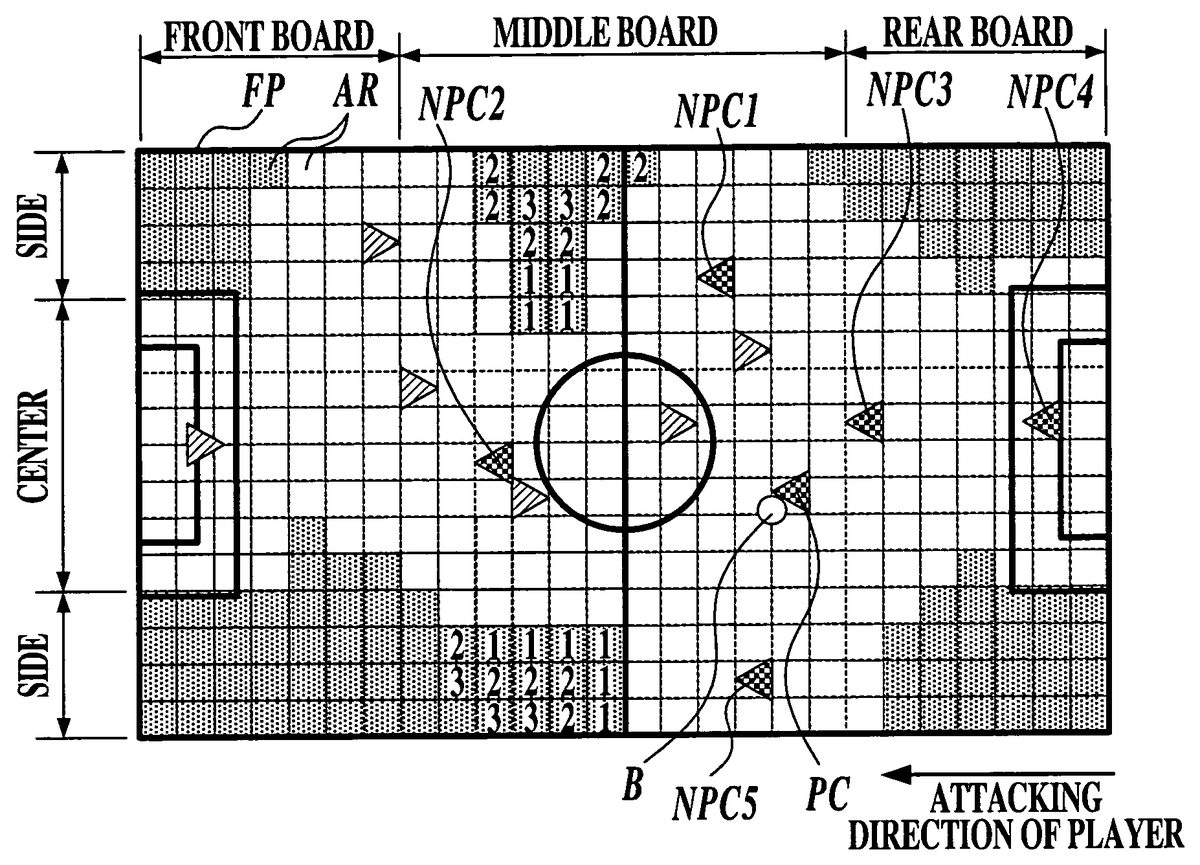
For example,FIGS. 16A and 16Bare schematic views for illustrating an example of the control of the non-player characters NPC in the kind of movement “running into forward space”. In the situation shown inFIG. 16A, a player character PC and five non-player characters NPC1-NPC5are shown as the characters belonging to the player team. Because the player character PC keeps the ball B, the player team is on the offensive side. Incidentally, the areas AR displayed with shading indicate that the areas AR are spaces, and the digits recorded in parts of the areas AR indicates approximate values of the space evaluation points of the areas AR.
When the game situation shown inFIG. 16Ais compared with the circumstantial conditions734bof the movement setting information734shown inFIG. 11, the kind of movement734a“running into forward space” is selected as the action of an executable movement (correspondingly to Step S104) because the ball B is in the range of the middle board in the pitch Fp.
When the athlete selection conditions734cshown inFIG. 11are examined in order from the upper side for the selection of the non-player character NPC who executes the kind of movement734a“running into forward space”, the non-player characters NPC1and NPC5, each being an athlete positioned in a side and capable of receiving a pass, are selected as the candidates for receiving the pass from the player character PC because the ball B is positioned at the center. Next, the area registration TBL733is referred to about areas AR included in each of prescribed retrieved ranges Fa1and Fa5corresponding to attacking directions, it is known that the parts shown with shading of the retrieved ranges Fa1and Fa5are spaces. Hereupon, the retrieved ranges Fa1and Fa5are prescribed ranges toward the attacking direction (competitor's position direction) on the basis of the positions of the non-player characters NPC1and NPC5, and the ranges corresponding to “the forward direction” of the non-player characters NPC1and NPC5. Consequently, both of the non-player characters NPC1and NPC5satisfy the condition of “space lies in attacking direction” (correspondingly to Step S108).
Next, as shown inFIG. 16B, the movement target point of each of the non-player characters NPC1and NPC5is determined. As to the non-player character NPC1, the areas AR included in the retrieved range Fa1are referred to, and the area AR-1having the highest space evaluation point is set as the movement target point. Similarly, as to the non-player character NPC5, the area AR-5in the retrieved range Fa5is set as the movement target point (correspondingly to Step S112).
Then, the movement evaluation point of each of the non-player characters NPC1and NPC5is calculated as follows. That is, the movement evaluation point of the non-player character NPC1is 5 (=movement evaluation point “2”/2×movement peculiar weighting factor “5”), and the movement evaluation point of the non-player character NPC5is 7.5 (=movement evaluation point “3”/2×movement peculiar weighting factor “5”) (correspondingly to Step S114).
Accordingly, the movement “running into front space” with the movement target point of the area AR-5is set to the non-player character NPC5(correspondingly to Step S120). The movement of the non-player character NPC5is controlled, for example, to run into the area AR-5, a space, at a full speed.
When the player see the action to send a pass to the non-player character NPC5, the player executes the tactics of running into a space in a game like in actual soccer.
[Hardware Configuration]
Next, a hardware construction which could implement the functions of the household game apparatus1200will be described.FIG. 17is a diagram showing an example of the hardware construction according to the embodiment of the present invention. The household game apparatus1200comprises a CPU1000, a ROM1002, a RAM1004, a data storage medium1006, a sound generation IC1008, an image generation IC1010, and I/O ports1012and1014. They are connected to each other via a system bus1016so as to input/output data.
The CPU1000corresponds to the processing unit20inFIG. 8, and performs total control of the household game apparatus1200and various data processes, according to a program stored in the data storage medium1006, a system program stored in the ROM1002, the operation input signals inputted through the control device1022or the like.
The ROM1002, the RAM1004and the data storage medium1006correspond to the storage unit70inFIG. 8. The ROM1002corresponds to the IC memory implemented in the main unit1210inFIG. 1, and stores programs and data such as the system program or the like related to the control of the main unit1210.
The RAM1004is a storage unit used as a work area of the CPU1000. The RAM1004stores for example, given contents in the ROM1002or the data storage medium1006, results computed by the CPU1000and the like.
The data storage medium1006corresponds to the CD-ROM1212, the IC memory1214and the memory card1216inFIG. 1, and stores the game information72inFIG. 8. The functions of the data storage medium1006could be implemented by an IC memory card, a hard disc unit detachable from the main unit, MO or the like. Furthermore, The data storage medium1006stores data stored in the ROM1002, and loads the data to use, as needed.
The sound generation IC1008is an integrated circuit designed to generate game sounds such as sound effects and BGM based on the data stored in the data storage medium1006or the ROM1002. The generated game sounds are output from a speaker1020. The speaker1020corresponds to the sound output unit40inFIG. 8or the speaker1222inFIG. 1.
The image generation IC1010is an integrated circuit designed to generate pixel information for outputting images to a display1018. The image generation IC1010corresponds to the image generation unit24inFIG. 8. The display1018corresponds to the image display unit30inFIG. 8or the display1220inFIG. 1.
The I/O port1012connects to a control device1022. The I/O port1014connects to a communication device1024.
The control device1022corresponds to the operation input unit10inFIG. 8, or the game controllers1202inFIG. 1. The control device1022is designed to permit a player to input various operation data
The communication device1024is designed to input/output various information to be used in the game unit to/from an external device. It connects to another game device in order to transmit/receive information required for the game program. It also transmits/receives the game program information via a communication line. The communication device1024corresponds to the communication unit50inFIG. 3or the communication device1218inFIG. 1.
Software execution with the CPU1000or a general-purpose DSP may also be allowed for processes which could be executed by the sound generation IC1008or the image generation IC1010.
The present invention applies not only to the household game apparatus1200shown inFIG. 1, also to various devices including an arcade game device, a mobile game device, a general-purpose computer such as a personal computer, a large-sized attraction device in which many players can participate, or the like.
FIG. 18shows an example of the exterior of an arcade game apparatus1300to which the present invention is applied, for example. As shown in the drawing, an arcade game apparatus1300is provided with a display1302for displaying game pictures, a speaker1304for outputting sound effect and BGM in the game, a joystick1306for inputting vertical and horizontal operations, push buttons1308, and a control unit1320for integrally controlling the arcade game apparatus1300by computer processing to execute a given game.
The control unit1320is equipped with a processing unit such as a CPU, and a ROM1322in which game programs and data are stored that are required to control the arcade game apparatus1300and to execute the game. The CPU mounted on the control unit1320reads from the ROM1322as appropriate and computes the programs and data to execute a variety of processes.
The player operates the joystick1306and push buttons1308while watching the game pictures displayed on the display1302to enjoy playing the game.
It should be understood that the application of the present invention is not limited to games to be executed on a stand-alone device, but the present invention may be applied to those called network games. Examples of the system configuration designed to implement a network game are as follows: (1) configuration having a home PC or home game system as a game terminal to be connected to a server via a wired/wireless communication line such as the Internet or a dedicated line network; (2) configuration connecting multiple game terminals to each other via a communication line without a server; (3) configuration connecting multiple game terminals via a communication line, one of which functions as a server; and (4) configuration physically linking multiple game terminals with each other to serve as a single system (for example, arcade game system).
Second Embodiment:
Next,FIGS. 19A-21will be referred to while a second embodiment to which the present invention is applied is described. The present embodiment is basically realized by constituent elements similar to those of the first embodiment. The present embodiment differs from the first embodiment in that the present embodiment executes the judgments of spaces by the team to control the non-player characters NPC. Incidentally, the constituent elements similar to those of the first embodiment are denoted by the same reference signs, and their descriptions are omitted.
FIGS. 19A and 19Bare views showing examples of area registration TBL's735of the present embodiment. The area registration TBL's735are ones in place of the area registration TBL733of the first embodiment. As shown inFIGS. 19A and 19B, as the area registration TBL's735, an area registration TBL735-1storing the information concerning the power distribution of the player team, and an area registration TBL735-2storing the information concerning the power distribution of the COM team are prepared.
Each of the area registration TBL's735-1and735-2stores an area identification information733aof the areas AR, the representative point coordinates733bof representative points Q, the minimum arrival times Ts (735c) of each team, which times Ts have been judged by the power distribution calculation unit222, and space evaluation points735fset by the space evaluation unit223correspondingly to one another.
That is, by the reference to the area registration TBL's735-1and735-2, the places where the athletes of the own side team exist or do not exist, and the places where the athletes of the COM team exist or do not exist in the pitch Fp can be known. The own side team means one to which the player character PC belong.
FIG. 20is a view showing an example of movement setting information736in the present embodiment. The movement setting information736is the information in place of the movement setting information734in the first embodiment. As shown in the same drawing, each of the kinds of movements736acorrespondingly stores a circumstantial condition736bstoring the condition of the game situation under which the movement is selected, athlete selection conditions736cstoring conditions for the selection of the athlete who executes the movement, a movement target point selection condition736dstoring the condition of the position and/or the magnitude of the movement target point of the movement, a movement evaluation point736estoring an index or a calculation formula of the index, which index indicates the degree of the priority of the movement action, and a reference TBL736ginstructing each of the kind of movement736aon which of the area registration TBL's735-1and735-2should be referred to. In the present embodiment, the NPC movement setting unit228refers to one of the area registration TBL's735appointed by the reference TBL736gat the time of the selection of the movement target point of the kind of movement and the calculation of the movement evaluation points.
FIG. 21is a flow chart for illustrating the flow of a power distribution calculation process B in the present embodiment. The process to be described here is defined by the power distribution calculation program722, and is executed by the power distribution calculation unit222in place of the power distribution calculation process of the first embodiment.
As shown in the same drawing, the power distribution calculation unit222first initializes the registers in all of the areas of the area registration TBL's735-1and735-2(Step S202). Next, a loop7is executed to each team to obtain the information concerning the power distribution of each team (Steps S204-S214).
In the loop7, the power distribution calculation unit222first executes a loop8to all of the athletes belonging to each team (Steps S206-S212).
In the loop8, the power distribution calculation unit222first obtains the virtual movement point P of the athlete of the processing object (Step S44), and selects the areas AR included in the arrival time calculation range AC around the virtual movement point P (Step S46). Then, the power distribution calculation unit222executes a loop9to each of the selected areas AR, and calculates the arrival times T of the athlete of the processing object to arrive at the areas AR to register the minimum arrival times Ts in the area registration TBL's735(Steps S48-S210).
When the power distribution calculation unit222has executed the loop8to all of the athletes of the respective teams and has executed the loop7to both of the player team and the COM team, the power distribution calculation process B in the present embodiment is ended.
The space evaluation process and the NPC movement setting process are executed by the space evaluation unit223and the NPC movement setting unit228, respectively, similarly to the first embodiment.
According to the present embodiment, a power distribution situation is obtained to each team. Thereby, the power distribution more suitable to the object of the kind of movement can be referred to. In particular, the power distribution situation of the partner team of the player character PC, namely the own side team, is effective for the reference at the time of the execution of the movement control of the non-player characters NPC when the COM team keeps the ball B (in case of the defensive side).
[Descriptions of Modification Examples]
In the above, the first and the second embodiments of the present invention have been described. However, the application of the present invention is not limited to those embodiments, but the addition, the deletion and the alteration of the constituent elements may be suitably performed without departing from the spirit and the sphere of the present invention.
For example, the kinds of the applicable games are not limited to a soccer game and a strategic simulation, but the games can be similarly applicable as long as the games is ones for entering a ball into a goal area while competing among a plurality of teams composed of a plurality of athlete characters who can move in a field and include a player character acting in response to the operation inputs of a player and non-player characters. Sport games such as hockey, basketball and Rugby are suitable.
Moreover, for example, the magnitudes and the arrangement of the areas AR are uniformly set in the pitch Fp. However, the magnitudes and the arrangement are not limited to such a manner. For example, as shown inFIG. 22, the magnitudes and the arrangement may be configured to set minute areas ARs before the goals, and to set large areas ARb each having a larger area than that of each of the minute areas ARs in the vicinity of the center of the pitch Fp. In this case, the power distributions around the goals where characters are easily congested can be calculated more minutely and can be displayed. Moreover, on the other hand, the throughput is decreased at the parts of the areas Arb, and the speed of the process on the whole can be achieved to be high.
Moreover, the shape of an area AR is not limited to a quadrilateral, but the shape may be the other shapes such as a triangle, a hexagon, an ellipse and a sector form. In such a case, a geographical shape feature can be precisely expressed in a small number of areas.
Moreover, the ability speed732gis described to be a fixed value. However, for example, the ability speed732gmay be configured to decrease substantially according to the accumulation hours of entries to games by the storing of the game entry time accumulation hours of each athlete from each start of a game into the storage unit70with the game operating unit22and by the calculation of the arrival times T by the values produced by the multiplication of the ability speeds Va by coefficients in proportion to the game entry time accumulation hours at Step S50(seeFIG. 13). In this case, the tiredness of the athletes can be reflected.
Moreover, the movement setting information734may be set at every team. In this case, the setting of the condition of the movement setting information734produces differences in minute parts of tactics to make it possible to show the individuality of a team. Moreover, a change of the weighting factor in the calculation of the movement evaluation point734eenables to change the kind of preferential movement at every team. Thereby, the change of the weighting factor makes it possible to produce differences in the operation side of the tactics.
According to the present invention, the areas concerning the power of a character group are recognized on the arrival time of each character up to a plurality of sample points set in a game space, and the movements of characters can be controlled on the positions and/or magnitudes of the recognized areas.
Consequently, the control such as the movements of characters to areas on the positional relations from the characters to the areas, the detour of the areas, or the selection of larger dominant areas as movement target points makes it possible to make the characters act according to the geographical power distributions in a game space.
The entire disclosure of Japanese Patent Application No. Tokugan 2003-122695 filed on Apr. 25, 2003 including specification, claims, drawings and summary are incorporated herein by reference in its entirety.
Claims
- A game performing method for executing a game by controlling movements of characters constituting a character group in a game space and by generating an image of the game space, wherein the character group includes a plurality of character groups, the method comprising: setting a plurality of sample points in the game space;calculating positions of the characters after a prescribed time when the characters keep a present moving situation;calculating a time for each character to arrive at the set plurality of sample points from the calculated positions as starting points;drawing out, from the plurality of sample points, sample points to which an arrival time is more than or equal to a reference time for determining a space area for any character in any of the character groups, based on the calculated arrival time, the space area being an area not belonging to a power of any of the character groups in the game space;recognizing the space area in the game space, based on the drawn out sample points;controlling the movements of the characters based on the space area and/or magnitudes of the space area in the game space;and updating the image of the game space.
- The method as claimed in claim 1 , further comprising: selecting a character within a character group and controlling the movements of the character based on the relative positional relationship between the character and the space area and/or the magnitudes of the space area.
- The method as claimed in claim 2 , wherein the game is a competition-type game, in which an attacking direction of the character group is previously determined, and the character selected to be controlled is selected in consideration of the attacking direction of the character group.
- The method as claimed in claim 2 , wherein the game is a ball game, and the character selected to be controlled is selected in consideration of a position of a ball in the game space.
- The method as claimed in claim 1 , further comprising: setting movement target positions within the recognized space areas, wherein controlling the movements of the characters includes moving the characters to the set movement target positions.
- A game performing method for executing a game by controlling movements of characters constituting a character group in a game space and by generating an image of the game space, wherein the character group includes a plurality of character groups, the method comprising: setting a plurality of sample points in the game space;calculating positions of the characters after a prescribed time when the characters keep a present moving situation;calculating a time for each character to arrive at the set plurality of sample points from the calculated positions as starting points;recognizing an area pertaining to power of each of the character groups, wherein the power of each of the character groups is based on an arrival time of each of the characters in the character group to each character's sample point, from among the calculated arrival time;recognizing, as a space area, an area not belonging to the power of any of the character groups in the game space, based on the recognized area pertaining to the power;controlling the movements of the characters based on a position of the space area and/or a magnitude of the space area in the game space;and updating the image of the game space.
- The method as claimed in claim 6 , further comprising: setting movement target positions within the recognized space areas, wherein controlling the movements of the characters includes moving the characters to the set movement target positions.
- The method as claimed in claim 7 , wherein movement target positions are set from recognized power areas to recognized space areas.
- The method as claimed in claim 6 , wherein the character groups include a first character group and a second character group, the power of each of the character groups is based on the calculated times of each group to arrive at their respective sample points, and controlling the movements of the characters constituting the first character group based on the characters' positions and/or the magnitudes of power in the recognized areas wherein the recognized areas pertain to the power of the second character group in the game space;and controlling the movements of the characters constituting the second character group based on the characters' positions and/or the magnitudes of power in the recognized areas wherein the recognized areas pertain to the power of the first character group in the game space.
- The method as claimed in claim 6 , wherein the character groups include a first character group and a second character group, the power of each of the character groups is based on the calculated times of each group to arrive at their respective sample points, the controlling of the movements of the characters constitutes the first character group based on the characters' positions and/or the magnitudes of power in the recognized areas wherein the recognized areas pertain to the power of the first character group in the game space, and controlling the movements of the characters constituting the second character group based on the characters' positions and/or the magnitudes of power in the recognized areas wherein the recognized areas pertain to the power of the second character group in the game space.
- The method as claimed in claim 6 , further comprising: selecting a character within a character group and controlling the movements of the character based on the relative positional relationship between the character and the space area and/or the magnitudes of the space area.
- The method as claimed in claim 11 , wherein the game is a competition-type game, in which an attacking direction of the character group is previously determined, and the character selected to be controlled is selected in consideration of the attacking direction of the character group.
- The method as claimed in claim 11 , wherein the game is a ball game, and the character selected to be controlled is selected in consideration of the position of a ball in the game space.
- The method as claimed in claim 6 , wherein the powers of the character groups are recognized when a predominance degree of each sample point is calculated so as to make the predominance degree higher as the arrival time of the character is shorter.
- A game apparatus for executing a game by controlling movements of characters constituting a character group in a game space, and by generating an image of the game space, wherein the character group includes a plurality of character groups, the game apparatus comprising: a point setting section for setting a plurality of sample points in the game space;an inertia calculation section for calculating positions of the characters after a prescribed time when the characters keep a present moving situation;an arrival time calculation section for calculating the times that each character takes to reach the set plurality of sample points from the calculated positions as starting points;a drawing section for drawing out, from the plurality of sample points, sample points to which an arrival time is more than or equal to a reference time for determining a space area for any character in any of the character groups, based on the calculated arrival time, the space area being an area not belonging to the power of any of the character groups in the game space;a space area recognition section for recognizing the space area in the game space, based on the drawn out sample points;a movement control section for controlling the movements of the characters based on a position of the space area and/or a magnitude of the space area in the game space;and a generated image display section for displaying the generated the display image.
- A computer-executable storage medium that contains a computer executable program that causes an operating device to receive a data signal embodied in a carrier wave, the data signal causing the operating device to perform a method comprising: setting a plurality of sample points in a game space;calculating positions of characters after a prescribed time when the characters keep a present moving situation;calculating a time for each character to arrive at the set plurality of sample points from the calculated positions as starting points;drawing out, from the plurality of sample points, sample points to which an arrival time is more than or equal to a reference time for determining a space area for any character in any of the character groups, based on the calculated arrival time, the space area being an area not belonging to a power of any of the character groups in the game space;recognizing the space area in the game space, based on the drawn out sample points;controlling movements of the characters based on the space area and/or magnitudes of the space area in the game space;and updating the image of the game space.
- A computer-readable storage medium that includes a program stored therein, wherein when loaded onto an operating device, the program makes the operating device execute a method comprising: setting a plurality of sample points in a game space;calculating positions of characters after a prescribed time when the characters keep a present moving situation;calculating a time for each character to arrive at the set plurality of sample points from the calculated positions as starting points;drawing out, from the plurality of sample points, sample points to which an arrival time is more than or equal to a reference time for determining a space area for any character in any of the character groups, based on the calculated arrival time, the space area being an area not belonging to a power of any of the character groups in the game space;recognizing the space area in the game space, based on the drawn out sample points;controlling movements of the characters based on the space area and/or magnitudes of the space area in the game space;and updating the image of the game space.
- A game apparatus for executing a game by controlling movements of characters constituting a character group in a game space and by generating an image of the game space, wherein the character group includes a plurality of character groups, the apparatus comprising: a point setting section for setting a plurality of sample points in the game space;an inertia calculation section for calculating positions of the characters after a prescribed time when the characters keep a present moving situation;an arrival time calculation section for calculating the time for each character to arrive at the set plurality of sample points from the calculated positions as starting points;an area recognition section for recognizing an area pertaining to power of each of the character groups, wherein the power of each of the character groups is based on an arrival time of each of the characters in the character group to each character's sample point, from among the calculated arrival time;a space area recognition section for recognizing, as a space area, an area not belonging to the power of any of the character groups in the game space, based on the recognized area pertaining to the power;a movement control section for controlling the movements of the characters based on a position of the space area and/or a magnitude of the space area in the game space;and a generated image display section for displaying the generated display image.
- A computer-executable storage medium that contains a computer executable program that causes an operating device to receive a data signal embodied in a carrier wave, the data signal causing the operating device to perform a method comprising: setting a plurality of sample points in a game space;calculating positions of characters after a prescribed time when the characters keep a present moving situation;calculating a time for each character to arrive at the set plurality of sample points from the calculated positions as starting points;recognizing an area pertaining to power of each of the character groups, wherein the power of each of the character groups is based on an arrival time of each of the characters in the character group to each character's sample point, from among the calculated arrival time;recognizing, as a space area, an area not belonging to the power of any of the character groups in the game space, based on the recognized area pertaining to the power;controlling the movements of the characters based on a position of the space area and/or a magnitude of the space area in the game space;and updating the image of the game space.
- A computer-executable storage medium that stores a program, wherein when the program is loaded onto an operating device, the program making the operating device execute a method comprising: setting a plurality of sample points in a game space;calculating positions of characters after a prescribed time when the characters keep a present moving situation;calculating a time for each character to arrive at the set plurality of sample points from the calculated positions as starting points;recognizing an area pertaining to power of each of the character groups, wherein the power of each of the character groups is based on an arrival time of each of the characters in the character group to each character's sample point, from among the calculated arrival time;recognizing, as a space area, an area not belonging to the power of any of the character groups in the game space, based on the recognized area pertaining to the power;controlling the movements of the characters based on a position of the space area and/or a magnitude of the space area in the game space;and updating the image of the game space.
Disclaimer: Data collected from the USPTO and may be malformed, incomplete, and/or otherwise inaccurate.