U.S. Pat. No. 7,384,340
TRADING CARDS INTERACTIVE WITH ELECTRONIC GAME MACHINE AND GAME SYSTEM
AssigneeNintendo Co Ltd
Issue DateFebruary 12, 2003
Illustrative Figure
Abstract
Trading cards consist of a single rule card and a plurality of character cards. The rule card is formed with a data recording area on its front surface. The data recording area of the rule card is mechanically readably recorded with rule program data determining a rule of an interactive game. Each character card is formed with a data recording area on its front surface. The data recording area of the character card is mechanically readably recorded with parameter data. An electronic game machine is loaded with a cartridge, and on the electronic game machine, the interactive game according to the rule program data read from the rule card and the parameter data read from the character card is executed on the basis of a game program of the cartridge.
Description
DETAILED DESCRIPTION OF THE PREFERRED EMBODIMENTS FIG. 1A,FIG. 1BandFIG. 1Care plane views showing one embodiment of trading cards10according to the present invention. The trading cards10include at least one rule card11and a plurality of character cards12A,12B (it is noted that only two character cards are shown in the drawings, and others are omitted). Although one rule card11and two character cards12A and12B are shown in this Figure, it is likely that more than one rule card11and more than two character cards12A,12B . . . are utilized when playing an interactive game. The rule card11is formed with the following recording areas on a front surface (one main surface)11aand a rear surface (other surface)11bof a quadrate-shaped card. That is, the front surface11ais formed with a card-type recording area111in an upper portion, a rule description recording area112below it, and data recording areas113and114at both sides of the rule description area112. The card-type recording area111is recorded with card-type data (card No. and so on) for specifying a nature of a card (difference between the rule card and the character card) and a type of cards having the same nature (the rule card in this case). The rule description recording area112is visually recognizably recorded (printed) with descriptive text of a rule depending on the type of the rule card11text information such as letters, numerals, symbols and etc. The data recording areas include a rule data recording area113and a setting data recording area114. The rule data recording area113is mechanically readably recorded with program data for deciding a rule of the interactive game associated with the electric game machine realized by the rule card11. As one example, in a case where the rule card11is a card playable for Swedish Relay (which is similar to a standard 4×100 relay except that each runner progressively runs farther than the previous one), the ...
DETAILED DESCRIPTION OF THE PREFERRED EMBODIMENTS
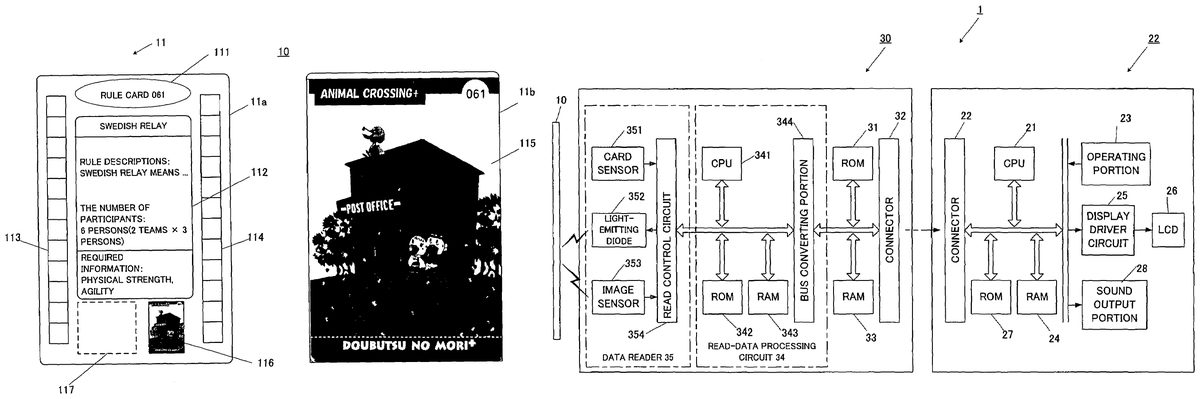
FIG. 1A,FIG. 1BandFIG. 1Care plane views showing one embodiment of trading cards10according to the present invention. The trading cards10include at least one rule card11and a plurality of character cards12A,12B (it is noted that only two character cards are shown in the drawings, and others are omitted). Although one rule card11and two character cards12A and12B are shown in this Figure, it is likely that more than one rule card11and more than two character cards12A,12B . . . are utilized when playing an interactive game.
The rule card11is formed with the following recording areas on a front surface (one main surface)11aand a rear surface (other surface)11bof a quadrate-shaped card. That is, the front surface11ais formed with a card-type recording area111in an upper portion, a rule description recording area112below it, and data recording areas113and114at both sides of the rule description area112. The card-type recording area111is recorded with card-type data (card No. and so on) for specifying a nature of a card (difference between the rule card and the character card) and a type of cards having the same nature (the rule card in this case). The rule description recording area112is visually recognizably recorded (printed) with descriptive text of a rule depending on the type of the rule card11text information such as letters, numerals, symbols and etc. The data recording areas include a rule data recording area113and a setting data recording area114.
The rule data recording area113is mechanically readably recorded with program data for deciding a rule of the interactive game associated with the electric game machine realized by the rule card11. As one example, in a case where the rule card11is a card playable for Swedish Relay (which is similar to a standard 4×100 relay except that each runner progressively runs farther than the previous one), the data recording area113is program data in which a rule of the Swedish Relay is programmed, the rule description recording area112is recorded with descriptive text (an explanation of the rule, the number of participants, utilizing physical strength and agility as necessary parameter information, and so on) describing the rule of the Swedish Relay.
The rear surface (the other surface)11bof the rule card11is formed with a character information recording area115. The character information recording area115is visually recognizably depicted with a character figure, scene, building, and item figure appearing in the game. This records character information for creating a user inclination to collect or heightening a user desire to collect the cards.
On the other hand, the character cards12A,12B, are, in one example, formed with the following recording areas in which the following information or data are respectively recorded on an front surface (one main surface)12aand on a rear surface (the other surface) of a quadrate-shaped card as shown inFIG. 1BorFIG. 1C. That is, each of the character cards12A and12B is formed with a card-type recording area121in an upper portion, a character specific recording area122for recording character specific information below the card-type recording area and a data recording area123formed along any one of sides of the character specific area122. The card-type recording area121is visually recognizably recorded (printed) with type data (card No. and so on) for specifying a nature of a card and a type of cards having the same nature (the character card in this case). The character specific information recording area122is, using text information such as letters, numerals, symbols and etc., visually recognizably recorded (printed) with information specific to a character (e.g., name of character, gender, constellation, profile, message such as a favorite word and etc.) representative of individuality or an attribute of the character decided by the type of the character cards12A,12B, . . . . The data recording area123is mechanically readably (optical, electrical, magnetic and etc.) recorded with parameter data specific to the character.
Furthermore, each of the character cards12A and12B is formed with a character information recording area (first information recording area)124on the rear surface (the other surface)12b. The information recording area124is visually recognizably recorded with character information (such as a figure of an animal appearing in the game) to heighten or create a user inclination to collect the cards. Specifically, a character figure, a background, a building or an item figure appearing in the game is depicted as the character information as necessary.
Thus, if the character information recording area124is formed on the rear surface12bdifferent from the front surface formed with the data recording area123, it is possible to increase the displayed size of a character figure, providing more attractive trading cards to the user.
Each of the character cards12A,12B, is preferably formed with a reduced recorded area125and other recording area126in a blank region on the front surface12a. The reduced recorded area125is printed with a smaller character figure of the character figure (animal) printed in the information recording area124on the rear surface. The other recording area117is printed with message information or the watchword from the character to the player, or a password to be input to the electronic game machine through a player operation.
In the same manner, the rule card11shown inFIG. 1Amay be formed with a reduced recorded area116and other recording area117in a blank region on the front surface11a. The reduced recorded area116is printed with a smaller character figure of the character figure on the rear surface, and the other recording area117is printed with usage of the rule card.
It is possible to use an optically readable recording scheme, an electrically readable storing scheme, a magnetically readable recording scheme or the like as the method for mechanically readably recording the data in the above-described data recording areas113,114and123, for example.
The optical recording method uses, for example, printing with a two-dimensional barcode. The two-dimensional barcode has a recording area formed by gathering together, in a scanning direction, unit blocks or lattices each having a predetermine area (e.g. 3×3 square mm), whereby dots of each block are vertically and horizontally distributed. Furthermore, the printing is made such that the dot distribution is varied in each column (or line) as divided at a constant interval in any one of the vertical and horizontal directions. This makes it possible to record a great deal of data (e.g. approx. 100 bytes of data per one unit block). In the two-dimensional barcode recording scheme, in addition to the parameter data to be inherently recorded, block Nos. are recorded as the data not to be used in game processing but to distinguish the data arrangement order in each block. This makes it possible to read the cards even in a case where the reading sequence or order is arbitrarily changed when the data recording areas113,114and123are formed in a reading (moving) direction of the trading card10and/or in a plurality of locations in one card. And, by changing the arrangement of the data after reading, the read data is easy for use in the electronic game machine.
In the electrical recording method, the trading card10is configured, for example, by an IC card, and data input/output terminals (not shown) are formed in the vicinity of the location that the IC is formed, and the parameter data is written or stored in advance on the non-volatile memory (ROM) within the IC. In this case, the ROM capacity within the IC is different depending upon the integration degree of the IC chip. When the capacity is insufficient only with the ROM, it is possible to use a writable/readable memory (RAM) within the IC chip. In this case, more data can be recorded than in the optical recording method even if a recording area is small.
In the magnetic recording method, magnetic stripes are formed in the data recording areas113,114and123in order for magnetic recording onto the magnetic stripes by use of a magnetic head.
These recording methods, having merits and disadvantages, may be properly selected taking into consideration a use purpose and advantages and disadvantages. For example, the two-dimensional barcode has great capacity and is inexpensive but has a lowered reading accuracy when dusty or scratched, and it is impossible to write new data, and the data reader is expensive. The IC card has great capacity, high reading accuracy, can be read at high speed, it is possible to write and read data, and the data reader/writer is cheaply available. But the cost of the IC card itself is expensive. With the magnetic stripe, writing and reading is possible with an inexpensive structure, but the amount of information that can be recorded is less and the data is readily ruined by proximity to a magnet. Accordingly, a proper recording form may be selected while taking into consideration the purpose of the use of the trading card10, user age, purchase price, etc.
The description has been made of a case where the rule data recording area113and the setting data recording area114are formed along the respective longitudinal sides of the rule card11; however, in a case that an amount of data to be recorded is less, these recording areas may be formed together along only one side. Further, these recording areas may be formed along the longitudinal side and the lateral side, or both of the rectangular sides.
Furthermore, although the description has been made on a case where the rule card11or the character cards12A,12B, of this embodiment shown inFIGS. 1A to 1Cis formed with the data recording areas113,114and123along a longitudinal one side or two longitudinal sides of the card, the data recording areas may be formed along the two sides of one lateral side and one longitudinal side, the three sides of two longitudinal sides and one lateral side or the four sides of two longitudinal sides and two lateral sides. Thus, the amount of information to be recorded can be increased by increasing the number of sides or locations forming the information recording areas113,114,123. Consequently, the content of an electronic game using the trading cards10can be diversified.
Furthermore, the rule card11formed with one or a plurality of data recording areas113and114or the character cards12A,12B formed with the data recording area123is recorded with a block No. in each block included in the data recording areas113,114,123so that, even if there is a difference in reading direction and/or order or sequence, the read data out of each block can be rearranged according to the block No. order after reading all the blocks to be used for game processing.
What follows is a description of a configuration of the game system for performing the interactive game by use of the above-described trading cards10. That is, a description is specifically made of an embodiment in a case where the electronic game machine is a portable game machine20, and a recording scheme applied to the respective recording areas113,114and123of the trading card10is the optical recording method utilizing the two-dimensional barcode.
The trading cards10are collected as collection cards, distinguished by the figures or the passwords printed on the character information recording areas115and112(and/or in addition to the reduced recorded areas116and125), and utilized for the interactive game associated with the electronic game machine by use of the rule data and the parameter data recorded on the data recording areas113,114and123. The following description is made on a case where a content of the game (rule) associated with the trading card10with the electronic game machine is a competition game (Swedish Relay), and the parameter data of the character cards12A,12B are parameters utilized in the interactive game based on the rule.
FIG. 2is a block diagram of a game system associated with the electronic game machine using the trading cards according to the illustrative embodiments. InFIG. 2, a game system1comprises the electronic game machine (hereinafter, correctively referred to as “game machine”)20such as a portable game machine or a video game machine and etc. and a game cartridge as an example of a game information storage medium (hereinafter, briefly referred to as “cartridge”)30in addition to the above-described trading cards10.
The game machine20includes a CPU21as an example of processing means. The CPU21is connected with a connector22to which the game cartridge30is removably attached, an operating portion23, a RAM24for temporarily, writably/readably storing data, and a display drive circuit25via a bus. The display drive circuit25is connected with a liquid crystal display (LCD)26. The game machine20further includes a built-in ROM27and a sound output portion28. The ROM27stores a program for processing at a start-up of the CPU21and realizing, in a software fashion, the function of display drive circuit25. The sound output portion28, when the CPU21applies as digital data the sound effect or sound for a game stored in a ROM31, converts the sound data into an analog sound signal to be output through a speaker (not shown).
It is noted that where the game machine20is a video game machine, a TV monitor (not shown) is connected in place of the LCD26, and a video signal generating circuit (not shown) is provided in place of the display drive circuit25to thereby convert the image display data into an image signal (video signals or RGB signals).
The game information storage medium30is a game cartridge configured by incorporating within a case (not shown) a non-volatile memory or fixedly storage memory (e.g. ROM)31, a connector32, a writable and readable memory (RAM)33, a read-data processing circuit34and a data reader35. The connector32is to electrically connect between the connector22of the game machine20and the cartridge30, and uses an edge connector or the like forming a plurality of contacts in an end edge of a print circuit board. The ROM31, the RAM33and the read-data processing circuit34are connected to the connector32via the bus. The read-data processing circuit34is connected with the data reader35.
The ROM31is fixedly stored with an initial setting program for performing an initial setting at a start-up of the game, a screen display program for displaying a menu selection screen, and as necessary a game program in a case of playing the electronic game machine singly.
The RAM33is a writable memory for temporarily storing the rule data and setting data read from the rule card11by the data reader35and the parameter data read from the character cards12A,12B. The RAM33is backed-up with a battery or the like (not shown) in order to prevent the data from being lost even upon removal from the game machine20. In addition to or in place of the RAM33, a flash memory (flash ROM) may be provided that does not require backup by a battery. The RAM33includes areas or tables which stores in correspondence to the kinds of the trading cards having been read the parameter data of the respective trading cards (seeFIG. 6described later). Also, the RAM33includes various storage areas such as an area to store the dot data of a predetermined number of characters, an area to store the text data of a predetermined number of characters and an area to store program data for the interactive game.
The data reader35mechanically reads the rule data and the setting data recorded in the data recording areas113and114of the rule card11and the parameter data recorded in the data recording areas123of the character cards12A,12B. If the data recorded in the data recording areas113,114,123is recorded (or printed) with the two-dimensional barcode, for example, an optical reader is utilized. If stored in the IC card, an IC-card reader is used. Where recorded on the magnetic stripe, a magnetic reader is used. The read-data processing circuit34is a circuit for processing the data read by the data reader35, which converts the read data into data processable by the CPU21by making a proper processing depending upon the recording scheme.
More specifically, for example, where the parameter data is recorded by the two-dimensional barcode, the data reader35includes a card sensor351, a light-emitting diode352or a CCD sensor (or image sensor)343, and a read control circuit354. The card sensor351detects a period of between a timing that a tip end of the trading card10is inserted into the guide361and a timing that a rear end thereof has gone out of the guide361(seeFIG. 3), and during this period, generates a pulse so as to enable the light-emitting diode352, the CCD sensor353and the read control circuit354. The light-emitting diode353makes light-emission during the period of the pulse input from the card sensor351so as to illuminate the data recording areas113and114of the rule card11or the data recording areas123of the character cards12A,12B. The CCD sensor353receives reflected light from the light-emitting diode352and optically reads the various data such as the rule data, the parameter data and etc. recorded on the data recording areas113,114,123. The sensor353temporarily stores the dot pattern per the unit block of the two-dimensional barcode, and dissolves the dot pattern into dot data of one line in the moving direction of the trading card10(or one line in a direction orthogonal to the moving direction), and then converts the dot data into bit series data to supply the same to the read control circuit354. The read control circuit354converts the read data into a data format suitable for temporary storage within a RAM343(described later) so as to supply the same to the read-data processing circuit34.
The read-data processing circuit34includes a CPU341, a ROM342, the RAM343and a bus converting portion344. The ROM342fixedly stores a program for conversion of the read data read by the data-reader35into a predetermined format, a program for controlling writing to the RAM343, and a program for controlling the transfer to the CPU21through the bus converting portion344. Then, the CPU341writes and temporarily stores the read data to the RAM343on a byte-unit basis on the basis of a program stored in the ROM342, sequentially reads the data, and makes the bus converting portion344convert the data into a predetermined format to be transferred to the portable game machine20.
FIG. 3is a view of a game system of the illustrative embodiments. InFIG. 3, the portable game machine20has an operating portion23and the LCD26arranged on one main surface (surface inFIG. 3) of a flat-formed housing29. The operating portion23includes a direction designating key for designating a moving direction of a character, a motion key for instructing an action of the character, a start key for instructing a start of the game, etc. The game housing29has an insertion hole (not shown) formed in a back-surface upper portion thereof to receive therein a cartridge30.
The cartridge30includes a housing36having an outer shape at a part of the housing for insertion in the insertion hole of the housing29. The housing36has a guide361formed to be exposed above as attached to the portable game machine20. The guide361has a groove for guiding the trading cards10comprising rule cards11and/or character cards12A,12B, in a moving direction. The above-described data reader35is incorporated in the vicinity of the guide361within the cartridge30so as to read the data recorded in the data recording area113,114,123.
Next, an outline of an operation of theFIG. 2illustrative embodiment is described. First, a description is made of a case where the game machine is independently utilized. In this case, the cartridge30is loaded into the game machine20(connection is made between the connector22and the connector32). When the power switch (not shown) is turned-on, the CPU21executes an initial setting on the basis of the initial setting program stored in the ROM31and then executes a game processing based on the game program, whereby image data for displaying game images is generated. At this time, if the player instructs a moving direction and/or action of a hero character appearing in the game by operating the operating portion23, the CPU21changes the moving direction and/or action of the hero character based on the player instruction according to the game program. The game image according to a result of such processing by the CPU21is displayed on the LCD26.
On the other hand, in a case where the interactive game associated with the electronic game machine is to be played by use of the trading cards10, the read-data processing circuit34and the data reader35are activated prior to play. Then, the player takes an operation required for reading the data recorded on the data recording areas113and114of the rule card11or the data recording area123of the character card12A,12B (e.g. parallelly-moving the trading card10in proximate state to the data-reader35in a case of the two-dimensional barcode recording) by parallelly-moving the trading card10by hand scan. In response to the operation, the data reader35reads the data recorded on the card. More specifically, the CCD sensor dissolves the dot data of the two-dimensional barcode into column unit data so as to convert the dot data into the bit series data, and by sequentially repeating such a conversion in the movement direction, the two-dimensional (planer) data is converted into one-dimensional (bit series) data. The read one-dimensional data is dissolved into 1-byte-unit data by the read-data processing circuit34such that the data can be written into the RAM33, and the 1-byte-unit data is further rearranged in the order of the block No. of the two-dimensional barcode (subjected to a data format conversion) to be applied to the CPU21, and then, written to the RAM33by the CPU21.
FIG. 4is an illustrative view showing rule data and setting data recorded on the data recording areas113and114of the rule card11. InFIG. 4, the data recording area113is recorded with a rule program such as an error display program and etc. for realizing an interactive game using the trading cards10. The data recording area114is recorded with the setting data such as number-of-cards specifying data (or flag), parameter selection data (or selection flag), etc. The number-of-cards specifying data is set with the number of the character cards useable in the interactive game. The parameter selection data is recorded with data for selecting the kind of the parameter to be utilized in the interactive game from parameters recorded in the data recording area123of the character card12. The kind and the number of parameters to be selected differ depending on the kind of the rule card11.
FIG. 5is an illustrative view showing the parameter data recorded in the data recording area123of the character cards12A and12B. InFIG. 4, parameter data is recorded on the data recording area123. The parameter data includes a card No., a character name, a tribe, character, gender, constellation, ability data and etc. The ability data includes intellectual power, physical strength, agility, power, popularity, etc.
These parameter data (including the ability data) differ depending upon the type of the trading cards and relation with the rule card11. InFIGS. 1A to 1C,FIG. 4andFIG. 5embodiments, a description is given of an animal card; however, where the technical idea of the present invention is applied to a monster card, or other card, various abilities and techniques (physical strength, agility, decisive attack, affinity with another monster) in each kind of monster are set as the parameter data.
FIG. 6is an illustrative view showing a memory map of the RAM33(or flash memory). InFIG. 6, the RAM33includes a setting-data storing-area and storing areas for storing parameters of a predetermined number of character cards12A,12b. The setting data recording area temporarily stores setting data read from the rule card11, that is, data set with a parameter to be used for the interactive game (e.g., physical strength or endurance and agility or turn of speed) from a plurality of types of parameter data of each of character cards12A,12B.
FIG. 7is a flowchart explaining an exemplary operation of the card reader35and the read-data processing circuit34(or the process by the CPU341). When the power switch (not shown) of the portable game machine20is turned-on, the CPU341starts the operation ofFIG. 7on the basis of the program of the ROM342.
In a step S11, it is determined on the basis of an output of the card sensor351whether or not a trading card10insertion has been detected. If no insertion is detected, the card sensor351waits to detect a trading card10. When a trading card10(rule card11or character cards12A,12B) is inserted in the guide361, the card sensor351detects the trading card10. In response thereto, in a step S12, the light-emitting diode (LED)352is driven for lighting. In a step S13, the player starts to move the trading card10along the guide361, moving it along a side forming the data recording area113,114,123. In a following step S14, the CCD sensor353optically reads the data recorded in the data recording areas113,114and123by two-dimensional barcode scheme. In a step S15, the data read by the CCD sensor353is subjected to an equalization processing by the read control circuit354, and in a step S16, this data is converted into binary data of “1” or “0” on a dot-unit basis. In a step S17, the CPU341converts the binary data on a column-unit basis into a predetermined format having one block of data column, and writes and stores it in the RAM343. In a step S18, it is determined whether or not the trading card movement10has been completed. That is, if the card sensor351is in a period where the trading card10is being detected, the process returns to the above described step S14so as to repeat the operation of the steps S14to S18until the trading card10is not detected. The operation of the steps S14to S18is repeated until all the block data recorded in the data recording area113,114and123have been read out.
Then, if a completion of card movement is detected in the step S18, the process proceeds to a step S19so as to turn-off the light-emitting diode351. The data recorded in the data recording areas113and114of the rule card11and/or the data recording area123of the character card12A . . . is thus read and temporarily stored in the RAM343. In a following step S20, the record data of one rule card11and/or the character card12A stored in the RAM343is sequentially read out by the CPU341and transferred to the portable game machine20through the bus conversion circuit344, and the connectors32and22. At this time, the CPU21temporarily stores the read data transferred from the cartridge30into the RAM24. In a step S21, the CPU341analyzes the read data stored in the RAM24.
It is noted that where the data recording areas113and114are formed along the opposite two sides (into two locations) of the trading card10(rule card inFIG. 1), or where formed along the three sides (in three locations) of the trading card10, or where formed along the four sides (in four locations) of the trading card10, the process of the steps S11to S21is repeated according to the number of the locations. Also, even if the direction and/or order of reading each trading card10is changed, because block Nos. are recorded in the blocks included in the respective data recording areas113,114and123, the read-out data of the blocks can be rearranged in the order of the block No. after reading all the blocks and temporarily stored in the RAM343.
Thereafter, in a step S22, the CPU21performs a process for adding a change according to the analyzed read data onto the process based on the inherent game process on the basis of the analyzed read data temporality stored in the RAM24and the program stored in the ROM31. As the change-adding process, if the data recorded in the data recording areas113,114or123, for example, is text data, a process for displaying read-out letters or a text on the LCD26is performed (step S22a). Furthermore, where the data recorded in the data recording areas113,114and123is graphic (or dot) data, the graphic data is displayed on the LCD26(step S22b). In addition, where the data recorded in the data recording areas113,114and123is sound data, such as cry or call of animal, the sound data is digital-analog (DA) converted and output as a sound from the sound output portion28(step S22c). Although processes or operations are possible depending upon the kind of read data, the process or operation is determined depending upon the record data in the data recording areas113,114and123and the program in the ROM31.
Various games are to be thought of as an electronic game using the data read out of the data recording areas113,114and123of the trading card10or a combined (interactive) game of trading cards and an electronic game (step S22), and an example thereof is explained in detail below.
FIG. 8shows a flowchart as an example of the game process,FIG. 9shows a flowchart as an example of an interactive game process, andFIG. 10shows a display example of an interactive game (Swedish Relay). In the following, the description is made referring these figures for a specific operation of an electronic game using the trading cards.
First, as an example of the interactive game, a description is simply made of a game rule and an arrangement for an instance of the Swedish Relay shown inFIG. 10. As a game rule, a first team is matched against a second team, and both teams field three runners, i.e., a first to third runners. As parameter data to be selected and set, physical strength (endurance) and agility (turn of speed) are utilized. Herein, the physical strength is generally inversely proportional to the agility. That is, a runner high in physical strength and endurance is low in agility (strength or turn of speed) and conversely, a runner low in physical strength and endurance is high in agility (strength or turn of speed), and in rare case, some characters are high or low in both abilities. Therefore, a runner who has a high parameter value in agility is suited to be the first runner, and runners who have a high parameter value in physical strength are suited to be the second and third runners.
Accordingly, as an exemplary order of reading the cards, the data recording area114of the rule card11recorded with the setting data is read first, and then the data recording areas123of three character cards (e.g.,12A to12C) to be the first to third runners in the first team are read. Then the data recording areas123of three character cards (e.g.,12D to12F) to be the first to third runners in the second team are read, and finally, the data recording area113of the rule card11recorded with the rule data is read.
More specifically, each of players leading the first team and the second team selects a card having a parameter superior in physical strength and/or agility (strength or turn of speed) from among his own characters (cards) and considers in which order the characters should be put so as to be the first through third runners. Then, the parameter data in the data recording areas123of the character cards is read in the order of the first to the third runners. It is noted that the parameter data recorded in the data recording area123is not preferably visually recognizable and therefore, it is possible for the player to plot one's strategy of the Swedish Relay after learning each item of parameter data for each card No. on the basis of experiences obtained after performing the interactive game utilizing the same character cards several times.
Prior to game start, the player loads the cartridge30on the game machine20and then turns-on the power switch (not shown). In response thereto, the CPU21executes the following processes on the basis of the program stored in the ROM31. That is, in a step S31, an initialization process, e.g. initially clearing the RAM24, transferring the backup data stored in the RAM33to the RAM24and so on is performed. In a step S32, a mode selection screen at a start of the game is displayed. In this mode selection screen, the display shows a selection of any of the game modes for playing an electronic game not using the trading cards10or an interactive game associated with the electronic game using the trading cards10. According to the display, the player performs a selecting operation. In a step S33, it is determined whether or not the interactive game with the trading cards10is selected. In a case that it is determined that a game mode for playing an electronic game not using the trading cards10is selected, the process proceeds to a step S34to process the program for an electronic game machine alone (or usual game) stored in the ROM31. Thereby an image display and sound output based on the process are performed and then completed. This process is similar to the conventional portable game, hence detailed explanation is omitted here.
On the other hand, if it is determined that the interactive game with the trading card10has been selected in the above-described step S33, the process proceeds to a process after a step S35. That is, in the step S35, a display instructing an operation for reading the trading card10(e.g., “Let Card Data Read”, etc.) is shown as a program process, from programs stored in the ROM31, for playing the interactive game with the trading card10. According to the display, the player moves the trading card10along the guide361so as to read the data recorded on the data recording area. Next, in a step S36, it is determined whether or not the data of the rule card11has been read. This determination is made by determining whether or not data read from the data recording areas113,114and123is data recorded on the rule card11while accessing the RAM343by the CPU21. When it is recognized that the data is not rule card11data, it is determined whether or not the data is another kind of game card data in a step S37. If it is determined the data is not another kind of game card (if it is character cards12A to12F), the process returns to the step S35. If it is determined the data is another kind of game card, a process based on the read card is performed in a step S38, and then, the process returns to the step S35so as to wait for a reading operation of the rule card11by the player.
On the other hand, when it is determined reading of the rule data11has been performed in the step S36, all the data read from the data recording areas113and114is temporarily stored in the RAM24in a step S39. In a step S40, the setting data (data for specifying which item of setting data is to be read out of the setting data recorded in the data recording area123of the character card12A) is transferred from the RAM24to the RAM33and temporarily stored in the RAM33. Furthermore, in a step S41, the number-of-cards data (number-of-cards data of the character cards to be read or the rest of cards data in a series of the interactive game) out of the rule data read from the card is transferred from the RAM24to the RAM33to be temporarily stored in the RAM33.
In a following step S42, a message instructing an operation for reading the data recording area123of the trading card10(rule card11or character card12A) is displayed. Viewing the message display, the player performs an operation for reading out a next trading card10(since the rule card11has read, a next card is actually any one of character cards12A to12F). In response thereto, in a step S43, when it is recognized that data of the character cards12A to12F has been read out, it is determined whether or not the remaining number of cards is zero. When it is determined that the remaining number of cards is not zero, all the parameter data read from the data recording area123of any one of the character cards is stored in RAM24in a following step S45. In a step S46, the selected parameter data to be utilized in the interactive game is written to the RAM33on the basis of the setting data (or parameter data selection flag). In a step S47, the number-of-cards data stored in the RAM33is subtracted by one so as to be stored and renewed as the remaining number-of-cards data. In a step S48, the remaining number of cards required to be read of the character cards is displayed on the LCD26. Viewing this, the player sequentially repeats the process so as to read the character cards corresponding to the remaining number of cards. Therefore, in a step S49, it is determined the data is not the rule card11, it is determined the data is not another kind of data in a step S50, and then, the process returns to the step S42.
By repeating the operation from the above-described steps S42to S50, a predetermined number (6 in an example of the Swedish Relay shown inFIG. 10) of character cards12A to12F are read. Thus, after reading the parameter data of 6 sheets of character cards12A to12F, the parameter data of the character cards12A to12C in the first team is stored in areas corresponding to the card No.1to3in the RAM33, and the parameter data of the character cards12D to12F in the second team is stored in the areas corresponding to the card No.4to6in the RAM33.
Next, when a reading operation of the rule data recorded in the data recording area113of the rule card11is performed by the player, the game machine determines, in the above-described step S43, that the data is not the character card data. Thus, it is determined in the step S49that the rule data of the rule card11is read and then the process proceeds to a step S51. In the step S51, it is determined the remaining number of cards is zero. In a step S52, the read rule data is stored (held) in the RAM24. Thereafter, the process proceeds to an interactive game subroutine (seeFIG. 9described later) based on the read trading card10in a step S60.
Noted that when it is determined in the above-described step S51that the rest of the number of cards is not zero, the machine determines that the rule card11has been erroneously read prior to the number of character cards rule has been read, and an error display is made in a step S54. Thereafter, the process returns to the step S42to wait for a reading of the predetermined number of character cards. Furthermore, when another kind of card (i.e., not the trading cards10based on the rule of the Swedish Relay) is determined to have been read in the above-described step S50, a process based on the data of the read kind of card is performed in a step S53.
Next, an operation of displaying the interactive game such as the Swedish Relay shown inFIG. 10is described according toFIG. 9flowchart. The description uses the setting data, the parameter data of each character and the rule data read from the rule card11and the predetermined number of character cards12A to12F according to the process shown inFIG. 8.
To start the interactive game after reading the various kinds of data of the trading cards10, the player depresses a start button included in the operation switch23. In a step S61, the machine waits for the depression of the start button, and when is the machine determines that the start button is depressed, the process proceeds to a step S62. In the step S62, the parameter data of a predetermined number of character cards (6inFIG. 10display example) is read from the parameter data recording areas of the RAM33so as to be written to the RAM24. In a step S63, a card to be processed is specified (InFIG. 10example, first, the character card12A corresponding to the first runner in the first team and the character card12D corresponding to the first runner in the second team are specified). In a step S64, processing based on the parameter data (physical strength and agility) of the specified character cards12A and12D is performed on the basis of the rule program (rule data recorded in the data recording area13of the rule card11and temporarily stored in the RAM24). In a step S65, a game image is displayed on the LCD26of the portable game machine20on the basis of a processing content (or processing result). More specifically, a moving distance per a unit of time as to the first runner in the first team is calculated on the basis of the physical strength and the agility of the parameter data recorded in the character card12A, and on the basis of the result, a process is performed such that the first runner in the first team is gradually moved by the distance. At approximately the same time, the moving distance per a unit of time as to the first runner in the second team is calculated on the basis of the physical strength and the agility of the parameter data recorded in the character card12D, and on the basis of the result, a process is performed such that the first runner in the second team is gradually moved by the distance.
In a following step S66, it is determined whether or not a unit of process based on the rule (e.g., the moving process of the first runner in each team) is completed, and if the unit of process is not completed, the process returns to the step S64so as to repeat the processing from the steps S64to S66. Furthermore, if the unit of process is completed, it is determined whether or not processing of all the character cards based on the rule is completed in a step S67. If it is determined all the processing is not completed, the process returns to the step S63so as to repeat the processing from the steps S63to S67.
Specifically, by the above-described process, a display process is made such that the respective first runners in the first team and the second team run 100 meters so as to relay the second runner on the basis of the parameter data of the character card12A and the character card12D. Then, when the first runner in any one of the first team and the second team runs 100 meters so as to relay the second runner, it is determined the unit process on the basis of the rule is completed in the above-described step S66, and in step S67it is determined that the process of all the character cards based on the rule has not been completed. Thus, the process returns to the step S63so as to specify a character card (e.g.,12B) corresponding to a second runner in a team having completed a relay leg (e.g., first team) and performs a process based on the parameter data of the character card. That is, as to the first team, a calculation process to display the second runner is performed, and as to the second team, a calculation process to continue to display the first runner is performed. In addition, when the first runner of the second team relays to the second runner of the second team, a calculation process to display the second runner in the second team is performed. In this case, the running distance of the second runner in each team is, for example, 200 meters (double the distance of the first runner).
Furthermore, when the second runners of the respective teams run 200 meters (a total running distance reaches 300 meters), the character cards corresponding to the third runners12C and12F are specified, and a process based on the parameter data of the character cards is performed. Then, when the third runners in the respective teams run 300 meters (a total running distance run by the first to third runners reaches 600 meters), it is determined the process of all the character cards12A to12F based on the rule has been completed in the step S67, the process proceeds to a step S68. In the step S68, a game result is displayed. For example, a winner display for a team whose third runner finished first is made, and then, the process returns to a main routine (FIG. 8).
As described above, the data recorded on the trading cards10including the rule card11and the character cards12A,12B, is read, and on the basis of the read data, an interactive game using the portable game machine20and the trading card10is performed. Thus, simply by purchasing additional character cards, it is possible to perform the interactive game utilizing different parameter data, and by adding a different kind of rule card, it is possible to change a game content of the interactive game. That is, simply by adding a low-cost trading card10, it is possible to enjoy the interactive game having a different game content without newly purchasing a game cartridge30. Furthermore, it is possible for the player to collect the trading cards so as to increase the variety and therefore to enhance willingness to collect the trading cards.
Although the description has been made for a case where the rule data recorded on the trading card is Swedish Relay in the above-described embodiment, the technical idea of the illustrative embodiments can be applied to various kinds of interactive games. For example, where the game cartridge is a baseball game and where the trading card is a baseball card, the character card is recorded with, in addition to a baseball player's picture, his batting average, the number of home-runs, the number of times at bat and etc. as parameter data, and the rule program data of the rule card is set such that home-run derby and competition of the number of hits are performed.
Furthermore, where the trading card is a soccer card, the character card is recorded with a soccer player's picture, the number of goals, a success rate of goal and etc. as the parameter data, and a shoot-out is competed utilizing such the parameter data.
In addition, where the game content concerns a role-playing game or an action game, the character may be a game-appearing person, animal or imaginary animal or plant while the parameter data is appearing-person's life, power, ability, available items (weapons, guards, magic) and so on.
Although a description was made of the portable game machine having an LCD as one example of a game machine in the above-described example, the technical idea of the illustrative embodiments is not limited to such structure but applicable to the games using a video game machine or a personal computer. In such a case, the storage data on the ROM31of the cartridge30is stored in an information storage medium for a video game machine, e.g. memory cartridge, magnetic disk, CD-ROM or DVD (digital versatile disk) or the like. The data reader35and the read-data processing circuit34will be connected integrally with or externally from the video game machine or personal computer.
Although the present invention has been described and illustrated in detail, it is clearly understood that the same is by way of illustration and example only and is not to be taken by way of limitation, the spirit and scope of the present invention being limited only by the terms of the appended claims.
Claims
- Trading cards used interactively with an electronic game machine including an external information reader which reads data recorded on the trading cards, a processor which processes the data read by the external information reader, and an image display which displays an image based on a processing result by said processor, wherein said trading cards includes at least one rule card and a plurality of character cards, each of said plurality of character cards is used for playing an electronic game using the character cards, and is formed with: a first data recording area recorded in a machine-readable manner with character specific parameter data on one main surface thereof, and a first visual information recording area in which identifying information identifying a kind of the character card and character information are recorded in a visually recognizable manner on at least one of said one main surface and other main surface, said rule card is formed, on one main surface thereof, with a second data recording area in which rule program data for programming a rule of the game utilizing said trading cards is recorded in a manner that the same is machine-readable by said external information reader, whereby an interactive game is playable by making said external information reader read said at least one rule card and said plurality of character cards.
- Trading cards according to claim 1 , wherein each of said plurality of character cards has said first visual information recording area formed on the one main surface different from the main surface formed with said first data recording area.
- Trading cards according to claim 1 , wherein each of said plurality of character cards has said first visual information recording area formed on the main surface different from the surface formed with said first data recording area, and character information which has a smaller size than the character information recorded in said first visual information recording area and which is the same as the character information that is recorded at a blank portion on the same surface as said first data recording area.
- Trading cards according to claim 1 , wherein the character information recorded in said first visual information recording area is a character figure, and text information in relation to said character figure is further recorded on the main surface formed with said first data recording area.
- Trading cards according to claim 1 , wherein said rule card is formed with a second visual information recording area in which information that causes an inclination to collect is recorded in a visually recognizable manner and which is formed on a surface different from the main surface formed with said second data recording area.
- Trading cards according to claim 4 , wherein said rule card is recorded in a visually recognizable manner with descriptive information relating to a rule of the electronic game on the main surface formed with said second data recording area.
- Trading cards according to claim 1 , wherein each of said plurality of character cards is recorded with a plurality of kinds of parameter data in said first data recording area, and said rule card is, on the main surface formed with said second data recording area, recorded with setting data for setting a kind of parameter data to be read, prior to start of the game utilizing said trading cards, from among said plurality of kinds of parameter data recorded in said parameter data recording areas of said character cards.
- Trading cards according to claim 1 , wherein each of said plurality of character cards is recorded with a plurality of kinds of parameter data in said first data recording area, said rule card is, on the main surface formed with said second data recording area, further formed with a third data recording area in which setting data for setting a kind of parameter data, to be read, prior to start of a game utilizing said trading cards, from among said plurality kinds of parameter data recorded in said parameter data recording areas of said character cards, is recorded in a manner that the same is readable by said external information reader.
- Trading cards according to claim 1 , wherein the rule of the game programmed by the rule program data recorded on the rule card defines a rule of competition between a plurality of characters in the electronic game.
- Trading cards according to claim 9 , wherein the rule of competition defines a rule of a home-run derby in a baseball electronic game.
- Trading cards according to claim 9 , wherein the rule of competition defines a rule in a relay race between characters.
- Trading cards associated with an electronic game machine including an external information reader which reads data recorded on the trading cards, a processor which processes the data read by the external information reader, and an image display which displays an image based on a processing result by said processor, wherein said trading cards includes at least one rule card and a plurality of character cards, each of said plurality of character cards is used for playing an electronic game using the character cards, and is formed with: a first data recording area recorded in a machine-readable manner with different kinds of parameters specific to the character on one main surface thereof, and a first visual information recording area in which identifying information for identifying a kind of the character card and character information are recorded in a visually recognizable manner on at least any one of said one main surface and other main surface, said rule card is formed with: a second data recording area, on one main surface thereof, in which rule program data for programming a rule of a game utilizing said trading cards is recorded in a manner that the same is machine-readable by said external information reader, and a third data recording area, on the main surface formed with said second data recording area, in which setting data for setting a kind of parameter data, to be read, prior to start of a game utilizing said trading cards, from among plurality of kinds of character specific parameter data recorded in said first data recording areas of said character cards, is recorded in a manner that the same is machine-readable by said external information reading reader, whereby an interactive game is playable by making said external information reader read said at least one rule card and said plurality of character cards.
- Trading cards according to claim 12 , wherein the rule of the game programmed by the rule program data recorded on the rule card defines a rule of competition between a plurality of characters in the electronic game.
- Trading cards according to claim 13 , wherein the rule of competition defines a rule of a home-run derby in a baseball electronic game.
- Trading cards according to claim 13 , wherein the rule of competition defines a rule in a relay race between characters.
- A game system for performing an interactive game associated of trading cards with an electronic game machine utilizing at least one rule card and a plurality of character cards, wherein each of said plurality of character cards is used for playing an electronic game using the character cards, and is formed with: a first data recording area recorded in a machine-readable manner with character specific parameter data on one main surface thereof, and a first visual information recording area in which identifying information for identifying a kind of the character card and character information are recorded in a visually recognizable manner on at least any one of said one main surface and other main surface, wherein said rule card is, on one main surface thereof, formed with a second data recording area in which rule program data for programming a rule of a game utilizing said trading cards is recorded in a manner that the same is machine-readable by said external information reader, said electronic game machine includes: the external information reader which reads the parameter data recorded in said first data recording area of said each character card and the rule program data recorded in the said second data recording area of said rule card, a program data storage which stores program data, a processor which processes each of the data read by said external information reader according to said program data, and a display which displays an image based on a processing result of said processor, wherein a process of said processor makes said external information reader read said at least one rule card and said plurality of character cards, so that said processor makes said display game image data generated based on the rule program data recorded on the rule card by utilizing the parameter data stored in said character card.
- A game system according to claim 16 , wherein said rule card records, in said second data recording areas a determining program for determining a predetermined relation with said character card and an error display program for displaying an error message, and said processor executes said determining program read from said rule card, and executes said error display program when the predetermined relation is not determined on the basis of the data read from said character card.
- A game system according to claim 16 , wherein said plurality of character cards are recorded with a plurality of kinds of parameter data in said first data recording area, and said rule card is, on the main surface formed with said second data recording area, recorded with setting data for setting a kind of parameter data, to be read, prior to start of a game utilizing said trading cards, from among said plurality kinds of parameter data recorded in said first data recording areas of said character cards.
- A game system according to claim 18 , wherein said rule card includes as the setting data number-of-cards specifying data for specifying the number of said character cards required for reading and kind selection data for determining to selectively read at least one kind of parameter data included in said plurality of kinds of parameter data recorded on said character card, and said processor, when the setting data is read by said external information reader, makes said display the number of said character cards to be read on the basis of said number-of-cards specifying data and performs a process combining a predetermined kind of parameter data with said rule program data on the basis of said kind selection data.
- A game system according to claim 16 , wherein each of said plurality of character cards is recorded with a plurality of kinds of parameter data in said first data recording area, said rule card is, on the main surface formed with said second data recording area, further formed with a third data recording area in which setting data for setting a kind of parameter data, to be read, prior to start of a game utilizing said trading cards, from among said plurality of kinds of parameter data recorded in said first data recording areas of said character cards, is recorded in a manner that the same is readable by said external information reader.
- A game system according to claim 16 , wherein said rule card records in said second data recording area the number-of-cards data of said character card required for performing an interactive game with said electronic game machine, and said processor calculates the number of cards of said read character cards on the basis of the number-of-cards data read from said rule card, and activates reading of said character cards until a predetermined number of cards is reached.
- A game system according to claim 16 , wherein said rule card includes a plurality of kinds each of which is formed with rule program data having a different rule in the second data recording area, and said processor makes said display an image for an electronic game based on the different rule program data read from said rule card depending upon the kind of said rule card read by said external information reader.
- A game system according to claim 16 , wherein said rule card records as rule program data a rule data set such that a display content of the game image by said display is different depending upon a different reading order of the parameter data recorded in each of said plurality of character cards.
- A game system according to claim 16 , wherein the rule of the game programmed by the rule program data recorded on the rule card defines a rule of competition between a plurality of characters in the electronic game.
- A game system according claim 24 , wherein the rule of competition defines a rule of a home-run derby in a baseball electronic game.
- A game system according to claim 24 , wherein the rule of competition defines a rule in a relay race between characters.
- In an electronic game machine including an external information reader which reads data recorded on trading cards, a processor which processes the data read by the external information reader and an image generator which generates images for display based on a processing result by said processor, a method comprising: reading, with the external information reader of the electronic game machine, a plurality of character trading cards, each of said plurality of character trading cards having machine-readable character specific parameter data and human-readable visual information which identifies character information;reading, with the external information reader of the electronic game machine, a rule trading card having machine-readable rule program data for programming a rule of a game;processing, with the processor of the electronic game machine, the data read from the plurality of character trading cards and the rule trading card, to generate images for gameplay of the game.
- A method according to claim 27 , wherein the machine-readable character specific parameter data and the human-readable visual information which identifies character information of each of said plurality of character trading cards are located on opposite sides of that character trading card.
- A method according to claim 28 , wherein the human-readable visual information on each of the character trading cards includes a character figure, and each of the character trading cards further includes text information in relation to said character figure.
- A method according to claim 28 , wherein the rule trading card includes human-readable visual information, the human-readable visual information being located on the opposite side of the rule trading card on which the machine-readable rule program data is located.
- A method according to claim 30 , wherein the human-readable visual information on the rule trading card includes descriptive text information relating to a rule of the game.
- A method according to claim 27 , wherein, in addition to the machine-readable rule program data, the rule trading card has machine-readable setting data for setting a type of parameter data to be read from the character specific parameter data recorded on the character trading cards prior to the start of the game.
- A method according to claim 27 , wherein the machine-readable character specific parameter data on the plurality of character trading cards represents a plurality of different types of parameter data;and in addition to the machine-readable rule program data, the rule trading card further includes machine-readable setting data for setting a type of parameter data to be read from among the plurality of types of parameter data recorded in the machine-readable character specific parameter data of the character trading cards.
- A method according to claim 27 , wherein the rule of the game programmed by the rule program data recorded on the rule trading card defines a rule of competition between a plurality of characters in the game.
- A method according to claim 34 , wherein the rule of competition defines a rule of a home-run derby in a baseball game.
- A method according to claim 34 , wherein the rule of competition defines a rule in a relay race between characters.
- A method according to claim 27 , wherein, in addition to the machine-readable rule program data, the rule trading card has machine-readable setting data for setting the number of character trading cards to be used in the game.
- A method according to claim 37 , further comprising calculating, with the processor, the number of character trading cards read by the external information reader.
- A method according to claim 38 , further comprising comparing the number of character cards read by the external information reader with the number of character trading cards set by the rule trading card.
Disclaimer: Data collected from the USPTO and may be malformed, incomplete, and/or otherwise inaccurate.