U.S. Pat. No. 7,361,091
PLAYER SKILL EQUALIZER FOR VIDEO GAMES
Issue DateOctober 7, 2005
Illustrative Figure
Abstract
The present invention senses a player's coordination and reaction time levels while operating a video game, or a video game of chance, and automatically adjusts various parameters affecting the game play, to minimize or eliminate the effect that said player's skill has on a game outcome. In certain circumstances, the present invention may actually provide an element of control over the game outcome, but the intent of the invention is to bridge the entertainment gap that currently exists between skill based video game entertainment and the traditional formats of video games of chance—resulting in a much broader demographic appeal for video games of chance.
Description
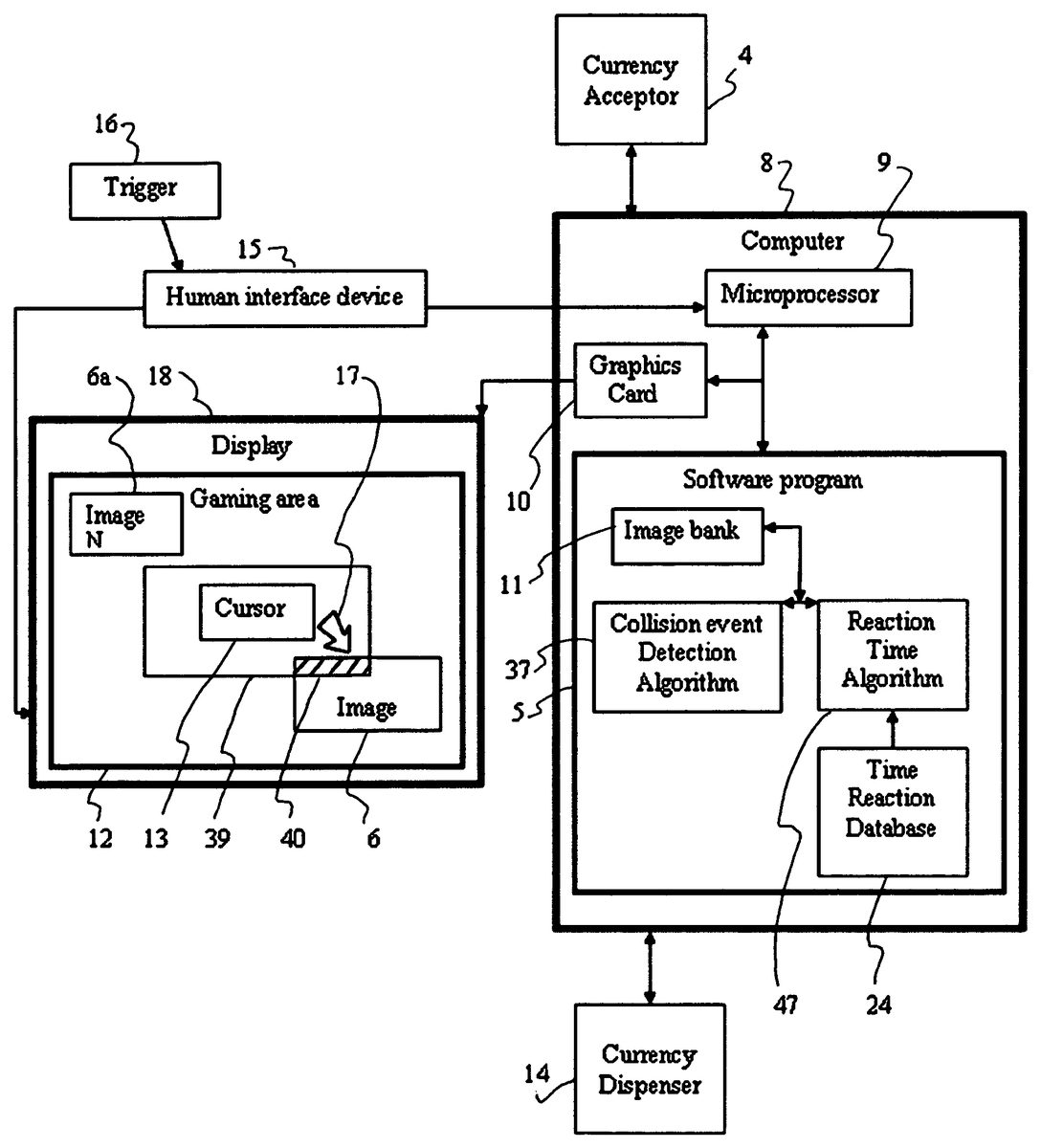
DETAILED DESCRIPTION OF THE PREFERRED EMBODIMENT The preferred embodiment of the present invention, as presented in the software logic and hardware component flow chart inFIG. 1, is an automatic skill level equalizing gaming apparatus that senses a player's hand-eye coordination level and reaction times, and adjusts certain parameters affecting game play to minimize or eliminate the effect that said player's hand-eye coordination level and reaction times have on a game outcome. The invention utilizes a software program5, configured to operate on a standard microprocessor based computer8, well known in prior art, to generate an image6within a gaming area12, as well as render gaming area12. A currency acceptor4may be electrically coupled to computer8to allow games to played for money. The most successful video game genres include first person shooters, flying, driving, and fighting games. The present invention as disclosed is equally effective in all of these genres in equalizing game play for players of all skill levels. I have chosen a shooting style of game play to illustrate the novel and unique elements of the invention, however, the technology will remain essentially the same for all video game genres. In the present invention, a “3D” graphics card10may be utilized as an integral part of computer8, and software program5, to generate a three dimensional virtual world referred to herein as gaming area12. Graphics card10is well known in prior art, so there is no need to go into great detail herein. Software program5runs on microprocessor9within computer8. Said software program5is configured to create a computer generated, virtual world, gaming area12. Computer8may also generate and display variable sized virtual worlds as said gaming area12. Gaming area12is presented to a player on display means18. Display means18may be a video monitor, a television, or any other electronic or mechanical means capable of displaying computer generated graphic images. ...
DETAILED DESCRIPTION OF THE PREFERRED EMBODIMENT
The preferred embodiment of the present invention, as presented in the software logic and hardware component flow chart inFIG. 1, is an automatic skill level equalizing gaming apparatus that senses a player's hand-eye coordination level and reaction times, and adjusts certain parameters affecting game play to minimize or eliminate the effect that said player's hand-eye coordination level and reaction times have on a game outcome. The invention utilizes a software program5, configured to operate on a standard microprocessor based computer8, well known in prior art, to generate an image6within a gaming area12, as well as render gaming area12. A currency acceptor4may be electrically coupled to computer8to allow games to played for money.
The most successful video game genres include first person shooters, flying, driving, and fighting games. The present invention as disclosed is equally effective in all of these genres in equalizing game play for players of all skill levels. I have chosen a shooting style of game play to illustrate the novel and unique elements of the invention, however, the technology will remain essentially the same for all video game genres.
In the present invention, a “3D” graphics card10may be utilized as an integral part of computer8, and software program5, to generate a three dimensional virtual world referred to herein as gaming area12. Graphics card10is well known in prior art, so there is no need to go into great detail herein. Software program5runs on microprocessor9within computer8. Said software program5is configured to create a computer generated, virtual world, gaming area12. Computer8may also generate and display variable sized virtual worlds as said gaming area12. Gaming area12is presented to a player on display means18. Display means18may be a video monitor, a television, or any other electronic or mechanical means capable of displaying computer generated graphic images.
Referring now toFIG. 1, an image bank11is provided within said software program5that acts as a library from which software program5generates any image6to present within gaming area12on display means18. Image6can be a graphical representation of anything at all. The trajectory initiation, direction, and termination functions of any image6are software configurable as any moving or stationary position within and throughout gaming area12.
The player may then use a human interface device15to aim a position indicator such as a virtual cursor13, generated by game software5, toward an image6, and input a collision event command signal using a trigger16incorporated into human interface device15, to launch a virtual projectile17toward any image6. Human interface device15may be a joystick, trackball, touch screen, button, or other human interface means as the player control means integrated within any video game device well known in prior art. Said cursor13may also be represented graphically as a weapon, a car, a plane, a character, or anything else. Said virtual projectile17may also be represented graphically as a weapon, a car, a plane, a character, or anything else.
When a player interacts with an image6by aiming cursor13toward said image6, and pressing trigger16, collision proximity detection algorithm37integrated into software program5, may then be configured to determine the “relative proximity” of said cursor13to said image6, and then also compare the relative proximity of cursor13to any other “image N”6a, and then adjust the effective size of any virtual projectile17, or the effective size of cursor13, so that a collision event40, defined by software program5, is completed between image6and virtual projectile17, or cursor13.
The basic mathematical structure of the collision proximity detection algorithm37works equally well for both two dimensional and three dimensional video games. Said collision proximity detection algorithm37establishes all XY or XYZ position points from the center of a virtual projectile17, or the center of a cursor13, or the center of an image6, or the center of an “image N”6a, and is structured logically as follows:
IFCursor 13 is located at:XY position DANDImage 6 is located at:XY position EANDImage “N” 6a is located at:XY position FANDVirtual Projectile 17 launches from:XY position G (or D)ANDThe distance from D to E is lessthan the distance from D to FTHENVirtual Projectile 17 will travel from:G to E position to resultin a Collision Event 40ORCursor 13 will effectively expand tocontact position E.
The effective cursor size bounding box39indicates this effective enlargement of a cursor13within gaming area12. Further, the trajectory initiation, direction, and termination functions of any virtual projectile17are software configurable within the invention software program5as either fixed or random positions within and throughout gaming area12. Software program5may also be configured such that if a player does not react to an image6within a predetermined time frame of generation of said image6by software program5, the software program5may be configured with algorithms to automatically complete the game for the player.
The invention may also be used to adjust the game play to minimize or eliminate the effect that a player's reaction time has on a game outcome, utilizing the software logic and hardware component flow chart as shown inFIG. 1. Specifically, when a player interacts with an image6by aiming cursor13toward said first image6, and pressing trigger16, “reaction time detection47” algorithm integrated into software program5, may then be configured to determine the “time of initial movement” of said cursor13toward said image6by a player, and then compare that time to a “preset minimum or maximum time of initial movement24” database—and then adjust the rate of movement of any image6, so that when said projectile17is launched by a player by activating trigger16, a collision event40, detectable by software program5, is completed between image6and virtual projectile17or cursor13. Software program5may also be configured such that if a player does not react to an image6within a predetermined time frame, the software program5may be configured to automatically complete a game for the player.
A payout chute14may be electrically coupled to computer8to dispense currency to a player.
In a multiple player environment as disclosed inFIG. 2, a client/server computer network, well known in prior art, is configured such that more than one player may individually interact with any image56through any human interface means65coupled to any remote gaming computer58, fitted with a microprocessor47. A currency acceptor48is electrically coupled to gaming computer58to allow players to play games for money. The timing of each player's interaction with, as well as the position of image56at said time of interaction, may then be transmitted to the central data processing server51by client software program52on remote gaming computer(s)58. These interactions may then be analyzed by server software50on central data processing server51, and the proper winning interaction or interactions determined by an algorithm that compares all said player interactions, or set of interactions. All of the remote gaming computer(s)58may then be provided with win or loss information with respect to each set of interactions from the central data processing station51through data link57. Each individual remote gaming computer(s)58may then respond to said win/loss information and provide the player a gain or reduction in credits or currency.
All of the image generation capabilities and game characteristics embodied within software program52are actually incorporated within server software50on central data processing station51and the client software program52on remote gaming computer(s)58—but said image generation capabilities and game characteristics are divided between the two systems. In a multi-player environment, certain tasks that are normally handled by one software program are necessarily split up between several software programs, and several pieces of hardware. For example, in a multi-player configuration, server software50may transmit image generation data over data link57to client software program52. Client software program52would then use 3D engine59to render an image56from image bank61on remote gaming computer58to video display49, in a computer generated gaming area53. Human interface device65and trigger66in the multi-player configuration described inFIG. 2, would be used in the same way as the embodiment of the invention as described in the specification forFIG. 1, but would be coupled to remote gaming computer58, and through client software program52, would provide target image56interaction data to central data processing server51over data link57. A pay table67, incorporated into server software50, may activate payout functions on client software program52to enable a currency dispenser58to dispense currency to a player.
Having thus described exemplary embodiments of the present invention, it should be noted by those skilled in the art that the within disclosures are exemplary only and that various other alternatives, adaptations, and modifications may be made within the scope of the present invention. Although the present invention has been described in connection with details of the preferred embodiment, many alterations and modifications may be made without departing from the invention. Accordingly, it is intended that all such alterations and modifications may be considered as within the spirit and scope of the invention as defined in the appended claims.
Claims
- A Video Game Player Skill Equalizer comprising, in combination: a computer means;a computer program product;said computer program residing on a computer readable medium on said computer means, and configured to generate a virtual world drawn from a first library of visual elements contained within said first computer program, and to present said virtual world to a player on a visual display means;said computer program further configured to generate at least two images drawn from a second library of visual elements contained within said computer program, and present said at least two images to said player within said virtual world;at least one player control signal input means interfaced to said computer means, and Configured to register an x, y, or x, y, z axis coordinate within said computer program, in response to a player initiated control signal input;said computer program being further configured to complete a collision event between the x, y, or x, y, z axis coordinate defined by said player initiated control signal input and the nearest x, y, or x, y, z axis coordinate of at least one image of said at least two images, and said collision event being completed by said computer program without any additional control signal input initiated by said player;wherein, if the player does not react to at least one image of said at least two images in a predetermined time frame, said computer program may automatically complete a collision event with said at least one image.
- A Video Game Player Skill Equalizer in accordance with claim 1 that provides at least one joystick, trackball, touch screen, button, or other human interface means as the player control means for allowing player interaction with said at least one image said virtual three-dimensional world.
- A Video Game Player Skill Equalizer in accordance with claim 1 that provides at least one means to allow more than one player to simultaneously participate in a video game of chance.
- A Video Game Player Skill Equalizer in accordance with claim 1 which provides apparatus for accommodating at least one player at a remote location, said apparatus comprising: a central data processing server;at least one remote gaming computer;a two-way data link connecting said central data processing server to said remote gaming computer;said remote gaming computer having: means for receiving image generation and position data from said central data processing station;means for displaying images generated from said image generation and position data;means for inputting a response from a player to the image generation and position data;means for transmitting said response to said image generation and position data to said central data processing server over said data link, and said central data processing server having: means for receiving said responses to said image generation and position data over said data link from said remote gaming computer;means for comparing said responses from more than one remote gaming computer to determine the win or loss condition of said remote gaming computers;and means for transmitting a win or loss condition signal to said remote gaming computers.
- A Video Game Player Skill Equalizer in accordance with claim 1 that incorporates at least one means to accept currency or a currency equivalent from a player.
- A Video Game Player Skill Equalizer in accordance with claim 1 that incorporates at least one means to return said currency or a currency equivalent payout to a player.
- A Video Game Player Skill Equalizer in accordance with claim 1 that incorporates at least one collision event completion algorithm that establishes all XY or XYZ position coordinates of the center of a virtual projectile, or the center of a cursor, or the center of a first image, or the center of a secondary image, all within said virtual world, and is structured logically as follows: IF a Cursor is located at: XY position D AND a first Image is located at: XY position E AND a secondary Image is located at: XY position F AND a Virtual Projectile launches from: XY position G (or D) AND the distance from said position D to position E is less than the distance from position D to position F THEN said Virtual Projectile will travel from position G to position E to result in a collision event AND/ said Cursor will effectively expand in OR size to result in a collision event with any said image located on E.
Disclaimer: Data collected from the USPTO and may be malformed, incomplete, and/or otherwise inaccurate.