U.S. Pat. No. 7,347,779
COMPUTER GAME CONTROLLER
AssigneeAustralian Simulation Control Systems Pty Ltd.
Issue DateJuly 20, 2005
Illustrative Figure
Abstract
A computer game controller (1) includes a tripod (12) from which a game player is suspended in a chair harness (52), or the like. A bearing (20) allows movement of the chair either back and forth and side to side, or rotationally about a vertical axis. Movement of the chair is monitored by a sleeved stem which moves in the same manner as a joystick plus rotational controller. Adjustable handlebars (24) including control means are fixed to the frame. A player supported by the chair or harness may move the chair or harness to control a car, plane, bike, avatar, or other sprite in the computer game. Other control functions are mounted on the handlebars and are operably by the player's hands. In use a player gasps the handlebars and controls the game's sprite by moving his or her body to move the sleeved stem's joystick type control. Thus the player is able to utilise their entire body to control action in the computer game, and exercise at the same time as playing the game. Elastic straps (70, 72, 74) may extend between the chair, harness or the like to increase the effort required for the player to move, thus providing increased levels of exercise. The frame is collapsible for storage and transport purposes. The handlebars and chair are adjustable to suit the game being played on the console and the size of the player.
Description
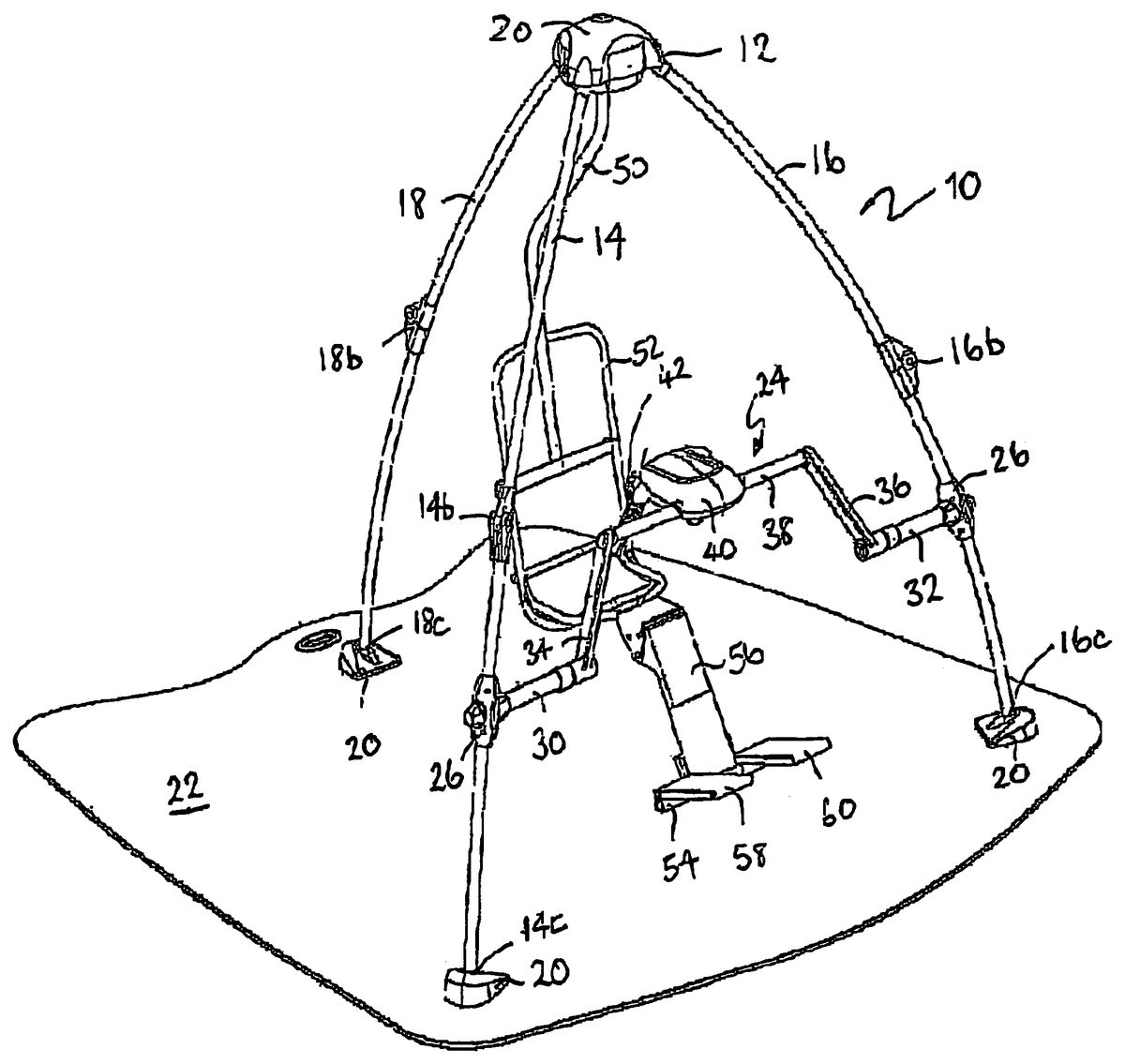
DETAILED DESCRIPTION OF A PREFERRED EMBODIMENT Referring to the drawings,FIG. 1shows an embodiment of a whole body game controller10embodying the present invention. InFIG. 1, the game controller10is configured as a game controller for a computer game simulating the driving of a motor vehicle (not shown). The game controller10includes a frame in the form of a tripod12having two front legs14,16and one rear leg18. The top of each leg is connected to a top or head20of the tripod about respective pivots14a,16aand18aas shown in more detail inFIG. 5. The legs themselves, are gently curved and are hinged about their respective mid points14b,16b,18bso that they can be folded in two. The feet14c,16c,18cof each leg locates in and is locked in a cylindrical hole in a plastic moulding20fixed to a mat22on which the tripod sits. The mat is made of a fibre glass reinforced plastic fabric, although any strong flexible material would be suitable for forming the mat. The locking of the feet to the mat prevents the legs of the tripod from splaying outwards. A handlebar assembly24extends between the front two legs of the tripod. The handlebar assembly24is mounted to the front legs14,16by means of plastic fittings26which can be slid up or down the legs so that the height of the handlebar assembly is adjustable. The handlebar assembly should be detachable from the legs for storage and transport of the apparatus, but the specific manner in which the handlebar assembly is connected to the frame is not critical. As shown inFIG. 1, the handlebar assembly24includes two co-axial stub portions30,32linked by two radial arm portions34,36to a central bar38extending parallel to the stub portions. The radial arm portions34,36pivot about the stub portions to enable adjustment of the position of the central bar38relative to the stub portions. A control console40including handle grips42,43(not shown inFIG. 1) is attached ...
DETAILED DESCRIPTION OF A PREFERRED EMBODIMENT
Referring to the drawings,FIG. 1shows an embodiment of a whole body game controller10embodying the present invention. InFIG. 1, the game controller10is configured as a game controller for a computer game simulating the driving of a motor vehicle (not shown).
The game controller10includes a frame in the form of a tripod12having two front legs14,16and one rear leg18. The top of each leg is connected to a top or head20of the tripod about respective pivots14a,16aand18aas shown in more detail inFIG. 5. The legs themselves, are gently curved and are hinged about their respective mid points14b,16b,18bso that they can be folded in two. The feet14c,16c,18cof each leg locates in and is locked in a cylindrical hole in a plastic moulding20fixed to a mat22on which the tripod sits. The mat is made of a fibre glass reinforced plastic fabric, although any strong flexible material would be suitable for forming the mat. The locking of the feet to the mat prevents the legs of the tripod from splaying outwards.
A handlebar assembly24extends between the front two legs of the tripod. The handlebar assembly24is mounted to the front legs14,16by means of plastic fittings26which can be slid up or down the legs so that the height of the handlebar assembly is adjustable. The handlebar assembly should be detachable from the legs for storage and transport of the apparatus, but the specific manner in which the handlebar assembly is connected to the frame is not critical.
As shown inFIG. 1, the handlebar assembly24includes two co-axial stub portions30,32linked by two radial arm portions34,36to a central bar38extending parallel to the stub portions. The radial arm portions34,36pivot about the stub portions to enable adjustment of the position of the central bar38relative to the stub portions. A control console40including handle grips42,43(not shown inFIG. 1) is attached to the central bar38.
A T bar50(best seen inFIG. 2) depends down from the head of the tripod. The T-bar50is suspended from the head of the tripod by a bearing such that it can be swung backwards and forwards and side to side or rotated about a vertical axis A. Movement of the T-bar is monitored by a sleeved stem that is located in the centre of the bearing. The sleeved stem moves in same way as a standard joystick and transmits the same control instructions as a standard joystick either side to side and back and forth, or rotation about vertical axis A. The head which is shown in more detail inFIG. 5includes a locking means not illustrated, which can be activated to allow either side to side and forwards and backwards movement relative to the consol or vertical rotation.
As shown inFIG. 1a chair52is removably attached to the T-bar50. The chair includes a foot rest54in the form of a bar which is mounted to the chair by an length adjustable member56which is pivoted to the chair52. Foot pedals58,60are removably attached to the foot rest54.
In the configuration for use in simulating driving a car shown inFIG. 1, vertical rotation about the bearing about axis A is permitted and side to side and backward and forward movement is locked off. The player grasps the handle grips which are angled down to simulate a steering wheel and turns the vehicle by pushing on the handlebars and twisting their body. The pedals58,60typically control acceleration and braking as in a normal car.
The game controller is adjustable to suit different types of computer game. For exampleFIG. 4shows the apparatus configured for a motorbike riding game in which the handle grips are pivoted such that they extend generally parallel to the central bar38and, as in a typical motorbike, the right handle bar acts a twist grip throttle for the motorbike in the game. Also the foot pedals58,60are removed and the length adjustable member56is pivoted so that the foot rest54is located generally beneath the seat as occurs in a real motorbike, so that the rider can adopt a more realistic position simulating the riding of a real motorbike. In the motorcycle configuration as shown inFIG. 4, backwards and forwards, and side to side rotation is typically permitted whilst vertical rotation is locked off.
Also shown inFIG. 4, are three optional elastic straps70,72,74which extend between the chair and each leg of the tripod. The straps make it more difficult for the player of the computer games to move the chair and thus increase resistance of movement of the chair. This allows the game controller apparatus to be used as an exercise type apparatus. The level of exercise a game player will get from using the controller will depend on the elasticity of the straps which may be adjustable to suit the weight and fitness of the person using the controller. The straps may also be used with the game controller in any of the other configurations but are omitted for clarity reasons.
As shown inFIGS. 2 and 3, it is also possible to configure the apparatus for flying game with the player in a prone position.FIG. 2shows the apparatus with the chair removed52and the console40lowered and adjusted so that the player can operate it in a prone position by rotating the central bar about the stub portions30,32and pivoting the console40so that it is at an angle of about 300 to the horizontal. With reference toFIG. 3a player80is suspended by a two part harness shown schematically one first part82of the harness being suspended from the “T” of the T-bar supporting the players chest, and the other part84hanging from an upper part of the T-bar near the head20supporting the players legs. When the elastic straps are used they are connected to the first part82.FIGS. 6 and 7illustrate the harness components in more detail each comprising a cushion86,88suspended by webbing. The webbing90supporting the leg/thigh cushion88is adjustable and incorporates a releasable cleat mechanism so that the player can mount the game controller apparatus resting his chest on the chest cushion82and place their legs on the cushion84with the webbing90extended so that the cushion88is on or close to ground and then using a cleat mechanism shorten the webbing straps to raise the cushion to the operative position shown inFIG. 3.
Clearly, the exact configuration of the apparatus may be changed for different simulations as well as simulating flying, driving a bike, driving a car, the apparatus may also be used to simulate a plane, spaceship, or indeed, used to control any type of sprite including an avatar in a computer game, and although it is best suited to driving or flying games there is no reason why it could not be used to control the movements of a sprite such as a monkey, plumber or a hedgehog or any computer game character, although the players movements would not necessarily logically correspond with those of the sprite. The apparatus may also be dismantled for storage and transport by detaching the handlebar assembly24, and the chair, removing the feet14c,16c,18cof each leg of the tripod from the plastic mouldings20and folding the legs of the tripod towards each other, and also in two about the hinges.
It will be appreciated that as in all computer game controllers electronic modification may be required for the game controller to be used with different gaming consoles. The electronics used are standard in the art and the necessary adjustments are a matter of routine for the person skilled in the art.
The dimensions and materials used for making the apparatus may be varied however aluminium is preferred as the material for the frame and chair due to its strength to weight characteristics.
It will be appreciated that the use of a player's entire body in playing the game, particularly combined with the use of the elastic straps, will create an exercise value in game playing which has not previously been available and will also enable the use of the apparatus for physiotherapy and other applications.
It will be appreciated that it is possible to replace the chair/harness with a wheel-less pedal bike or motorbike frame for added realism. Also exercise apparatus could be suspended from the frame when appropriate games are developed to use the apparatus as an exercise/remedial therapy facility.
It will be appreciated by persons skilled in the art that numerous variations and/or modifications may be made to the invention as shown in the specific embodiments without departing from the spirit or scope of the invention as broadly described. The present embodiments are, therefore, to be considered in all respects as illustrative and not restrictive.
Claims
- A computer game controller comprising means for suspending a player from a tripod, in a support means such as a chair, or harness, from a bearing means wherein bearing means located on top of the tripod, the bearing means including a control means for inputting position signals to a computer to control the movement of a sprite such as a vehicle or character, in a computer game, the bearing allowing side to side, forwards and backwards, and rotational movement of the player about the bearing and including selectively operable locking means for preventing either rotational movement or side to side and forwards and backwards movement, the arrangement being such that movement of the player's body may move the chair or harness to control the sprite in the computer game, the controller further including resistance means for increasing the resistance to movement of the support means relative to the bearing, thereby providing physiotherapy exercise for the player.
- A computer game controller as claimed in claim 1 wherein the means for suspending a player comprises a frame and wherein a handlebar means which can be grasped by the player in use is attached to the frame.
- A computer game controller as claimed in claim 2 wherein the position of the handlebar means is adjustable.
- A computer game controller as claimed in claim 1 wherein the control means is of the joy stick type or of a rotational control wheel type.
- A computer game controller as claimed in claim 1 wherein game control means, other than movement control means for the sprite, are located on handle bars, steering wheel or other control means that are operable by a player's hands.
- A computer game controller as claimed in claim 2 wherein the frame may be folded down, dis-assembled or otherwise collapsed for storage and transport.
- A computer game controller as claimed in claim 1 wherein the player is suspended in a chair and wherein the chair includes an adjustable foot rest.
- A computer game controller as claimed in claim 2 wherein the resistance means comprise an elastomeric strap extending between the frame and the support means.
- A computer game controller comprising: a tripod having a head incorporating a bearing means;support means for suspending a player from the bearing means, the bearing means including a position control means for inputting position signals to a computer for controlling the movement of a sprite such as a vehicle or character in a computer game being played on the computer;handlebar means which may be fixed relative to the tripod and grasped by the player;further including resistance means for increasing the resistance to movement of the support means relative to the bearing;the arrangement being such that movement of the player grasping the handlebar means and moving their body may cause rotational, side to side or back and forth movement of the bearing causing a corresponding movement in the control means with the resistance means increasing the effort required by the player to move the support means thereby providing physiotherapy or exercise to the player.
- A computer game controller as claimed in claim 9 wherein the position control means is of the joy stick type or a rotational wheel type.
- A computer game system for playing a computer game comprising a computer console, a display means for displaying a game being played on the computer game system, and a game controller as claimed in claim 1 or claim 9 wherein movement of the body of a player suspended from the game controller is arranged to cause movement of a sprite in the game being played.
Disclaimer: Data collected from the USPTO and may be malformed, incomplete, and/or otherwise inaccurate.