U.S. Pat. No. 7,335,134
EXERCISE AND GAME CONTROLLER APPARATUS AND METHOD
Issue DateFebruary 23, 2004
Illustrative Figure
Abstract
An apparatus and method for an exercise apparatus incorporating sensor means 30 for translating body movement imparted to the exercise apparatus by the user 20 that is measured and transmitted to a video game 34 as commands generated by the sensor enhanced exercise apparatus forming the user control interface 36. The exercise apparatus 10 has a platform 12 with a resistive member 14 extending therefrom along with arms 16 fastened to the resistive member forming a cradle for the user 20 and extending outwardly terminating in hand grips 18. The present invention 10 moves and senses motion in the transverse 24, anterior-posterior 26 and longitudinal 28 axis.
Description
LIST OF REFERENCE NUMERALS With regard to reference numerals used, the following numbering is used throughout the drawings.10present invention12base14vertical resistive member16arm member18hand grip20user22arrows24transverse axis26anterior-posterior axis28longitudinal axis30sensor field32buttons and switches34video game36user control interface38force/vibration feedback40trigger42wheel44toggle46360 degree directional button48throttle50⅔ position switch52other control DETAILED DESCRIPTION OF THE PREFERRED EMBODIMENT The following discussion describes in detail one embodiment of the invention (and several variations of that embodiment). This discussion should not be construed, however, as limiting the invention to those particular embodiments since practitioners skilled in the art will recognize numerous other embodiments as well. For a definition of the complete scope of the invention, the reader is directed to the appended claims. Turning toFIG. 1, shown therein is an illustrative view of the uses of the present invention10. The present invention is an exercise apparatus having sensors to detect user20movement during an exercise regimen that is translated into commands for video game software. The incorporation of the sensors and exercise apparatus forms the user control interface. The apparatus is comprised of a base platform12or seat upon which the user20sits or stands with a vertical resistance member14extending from the base and an arm support member16being length adjustable as shown by arrows at22having hand grips18located at each distal end. Sensor means are incorporated into the exercise apparatus10for measuring forces imparted by the user20to the resistive member. Motion A shows a user20using the present invention10in a forward-backward motion; Motion B shows a side-to-side motion; and Motion C shows a twisting motion. Turning toFIG. 2, shown therein is a perspective view of the present invention10. Shown is the present invention10comprising an exercise apparatus comprising a base support member12upon which the user sits, a vertical resistance member14mounted on the base support with an arm support member16having hand grips18located at each distal end. The exercise apparatus10incorporates sensors that measure movement ...
LIST OF REFERENCE NUMERALS
With regard to reference numerals used, the following numbering is used throughout the drawings.10present invention12base14vertical resistive member16arm member18hand grip20user22arrows24transverse axis26anterior-posterior axis28longitudinal axis30sensor field32buttons and switches34video game36user control interface38force/vibration feedback40trigger42wheel44toggle46360 degree directional button48throttle50⅔ position switch52other control
DETAILED DESCRIPTION OF THE PREFERRED EMBODIMENT
The following discussion describes in detail one embodiment of the invention (and several variations of that embodiment). This discussion should not be construed, however, as limiting the invention to those particular embodiments since practitioners skilled in the art will recognize numerous other embodiments as well. For a definition of the complete scope of the invention, the reader is directed to the appended claims.
Turning toFIG. 1, shown therein is an illustrative view of the uses of the present invention10. The present invention is an exercise apparatus having sensors to detect user20movement during an exercise regimen that is translated into commands for video game software. The incorporation of the sensors and exercise apparatus forms the user control interface. The apparatus is comprised of a base platform12or seat upon which the user20sits or stands with a vertical resistance member14extending from the base and an arm support member16being length adjustable as shown by arrows at22having hand grips18located at each distal end. Sensor means are incorporated into the exercise apparatus10for measuring forces imparted by the user20to the resistive member. Motion A shows a user20using the present invention10in a forward-backward motion; Motion B shows a side-to-side motion; and Motion C shows a twisting motion.
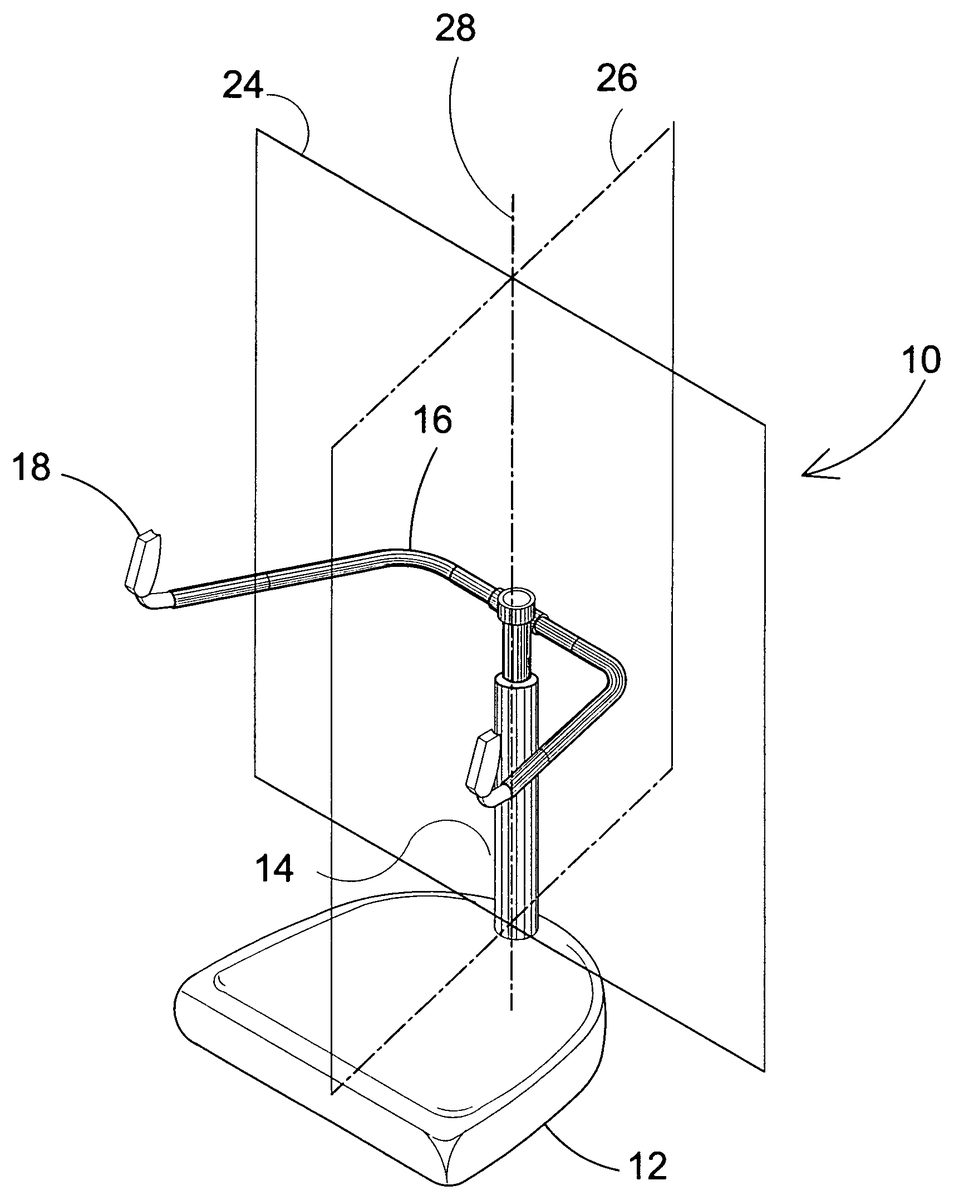
Turning toFIG. 2, shown therein is a perspective view of the present invention10. Shown is the present invention10comprising an exercise apparatus comprising a base support member12upon which the user sits, a vertical resistance member14mounted on the base support with an arm support member16having hand grips18located at each distal end. The exercise apparatus10incorporates sensors that measure movement of the resistive member through a transverse axial plane24, anterior-posterior axial plane26, longitudinal axial plane28and combinations thereof.
Turning toFIG. 3, shown therein is an illustrative top view of the present invention10in use. Shown is a top view of a person20positioned on the exercise apparatus of the present invention10. Body movement of the user20through the transverse24, anterior-posterior26and longitudinal28axial planes cause reciprocal movement in the resistive member14that is measured and transmitted to video game software. The sensor field30also indicates combinational axial movement.
Turning toFIG. 4, shown therein is an illustrative side view of the present invention10in use—motion “A”. Shown is a side view of a person20using the exercise apparatus of the present invention10performing body movement through the anterior-posterior26axial plane that is imparted to the resistive member14, which has sensor means for measuring and transmitting the movement as commands to video game software. Also shown are base seat12, arms16and hand grips18.
Turning toFIG. 5, shown therein is an illustrative front view of the present invention10in use—motion “B”. Shown is a side view of a person20using the exercise apparatus of the present invention10performing body movement through the transverse24axial plane that is imparted to the resistive member14, which has sensor means for measuring and transmitting the movement as commands to video game software.
Turning toFIG. 6, shown therein is an illustrative top view of the present invention10in use—motion “C”. Shown is a side view of a person20using the exercise apparatus of the present invention10performing body movement through the longitudinal28axial plane that is imparted to the resistive member14, which has sensor means for measuring and transmitting the movement as commands to video game software.
Turning toFIG. 7, shown therein is a block diagram of the present invention. Shown is a block diagram of the components of the present invention comprising a platform12having a stanchion-like resistive member14extending therefrom with arms16extending outwardly terminating in hand grips18which may include buttons and/or switches32. Incorporated within the exercise apparatus are sensors30for translating body movement imparted to the resistive member that are measured and transmitted to video game software34. The exercise device and integral sensors form the user control interface36to the software.
Turning toFIG. 8, shown therein is a block diagram of the present invention with force/vibration feedback38. Shown is a block diagram of the present invention having an additional element. The exercise apparatus is comprised of a platform12having a stanchion-like resistive member14extending therefrom with arms16extending outwardly terminating in hand grips18which may include buttons and/or switches32. Incorporated within the exercise apparatus are sensors30for translating body movement imparted to the resistive member14that are measured and transmitted to video game software34. Additional the exercise apparatus incorporates a force/vibration feedback mechanism38whereby the video game34can cause movement within the resistive member14and or hand grips18in response to signals received from the sensors30and/or hand grips18. The exercise device, integral sensors30and force/vibration feedback38form the user control interface36to the software.
Turning toFIG. 9, shown therein is a block diagram of the present invention's hand grip18control features. The hand grips18of the present invention provides various control features of typical game controllers used in conjunction with video game boxes, personal computer game software, and the like. The present invention's hand grips may include a plurality of features taken from the following group which might include a trigger40, wheel42, toggle44, buttons and switches that provide means for 360° pivoting action46, force/vibration feedback, throttle48, ⅔ position switch50and other52user controlled commands.
Claims
- An apparatus for allowing a user to exercise and for providing input control signals to a video game, comprising: a) a base having a front anterior and a rear posterior end, a top and a bottom, and a pair of sides, wherein the user can stand or sit on said top;b) a vertical member being disposed on said top of said rear end of said base, said vertical member having first and second ends wherein said first end is mounted onto said base, wherein said vertical member is resistively flexible in the transverse axis, wherein said vertical member is resistively flexible in the anterior-posterior axis, wherein said vertical member is resistively flexible about the longitudinal axis;c) a pair of arms being disposed on said second end of said vertical member, wherein said arms each have an end, wherein said ends extend toward said front of said base, wherein said arms form a cradle about the user disposed on said base so that the back of the user is oriented toward said vertical member and the front of the user is oriented toward said ends of said arms;d) a hand grip being disposed on each of said ends of said arms so that the hands of the user can grasp each said hand grip;e) a first sensor for sensing and transmitting signals to the video game in response to movement of said vertical member by the user to permit input signals to be provided to the video game;f) at least one control button member disposed on said hand grip so that the user can manipulate said control button and a second sensor for transmitting signals to the video game in response to manipulation of said control button by the user;and g) a force/vibration feedback mechanism for transmitting separate signals from the video game to said vertical member and hand grip in response to signals received from said sensors for causing movement within said resistive member and hand grip.
- The apparatus of claim 1 , wherein said control member is at least one control button.
- The apparatus of claim 1 , wherein said control member is a switch being disposed on said hand grip so that the user can manipulate said control switch, and a second sensor for sensing and transmitting signals to the video game in response to manipulation of said control switch by the user.
- The apparatus of claim 1 , wherein said control member is a throttle.
- The apparatus of claim 1 , wherein said control member is at least one 360 degree control button.
- The apparatus of claim 1 , wherein said control member is at least one trigger.
- The apparatus of claim 1 , wherein said control member is at least one wheel.
- The apparatus of claim 1 , wherein said control member is at least one ⅔ position switch.
- The apparatus of claim 1 , wherein said control member is at least one toggle.
- The apparatus of claim 1 , wherein said vertical member provides resistance to a user as the vertical member is flexed by the user.
- The apparatus of claim 10 , wherein said first sensor senses movement of said vertical member in said transverse axis.
- The apparatus of claim 11 , wherein said first sensor senses movement of said vertical member in said anterior-posterior axis.
- The apparatus of claim 12 , wherein said first sensor senses movement of said vertical member in said longitudinal axis.
- A method for allowing a user to exercise and for providing input control signals to a video game, comprising the steps of: a) providing a base having a front anterior and a rear posterior end, a top and a bottom, and a pair of sides, wherein the user can stand or sit on said top;b) attaching a first end of a vertical member onto the top of the rear end of the base, the vertical member being resistively flexible in the transverse axis, the anterior-posterior axis, and about the longitudinal axis;c) attaching a pair of arms onto the second end of the vertical member, wherein the arms each have an end, wherein the ends of the arms extend toward the front of the base so as to form a cradle about the user disposed on the base so that the back of the user is oriented toward the vertical member and the front of the user is oriented toward the ends of the arms;d) attaching a hand grip onto each end of the arm so that the hands of the user can grasp each hand grip;e) sensing and transmitting signals to the video game in response to movement of the vertical member by the user to permit input signals to be provided to the video game;f) providing a feedback signal from the video game to the vertical member in response to the input signals wherein the vertical member then transmits a force to the user through said vertical member;g) mounting at least one input device onto the hand grip, said user manipulating the input device, and sensing and transmitting signals to the video game in response to manipulation of the input device by the user;and h) providing a feedback signal from the video game also to the hand grip in response to the input signals wherein the hand grip then transmits a force to the user whereby the user senses this feedback in both of the vertical member and the hand grip.
Disclaimer: Data collected from the USPTO and may be malformed, incomplete, and/or otherwise inaccurate.