U.S. Pat. No. 7,331,870
MULTIPLAYER BIOFEEDBACK INTERACTIVE GAMING ENVIRONMENT
AssigneeUnyte Health Inc
Issue DateApril 1, 2004
Illustrative Figure
Abstract
The present invention provides a method and apparatus in which a biometric information relating to a player is used to facilitate game play in multiplayer game environments. In particular, the present invention provides a game platform, a biofeedback sensor, and a biofeedback signal interface connection between the game platform and the biofeedback sensor. The biofeedback signal interface converts the biofeedback sensor information into a signal input usable by the game platform, which executes multimedia events as determined, in part, by the biometric information.
Description
DETAILED DESCRIPTION An embodiment of the present invention will be described with reference toFIGS. 1 to 7.FIG. 1is a functional block diagram of a biofeedback gaming environment100useful for an individual playing a single player biofeedback game. Biofeedback gaming environment100includes a game platform102, a biofeedback signal interface104, and a plurality of biofeedback sensors106. Biofeedback wiring harness108connects the biofeedback, sensors106to biofeedback signal interface104. Biofeedback signal interface104can be connected to game platform102by a standard cable110, such as a coaxial cable, a universal serial bus (USB) cable, an optical cable, or the like. Biofeedback signal interface104and game platform102could be integrated into one or more parts or processors. If biofeedback signal interface104were incorporated into game platform102, cable110would likely be replaced by other communication protocols, such as a bus. Also, wiring harness108and cable110could be replaced by a wireless communication links if desired. Further, game platform102could incorporate a web browser and server to allow downloading or streaming the game program over a network, such as, a local area network, an Ethernet, a wide area network, a wireless network, the Internet, or the World Wide Web, which will be explained further below. Biofeedback signal interface104converts biofeedback information from an individual into signals that can be processed by gaming platform102. The operation of biofeedback signal interface104is well known in the art and will not be further explained herein, except as it relates specifically to the present invention. Game platform102could be any conventional game platform, such as, for example, a personal computer, a Sony PLAYSTATION2™, a Microsoft XBOX™, a Nintendo GAMECUBE™, a portable electronic game, a PDA, cellular telephone, a wireless device, a network connection, a server, or the like. The game platform would operate in a manner similar to existing game platforms by loading the game program into the system. Game platform102would execute a game program, which would include ...
DETAILED DESCRIPTION
An embodiment of the present invention will be described with reference toFIGS. 1 to 7.FIG. 1is a functional block diagram of a biofeedback gaming environment100useful for an individual playing a single player biofeedback game. Biofeedback gaming environment100includes a game platform102, a biofeedback signal interface104, and a plurality of biofeedback sensors106. Biofeedback wiring harness108connects the biofeedback, sensors106to biofeedback signal interface104. Biofeedback signal interface104can be connected to game platform102by a standard cable110, such as a coaxial cable, a universal serial bus (USB) cable, an optical cable, or the like. Biofeedback signal interface104and game platform102could be integrated into one or more parts or processors. If biofeedback signal interface104were incorporated into game platform102, cable110would likely be replaced by other communication protocols, such as a bus. Also, wiring harness108and cable110could be replaced by a wireless communication links if desired. Further, game platform102could incorporate a web browser and server to allow downloading or streaming the game program over a network, such as, a local area network, an Ethernet, a wide area network, a wireless network, the Internet, or the World Wide Web, which will be explained further below.
Biofeedback signal interface104converts biofeedback information from an individual into signals that can be processed by gaming platform102. The operation of biofeedback signal interface104is well known in the art and will not be further explained herein, except as it relates specifically to the present invention.
Game platform102could be any conventional game platform, such as, for example, a personal computer, a Sony PLAYSTATION2™, a Microsoft XBOX™, a Nintendo GAMECUBE™, a portable electronic game, a PDA, cellular telephone, a wireless device, a network connection, a server, or the like. The game platform would operate in a manner similar to existing game platforms by loading the game program into the system. Game platform102would execute a game program, which would include receiving input from bios inputs, biofeedback input, and using those inputs by a multimedia event engine to generate a series of multimedia stimulus, such as images, sounds, audiovisual displays, graphics, still pictures, animations, and the like, or a combination thereof. It is envisioned that game platform102would have a conventional bios devices112, such as a joystick, keyboard, or mouse, and a conventional display114, such as a computer monitor, T.V., LCD, or the like. This would allow game platform102to operate in a conventional manner with a conventional game program. Further, it is envisioned that various parts of the present invention would function as a typical electronic game. Alternatively, the conventional bios device could be removed from game platform102such that biofeedback interface104provides the only input. Notice, multiple combinations of bios devices and biofeedback interfaces104are possible. The game program could be loaded in a remote server and processor with the multimedia images streamed or downloaded to a local display for a player in a conventional manner. (SeeFIG. 3) Alternatively, the game program could be stored on a media116and loaded into an appropriate drive120of game platform102. Media116and corresponding drive120could be any conventional protocols, such as, conventional magnetic discs, optical discs, tapes, CDs, DVDs, or the like.
It is envisioned that biofeedback sensors106will be a plurality of ring type sensors capable of fitting on the fingers of users. For example, two sensors may measure skin conductance. Measuring skin conductance provides an epidural skin response (also known as EDR or GSR) input of the player to game platform102. Epidural skin response measures, for example, the stress level of the player. Epidural skin response sensors are well known in the art and useful for devices, such as, lie detectors. Another sensor may be an infrared senor that may measure the player's heartbeat. Infrared sensors of this sort are also well known in the art. Measuring the player's heartbeat can be useful in determining a variable heart rate. The variable heart rate could be useful in determining, for example, the coherence between the player's sympathetic and parasympathetic nervous systems. While three sensors to determine two biometric values have been described, other combinations of sensors and other biometrics are possible. For example, biometrics could be measured for blood press, temperature, EKGs, EEGs, EMGs, brain waves, blood oxygen levels, respiratory rates, or the like. Also, the game play could be based on one or more biometric values measured using one or more biometric sensor. In other words, you could have a game where only one biometric, such as, a respiratory rate, is measured. Alternatively, you could have a game where two or more biometrics are measured at various times. Still further, a game could be designed where two biometrics are measured at substantially the same time, such as, a combination or variable heart rate and respiratory rates. In other words, the combination of sensors and biometrics is a matter of design choice.
Biofeedback sensors106would sense the particular biometric value of concern and send the raw biometric data to biofeedback interface104. For example, the heart beat sensor would send representative signal, such as counts per minute, to biofeedback interface104. Biofeedback interface104converts the raw biometric data into a biometric game input signal, which may correspond to a variable heart rate, and transmits that signal to game platform102. We note here that the function of biofeedback interface104could be contained in biofeedback sensors106circuitry, contained on a peripheral circuit card inserted into game platform102, or performed by the game platform102itself. Game platform102would use the biometric game input signal to accomplish tasks or to control the game environment. For example, if a particular task in the game program was to cause a hot air balloon to rise to a particular level based on particular decrease in the player's stress level as measured by EDR, then biometric sensors106would measure skin conductance. Biofeedback interface would receive the raw biometric data and convert it to a biometric game input, which in this case would be a stress indicator. Game platform102would receive the biometric game input and cause the balloon to rise up a predetermined amount for a corresponding decrease in stress as indicated by the differential of conductance values. For example, if the player's stress decreases such that the sensors may indicate a 10 micromho change in skin conductance. The 10 micromho change in skin conductance may correspond to a 10 foot increase in the balloon's altitude. Another task may be, for example, achieving a particular variable heart rate to cause a game door to open. Still another task may be requiring a particular respiratory rate to float on a body of water or travel down a hall. While desirable to have some coordination between the game task and a particular or combination of physiological characteristics is desirable, it is also not necessary. For example, a low heart rate may cause a game character to run faster, which is not intuitive. Generally, the biometric and the associated task is a matter of design choice.
FIG. 2shows a flowchart200illustrative of a possible game play using the present invention. First, a game program is initiated on game platform102, step202. After the game program is initiated, game play begins by providing a first multimedia event, step204. The first multimedia event may be a single event (such as a still image) or a sequence of multimedia events. During the game play, the system continually or periodically monitors the game to determine whether the game program requires a user biometric input, step206. If a biometric input is not required, game play returns to providing multimedia events, step204. (While shown as separate steps for ease of illustration, one of skill in the art would recognize on reading the disclosure that the display of multimedia events does not necessarily pause when the game play requires input and biofeedback input, and multimedia display can occur in discrete steps, simultaneously, substantially simultaneously, or a combination thereof). Further, while waiting for or processing, or in conjunction with a biometric input, a player could manipulate game play using conventional bios devices.
If a biometric input is required for game play, the game program receives the biometric game input signal, step208. The biometric game input signal is processed by game platform102, step210. Based on the processed signal, game platform102provides an appropriate multimedia event, step212. The appropriate multimedia event is at least a second multimedia event or sequence of multimedia events. After providing the appropriate multimedia event based on the biometric input, the game play system determines whether additional biometric input is required, step206. While not specifically shown, game play termination could be provided after any particular multimedia event, according to conventional methods.
Although the above description generally relates to a single player or user interacting with the game environment, it would be possible to establish a collective or competitive game play, which will be explained in more detail below. For example, referring back toFIG. 1, instead of one set of biometric sensors106providing input to biofeedback signal interface104, two or more sets of sensors106could provide input to one or more interfaces104. For example, assuming that sensors106were configured to measure EDR, then the interface (or interfaces)104could supply each of the two or more player's EDR biometric game input signal to game platform102or interface104could combine the signal into a collective player signal to supply a collective biometric game input signal to game platform102. If the biometric game input signals for the individual players are transmitted to game platform102, then the game platform102may be programmed to develop a collective biometric game input signal. Using the hot air balloon example, if three players are playing together, the game program may be designed to only increase the balloon's height when the players collectively reach certain biometric values, i.e., all three players need to collectively reduce their stress level to cause the balloon to rise. If one or two players reduce their stress, the balloon may move somewhat, but the goal is only reached if the community of players works together. For competitive play, one player's stress reduction may cause the balloon to rise while the second player's stress variable heart rate may cause the balloon to lower (or the wall to increase in height). Again, the combinations of collective and competitive tasks are limited by the game programmers imagination. While collective and competitive multiple player games can be played by players at the same location, collective or competitive players can be located at remote locations through use of any type of computer network such as local-area networks, the world-wide web, telephony networks or wide-area networks, any of which could be wired or wireless.
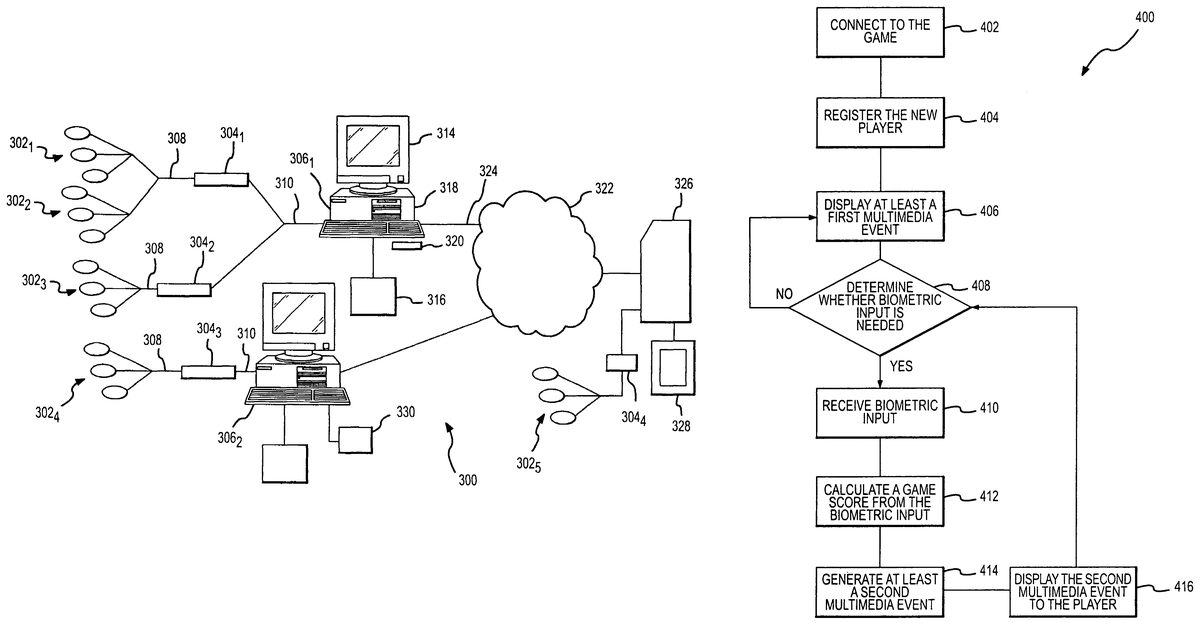
Referring now toFIG. 3, a multiplayer biofeedback gaming system300is shown in more detail. Biofeedback gaming system300includes a plurality of biofeedback sensors3021to3025, a plurality of biofeedback signal interfaces3041to3044, and a plurality of game platforms3061to3062. Each game platform306may be connected to a conventional BIOS330(of which only one is shown) such that any game being played can accept biofeedback input as well as conventional game input.
A plurality of biofeedback wiring harnesses308connect sensors302to interfaces304. Wiring harnesses308can be conventional cables, fibers, or wireless connections. If interfaces304are integrated into sensors302, wiring harness308could be buses or the like. A plurality of connections310connect interfaces304to game platforms306. Connections310can be any number of conventional devices such as, for example, cables, fibers, wireless, buses, or the like. Game platforms306generally include displays314, memory316, computer medium drives318capable of reading code stored on computer medium320. Computer medium drive318is generally designed to read computer medium320. Such medium could be, for example, a magnetic disk, an optical disk, a tape, CDs, DVDs, or the like. Game platforms306operate in a conventional manner to process a game program such that a user can interact with a variety of multimedia events using conventional Bios330or biometric inputs (sensors302, interfaces304, and the like).
Multiple biofeedback sensors can be connected to a single interface, such, as biofeedback sensors3021and3022are connected to a single biofeedback signal interface3041. Moreover, multiple biofeedback signal interfaces connected to one or more biofeedback sensors can be connected to a single game platform306, such as, for example, biofeedback signal interface3041(with two sensor inputs) and biofeedback signal interface3042having an input from biofeedback sensor3023, are both connected to game platform3061. Game platform3061is capable of running the software and processing the signals for a biofeedback game either stored in memory316or read from a computer medium320loaded in computer medium drive318. Thus, multiple players using multiple biofeedback sensors302and one or more interfaces304can play the game on a single local game platform3061.
Instead of running the game locally, game platform306, could establish a connection to a network322using a conventional network connection324. Server326, also connected to network322, accepts input from game platform3061and3062and provides output back to the game platforms to be displayed on the respective displays314. Two-way connections between game platform306and server326are generally known in the art and will not be further explained herein. Server326may be a game platform as well with a local player connected via a biofeedback sensor3025and biofeedback signal interface3044. The local player would use a local display328. While only one local player is shown, multiple players may be connected directly to server326.
Network322can be a local area network, a wide area network, a wireless network, an Ethernet, the Internet, the World Wide Web, a combination thereof, or the like. Data transfer and game playing would follow conventional protocols similar to massive on-line multiplayer games, such as, Ultima™ Online and Everquest™.
Referring now toFIG. 4, a flowchart400illustrates a possible methodology associated with multiplayer biofeedback game300. Flowchart400assumes play is over network322where server326is processing the game and providing the multimedia events to the players, but one of ordinary skill in the art would recognize on reading the disclosure that multiple players could play the game on a single processor. Generally with networked games, the game simulation is running, thus the first step for any individual player is to connect to the game, step402. The game registers the new player, step404. For example, the game may register one player per processor. However, when multiple players connect to one processor, players can be identified as a single player or as a composite of multiple players. In other words, referring toFIG. 3, processor3061receives input from biofeedback sensors3021,3022, and3023. Processor3061could process the various biofeedback inputs into a single composite player signal (forming the composite signals will be explained in more detail below), provide multiple player signals to server326, or form a composite signal from sensors3021and3023and send two player signals, the composite and player3022as two separate players. Once the connection is established and the player (or players) is (are) registered, at least a first multimedia event is sent to and displayed at the display of the player (players and users are often used interchangeably herein), step406. The first multimedia event could be a single event or a sequence of events.
During the course of play, the program will determine whether biometric input is needed, step408. When it is determined that a biometric input is needed, the system receives biometric input, step410. Next, the system calculates a game score from the received biometric input, step412. The game score may be a game score developed from a composite of biometric inputs, see below. Alternatively to developing the composite signal from all the registered players, biometric signals from a subset of registered players could be used to develop the composite signal. For example, players may be grouped into player group A, player group B, and player group C. The system may only use player group B to develop the signal. Based on the game score, at least a second multimedia event is generated, step414. The second multimedia event can be a single event or a sequence of events. Finally, the second multimedia event is displayed to the player, step416. Once the system displays the second multimedia event, control is returned to step408to determine whether additional biometric input is needed. Finally, while shown as discrete steps, displaying multimedia events and processing the biometrics may occur substantially simultaneously.
Prior to explaining the details associated with the development of composite multiplayer composite biometric inputs, examples of game play associated with the present invention will be provided. These examples are for illustrative purposes only.
Consider a networked-based multiplayer game event where a multitude of players are connected through individual or shared computers. The biofeedback sensors could be monitoring, for example, variable heart rate. The multimedia event being displayed is a village suffering a drought. The goal of the game event is to cause rain on the village. In order to cause the needed rain, the players are instructed to perform a particular technique, such as a breathing technique, that influence variable heart rate, which is being monitored by the biofeedback sensors. The signals from all the players are processed into a composite signal. Based on the composite signal, the appropriate multimedia event may be, for example, a drizzle for a poor composite score, a downpour for an excellent composite score, somewhere between a drizzle and a downpour for the spectrum of responses between poor and excellent, or the like. Using the above referenced player groups, instead of forming a composite signal from all the registered players, player group A may be assigned the east side of the village for rain, player group B may be assigned the west side of the village for rain. Thus, it may be no rain or drizzle in some sections, a downpour in others based on the player group response. For an additional twist, player group C could be used to combat the rain, in other words, output from group C might be used to lower the composite scores of other groups thus creating a competitive environment.
While an entire game could be developed using simply biofeedback inputs, it would also be possible to integrate biofeedback components into networked game environments that exist. For example, a “guild” (a.k.a player group) of EVERQUEST could try to conquer an empire using conventional techniques, such as, for example, deploying soldiers and fighting. Alternatively, the “guild” could try to conquer the empire using a meditative technique. Cooperative techniques could be as simple as two players working together. For example, in a joust the knight player may need to feel enraged to build up strength to hold a lance while a squire may need to feel calm so the horse runs fast and straight. Similarly, in a random encounter, a player may attempt to shoot a beast, but can only operate the gun if the biometric input indicates a relatively calm state.
Referring toFIG. 5, a flowchart500is shown for developing a composite score. First, the game platform identifies the registered players needed to develop the composite score, step502. This identification could be a single player, a group of players, all players, or the like. Next, the system calculates a temporary game score for each identified registered player based on the appropriate biometric input or inputs, step504. Once each individual temporary game score is generated, a game score is calculated from the temporary game scores, step506. The game score can be an average of the temporary game scores. Instead of the average game score, the system could use the median score, total sum, or some other formulaic combination. For example, the composite game score could be a weighted average, a time weighted average, a weighted differential equation or the like. The signal interfaces, local game platforms, or server could calculate the game scores for individual players as a matter of design choice. Generally, in networked environments, server326calculates the composite, but server326could designate a particular game platform to calculate the composite. In single game platform environments, the game platform running the game calculates the composite.
Referring now toFIG. 6, a flowchart600showing an alternative method of calculating a composite score or signal consistent with the present invention is shown. First, a group of registered users needed for the biometric input are identified, step602. Next, a composite biometric input is developed by combining the biometric input from the identified players, step604. The composite biometric may be developed from averaging the particular raw biometric input (before or after conversion to a game platform usable signal), summing the raw biometric input, or other formulaic combinations. The composite biometric is used to calculate a composite game score, step606. Optionally, awards may be awarded to users, step608. The award may be, for example, points, experience, additional abilities, advancement to the next event, or the like. The awards may be distributed equally to the group of users or based on individual performance. Thus, if one of the players in the group of players performed better than another of the players, the better performing player may receive more of the award.
Numerous equations could be used to composite biometric signals. The following two and three player examples using heart rate and EDR are provided for illustration and should not be considered limiting. One possible composite could be derived by using player one's EDR as a DC voltage signal and player two's heart rate as a sinusoidal riding on the DC voltage. Another composite could include player one's heart rate as a base sinusoidal signal, player two's EDR could be used to modify the weight of the sinusoidal signal, and player three's composite of player three's EDR and heart rate could control another sinusoidal signal. Still another composite could be where player one's heart rate controls a frequency of a signal and player two's EDR controls amplitude. Again, more players and more, other, or less biometric information could be used to composite the scores.
As can be seen, many alternatives to developing a composite game score exist. Calculating individual game scores and generating a composite or combining the individual biometrics and then calculating a composite game score are two non-limiting examples of ways to calculate a composite signal or composite score.
Referring no toFIG. 7, a single game platform306and server326connected over network322is shown. WhileFIG. 7shows a possible interaction between platform306and server326, one of ordinary skill in the art will now recognize that the functionality of the various components can be arranged in one or more locations, such as, for example, the components shown as contained in server326could be integrated into platform306, etc. Display314could be separate as shown or integrated into game platform306. Game platform306could also be any free-standing game platform such as a personal computer, Xbox™, Gamecube™, etc.
Referring specifically to game platform306, a first processing unit702can be used to execute program code and coordinate the various components of platform306by sending and receiving signals over bus work704. As shown, biometric senor302sends biometric input to a biometric input port706. Biometric input could be preprocessed by interface304and/or processing unit702as desired. Processor702directs the biometric input biometric signal output port708. Biometric signal output port708transmits the biometric input to the biometric signal input port710over network connection712, network322, and network connection714.
A second processing unit716can be used to execute program code and coordinate the various components of server326by sending and receiving signals over bus work718. Biometric input is directed to an event engine720. Event engine720uses the biometric input to generate an event sequence signal. Event sequence signal is used by a multimedia event engine722to generate multimedia events based on the event sequence signal. Multimedia events are transmitted by multimedia event output port724to multimedia event input port726over network connection728, network322, and network connection730. The multimedia events received at multimedia event input port726are displayed on display314. Network connections712and730may be the same connection and network connections714and728may be the same.
While the invention has been particularly shown and described with reference to an embodiment thereof, it will be understood by those skilled in the art that various other changes in the form and details may be made without departing from the spirit and scope of the invention.
Claims
- An apparatus for processing a multiplayer game configured to user biometric input, the apparatus comprising: at least one game platform;the at least one game platform comprising: a multimedia event engine to generate multimedia events based on an event sequence and transmit the multimedia events to at least one display to be viewed by a first group of users;at least one biometric signal input to receive variable biometric information separate from a bios input from a second group of users, the second group of users selected from a group of users consisting of: all the first group of users, at least one of the first group of users, or none of the first group of users;an event generation engine, the event generation engine transmitting to the first group of users a requested change in the variable biometric information and using changes in the variable biometric information from said at least one biometric signal input separate from the bios input to generate the event sequence;and at least one multimedia event output to transmit multimedia events to the first group of users.
- The apparatus according to claim 1 , wherein the game platform is a processor selected from a group consisting of an electronic game platform, a computer processor, a desktop computer, a server, a laptop computer, a portable electronic game, a cellular phone, or a PDA.
- The apparatus according to claim 1 , further comprising at least one bios input separate from the at least one biometric signal input.
- The apparatus according to claim 3 , wherein the bios input is selected from a group consisting of a mouse, a keyboard, an electronic pen, a track ball, a mouse pad, and a joystick.
- The apparatus according to claim 1 , further comprising at least one biometric sensor connected to the at least one biometric signal input.
- The apparatus according to claim 5 , wherein the at least one biometric sensor corresponds to the number of the second group of users.
- The apparatus according to claim 1 , wherein the at least one game platform comprises a plurality of game platforms connected by a network.
- The apparatus according to claim 7 , wherein at least one of the plurality of game platforms comprises a server.
- The apparatus according to claim 7 , wherein the network comprises at least one of a local area network, a wide area network, an Internet, a World Wide Web, and an Ethernet.
- The apparatus according to claim 1 , wherein the game platform further comprises a user identifier, the user identifier identifies the second group of users and the first group of users.
- The apparatus according to claim 10 , wherein the second group of users equals the first group of users.
- The apparatus according to claim 1 , wherein the second group of users comprises at least one user from the first group of users.
- The apparatus according to claim 5 , further comprising at least one biometric signal interface between the at least one biometric sensor and the at least one biometric signal input.
- The apparatus according to claim 13 , wherein the at least one biometric signal interface converts raw biometric information to a biometric signal input usable by the game platform.
- A system for playing a multiplayer biometric feedback game, comprising: at least one server;at least one game platform;the at least one server connected to the at least one game platform through a network connection;at least one biometric sensor coupled to the at least one game platform;the at least one server comprising: at least one biometric signal input port to receive a biometric signal, comprising variable biometric information, separate from a bios signal, at least one multimedia event output port to output multimedia events, at least one event engine to transmit to one or more players a requested change in the variable biometric information and use changes in the variable biometric information from said biometric signal, separate from the bios signal, to generate an event sequence, and at least one multimedia event engine to generate multimedia events based on the event sequence to be output through the at least one multimedia event output port;the at least one game platform comprising: at least one biometric input port to receive biometric input from the at least one biometric sensor, at least one biometric signal output port to output the biometric signal, at least one multimedia event input port to receive multimedia events, and at least one display to display the received multimedia events.
- The system according to claim 15 , further comprising at least one processor, the processor generates a game score based on biometric input received from the at least one biometric sensor.
- The system according to claim 16 , wherein the at least one processor is located within the server.
- The system according to claim 16 , wherein the at least one processor generates the game score based on a composite of individual game scores.
- The system according to claim 15 , further comprising at least one bios input coupled to the at least one game platform, whereby the at least one bios input is transmitted to the at least one server and used by the multimedia event engine to generate multimedia events.
- The apparatus according to claim 15 , wherein the network connection comprises a connection selected from the group consisting of a local area network, a wide area network, a World Wide Web, an Internet, and an Ethernet.
- A system for playing a biofeedback game, the system comprising: at least one gaming platform, the at least one gaming platform comprising a multimedia output to display a sequence of multimedia events to at least one user, a bios input to receive bios input from a controller, a biofeedback signal input to receive variable biometric input from the at least one user separate from the bios input, and a multimedia engine to generate the sequence of multimedia events;at least one biometric sensor attached to the at least one user, the at least one biometric sensor coupled to the biofeedback signal input to provide biometric input;and a server, the server transmitting to the at least one user a requested change in the variable biometric input and using the variable biometric input separate from the bios input to provide sequence information to the multimedia engine such that the multimedia engine can generate the sequence of multimedia events.
- The system according to claim 21 , wherein the server is incorporated into the at least one gaming platform.
- The system according to claim 21 , wherein the server is remote from the at least one gaming platform and connected to the at least one gaming platform through a network.
- The system according to claim 21 , wherein the at least one gaming platform comprises a plurality of gaming platforms, and wherein the server is incorporated into one of the plurality of gaming platforms to coordinate the sequence of multimedia events displayed by the plurality of gaming platforms.
- The system according to claim 21 , wherein the controller comprises at least one of a mouse, a keyboard, or a graphical user interface.
Disclaimer: Data collected from the USPTO and may be malformed, incomplete, and/or otherwise inaccurate.