U.S. Pat. No. 7,300,353
GAME SERVER, RECORDING MEDIUM FOR STORING GAME ACTION CONTROL PROGRAM AND NETWORK GAME ACTION CONTROL METHOD FOR IMPLEMENTING MULTIPLE PLAYER TEAM ALTERATION
AssigneeKonami Computer Entertainment Osaka, Inc.
Issue DateApril 25, 2002
Illustrative Figure
Abstract
A search processor associates identifying information regarding terminal devices and stores this in an information memory as a team, an information deletion processor transmits a member deletion request from one terminal device belonging to a team, to the other terminal devices belonging to the team, regarding another terminal device belonging to the team, and deletes from the information memory the identifying information regarding the other terminal device based on the responses from each terminal device, and a replacement processor transmits an admission request from one terminal device belonging to the team to the other terminal devices belonging to the team, selects a terminal device that satisfies the admission criteria included in the admission request based on the responses from the other terminal devices, and stores the identifying information regarding the selected terminal device in the information memory.
Description
DESCRIPTION OF THE PREFERRED EMBODIMENTS FIG. 1is a drawing showing the overall construction of a network game system in which the network game action control program pertaining to the present invention is executed. The network game comprises a game (Web) server1that is connected to the Internet, which comprises the network, cellular telephone2, which is an example of a mobile communication device that functions as a terminal device, a database server3that stores data such as member information, and a network center4that constitutes the mobile communications business that mediates the connection between the cellular telephone2and the Internet. The network center4′ is another mobile communications business that mediates the connection between the cellular telephone2′ and the Internet. In this embodiment, the game server1and the database server3are described as separate components, but they may comprise the same component. The game server1is a prescribed server (such as a server run by an Internet service provider with which the administrator of this system has a contract) among the numerous servers connected to the Internet, and includes the incoming call tone melody award game device10that comprises the server-side game device shown inFIG. 2. This incoming call tone melody award game device10includes internal hardware and software needed for the playing of an incoming call tone melody award game. It also has an own-address storage unit and a temporary storage unit for e-mail address data and the like sent by players. The database server3is a server that manages data such as member personal information used in the game, and among other things, stores and searches for various types of data. Member data comprises such data as e-mail addresses for the cellular telephone2possessed by each member, personal information for each member input from the personal information input screen400described below, such as ‘Nickname’, ‘Gender’, Favorite musical genre’, ‘Address’, ‘Age’, etc., part ...
DESCRIPTION OF THE PREFERRED EMBODIMENTS
FIG. 1is a drawing showing the overall construction of a network game system in which the network game action control program pertaining to the present invention is executed. The network game comprises a game (Web) server1that is connected to the Internet, which comprises the network, cellular telephone2, which is an example of a mobile communication device that functions as a terminal device, a database server3that stores data such as member information, and a network center4that constitutes the mobile communications business that mediates the connection between the cellular telephone2and the Internet. The network center4′ is another mobile communications business that mediates the connection between the cellular telephone2′ and the Internet. In this embodiment, the game server1and the database server3are described as separate components, but they may comprise the same component.
The game server1is a prescribed server (such as a server run by an Internet service provider with which the administrator of this system has a contract) among the numerous servers connected to the Internet, and includes the incoming call tone melody award game device10that comprises the server-side game device shown inFIG. 2. This incoming call tone melody award game device10includes internal hardware and software needed for the playing of an incoming call tone melody award game. It also has an own-address storage unit and a temporary storage unit for e-mail address data and the like sent by players.
The database server3is a server that manages data such as member personal information used in the game, and among other things, stores and searches for various types of data. Member data comprises such data as e-mail addresses for the cellular telephone2possessed by each member, personal information for each member input from the personal information input screen400described below, such as ‘Nickname’, ‘Gender’, Favorite musical genre’, ‘Address’, ‘Age’, etc., part selection information input from a part selection screen410described below, individual evaluation parameter values such as ‘rhythm’, ‘pitch’ and ‘endurance’, which are managed with the purpose of determining the incoming call tone melody data mainly provided to members via the incoming call tone creation processor110described below, and the value for ‘physical strength’ that comprises the standard for determining whether or not the activities selected from the menu screen described below can be carried out.
FIG. 2is a functional construction drawing of the incoming call tone melody award game device10. The incoming call tone melody award game device10includes a game progress processor100that controls the game action, a personal information registration processor101that carries out member registration processing of personal information on the player that plays the game using a cellular telephone2, a musical instrument determination processor102that determines the role (part) of the player in a band that operates as a team, an event execution processor103that reads a prescribed event from an event memory150and executes the event, an event evaluation unit104that evaluates the results of the executed event and updates individual evaluation parameters for the player registered as a member, a buddy search processor108that searches for buddies that will comprise a band that operates as a team, an incoming call tone melody creation processor110that selects an incoming call tone melody from an incoming call tone melody memory160based on individual evaluation parameters for the player, which constitute event evaluation results, a member information deletion processor111that deletes identifying information regarding a cellular telephone2from the member information memory170in response to deletion approval responses, a member replacement processor112that registers identifying information regarding a cellular telephone2in the member information memory170in response to admission approval responses, a team breakup processor113that deletes identifying information regarding all cellular telephones2belonging to a team registered in the member information memory170in response to breakup approval responses, a quit team processor114that deletes a given cellular telephone2from the member information memory170in response to a quit request from that cellular telephone2, an event memory150that stores image data and text data that are prepared as events, as well as image data and text data needed for game action, an incoming call tone melody memory160that stores multiple ranked incoming call tone melodies, a member information memory170that stores identifying information corresponding to a given number of cellular telephones2as a team by associating it together, a ROM180that stores the game program, etc., and a RAM190that temporarily stores data undergoing processing.
The communication unit140enables data communication between the cellular telephone2possessed by each player and the server1, transmits to the cellular telephone2various game screens including necessary image and text data and leads them to the monitor, and receives the contents of transmissions from the cellular telephone2. In addition, it transmits to the player the incoming call tone melody data created by the incoming call tone melody creation processor110.
The e-mail transmission unit141performs processing to send the game action notification information to each player's cellular telephone2via e-mail. The e-mail transmission unit141can also simultaneously transmit identical e-mails to multiple cellular telephones.
The processing carried out between and including the routines executed by the personal information registration processor101and the incoming call tone melody creation processor110are explained below with reference toFIGS. 8 through 21, and the processing carried out between and including the routines executed by the member information deletion processor111and the quit team processor114are explained below with reference toFIGS. 22 through 39.
The buddy search processor108functions as member information processing means, the member information deletion processor111functions as member information deletion means, the member replacement processor112functions as member replacement means, the e-mail transmission unit141functions as e-mail transmission means, and the member information memory170functions as a memory.
FIG. 3is a block diagram of a cellular telephone2, and extracts and explains only the particular functions necessary for the implementation of the present invention. The cellular telephone2includes a controller20comprising a computer that performs comprehensive control of the various components, and this controller20is connected to a keypad201that functions as an input member, a VRAM202athat stores image data displayed on a monitor202, an antenna203, a RAM204that temporarily stores input data and data for processing, and a ROM25that stores the game program, etc.
The keypad201has a ten-key keypad used for input of telephone numbers, as well as function keys used for moving the cursor displayed on the monitor202and for decision-making, and a circuit ON/OFF key and the like. Text can be input using the ten-key keypad in accordance with the function key settings, which enables e-mail data and e-mail addresses to be input.
The VRAM202atemporarily stores images displayed on the monitor202that comprises a liquid crystal display device or other apparatus, and by repeatedly reading to and displaying on the monitor202at prescribed cycles the images written to the VRAM202a,such images can be viewed as still images due to the afterimage phenomenon.
The display processor206, the key input processor207and the sending/receiving controller208, which collectively comprise the controller20, will now be explained. The display processor206displays on the monitor10input operation confirmations, various input guide images, and image data sent from the incoming call tone melody award game10. It also displays the contents of e-mails. The display controller206has a capacity sufficient to store at least one screen's worth of image data. For example, where only a part of an image is displayed on the monitor202, the image can be scrolled up, down or in some other direction in response to the operation of specified keys on the keypad201, helping to permit the entire image to be seen. The key input processor207creates information in response to the operation of the keypad201.
The sending/receiving controller208performs circuit control in connection with the making and receiving of calls to and from wireless public lines and the sending and receiving of sound data, as well as processing in connection with the sending and receiving of data contained in e-mails sent over the Internet or other network, and the sent and received data is transmitted via the antenna203. The image data sent and received via the cellular telephone2is transmitted in packets after being compressed in GIF format, for example.
The basic game sequence for the game in which the present invention is applied will now be explained. A player accesses the game server1from his or her cellular telephone2, game images and various other type of image information (here, ‘image information’ comprises at least image data or text data) are received by the player's cellular telephone2from the incoming call tone melody award game device10of the game server1as game data, and these images are displayed on the monitor202of the cellular telephone2. The game proceeds via player responses to instructions (in this embodiment, question numbers for questions posed in a multiple-choice format) contained in the images displayed on the monitor202. The response data (number data) is transmitted to the incoming call tone melody award game device10as game data, prescribed evaluation processing is carried out as game processing in response to this data, and the player's individual evaluation parameters are updated. Through repetition of this sending and receiving process and of the evaluation processing for a prescribed number of times, evaluation results comprising the player's individual evaluation parameters are finally determined. In response to these individual evaluation parameters, an incoming call tone melody is determined and is transmitted to the player's cellular telephone2over the network.
FIGS. 4 through 7are diagrams showing the sequence of the incoming call tone melody award game.FIG. 4is a diagram showing the basic sequence of the overall game. First, a game such as a ‘Buddy search’ game, in which buddies that will form a team (here, a musical band) are sought within an individual activity period that comprises a maximum of 20 days, is played (ST1). If bandmates are not found within 20 days of the commencement of the game, the incoming call tone melody is determined based on the player's individual evaluation parameter values at that point, the incoming call tone melody is transmitted to the player's cellular telephone2, and the game ends (ST3).
If bandmates are found within 20 days of the commencement of the game and a team is formed, a 10-day amateur band activity period commences. During this 10-day amateur band activity period, a ‘Band practice’ or similar game described below progresses. ‘Band practice’ is a game in which a team event takes place through the cooperation of all of the members comprising the team (i.e., the band), the results of the responses made by all of the members of the band comprising the team are collectively evaluated, and the player's individual evaluation parameter values are updated (ST5). Once the 10-day amateur band activity period has elapsed, the ‘fame’ parameter, which is one of the player's individual evaluation parameters, is evaluated, and if the value does not reach a prescribed value, an incoming call tone melody is determined based on the player's individual evaluation parameter values, the incoming call tone melody is transmitted to the player's cellular telephone2, and the game ends (ST7).
Where the 10-day amateur band activity period has elapsed, the ‘fame’ parameter comprising one of the player's individual evaluation parameters is evaluated, and the value equals or exceeds a prescribed value, a seven-day professional band activity period commences. During this seven-day professional band activity period, the ‘Band practice’ game described above or a similar game is played (ST9). Once the seven-day professional band activity period elapses, an incoming call tone melody is determined based on the player's individual evaluation parameter values, the incoming call tone melody is transmitted to the player's cellular telephone2, and the game ends (ST11).
FIG. 5is a diagram showing the sequence of the game played during the individual activity period. Before the game begins, first, member registration is carried out via the input of personal information (ST13). The parts that will be played by the players in a band are selected by the players in order to form a band that will operate as a team (ST15). Here, the band comprises the four parts of ‘Vocals’, ‘Guitar’, ‘Bass’ and ‘Drums’, for example. When part selection is completed, the game begins.
When the game begins, an event is randomly read out from the event memory150and executed (ST17). The results of the execution of the event are then evaluated, and the player's individual evaluation parameter values are updated (ST21). The player can select activities such as ‘Individual practice’ or ‘Street concert’ until the player's ‘physical strength’ for that day is exhausted (ST19). Here, ‘physical strength’ is managed as a numerical value, and is depleted based on the type of activity and the amount of time that the activity is performed. In addition, where the ‘Individual practice’ activity is carried out, for example, the player's individual evaluation parameter values are updated in accordance with the results of such activity (ST21). The player can also perform a ‘Buddy search’ to look for bandmates (ST19). If buddies are found as a result of the ‘Buddy search’ and a band (team) is formed, amateur band activities commence (ST27). The game carried out during the individual activity period described above can be played repeatedly within a maximum period of 20 days following member registration. If bandmates are not found within the maximum 20-day period, an incoming call tone melody is determined based on the player's individual evaluation parameter values, the determined incoming call tone melody is transmitted to the cellular telephone2, and the game ends.
FIG. 6is a diagram showing the sequence of the game played during the amateur band activity period. First, an event is randomly read out from the event memory150and executed (ST29). The results of the execution of the event are then evaluated, and the player's individual evaluation parameter values are updated (ST33). Such events include team events (for example, band practice) jointly executed by all of the band members. The results of the execution of team events are evaluated for the team as a whole, and the player's individual evaluation parameter values are updated.
The player can also select activities such as ‘Individual practice’ or ‘Street concert’ until the player's ‘physical strength’ for that day is exhausted (ST31). Here, ‘physical strength’ is managed as a numerical value, and is depleted based on the type of activity and the amount of time that the activity is performed. Where the ‘Individual practice’ activity is carried out, for example, the player's individual evaluation parameter values are updated in accordance with the results of such activity (ST33). Where the ‘fame’ parameter comprising one of the player's individual evaluation parameters equals or exceeds a prescribed value, professional band activities commence (ST39).
The game carried out during the amateur band activity period described above can be played repeatedly within a maximum period of 10 days following the commencement of amateur band activity. If the ‘fame’ parameter comprising one of the player's individual evaluation parameters does not equal or exceed a prescribed value within the maximum 10-day period, an incoming call tone melody is determined based on the player's individual evaluation parameter values, the determined incoming call tone melody is transmitted to the cellular telephone2, and the game ends.
FIG. 7is a diagram showing the sequence of the game played during the professional band activity period. First, an event is randomly read out from the event memory150and executed (ST41). The results of the execution of the event are then evaluated, and the player's individual evaluation parameter values are updated (ST45). Such events include team events (for example, band practice) jointly executed by all of the band members. The results of the execution of team events are evaluated for the team as a whole, and the player's individual evaluation parameter values are updated.
The player can also select activities such as ‘Individual practice’ until the player's ‘physical strength’ for that day is exhausted (ST43). Here, ‘physical strength’ is managed as a numerical value, and is depleted based on the type of activity and the amount of time that the activity is performed. Where the ‘Individual practice’ activity is carried out, for example, the player's individual evaluation parameter values are updated in accordance with the results of such activity (ST45).
The game carried out during the professional band activity period described above can be played repeatedly within a maximum period of seven days following the commencement of professional band activity. When the seven-day period has elapsed, an incoming call tone melody is determined based on the player's individual evaluation parameter values, the determined incoming call tone melody is transmitted to the cellular telephone2, and the game ends (ST49).
FIG. 8is an example of the personal information input screen displayed when member registration for a player is carried out. When the player accesses the game server1from the cellular telephone2in order to begin the incoming call tone melody award game, the data for the personal information input screen400is read out from the event memory150by the personal information registration processor101and is then transmitted to and displayed on the cellular telephone2.
The personal information input screen400comprises a guidance display area401that displays guidance regarding input operations, a nickname input area402in which a nickname comprising a name by which the cellular telephone2for which member registration is performed is to be recognized after the game begins is entered, a gender input area403in which a gender is selected and entered, a musical genre input area404in which the desired musical genre is selected and entered from among ‘J-POPS’, ‘Rock’, ‘R&B’, ‘Techno’ and ‘Enka’, an address input area405in which the geographical area in which the player comprising the user of the cellular telephone2lives is selected and entered, an age input area406in which the age of the player comprising the user of the cellular telephone2is entered, a self-PR input area407in which the player comprising the user of the cellular telephone2enters information about himself or herself, an image display input area408in which the player inputs a selection regarding whether or not images are to be displayed on the cellular telephone2when the game is played, and an OK button409that is pressed when the various input operations are completed.
When the player completes the input of information using the personal information input screen400displayed on the cellular telephone2and presses the OK button409, the input personal information is transmitted from the cellular telephone2to the game server1, and is then transmitted by the personal information registration processor101from the game server1to the database3, where it is stored. The personal information input from the personal information input screen400is stored in the database server3at least until the player completes the game.
FIG. 9is an example of a part selection screen displayed to input the part of the player in a band that operates as a team after member registration for that player is performed. When the player completes the input of personal information using the personal information input screen400and the information is sent to the game server1, part selection screen data is read out by the musical instrument determination processor102from the event memory150and is then transmitted to and displayed on the cellular telephone2.
The part selection screen410comprises an image display area411that displays an image indicating part selection, a guidance display area412that displays guidance regarding the input operation, a first-choice input area413in which the player selects and enters a first-choice part from a group of four parts consisting of ‘Vocals’, ‘Guitar’, ‘Bass’ and ‘Drums’, a second-choice input area414in which the player selects and enters a second-choice part from this group of four parts, a third-choice input area415in which the player selects and enters a third-choice part from this group of four parts, and an OK button416that is pressed when these input operations are completed.
When the player completes the input of information using the part selection screen410displayed on the cellular telephone2and presses the OK button416, the input part selection information is transmitted from the cellular telephone2to the game server1, and is then transmitted by the musical instrument determination processor102from the game server1to the database3, where it is stored. As with the player's personal information, the part selection information input from the part selection screen410is stored in the database server3at least until the player completes the game. When the input operations on the part selection screen410are completed and the OK button416is pressed, the input part selection information is transmitted from the cellular telephone2to the game server1and the game begins.
FIG. 10is an example of an event display screen displayed when an event is executed after input on the part selection screen410is completed and the game is begun. The game begins with the game played during the individual activity period. When the part selection information is transmitted from the cellular telephone2to the game server1, the game begins, event display screen data for an event randomly selected by the event execution processor103is read out from the event memory150, and this data is then transmitted to and displayed on the cellular telephone2.
The event display screen420comprises a screen display area421that displays an image indicating the contents of the event, a contents display area422that displays the contents of the event, an individual evaluation parameter update result display area423that displays the amount by which the player's individual evaluation parameter values will be updated in accordance with the results of the executed event, and an OK button424that is pressed after the contents of the event are confirmed.
When the player completes confirmation of the contents of the event display screen420displayed on the cellular telephone2and presses the OK button424, the confirmation of the event is transmitted from the cellular telephone2to the game server1, the player's individual evaluation parameter values are updated by the event evaluation processor104in response to the event, and these values are transmitted to and stored in the database server3.
FIG. 11is an example of the menu screen from which to select the activity to be executed by the player during the individual activity period, which is selected from among such activities as ‘Individual practice’ and ‘Street concert’. When a game is begun during the individual activity period, the menu screen430(or where an event occurs, the event display screen420) is displayed. When part selection information is transmitted from the cellular telephone2to the game server1, the game begins, the maximum 20-day individual activity period goes into effect, and the data for the menu screen430is read out from the event memory150by the game progress processor100is transmitted to and displayed on the cellular telephone2.
The menu screen430comprises an image display area431in which is displayed an image indicating that the individual activity period is in effect, a period display area432in which is displayed the number of days that have elapsed since the beginning of the individual activity period, i.e., since the beginning of the game, as well as the number of days remaining in the individual activity period, an activity item display area433in which are displayed activity items available for selection, and an OK button434that is pressed after an activity item is selected. During the amateur band activity period (or during the professional band period), an image is displayed in the image display area indicating that the amateur band activity period (or the professional band period) is in effect, and a menu screen is displayed in which ‘Buddy search’ is omitted from the available activities and ‘Chat with buddy’ and ‘Band menu’ are added.
When the player selects an activity item from the menu screen430displayed on the cellular telephone2and presses the OK button434, the activity item is transmitted from the cellular telephone2to the game server1, and the subsequent screen corresponding to the activity item is displayed on the player's cellular telephone2by the game progress processor100.
FIG. 12is an example of an individual practice screen displayed on the player's cellular phone2when the activity item ‘Individual practice’ has been selected by the player from the menu screen. When the activity item ‘Individual practice is transmitted from the cellular telephone2to the game server1, the data for the individual practice screen is read out from the event memory150by the individual practice processor105is transmitted to and displayed on the cellular telephone2.
The individual practice screen440comprises a physical strength display area441in which is displayed the amount of ‘physical strength’ remaining for that game day, an individual practice item display area443in which are displayed individual practice items and the amount of ‘physical strength’ required to perform each item, and an OK button444that is pressed when the selection of an individual practice item is completed. However, an individual practice item that requires an amount of ‘physical strength’ that exceeds the ‘physical strength’ remaining for that game day as displayed in the physical strength display area441cannot be selected.
When the player selects an individual practice item from the individual practice screen440displayed on the cellular telephone2and presses the OK button444, the individual practice item is transmitted from the cellular telephone2to the game server1, the data for the individual practice result display screen corresponding to the individual practice item is read out from the event memory150by the individual practice processor105, and this data is transmitted to and displayed on the cellular telephone2.
FIG. 13is an example of an individual practice result display screen displayed on the player's cellular telephone2when the individual practice item ‘Personal grooming’ is selected by the player from the individual practice screen440. When the individual practice item ‘Personal grooming’ is transmitted from the cellular telephone2to the game server1, the data for the individual practice result screen is read out from the event memory150by the individual practice processor105, and this data is transmitted to and displayed on the cellular telephone2.
The individual practice result display screen450comprises an image display area451in which is displayed an image that indicates the contents of the individual practice item (here, ‘Personal grooming’), an explanation display area452in which is displayed a description, explanation and the like of the individual practice item, an individual evaluation parameter display area453in which is displayed the changes in the player's individual evaluation parameters as a result of the performance of the individual practice item, and an OK button454that is pressed when confirmation of the individual practice result display screen450by the player is completed.
When the player completes confirmation of the contents of the individual practice result display screen450displayed on the cellular telephone2and presses the OK button454, the confirmation of the individual practice result display screen450is transmitted from the cellular telephone2to the game server1, the player's individual evaluation parameter values are updated in accordance with the individual practice items by the individual practice processor105, and these values are transmitted to and stored in the database server3. When the above processing is completed, the data for the menu screen is read out from the event memory150by the game progress processor100, and this data is then transmitted to and displayed on the player's cellular telephone2.
FIG. 14is an example of the street concert screen displayed on the player's cellular telephone2when the activity item ‘Street concert’ is selected by the player from the menu screen. When the activity item ‘Street concert’ is transmitted from the cellular telephone2to the game server1, the data for the street concert screen is read out from the event memory150by the street concert processor106, and this data is then transmitted to and displayed on the player's cellular telephone2.
The street concert screen460comprises an image display area461in which is displayed an image indicating a street concert, a location selection area462in which to select a concert location from the four locations of ‘Front of station’, ‘Shopping mall’, ‘Under overpass’ or ‘Red light district at night’, a duration selection area463in which to select a concert duration from the four times of ‘5 minutes’, ‘15 minutes’, ‘30 minutes’ and ‘1 hour’, an OK button464that is pressed when confirmation of the location and duration of the concert is completed, and a return button465that is pressed when the player wishes to return to the menu screen.
When the player selects the location and duration of the concert from the street concert screen460displayed on the cellular telephone2and presses the OK button464, the location and duration of the concert are transmitted from the cellular telephone2to the game server1, the data for the street concert determination screen corresponding to the location and duration of the concert is read out from the event memory150by the street concert processor106, and this data is then transmitted to and displayed on the player's cellular telephone2. When the return button465is pressed, the pressing of the return button465is transmitted from the cellular telephone2to the game server1, and the menu screen is read out from the event memory150by the street concert processor106and thereafter transmitted to and displayed on the cellular telephone2.
FIG. 15is an example of a street concert determination screen displayed on the player's cellular telephone2when the location and duration of the street concert are selected by the player from the street concert screen460and the OK button464is pressed. When the location and duration of the concert are transmitted from the cellular telephone2to the game server1, the data for the street concert determination screen is read out from the event memory150by the street concert processor106, and this data is transmitted to and displayed on the cellular telephone2.
The street concert determination screen470comprises a duration/location display area471in which is displayed the location and duration of the concert selected from the street concert screen460, a guidance area472in which guidance is displayed, and an OK button473that is pressed when the contents of the street concert determination screen470are confirmed by the player.
When the player confirms the contents of the street concert determination screen470displayed on the cellular telephone2and presses the OK button474, the confirmation of the street concert determination screen470is transmitted from the cellular telephone2to the game server1, and after the street concert duration selected from the street concert screen470has elapsed, the changes in the player's individual evaluation parameter values are transmitted in the form of an e-mail to the player's cellular telephone2by the street concert processor106as street concert results. When the OK button474is pressed, the confirmation of the street concert determination screen470is transmitted from the cellular telephone2to the game server1, the data for the menu screen is read out from the event memory150by the street concert processor106, and this data is transmitted to and displayed on the cellular telephone2.
FIG. 16is an example of the buddy search screen displayed on the player's cellular telephone2when the activity item ‘Buddy search’ is selected by the player from the menu screen430during the individual activity period. When the activity item ‘Buddy search’ is transmitted from the cellular telephone2to the game server1, the data for the buddy search screen is read out from the event memory150by the buddy search processor108is transmitted to and displayed on the cellular phone2.
The buddy search screen480comprises an image display area481in which is displayed an image that indicates a buddy search, a location selection area482in which the location of the buddy search is selected from among the four areas of ‘Front of station’, ‘Shopping mall, ‘Under overpass’ or ‘Red light district at night’, an OK button483that is pressed when selection of the location of the buddy search is completed, and a return button484that is pressed when the player wishes to return to the menu screen430.
When the player completes selection of a buddy search location from the buddy search screen480displayed on the cellular phone2and the OK button483is pressed, the buddy search location is transmitted from the cellular telephone2to the game server1, the data for the buddy search determination screen corresponding to the buddy search location is read out from the event memory150by the buddy search processor108, and this data is then transmitted to and displayed on the cellular telephone2. If the return button484is pressed, the pressing of the return button484is transmitted from the cellular telephone2to the game server1, the data for the menu screen430is read out from the event memory150by the buddy search processor108is transmitted to and displayed on the cellular telephone2.
FIG. 17is an example of the buddy search determination screen displayed on the player's cellular telephone2when the buddy search location is selected from the buddy search screen480and the OK button483is pressed by the player. When the location for the buddy search is transmitted from the cellular telephone2to the game server1, the data for the buddy search determination screen is read out from the event memory150by the buddy search processor108is transmitted to and displayed on the cellular phone2.
The buddy search determination screen490comprises a location display area491in which is displayed the buddy search location selected from the buddy search screen480, a guidance display area492in which guidance is displayed, and an OK button493that is pressed when the contents of the buddy search determination screen490are confirmed by the player.
When the player confirms the contents of the buddy search determination screen490displayed on the cellular telephone2and the OK button493is pressed, the confirmation of the contents of the buddy search determination screen490is transmitted from the cellular telephone2to the game server1. The buddy search processor108then searches at prescribed time intervals during the individual activity period for three other players who (i) are executing a ‘Buddy search’, (ii) selected the same buddy search location, and (iii) can form a four-member band including the player (i.e., three other players that have different part information from the player). Where suitable buddies are found as a result of the buddy search, the identifying information (such as an authentication ID that identifies the cellular telephone2) that identifies the cellular telephone2of each of the four members that will comprise the band is associated together as a team by the buddy search processor108and stored in the member information memory170. The ‘band name’, as well as the nicknames, part information and other information regarding the members of the band, are transmitted to the player's cellular telephone2in the form of an e-mail. If buddies are not found within the individual activity period, an incoming call tone melody is determined by the incoming call tone melody creation processor110based on the values of the player's individual evaluation parameters, the incoming call tone melody is transmitted to the cellular telephone2, and the game ends.
FIG. 18is an example of the team event display screen displayed when a team event (band practice) is executed during the amateur band activity period or the professional band activity period. During the period between the time that the player executes a ‘Buddy search’ and finds buddies and the time that the game ends, i.e., during the amateur band activity period or the professional band activity period, the team event display screen data for a team event selected randomly from among team events is read out from the event memory150by the event execution processor103and is transmitted to the cellular telephone2of each member of the team.
The team event display screen500comprises an image display area501in which is displayed an image that indicates the nature of the team event, a band name display area502in which the band name is displayed, a guidance area503in which guidance is displayed, a quiz display area504in which a question comprising the event is displayed, a choices display area505in which the choices for the answer to the question are displayed, and an OK button506that is pressed after the player completes selection from among the choices.
Here, the question displayed in the quiz display area504is a question that requires all of the members of the band to cooperate in answering the question, thereby giving a role to each of the members. Specifically, the first through fourth characters of an answer comprising the same number of characters (here, four characters) as the number of persons in the band (four persons) must be answered by the respective four members of the band, and the event evaluation processor104evaluates whether or not the four characters obtained as a result are correct.
The description in this embodiment involved a situation in which each of the members of the band was required to provide an answer for one character, but it is also acceptable if each member is required to provide an answer for two or more characters. In this case, the total number of characters of the answer equals the number of characters obtained by multiplying the number of characters answered by each member by the number of band members. It is also acceptable if each member of the band is required to provide an answer for a different number of characters depending on his or her part. In this case, the total number of characters assigned to the various parts comprises the total number of characters of the answer.
When the player completes selection from the choices display area505and the OK button504is pressed, the choice information is transmitted from the cellular telephone2to the game server1and is temporarily stored therein. When all of the members of the band complete their answers (i.e., when the OK button504is pressed by all of the members), the player's individual evaluation parameter values are updated by the event evaluation processor104based on the answer results from all members of the band, and these values are transmitted to and stored in the database server3.
FIG. 19is an example of the chat input screen displayed when ‘Chat with buddy’ is selected from the menu screen during the amateur band activity period or the professional band activity period. When the player selects ‘Chat with buddy’ from the menu screen during the amateur band activity period or the professional band activity period, the data for the chat input screen is read out from the event memory150by the buddy chat processor107and is then transmitted to and displayed on the cellular telephone2.
The chat input screen510comprises a guidance display area511in which guidance is displayed, a message input area512in which a message to be conveyed to the buddies comprising the band is entered, and a send button513that is pressed after the player completes entry of the message.
When the player completes entry of the message and the send button513is pressed, the entered message information is transmitted from the cellular telephone2to the game server1, and is then transmitted by the buddy chat processor107as an e-mail to the cellular telephone2of each of the members of the band to which the player who entered the message belongs (except the band member who entered the message).
Where ‘Status’ is selected from the menu screen430, a status screen is displayed from which the player can check on the player's own status or the status of the other members of the team. In this status screen are displayed values for individual evaluation parameters such as the player's ‘pitch’, ‘rhythm’, or ‘looks’, enabling the player to check on the abilities of the other members and decide whether or not to execute member deletion or member replacement processing with reference to this status information.
In addition, the answers of the other members to the quiz question displayed in the quiz display area504can be viewed or transmitted as an e-mail.
In this way, the player can learn the thinking of the other members regarding the game, and can decide whether or not to execute member deletion or member replacement processing accordingly. Moreover, the player can also learn the thinking of the other members through an exchange of e-mails with the other players on the team via the buddy chat processor107.
FIG. 20is an example of the incoming call tone melody receipt screen displayed when ‘Receive incoming call tone melody’ is selected from the menu screen. When the player selects ‘Receive incoming call tone melody’ from the menu screen, the data for the incoming call tone melody receipt screen is read out from the event memory150by the incoming call tone melody creation processor110and is transmitted to and displayed on the player's cellular telephone2.
The incoming call tone melody receipt screen520comprises a guidance display area521in which guidance is displayed, a selection area522in which the player selects whether or not to receive an incoming call tone melody, and an OK button523that is pressed after this selection is completed.
When the player selects ‘Create’ and presses the OK button523, the selection indicating creation of an incoming call tone melody is transmitted from the cellular telephone2to the game server1, an incoming call tone melody is selected by the incoming call tone melody creation processor110, and after the data for the incoming call tone melody is read out from the incoming call tone melody memory160and arrangement processing is carried out with regard to the read-out incoming call tone melody (referred to as the ‘basic melody’), the post-arrangement incoming call tone melody is transmitted from the game server1to the cellular telephone2. Here, incoming call tone melody selection is determined based on the player's individual evaluation parameter values (the higher the player's individual evaluation parameter values, the higher the ranking of the incoming call tone melody selected), and the nature of the arrangement processing performed with regard to the selected incoming call tone melody is also determined based on the player's individual evaluation parameter values (the higher the player's individual evaluation parameter values, the less elaborate the arrangement). On the other hand, if the player selects ‘Return’ and presses the OK button523, an instruction to return to the menu screen is transmitted from the cellular telephone2to the game server1, and the data for the menu screen is read out from the event memory150by the incoming call tone melody creation processor110and is transmitted to and displayed on the cellular telephone2.
FIGS. 21A through 21Dshow examples of the arrangement processing performed by the incoming call tone creation processor110.FIG. 21Ais the basic melody,FIG. 21Bis the result of arrangement processing of the basic melody where the player's individual evaluation parameter value for the ‘musical sense’ parameter is low,FIG. 21Cis the result of arrangement processing of the basic melody where the player's individual evaluation parameter value for the ‘rhythm’ parameter is low, andFIG. 21Dis the result of arrangement processing of the basic melody where the player's individual evaluation parameter value for the ‘endurance’ parameter is low. Where the ‘pitch’ parameter value is low, the basic melody is arranged so that the pitch is off, where the ‘rhythm’ parameter value is low, the basic melody is arranged so that the length of the notes is off, and where the ‘endurance’ parameter value is low, the basic melody is arranged so that the melody piece is short.
The present invention enables a player on a team to propose that members of a band operating as the team be changed during the amateur band activity period or professional band activity period described above. A member deletion request proposed from a cellular telephone2belonging to a member of a team is received, this member deletion request is transmitted to the other members of the team, each member's response to this transmitted member deletion request is selected from among the possible responses of, for example, ‘Agree’ and ‘Disagree’, and a determination regarding approval of the proposal is made based on the principle of majority vote. The principle of majority vote means that the determination of whether or not the request is approved or denied is made based on the opinion of the majority of the team members. In other words, if the number of members who ‘Agree’exceeds the number of members who ‘Disagree’, the member deletion request is deemed approved, and that member is removed from the team. Next, a member replacement request (a new member admission request) from a cellular telephone2urging the admission of a new member is received, this member replacement request is transmitted to the other members of the team, each member's response to this transmitted member replacement request is selected from among the possible responses of ‘Agree’ and ‘Disagree’, and a determination regarding approval of the proposal is made based on the principle of majority vote. In other words, if the number of members who ‘Agree’ exceeds the number of members who ‘Disagree’, a player who is not registered to the team is added to the team. Members of a team are replaced in this fashion.
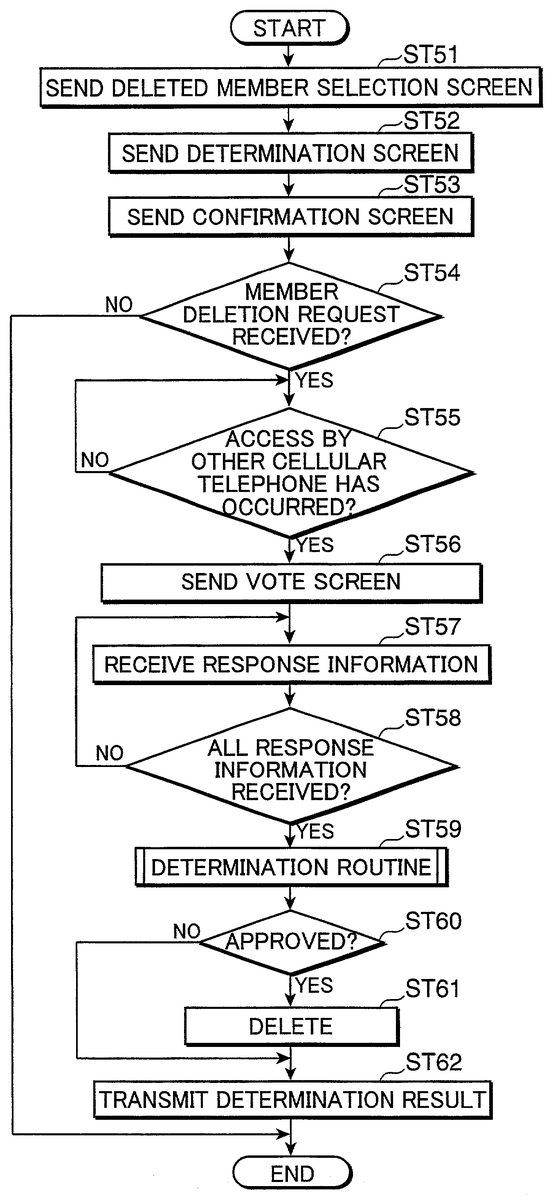
FIG. 22is a flow chart showing the sequence of the member information deletion routine,FIG. 23is an example of an image cycling where ‘Complain about member’ is selected from the band menu screen610, andFIGS. 24 through 26are examples of screens transmitted to the cellular telephones2.
First, when the main menu screen600shown inFIG. 23is displayed by the game progress processor100and ‘Band menu’ is selected from this main menu screen600, the band menu screen (request item selection screen)610is displayed. If ‘Complain about member’ is selected from the band menu screen610, the deleted member selection screen611is transmitted by the member information deletion processor111to the cellular telephone2(ST51), and is displayed on the monitor202of the cellular telephone2. In this deleted member selection screen611, a display is shown by which to complain about a member. Here, items to enable the player to select the member the player wants to delete, such as ‘User A (vocals)’, ‘User B (bass)’ and ‘User C (drums)’ are displayed, and the player's selection is received. If any of the items is selected, the determination screen612is transmitted by the member information deletion processor111(ST52) and displayed on the monitor202. The determination screen612is a screen that is transmitted when ‘User A (vocals)’ is selected from the deleted member selection screen611, and here, if ‘No’ is selected, the routine ends and the screen reverts to the band menu screen610. If ‘Yes’ is selected here, the confirmation screen613by which the contents displayed on the determination screen612are confirmed are transmitted to the cellular telephone2by the member information deletion processor111(ST53) and displayed on the monitor202. A member deletion request is then transmitted from the cellular telephone2to the game server1and the screen reverts to the band menu screen510. When the game server1receives the member deletion request (YES in ST54), if the next time other members access the game (YES in ST55), the vote screen701(FIG. 24) is transmitted to each of the other members (ST56). The vote screen701is displayed on the monitor202of each cellular telephone2, and either ‘Disagree’ or ‘Agree’ is selected by each player and received as response information by the game server1(ST57). When all of the response information is received by the game server1(YES in ST58), an approval/denial determination routine is carried out by the member information deletion processor111(ST59). This determination routine is deemed to result in approval where the number of cellular telephones2selecting ‘Agree’ exceeds the number of cellular telephones2selecting ‘Disagree’ (YES in ST60), and upon receiving this approval response, the member information deletion processor111deletes the identifying information for that cellular telephone2from the member information memory170(ST61). If the number of cellular telephones2selecting ‘Disagree’ exceeds the number of cellular telephones2selecting ‘Agree’ in step ST60(NO in ST60), approval is not deemed to result (NO in ST60), and the member information deletion processor111advances to step ST63. For a situation in which the number of ‘Agree’ and ‘Disagree’ responses are equal in the determination routine of step ST59, the winning response can be set beforehand, and in this embodiment, it is set as ‘Disagree’ (not approved). The result of the determination is then transmitted to all of the members of the band by the e-mail transmission unit116(ST62).FIGS. 25 and 26are examples of e-mail screens notifying the players of the determination result. The approval screen702is a screen displayed on the monitors202where the member deletion request has passed, while the denial screen703is a screen displayed on the monitors202where the member deletion request has been denied.
FIG. 27is a flow chart showing the sequence of the member replacement routine,FIG. 28is an example of the screen cycling carried out when ‘Recruit new member’ is selected from the band menu screen610, andFIGS. 29 through 31are examples of screens transmitted to the cellular telephones2.
First, when ‘Recruit new member’ is selected from the band menu screen610inFIG. 28, the admission criteria selection screen621is transmitted to the cellular telephone2by the member replacement processor112(ST71) and displayed on the monitor202. This admission criteria selection screen621displays the fact that a new member is being sought. Here, the displayed admission criteria required for the new member may include such criteria as ‘Anyone is OK’, ‘Average level of 3 or higher’, or ‘Average level of 5 or higher’, and the player's selection thereof is received. When one of the items is selected, the determination screen622is transmitted by the member replacement processor112(ST72). The determination screen622is a screen transmitted when ‘Anyone is OK’ is selected from the admission criteria selection screen621, and where ‘OK’ is thereupon selected, the confirmation of the contents displayed in the determination screen622is transmitted from the cellular telephone2to the game server1, and the screen returns to the band menu screen610. When the game server1receives a member replacement request (YES in ST73), if the next time other members access the game (YES in ST74), the vote screen711(FIG. 29) is transmitted to each of these other members (ST75). The vote screen711is displayed on the monitor202of each cellular telephone2, each player responds by selecting either ‘Disagree’ or ‘Agree’, and the response information is received by the game server1(ST76). When all of the response information is received by the game server1(YES in ST77), an approval/denial determination routine is carried out by the member replacement processor112(ST78). This determination routine is deemed to result in approval where the number of cellular telephones2selecting ‘Agree’ exceeds the number of cellular telephones2selecting ‘Disagree’ (YES in ST79), and upon receiving this approval response, the member replacement processor112selects a cellular telephone2that satisfies the admission criteria and stores the identifying information for the selected cellular telephone2in the member information memory170(ST80). Here, when a cellular telephone2that satisfies the admission criteria is selected, the cellular telephone2that used to belong to that team but was deleted therefrom by the member information deletion processor111in the member information memory170will not be selected once more. If the number of cellular telephones2selecting ‘Disagree’ exceeds the number of cellular telephones2selecting ‘Agree’ in step ST79(NO in ST79), approval is not deemed to result (NO in ST79), and the member replacement processor112advances to step ST81. For a situation in which the number of ‘Agree’ and ‘Disagree’ responses are equal in the determination routine of step ST78, the winning response can be set beforehand, and in this embodiment, if the number of ‘Agree’ and ‘Disagree’ responses are equal, the winning response is set as ‘Disagree’ (not approved). The result of the determination is then transmitted to all of the members of the team by the e-mail transmission unit116.FIGS. 30 and 31are examples of e-mail screens notifying the players of the determination result. The approval screen712is a screen displayed on the monitors202where the member replacement request has passed, while the denial screen713is a screen displayed on the monitors202where the member replacement request has been denied.
FIG. 32is a flow chart showing the sequence of the team breakup routine,FIG. 33is an example of the screen cycling that occurs when ‘Suggest breakup’ is selected from the band menu screen610, andFIGS. 34 through 36are examples of screens transmitted to the cellular telephones2.
First, when ‘Suggest breakup’ is selected from the band menu screen610inFIG. 33, the team breakup determination screen631is transmitted to the cellular telephone2by the team breakup processor113(ST91) and displayed on the monitor202. This team breakup determination screen631displays a screen seeking confirmation regarding the suggestion that the band break up. Here, if ‘No’ is selected, and the screen returns to the band menu screen610. If ‘Yes’ is selected, the confirmation screen532is transmitted by the team breakup processor113(ST92) and displayed on the monitor202. If ‘OK’ is selected from the confirmation screen632, the confirmation of the contents displayed in the determination screen632is transmitted from the cellular telephone2to the game server1, and the screen returns to the band menu screen610. When the game server1receives a team breakup request (YES in ST93), the vote screen721(seeFIG. 34) is transmitted (ST95) to each of the other members the next time they access the game. The vote screen721is displayed on the monitor202of each cellular telephone2, each player responds by selecting either ‘Disagree’ or ‘Agree’, and the response information is received by the game server1(ST96). When all of the response information from the cellular telephone2is received by the game server1(YES in ST97), an approval/denial determination routine is carried out by the team breakup processor113(ST98). This determination routine is deemed to result in approval where the number of cellular telephones2selecting ‘Agree’ exceeds the number of cellular telephones2selecting ‘Disagree’ (YES in ST99), and upon receiving this approval response, the team breakup processor113deletes the identifying information for the cellular telephones2of all of the team members from the member information memory170(ST100). If the number of cellular telephones2selecting ‘Disagree’ exceeds the number of cellular telephones2selecting ‘Agree’ in step ST99, approval is not deemed to result (NO in ST99), and the team breakup processor113advances to step ST101. For a situation in which number of ‘Agree’ and ‘Disagree’ responses are equal in the determination routine of step ST98, the winning response can be set beforehand, and in this embodiment, if the number of ‘Agree’ and ‘Disagree’ responses are equal, the winning response is set as ‘Disagree’ (not approved). The result of the determination is then transmitted to the cellular telephones of all the members of the team by the e-mail transmission unit116(ST101).FIGS. 35 and 36are examples of e-mail screens notifying the players of the determination result. The approval screen722is a screen displayed on the monitors202where the team breakup request has passed, while the denial screen723is a screen displayed on the monitors202where the team breakup request has been denied.
FIG. 37is a flow chart showing the sequence of the quit team routine,FIG. 38is an example of the screen cycling that occurs when ‘Quit team’ is selected from the band menu screen610, andFIG. 39is an example of the screen transmitted to the cellular telephones2.
First, when ‘Quit team’ is selected from the band menu screen610inFIG. 38, the quit team determination screen641is transmitted to the cellular telephone2by the quit team processor114(ST111), and a message seeking confirmation that the player wishes to quit the team is displayed in the quit team determination screen641. If ‘No’ is selected here, the screen returns to the band menu610. If ‘Yes’ is selected, the player is deemed to quit the band of which he or she has been a member and the determination screen642is transmitted by the quit team processor114(ST112). If ‘OK’ is selected here, the confirmation of the contents displayed on the confirmation screen642is transmitted from the cellular telephone2to the game server1(ST113), and the screen returns to the band menu screen610. The quit team processor114then deletes the identifying information for that cellular telephone2from the member information memory170(ST114). In this case, responses are not sought from the other members, and the e-mail screen731(FIG. 39) on which the fact that the player has quit the team is sent in the form of an e-mail to the other members of the band by the e-mail transmission unit141(ST115).
The present invention may also be employed in various applications as described below.
(A) This embodiment described a situation in which a band was formed as a team, but the present invention may also be applied in a game in which the team comprises a chorus or a baseball or soccer team, or any other game in which multiple terminal devices comprise a single team. In this case, a more versatile network game can be provided.
(B) This embodiment described a situation in which the selection and arrangement of an incoming call tone melody were determined based on the player's individual evaluation parameter values, but it is also acceptable if only one of these processes is performed. Where only the selection of an incoming call tone melody is performed, the arrangement process becomes unnecessary. Where only the arrangement process is performed with regard to an incoming call tone melody, the capacity of the memory used to store the incoming call tone melody can be reduced.
(C) This embodiment described a situation in which one incoming call tone melody was provided, but it is also acceptable if two or more incoming call tone melodies are provided. In this case, the number of melodies provided based on the player's individual evaluation parameter values can also be changed, which increases the complexity of the game and makes it more interesting.
(D) This embodiment described a situation in which the terminal device comprised a mobile communication device, particularly a cellular telephone2, but the present invention is not limited to this implementation, and terminal device may also comprise a personal computer or other apparatus that is equipped with a modem connected to a network (wired or wireless) such as public telephones, the Internet or e-mail, as well as with a monitor and key operation unit. In the case of a personal computer, image information that is compressed in JPEG or other format can be transmitted and received, enabling the amount of game data to be increased, thereby increasing the applicability of the present invention in various types of games.
(E) This embodiment described a situation in which the player's proposals involved selection from among multiple choices, but the present invention is not limited to this implementation, and it is also acceptable if the player inputs text directly. In this case, the complexity of the game increases, making the game more interesting.
In summary, the present invention relates to a game server that transmits and receives information to and from a plurality of terminal devices over a network. The game server of this invention comprises: a memory; member information processing means for associating identifying information regarding three or more terminal devices and for storing the associated information as a team; member information deletion means for transmitting a member deletion request regarding one terminal device belonging to the team from the another one of said terminal devices belonging to said team to the other terminal devices belonging to said team and for deleting the identifying information of said one of the terminal device from said memory based on the responses from each terminal device in regard to said member deletion request; and member replacement means for transmitting a member admission request from one terminal device belonging to said team to the other terminal devices belonging to said team, selecting a terminal device that does not belong to said team and satisfies admission criteria included in said member admission request based on the responses from the other terminal devices to said member admission request, and for storing the identifying information regarding the selected terminal device in said memory as a member of said team.
According to the aforementioned structures, identifying information regarding three or more terminal devices from among a plurality of terminal devices previously registered as members is associated together and stored in a prescribed memory as a team. A member deletion request is transmitted from one terminal device belonging to the team regarding which identifying information is associated together, to the terminal devices of the other members to the team, seeking deletion of another terminal device stored in the memory as a member of the team. Based on the responses of each terminal device to this member deletion request, the identifying information regarding the other terminal device is deleted from the memory. Following this deletion processing, a member admission request seeking the admission of a new terminal device as a member of the team to replace the terminal device deleted from the memory is sent by a terminal device belonging to the team to the other terminal devices belonging to the team. Based on the responses of each terminal device to this member admission request, a terminal device that satisfies the admission criteria included in the member admission request is selected from among terminal devices that are not registered in the memory and do not belong to the team, and the identifying information regarding the selected terminal device is stored in the memory as a team member. In this way, a player having a different game intention or a player with a low skill level can be removed from the team and a new member having the same game intention or a member with a high skill level can be admitted to the team. Accordingly, a member having a different game intention or a member with a low skill level can be removed from the team and a new member can be admitted to the team. In this way, the members comprising the team can be replaced, such that the game may be played with members having the same game intentions, making the game more interesting.
The above described server may further include reference means that enables reference to the game histories of the other terminal devices belonging to the team. According to this construction, players can refer to the game histories of the other members of the team, such as the skill levels assigned to each player on the team. Accordingly to the invention described, because the game histories of other members of the team can be consulted, they can be referred to when deleting players as members.
In the above described invention, the member information deletion means can be set to carry out the determination regarding whether or not to grant the member deletion request based on the principle of majority vote. According to this construction, because the determination regarding whether or not to grant a member deletion request is made based on the principle of majority vote, the desires of team members can be reflected in a member deletion determination. Accordingly, because desires of team members can be reflected in a member deletion determination, the game is made more interesting.
In the above described invention, the member replacement means can be set to carry out the determination regarding whether or not to grant a new member admission request based on the principle of majority vote. According to this construction, because the determination regarding whether or not to grant a member replacement request (the new member admission request) is made based on the principle of majority vote, the desires of team members can be reflected in a member replacement determination. Accordingly, because desires of team members can be reflected in a member replacement determination, the game is made more interesting.
The invention described above may further include an e-mail transmission means that transmits the result of a determination to the terminal devices belonging to the team via e-mail. According to this construction, the result of a determination can be transmitted to the terminal devices belonging to the team via e-mail. Accordingly, because the result of a determination can be transmitted to the terminal devices belonging to the team members via e-mail, the players can confirm the result of a member deletion request or a member replacement request.
In the invention described above, a plurality of admission criteria can be prepared in advance for possible selection. According to this construction, because the selected admission criterion is added by being selected from among a plurality of admission criteria, members that are desired by the players can be admitted to the team. Accordingly, because a member desired by a player can be added to the team, and players' desires can be taken into account, team members can be replaced by members having the same intentions, making the game more interesting.
In the invention, the member replacement means preferably prevent the selection of the terminal device that was deleted by the member information deletion means. According to this construction, because the selection of the terminal device that was deleted by the member information deletion means is prevented, a deleted terminal device can no longer join the same team again. Accordingly, because a deleted terminal device can no longer join the same team again, a new player is certain to be registered.
In the invention, the terminal devices that constitute a team are preferably each assigned different roles. According to this construction, because a role is assigned to each terminal device and a team is composed of a prescribed number of terminal devices that fulfill different roles, terminal devices that perform the same roles no longer exist on the same team. Accordingly, because terminal devices that perform the same roles no longer exist on the same team, individual players' roles are firmly established, making the game more interesting.
The present invention relates also to a recording medium for storing a game action control program wherein a game server connected to a network and on which a game is played by teams via the transmission and receipt of information over the network between said server and the plurality of terminal devices that constitute a team in which said action control program comprising the steps of: causing said game server to associate together identifying information regarding three or more terminal devices and to store said associated identifying information in memory as one team; causing said game server to transmit a member deletion request regarding one terminal device belonging to the team from the another one of said terminal devices belonging to said team to the other terminal devices belonging to said team and to delete the identifying information of said one of the terminal device from said memory based on the responses from each terminal device in regard to said member deletion request; and causing said game server to transmit a member admission request from one terminal device belonging to said team to the other terminal devices belonging to said team, select a terminal device that does not belong to said team and satisfies admission criteria included in said member admission request based on the responses from the other terminal devices to said member admission request, and to store the identifying information regarding the selected terminal device in said memory as a member of said team.
According to this construction described in the above, identifying information regarding three or more terminal devices from among a plurality of terminal devices previously registered as members is associated together and stored in a prescribed memory as a team. A member deletion request is transmitted from one terminal device belonging to the team regarding which identifying information is associated together, to the terminal devices of the other members to the team, seeking deletion of another terminal device stored in the memory as a member of the team. Based on the responses of each terminal device to this member deletion request, the identifying information regarding the other terminal device is deleted from the memory. Following this deletion processing, a member admission request seeking the admission of a new terminal device as a member of the team to replace the terminal device deleted from the memory is sent by a terminal device belonging to the team to the other terminal devices belonging to the team. Based on the responses of each terminal device to this member admission request, a terminal device that satisfies the admission criteria included in the member admission request is selected from among terminal devices that are not registered in the memory and do not belong to the team, and the identifying information regarding the selected terminal device is stored in the memory as a team member. In this way, a player having a different game intention or a player with a low skill level can be removed from the team and a new member having the same game intention or a member with a high skill level can be admitted to the team. Accordingly, a member having a different game intention or a member with a low skill level can be removed from the team and a new member can be admitted to the team. In this way, the members comprising the team can be replaced, such that the game may be played with members having the same game intentions, making the game more interesting.
Furthermore, the present invention relates to a network game action control method that enables communication of information between a server and a plurality of terminal devices over a network, in which said method comprising the steps of: associating identifying information regarding three or more terminal devices and for storing the associated information in a memory of said server as a team; transmitting a member deletion request regarding one terminal device belonging to the team from the another one of said terminal devices belonging to said team to the other terminal devices belonging to said team and for deleting the identifying information of said one of the terminal device from said memory based on the responses from each terminal device in regard to said member deletion request; and transmitting a member admission request from one terminal device belonging to said team to the other terminal devices belonging to said team, selecting a terminal device that does not belong to said team and satisfies admission criteria included in said member admission request based on the responses from the other terminal devices to said member admission request, and for storing the identifying information regarding the selected terminal device in said memory as a member of said team.
According to this construction, identifying information regarding three or more terminal devices from among a plurality of terminal devices previously registered as members is associated together and stored in a prescribed memory as a team. A member deletion request is transmitted from one terminal device belonging to the team regarding which identifying information is associated together, to the terminal devices of the other members to the team, seeking deletion of another terminal device stored in the memory as a member of the team. Based on the responses of each terminal device to this member deletion request, the identifying information regarding the other terminal device is deleted from the memory. Following this deletion processing, a member admission request seeking the admission of a new terminal device as a member of the team to replace the terminal device deleted from the memory is sent by a terminal device belonging to the team to the other terminal devices belonging to the team. Based on the responses of each terminal device to this member admission request, a terminal device that satisfies the admission criteria included in the member admission request is selected from among terminal devices that are not registered in the memory and do not belong to the team, and the identifying information regarding the selected terminal device is stored in the memory as a team member. In this way, a player having a different game intention or a player with a low skill level can be removed from the team and a new member having the same game intention or a member with a high skill level can be admitted to the team. Accordingly, a member having a different game intention or a member with a low skill level can be removed from the team and a new member can be admitted to the team. In this way, the members comprising the team can be replaced, such that the game may be played with members having the same game intentions, making the game more interesting.
This application is based on Japanese patent application serial no. 2001-133451, filed in Japan Patent Office on Apr. 27, 2001, the contents of which are hereby incorporated by reference.
Although the present invention has been fully described by way of example with reference to the accompanying drawings, it is to be understood that various changes and modifications will be apparent to those skilled in the art. Therefore, unless otherwise such changes and modifications depart from the scope of the present invention hereinafter defined, they should be construed as being included therein.
Claims
- A game server that transmits and receives information to and from a plurality of terminal devices over a network, said game server comprising: a memory;member information processing means for associating identifying information regarding a first, a second and a third terminal device from said plurality of terminal devices;said member information processing means storing, as a team, the associated information in said memory from said first, second and third terminal devices;member information deletion means for transmitting a member deletion request regarding said first terminal device from said second terminal device to said third terminal device;said member information deletion means deleting the identifying information of said first terminal device from said memory responsive to an agreement to delete said first terminal device from said second and third terminal devices;and member replacement means for transmitting an admission criteria selection screen to one terminal device of said team responsive to said one terminal device requesting an admission of another terminal device into said team, said another terminal device not belonging to said team, said another terminal device satisfying admission criteria included in said member admission request, said admission criteria being defined by a plurality of criteria;said member replacement means transmitting a member admission request from said one terminal device to other terminal devices on said team responsive to an agreement to admit another terminal device by said team;said member replacement means selecting a fourth terminal device from said plurality of terminal devices responsive to member selection criteria provided from the other terminal devices;and said member replacement means storing the identifying information regarding the fourth terminal device in said memory as a member of said team.
- The game server according to claim 1 , further comprising reference means for enabling reference to game histories of the other terminal devices belonging to said team.
- The game server according to claim 1 , wherein said member information deletion means carries out determination regarding whether or not to grant the member deletion request based on a principle of majority vote.
- The game server according to claim 1 , wherein said member replacement means carries out determination regarding whether or not to grant the member admission request based on a principle of majority vote.
- The game server according to claim 1 , further comprising an e-mail transmission means for transmitting the result of said determination to the terminal devices belonging to said team via e-mail.
- The game server according to claim 1 , wherein said plurality of said admission criteria is selectable from criteria prepared in advance.
- The game server according to claim 1 , wherein said member replacement means prevents the selection of the terminal device that was deleted by the member information deletion means.
- The game server according to claim 1 , wherein the terminal devices that constitute a team are each assigned different roles.
- The game server of claim 1 , wherein said member replacement means transmits a vote screen from said game server to the other team terminal devices, said member replacement means receiving votes for the admission criteria from said other team terminal devices.
- The game server of claim 1 , wherein said member information deletion means sends a vote screen to said third team terminal device for identifying said second team terminal device as the terminal sending said member deletion request.
- A recording medium for storing a game action control program, wherein a game server connects over a network to a plurality of terminal devices, said plurality of terminal devices defining one or more teams, said game being played on said server by said teams by transmitting and receiving information over the network between said server and said teams, said action control program causing said game server to perform steps, said steps comprising: associating identifying information regarding a first, a second and a third terminal device from said plurality of terminal devices;storing, as one team, said associated identifying information in a memory;transmitting a member deletion request regarding said first terminal device from said second terminal device to said third terminal device;deleting the identifying information of said first terminal device from said memory responsive to an agreement to delete said first terminal device from said second and third terminal devices;transmitting an admission criteria selection screen to one terminal device of said team responsive to said one terminal device requesting an admission of another terminal device into said team, said another terminal device not belonging to said team, said another terminal device satisfying admission criteria included in said member admission request, said admission criteria being defined by a plurality of criteria;transmitting a member admission request from said one terminal device to other terminal devices on said team responsive to an agreement to admit another terminal device by said team;selecting a fourth terminal device from said plurality of terminal devices responsive to member selection criteria provided other terminal devices;and storing the identifying information regarding the fourth terminal device in said memory as a member of said team.
- A network game action control method for enabling communication of information between a server and a plurality of terminal devices over a network, said method comprising the steps of: associating identifying information regarding a first, a second and a third terminal device from said plurality of terminal devices;storing, as a team, the associated information for said first, second and third terminal devices in a memory of said server;transmitting a member deletion request regarding said first terminal device from said second terminal device to said third terminal device;deleting the identifying information of said first terminal device from said memory responsive to an agreement to delete said first terminal device from said second and third terminal devices;transmitting an admission criteria selection screen to one terminal device of said team responsive to said one terminal device requesting an admission of another terminal device into said team, said another terminal device not belonging to said team, said another terminal device satisfying admission criteria included in said member admission request, said admission criteria being defined by a plurality of criteria;transmitting a member admission request from said one terminal device to other terminal devices on said team responsive to an agreement to admit another terminal device by said team;selecting a fourth terminal device from said plurality of terminal devices responsive to member selection criteria provided from the other terminal devices;and storing the identifying information regarding the fourth terminal device in said memory as a member of said team.
- A game server for transmitting and receiving information to and from a plurality of terminal devices over a network, said game server comprising: a memory;member information processing means for associating identifying information regarding a first, a second and a third terminal device from said plurality of terminal devices;said member information processing means staring, as a team, the associated information in said memory;reference means for enabling any of said terminal devices to refer to game histories of the other terminal devices on said team for deciding whether to execute one of a member deletion or a member replacement;member information deletion means for transmitting a member deletion request regarding said first terminal device from said second terminal device to said third terminal device;said member information deletion means deleting the identifying information of said first terminal device from said memory responsive to an agreement to delete said first terminal device from said second and third terminal devices;member replacement means for transmitting an admission criteria selection screen to one terminal device of said team responsive to said one terminal device requesting an admission of another terminal device into said team, said another terminal device not belonging to said team, said another terminal device satisfying admission criteria included in said member admission request, said admission criteria being defined by a plurality of criteria;said member replacement means transmitting a member admission request from said one terminal device to other terminal devices on said team responsive to an agreement to admit another terminal device by said team;said member replacement means selecting a fourth terminal device from said plurality of terminal devices responsive to member selection criteria provided from the other terminal devices;and said member replacement means storing the identifying information regarding the fourth terminal device in said memory as a member of said team.
- The game server according to claim 1 , wherein said team is a band and each of said terminal devices plays a specific part in said band,
- A game server for, transmitting and receiving information to and from a plurality of terminal devices over a network, said game server comprising;a memory;member information processing means for associating identifying information regarding a first, a second and a third terminal device from said plurality of terminal devices;said member information processing means storing, as a team, the associated information in said memory;reference means for enabling any of said terminal devices to refer to game histories of the other terminal devices on said team in order to decide whether or not to execute one of a member deletion or a member replacement;member information deletion means for transmitting a member deletion request regarding said first terminal device, which concurrently is actively involved in playing the game with the team, from said second terminal device to said third terminal device;said member information deletion means deleting the identifying information of said one of the terminal device from said memory responsive to an agreement to delete said first terminal device from said second and third terminal devices;member replacement means for transmitting an admission criteria selection screen to one terminal device of said team responsive to said one terminally device requesting an admission of another terminal device into said team, said another terminal device not belonging to said team, said another terminal device satisfying admission criteria included in said member admission request, said admission criteria being defined by a plurality of criteria;said member replacement means transmitting a member admission request from said one terminal device to other terminal devices on said team responsive to an agreement to admit another terminal device by said team;said member replacement means selecting a fourth terminal device from said plurality of terminal devices responsive to member section criteria provided from the other terminal device;and said member replacement means storing the identifying information regarding the fourth terminal device in said memory as a member of said team.
Disclaimer: Data collected from the USPTO and may be malformed, incomplete, and/or otherwise inaccurate.