U.S. Pat. No. 7,300,056
SYSTEM AND METHODS FOR RANDOMIZING PLAYING INSTRUMENTS FOR USE IN ONLINE GAMING
AssigneeGIOIA Systems, LLC
Issue DateAugust 24, 2006
Illustrative Figure
Abstract
Aspects of the present invention provide systems and methods relating to online gaming utilizing virtual playing instruments generated from physical playing instruments. According to one aspect of the invention, physical playing instruments are utilized in a gaming environment that may be scrambled, shuffled, and/or played remotely over a network. In one embodiment, the physical playing instruments are traditional poker-style gaming playing cards. The playing instruments include at least one identifier that may be read upon being dealt, such as identified and stored on a computer-readable medium before a game. In one such embodiment, computer-executable instructions may utilize the information on the computer-readable medium in conjunction with one or more games. Further aspects relate to validating the playing instruments and/or systems before, during, and/or after conducting one or more games with the playing instruments.
Description
DETAILED DESCRIPTION OF THE INVENTION Introduction FIG. 1ais a flowchart depicting one exemplary method of preparing a virtual set of playing instruments. As one skilled in the art will appreciate, the exemplary method may be performed with a variety of gaming systems; however, to aid the reader in understanding the invention, the method of playing the exemplary card game will be shown by way of illustrating the exemplary embodiments disclosed inFIGS. 2-9. Moreover, the disclosed methods may comprise more or fewer steps, as it is understood the exemplary steps illustrate just one embodiment. As shown inFIG. 1a, a plurality of playing instruments, such as cards, may be introduced into a closed system (step100). As used herein, a “closed system” relates to one or more devices that are configured to conduct one or more processes without direct human intervention. In one embodiment, the closed system may be tamper-resistant or tamper-proof, wherein direct human intervention may cause the system to cease one or more operations and even reset operation. In yet another embodiment, direct human intervention may initiate the transmittal of an error message to one or more players, operators and/or third-parties. One skilled in the art will readily appreciate that a plurality of cards may be introduced through a variety of processes. In one embodiment, an unopened deck of playing cards sealed in polyurethane or cellophane wrapping is fed in to the system. In one such embodiment, any covering, such as a plastic wrapping may be mechanically removed, and the cards subsequently removed from a container, such as a cardboard box without direct human contact with the cards. Optional step101may then be initiated. In step101, at least a portion of the plurality of cards introduced in step100are validated. In one embodiment, a card reader may be utilized to rapidly determine the ...
DETAILED DESCRIPTION OF THE INVENTION
Introduction
FIG. 1ais a flowchart depicting one exemplary method of preparing a virtual set of playing instruments. As one skilled in the art will appreciate, the exemplary method may be performed with a variety of gaming systems; however, to aid the reader in understanding the invention, the method of playing the exemplary card game will be shown by way of illustrating the exemplary embodiments disclosed inFIGS. 2-9. Moreover, the disclosed methods may comprise more or fewer steps, as it is understood the exemplary steps illustrate just one embodiment.
As shown inFIG. 1a, a plurality of playing instruments, such as cards, may be introduced into a closed system (step100). As used herein, a “closed system” relates to one or more devices that are configured to conduct one or more processes without direct human intervention. In one embodiment, the closed system may be tamper-resistant or tamper-proof, wherein direct human intervention may cause the system to cease one or more operations and even reset operation. In yet another embodiment, direct human intervention may initiate the transmittal of an error message to one or more players, operators and/or third-parties. One skilled in the art will readily appreciate that a plurality of cards may be introduced through a variety of processes. In one embodiment, an unopened deck of playing cards sealed in polyurethane or cellophane wrapping is fed in to the system. In one such embodiment, any covering, such as a plastic wrapping may be mechanically removed, and the cards subsequently removed from a container, such as a cardboard box without direct human contact with the cards.
Optional step101may then be initiated. In step101, at least a portion of the plurality of cards introduced in step100are validated. In one embodiment, a card reader may be utilized to rapidly determine the validity of the cards. The card reader may determine the identity of the plurality of cards based on the presence of at least one identifier. As shown inFIG. 2, card208has a plurality of identifiers210a,210b. As used herein, an identifier can be any marking, attribute, and/or property of a card used in conjunction with a card reader, such as card reader206to identify the card. In one embodiment, the identifier contains information such as a source code for determining which deck or subset of cards the card originated from. For example, identifier210amay comprise a scannable code, such as a bar code that is readable by card reader206. Yet in other embodiments, reader206may be an RFID reader configured to read identifier210b. In still yet other embodiments, the identifier210amay comprise at least one physical alteration to the card, such as for example, a notch, groove, or extrusion that may be used with card reader206to identify the card. In still yet another embodiment, the identifier comprises a picture and/or text that is readable with a camera.
The identifiers210a,210bmay comprise a plurality of information, such as but not limited to: a numerical value of the card and the “suit” (i.e., club, spade, heart) or other subset classification of the card. Indeed, in one embodiment, the identifier210amay also aid in ensuring the fairness and accuracy of the game. In one embodiment incorporating step101, a card reader may read one or more decks of cards. In one embodiment, a video image may be taken of each card to confirm the cards within the deck are in sequential order as generally found in new decks of cards. In yet another embodiment, a non-image identifier may be used to determine the sequential ordering of the cards. This method may be used, for example, to determine all 52 cards of a deck are present, there are no double cards, and/or that no invalid cards are present.
Step101may also be used for multi-deck systems, such as when conducting multi-deck Blackjack. For example, identifier210amay comprise information regarding the origination of the dealt card. For example, if 3 decks are utilized for a particular game, one identifier, for example, identifier210a, may comprise information regarding which deck the card originated from to ensure that fewer or more than 3 decks were not being used and/or became improperly combined. For example, if a game is utilizing decks 001, 002, and 003, the card reader206may be configured to discard any card not from decks 001, 002, and 003. In yet another embodiment, the detection of cards not belonging to decks 001, 002, and 003 may cause the termination of the current game and a new deck or decks of cards will be shuffled to initiate a new game. In yet another embodiment, identifiers may be utilized to determine the number of times a particular card or deck of cards have been previously used. For example, in one embodiment, after a deck of cards has been used 100 times, that deck of cards is removed from the closed system and a new deck of cards is introduced. In still yet another embodiment, the identifying information retrieved from an identifier, such as identifier210amay be stored in an electronic medium for later analysis (as described below).
In one embodiment, step102may be initiated to scramble at least a portion of the plurality of cards before the completion of the validation step101. For example, one or more identifiers, such as identifiers (210a,210b) may be scanned or otherwise read or recorded as the card is being transported to a scrambling device (such as shown inFIG. 5). In one such embodiment, if a card is found invalid, the scrambling step, such as step102may be aborted and the cards are physically removed from the system. For example, as shown in the illustrative embodiment, step103may be implemented even before a single card is scrambled, such as in step102. In one such embodiment, if step103determines at least one card is not valid, step105may be implemented to remove at least a portion of the plurality of cards.
In one embodiment, a transport mechanism is utilized to transport the plurality of cards through the closed system. The transport mechanism may have two or more “stops”, wherein if a card is determined not be be valid, the first stop of the transport mechanism is utilized, and the cards are “dumped” or discarded from the closed system, wherein if the cards are determined to be valid, the second stop may be utilized. In one such embodiment, the second stop may be a shuffling mechanism, such as may be utilized in step104. One skilled in the art will readily appreciate that step103may be initiated before, during, or after any step prior to actually using the data obtained from the card, such as may be retrieved from the identifier(s) (210a,210b), in an actual game.
In step102, a plurality of cards may automatically be scrambled. While some semi-automated card shufflers quickly shuffle one or more decks of cards, this does not adequately recreate live play, which often may include a manual scrambling procedure by the dealer. Indeed, those skilled in the art readily understand that even a good shuffling device cannot truly randomize cards as only the cards actually displaced by the shuffler actually are re-arranged, thereby leaving the majority of the cards in the same order as before entering the shuffling device. Scrambling, also referred to as washing, is considered a more thorough randomizing technique where a person places the cards (generally face down) over a surface, such as a table, and randomly spreads the cards over the surface in a random fashion. By increasing the randomness of the ordering of the cards, players are more likely to trust the game.
Step102may be fully automated, therefore allowing for remote operation and, as discussed above, increase the trustworthiness of the process by preventing direct human intervention. The structure and operation of exemplary scrambling devices that may be used in one or more embodiments of the invention are more fully described in relation toFIGS. 5-9. Scrambling step102may be used in conjunction with one or more shuffling steps, such as shuffling step104. Step104involves the physical movement of a plurality of cards, such as deck of cards202, as shown inFIG. 2. Step104may be performed through mechanical or electrical mechanisms; however, the cards are physically shuffled. Therefore, the final order of the cards is not determined solely by a random number generator or algorithm. One skilled in the art will realize that one or more embodiments may utilize an algorithm to determine the longevity of the shuffle or the like, however, the final order of the cards cannot be accurately predicted upon applying one predetermined algorithm. Moreover, one skilled in the art will readily appreciate that a scrambling step, such as step102may occur without a shuffling step, such as step104. In yet other embodiments, the number of shuffles occurring in step104may vary from one instance to the next. In one embodiment, the use of a scrambling step may reduce the number of shuffling instances in step104. Likewise, an increase in shuffling instances may reduce the duration of a scrambling step.
Shuffling device204ofFIG. 2illustrates one exemplary automatic shuffling device according to one embodiment of the present invention that may be used to perform step104. In one embodiment, the shuffling device204is configured to house a plurality of gaming instruments, such as standard poker playing cards. In other embodiments, the shuffling device is configured to house odd shaped or three-dimensional “cards”, such as balls. Indeed, one embodiment of the invention may utilize a chamber to house the cards, wherein pressurized air is introduced into the chamber having the plurality of cards. As used herein, pressurized air may include but is not limited to: gas(es) under pressure as compared with the ambient pressure, forced gas(es) at either standard or elevated pressure that is traveling at a higher velocity than ambient air, and combinations thereof. The pressurized air may alter the arrangement of the plurality of cards in a random fashion. This method of shuffling is especially advantageous when utilizing three-dimensional cards, such as balls. In one embodiment, the cards are shuffled for a predetermined length of time, whereas in another embodiment, a user input may determine the longevity of the shuffle.
In step106, a card is physically dealt, such as from the deck of cards202. In one embodiment, the top card of the deck will be dealt; however, one skilled in the art will appreciate that other embodiments may draw a card at random. For example, embodiments having balls in a pressurized chamber may be randomly selected. While the cards are physically dealt, select embodiments may not remove the card from the shuffling device. Indeed, in one embodiment having a closed system, such as that described in relation to step101, the card is merely transferred to another section or compartment of the shuffling device204. Yet in other embodiments, the card is dealt from a device that is separate from the shuffling device204. In step108, the identity of the dealt card is determined. In one embodiment, steps106and108may occur substantially simultaneously, wherein the identity of the card is determined as it is physically dealt.
At step110, the identity of each card dealt in step106may be electronically stored on one or more computer readable mediums. The identity of the cards is stored in correlation to the sequence the cards were dealt in. While one skilled in the art will readily appreciate that the identity and sequence information may be stored in any format and arrangement, including but not limited to, plain text, ASCII, and/or a proprietary format, the Applicants have found that storing and retrieving the information in a database, such as Microsoft® Access, provides acceptable results.
In one embodiment, if 52 standard playing cards were dealt and subsequently identified in steps106and108, a database listing for those cards may comprise 52 rows (hypothetically numbered 1 to 52) having at least one column filled with the identifying information for each card, respectively. For example, the card whose information is stored in row 1 of the listing may be considered the top card in the “virtual deck”, wherein the information stored in row 52 of the listing may be considered the bottom card of the “virtual deck”. For purposes of clarity, the terms “database listing” and “listing” are used throughout the Specification to refer to the electronic storage of the dealt cards, but as discussed above, any techniques that allows the electronic recordation of identifying information is contemplated in the scope of the invention.
The one or more computer-readable mediums may be on the same or different computing devices. In one embodiment, at least one computer-readable medium is remote, and may be accessed, for example, by a network configuration, such as network configuration300shown inFIG. 3. In yet another embodiment, the listing may comprise additional information, such as previous usage of the cards, (i.e., the card was a burn card in a specific game in the past).
One embodiment of the invention allows remote operators, players, and regulators to monitor and/or participate in the physical game through a network, such as the World Wide Web.FIG. 3illustrates one possible network configuration (300) having a client/server network setup. In the network configuration300, clients302(1)-302(N) can each request information from a host computer304across a network306. (N represents a whole number.) The client302(1), for example, may send a request across the network306to join a game session. In one embodiment, the request may arrive at the host computer306at a network interface card (NIC)308. From the NIC308, the request can travel along an input/output (I/O) bus310and through a network stack312to web server314running web server software. The web server may also comprise software to allow game play or be electronically connected to a computer-readable medium having the necessary software to allow game play.
The web server314handles the request (including any necessary connection setup and information retrieval) and, if necessary, reads information from a local storage mechanism316such as a buffer or a data cache. The web server314may then return any content requested by the client302(1) to the client302(1), with the content traveling through the network stack312, the I/O bus310, the NIC308, and the network306. Likewise, clients302(1)-302(N) can each send and receive information to each other, such as for example, chatting and/or card information.
Returning toFIG. 1, the identity of each card determined at step108and placed into electronic format, such as the database listing described above, may be validated at step112. In one embodiment, step112may incorporate one or more processes or information from step101. For example, analysis at step112may determine that each card identified in step101has been dealt and stored on the at least one computer-readable medium in step110. Additional analysis may include ensuring that cards not identified in step101are not present within the cards dealt in step106and/or other steps to ensure the validity of the deck. In one embodiment, the determination of validity may be determined from the deck ID information and the card ID that was gathered when the card was identified in step108. In one embodiment, a database listing created at step110may be compared with a database listing created at step101when initially validating the cards to ensure the same cards were dealt in both occasions (albeit in a different sequence).
If at step112, if at least one card is not validated, the operation may send an alert, revert to different processes, terminate the operation, and/or other mechanisms to ensure validity of the game. In one embodiment, the determination that one or more cards may not be valid may cause the process to terminate. In yet another embodiment, one or more error messages may me transmitted to one or more players, operators and/or third-parties. In yet another embodiment, the process may revert to one or more previous steps shown inFIG. 1. For example, step100may be re-initiated, wherein the plurality of cards dealt in step106are discarded and new cards are introduced into the system. As one skilled in the art will appreciate, fewer or additional steps may be taken to prevent unauthorized introduction of cards into the process. If, however, the cards are determined to be valid, step114may occur.
At optional step114, computer-executable instructions may further rearrange the sequence of the cards dealt in step106. For example, in one embodiment, the sequence of the rows may be reversed, such as the card in slot52will then be at the “top” of the virtual deck and the card in slot1may then be considered the “bottom” card of the deck. As one skilled in the art will readily appreciate, each of the 52 cards of a standard deck may be repositioned to each of the 52 rows, thereby creating 2,704 possible arrangements. While one or more algorithms may be utilized in repositioning the cards or determining the duration of repositioning the cards among other factors, an algorithm is not utilized to serve as a random number generator for recreating a “fake” deal, rather the sequence of the dealing of step106is utilized when resorting any sequences.
In step116the identities of the dealt cards are transmitted to at least one user. A user may include, but is not limited to: a third-party who will individually administer a game using the information, such as in the form of the database listing described above and/or a “user” may be a third-party, such as a regulator ensuring accuracy of the game. Transmission may be performed through a variety of mediums, such as the network environment illustrated inFIG. 3. Moreover, the data may be replicated and/or copied to a secure server. In such an example, the original file may be retained in a read-only file that may be utilized for verification purposes, such as one or more validation procedures presented inFIG. 1c.
If, for example, at least one “user” is a third-party who will individually administer a game with the number listing, a copy of the listing produced in step110or114may be transmitted. In one embodiment, the listing is copy-protected to prevent unauthorized access and tampering with the sequence. Moreover, as explained in more detail below, the results of any game conducted with the listing may be validated by an uninterested party, such as being compared with the listing produced instep112or114.
Regardless of the “user”, the administration of a game utilizing the listings described above may be conducted without the need for human scrambling, shuffling, and/or validation. Additionally, one or more card games may be administered without the need for random card generators since the sequence information used for the games is created from the dealing of an actual deck of cards or derived from the dealing of an actual deck of cards.
Further aspects of the invention relate to the utilization of the information gathered in one or steps above, in conjunction with or independent of additional steps or processes, to conduct one or more games. For example, the games may be conducted by the “user” described in step116or by other third parties. The exact administration of the game may depend on the traditional rules of a particular game, and/or local regulations and laws. Specifically regarding the rules of particular games, in some card games, it is customary to allow at least one player to cut the deck, therefore optional step118may be implemented to determine if the game allows cutting and/or other forms of rearrangement of the cards by a player. If the employed embodiment permits a user or player to cut the deck, step120may be implemented to receive an input from a player regarding the cutting of the virtual deck of cards as stored on the computer readable medium, for example, as represented in the database listing.
FIGS. 4aand4bshow exemplary methods of allowing a player to cut or otherwise rearrange the arrangement of virtual cards in the database listing. With reference to bothFIG. 4aandFIG. 4b, a graphical representation of the deck of cards or a portion thereof, such as representation402can be displayed on an output device, such as monitor404operatively connected to a client302(1)-(N). The user may provide an input through an input device to select a location to “cut” the deck. For example, arrow406may be positioned to select a specific card within the graphical representation of the deck of cards402. As seen inFIG. 4a, the graphical representation of the cards portrays a plurality of cards presented to the user “face down”, for example as spread across a flat surface such as a poker table. The graphical representation shown inFIG. 4bportrays a plurality of stacked cards, for example, such as when arranged in a deck. The player may be allowed to choose any individual card within the graphical representation402, wherein each card displayed to the user is electronically mapped to one virtual card stored on the computer-readable medium, such as the database listing. For example, in one embodiment, each graphical representation of a card comprises at least one interactive “pixel point”. The interactive pixel point is selectable by a user-input device, such as a mouse operated by the player. In operation a player may select a pixel point of a specific card within the plurality of cards by navigating a mouse over the pixel point and actively “select” the card by pressing a button on the mouse, thus providing a user-input.
Once selected, the user input may be transmitted through the network, for example as described in relation toFIG. 3, to a computer-readable medium containing the database listing, where the “virtual” deck represented by the rows of the database listing is “cut” according to the user input. Upon being cut, the next sequential card in the listing will be utilized. For example, if the player determines to cut the card represented by the 12throw in the listing, the card represented in the 13throw of the virtual deck will be dealt. In other embodiments, shuffling may occur until a user input is received. In one embodiment, further processes will not occur unless a user input is received in step120. This may be especially advantageous to eliminate the use of automated programs for playing games. In such embodiments, if a player does not provide a user input to select a card to cut, the program may time out, thereby preventing the game to be played. In another embodiment, the player may select button408to provide a user input without being forced to pick a card to cut from the deck. Of course, one skilled in the art will realize that in some games a cut may be desired, and therefore another mechanism may be implemented to ensure an authentic user input is received before beginning the game.
At step122, game play utilizing the listing may be initiated or continued, depending whether step120and/or others steps are utilized. For example, one or more cards may be dealt in sequential order as per the listing. The exact dealing of cards, usage of burn cards, and other factors will depend of the type of game being administered, the number of players, and other variables which may be predetermined by the players, administrators, or a combination thereof. For example, in Draw Poker, the conventional poker hand rankings that are winning combinations are a Royal Flush, a Straight Flush, a Four of a Kind, a Full House, a Flush, a Straight, a Three of a Kind, a Two Pair and a Pair of Jacks or Better, wherein a payout table is established based on the number of coins wagered by the player and the type of poker hand achieved.
One skilled in the art will understand there are many poker formats used in poker. These poker game formats include, but are not limited to: Jacks (or even Tens) or Better Draw Poker, Bonus Poker, Double Bonus Poker, Double Double Bonus Poker, Super Double Bonus Poker, Triple Bonus Poker, Deuces Wild Poker, Jokers Wild Poker, Deuces and Jokers Wild Poker, Texas Holdem Poker, Omaha Hi Poker, Omaha Hi Lo Poker, Stud Poker Hi, and Stud Poker Hi Lo. One skilled in the art will realize that these and other games of the present invention may be played with a wagering system, wherein the wagering system may vary, such as limited and no limit stakes. In yet other embodiments, other traditional card games may be employed, such as Black Jack, Caribbean Stud, or the like. In one embodiment, the system is configured to allow a player to choose among numerous game formats. The player may then make a wager based on upon that choice of game format.
FIG. 1bshows a flowchart depicting one exemplary method of playing a game with the virtual set of playing instruments according to one embodiment of the present invention. To provide an illustrative example of how different game formats be used with the present invention, step124may be implemented at anytime throughout the game subject to rules of the particular game to allow the player to provide an input, for example, to instruct the computer that the player does not wish to be dealt another card. As step126indicates, game play will continue according to the type of game being administered. If, however, the player does provide an input in step124, step128maybe implemented to determine if the additional information regarding card identity is received from the database listing or other file created on a computer-readable medium comprising information about the card identification. If at step128, it is determined that information regarding at least one additional card is required, step130may be initiated to “deal” at least one card according to the database listing.
Returning to step126, game play will resume until it is determined at step132that the game is over. As one skilled in the art will understand, step126may incorporate any of the preceding steps or optional additional steps to continue to the game, such as for example, “redealing” cards according to the database listing or additional database listings, and/or determining when and to whom the dealt cards are displayed to. Moreover, select card games may incorporate one or more “burn” cards. For example, in one embodiment where Texas Hold'em is being played, a burn card may be utilized during one or more rounds of dealing. For example, if the virtual card represented in the 17throw of a database listing is the next sequential card to be dealt, but the game utilizes burn cards, the virtual card represented in the 18throw may be “dealt” to a user. In such an embodiment, the virtual card in the 17throw is skipped over and discarded from the virtual deck similarly to an actual burn card.
Once it is determined game play has ended, for example at step132, one or validation procedures may be initiated.FIG. 1cis a flowchart of one exemplary method of ensuring validity of the game according to one embodiment of the present invention. In one embodiment, step134may compare the identity of each virtual card dealt and/or the sequence the cards were dealt during game play to ensure the validity of the game. Yet in another embodiment, steps to ensure the validity of the game may be transmitted as the game is in progress. In one embodiment, the results are remotely transmitted through a network, such as network configuration300to compare with the original or copy of the file created in step(s)110and/or114. In one such embodiment, the person or persons creating the original file(s) are independent of the person or persons conducting the games to further protect the integrity of the process. In one embodiment, a working copy of a database listing created in step110was utilized during game play in which the results of the cards “dealt”, “burned”, “cut” or otherwise utilized in the game are transmitted to a computer device for comparison. As one skilled in the art will realize, the transmission may be through one or more secure transmission protocols, utilize one or more firewalls, require authorization, and/or include other steps to further ensure the validity of the game.
In another embodiment, optional step136may be initiated to ensure the “pixel point” chosen by one or more players during one or more rounds in fact was properly correlated to the correct location in the database listing or other file that corresponds with the removed virtual card. If, at step138, it is determined the pixel point is not correct, step140may be implemented to send an error message to a player, operator, regulator, and or any party involved in the organization and operation of the game. If, however, at step138, it is determined that the validation in step(s)134and/or136were successful, one or more additional validation steps may be undertaken.
Optional validation procedures may be utilized to validate one or more burn cards (step142), and/or validate that virtual cards dealt during game play were dealt in the correct fashion in accordance to the database listing and/or rules of the game (step146). In each instance, a process may determine if the validation procedure is successful, such as steps144and148, respectively. As seen inFIG. 1c, if one or more of the steps is unsuccessful, an error message, such as presented through step140may be initiated. As one skilled in the art will readily appreciate, different error messages and procedures may be used for different findings of invalidity. For example, a finding that a pixel point was not validated may prompt an automatic analysis of select computer components, switch servers, and/or utilize back up equipment and/or database listings. Yet a finding in step144that a card was not properly burned may prompt analysis of different components and/or prompt notification to one or more different parties. Moreover, one skilled in the art will understand that in addition to the exemplary validation procedures shown in the illustrative embodiment there are numerous additional aspects of card games that may be monitored and checked for validity. In one embodiment of the invention, a validation procedure may terminate with step150, which returns a notification to a party, such as a player of the game, informing them they are the winner of the game, the final score of each player, or other information relating to the outcome of the game that has been validated.
As discussed above in relation to step102, further aspects of the invention relate to fully automated systems and methods for scrambling playing instruments, such as cards, before being dealt to one or more players. Embodiments of an exemplary scrambling device will first be described in terms of a basic structure, and then will be described in terms of exemplary functions.
Structure of Exemplary Scrambling Devices
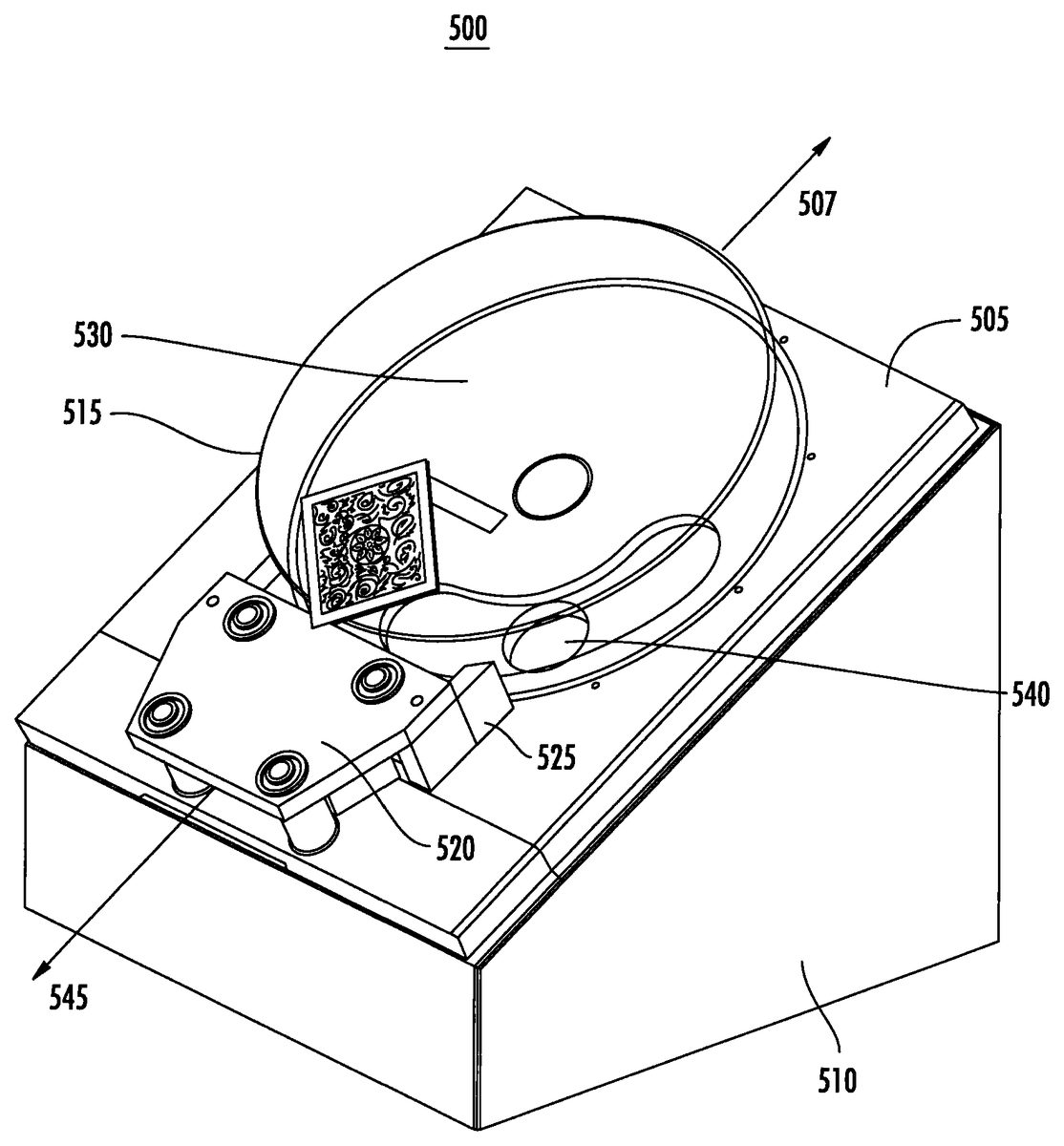
FIG. 5shows a perspective view of a scrambling device according to one embodiment of the invention. Exemplary scrambling device500comprises base plate505. Base plate505may be constructed of any sturdy material, including fabricated metals, such as steel and aluminum, plastics, wood, and synthetic materials. The exact material will depend on a myriad of factors, such as for example, the desired longevity and/or costs. As seen inFIG. 5, the base plate may be positioned atop a housing, such as housing510to place base plate505at an incline in the direction of arrow507. One skilled in the art will readily appreciate the incline may be along any axis, so long as there is an elevated portion of the chamber and a lower portion of the chamber. The exact inclination of base plate505will vary on the shape, size and number of playing instruments to be scrambled, among other factors, however in one embodiment wherein 52 standard playing cards measuring about 2¼ inches wide and about 3½ inches in length are to be scrambled, the inventors have found an angle of about 20 to about 60 degrees to be especially advantageous. In one embodiment, the angle of about 30 degrees provided suitable results. However, one skilled in the art will readily appreciate that other angles may be used.
Mounted on the top of base plate505is scrambling chamber515and aligner520. Illustrative scrambling chamber515is a cylindrical ring constructed of sturdy material that may provide a sidewall when mounted on top of the base plate505. In one embodiment, a transparent plastic based material may be used to further increase the security of the game. Indeed, in one embodiment, players and/or administrators may view the scrambling of the playing cards through the use of a camera or other imaging apparatus. In one embodiment, the top portion of the chamber515is uncovered and may only comprise the upper edges of the sidewall, for example, formed by the cylindrical ring600, shown inFIG. 6, and discussed more below.
While the exemplary chamber515is cylindrical, one skilled in the art will readily appreciate other shapes may be utilized. Moreover, variations in a cylindrical shape, such as grooves or protrusions, may further allow randomization of the playing cards during one or more of the steps described below. The height and the width of the scrambling chamber may vary depending on the size, shape, and number of the playing instruments being scrambled. When scrambling 52 standard playing cards measuring about 2¼ inches wide and about 3½ inches in length, the inventors have found a vertical height of about 0.75 inches to about 2¼ inches to be especially efficient when utilizing scrambling chamber505. Utilizing other sizes may of course change the viable dimensions of the chamber500. For example, in one embodiment using playing cards having two sides and it is desirable not to flip over the cards while in the chamber, the chamber's vertical height should not exceed the shortest dimension (length or width) of the playing cards. Using 52 standard playing cards, the inventors have discovered excellent results utilizing a chamber having a diameter of about 8 inches to about 14 inches.
Looking briefly toFIG. 6, it shows a full-frontal and a frontal perspective view of an exemplary ring structure that may be used in conjunction with a bottom to form a scrambling chamber according to one embodiment of the invention. The exemplary ring structure may be mounted on top of base plate505, thereby creating a canister-like structure where the sides of the canister are created by the ring structure600and the bottom of the canister is created by the base plate505(or a rotating plate mounted thereon, as discussed in more detail below). In the illustrative embodiment, the ring structure is not fully enclosed, but rather has two edges605defining a void and/or opening. In operation, the edges605of the ring structure600may be aligned with the upper left and right protrusions525of aligner520. In this arrangement, the void between edges605allows playing cards to exit to aligner520. (FIG. 9, discussed in more detail below, shows several perspective views of an exemplary aligner according to one embodiment of the invention). However, in another embodiment, the ring structure or any structure forming the sidewalls of the chamber515may be an endless member w/o openings, such as an oval, circle, etc.
In one embodiment, the chamber may have a closable lid or a permanent top that covers at least a portion of the chamber. In yet other embodiments, for example, the chamber illustrated inFIG. 5, there is no cover, but rather the top portion of the chamber is defined by open space formed substantially by the upper perimeter of the sidewalls, such as formed by the ring structure600shown inFIG. 6.
Base plate505may further have a rotating plate rotatably engaged thereon. Exemplary rotating vacuum plate530is about the same diameter of scrambling chamber515. In one embodiment, the base plate505and rotating vacuum plate530are positioned and arranged to introduce and/or remove a gas, such as atmospheric air, into the scrambling chamber.FIG. 7shows a frontal view of one exemplary base plate according to one embodiment of the invention that may be used in conjunction with a rotating plate to further increase the random ordering of the playing cards.
Looking toFIG. 7, exemplary base plate700is substantially planar. The overall shape of the base plate is not significant except that it must be at least as wide as the shuffling chamber, such as chamber515. Base plate700may further include grooves, holes, or protrusions, such as exemplary holes705for mounting the shuffling chamber, such as scrambler ring600onto the base plate700. In embodiments where scrambling ring600is utilized, exemplary mounting locations710may be used to position the two edges605of the scrambling ring in close proximity or in contact with protrusions525of aligner520.
Exemplary base plate700may also comprise one or more vacuum ports, such as vacuum port715that is in operative communication with a vacuum source, such as a DC vacuum motor. In one embodiment, a vacuum port is positioned so that when mounted on housing510, the vacuum port is in close proximity to the aligner520(seeFIG. 5, which shows vacuum port540in close proximity to the aligner520). Exemplary base plate700may also include one or more pressurized ports, such as port720to introduce pressurized air, for example through a DC Motor, to the scrambling chamber. As described above, pressurized air may include but is not limited to: gas(es) under pressure as compared with the ambient pressure, forced gas(es) at either standard or elevated pressure that is traveling at a higher velocity than ambient air, and combinations thereof. Exemplary uses of these ports will be described in more detail below.
The base plate700may also comprise a void, such as hole725for allowing a shaft, crank, or other connecting device to mount and rotate the rotating plate.FIG. 8shows two exemplary views of one rotating plate800that may be used with base plate505and/or700. The plate800may comprise one or more mounting locations, such as mounting holes805for mounting on a shaft, crank, or apparatus for allowing it to spin rotationally in relation to the base plate505or700. While the exemplary mounting location is a hole, those skilled in the art will readily appreciate that any mechanism, such as a clicking locking mechanism may allow connection of the rotating plate. In one embodiment, the vacuum plate800having an integral shaft may be used, thus negating the use for mounting hardware.
Vacuum plate800may also comprise vacuum holes integrated thereon. The location, pattern, and quantity of vacuum holes810may vary depending on the desired air and/or vacuum pressure utilized, the number of cards being scrambled, among other factors. In the illustrative embodiment, there are four groups of holes arranged in a circular fashion around the outer perimeter of the vacuum plate800, such as that when the vacuum plate rotates over the base plate505/700, at least a portion of the holes810in each group pass over the vacuum port715and/or the air port720. In yet other embodiments, the holes810do not pass over the vacuum port715or air port720directly. This may be utilized, for example, when a larger quantity of air pressure or vacuum is utilized or when different amounts of pressure are desired at different locations.
The structure of exemplary aligners, such as aligner520are best understood after an explanation of the functioning of the scrambling device, which is explained below.
Exemplary Functions of Embodiments of the Scrambling Device
In one embodiment of the invention, 52 standard playing cards are fed into the scrambling chamber515/700having a rotating vacuum plate530as a base. In one embodiment, individual cards enter the chamber at a 20 to 60 degree angle in relation to the vacuum plate530. The vacuum plate rotates at a velocity of about 10 to about 80 rpm. In one embodiment, the rotation continues for about 18 seconds. The inventors have found that in one embodiment, all 52 cards are in the scrambling chamber515/700in as little as about 8 seconds. During this time, the vacuum port715and air port720may be activated.
Looking toFIG. 5for reference, playing cards passing over the vacuum port are pulled against the vacuum plate530and are carried from the bottom of the chamber upwards in a circular fashion in the direction of arrow507until the card are at a point approximately at 12 o'clock (the top) in the chamber. Holes located in various positions in the base plate ensure that at least some of the cards positioned against the vacuum plate are grabbed by the vacuum in the vacuum holes (i.e.,810) and carried upward allowing at least a portion of the cards to be in continual motion throughout the cycle. In one such embodiment, once the cards reach the top of the chamber515, gravity and/or another force, such as pressurized air, may then cause the card(s) or portion thereof to fall back towards the bottom of the chamber.
Air pressure may also be introduced into the process, further randomizing the ordering of the playing cards. There are a plurality of methods to introduce air pressure; however, the inventors have found two processes to be especially useful. One skilled in the art will readily appreciate these methods are merely illustrative and that other similar methods are within the scope of the invention. One method uses a DC volume air blower motor capable of delivering about 0.05 to about 1.0 CFM of air into the chamber. It may be positioned anywhere within the chamber. In one embodiment, it is positioned at approximately a position that the playing cards pass over as they rotate from the bottom to the top of the chamber. This air flow forces the cards in the chamber to separate and allows the playing cards falling from the top of the chamber to randomly intermix with the cards at the bottom of the chamber.
Another method, that may be used in conjunction with the above method, other methods, or independently uses compressed air ranging from about 20 to about 80 PSI and may be accomplished by positioning compressed air fittings. In one embodiment, the inventors have found that fittings ranging from 2 to 6 are suitable. It may be positioned anywhere within the chamber. In one embodiment, it is positioned at approximately a position that the playing cards pass over as they rotate from the bottom to the top of the chamber.
Upon completion of the “scramble” cycle, the vacuum plate530may decrease velocity while any air flow and vacuum is reduced or ceases, thus allowing the playing cards to accumulate at the bottom of the chamber. In one embodiment, the air flow and vacuum is substantially discontinued and the vacuum plate slows to approximately 5 rpm. An actuator or other mechanism may then create an exit pathway allowing the cards to leave the chamber. In one embodiment, sensors located at the bottom of the chamber may indicate when all the playing cards have been removed from the chamber at which time all motion in the chamber ceases. In yet another embodiment, aligner520may be used to aid the alignment of the playing cards after being scrambled.
FIG. 9shows perspective views of an exemplary aligner that may be used in conjunction with a scrambling device according to one embodiment of the invention. The exemplary aligner900may be similar to aligner520. As shown inFIG. 9, aligner900comprises an aligner base plate905. Aligner base plate905may be made of any sturdy material as well known to those skilled in the art. Aligner base plate905may be shaped to have or further comprise extensions or protrusions, such as protrusions910. The extensions and/or protrusions910may be shaped or fitted to complement the shape of the scrambling chamber515. For example, the illustrative protrusions910are shaped to coincide with the edges605of ring600. In such an embodiment, aligner base plate905may be in rigid communication with base plate505. Yet in other embodiments, it may be a portion of base plate505.
One or more aligner rollers915may extend from the aligner base plate905in a substantially perpendicular arrangement. As seen inFIG. 9, there are two aligner rollers in a substantially horizontal relationship with each other. The exact distance between the aligner rollers915will vary depending on the intended usage and a myriad of factors known or obvious to those skilled in the art. In one embodiment, the inventors have discovered that a distance of about 2¾ inches between the aligner rollers is suitable for aligning standard playing cards. The inventors have also discovered that a metal axle having a ribbed rubber outer layer also is suitable for the aligner rollers915; however, other materials are within the scope of the invention. As seen in the illustrative embodiment, a distal end of the aligner rollers915may be in rotatable communication with top plate917.
The aligner rollers915may also be in mechanical communication with a motor, such as motor920, which may be a variable speed DC motor. As mentioned above, sensors located at the bottom of the chamber may be included to indicate when no cards remain in the chamber, at which time the motor920may stop rotating aligner rollers915.
Another set of rollers, such as exit rollers925may be horizontally spaced from each other at about 1 to about 2½ inches below the aligner rollers915. In one embodiment, the exit rollers are spaced apart at a distance equal to the width of the cards or playing instruments being used. In one embodiment, the exit rollers925may rotate in opposite directions with respect to each other, where the rotating action feeds cards received from the aligner rollers915out in the general direction of arrow545shown inFIG. 5. In one embodiment, sensors may be positioned to indicate when no playing cards remain in the aligner520/900. In further embodiments, the cards are subsequently stacked or otherwise arranged for further processing. Such processing could include: descrambling, shuffling, or dealing the cards.
While the exemplary embodiment has been discussed in broad terms of a networking environment, the invention, however, may be configured for personal gaming systems, such as Sony® Playstation® or Microsoft® Xbox®, handheld systems such as a Palm® or Treo®, among others, for example, cellular-based applications. In still yet further embodiments, the invention is configured for web-based applications that may be incorporated within or independent of cellular-based applications.
Claims
- An automated method comprising: (a) physically randomizing a plurality of physical playing instruments without the utilization of a random number generator, each playing instrument having at least one identifier, wherein the randomization process includes a scrambling process comprising: (i) introducing a plurality of playing cards in an inclined chamber having a base comprising an elevated portion and a lowered portion, wherein the plurality of playing instruments are introduced with the first side facing down with respect to the base and the second side facing upwards;(ii) introducing a vacuum force upon at least a portion of the lowered portion of the chamber wherein the first side of at least one playing instrument is pulled against the chamber base;and (iii) rotating the chamber, wherein the first side of the plurality of playing instruments remains substantially downward, and the at least one playing instrument pulled against the chamber base rotates at substantially the same velocity as the chamber until rotating to a location within the elevated portion of the chamber that is not substantially proximate to the vacuum force, wherein the first side of the at least one playing instrument ceases to be pulled against the chamber base. (b) electronically determining the identity of at least two physical playing instruments in a sequential order before initiation of a game;and (c) electronically storing the identity of the at least two playing instruments of (b) on one or more computer-readable mediums to create a virtual deck of virtual playing instruments derived from the physical plurality of playing instruments for use in one or more electronic games, wherein the identity of the at least two playing instruments is stored in correlation to the sequence the identities were determined in (b).
- The method of claim 1 , wherein (a) further includes an automated shuffling process.
- The method of claim 2 , further comprising: (d) electronically determining the identity of the at least two playing instruments before (a);and (e) comparing the identity of the playing instruments determined in (d) with the determination of (b) to ensure validity of the playing instruments.
- The method of claim 1 , further comprising: (d) creating at least a second virtual deck of playing instruments from the virtual deck of playing instruments created in (c) by rearranging the ordering of the sequence of the virtual playing instruments within the virtual deck.
- The method of claim 4 , further comprising: (e) validating the second virtual deck of playing instruments against the first virtual deck of playing instruments.
- The method of claim 5 , further comprising: (f) initiating a game according to pre-defined rules that include the distribution of the at least two playing instruments in a sequential order.
- The method of claim 6 , further comprising: (g) comparing the sequential order the at least two playing instruments of the virtual deck were distributed in the game of (f) against the sequential order the playing instruments were stored in (c).
- The method of claim 1 , wherein the plurality of playing instruments have a first side and a second side and further are characterized by a first dimension of substantially about 2.25 inches to about 2.5 inches and a second dimension of about 3.5 inches.
- The method of claim 1 , wherein the scrambling process further comprises: (iv) introducing a pressurized force upon at least a portion of the elevated portion of the chamber wherein the first side of at least one playing instrument passing over the pressurized force is pushed away from the base of the chamber in sufficient force to allow the at least one playing instrument to fall towards the lower portion of the chamber and permit the least one playing instrument to become more distant from at least one proximate second playing instrument.
- An automated system comprising: an automated apparatus configured for physically randomizing a plurality of physical playing instruments in absence of a random number generator, each playing instrument having at least one identifier, wherein the apparatus comprises a chamber positioned at an incline such that the chamber has a lower portion and an elevated portion, the chamber having a base and further being configured to receive the plurality of playing instruments with a first side facing down with respect to the chamber and a second side facing upwards;the chamber further comprising: a vacuum configured to exert a vacuum force upon at least a portion of the lowered portion of the chamber wherein the first side of at least one playing instrument is pulled against the chamber base;and a motor configured to rotate the chamber, wherein the first side of the plurality of playing instruments remains substantially downward, and the at least one playing instrument pulled against the chamber base rotates at substantially the same velocity as the chamber until rotating to a location within the elevated portion of the chamber that is not substantially proximate to the vacuum force, wherein the first side of the at least one playing instrument ceases to be pulled against the chamber base.
- The system of claim 10 , further comprising: an automated playing instrument reader for electronically determining the identity of at least two playing instruments in a sequential order at least one time before the initiation of a game;and one or more computer-readable mediums in operative communication with said playing instrument reader for storing the identity of the at least two playing instruments to create a virtual deck of virtual playing instruments derived from the physical plurality of playing instruments for use in one or more electronic games, wherein the identity of the at least two playing instruments is stored in correlation to the sequence the identities were determined by the playing instrument reader.
- The system of claim 11 , wherein the automated playing instrument reader is configured to read the at least two playing instruments before and after the at least two playing instruments are physically rearranged to increase the validity of the system.
- The system of claim 11 , further including a processor configured to compare the sequential order the at least two playing instruments of the virtual deck were distributed in a game against the sequential order of the virtual playing instruments were determined before the game to validate the usage of the virtual deck during the game.
- The system of claim 10 , further including a processor configured to derive at least a second virtual deck of playing instruments from the virtual deck of playing instruments stored on the one or more computer-readable mediums by rearranging the ordering of the sequence of the virtual playing instruments within the virtual deck.
- The system of claim 14 , further being configured to validate the second virtual deck of playing instruments against the first virtual deck of playing instruments before usage in one or more games.
- A method comprising: (a) retrieving from a computer-readable medium, electronic information comprising a collection of virtual playing instruments sequentially arranged, wherein the sequential arrangement of the playing instruments has been determined by a method comprising: (i) physically randomizing a plurality of physical playing instruments without the use of a random number generator until a user input is received from a remote user through a network, wherein each playing instrument comprises at least one identifier;(ii) electronically determining the identity of at least two playing instruments in a sequential order before initiation of a game;and (iii) electronically storing the identity of the at least two playing instruments of (ii) on one or more computer-readable mediums to create a virtual deck of virtual playing instruments derived from the physical plurality of playing instruments for use in one or more electronic games, wherein the identity of the at least two playing instruments is stored in correlation to the sequence the identities were determined in (ii);(b) requiring the receipt of an electronic signal through a network from at least one remote user comprising a user input selected from the group consisting of: (i) a user input configured to cut the virtual deck of playing instruments, thereby determining the initiation point for distribution of the at least two virtual playing instruments;and (ii) a user input configured to indicate the at least one remote user does not wish to cut the virtual deck, wherein the receipt of the electronic signal detects utilization of remote automated programs;and (c) initiating a game according to pre-defined rules that include the distribution of at least two virtual playing instruments in sequential order to one or more players.
- The method of claim 16 , further comprising: (d) receiving notification the game initiated in (a) has concluded;and (e) comparing the sequential order the at least two playing instruments of the virtual deck were distributed in the game of (a-ii) with the sequential order of the playing instruments were determined in (b).
- The method of claim of 16 , wherein the physical randomization of the playing instruments includes a process selected from the group consisting of: shuffling, scrambling, and combinations thereof.
Disclaimer: Data collected from the USPTO and may be malformed, incomplete, and/or otherwise inaccurate.