U.S. Pat. No. 7,297,061
GAME CONTROLLER HAVING MULTIPLE OPERATION MODES
AssigneeMattel, Inc.
Issue DateDecember 16, 2003
Illustrative Figure
Abstract
The game controller including at least one control such as a joystick which includes at least two modes of operation. The game controller includes an invert switch which enables a player to switch between the different modes of operation. In one embodiment, the game controller includes a control which has a normal mode and an invert mode. The normal mode enables a player to move the joystick up or forward to correspondingly move up on the game display or move the joystick down or backward to correspondingly move on the game display. Conversely, the invert mode enables a player to move the joystick up or forward to correspondingly move down on the display and also move the joystick down or backward to move up on the display. The game controller enables the player to switch between the different modes of operation on the game controller itself instead of through the video game system or software for the game.
Description
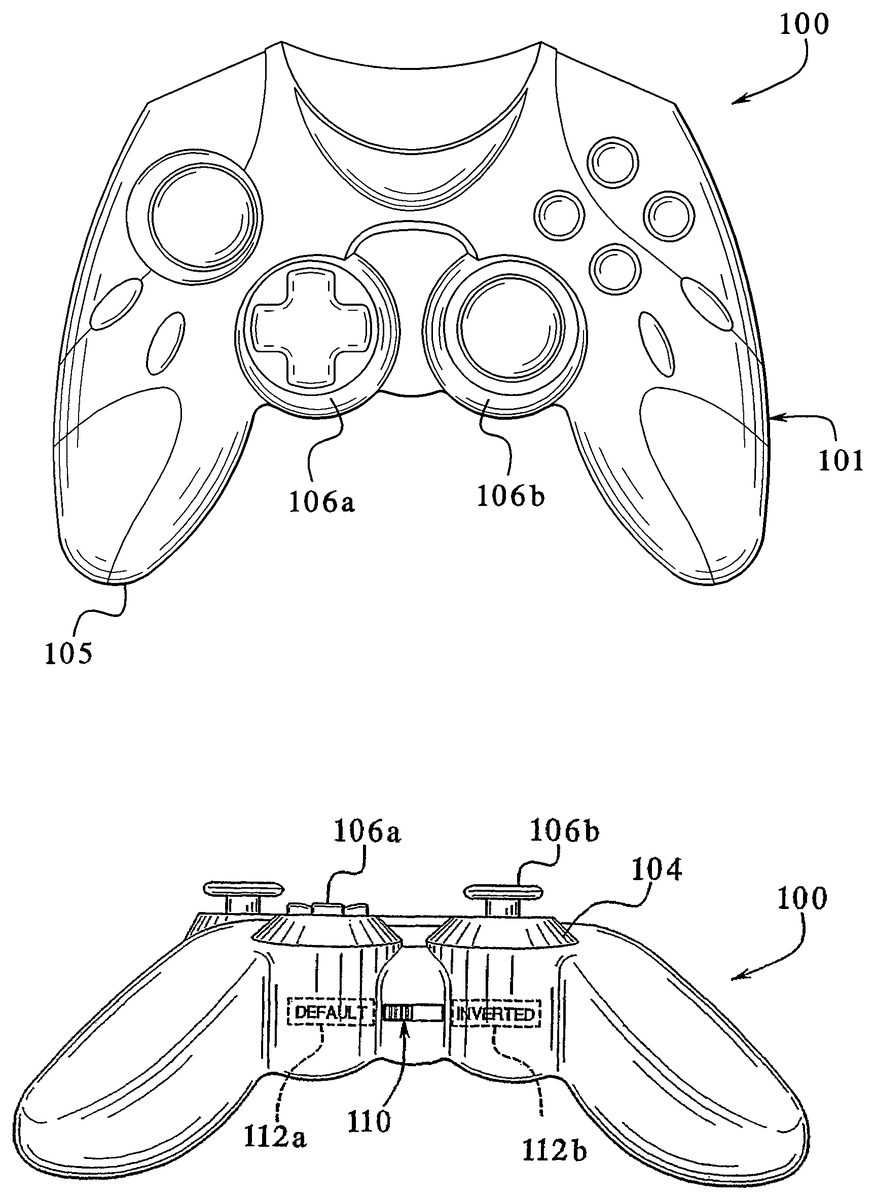
DETAILED DESCRIPTION OF THE INVENTION Referring toFIGS. 1 to 5, a game controller100of the present invention operates a video game system. In particular, the game controller100communicates with a game console120of the video game system (not shown) to operate a game, as is well known in the art. Generally, game controller100includes a housing101having a top member102and a bottom member104that includes at least one control or control device, but preferably includes multiple control devices such as first and second controls or first and second joysticks106aand106b, and supports electronics therein including a microprocessor124, as illustrated inFIG. 5, which communicates with the game software121associated with the game console120, using at least one electrical connector or electrical connection. The top housing102include openings or slots such as openings115aand115bthat correspond to each of the control devices106aand106b. The top housing102connects to or is otherwise attached to bottom housing104to enclose the internal components of the game controller such as the microprocessor124. In one embodiment, a decorative cover105is attached to the outside of at least the top housing102and includes openings that correspond to the size and shape of the control devices on the game controller. The decorative cover may be made using a suitable material such as rubber, plastic or the like. In one embodiment, the first and second joysticks106aand106boutput analog data corresponding to the direction (e.g. up, down, right, left) of the joysticks106aand106bas the joysticks are operated by a player of the video game. The analog data from joysticks106aand106bis converted to digital data and communicated to the microprocessor124of game controller100which in turn communicates with the video game software121to operate the game. In one embodiment, the game controller100includes a switch mechanism110for switching between different modes of operation (i.e., normal/default mode and the invert mode) for a control device, which enables a player to choose between the different modes of operation. ...
DETAILED DESCRIPTION OF THE INVENTION
Referring toFIGS. 1 to 5, a game controller100of the present invention operates a video game system. In particular, the game controller100communicates with a game console120of the video game system (not shown) to operate a game, as is well known in the art. Generally, game controller100includes a housing101having a top member102and a bottom member104that includes at least one control or control device, but preferably includes multiple control devices such as first and second controls or first and second joysticks106aand106b, and supports electronics therein including a microprocessor124, as illustrated inFIG. 5, which communicates with the game software121associated with the game console120, using at least one electrical connector or electrical connection. The top housing102include openings or slots such as openings115aand115bthat correspond to each of the control devices106aand106b. The top housing102connects to or is otherwise attached to bottom housing104to enclose the internal components of the game controller such as the microprocessor124.
In one embodiment, a decorative cover105is attached to the outside of at least the top housing102and includes openings that correspond to the size and shape of the control devices on the game controller. The decorative cover may be made using a suitable material such as rubber, plastic or the like.
In one embodiment, the first and second joysticks106aand106boutput analog data corresponding to the direction (e.g. up, down, right, left) of the joysticks106aand106bas the joysticks are operated by a player of the video game. The analog data from joysticks106aand106bis converted to digital data and communicated to the microprocessor124of game controller100which in turn communicates with the video game software121to operate the game.
In one embodiment, the game controller100includes a switch mechanism110for switching between different modes of operation (i.e., normal/default mode and the invert mode) for a control device, which enables a player to choose between the different modes of operation. For example, in the normal or default mode, actuating the control device or joystick106bupwardly directs a corresponding indicator, icon or the like on the video game display122upwardly, and likewise, actuating the joystick106bdownwardly directs the indicator downwardly on the display122.
Conversely, in the invert or inverted mode, actuating the joystick downwardly directs the indicator of the video game upwardly on the display and actuating the joystick upwardly directs the indicator of the video game downwardly on the display, similar to the control device of an airplane. It should be appreciated that normal and invert modes can be set for either of the above operations as long as the normal and invert modes result in opposite responses of an indicator or indicators in the video game, respectively, when a player is operating joysticks106aor106bof the game controller100.
Also, it should be appreciated that the switch mechanism110may be associated with any directional movement associated with a video game, such as up, down, left, right or diagonal directions or any other suitable directional movement of a control device. In one embodiment, the normal mode directs an indicator of a video game to the right and left in response to actuation of the joysticks106aor106bto the right and left, respectively, and the inverted mode directs the indicator of the video game to the left and right in response to actuation of the joysticks106or106bto the left and right, respectively.
In one embodiment, switch mechanism110includes switch housing116and a switch such as mechanical switch114(shown inFIGS. 4A,4B and4C) connected to the switch housing, where the switch114is operated by a player of the video game to achieve the preferred mode of operation for the control device. In one embodiment, switch114employs a hardware “flag” that electrically communicates with the microprocessor124of game controller100via one or more electrical connectors118to indicate which mode of operation has been selected by a player. In particular, the player physically moves the switch114to either the normal or default mode, or to the invert or inverted mode. The switch114then communicates the player's selection to microprocessor124. Switch114remains in a constant state (i.e., normal or invert mode) until the player subsequently moves the switch114.
In another embodiment, switch114employs a software flag. In this embodiment, switch114temporarily remains in either the normal or invert states or modes. The microprocessor124is programmed to recognize the state, mode or position of switch114before and after the switch is actuated by the player, as described above, and returns switch114to its original state after a preset period of time.
Once the microprocessor124receives the output data126from joysticks106aand106band the desired mode of operation, the microprocessor124communicates this data to the game console120. Specifically, when the player selects the normal mode of operation, the player either leaves switch114in the normal/default position or physically moves the switch from the invert position to the normal/default position. The microprocessor120communicates the output data or value126from the joysticks106aand/or106bto game console120, as is known in the art. When the player selects the opposite mode or the invert mode of operation by either moving switch114to the invert position or leaving switch114in the invert position, microprocessor124communicates the inverted data or value to game console120by one of two methods.
A first method of inverting the joystick data or value employs a potentiometer. A potentiometer has three connections: a plus connection, a “wiper” connection, and a ground connection where the plus and wiper connections have either a “plus” or a “minus” resistance. In the normal mode of operation, for example, as the wiper connection moves away from the ground connection, the resistance increases which thereby increases the control value or joystick value at the analog to digital converter128. Accordingly, to produce an inverted value, the plus and ground connections are physically swapped.
A second method of inverting the joystick data or value employs a mathematical method using the maximum value that can be produced by the circuit. The maximum value is electrically determined based on the components and software of the game controller100. An inverted or invert value is determined by subtracting a read value or actual value of the joystick output value from the known maximum value. For example, if the maximum value is sixty-four and the output value received from the joysticks106aor106b(through the analog to digital converter128) is forty, the inverted value is twenty-four (i.e., (64−40)=24).
Once the inverted values are determined by either of the above two methods, the microprocessor124communicates the inverted values to the game console120and software121which directs the indicator or indicators of the video game to respond accordingly. Since the game software receives the inverted values, the software directs the game as if the player were operating the controls or joysticks in the opposite direction.
Accordingly, the present invention enables a player to invert the operation of one or more control devices on a game controller instead of using complicated setup procedures employed by the game software. In particular, the present invention enables a player to easily switch the mode of operation for the control device by actuating, changing or moving switch114located on the game controller100to a desired operational mode.
In another embodiment, at least one indicator such as first and second indicators112aand112b, respectively, are associated with each of the different modes of operation to identify the mode of operation. For example inFIGS. 4A and 4B, the first indicator112aand the second indicator112beach include text or a phrase such as “DEFAULT” and “INVERTED” which identify the different modes associated with switch114. It should be appreciated that the indicators may be text, audio, audio-visual, symbols or any suitable indicator that identifies the modes of operation.
In an alternative embodiment, the game controller includes a plurality of control devices such as a plurality of joysticks. Each of the joysticks is controlled by a single switch mechanism. In this embodiment, a player uses the switch mechanism to change the mode of operation to the same mode of operation for all of the control devices. In another embodiment, the game controller includes a plurality of switch mechanisms where each switch mechanism is associated with a different control device. In this embodiment, the player uses each switch mechanism to change the operational mode for one or more of the control devices. It should be appreciated that any suitable number of control devices and switch mechanisms may be included on the game controller to control the operations of one or more of the control devices.
In one embodiment the control device of the game controller is a touch screen.
It should be understood that various changes and modifications to the presently preferred embodiments described herein will be apparent to those skilled in the art. Such changes and modifications can be made without departing from the spirit and scope of the present invention and without diminishing its intended advantages. It is therefore intended that such changes and modifications be covered by the appended claims.
Claims
- A controller for a video game system comprising: a housing;a control device connected to the housing, said control device having an axis of control with a first operational mode and a second operational mode, the first operational mode being an inversion of the second operational mode;a switch mechanism connected to the housing and in communication with said control device, said switch mechanism enabling a player to select the first operational mode or the second operational mode for the control device;and a processor included in the housing and in communication with the control device and the switch mechanism, said processor operable to determine whether the player has selected the first operational mode or the second operational mode and employ the first operational mode or the second operational mode of the control device based on the selection made by the player.
- The controller of claim 1 , wherein the control device includes a joystick.
- The controller of claim 1 , wherein the control device includes a button.
- The controller of claim 1 , wherein the control device includes a touch screen.
- The controller of claim 1 , wherein the switch mechanism includes a mechanical switch.
- The controller of claim 1 , wherein the switch mechanism includes a button.
- The controller of claim 1 , wherein the first operational mode includes at least one first operation for the control device and the second operational mode includes at least one second operation for the control device.
- The controller of claim 7 , wherein the first operation and the second operation are different.
- The controller of claim 7 , wherein the first operation and the second operation are opposite operations.
- The controller of claim 1 , which includes the plurality of control devices connected to the housing, wherein the switch mechanism enables the player to select the first operational mode or the second operational mode for a plurality of the control devices.
- The controller of claim 1 , which includes a plurality of control devices connected to the housing, wherein the switch mechanism enables the player to select the first operational mode or the second operational mode for all of the control devices.
- The controller of claim 1 , which includes at least one first indicator associated with the first operational mode and at least one second indicator associated with the second operational mode.
- A controller for a video game system comprising: a housing;a control device connected to the housing and configured for on-screen manipulation of game play, said control device having at least one axis of control with a normal operational mode and an inverted operational mode;a switch mechanism connected to the housing and in communication with said control device, said switch mechanism including a first position and a second position, said first position being associated with the normal operational mode and said second position being associated with the inverted operational mode, said switch mechanism enabling a player to select the normal operational mode or the inverted operational mode by moving the switch to one of the first position and the second position;and a processor included in the housing and in communication with the control device and the switch mechanism, said processor operable to enable the player to move the switch to the first or the second position, determine whether the switch mechanism is in the first position or the second position and cause the control device to operate according to the normal operational mode or the inverted operational mode based on the determined position of the switch.
- The controller of claim 13 , wherein the normal operational mode causes the control device to operate according to a first set of operations and the inverted operational mode causes the control device to operate according to a second set of operations, wherein at least one operation in said first set of operations is opposite to the operations in said second set of operations.
- The controller of claim 13 , wherein the normal operational mode causes the control device to operate according to a first set of operations and the inverted operational mode causes the control device to operate according to a second set of operations, wherein said first set of operations are opposite to the operations in said second set of operations.
- The controller of claim 13 , wherein the switch mechanism includes a mechanical switch.
- The controller of claim 13 , wherein the switch mechanism includes a button.
- The controller of claim 13 , which includes the plurality of control devices connected to the housing, wherein the switch mechanism enables the player to select the normal operational mode or the inverted operational mode for a plurality of the control devices.
- The controller of claim 13 , which includes a plurality of control devices connected to the housing, wherein the switch mechanism enables the player to select the normal operational mode or the inverted operational mode for all of the control devices.
- The controller of claim 13 , which includes at least one first indicator associated with the normal operational mode and at least one second indicator associated with the inverted operational mode.
- A method of operating a video game controller, said method comprising: (a) providing a hand-held game controller including at least one control device for use in on-screen manipulation of video game play, said control device including an axis with a first operational mode and a second operational mode, the first operational mode being the inverse of the second operational mode;(b) enabling a player to select the first operational mode or the second operational mode for the control device using a switch mechanism connected to the game controller and in communication with said control device;(c) determining whether the player has selected the first operational mode or the second operational mode;and (d) activating the first operational mode or the second operational mode of the control device based on the selection made by the player.
- The method of claim 21 , wherein providing the game controller including a control device includes providing a game controller including a joystick.
- The method of claim 21 , wherein providing the game controller including a control device includes providing a game controller including a button.
- The method of claim 21 , wherein providing the game controller including a control device includes providing a game controller including a touch screen.
- The method of claim 21 , wherein providing the game controller including a control device includes providing a game controller including a mechanical switch.
- The method of claim 21 , wherein the operations of the first operational mode are opposite to the operations of the second operational mode.
- The method of claim 21 , wherein enabling the player to select the first operational mode or the second operational mode includes enabling the player to select the first operational mode or the second operational mode for a plurality of control devices connected to the game controller.
- The method of claim 21 , which includes providing at least one first indicator associated with the first operational mode and at least one second indicator associated with the second operational mode, wherein the first indicator and the second indicator are included on the game controller.
- A method of operating a video game controller, said method comprising: (a) providing a hand-held game controller including at least one control device and a switch mechanism connected to the game controller, said control device including an axis of control with a normal operational mode and an inverted operational mode, said switch mechanism being changeable between a first position and a second position, wherein said first position is associated with the normal operational mode and the second position is associated with the inverted operational mode;(b) enabling a player to select the first position or the second position using the switch mechanism;(c) determining whether the player has selected the first position or the second position based on the position of the switch mechanism;and (d) activating the normal operational mode or the inverted operational mode of the control device based on the determined position of the switch mechanism.
- The method of claim 29 , which includes associating a first set of operations with the normal operational mode and second set of operations with the inverted operational mode, wherein at least one operation in said first set of operations is opposite to the operations in said second set of operations.
- The method of claim 29 , which includes associating a first set of operations with the normal operational mode and second set of operations with the inverted operational mode, wherein all of the operations in said first set of operations are opposite to the operations in said second set of operations.
- The method of claim 29 , wherein enabling the player to select the normal operational mode or the inverted operational mode includes enabling the player to select the normal operational mode or the inverted operational mode for a plurality of control devices connected to the game controller.
- The method of claim 29 , which includes providing at least one first indicator associated with the normal operational mode and at least one second indicator associated with the inverted operational mode, wherein the first indicator and the second indicator are included on the game controller.
- The method of claim 21 , wherein activating the first operational mode or the second operational mode includes electrically switching to the first operational mode or the second operational mode based on the selection made by the player.
- The method of claim 21 , wherein activating the first operational mode or the second operational mode includes changing input data generated by the control device to activate the first operational mode or the second operational mode based on the selection made by the player.
- The method of claim 29 , wherein activating the normal operational mode or the inverted operational mode includes electrically switching to the first operational mode or the second operational mode based on the determined switch position of the switch mechanism.
- The method of claim 29 , wherein activating the normal operational mode or the inverted operational mode includes changing input data generated by the control device to activate the normal operational mode or the inverted operational mode based on the determined switch position of the switch mechanism.
- A controller for a video game system, comprising: a housing sized and configured to be hand-held;a control device coupled to said housing and having at least one axis of control with a first operational mode and a second inverted operational mode, each of said operational modes configured to operate without substantially inverting said housing;and electrical circuitry in communication with the control device, said electrical circuitry operable to determine whether the first operational mode or the second operational mode has been selected and employ the first operational mode or the second operational mode of the control device based on the selection.
- The controller of claim 38 , wherein the control device includes a joystick.
- The controller of claim 39 , wherein the first operational mode and the second operational mode are opposite.
- The controller of claim 39 , wherein the control device includes at least four buttons.
- The controller of claim 41 , wherein the first operational mode and the second operational mode are opposite.
- The controller of claim 41 , wherein said first operational mode and said second operational mode are configured to operate without substantially inverting said at least four buttons.
- A game controller, comprising: a body;at least one input button positioned on said body;a joystick adjacent said at least one input button and having at least one axis of control, the joystick configured for use in on-screen video game play;and electrical circuitry adapted to allow selective inversion of said at least one axis of control without substantially inverting said body.
- A game controller according to claim 44 , wherein said at least one axis of control includes at least two axes of control;and said electrical circuitry adapted to allow selective inversion of at least one of said at least two axes of control.
Disclaimer: Data collected from the USPTO and may be malformed, incomplete, and/or otherwise inaccurate.