U.S. Pat. No. 7,278,921
PARTICIPANT SEARCH METHOD IN ONLINE GAME OR ONLINE CHAT, PARTICIPANT SEARCHING DEVICE, PARTICIPANT NETWORK SERVER, NETWORK TERMINAL AND COMPUTER PROGRAM
AssigneeKabushiki Kaisha Eighting
Issue DateApril 4, 2002
Illustrative Figure
Abstract
A participant search method in an online game and online chat, wherein, when starting an online game or online chat on a network connecting a plurality of subscribers to each other with a network server as a core, the network server that has received participant search information from one subscriber matches network subscriber-related attribute information stored in the server with the participant search information to select a matched subscriber currently connected to the network, distributes participant recruiting information to that subscriber, and sends back participant acceptance information for the subscriber who has accepted the recruiting information to the above-described one subscriber.
Description
BEST MODE FOR CARRYING OUT THE INVENTION A preferred embodiment of the processing for searching an adversary in an online game is described below with reference to the related drawings. FIG. 1is an explanatory view showing general configuration of a device and a method according to the present invention, andFIG. 2andFIG. 3show examples of a display screen at a network terminal. InFIG. 1, the terminal A and terminal B1, terminal B2, . . . terminal B5, . . . terminal Bnare connected respectively through a network to a network server S. Therefore, the terminal A and terminal B1, terminal B2, . . . terminal B5, . . . terminal Bnare network game clients, and it is assumed in the following description that the terminal A is of a subscriber who spontaneously expresses a hope to enjoy the online game and his or her will to start the game, namely match demander, and that the terminal B1, terminal B2, . . . terminal B5, . . . terminal Bnare of other network subscribers, namely potential participants in the online game. FIG. 2is a preferable default start-up screen at the terminal A, and various types of operation buttons and a pull-down menu are shown on a control screen shown in the right hand side on the default screen, and a development screen29for a game or chat is displayed in the entire left hand side portion of the default screen. At first, the match demander clicks on a connection button31on the default screen to connect the demander's terminal through a network to the network server S. Then to set conditions for the adversary, the demander selects a game selection radio button32between the game selection radio button32and a chat selection radio button33to open a game selection pull-down menu34for selecting a desired game not shown ...
BEST MODE FOR CARRYING OUT THE INVENTION
A preferred embodiment of the processing for searching an adversary in an online game is described below with reference to the related drawings.
FIG. 1is an explanatory view showing general configuration of a device and a method according to the present invention, andFIG. 2andFIG. 3show examples of a display screen at a network terminal. InFIG. 1, the terminal A and terminal B1, terminal B2, . . . terminal B5, . . . terminal Bnare connected respectively through a network to a network server S. Therefore, the terminal A and terminal B1, terminal B2, . . . terminal B5, . . . terminal Bnare network game clients, and it is assumed in the following description that the terminal A is of a subscriber who spontaneously expresses a hope to enjoy the online game and his or her will to start the game, namely match demander, and that the terminal B1, terminal B2, . . . terminal B5, . . . terminal Bnare of other network subscribers, namely potential participants in the online game.
FIG. 2is a preferable default start-up screen at the terminal A, and various types of operation buttons and a pull-down menu are shown on a control screen shown in the right hand side on the default screen, and a development screen29for a game or chat is displayed in the entire left hand side portion of the default screen.
At first, the match demander clicks on a connection button31on the default screen to connect the demander's terminal through a network to the network server S. Then to set conditions for the adversary, the demander selects a game selection radio button32between the game selection radio button32and a chat selection radio button33to open a game selection pull-down menu34for selecting a desired game not shown in the figure. Then the demander inputs a number of the demanders team members in an input column35for a number of the demanders team members (Note that this operation is not required in a one versus one game), and clicks on an adversary call button36a. It is needless to say that, in a case of a game in which a team comprising a plurality of members plays a game with another team also comprising a plurality of members, the demanders team members have been decided at this timing.
The operation described above is a requirement for setting conditions for searching an adversary in an online game, and when a counterpart for chatting is searched, the demander selects the chat selection radio button33and then clicks a chat call button36b. The reference numeral37bindicates a chat acceptance button having the same function as a match acceptance button37adescribed below, while the reference numeral40bindicates a chat start button having the same function as a game start button40adescribed below.
When the adversary call button36ais clicked, an adversary search signal21including the adversary search information such as a type of a game to be played is prepared, and the signal21is transmitted from the terminal A to the network server S. In the network server S, a subscriber or subscribers satisfying the set conditions in the attribute information for taste for a game or the like registered by the network subscribers in entry or in the attribute information for a skill ranking or points and a rank in each game or the like updated or added from time to time and also currently connected to the network are selected. Then the network server S transmits an adversary recruiting signal22including data for the game type described above, set conditions such as a number of team members, and a message previously prepared (such as, for instance, “an adversary for the game XXXX is required”) to the terminals B for potential adversaries for the online game.FIG. 1shows that the recruiting signal22has been transmitted to the terminal B1, terminal B5, and terminal Bnrespectively.
The terminal B also has the same control screen30as that in the terminal A, and displays the screen29for a game or chatting described above or the screen for the stand-by state (a) shown inFIG. 3, and when the recruiting signal22is received, a match call button41flickers, and the screen for the call receiving state (b) shown inFIG. 3is displayed. It should be noted that, inFIG. 3, the reference numeral42indicates a call button flickering when the terminal B receives the recruiting signal22for chatting.
In the terminal B, when an open button44is clicked, the screen for the call receiving state (b) shown inFIG. 3is switched to the development screen29and the control screen30shown inFIG. 2. Then, when a subscriber for hoping participation in the game at the terminal B clicks on the match acceptance button37a, the terminal B transmits a match acceptance signal23including the match acceptance information to the network server S. Upon reception of the acceptance signal23, the network server S transmits an adversary selection signal24including the attributes information for a net name, a skill ranking, and others previously registered therein and the IP address information previously registered therein to the terminal A.FIG. 1shows that the acceptance signals23,23have been transmitted from the terminal B5and the terminal Bnrespectively and then the selection signals24,24have been transmitted to the terminal A through the server S.
A participant list39showing subscribers having expressed their hope to participate in the game is shown in a list form on the control screen30of the terminal A having received the selection signal24, and then the match demander double-clicks on a net name shown in the participant list39, takes into considerations the attribute information displayed in response to above clicking now shown in the figure, selects a desired adversary from those shown in the participant list39, and presses a game start button40ato wait for start of the game. As described above, with the method according to the present invention, the match demander can immediately search for an adversary or adversaries for the game through the simple operation described above.
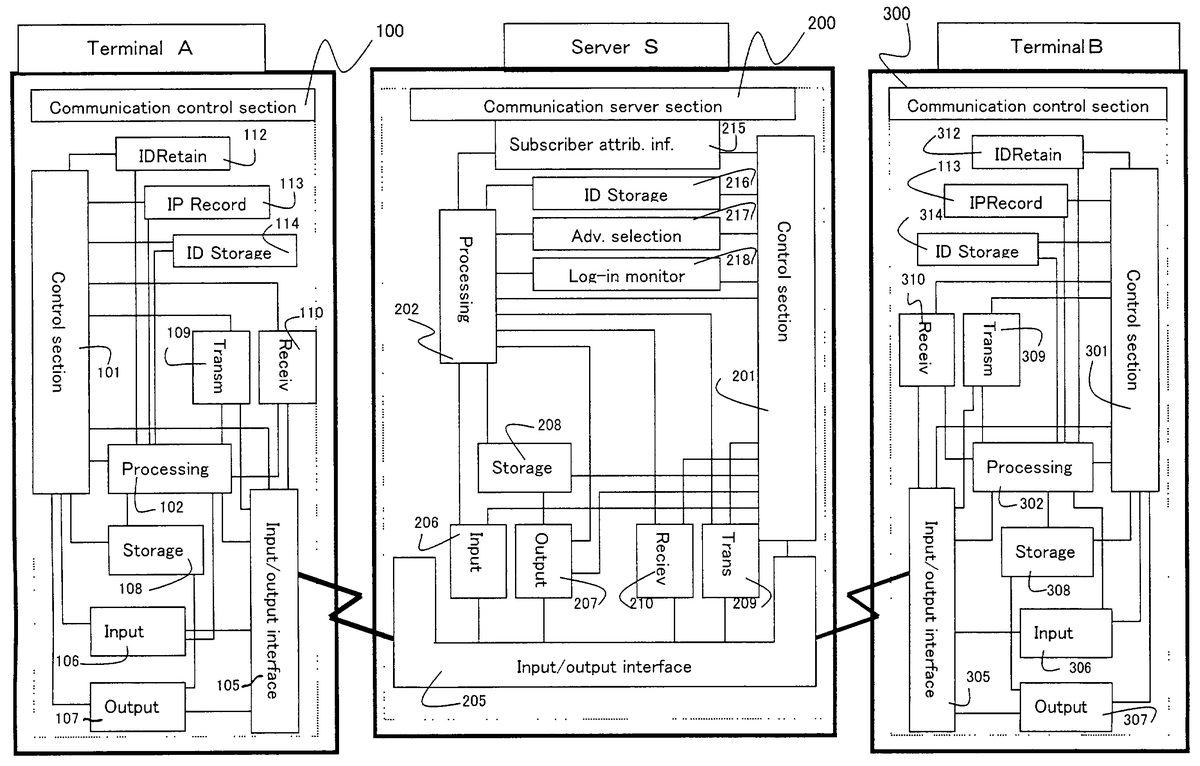
FIG. 4is a block diagram showing basic configuration of the adversary search processor, and a communication control section100, a communication server section200, and a communication control section300each constituting the match search processor according to the present invention are shown at each of the terminal A, network server S, and terminal B. In addition to the components described above, a game control section and a game server section required for playing the game are provided to the terminal A, terminal B, and network server S respectively.
Each of the communication control section100, communication server200, and communication control section100has functional sections for executing the ordinary functions to be performed by each section. The functional sections include the control sections101,201,301for controlling operations of the sections100,200, and300respectively, processing sections102,202, and302for processing data stored in each section, input/output interfaces105,205,305connected to various types of input/output peripheral devices not shown in the figure as well as to the network, input sections106,206,306for receiving data from the input/output interface sections105,205,305respectively, output sections107,207,307for outputting data, storage sections108,208,308for storing data therein, transmission sections109,209,309for transmitting communication data, and receiving sections110,210,310for receiving communication data.
The communication control sections100,300of the terminal A and terminal B have, in addition to the functional sections for executing the ordinary functions to be performed by each section, ID retaining section112,312for retaining therein IDs assigned to subscribers from the network server S, and IP recording sections113,313for temporally recording therein IP addresses assigned in the online mode from a provider to which each subscriber subscribes until execution of the offline processing respectively. Further the communication control sections100,300should preferably have ID storage sections114,314for selecting candidates for ID exchangers from the network subscribers and storing therein the subscribers' IDs in the respectively terminals.
The communication server section200has, in addition to the functional sections for executing the ordinary functions to be performed by the section, a subscriber attribute information storage section215for storing therein attribute information for all of the subscribers (such data as names, sex, hobbies, each subscriber's own games, and highest scores), an ID storage section216for storing therein IDs of all subscribers, an adversary selection section217for selecting an adversary or adversaries from the candidates, attribute information of which are stored in the subscriber attribute information storage section215in response to a request from a subscriber hoping to start playing a game, and a log-in monitoring section218for managing a relation between an ID and IP address of logging-in subscriber and the channel.
An automated adversary search method by the search processor is described below.
In the communication control section100at the terminal A, information for conditions such as selection of a game or chatting, a name of a specified game, a number of team members or the like entered from the input/output interface105is sent via the input section106to the processing section102according to an instruction by the control section101and is stored in the storage section108. Then the self IP address of the subscriber stored in the IP recording section113and acquired upon the current connection and the information stored in the storage section108are subjected to processing in the processing section102and sent to the transmission section109according to an instruction from the control section101, and are transmitted as an adversary search signal21to the communication server section200in the network server S through the network as a medium from the input/output interface105.
The information included in the search signal21is sent to the receiving section210in the communication server section200via the input/output interface205, subjected to processing in the processing section202according to an instruction by the control section201, and then is stored in the storage section208. Based on the search information and the information stored in the subscriber attribute information storage section215, and also according to an instruction from the control section201, the adversary selection section217selects data concerning candidates for the adversary or adversaries. Namely, only an inter-field collation between the search information and the information stored in the subscriber attribute information storage section215is required to be performed in the adversary selection section217, and by setting parameters in this step, flexible response can be performed regardless of whether a number of subscribers currently logging-in is large or small.
On the other hand, the log-in monitoring section218in the communication server section200always monitors subscribers currently logging-in in the network. The processing for determination in the log-in monitoring section218is described with reference toFIG. 5.
InFIG. 5, the reference numerals50to59indicate operating states of control buttons in the terminal B. The reference numerals from60to69indicate types of signals which the log-in monitoring section218receives in response to operations of the button, and the reference numerals from70to79indicate contents of determination performed based on the signals in the log-in monitoring section218.
For instance, when an operator of the terminal B clicks on the connection button31on the control screen30shown inFIG. 2(operation51), the ID information is transmitted to the server S, and the log-in monitoring section218determines that the received ID information61is online start71. In this state, when the adversary search signal21from another subscriber is received in the server S, it is determined that playing the game at the terminal B is impossible. In operations52to58at the terminal B, the respective signals are transmitted similarly, and the determinations72to78are made based on the received signals62to68in the log-in monitoring section218. Namely in the determinations71,73,75, and77, it is determined that playing the game at the terminal B is impossible, while, in the determinations72,74,76, and78, it is determined that playing the game at the terminal B is possible. Although not shown in the figure, when the disconnection button38is clicked on the control screen30, a network disconnection signal is transmitted from the terminal, while the server S makes determination on the disconnected state and the terminal is excluded from an object for the determination function.
Status of each of the terminals B currently connected to the server S is identified through the determination processing in the log-in monitoring section218, and candidate(s) for an adversary or adversaries are extracted. It is expected that a number of terminals always connected to the network will increase in the future, but in that case, a number of terminals in the queuing state as shown inFIG. 3(a) increases, and processing in the log-in monitoring section218having a function for identifying the queuing terminals will become indispensable.
Data for the candidates for an adversary or adversaries is collated to the log-in data in the log-in monitoring section218, and appropriate data for the candidates currently logging-in is screened out and transmitted to the transmission section209. The transmission section209transmits, according to an instruction from the control section201, to the IP address on the network included in each data, the adversary recruiting signal22from the input/output interface205to the network. It should be noted that the IP address is collated to the subscriber ID stored in the ID storage section216.
The adversary recruiting signal22is processed in the processing section302according to an instruction from the control section301transmitted via the receiving section310from the input/output interface305in the communication control section300at the terminal B corresponding to the IP address, and is stored in the storage section308. The recruit signal22is sent via the input/output interface305to a terminal display section not shown in the figure, and a network name in the participant list39shown inFIG. 2is lit for display (“new” is displayed when the specified network name has not been registered in the terminal B). In a case of the stand-by state (b), as shown inFIG. 3, the match call button41flickers for display.
When a subscriber having checked the display above hopes to participate in the game, and recognizes that the current screen of the subscriber's terminal is the development screen29for a game or chatting as shown inFIG. 2, the subscriber clicks on the match acceptance button37, and when the current screen is the stand-by screen shown inFIG. 3, the subscriber clicks on an instant match button43. As a result, in the terminal B, the current IP address from the IP recording section313and the subscriber ID from the ID retaining section312are transferred and processed by the processing section302according to an instruction from the control section301, and then are sent to the transmission section309. Then, according to an instruction from the control section301in the terminal B, the match acceptance signal23including the information described above is transmitted from the input/output interface305through the network to the communication server section200.
The match acceptance signal23entered the receiving section210from the input/output interface205in the communication server section200is transferred to the processing section202according to an instruction from the control section201. The processing section202sends the data together with those stored in the subscriber attribute information storage section215to the transmission section209, and again transmits the data as an adversary selection signal24via the input/output interface205through the network to the terminal A.
The adversary selection signal24enters the receiving section110via the input/output interface105in the terminal A, and is processed in the processing section102according to an instruction from the control section101to be stored a subscriber ID included in the selection signal24in the ID storage section114. At the same time, the selection signal24is sent via the storage section108, output section107, and input/output interface105to a display section, not shown in the figure, of the terminal A, and is displayed as the net name in the participant list39as shown inFIG. 2.
At this point of time, the match demander at the terminal A clicks twice on the net name, selects a desired adversary from among a plurality of adversaries by taking into considerations the candidates' attribute or other information displayed on another window, presses the game start button40a, and stands by for start of the game. When the game start button40ais pressed, a game start signal25is generated in the terminal A, and this start signal25passes through the input/output interfaces105,205and enters the receiving section210in the communication server section200. The start signal25is sent to the log-in monitoring section218by the processing section202according to an instruction from the control section201and is monitored until a terminate signal is received from the terminal A.
The processing functions of the communication control sections100,300and the communication server section200can be recorded as a processing program in a computer-readable recording medium such as a CD-ROM, or a DVD-ROM.
With the participant search processing method according to the present invention, search for a participant or participants is automated when starting an online game or online chatting, so that search for participant(s) is extremely simplified. In a case of an offline game, it is possible to start the game immediately at any time, so that this method is most suited to an online game in which two or more players participate.
With the participant search processor according to the present invention, a demander searching an adversary or adversaries for a game or chatting can easily and immediately find out the adversary or adversaries through simple operations.
Claims
- A method of searching a participant or participants in an online game or online chatting, comprising: providing, to each of a group of subscribers, an ID retaining section for retaining an ID to be assigned from a network server, an IP recording section for temporally recording an IP address assigned, when connected to a network, from a provider in which each subscriber subscribes until connection to the network is disconnected, a transmission section to the server, and a control section connected to the ID retaining section, the IP recording section and the transmission section, receiving participant search information from one of the subscribers in starting the online game or online chatting on the network to which a plurality of subscribers is connected with the network server as a core, said network server having a log-in monitoring section;managing a channel and a relation between the ID and the IP address of all of the subscribers currently logging-in by the server;collating attribute information concerning the subscribers stored in the server in response to the participant search information by the server;selecting subscribers other than the one of the subscribers satisfying the participant search information in all the subscribers currently connected to the network by the server;distributing participant recruiting information to the selected subscribers by the server;upon acceptance to the participant recruiting information, transferring an IP address and an ID of an accepted subscriber through the transmission section to the server;returning the participation acceptance information of the accepted subscriber to the one of the subscribers by the server;and sending a start signal from the one of the subscribers to the log-in monitoring section, said log-in monitoring section monitoring until a termination signal is received from the one of the subscribers.
- A participant search device used for an online game or online chatting performed on a network to which a network server and a plurality of network terminals are connected, wherein each of the network terminals comprises an ID retaining section for retaining an ID to be assigned from the network server, an IP recording section for temporally recording an IP address assigned, when connected to the network, from a provider in which each subscriber subscribes until connection to the network is disconnected, a transmission section to the server, and a control section connected to the ID retaining section, the IP recording section and the transmission section, the IP address in the IP recording section and the ID in the ID retaining section in at least one of the subscribers being transferred to the server, upon receiving and acceptance to participant recruiting information, through the transmission section, and wherein said network server comprises: a subscriber attribute information storage section for storing attribute information for network subscribers;an ID storage section for storing therein IDs of the subscribers;a participant selection section for selecting subscribers satisfying conditions specified in a request from another of the subscribers with the attribute information stored in the subscriber attribute information storage section;a transmission section for transmitting the participant recruiting information to the selected subscribers connected to the network;a control section for receiving a start signal from the another of the subscribers after the another of the subscribers receives the acceptance of the participant recruiting information from at least one of the subscribers, and starting an operation, and a log-in monitoring section for receiving the start signal through the transmission section of the server and managing a relation between the ID and the IP address of all of the subscribers currently logging-in and a channel until a termination signal is received from the one of the subscribers.
- A network server having a communication server section for searching a participant or participants in an online game or online chatting, wherein the communication server section comprises: a subscriber attribute information storage section for storing therein attribute information for network subscribers;an ID storage section for storing therein subscribers' IDs;a participant selection section for selecting the subscribers satisfying the attribute information having been stored in the subscriber attribute information storage section in response to a demand from another of the subscribers;a transmission section for transmitting participant recruiting information to the selected subscribers connected to a network;a control section for receiving a start signal from another of the subscribers after the another of the subscribers receives acceptance of the participant recruiting information from at least one of the subscribers, and starting an operation, and a log-in monitoring section for managing a relation between an ID and an IP address of all of the subscribers currently logging-in and a channel until a termination signal is received from the one of the subscribers.
- A computer program for a network server embedded in a computer readable medium for searching a participant or participants in an online game or online chatting comprising the steps of: retaining an ID to be assigned from a network server in each of a group of subscribers;temporally recording an IP address in each of the subscribers, said IP address being assigned, when connected to a network, from a provider in which each subscriber subscribes until connection to the network is disconnected;managing a channel and a relation between the ID and the IP address of all of subscribers currently logging-in;receiving participant search information from one of the subscribers connected to the network in starting the online game or online chatting on the network to which a plurality of the subscribers is connected with the network server as a core;collating the participant search information to attribute information for the network subscribers stored in the server and selecting other subscribers currently connected to the network;distributing participant recruiting information to the other subscribers connected to the network;transferring the IP address and the ID in another of the subscribers to the server, upon acceptance to the participant recruiting information by the another of the subscribers;returning the participation acceptance information for the another of the subscribers to the one of the subscribers;and sending a start signal from the one of the subscribers to a log-in monitoring section of the server, said log-in monitoring section monitoring until a termination signal is received from the one of the subscribers.
- The method of searching according to claim 1 , wherein said managing the channel and the relation includes managing a channel and a relation between servers.
- The computer program according to claim 4 , wherein said managing the channel and the relation includes managing a channel and a relation between servers.
- The method of searching a participant or participants according to claim 1 , wherein search for the participant or participants is automated when starting the online game or online chatting.
- The computer program according to claim 4 , wherein search for the participant or participants is automated when starting the online game or online chatting.
Disclaimer: Data collected from the USPTO and may be malformed, incomplete, and/or otherwise inaccurate.