U.S. Pat. No. 7,244,183
GAMING SYSTEM EMPLOYING BOTH ACTION FIGURE AND VIDEO GAME PLAY
Issue DateSeptember 19, 2003
Illustrative Figure
Abstract
A gaming system that employs a video game system and action figures to allow both video game play and action figure play. A video game score, obtained by a player through video game play, may be transferred to the action figure associated with that player to become the action figure score of that action figure. The action figures have a gun that generates a light beam and a target detector for receiving light beams from other action figures. The action figure will register a hit, and break apart, if its target detector receives a light beam from another action figure that has a higher action figure score.
Description
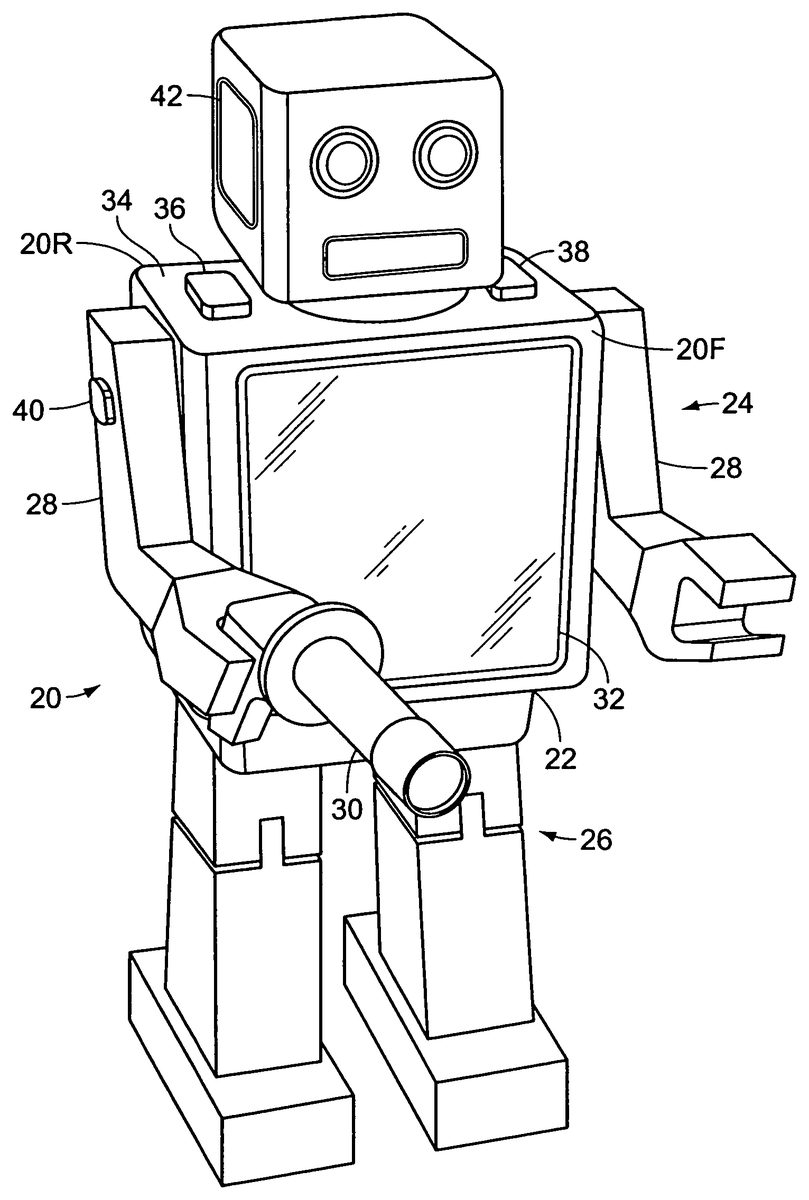
DETAILED DESCRIPTION OF THE PREFERRED EMBODIMENTS Within the following description, a gaming system is described that integrates video game play, using a video game system, with action figure play. According to the present invention, skillful play during video game play helps a player achieve a competitive advantage during action figure play. FIG. 1illustrates an actionfigure 20that forms a part of the gaming system according to the present invention. In particular, during action figure play, one of the action figures is associated with each player. Each action figure may take on a variety of shapes but has a generally humanoid shape and appearance, having a waist22that separates an upper portion24and lower portion26. The actionfigure 20has a pair of arms28and a light producing gun30attached to one of the arms28that selectively produces a highly directional light beam. The action figure has a front20F and a rear20R. The action figure has at least one detector target32, preferably located on the front20F, on the upper portion24. The detector target32is capable of detecting the light beam from the light producing gun30of other action figures. It should be noted that within the scope of the present invention, the light beam may be visible light, and may also be infrared, ultraviolet, or other forms of electromagnetic radiation that has the directional propagating and detection properties suitable for the goals of the present invention. The actionfigure 20has a shoulder surface34having a fire button36and a quick draw button38. A reset button40is also provided on one of the arms28. Clearly, the positioning of buttons36,38,40may be altered to facilitate ease of use and as the shape of the action figure itself is varied, and such buttons may be labeled with indicia as necessary to indicate their purpose. A score display42is provided on the actionfigure 20. The score display42may be used to selectively ...
DETAILED DESCRIPTION OF THE PREFERRED EMBODIMENTS
Within the following description, a gaming system is described that integrates video game play, using a video game system, with action figure play. According to the present invention, skillful play during video game play helps a player achieve a competitive advantage during action figure play.
FIG. 1illustrates an actionfigure 20that forms a part of the gaming system according to the present invention. In particular, during action figure play, one of the action figures is associated with each player. Each action figure may take on a variety of shapes but has a generally humanoid shape and appearance, having a waist22that separates an upper portion24and lower portion26. The actionfigure 20has a pair of arms28and a light producing gun30attached to one of the arms28that selectively produces a highly directional light beam. The action figure has a front20F and a rear20R. The action figure has at least one detector target32, preferably located on the front20F, on the upper portion24. The detector target32is capable of detecting the light beam from the light producing gun30of other action figures. It should be noted that within the scope of the present invention, the light beam may be visible light, and may also be infrared, ultraviolet, or other forms of electromagnetic radiation that has the directional propagating and detection properties suitable for the goals of the present invention.
The actionfigure 20has a shoulder surface34having a fire button36and a quick draw button38. A reset button40is also provided on one of the arms28. Clearly, the positioning of buttons36,38,40may be altered to facilitate ease of use and as the shape of the action figure itself is varied, and such buttons may be labeled with indicia as necessary to indicate their purpose.
A score display42is provided on the actionfigure 20. The score display42may be used to selectively display a score of the actionfigure 20as indicated inFIG. 2, under the control of the player. Accordingly, if the player does not wish to display the score of the action finger associated therewith, the player can opt to blank the score display42, as indicated inFIG. 1.
According to the present invention, the gaming system employs the video game system50, illustrated inFIG. 6. In many respects, the video game system50is conventional, having a video game control unit52which may be microcontroller or microprocessor based; having at least one player controller54; and having a video display56. In a conventional manner, the player plays a video game, by viewing the video display56and manipulating the player controller54. Also in a conventional manner, the player achieves a video game score by meeting the objectives of the video game. The video game score achieved will be greater as the skill level of the player increase.
Now, in accordance with the present invention, the video game score may be transferred to one of the action figures20by the player, such that the action figure score becomes the video game score. To facilitate such transfer, the video game system has a score transmitter57that is configured to transfer the video game score to one of the action figures. A variety of technologies and schemes may be used to achieve telemetry between the video game control unit52and the actionfigure 20. However, a simplistic scheme involves an encoded light beam of the type detectable by the target detector32on the action figure. Such requires only minimal additional hardware by way of a light emitter associated with the video game system50. Accordingly, it is preferred that the score transmitter57is a light emitter that produces an encoded signal when prompted by a player by pressing a transfer button58. Thus, the player holds the target detector32of the actionfigure 20associated with that player in the immediate vicinity of the score transmitter57and presses the transfer button58. The video game system produces the encoded signal, which includes the video game score. The actionfigure 20decodes the encoded signal and makes the score received thereby the action figure score.
According to the goals of the present invention, the action figure score alters its effectiveness and interactions with other action figure and other gaming system objects. In particular, each action figure has its own action figure score, and other gaming objects (such as fixed target objects, monsters having a detecting target, etc.) have their own value. Thus, if the actionfigure 20can successfully attack a gaming object with a value less than the action figure's score, or can successfully attack another action figure with a lower score. It should be apparent then, by obtaining its score from the video game system, the action figure's competitive ability during action figure play is directly affected by the video game score. Therefore, by skillfully achieving a higher video game score, a player is assured success during action figure play against other players possessing action figures having a lower action figure score. Referring then toFIG. 7, the player plays the video game90, and continues to do so until the player achieves a video game score desired by said player92—at which time the player holds the action figure associated with that player in the vicinity of the video game system and presses the transfer button94. The video game score is transferred to the actionfigure 96and is received and stored by the actionfigure 98.
To illustrate the manner in which the action figure score alters its effectiveness during action figure play, reference may be made toFIG. 8. As illustrated, during action figure play, the player typically will repeatedly press the fire button on the actionfigure 100. The gun produces a light beam with the action figure score encoded therein102. If the light beam is not detected by the target detector of an attacked action figure, the player will continue to press the fire button100. If the light beam is detected by the target detector of an attacked actionfigure 104, it is determined whether the encoded action figure score thus detected is greater than the action figure's score106. Such repeated firing100, production of light beams102, detection of light beams104, and determination of the score associated with the incoming light beams106will continue until the incoming light beam is associated with an action figure having a score greater than the attacked figure's action figure score, at which point the attacked figure is deemed to have been “hit” or “destroyed”. To add to the dramatic effect of the same, the action figure breaks apart. To accomplish the same in a non-destructive manner, a solenoid is activated to break the attacked figure into two pieces108. At this point, of course, the action figure can be reassembled, and reset using the reset button40.
FIGS. 3 and 4illustrate a non-destructive mechanism for facilitating the actionfigure 20breaking apart when hit. In particular, The upper and lower portions24,26of the actionfigure 20are distinct components that are selectively attached together using a pin60that extends vertically downward from the upper portion. The pin extends upwardly into an upper portion opening62and then finally into a solenoid catch64within the upper portion24that selectively holds and releases the pin60. When the upper and lower portions24,26are assembled, the pin60is held securely by the solenoid catch64. The upper portion24is preferably allowed to rotate on the pin60, to allow movement of the actionfigure 20at its waist22. When the actionfigure 20is to break apart, the solenoid catch64is signaled to release the pin60to allow the upper and lower portions24,26to separate. To make their separation more dramatic, however, a spring66is disposed around the pin60. The spring66is compressed between the upper and lower portions24,26when they are mated together. When the pin60is released by the solenoid catch64, the spring66is allowed to expand, propelling the upper portion24upwardly, and creating a dramatic yet non-destructive separation of the upper and lower portions24,26.
Referring toFIG. 2, to enhance action figure play by providing the action figure freedom of movement, the actionfigure 20is selectively seated upon a vehicle70; and the vehicle70and actionfigure 20selectively controllable with a hand-held remote control80. The vehicle may be in various configurations. Preferably, however a two-wheeled motorcycle or three-wheeled “trike” is preferred. Referring to bothFIG. 2andFIG. 5, the hand-held remote control80has mobility controls81, a fire button82, a quick draw button83, and a transmitter84for producing radio frequency (RF) signals85to communicate depressions of the fire button82and quick draw button83, and movements of the mobility controls81. Such RF signals85are received by the vehicle70and the actionfigure 20, as appropriate. In particular, movements of the mobility controls81are detected and transmitted by the hand-held remote control80, and then received and decoded by the vehicle70to control a steering servo72, and a throttle control74that selectively controls a drive motor76to make the vehicle move forwardly and rearwardly at varying speeds. In a similar manner, depressions of the fire button82and activation of the quick draw button83are communicated to the actionfigure 20.
The actionfigure 20has a control unit44, preferably microprocessor or microcontroller based, that provides the general functionality of the actionfigure 20as previously described. In particular, the control unit44operates the solenoid64that selectively keeps the action figure body intact or detaches the same when a hit is registered, and facilitates reattachment once the reset button40is pressed. The control unit generates the light beam when prompted by the fire button36, and receives incoming signals from the target detector32. As previously described, the incoming signals representing the light beam received by the target detector32embody the action figure score of another action figure that generated said light beam. Of course, the action figure score is itself scored by the control unit44, is visually tendered upon the score display42, and is compared with scores encoded within incoming light beams in the manner described previously with reference toFIG. 8.
Also illustrated inFIG. 2is the quick draw button38that is in direct communication with the control unit44and a quick draw button83on the hand-held remote control80in RF communication with the control unit44. The gaming system has a quick draw mode, whereas the players can choose to enter a quick draw mode. When in the quick draw mode, essentially the action figure scores are temporarily ignored. Thus, when the action figures battle each other as illustrated inFIG. 8, the step of determining whether the encoded score within the incoming light beam is greater than the attacked (detecting) action figure's score106is eliminated. Instead, the action figure will determine a hit, and proceed to step108when an incoming light beam is detected—regardless of the score associated therewith. To allow the score to be disregarded, however, the player must voluntarily place the action figure in quick draw mode.
In conclusion, herein is presented a gaming system that integrates video game play with action figure play such that skillful video game play by a player provides that player a competitive advantage during action figure play. The invention is illustrated by example in the drawing figures, and throughout the written description. It should be understood that numerous variations are possible, while adhering to the inventive concept. Such variations are contemplated as being a part of the present invention.
Claims
- A gaming system, using a video game system having video game controllers and a video display, and using an action figure associated with the player, comprising the steps of: achieving a score by the player by playing the video game by viewing the video display while operating the video game controllers;transferring the score from the video game system to the action figure;and interacting the action figure with other gaming system objects such that the effect of the action figure upon the other gaming system objects is determined by the score of the action figure.
- The gaming system as recited in claim 1 , wherein the action figure has a light producing gun and a target detector;and wherein the step of interacting the action figure with other gaming system objects further comprises firing the light producing gun to produce a light beam that is oriented at the other gaming system objects and determining a hit when the light beam hits the other gaming system object and the score of the action figure is greater than the value of said gaming system object.
- The gaming system as recited in claim 2 , wherein the gaming system objects include another action figure having a light producing gun and a target detector;wherein the value of said other action figure is its own score achieved through video game play;and wherein the step of determining a hit further comprises determining a hit by the action figure when the light beam of another action figure hits the target of the action figure and the score of the other action figure is greater than the score of the action figure.
- The gaming system as recited in claim 3 , further comprising a hand-held remote controller associated with each action figure;and wherein the step of firing the light producing gun for one of the action figures further comprises signaling said action figure to fire its light producing gun by the hand-held remote controller.
- The gaming system as recited in claim 4 , further comprising a vehicle associated with each action figure, said vehicle having steering and a motor for propelling the vehicle forwardly and rearwardly;and the method as recited further comprises the steps of seating the action figure upon the vehicle;and moving the action figure using the hand-held remote controller.
- The gaming system as recited in claim 5 , wherein each action figure has a quick draw mode;wherein the method as recited further comprises activating the quick draw mode on each of the action figures, firing the light producing gun of each action figure toward another of the action figures, and registering a hit by the action figure that first detects a light beam at its target detector.
- The gaming system as recited in claim 6 , wherein each action figure has an upper portion and a lower portion;the upper portion and lower portion are selectively attached to each other;and wherein the step of determining a hit by the action figure further comprises separating the upper and lower portion of the action figure.
- The gaming system as recited in claim 3 , wherein each action figure has an upper portion and a lower portion;the upper portion and lower portion are selectively attached to each other;and wherein the step of determining a hit by the action figure further comprises separating the upper and lower portion of the action figure.
- The gaming system as recited in claim 8 , further comprising a hand-held remote controller associated with each action figure;and wherein the step of firing the light producing gun for one of the action figures further comprises signaling said action figure to fire its light producing gun by the hand-held remote controller.
- The gaming system as recited in claim 9 , further comprising a vehicle associated with each action figure, said vehicle having steering and a motor for propelling the vehicle forwardly and rearwardly;and the method as recited further comprises the steps of seating the action figure upon the vehicle;and moving the action figure using the hand-held remote controller.
Disclaimer: Data collected from the USPTO and may be malformed, incomplete, and/or otherwise inaccurate.