U.S. Pat. No. 7,229,072
PLAYING SURFACE FOR A GAME AND METHOD OF USING A GAME PLAYING SURFACE
AssigneeIndividual
Issue DateSeptember 30, 2005
Illustrative Figure
Abstract
The invention may be embodied as a playing surface. Such a playing surface may include a first boundary wall, a second boundary wall, a first zone separator and a second zone separator. The second zone separator may be spaced apart from the first zone separator in order to provide a first zone area residing between the first zone separator and the second zone separator. The zone separators may each have an angled surface which are positioned so that a sphere may be rolled toward the angled surface of the zone separator, roll over the zone separator and into a zone area.
Description
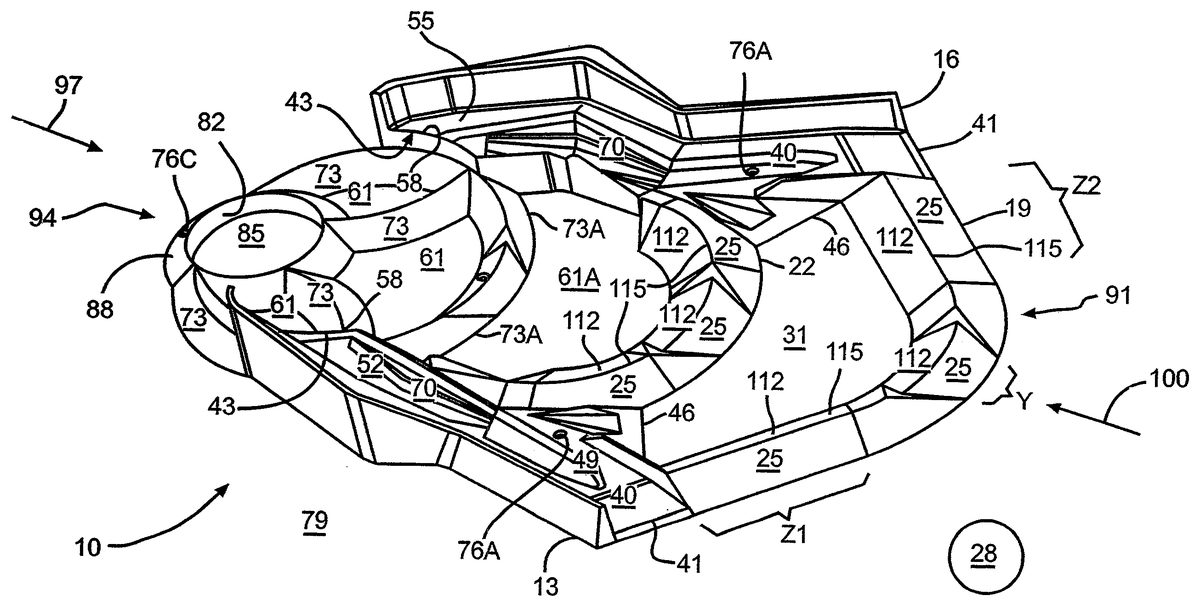
FURTHER DESCRIPTION OF THE INVENTION An embodiment of the invention may include a playing surface10having a first boundary wall13, a second boundary wall16, a first zone separator19and a second zone separator22. Such an embodiment is depicted inFIGS. 1 through 7. The first zone separator19may extend between the first boundary wall13and the second boundary wall16, and may have an angled surface25. The second zone separator22may be spaced apart from the first zone separator19in order to present a first zone area31residing between the first zone separator19and the second zone separator22. The second zone separator22may extend between the first boundary wall13and the second boundary wall16, and may have an angled surface25. As used herein, the term “angled” is used to mean an angle between 5 degrees and 75 degrees measured from a substantially flat playing substrate79. The angled surfaces25may be sloped to inhibit but not prevent a game piece28from traversing the zone separators19,22. The angled surfaces25of the zone separators19,22may be positioned so that a spherical game piece28, such as a tennis ball, may be rolled toward the angled surface25of the first zone separator19, roll over the first zone separator19into the first zone area31, and be inhibited but not prevented, from leaving the first zone area31by the second zone separator22. Similarly, if a spherical game piece28is rolled toward the second zone separator as part of an attempt to place the game piece28in the first zone area31, the game piece28may roll over the second zone separator22into the first zone area31, and be inhibited but not prevented, from leaving the first zone area31by the first zone separator19. In this fashion, the angled surfaces25of the zone separators19,22,73may be positioned so that a spherical game piece28that is rolled toward one of the angled surfaces25of one of the zone separators19,22,73must traverse that zone separator19,22,73in order to access a zone ...
FURTHER DESCRIPTION OF THE INVENTION
An embodiment of the invention may include a playing surface10having a first boundary wall13, a second boundary wall16, a first zone separator19and a second zone separator22. Such an embodiment is depicted inFIGS. 1 through 7. The first zone separator19may extend between the first boundary wall13and the second boundary wall16, and may have an angled surface25. The second zone separator22may be spaced apart from the first zone separator19in order to present a first zone area31residing between the first zone separator19and the second zone separator22. The second zone separator22may extend between the first boundary wall13and the second boundary wall16, and may have an angled surface25. As used herein, the term “angled” is used to mean an angle between 5 degrees and 75 degrees measured from a substantially flat playing substrate79.
The angled surfaces25may be sloped to inhibit but not prevent a game piece28from traversing the zone separators19,22. The angled surfaces25of the zone separators19,22may be positioned so that a spherical game piece28, such as a tennis ball, may be rolled toward the angled surface25of the first zone separator19, roll over the first zone separator19into the first zone area31, and be inhibited but not prevented, from leaving the first zone area31by the second zone separator22. Similarly, if a spherical game piece28is rolled toward the second zone separator as part of an attempt to place the game piece28in the first zone area31, the game piece28may roll over the second zone separator22into the first zone area31, and be inhibited but not prevented, from leaving the first zone area31by the first zone separator19. In this fashion, the angled surfaces25of the zone separators19,22,73may be positioned so that a spherical game piece28that is rolled toward one of the angled surfaces25of one of the zone separators19,22,73must traverse that zone separator19,22,73in order to access a zone area31,61,61A,85, and while traversing that zone separator19,22,73, the sphere is in rolling contact with that zone separator19,22,73, and the sphere may be inhibited but not prevented from leaving the zone area31,61,61A by another of the zone separators19,22,73that defines a boundary of the zone area.
It should be noted that although features of the playing surface10are described with regard to a spherical game piece28, the playing surface10may be used with game pieces28having different shapes. For example, another type of game piece28is a bean bag having a shape shown inFIG. 8. The bean bag inFIG. 8has a substantially flat edge34and a curvilinear edge37, which has been found to provide a bean bag that is easily held and may provide greater control in throwing the bean bag toward a desired location on the playing surface10.
A ramp40may be provided in one or both of the boundary walls13,16. A first entrance41to the ramp40may be provided proximate to the first zone separator19. A forward exit43from the ramp40may be provided distal from the first zone separator19. Proximate to the forward exit43, there may be a substantially horizontal region55on which a game piece28may stall while the game is played. The ramp40may include a blocking ledge58at the forward exit43. Such a blocking ledge58may make it more likely that a game piece28will become stalled on the substantially horizontal region55. A subsequent game piece28rolling up the ramp40toward the forward exit43may contact the stalled game piece28and push the stalled game piece28toward the forward exit43. Upon leaving the ramp40via the forward exit43, a game piece28may land in one of several other zone areas61. A second entrance46to the ramp40may be provided in the region of the first zone area31. The second entrance46may allow game pieces28to roll from the first zone area31onto the ramp40.
If a game piece28does not have enough energy to reach the forward exit43and does not stall on the substantially horizontal region55, the game piece28may roll down the ramp40and off the playing surface10via the first entrance41, or into the first zone area31via the second entrance46.
If desired, other ramp exits may be provided in the ramp40to allow a game piece28to exit the ramp40at a location other than the forward exit43, for example an exit may be provided to allow a game piece28to exit the ramp in one or more of the zone areas31,61.
The ramp40may have a first elevation49in the vicinity of the first zone separator19and a second elevation52in the vicinity of the second zone separator22. The first elevation49may be different from the second elevation52, for example, the first elevation49may be lower than the second elevation52so that if a game piece28is rolled toward the ramp40, the elevation of the game piece28will increase as the game piece28moves along the ramp40toward the forward exit43.
Channels70may be included in the ramp40. Such channels70may influence how a game piece28traverses the ramp40, and the channels70may be sized in width so that game pieces28having different diameters may move along the ramp40differently. Such an arrangement may make playing the game more or less challenging depending on the size of the game piece28.
At least one of the zone separators19,22,73may have a hole76through which a screw may be inserted in order to secure the playing surface10to a playing substrate79. For example, the playing substrate79may be a lawn. The ramps40may be provided with a hole76A, which may accept a screw in order to secure the playing surface10to the playing substrate, or which may be used to drain water from the ramps40.
The angled surface25of one or more of the zone separators19,22,73need not have a constant slope. For example, the slope of the first zone separator19is shown substantially constant in the regions identified by “Z1” and “Z2”, but the slope is different in the centrally located region identified by “Y”. The Y region has less of a slope, and may provide easier access to the first zone area31should a game piece28be rolled toward the Y region. In this manner, less energy may be needed for a game piece28to roll over the first zone separator19via the Y region, through the first zone area31, over the second zone separator22, through a second zone area61A, over a third zone separator73A and into a third zone area61B. Although it may be possible to roll through all three zone areas31,61A,61B by traversing the zone separators19,22,73in the regions having the greatest slope, playing surface10may require the game piece28to have more energy to do so. Further, in traversing the zone separators19,22,73, the game piece28may be deflected by one or more of the zone separators19,22,73toward a boundary wall13,16, for example, if the angle of attack for the game piece28does not result in the game piece28traversing the zone separator19,22,73along the shortest distance.
Other types of zone areas61may be included in the playing surface10. One such other zone area61may be defined by a separator82having substantially vertical walls (relative to the playing substrate79) in order to define an interior cup zone area85. Such a cup zone area85may be used to simulate the cup of a golf course into which a golf ball may be caused to roll. An exterior surface88of such a cup zone separator82may be angled to facilitate a golf ball rolling over the cup zone separator82and into the cup zone area85.
The cup zone area85may be located on a first extreme end91of the playing surface10, and the first zone separator19may be located on a second extreme end94of the playing surface10. In this manner, the playing surface10may be utilized from different directions. In a first one of the directions97, the cup zone area85would be proximate to a player and in this arrangement, the playing surface10may be easily used by a player to practice putting. It will be recognized that when the playing surface is played in the first direction, the ramps40will not easily accept a game piece28rolling toward the playing surface10. In a second one of the directions100, the playing surface10may be used to play a game that is described below, and in this second direction100, the ramps40will easily accept a game piece28rolling toward the playing surface10. It will be recognized that if a game piece28is propelled with enough force toward the playing surface10, the game piece28may traverse the playing surface10from the first extreme end91to the second extreme end94, or from the second extreme end94to the first extreme end91, depending on the direction100,97in which play is occurring.
In an embodiment of the invention, a putting ramp103may be used to facilitate a golf ball rolling into the cup zone area85.FIGS. 9A and 9Bdepict one such putting ramp. The putting ramp103may have a hole76B, which may accept a screw in order to secure the putting ramp103to the playing substrate79. The putting ramp103may include a peg106which is sized to fit into a hole76C on the playing surface10, and thereby secure the putting ramp103to the playing surface10.
The first zone separator19may include a slanted surface112that extends between the first boundary wall13and the second boundary wall16. The slanted surface112and the angled surface25may meet to form a ridge115. In this arrangement, a game piece28that expends kinetic energy to traverse an angled surface25may recover much of that kinetic energy as it rolls down the slanted surface112. Similarly, if the game is played from a different direction, a game piece28that expends kinetic energy to traverse a slanted surface112may recover much of that kinetic energy as it rolls down the angled surface25.
The playing surface10may be made from a buoyant material, such as styrofoam, or may be supported by floatation devices. Such a playing surface10may be used in a swimming pool. In one such embodiment of the invention, the zone areas31,61,85may be open areas which partially fill with water.
The invention may include a method of playing a game.FIG. 10depicts steps according to such a method, which may include providing200a playing surface, such as the one depicted inFIGS. 1 through 7. For example, the playing surface may have (a) a first boundary wall, (b) a second boundary wall, (c) a first zone separator extending between the first boundary wall and the second boundary wall, the first zone separator having an angled surface, and (d) a second zone separator extending between the first boundary wall and the second boundary wall, the second zone separator having an angled surface, the second zone separator being spaced from the first zone separator in order to present a first zone area residing between the first zone separator and the second zone separator. A screw may be driven203through one or more of the zone separators and into a playing substrate in order to secure the playing surface to the playing substrate.
A game piece may be provided206, for example, a substantially spherical ball may be provided. The game piece may be propelled209toward the playing surface, for example the game piece may be rolled toward the playing surface so that the game piece rolls212over the angled surface of the first zone separator.
The game piece may roll215down the first zone separator, and roll218on the angled surface of the second zone separator, but not over the second zone separator. In such a situation, the game piece may roll down221the angled surface of the second zone separator and come to rest224in the first zone area.
Points may be awarded based on where the game piece rests224at the end of play. For example, one point may be awarded if the game piece rests in the first zone area, two points if the game piece rests in the second zone area and three points if the game piece rests in a third zone area. If two people are playing against each other, the game may be played by throwing all the game pieces at the playing surface, tallying the points of each player based on where game pieces of each player rest, and then awarding the difference in point tallies to that player with the most points.
U.S. provisional patent application Ser. No. 60/614,536 includes descriptions of embodiments of the invention. U.S. provisional patent application Ser. No. 60/614,536 is hereby incorporated by reference.
Although the present invention has been described with respect to one or more particular embodiments, it will be understood that other embodiments of the present invention may be made without departing from the spirit and scope of the present invention. Hence, the present invention is deemed limited only by the appended claims and the reasonable interpretation thereof.
Claims
- A playing surface, comprising: a first boundary wall, which includes a ramp having a first elevation in the vicinity of the first zone separator and a second elevation in the vicinity of the second zone separator, wherein the first elevation is different from the second elevation, and the ramp includes an exit distal from the first zone separator;a second boundary wall;a first zone separator extending between the first boundary wall and the second boundary wall, the first zone separator having an angled surface that is sloped to inhibit but not prevent a game piece from traversing the first zone separator;a second zone separator extending between the first boundary wall and the second boundary wall, the second zone separator having an angled surface that is sloped to inhibit but not prevent a game piece from traversing the second zone separator, the second zone separator being spaced from the first zone separator in order to present a first zone area residing between the first zone separator and the second zone separator;the angled surfaces of the zone separators being positioned so that a sphere that is rolled toward the angled surface of one of the zone separators must traverse that zone separator in order to access the first zone area, and while traversing that zone separator the sphere is in rolling contact with that zone separator, and the sphere is inhibited but not prevented from leaving the first zone area by the other of the zone separators.
- The playing surface of claim 1 , wherein the ramp includes an entrance proximate to the first zone separator.
- The playing surface of claim 1 , wherein the ramp includes a substantially horizontal region proximate to the exit.
- The playing surface of claim 1 , wherein at least one of the zone separators has a hole therethrough, which may accept a screw in order to attach the playing surface to a playing substrate.
- The playing surface of claim 1 , wherein the angled surface of the first zone separator does not have a constant slope.
- The playing surface of claim 5 , wherein the angled surface in a centrally located region of the first zone separator has a slope that is less than a slope of regions which are not centrally located.
- The playing surface of claim 1 , further comprising a third zone separator having substantially vertical walls defining an interior cup zone area.
- The playing surface of claim 7 , wherein the third zone separator has an angled exterior surface.
- The playing surface of claim 7 , wherein the cup zone area is on a first extreme end of the playing surface, and the first zone area is on a second extreme end of the playing surface.
- The playing surface of claim 1 , wherein the first zone separator includes a slanted surface extending between the first boundary wall and the second boundary wall.
- The playing surface of claim 10 , wherein the slanted surface and the angled surface meet to form a ridge.
- The playing surface of claim 1 , wherein the playing surface is made from a buoyant material.
- A playing surface, comprising: a first boundary wall;a second boundary wall;a first zone separator extending between the first boundary wall and the second boundary wall, the first zone separator having an angled surface that is sloped to inhibit but not prevent a game piece from traversing the first zone separator, and wherein the angled surface of the first zone separator does not have a constant slope;a second zone separator extending between the first boundary wall and the second boundary wall, the second zone separator having an angled surface that is sloped to inhibit but not prevent a game piece from traversing the second zone separator, the second zone separator being spaced from the first zone separator in order to present a first zone area residing between the first zone separator and the second zone separator;the angled surfaces of the zone separators being positioned so that a sphere that is rolled toward the angled surface of one of the zone separators must traverse that zone separator in order to access the first zone area, and while traversing that zone separator the sphere is in rolling contact with that zone separator, and the sphere is inhibited but not prevented from leaving the first zone area by the other of the zone separators.
- The playing surface of claim 13 , wherein the first boundary wall includes a ramp having a first elevation in the vicinity of the first zone separator and a second elevation in the vicinity of the second zone separator, wherein the first elevation is different from the second elevation.
- The playing surface of claim 14 , wherein the ramp includes an entrance proximate to the first zone separator.
- The playing surface of claim 14 , wherein the ramp includes an exit distal from the first zone separator.
- The playing surface of claim 16 , wherein the ramp includes a substantially horizontal region proximate to the exit.
- The playing surface of claim 13 , wherein at least one of the zone separators has a hole therethrough, which may accept a screw in order to attach the playing surface to a playing substrate.
- The playing surface of claim 13 , wherein the angled surface in a centrally located region of the first zone separator has a slope that is less than a slope of regions which are not centrally located.
- The playing surface of claim 13 , further comprising a third zone separator having substantially vertical walls defining an interior cup zone area.
- The playing surface of claim 20 , wherein the third zone separator has an angled exterior surface.
- The playing surface of claim 20 , wherein the cup zone area is on a first extreme end of the playing surface, and the first zone area is on a second extreme end of the playing surface.
- The playing surface of claim 13 , wherein the first zone separator includes a slanted surface extending between the first boundary wall and the second boundary wall.
- The playing surface of claim 23 , wherein the slanted surface and the angled surface meet to form a ridge.
- The playing surface of claim 13 , wherein the playing surface is made from a buoyant material.
- A playing surface, comprising: a first boundary wall;a second boundary wall;a first zone separator extending between the first boundary wall and the second boundary wall, the first zone separator having an angled surface that is sloped to inhibit but not prevent a game piece from traversing the first zone separator;a second zone separator extending between the first boundary wall and the second boundary wall, the second zone separator having an angled surface that is sloped to inhibit but not prevent a game piece from traversing the second zone separator, the second zone separator being spaced from the first zone separator in order to present a first zone area residing between the first zone separator and the second zone separator;the angled surfaces of the zone separators being positioned so that a sphere that is rolled toward the angled surface of one of the zone separators must traverse that zone separator in order to access the first zone area, and while traversing that zone separator the sphere is in rolling contact with that zone separator, and the sphere is inhibited but not prevented from leaving the first zone area by the other of the zone separators;a third zone separator having substantially vertical walls defining an interior cup zone area.
- The playing surface of claim 26 , wherein the first boundary wall includes a ramp having a first elevation in the vicinity of the first zone separator and a second elevation in the vicinity of the second zone separator, wherein the first elevation is different from the second elevation.
- The playing surface of claim 27 , wherein the ramp includes an entrance proximate to the first zone separator.
- The playing surface of claim 27 , wherein the ramp includes an exit distal from the first zone separator.
- The playing surface of claim 29 , wherein the ramp includes a substantially horizontal region proximate to the exit.
- The playing surface of claim 26 , wherein at least one of the zone separators has a hole therethrough, which may accept a screw in order to attach the playing surface to a playing substrate.
- The playing surface of claim 26 , wherein the angled surface of the first zone separator does not have a constant slope.
- The playing surface of claim 32 , wherein the angled surface in a centrally located region of the first zone separator has a slope that is less than a slope of regions which are not centrally located.
- The playing surface of claim 26 , wherein the third zone separator has an angled exterior surface.
- The playing surface of claim 26 , wherein the cup zone area is on a first extreme end of the playing surface, and the first zone area is on a second extreme end of the playing surface.
- The playing surface of claim 26 , wherein the first zone separator includes a slanted surface extending between the first boundary wall and the second boundary wall.
- The playing surface of claim 36 , wherein the slanted surface and the angled surface meet to form a ridge.
- The playing surface of claim 34 , wherein the playing surface is made from a buoyant material.
- A method of playing a game, comprising: providing a playing surface having (a) a first boundary wall, which includes a ramp having a first elevation in the vicinity of the first zone separator and a second elevation in the vicinity of the second zone separator, wherein the first elevation is different from the second elevation, and the ramp includes an exit distal from the first zone separator, (b) a second boundary wall, (c) a first zone separator extending between the first boundary wall and the second boundary wall, the first zone separator having an angled surface, and (d) a second zone separator extending between the first boundary wall and the second boundary wall, the second zone separator having an angled surface, the second zone separator being spaced from the first zone separator in order to present a first zone residing between the first zone separator and the second zone separator, providing a substantially spherical game piece;rolling the game piece toward the playing surface, so that the game piece rolls over the angled surface of the first zone separator.
- The method of claim 39 , further comprising allowing the game piece to role on the angled surface of the second zone separator, but not over the second zone separator.
- The method of claim 39 , further comprising inserting a screw through the first zone separator and into a playing substrate.
- A method of playing a game, comprising: providing a playing surface having (a) a first boundary wall, (b) a second boundary wall, (c) a first zone separator extending between the first boundary wall and the second boundary wall, the first zone separator having an angled surface, wherein the angled surface of the first zone separator does not have a constant slope, and (d) a second zone separator extending between the first boundary wall and the second boundary wall, the second zone separator having an angled surface, the second zone separator being spaced from the first zone separator in order to present a first zone residing between the first zone separator and the second zone separator, providing a substantially spherical game piece;rolling the game piece toward the playing surface, so that the game piece rolls over the angled surface of the first zone separator.
- The method of claim 42 , further comprising allowing the game piece to role on the angled surface of the second zone separator, but not over the second zone separator.
- The method of claim 42 , further comprising inserting a screw through the first zone separator and into a playing substrate.
- A method of playing a game, comprising: providing a playing surface having (a) a first boundary wall, (b) a second boundary wall, (c) a first zone separator extending between the first boundary wall and the second boundary wall, the first zone separator having an angled surface, (d) a second zone separator extending between the first boundary wall and the second boundary wall, the second zone separator having an angled surface, the second zone separator being spaced from the first zone separator in order to present a first zone residing between the first zone separator and the second zone separator, and (e) a third zone separator having substantially vertical walls defining an interior cup zone area;providing a substantially spherical game piece;rolling the game piece toward the playing surface, so that the game piece rolls over the angled surface of the first zone separator.
- The method of claim 45 , further comprising allowing the game piece to role on the angled surface of the second zone separator, but not over the second zone separator.
- The method of claim 45 , further comprising inserting a screw through the first zone separator and into a playing substrate.
Disclaimer: Data collected from the USPTO and may be malformed, incomplete, and/or otherwise inaccurate.