U.S. Pat. No. 7,208,669
VIDEO GAME SYSTEM AND METHOD
AssigneeBlue Street Studios, Inc.
Issue DateAugust 25, 2004
Illustrative Figure
Abstract
A video game system comprises memory for storing data defining graphical objects for use in a video game. The system further comprises logic configured to enable a user to select at least one musical song to be played during a run of the video game. The logic is further configured to control at least one of the graphical objects during the run of the video game based on an attribute correlated with the selected song.
Description
DETAILED DESCRIPTION Embodiments of the present disclosure generally pertain to video gaming systems and methods for controlling video game object features and behaviors via selected sounds, such as music, provided by the gaming systems. In one embodiment, such sounds are selected by a user playing a game provided by a game unit. In another embodiment, sounds are selected by another individual, such as, for example, a gaming system manager located remote from the game unit or a person that is in the business of selling music, e.g., a retailer or a person associated with a record label. A system in accordance with one embodiment of the present disclosure allows a user to select particular types of music and/or particular songs, and music selected by the user affects particular elements and/or the behavior of particular elements in the gaming environment. Specifically, the system uses the music selected for play to initialize the game objects, their behavior, and their interrelationships based uniquely on each unique selection of music. Additionally, as the system plays, the selected music, the features and/or behavior of objects and/or characters in game are automatically controlled based on the music selected. FIG. 1depicts a video gaming system100in accordance with one exemplary embodiment of the present disclosure. The system100comprises a server102and a game unit104communicating via a network118. The server102comprises music-powered game server (MPGS) logic106, game content data107, and music information108. Note that a music-powered game generally refers to a video game in which selected sounds (e.g., music) affect events that occur during game play, the features and/or behaviors of video game objects, including objects representative of characters or inanimate objects, within the game, and/or the general look and feel of the gaming environment, such as will be described hereafter. The music information108preferably comprises music-powered attributes142and associated identifiers143. The music-powered attributes142can ...
DETAILED DESCRIPTION
Embodiments of the present disclosure generally pertain to video gaming systems and methods for controlling video game object features and behaviors via selected sounds, such as music, provided by the gaming systems. In one embodiment, such sounds are selected by a user playing a game provided by a game unit. In another embodiment, sounds are selected by another individual, such as, for example, a gaming system manager located remote from the game unit or a person that is in the business of selling music, e.g., a retailer or a person associated with a record label.
A system in accordance with one embodiment of the present disclosure allows a user to select particular types of music and/or particular songs, and music selected by the user affects particular elements and/or the behavior of particular elements in the gaming environment. Specifically, the system uses the music selected for play to initialize the game objects, their behavior, and their interrelationships based uniquely on each unique selection of music. Additionally, as the system plays, the selected music, the features and/or behavior of objects and/or characters in game are automatically controlled based on the music selected.
FIG. 1depicts a video gaming system100in accordance with one exemplary embodiment of the present disclosure. The system100comprises a server102and a game unit104communicating via a network118.
The server102comprises music-powered game server (MPGS) logic106, game content data107, and music information108. Note that a music-powered game generally refers to a video game in which selected sounds (e.g., music) affect events that occur during game play, the features and/or behaviors of video game objects, including objects representative of characters or inanimate objects, within the game, and/or the general look and feel of the gaming environment, such as will be described hereafter.
The music information108preferably comprises music-powered attributes142and associated identifiers143. The music-powered attributes142can comprise subsets of music-powered attributes142associated with a song, an album, and/or an artist, and the identifiers143preferably uniquely identify each set of music-powered attributes142, such that the MPGS logic106can retrieve a set of music-powered attributes142associated with a song, an album, and/or an artist upon request.
Note that the music-powered attribute identifiers143may comprise a universally recognized identification schema. For example, the music-powered attribute identifiers143may identify a set of music-powered attributes142associated with a song by the song's unique barcode, or the music-powered attribute identifiers143may identify a set of music-powered attributes142associated with an album by the album's title and/or artist.
The music-powered attributes142comprise data that describes, defines, or otherwise gives detailed information about the song, the album, and/or the artist with which the music-powered attributes142are associated. The music-powered attributes142associated with a particular song, album, and/or artist can comprise music-powered attributes142, such as, for example, genre, tempo, theme, a plurality of sub-themes, song or album title, topical attributes corresponding to the lyrics of the particular song, instantaneous events, hit rating, and crossover attributes, hereinafter referred to as the “music-powered song attributes.”
Additionally, music-powered attributes142defining, describing or otherwise providing information about an album can comprise music-powered attributes142associated with the album's color scheme, specific graphics associated with the album, and the like, hereinafter referred to as “music-powered album attributes.” Further, music-powered attributes142defining, describing or otherwise providing information about an artist can comprise music-powered attributes142associated with current events that are occurring relating to the artist, the artist's likes/dislikes, the artist's pet, and the like, hereinafter referred to as “music-powered artist attributes.”
These are only a few examples of various music-powered attributes142that can be used to provide information regarding a song, an album, and/or an artist, and other music-powered attributes142in other embodiments are possible.
The game content data107preferably comprises information that can be used to change the gaming environment. For example, game content data107can define models, motions, artwork, characters, objects, and game object attributes and scripts that utilize the data in conjunction with music-powered game (MPG) logic112, described further herein.
Note that a script refers to logic that provides a list of commands or actions to perform which are interpreted by the logic of a video game and provide the game developer the ability to quickly modify game play without changing the compiled video game logic. Two examples of script languages that are widely used in the video game industry are Python and Lua.
The game content data107can change periodically. Further, game content data107can be associated with the music-powered attributes142. In this regard, as described herein, the music-powered attributes142may designate a color scheme for a particular album. Thus, the palette associated with the color scheme designated in the music-powered attributes142associated with the album can be contained within the game content data107, as well as any art and/or graphics associated with the album.
Additionally, the game content data107can comprise advertisement information associated with a particular advertising campaign where an advertiser wishes to promote itself in association with particular music that consumer may enjoy in a music-powered game. As a specific example, if during a specified period of time, Coca-Cola desires to advertise its coke product in the gaming environment to consumers that enjoy hip-hop, then the game content data107can comprise graphics associated with virtual posters and/or billboards to be exhibited throughout the gaming environment related to Coca-Cola, and the system100will only display those virtual posters and/or billboards when consumers are playing music that contains the “hip-hop” value in its genre music-powered attribute142.
Additionally, if the gaming environment pertains to a nightclub, and Coca-Cola desires to advertise in the nightclub, the game content107may comprise data representative of a Coca-Cola billboard that is to be placed in the nightclub. Further, the game content data107may comprise a fanciful Coca-Cola lyric to be played periodically throughout game play, for example when the nightclub music is not playing, and the patrons are not dancing. Note that such lyrics can have associated with it a set of music-powered attributes142. For example, the music-powered attributes142may indicate a particular moment within the game play to play the jingle, and the music-powered attributes142may adjectivally provide character emotions, motions, and/or events to be utilized during game play to affect video game objects within the gaming environment.
As another example, a particular artist may desire to promote his/her fan club. Thus, the game content data107may define a virtual poster of the artist that is to appear within the gaming environment provided by the system100. Further, the game content data107may comprise graphical data that defines an animated representation (i.e., a character) resembling the artist and associated artist attributes, as will be described further herein. The game content data107may further indicate when the animated version of the artist is to appear in a game, such as, for example, when a song performed by the artist is played in the gaming environment. The animated representation of the artist may perform the song during game play, as well.
In the embodiment shown byFIG. 1, the game unit104comprises music-powered game (MPG) logic112and a music-powered game engine (“MPG engine”)114. Generally, the MPG logic112and the MPG engine114work in conjunction to provide a music-powered video game to a user116of the game unit104. During the course of game play, the game unit104displays a game environment wherein events that occur during game play, the features and/or behaviors of video game objects, including objects representative of characters or inanimate objects, within the game, and/or the general look and feel of the gaming environment are controlled via selected music that is audible to the user116.
The MPGS logic106communicates with the MPG engine114on the game unit104via the network118. The MPGS logic106transmits music information108associated with songs that are selected for play in the gaming environment via the network118to the MPG engine114. Note that music selection inputs may be provided by the user116, by the MPG engine114, by the MPGS logic106, or by an external source (not shown), such as, for example, a set of promotional music and associated music-powered attributes142may be created, selected, and provided by a music label. The MPG engine114preferably stores the music information108associated with songs that are selected for play on the game unit104, and provides the music information108to the MPG logic112, which is described in more detail with reference toFIG. 2.
The MPG logic112and the MPG engine114control events that occur during game play, features and/or behaviors of video game objects, including objects representative of characters or inanimate objects, within the game, and/or the general look and feel of the gaming environment, based upon music selections. As described hereinafter, such selections may be based on and controlled by inputs that are provided by the user116. The MPG logic112controls events that occur during game play, features and/or behaviors of video game objects, including objects representative of characters or inanimate objects, within the game, and/or the general look and feel of the gaming environment by utilizing the music-powered attributes142associated with one or more songs, hereinafter referred to as “song attributes,” played by the game unit104in accordance with the song selections made by a music-selection source, e.g., the user116. Additionally, the MPG logic112can also affect events that occur during game play, the features and/or behaviors of video game objects, including objects representative of characters or inanimate objects, within the game, and/or the general look and feel of the gaming environment using the music-powered album attributes and the music-powered artist attributes.
Although the embodiment being described indicates that the MPG engine114receives music selection inputs from the user116, the music selection inputs may also be provided by other sources in other embodiments of the gaming system100. In this regard, music can be selected by the user116, or the game can internally make selection and/or other external sources, e.g., digital radio, can provide the music selection inputs. Furthermore, music selection inputs can be provided by retailers via promotions, described further herein and record labels promoting a concert or an album.
For example, the MPGS logic106may provide music selection inputs indicative of promotional music and music-powered promotional attributes described hereafter, to the MPG engine114. Note that the music-powered promotional attributes are preferably a subset of the music-powered attributes142. The promotional music and music-powered promotional attributes142may be generated by a record label, for example, that desires to promote particular music associated with a particular album and/or artist, and the music-powered promotional attributes142describe and/or define the promotional music, much like the music-powered song attributes described hereinabove describe and define a particular song. Thus, music retailers that have access to the server102may desire to promote a particular song or artist corresponding to available music inventory that the retailer may have in its store and that the retailer desires to promote. The MPGS logic106may then transmit music selection inputs indicative of promotional music and promotional attributes to the game units104of users116that correspond to the available inventory or sales items of retailers in the same region as the user116.
Regardless of the source of the music selection inputs, during game play, the MPG engine114provides the MPG logic112with a listing, referred to as a “playlist,” of music tracks corresponding to the music selection inputs. Such a playlist120(FIG. 2) is described in more detail with reference toFIG. 2. The playlist120(FIG. 2) identifies the songs that are to be played during game play and can specify the sequence that such songs are to be played. In one embodiment, the MPG logic112displays the playlist120(FIG. 2) to the user116. Thus, as each song is played, the user116is able to see the previous song, the next song, and the like.
Furthermore, for the songs played by the MPG engine114, the MPG engine114preferably transmits music-powered attributes142associated with such songs to the MPG logic112. The attributes142can be received from a variety of sources. In a preferred embodiment, the music-powered attributes142are contained within the music information108maintained at the server102and are provided to the MPG engine114via network118by the MPGS logic106when the MPG engine114requests music-powered attributes142associated with particular music, an album, or an artist. As will be described in more detail below, the MPG logic112uses the music-powered attributes142corresponding to the selected music to make decisions that affect events that occur during game play, the features and/or behaviors of video game objects, including objects representative of characters or inanimate objects, within the game, and/or the general look and feel of the gaming environment. Several of the music-powered song attributes enumerated in the foregoing non-exhaustive list are generally described hereafter, and more detailed examples of several are also provided.
In this regard, the genre of a song describes the established class or categorization of the song. For example, song genre may include rock-and-roll, reggae, classical, country, hip-hop, jazz, and/or rhythm and blues (R&B).
The tempo of a song refers to a song's beat. Tempo can be described adjectivally, such as, for example, fast, slow, or medium. The tempo can also include actual beats per minute.
The general theme of a song can describe what a song is about, for example, love, anger, death, violence, social angst, etc. Sub-themes of a song can describe or include additional themes that relate to the song's overall theme. For example, if the theme of a song is love, then a sub-theme may be “hooking up,” dating, arguing, marriage, and/or the like. The music-powered song attributes, in addition to indicating a sub-theme, can indicate the time interval in the song that the sub-theme is addressed.
The music-powered topical song attributes corresponding to the lyrics of a song define specific topics and/or events specifically addressed and/or alluded to in the song lyrics. For example, the song may contain a casual reference to a hurricane, a car wreck, or a falling chandelier. The music-powered song attributes, in addition to indicating a particular topic or event, may also comprise data indicative of when a reference to the topic or event is made in the song. For example, if one of the topics in a song is a hurricane, the music-powered song attributes may indicate the time interval in the song when a verse about a hurricane plays.
An instantaneous event refers to an event that is to occur at a particular point marked within a song. For example, an instantaneous event may refer to breaking glass that is marked to occur when a breaking glass sound effect occurs in the song. The music-powered song attributes can provide data descriptive of instantaneous event and data indicating the point in the song that the event occurs. As an example, in music-powered song attributes associated with the Lynard Skynard song “Freebird,” the music-powered song attributes may indicate that, in the last ten seconds of the song, the characters in the gaming environment are to hold up lit cigarette lighters while another song, “Auld Lang Syne,” may have a music-powered event attribute that in the last five seconds of the song, the characters in the gaming environment are to grab their date and kiss them.
The music-powered hit rating song attribute refers to data indicative of the industry or market acceptance of the song, such as, for example, how the song might be rated on a national billboard. For example, on a scale of “1” to “10,” the hit rating music-powered song attribute might indicate a “10” if the song is a big hit or a “1” if the song is only recognized by a small niche community.
The music-powered crossover song attribute indicates whether the song might be acceptable in more than one genre. For example, the song's genre might be classified as country, but the song may further be thought of in the industry or the market as a dance song, in which case, the crossover music-powered song attribute might indicate a dance song.
Furthermore, each of the music-powered attributes142, including the music-powered song attributes, can also have an associated magnitude. For example, if a song has a “love” theme, a value can be associated with this theme that indicates to what extent the song is a “love” song. For example, if the song only tangentially pertains to love, then the magnitude associated with the theme may be a “3,” for example, on a scale from “1” to “10.” However, if “love” is the prevailing theme of the song, then the magnitude associated with the theme may be a “10.” Thus, the magnitude of a music-powered attribute142can be analyzed to determine the degree to which the music-powered attribute142is prevalent in the song.
The music-powered attributes142, including their corresponding magnitudes, provided by the MPG engine114are used by the MPG logic112to select, initialize, modify, and/or control events that occur during game play, the features and/or behaviors of video game objects, including objects representative of characters or inanimate objects, within the game, and/or the general look and feel of the gaming environment. The music-powered attributes142and their corresponding relationship to the MPG logic112and the MPG engine114is described in more detail with reference toFIGS. 3–7.
In one embodiment, a song, an album, and/or an artist is “classified” only once, and the music-powered attributes142associated with that classification are used by any MPG engine114and the MPG logic112in initializing, modifying and/or creating events during game play, the features and/or behaviors of video game objects, including objects representative of characters or inanimate objects, within the game, and/or the general look and feel of the gaming environment. “Classifying” is a term that refers to the act of defining and populating music-powered attributes142for a particular song, album, and/or artist.
However, in other embodiments, the classification of a song may directly depend upon the gaming environment created by the MPG logic112. In this regard, a song may be classified differently, for example, for a nightclub game, as opposed to the same song being classified differently for a shooter game.
The MPG engine114performs a variety of operations. Specifically, the MPG engine114receives music information108from the MPGS logic106, which the MPG engine114stores, preferably in a table format, on the game unit104for access during game play.
The server102also provides to the MPG engine114the game content data107, which comprises information about the video game environment that is directly associated with the music-powered attributes142that are new to user116and that are to be provided to the user116, as described hereinabove. Game content data107can be repeatedly updated to include new game content that the MPG engine114provides to the MPG logic112when the user116initiates game play, specifically selects new music for use in the game unit104, or requests new game content data107or when a record label, retailer, or the MPGS logic106decides to download new game content data107to a user116, as described in more detail with reference toFIG. 14.
Thus, if the user inserts a CD into the game unit104, and there is new music on the CD that is not yet in the catalog123or the authenticated song data227, as will be described in with reference toFIG. 2, the game104unit preferably interacts with the server102to retrieve the music-powered attributes142from the server102associated with each new song. Additionally, the music-powered attributes142may comprise album attributes and artist attributes, as described hereinabove. Furthermore, the game content data107may also comprise content associated with the song, album, or the artist, which the MPG engine114retrieves from the server102.
If the user116elects to receive new game content data107from the MPG engine114, the MPG logic112can incorporate events, features and/or behaviors of video game objects, including objects representative of characters or inanimate objects, within the game, and/or the general look and feel of the gaming environment corresponding to the new game content data107. As an example, the user116may elect to receive game content data107defining a new three-dimensional (3D) character. In this regard, the MPG logic112can place the character in the gaming environment and the character behaves in accordance with music being played in such environment as reflected by the new character's personality. As an example, the MPGS logic106may notify the user116that there is a modification (an “expansion pack”) available for the user's MPG logic112that will provide the user116a richer game environment and/or more functionality. Thus, the user116may elect to request the expansion pack for download.
Note that game content data107can be transmitted by the MPGS logic106on the server102to the MPG engine114on the game unit104. Therefore, the MPGS logic106can periodically provide to the game unit104updates on the game content data107. Furthermore, the MPG engine114plays music from a local playlist120or music received from a stream server (not shown) described further herein.
The user116can purchase or otherwise acquire music and associated music-powered attributes142for use during game play to affect events that occur during game play, the features and/or behaviors of objects, including video game objects representative of characters or inanimate objects, within the game, and/or the general look and feel of the gaming environment from internet music retailers, such as, for example, Napster. Additionally, the user116may purchase a CD from a retailer. When the user116purchases the music either through an online service or store retailer, the user116can download and/or copy the music to the game unit104. In order for the music to be used by the MPG logic112, the user116can obtain, via the MPG engine114, music-powered attributes142associated with the music from the music information108stored by the server102, or alternatively the music-powered attributes142associated with the music can be obtained directly from the CD purchased in retail or within a music file purchased online.
If the user116elects to use new music in the game unit104, the MPG engine114can receive new server music-powered attributes142and new game content data107from the MPGS logic106. The MPG engine114may then provide the new game content data107and the new music-powered attributes142to the MPG logic112, described further with reference toFIG. 2, and the MPG logic112can select, initialize modify, create, and/or control events, features and/or behaviors of video game objects, including objects representative of characters or inanimate objects, within the game, and/or the general look and feel of the gaming environment corresponding to the new game content data107.
As an example, the user116may elect to select music for play in the game that references a one-eyed, one-homed, flying purple, people-eater. Thus, the MPG engine114may request new game content data107and server music-powered attributes142and identifiers143that define and describe a monster having one-eye, one-horn, flies, and likes to eat people from the server102. In this regard, the MPG logic112can introduce the character to the gaming environment and the character behaves in accordance with music being played in such environment as reflected by the new character's personality. Alternatively, the game content data107could have provided a more generic character who's behavior is less driven by the specific music-powered attributes142of the new song and more driven by the music-powered attributes142of other songs classified in the system.
In some embodiments, key codes can be associated with the purchased music and used to ensure that the music is purchased or otherwise acquired from an authorized retailer or other legitimate source (i.e., the music is not pirated). Thus, a list of valid key codes can be maintained at the server102and/or stored in the game unit104. Such a list may include each valid key code and an identifier of the song or songs to which it pertains. When the user116acquires a song from a legitimate source, the user116is preferably provided the valid key code for the song by the legitimate source.
Moreover, before the MPG engine114adds a new song to the playlist or otherwise enables the new song to be used in the gaming environment provided by the MPG logic112, the MPG engine114can be configured to request a user-provided key code from the user116.
In one embodiment, the user116manually enters the user-provided key code in response to the foregoing request, which may be displayed to the user116as a user prompt. In this regard, the user preferably enters the key code provided by the retailer or other legitimate source at the time of purchase. In another embodiment, the user-provided key code can be automatically acquired by the MPG engine114. For example, the associated key code may be appended to the data defining the new song or located on the same media of the newly acquired song such that the key code verification process is completely transparent to the user116.
After obtaining the user-provided key code, the MPG engine114can then verify whether the song has been acquired from a legitimate source by having the song's user-provided key code compared to the aforementioned list of valid key codes. Note that the actual comparison may be performed by the MPG engine114, the MPGS logic106, or any other system component. If the user-provided key code matches or otherwise corresponds to the valid key code for the new song, the MPG engine114is authorized to interface the newly purchased song's music-powered attributes142with the MGP logic112for use in affecting the gaming environment or behavior of characters or other objects in the game and the server102removes the key code from the list of valid key codes111to ensure that another user116can not use the same legitimately acquired key code. The MPG engine114preferably does not add that new song to the playlist until a user-provided key code matches or otherwise corresponds to the song's valid key code.
Additionally, if the user116is unable to provide a key code that matches the song's valid key code, music retailers or record labels can provide key codes to the buyer after the purchase, e.g., online. Note that key codes can also be used on a per artist or per album basis such that a single key code can authorize the use of any song by a particular artist or a particular set of songs by one or more artists. Moreover, the MPGS logic106, via the MPG engine114, can ensure that music to be used in the gaming environment was legitimately acquired.
In one embodiment, the list of valid key codes is stored at the server102as key code data111, and the operation of such an embodiment will now be described in more detail.
In the instant example, assume that the user116purchases a CD and that the seller is an authorized distributor that provides a valid key code to the user116associated with the purchase. This valid key code is stored in the key code data111and is associated with an identifier that identifies the purchased song.
When a user116selects a song to be played in the gaming environment, the MPG engine114determines whether a user-provided key code is associated with the song. If so, the MPG engine114transmits a request to the MPGS logic106to verify whether the song selected by the user116was legitimately purchased or acquired. Such a request includes information identifying the selected song as well as the user-provided key code. The MPGS logic106determines if the user-provided key code matches the song's valid key code stored in the valid key code data111.
If the user-provided key code does not match the valid key code, then the MPGS logic106transmits a rejection notification to the MPG engine114, and the MPG engine114does not allow the selected music to be used by the MPG logic112. If the user-provided key code matches the valid key code in the key code data111, then the MPGS logic106transmits an acceptance notification to the MPG engine114, and the MPG engine114allows the selected music to be used by the MPG logic112. Additionally, the game engine114may designate the authorization of the song for use in the game112for future game sessions as well as designating any other songs that are associated with the valid key code (e.g., other songs from the same album or other collections of songs) for use in the game thus eliminating future prompts for the previously provided key code.
If the user116is unable to provide a key code that matches the valid key code, the MPG engine114can prompt the user116to determine if he would like to receive a valid key code for the song that the user116has selected for play. If so, the MPG logic112and/or the MPG engine114can direct the user116to an internet site (not shown) or a retailer where the user116can purchase, for a fee or otherwise, a copy of the selected music along with the valid key code or just the valid key code.
Thus, the system100serves to discourage the unlawful use of pirated music by encouraging users, e.g., user116of the system100, to obtain valid key codes for music that the user116desires to incorporate into the gaming environment. However, the use of key codes, as described hereinabove, is unnecessary and may be left out of at least some embodiments. Such an authentication method is further described with reference toFIGS. 2A–2B.
In one embodiment, the newly acquired music may contain on or with the media, e.g., CD, the music information108comparing the music-powered attributes142related to the newly purchased music. For example, if the user116purchases a CD containing a song for use by the game unit104, the CD may include, in addition to data defining the song, data defining various music-powered attributes, as described herein. Therefore, when the user116loads the newly purchased music into the game unit104, the MPG engine114and the MPG logic112can retrieve the music-powered attributes corresponding to the newly purchased music from the purchased media (e.g., CD) unless updates have been released since the CD was pressed.
Furthermore, music may be delivered to the user116along with a game (e.g., MPG logic112) that was developed to interface with the MPG engine114. In this regard, in at least some embodiments, the MPG logic112may be contained in a cartridge or on a CD that is removable from the game unit104. Such a cartridge or CD may include data defining not only the game logic112but also defining music and/or music-powered attributes to be used in the gaming environment controlled by the MPG logic112. Moreover, different types of logic112defining different types of video games may be interfaced with and run on the game unit104. For example, one cartridge or CD may include logic112for providing a virtual nightclub game, whereas another cartridge or CD may include logic112for providing a virtual auto racing game. In such embodiments, the MPG engine114is responsible for maintaining or managing data defining music and/or music-powered attributes, and each set of MPG logic112determines how such music-powered attributes are to be used in its respective gaming environment.
Additionally, the MPGS logic106can track and report music and use preferences of the user116, described further herein with reference toFIG. 8. Generally, the MPG engine114provides information to the MPGS logic106corresponding to the type of music acquired by the user116(e.g., interfaced with the game unit104by the user116) and the frequency that the user116selects specific songs or particular types of music for use in the gaming environment provided by the MPG logic112. Other types of user music and use preferences may be tracked and reported in other embodiments. The MPGS logic106can store the reported information on the server for subsequent access and use for marketing or advertising purposes, such as is described hereafter with reference toFIG. 8.
In one embodiment, the MPGS logic106supports the industry's popular Digital Rights Management (DRM) standards. In this regard, the system100abides by the limitations specified for a particular song regarding the number of times that a song that has been downloaded can be played.
In addition, a music selection, for example one made by a music label that is promoting a particular album and/or song on the album, may provide “promotional attributes,” which are also included in the music-powered attributes142, associated with the song and/or album that indicate that the song or album is only licensed for a specified number of times. The MPG engine114may be configured to ensure that the song or album is not played more than the specified number of times in the gaming environment. Furthermore, the attributes corresponding to a promotional song that is being promoted may also prompt the MPG engine114to disable fast forward and/or skipping functionality provided to an end user116. In this regard, the user116may be required to listen to the complete promotional song provided by the retailer, as opposed to listening to only a portion of the song provided.
The MPG engine114further facilitates user registration. In this regard, before the MPGS logic106sends music information108or game content data107to the user's game unit104, the MPGS logic106can first request that the user116register with the server102by sending, to the server102, various personal information about the user116and/or game unit104. In particular, when a new user116registers with the MPGS logic106, the MPG engine114may be configured to request registration information about the user116, such as the user's zip code, name, address, music likes/dislikes, gender, favorite bands, favorite retailers for purchasing music, and the like. The user116may then enter the requested registration information through a graphical user interface provided by the MPG engine114. The MPG engine114transmits the registration information to the MPGS logic106on the server102, and the MPGS logic106stores the user registration information105on the server102.
Furthermore, the MPG engine114can modify registration information of a user116. In this regard, the MPG engine114may periodically request that the user116update his registration information.
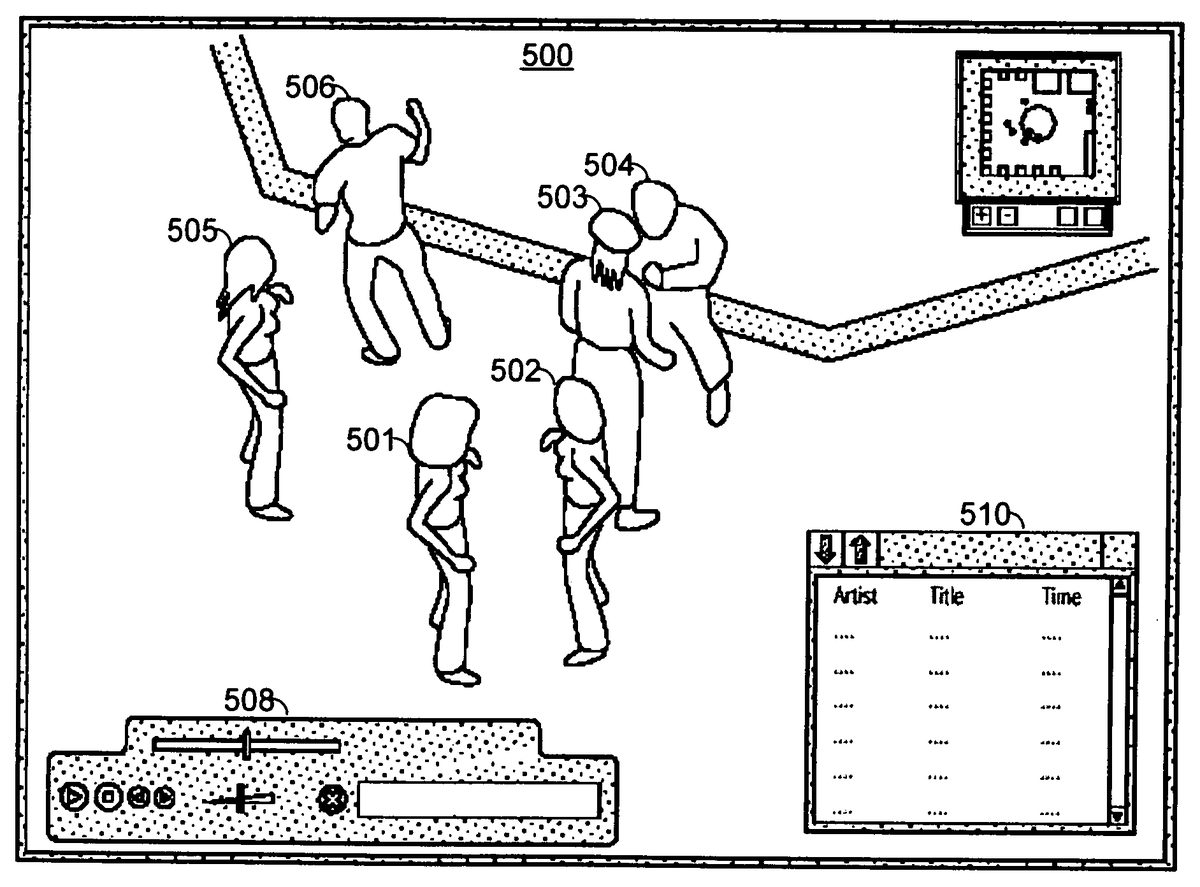
In operation generally, the user116, or another source as indicated herein, provides one or more inputs to initiate the MPG logic112at the game unit104. Upon initiation, the MPG logic112provides an interactive gaming environment, an example of which is illustrated and described in more detail with reference toFIG. 5.
The MPG logic112enables the user116to interactively play in the gaming environment. During play, the MPG engine114and the MPG logic112work in conjunction to select, initialize, create, modify, and/or control events that occur during game play, the features and/or behaviors of video game objects, including objects representative of characters or inanimate objects, within the game, and/or the general look and feel of the gaming environment in accordance with music-powered attributes of selected music.
Note that music selection inputs may be received by the game unit104from the user116, from the server102, or from other sources. In this regard, the MPG engine114receives a music selection (e.g., a selection identifying a song or a group of songs to be included in a playlist and incorporated into the gaming environment) from the user116via the MPG logic112, or another source as indicated herein. The MPG engine114associates the music selected with its various music-powered attributes, which are described in detail hereafter, and the MPG logic112uses the associated music-powered attributes to affect game play. The MPG engine114communicates the associated music-powered attributes to the MPG logic112, and the MPG logic112uses the attributes corresponding to the selected music to affect the gaming environment.
FIG. 2Adepicts an exemplary game unit104of the present disclosure. The exemplary game unit104generally comprises a processing unit208and memory200.
Memory200comprises data representative of game content inventory241, a playlist120, digital music121, an authenticated song list227, a music catalog123, object personality data220, and a playlist history225, and each of these components and their functionality are described further herein. Further, the memory200comprises game unit music-powered attributes250, the MPG engine114, the MPG logic112, and an MPG application program interface (API)204.
The game unit music-powered attributes250generally comprise a collection of music-powered attributes250that includes server music-powered attributes251, which is preferably a selected portion of the music-powered attributes142from the server102corresponding to the music played on the particular game unit104. Additionally, the game unit music-powered attributes250include music-powered playlist attributes219and music-powered playlist history attributes119.
The processing unit208may be a digital processor or other type of circuitry configured to run the MPG logic112and the MPG engine114, as well as other software, by processing and executing the instructions of the MPG logic112and the MPG engine114. The processing unit208communicates to and drives the other elements within the unit104via a local interface222, which can include one or more buses.
Furthermore, an input device212, for example, a keyboard, a switch, a mouse, and/or other type of interface, can be used to input data (e.g., song selection inputs) from a user116(FIG. 1) of the game unit104, and display device216, such as a monitor or television, can be used to display data to the user116. For example, the display device216can display a graphical gaming environment to the user116, an example of which is illustrated inFIG. 5and described in more detail hereafter. Examples of input devices may include, but are not limited to, a keyboard device, serial port, scanner, camera, microphone, card reader, and/or network connection.
Additionally, the exemplary game unit104comprises an audio device214connected to the local interface223, which may comprise one or more buses. In the exemplary game unit104, the audio device214, e.g., a speaker, preferably plays songs listed in the playlist of the MPG logic212sequentially during play of the game.
The game unit104can be connected to the network118(FIG. 1) via a network device210that allows the unit104to exchange data with the network118(FIG. 1). In this regard, the game unit104receives music information108from the server102, via the network118.
In an alternate embodiment, the network device210receives music from a streaming server (not shown). A streaming server is a computing device that transmits a stream of data representative of a single song, a portion of a song, a collection of songs, e.g., an entire album, or portions of a radio program, as described in detail with reference toFIG. 11, for example, to the game unit104over the network118. Examples of streaming media systems include the streaming tools for Windows Media or QuickTime. Prior to transmittal, the streaming server compresses the data, and upon delivery, the data is decompressed for use by the gaming system.
The MPG engine114, the application program interface (API)204, and the MPG logic112work in conjunction to provide a music-powered gaming environment to a user116(FIG. 1). The MPG engine114, the application program interface (API)204, and the MPG logic112are shown as implemented in software and stored in memory202. However, each may be implemented in hardware or a combination of hardware and software in other embodiments. Note that the MPG engine114comprises logic for implementing its functionality, as described herein. Further, as used herein, the term “logic,” refers to components that generally may be implemented in hardware, software, or a combination thereof, unless otherwise noted herein.
As noted herein, the MPG engine114, the MPG API204, and the MPG logic112are shown inFIG. 2Aas software stored in memory200. When stored in memory200, each can be stored and transported on any computer-readable medium for use by or in connection with an instruction execution system, apparatus, or device, such as a computer-based system, processor-containing system, or other system that can fetch the instructions from the instruction execution system, apparatus, or device and execute the instructions. In the context of this document, a “computer-readable medium” can be any means that can contain, store, communicate, propagate, or transport the program for use by or in connection with the instruction execution system, apparatus, or device. Note that the computer-readable medium could even be paper or another suitable medium upon which a program is printed, as the program can be electronically captured, via for instance optical scanning of the paper or other medium, then compiled, interpreted or otherwise processed in a suitable manner if necessary, and then stored in a computer memory.
The API204comprises defined code that interfaces the MPG logic112with the MPG engine114. In this regard, the API204provides a programmer with, for example, specific calls to operations of the MPG engine114that cause the MPG engine114to perform predefined functions, such as for example, adding or deleting songs from playlist120or providing the playlist120to the logic112so that the songs indicated by the playlist will be incorporated into the gaming environment. The integration of music information108(FIG. 1) into the gaming environment is described in more detail with reference toFIGS. 3–5.
More particularly, the API204may be defined at a high code level and provide a level of abstraction between the MPG logic112and the MPG engine114by which a programmer can create source code integrating API commands for controlling the MPG engine114so that the game is music-powered, as described herein. The API204provides the interface between a high level language, for example, “C” or “C++, in which the MPG logic112is written, and the lower level utilities and services which can be written without necessarily considering the calling conventions supported by a compiled language.
In operation, the MPG logic112provides the user116a gaming environment. For example, the gaming environment may be a virtual nightclub or war zone. Note that the gaming environment is preferably displayed within a graphical user interface (GUI), and an example of a gaming environment GUI is described in more detail with reference toFIG. 5.
A user116(FIG. 1) initiates the MPG logic112via the input device212. The MPG logic112displays via the display device216the particular gaming-environment, and the game begins. The MPG logic112may initiate with a default playlist to start the user116in the game. The default playlist can be provided, for example, along with the data defining the MPG logic112.
The MPG engine114uses the playlist120in order to determine the initial gaming environment. For example, if the genre of the first song is country, then the MPG engine114may be configured to provide country-like game content to the MPG logic112. Furthermore, the MPG engine114may use the playlist history225as the default playlist in order to create the gaming environment, as will be described further hereinafter.
The user116can add, delete, or shuffle songs within the playlist120during operation, and the addition and/or deletion from the playlist can affect the game play by changing the content or order of the songs being played. In one embodiment, the theme of each song in the playlist120is measured by type and magnitude to create a playlist theme rating that is the combined effect of each theme on the playlist120. This playlist theme rating can then be used to initialize objects and events. For example, if the playlist is made up of 80% love themes, 10% violence, and 10% social commentary, then the game engine114may initialize 80% of the characters with love traits and 80% of the game events to be love-based and likewise for the violence and social commentary themes.
In addition, the order of the playlist120can be significant in affecting the gaming environment. In this regard, music-powered song attributes250of a previous song can modify a character's present state. Therefore, with respect to the character's reaction to the current song, the character may react to the current song based upon the character's state, which may be affected by the previously played song or songs. Shuffling the order of the playlist120and playing the MPG logic112again, may produce a different state for the character and a different set of actions, reactions and/or interactions to the currently playing song.
Additionally, the MPG engine114may save the playlist120for future use even after the current run of the game has ended, which the MPG engine114may store as playlist history225, as described further herein.
The MPG logic112, in accordance with the type of gaming environment created, controls a plurality of video game objects, which may consist of, for example, characters (e.g., people or aliens), tanks, roller coasters, pets, and the like, as well as aggregate objects, such as those typically used in tycoon games, and other abstract video game elements including, but not limited to, landing squares on a board game, cards, in a card game, dice in a dice game, or questions in a quiz game. These are only exemplary video game objects, other video game objects can be used in other embodiments. Associated with a of the plurality of video game objects is object personality data220that defines, describes, and otherwise is used by the MPG logic112to determine how the objects will react to music and/or sounds.
During operation, the game unit104receives song selections identifying songs to be played in the gaming environment provided by the MPG logic112. The MPG engine114stores data indicative of the music selection inputs in the playlist120. As described herein, the playlist120can be a list of song identifiers for songs that the MPG engine114plays during the game controlled by the MPG logic112. The playlist120may include the data defining such songs, although such data may be stored elsewhere. Hereafter, unless otherwise noted, it will be assumed that the playlist120comprises a list of song identifiers and that data defining these songs is stored in memory as digital music121.
The MPG engine114can play music from locally stored digital music121, for example a song file in MP3 format. Thus, the MPG engine114transmits a song, as indicated in the playlist120, from stored digital music121to the audio device214. In addition to transmitting audio signals indicative of the selected song to the audio device214, the MPG engine114transmits the game unit music-powered attributes250, including those server music-powered attributes251specifically associated with the selected song, which can include song attributes, album attributes, and/or artist attributes, among others, to the MPG logic112. As noted hereinabove, the server music-powered attributes251are retrieved from the server102, and are preferably a portion of the server music-powered attributes142on the server102. However, the game unit music-powered attributes250may also comprise music-powered attributes retrieved from a CD, a stream of data, digital broadcast data, described further hereinafter.
In this regard, the MPG engine114, as described above, maintains server music-powered attributes251associated with songs, albums, and/or artists that can be played by the MPG engine114. The server music-powered attributes251are preferably populated by the MPGS logic106. In this regard, the MPGS logic106downloads music-powered attributes142to the MPG engine114corresponding to music for which the MPG engine114receives music selection inputs either from the user116or another source. In any event, the music-powered attributes142associated with selected digital songs121and the identifier143associated with the selected songs are stored on the game unit104in server music-powered attributes251and identifier229, respectively.
Additionally, music-powered attributes142or the game content data107that was originally distributed on a CD may be modified after distribution of the CD. The MPG engine114may update the server music-powered attributes251on the game unit104and the game content inventory241on the game unit104when such music-powered attributes142are updated. In so updating, the MPG engine compares the versions of the music-powered attributes251with the corresponding music-powered attributes142on the server102and updates those music-powered attributes250accordingly.
As an example, a song obtained from a CD may become a hit that was not expected, so it may be desirable to increase the song's hit rating, as indicated by its associated music-powered attributes. There may be a dance rating attribute associated with a song that describes to what extent a song can be danced. After release of the CD, a particular song becomes a favorite within dance clubs, so it may be desirable to increase the song's dance rating. A song may become associated with an unforeseen theme such as a song becoming popular in the gay community, being played at sporting events, or used on a political campaign, and the song's associated music-powered attributes may be modified to better reflect the song's overall market use by updating its themes and updating its hit rating to reflect its newly found popularity. The music-powered attributes142may be updated for a song that subsequently is associated with real world events, and events in the game can be tied to the real world events.
For example, if after a CD is distributed, a song becomes strongly linked to some new dance move, such as the well-known song “YMCA,” with its hand moves or “Macarena” with its arm/body moves, then the event values for the song can be updated for character motion files, and the song attributes can be classified with time stamps for their proper synchronization with the music. Other songs may become associated with events that are not synchronized with the music. For example if during a tour, an artist “sets their guitar on fire” during a song as Jimmy Hendrix became noted for, or “distributes scarves” as Elvis did, or has “panties thrown up on stage” as Tom Jones did, or “has fans scream at unheard of levels” as The Beatles did, then and event would be updated for the song that would trigger new world events or increase the likelihood of existing events occurring such as a speaker catching on fire, characters waving scarves, panties being found on the dance floor or patrons screaming respectively.
Before a song is played, as indicated by the playlist120, the MPG engine114retrieves the music-powered attributes associated with the song from the server music-powered attributes251and provides such music-powered attributes251to the MPG logic112. In this regard, the MPG engine114identifies the song that is to be played, searches the identifiers229associated with the songs by use of, for example, the title and artist, and retrieves the song's music-powered attributes251. Note that the identifiers229preferably provide an index to the music-powered attributes251.
In accordance with the manner in which the MPG logic112has been configured to use the game unit music-powered attributes250in relation to its game objects, the game play proceeds and events, objects, and the look and feel of the game are affected in accordance with the provided game unit music-powered attributes250. An exemplary gaming environment is described in detail with reference toFIG. 5.
As described herein with reference toFIG. 1, the server102can maintain key code data111(FIG. 1) that comprises key codes associated with legitimately acquired music. Likewise, the MPG engine114can maintain a current listing of the authenticated song within data227stored in memory200. Thus, when the user116attempts to use a new song in the gaming environment, the MPG engine114can ensure that the newly requested song has been authenticated, i.e., the user116is associated with a legitimate key code111on the server102with respect to the song, by searching the authenticated song data227. In this regard, if the user116purchased the song legitimately, then the MPG engine114stores an identifier in the authenticated song data227indicating that the particular song can be played by the MPG engine114. Thus, if the identifier of a particular song is listed in the authenticated song data227, then the engine114is authorized to interface the song with the MPG logic112so that it can be incorporated into the gaming environment. Authentication is described in more detail with reference toFIG. 2B.
Further, the MPG engine114can create a catalog123that comprises a complete listing of songs currently available for play by the game unit104. Notably, music available to the MPG engine114for play in the gaming environment created by the MPG logic112can be obtained in a variety of ways. For example, music can be loaded onto the game unit102via a CD or downloaded from an internet site, such as, for example, as an MP3 file. The MPG engine114can search fixed and removable storage on the game unit104, such as the unit's hard drive, CD drive, or DVD drive, for music that is in a format compatible to the MPG engine114. When the MPG engine114locates music in a compatible format, the MPG engine114can enter the located music into the catalog123and retrieve the music-powered attributes associated with the located song from the MPGS logic106on the server102. The MPG engine114can then store the located music's associated music-powered attributes142in the server music-powered attributes251of the game unit music-powered attributes250for retrieval during game play.
If the user116is the source providing the music selection inputs, the MPG logic112can display the catalog123to the user116. The user116can then make a selection from the displayed catalog123. When the user116selects a new song from the catalog123, the MPG engine114creates or updates the playlist120to reflect the music selection inputs and during game play provides the server music-powered attributes251corresponding to the songs selected from the catalog123.
When the MPG engine114retains historical information regarding the playlist120of the user116from past runs of the game, the MPG engine114can extract information from the playlist history225for future game play. Such information can be stored locally in memory200so that the MPG engine114can access the information directly, or the information can be transmitted to the MPGS logic106on the server102for storage remotely.
In one embodiment, the MPG engine114maintains the playlist history attributes119that define and/or describe the playlist history225. The playlist history attributes119can compile and characterize various music-powered attributes, such as for example, an attribute associated with songs recently played, an attributes associated with the frequency that a particular song is played, an attributes associated with the frequency that songs corresponding to a particular genre are played, and the like.
The MPG engine114and the MPG logic112use the playlist history attributes119to affect game play. For example, if a particular song associated with “love” is played repeatedly, then the MPG logic112can use this information to affect the behavior of, for example, the attitudes of the character objects in the game. In particular, if the love song that is played over and over is slow and downbeat, over time, the characters may begin to appear bored and listless. If, however, a song about “violence” is played over and over, the characters may begin to perform violent acts, for example, fighting, throwing things, arguing, etc.
Furthermore, the MPG engine114may use the playlist history225in order to modify the object personality data220. As described herein, the playlist history225comprises a list of songs indicative of songs that have historically been played by the MPG engine114by selection by the user116or otherwise. In addition to the list of song's, the playlist history is associated with the playlist history attributes119in the game unit music-powered attributes250. The playlist history attributes119provides attributes that define, describe, or otherwise categorize the playlist history225so that the playlist history225can affect the game play through the playlist history attributes119.
Thus, assume that a character object “Bill” is in the game and that Bill's personality data220indicates that he enjoys chewing bubble gum. Thus, each time that Bill appears in the gaming environment, Bill is controlled, based on his personality data220, such that he appears to be chewing bubble gum. However, the user116, or any other source as described herein, may repeatedly select music associated with barbecue, as indicated by the playlist history attributes119. Over time, the MPG engine114, based on the selections of music classified on the playlist history attributes119associated with barbecue, can modify Bill's personality data220from enjoying bubble gum to preferring barbecue.
In another example, if the user116has historically selected a particular genre music, then the playlist history attributes119collected from the playlist history225that the MPG engine114transmits to the MPG logic112can be associated with the particular genre of music.
As an illustration, assume the user116has frequently selected country music for play in the gaming environment. In such an example, the MPG logic112stores such information in the playlist history attributes119and utilizes the playlist history attributes119associated with the country songs to create a country-like gaming environment. For example, the MPG engine114may automatically provide game parameters defining a country bar, e.g., various patrons wear cowboy hats or there may be a mechanical bull in the country-like bar. However, if the user116has frequently selected disco music, the MPG engine114may automatically define a disco-like bar in accordance with the playlist history attributes119, e.g., various patrons may be dressed in 1970's type of attire.
As the game is played, the behaviors of the objects and/or characters, for example patrons at a nightclub, events that occur within the nightclub, and/or the look and feel of the nightclub behave, occur, and evolve in accordance with the game unit music-powered attributes250relating to the music being played during the game play and the objects' and/or character's personality data.
The MPG logic112can effectuate initialization, modification, creation and/or control of objects, events, and/or the look and feel of the gaming environment by associating particular game unit music-powered attributes251, playlist attributes219, and playlist history attributes119with the object personality data220.
Notably, an objects personality data220is a collection of data that defines the objects behavioral traits, physical appearance, features, and the like. For example, if a country song (as indicated by the song's music-powered attributes) is selected and an object's, for example, an object's personality data indicates that he has an extraordinary distaste for country music, then the action of the character may be controlled in response to the song to reflect this. As an example, the action of the character may be automatically controlled by the MPG logic112such that the character appears to become more agitated or less friendly while the song is playing. As a further example, the character may be controlled such that he throws a beer bottle against the wall or stops dancing in response to the play of a country song.
The MPG logic112can use a script, as described hereinabove, to define objects with a standard set of behavior traits such as “like,” “dislike,” “hate,” “defend,” or “promote.” Additionally, the script can define how these behavior traits are performed independent of the actual items that are “liked, disliked, hated, defended, or promoted.”
The system100enables the MPG logic112to extract the music-powered attributes250and bind them at load-time or run-time to the object personality data220of particular objects. Thus, MPG logic112can initialize, modify, create and/or control events, objects, and/or look and feel in the game each time the new music is selected. Using the system100, the MPG logic112can bind the music-powered attributes250to the object personality data220corresponding to a predefined and limited set of songs at the time the MPG logic112is implemented. In this regard, the MPG logic112may not rely on load-time or run-time additions of new music. Further, the MPG logic112can be configured to bind music-powered attributes250and the personality data220with respect to any music within the system100, realizing all songs in the system have music-powered attributes250at load-time or run-time.
However, if the character's personality data indicates that the character likes country music, then the character may be automatically controlled by the logic112such that it appears that he becomes less agitated or more friendly during the song. For example, the character may be controlled such that he begins to dance to the beat of the song being played. Other types of object personality data and the affects of the music-powered attributes on the events, the objects, and/or the look and feel of the gaming environment are possible in other examples.
Additionally, the MPG engine114may further facilitate changes in features of the gaming environment in accordance with the game unit music-powered attributes250. For example, if a country music song is playing or is selected via the input device212, the MPG engine114may transmit game content inventory241and music-powered attributes to the MPG logic112that facilitates the addition of wall art corresponding to country music songs, e.g., there may appear in the gaming environment a wall poster of a country music artist, such as George Strait, or an animated character representative of the artist might appear and possibly perform a song in the gaming environment.
In one embodiment, the gaming environment can be artist centric. In such an embodiment, if the user116purchases a particular artist's music, then the CD purchased comprises game content inventory141specifically corresponding to the artist, the artist's music, and music-powered attributes associated with the music. Therefore, when the user116loads the music and corresponding information into the game unit, the MPG engine114and the MPG logic112use the new game content inventory141and the game unit music-powered attributes250to customize the user's gaming environment to be centered around the artist.
For example, if a user116loads a Britney Spears CD into the game unit104, MPG engine114loads the new game content inventory141. The game content inventory141may comprise a plurality of music-powered attributes associated with the new CD. The game content may comprise data defining art similar to that exhibited on the most recent label of the Britney's CD, including the color scheme. The music-powered attributes descriptive of the artist centric gaming environment may further comprise music-powered attributes associated with the lifestyle and/or current events in the artist's life. Additionally, the game content107delivered to the game unit104may comprise a new character representative of the artist, as described herein. Along with the new character are the character's associated music-powered attributes.
Thus, after receiving the new game content inventory241and server music-powered attributes251, the MPG engine114loads the received music-powered attributes251into the MPG logic112. In this regard, the MPG engine112adds objects and/or modifies current objects and/or initiates events in accordance with the music-powered attributes251and the game content inventory241. For example, the nightclub may be “Club Britney,” which is decorated in the same colors of those on her newest album.
Furthermore, once the user116loads the artist centric gaming environment via the CD or otherwise, the MPG engine114can notify the MPGS logic106that the user116now has an artist centric gaming environment. The MPGS logic106can store such notification. Thus, when the MPGS logic106receives an update or new game content that pertains to the related artist, either through a record label, gamers, games designers, or the like, the MPGS logic106can automatically provide, based on the stored notification, the update or new game content to game unit104for incorporation into the artist centric gaming environment.
In addition to enabling a user116to create a character having a defined personality, as described herein. The MPG logic112may also provide the user116with an “empty” character, i.e., one whose personality is not at all or fully defined.
The music selection inputs provided by the user116or otherwise can be used by the MPG engine114to dynamically create the “empty” character's personality. As the music is selected for the playlist and/or played, the personality of the character is defined and changes. For example, if country-like music is selected, the object personality data220may be defined such that character becomes more country-like. As a further example, the character's affinity toward country music, as indicated by its associated object personality data, may be increased. Alternatively, the character's object personality data may be saved and used in future games.
As described herein, the MPG logic112in conjunction with the MPG engine114provides an interactive gaming environment. In this regard, the MPG engine114receives music selection inputs indicating which music is to be played in the gaming environment. The MPG engine114retrieves a portion of the server music-powered attributes142(FIG. 1) associated with the music selected by such inputs. The MPG logic112stores such selected portion of music-powered attributes251on the game unit104, and thereafter the music-powered attributes251are available to the MPG logic112to initialize, modify, create and/or control events, objects, and/or look and feel in the game. In addition, the MPG logic112may enable a user116to select gaming environment parameters in order to customize the gaming environment created by the MPG logic112.
In one embodiment, the user116customizes the gaming environment when the MPG logic112initializes during setup, although customization of the gaming environment may occur at other times. In customizing the gaming environment, the user116may select graphic settings, network options, and controls, the user's avatar, i.e., an iconic representation of the user116, and select other specialized gaming environment parameters. For example, if the simulation provided by the MPG logic112pertains to a nightclub, the MPG logic112can enable the user116to simulate purchasing the nightclub and selecting personnel staff.
In one embodiment of the system100(FIG. 1), the MPG engine114and the MPG logic112enable the user116to create his/her own personal events, objects, including characters and/or inanimate objects, and look and feel. In this regard, the MPG logic112displays a GUI via the display device216that preferably exhibits a character personality template with no values associated with various personality data. The personality template comprises a plurality of data identifiers and corresponding text fields in which the user116can enter magnitudes for customized personality traits or otherwise define such traits.
The MPG logic112saves the new personality template in the object personality data220, such that the MPG engine114can retrieve the data and provide it to the MPG logic112for game play.
Furthermore, the MPG engine114can transmit the newly created character and associated data to the MPGS logic106. The MPGS logic106can store the information corresponding to the newly created character in the game content data107. Thereafter, the MPGS logic106can offer the user-created game content to other users (not shown) that have similar game units104(FIG. 4).
In another embodiment, the game unit104may comprise a sensing unit217. In such an embodiment, game unit music-powered attributes250may comprise attributes created in response to inputs from the sensing unit217.
For example, the sensing unit217may comprise a microphone (not shown). The MPG engine114interfaces with the sensing unit217and collects audio input from the sensing device217. The MPG engine114identifies a sound, for example a telephone ring, and assigns particular music-powered attributes to the sound. The MPG engine114may analyze the sound and automatically assign music-powered attributes to the sound based on such analysis. Alternatively, the MPG114may receive user116inputs for defining the music-powered attributes to be assigned to the sound.
Thus, an object available to the MPG logic112for use in controlling the behavior of the game is the sound identified by a user input device, for example the telephone ring. Note that music-powered attributes associated with the telephone ring may comprise a general reaction attribute, such as frustration and/or disgust. Further, the music-powered attributes may comprise a motion file defining behaviors of the characters in the game, such that all the characters appear to turn and face the user116when the telephone ring sound is detected by the sensing unit217.
Thus, if during game play, the sensing device detects the ring of a phone, then the MPG logic112may control the characters of the game such that each character turns toward the user116at the display device216and behaves as if they are disgusted by the interruption and/or the phone on a virtual bar in the nightclub might ring.
In another embodiment, the MPG engine114may be configured to receive audio input, e.g., a song, and automatically classify the song, i.e., assign music-powered attributes to the song. In this regard, the MPG engine114can automatically identify a song's tempo, tone, beats, theme, and/or sub-themes. Such identification may be accomplished via any known or future-developed techniques. For example, via voice recognition, the MPG engine114can identify the use of particular words in the song, e.g., the word “love.” Thus, the MPG engine114can use such identification to assign a “love” theme music-powered attribute to the song provided as input. Notably, a song is described merely for exemplary purposes. Other audio inputs may be provided to the MPG engine114for classification in other embodiments, for example sound effects and books on tape. Further, such identification can be executed by the MPG engine114prior to playing the audio during game play and/or during game play.
In such an embodiment, there is preferably correlation logic261that compares data indicative of a plurality of sounds to a sound detected by the sensing device217. If the correlation logic261identifies the sound, e.g., the phone is ringing, the correlation logic261alerts the MPG engine114that the phone is ringing, and the MPG engine114transmits the ringing phone music-powered attributes to the MPG logic112. The MPG logic112controls the events that occur during game play, the features and/or behaviors of video game objects, including objects representative of characters or inanimate objects, within the game, and/or the general look and feel of the gaming environment, accordingly.
In another example, the sensing unit217may observe the behavior of the user116and assign music-powered attributes to a song or other sound based on such observed behavior. For example, the sensing unit217may provide a video image of the user116while the user116is listening to a particular song being played by the game unit104or other device. If the user116tends to show a relatively high degree of movement, the engine114may assume that the user116enjoys the song, and modify or define at least one of the song's music-powered attributes, accordingly.
Additionally, the MPG logic112may enable the user116to define his/her own set of music-powered attributes250for storage on the game unit104, as well. In this regard, the MPG logic112may display to the user116via the display device216a GUI that receives inputs corresponding to a song's music-powered attributes. Such user116may share his/her classifications with other users by providing his/her music powered attributes. A peer-to-peer architecture may be used to share such music powered attributes Also, a user116can record and/or composes his/her own music and then classifies his/her the music with music-powered attributes250. Such classification will allow the user116to use the recorded or composed music with the MPG logic112during game play. In such an embodiment, the recorded or composed music will preferably not require authentication, as described herein.
The GUI displayed by the MPG logic112may comprise a template defining a plurality of music-powered attributes related to a song and corresponding textfields. The user116can enter values into the text fields corresponding to the song, thereby customizing the music-powered attributes.
The MPG logic112receives the inputs and provides them to the MPG engine114, which stores the information in the game unit music-powered attributes250. Thus, when the user116selects the song associated with the new music-powered attributes251, the MPG logic112initializes, creates, modifies, and/or controls the events, objects and/or look and feel in accordance with the new music-powered attributes250.
FIG. 2Bis a flowchart illustrating exemplary method of authentication of the system200ofFIG. 2B.
A user116(FIG. 1) inserts a newly purchased CD in a local drive (not shown) of the game unit104(FIG. 2B), and the MPG engine114(FIG. 2B) receives a request for a list of all available music for play in the MPG logic112(FIG. 2B) in step282from the user116via the MPG logic112.
The graphical user interface (GUI) of the MPG logic112displays a catalog indicative of the list of available music for game play, including any music listed on the CD that may be inserted in the local drive in step284.
The user116selects a song from the catalog, and the selection is a song contained on the newly purchased inserted CD in step286. If the song has already been authenticated in step288, then the MPG engine114plays the requested song in step296. The MPG engine114may determine whether the song has been authenticated by searching the authenticated songs data227.
If the song has not been authenticated in step288, then the MPG engine114, via the MPG logic112, requests that the user116enter a valid key code in step290. The MPG engine114receives the key code from the user116in step292and validates the key code in step294.
The MPG engine114can validate the key code by transmitting the key code to the MPGS logic106on the server102. In this regard, the MPGS logic106searches the key code data111(FIG. 1). If the key code is located in the data111, then the key code is valid.
The MPG engine114then plays the requested song in step296. Further, the MPG engine114requests from the MPGS logic106all songs associated with the received key code in step297. The MPG engine114then updates the authenticated song data227in step298. Then MPGS logic106disables the key code in the key code data111in step299, so that the key code used by the user116is unable to be used by another party illegitimately.
FIG. 3illustrates an exemplary template300that defines exemplary music-powered song attributes of a song300. In this regard, each song in the playlist120(FIG. 2) is associated with a plurality of music-powered attributes that serve to describe and define details about the song. These music-powered attributes can be used by the MPG logic112during game play in order to initialize and/or modify the gaming environment provided by such MPG logic112. In this regard, the MPG logic112uses the music-powered attributes to select, initialize, create, modify, and/or control the events that occur during game play, the features and/or behaviors of video game objects, including objects representative of characters or inanimate objects, within the game, and/or the general look and feel of the gaming environment.
The template300illustrates mere examples of music-powered song attributes that can be associated with a song. Other music-powered song attributes are possible in other embodiments. The exemplary music-powered song attributes inFIG. 3include genre302, tempo304, theme306, sub-themes307, time-stamped events308, and hit rating314, and topical lyric attribute316.
An instantiation of a particular song's genre302can include, for example, country, rock-and-roll, hip-hop, reggae, or punk rock. The genre302is describes the established class or categorization of the music. Thus, if the current song is a rock-and-roll song, then the characters may don rock-and-roll attire and dance as such. However, if the current song is reggae, then the characters may have corn rolls and wear Jamaican attire. Other examples are possible in other embodiments.
An instantiation of a particular song's tempo304can include a description of the beat of the music. The tempo304may include, for example, data representative of the beats per minute of the song. Such data is an indication of the speed or rhythm of the song. Thus, a crowd of people at a nightclub may be dancing very slow or not at all if the beat of the song is slow. However, if a subsequent song has a quicker beat, then the patrons may begin to dance faster and livelier.
An instantiation of a particular song's theme306can include, for example, love, anger, death, social angst, etc. Thus, if there is a song about love (as indicated by the music-powered song attributes) playing from the playlist120, then the patrons may behave in accordance with their personalities with respect to love. For example, if there is a patron that recently received a broken heart, according to his personality data, and a love song is played, then he may behave distant and/or sad. If, however, another patron recently fell in love, according to his personality data, that patron may change such that he/she is more affectionate, demonstrative, and/or happy.
An instantiation of a particular song's sub-theme comprises data indicative of a variety sub-themes within the song. For example, if the song's theme is love, then the song may include sub-themes of hugging, hooking-up, meeting the parent, and the like.
An instantiation of a particular song's time-stamped events308can include a description of events that occur during the song and each event's associated time interval in the song. Such time-stamped events can be correlated to lyrics in the song or correlated to instantaneous events in the song.
For example, there may be a twenty (20) second interval TAassociated with Event A at time TAor a ten (10) second interval TBassociated with Event B at time TB. Based on the time-stamps defined by a song's music-powered attributes provided by the MPG engine114, the MPG logic112is able to control the gaming environment according to the time-stamped events. As an example, event A may be a verse about a dog. In such an example, the song attributes indicates when the verse occurs in the song and that the verse is related to a dog. Thus, if there is a character in the nightclub whose personality data indicate that the character's dog recently got ran over by a car, then the character can be automatically controlled to exhibit sad behaviors during the twenty second verse, such as he may sit down or become teary-eyed. Alternatively, the character may get into a fight with a person he thinks ran over his dog. Thus, the game content can react and/or interact with another object based upon the game unit music-powered attributes250.
As another example, assume that the song selected is “YMCA.” The music-powered song attributes for this song may comprise data indicating time intervals corresponding to the chorus of the song. In such an example, the MPG logic112may utilize a motion file (not shown) to control graphical objects in the gaming environment. The motion file is a file that defines the motion and/or action to be taken by one or more characters. Therefore, the MPG logic112, by obtaining the music-powered attributes associated with “YMCA” chorus, can play a motion file defining “YMCA” arm gestures at the time intervals indicated in the music-powered song attributes. Thus, characters may appear to make sequential arm gestures resembling the letters “Y,” “M,” “C,” and “A” when such letters are heard in the song.
The MPG logic112can comprise a plurality of motion files. For example, the MPG logic112may comprise motion files for walking, talking, chewing gum, fighting, sitting, leaning, and the like. Thus, the MPG logic112, in association with particular song attributes, can control the motion of the character's in the game. Furthermore, motion files may be associated with music-powered attributes that describe and/or define the motions for a particular object to make. As an example, a music-powered attribute may indicate the popularity of one or more motions defined by the motion file. In this regard, if the motion is a popular motion, then the MPG logic112can make all or a significant number of the characters in the gaming environment perform the motion. If it is not so popular, then the MPG logic112may make only a select few characters perform the motion.
In another example, musical rests (periods of silence) may be indicated as time-stamped events. One or more characters may be controlled to freeze or stop moving during a musical rest. In another example, characters may be controlled to dance in a particular manner during a particular part of a song. This section of the song may be time-stamped by the song attributes. Further, the song attributes may indicate that type of dancing or motions that are consistent with the time-stamped interval. Other types of time-stamped events may be indicated in other embodiments. Note that, as used herein, a “time-stamp” refers to any type of data that is used to indicate a particular point or interval within a song other type of sound.
An instantiation of a particular song's hit rating314can include a value that quantifies the song's hit rating. For example, each song can be rated on a scale from one to ten. In this regard, if the song is a huge hit in the music market, for example based on sales, then the data representative of the status may be ten. If the song has low sales, then the status314may be a one. Thus, if the hit rating of a song that is currently being played is ten, the MPG logic112may control the characters in the game play to indicate that the song is favored by the characters. In such an example, the characters may be controlled in such a manner as to dance livelier or quicker as the song is being played.
FIG. 4illustrates an exemplary character personality template400that can be used to describe and define a graphical character in the gaming environment. As described herein, each character created or employed by the MPG engine114and the MPG logic112has associated with it personality data. The MPG logic112uses the personality data associated with a character, as well as the song attributes for the song currently being played in order to determine events, actions taken by objects, topics of conversation discussed, and/or current behaviors of the characters. The personality data created for each object can create an artificial intelligence (AI) personality, and this AI personality can be directly related to how the object behaves in response to an external parameter or combinations of external parameters.
The template400defines exemplary object personality data corresponding to a character in the gaming environment, including data indicative of the character's talents402, emotional state403, music likes/dislikes404, life events405, date406, temperament407, buddy408, compatibilities409, turn-ons410, turn-offs411, short comings412, and desires/fears/interim desires413. When a character is instantiated by the MPG engine114, some or all of the data is provided a value or values that describe and define the instantiated character.
In this regard, an instantiation of a particular character may indicate that the character's talents402include singing, a foreign language, or art, for example, and a particular character's emotional state403may include data indicative of happy, sad, angry, and/or frustrated. Temperament may include extrovert, sensitive, courteous, aggressive, or high-strung. These are specific examples object personality data values as shown inFIG. 4.
There are a variety of ways in which music-powered attributes could affect the objects. For example, the physical traits of the objects can be initialized, modified, created, selected, and/or controlled. Further, a character may evolve as the music-powered attributes affect the gaming environment. For example, the character may become bigger, stronger, “cooler,” prettier, and/or taller or shorter. In a war game, weapons may affect each character differently depending on music being played. For example, the weapon may affect the character's strength, stamina, reaction times, shooting accuracy and throwing accuracy.
FIG. 5illustrates an exemplary gaming environment created by the MPG engine114and MPG logic112. Note that other types of video games can be music-powered, and the present disclosure is not limited to the gaming environment depicted byFIG. 5and specifically described herein. Embodiments of the present disclosure can comprise other games, such as, for example, a racing games, shooter games, SIM games, or any other video games known or hereafter created
In particular,FIG. 5illustrates a graphical gaming environment500of a virtual nightclub, hereinafter referred to as “Club Mojo,” comprising a variety of graphical characters including graphical characters501-507. For brevity, the following game play example is limited to graphical characters Missy503and Mike504.
The Club Mojo500further includes a music controller GUI interface508and a playlist510, which lists a plurality of music tracks that will be played sequentially as the game is played. The music controller GUI interface508enables a user116(FIG. 1) to control the play of the music. In this regard, the interface508provides a play button, fast forward button, rewind button, pause button, and a volume control button. Further, as described above, the user116is allowed to select the songs included in the playlist120(FIG. 2) and may add to or delete from the playlist as play progresses.
When Club Mojo is initiated by a user116(FIG. 1), the MPG engine114provides the MPG logic112with game parameters corresponding to a historical playlist. In this regard, some of the characters in accordance with their associated character personality traits may be more inclined to enjoy hip-hop music. Therefore, the characters that are brought into the gaming environment, if the playlist comprises a significant amount of hip-hop music, may be those that are more inclined to enjoy hip-hop music. Additionally, the graphical elements incorporated into the gaming environment that create the look and feel of Club Mojo may be more geared toward a “hip-hop” look and feel, based on the genre of the songs currently in the playlist. For example, the decorations in the bar may comprise posters of Bling Bling and/or DMX.
As the game begins, the MPG engine114provides a variety of game unit music-powered attributes250, including the playlist120and corresponding playlist attributes219based on music selection inputs, the server music-powered attributes251associated with the music selected, and the playlist history attributes119. Additionally, the MPG engine114transmits game content inventory241associated with the various music-powered attributes provided.
The MPG logic112then select, initializes, creates, modifies and/or controls the game environment based upon the music-powered attributes250received. In this regard, the behavior of the graphical characters502–507, the events that may occur in the nightclub, and the look and feel of the nightclub, in accordance with the music-powered attributes250associated with the currently playing song, are initialized, created, modified, and/or controlled in coordination with the characters' personality data220.
Thus, the MPG logic112may control the motion of the graphical characters502–507in accordance with the tempo of the currently playing song. If the tempo of the song is fast-paced, then the motion of the characters consequently may be quicker than if the song had a slower beat. As another example, the music-powered attributes250related to a song may cause a particular character's behavior to change to a sad or bored state, which would ultimately result in the walking motion and other similar motions of the character being played more slowly.
FIG. 6andFIG. 7illustrate specific personality data for character Missy503and character Mike504. In this regard, an instantiation of Missy personality data600comprises talents602, which include surfing and needlepoint. Further, her personality data includes a life event605indicated as breaking up with her boyfriend. Her temperament data607is defined by quantitatively indicating various personality traits on a scale from one to ten, including extrovert10, sensitivity7, courteous3, aggressive3, and high-strung 1. Her date608in the game play is indicated as Mike and her turn-offs data611includes mechanics and roller coasters.
Accordingly, an instantiation of Mike personality data700comprises talents602, which include working on cars. Further, his personality data includes a life event705indicating that he just bought a new car. His temperament data607is defined by quantitatively indicating various personality traits on a scale from one to ten, including extrovert1, sensitivity5, courteous1, aggressive9, and high-strung8. His date708in the game play is indicated as Missy and his turn-offs data611includes children.
In order to provide an example, the reactions of Missy and Mike to the music and to the game play is described in more detail. In this regard, in accordance with each character's personality data, the characters may react to a particular song theme, as indicated by the song's music-powered attributes.
For example, if the currently selected song displayed in the playlist510relates to a broken heart, as indicated by the song's correlated music-powered attribute data, then Missy502, in particular, may behave quite sad, because she recently broke up with her boyfriend, as indicated by Missy's personality data. If the song, however, were related to fast cars, as indicated by the music-powered song attributes, then Mike504may behave quite energetic and happy, because he recently purchased a new car, as indicated by Mike's personality data.
Furthermore, during game play, Missy502and Mike504may spend quite a bit of time chatting, because as indicated in their respective date's personality data608and708, they are presently on a date. However, as a song about fast cars begins to play and thus prompts Mike504to begin talking about his hobby of rebuilding cars, as indicated by his talent data702, Missy503might act extraordinarily disinterested, because as indicated in her turn-offs data611, she does not like mechanics. The user116may attempt to change this interaction between the characters, Missy502and Mike504, by stopping the play of the song about fast cars and starting a song about surfing, which is one of Missy's talents, as indicated by her personality data.
Note that the user selections for controlling the songs included in the playlist may be based upon the user's taste, or the user116may make selections of music based upon how the user116desires for the game to proceed. In this regard, the user116selects the music, but the characters AI personality determines how the character's behavior is automatically affected and controlled by the music selected by the user116. Further, the behavior of the game environment and/or the characters is tangentially based also upon the music-powered attributes associated with the music.
It should also be noted that the user selections for controlling the songs included in the playlist may also be used by the game unit104to automatically select additional songs to be included in the playlist. In particular, songs having music-powered attributes similar to those of one or more songs selected by a user may be automatically selected for inclusion in the playlist. Further, songs may be automatically selected based on events within the game environment.
For example, a song about violence, as indicated by the song's music-powered attributes, may be automatically selected in response to a violent behavior exhibited by one of the characters within the gaming environment. In another example, a character's personality data may indicate that he has a favorite song that has not been played in the gaming environment for a relatively long time, and such song may, therefore, be automatically selected for inclusion in the playlist. The music-powered attributes of the songs automatically selected for inclusion in the playlist, like the music-powered attributes associated with user selected songs, may be used to control the game environments (e.g., control the behavior of a character in the game environment).
Although Club Mojo has been used as an exemplary game comprising interactive characters (i.e., characters that appear to interact with each other), there are other types of games that can be music-powered. Indeed, another exemplary gaming environment may be a shooter game, wherein a plurality of weapons can be used in defending a character in an adversarial gaming environment. The music selection inputs can control the vulnerability of a character in the game, the effectiveness of the weapon chosen by the character, and/or the events, the behavior and/or features in the gaming environment. For example, based on music-powered attributes, particular music may make it rain, make a forest grow, make the wind blow or make a river swell.
FIG. 8illustrates a system800in accordance with another embodiment of the present disclosure.
The system800comprises a server802, a game unit804, and a business unit806. In addition to the MPGS logic106and the music information108illustrated inFIG. 1, the server802further comprises user specific promotions (USP) logic807and metrics data808.
The metrics data808generally comprises data related to a plurality of users116of game units804. In this regard, metrics data808comprises data relating to users116and indicating various personal information, such as their geographical location, gender, likes/dislikes, music preferences, and the like.
The business unit806generally comprises USP interface logic812. The USP interface logic812enables a user814of the business unit806to access services and data provided by the USP logic807at the server802. In this regard, an exemplary USP interface logic812may comprise, for example, a web browser that communicates to the USP logic807via the network118.
The USP logic807enables an administrator (not shown) on the server's-side of the system800to create, delete and modify accounts for a user814of the business unit806. Data indicative of the created, deleted, and/or modified accounts is preferably stored as account data816. In this regard, the USP logic807can create an account for a user814that allows the user814to manage game content, e.g., provide characters and corresponding AI personalities to the MPGS logic106, and to provide music selections to the MPGS logic106specifically directed at marketing promotions. Therefore, when a user116of a game unit104initiates a game, the USP logic807and the MPGS logic106work in conjunction to provide lists of new and current game content or music and/or corresponding music powered attributes available for download associated with a promotion or business project. A typical user814of the business unit806may include record labels, artists, retailers, and the like.
As an example, the user814of the business unit806may elect to perform various queries of the metrics data808to determine a direct market of users116that have recently purchased, listened to, or requested music information data on a particular album, such as a new Rolling Stones album. In determining this market, the user814may decide to promote an older Rolling Stones album or other Rolling Stone products to the same direct market group.
The user814can perform a variety of operations with the USP logic807via the USP interface logic812. For example, the USP interface logic812enables the user814to upload game content to the USP logic807, which the USP logic807in conjunction with the MPGS logic106can offer to a user116of the MPG logic112. In this regard, when a user116initiates the MPG logic112, the MPGS logic106on the server102can transmit to the MPG engine114a list of currently available downloads related to, for example, promotions. The MPG engine114can then present the download choices via the gaming environment of the MPG logic112.
In response to a request from either the user116or user814, the MPGS logic106can download the game content to the MPG engine114located on the game unit104.
Notably, the game content can include models for characters or features within the game that may correspond to the particular promotion, e.g., a graphical character of a particular musical artist, such as Mick Jagger, and his corresponding Al personality character data. Additionally, Rolling Stones' songs can be provided. Further, the game content can include textures and sounds to be used by the MPG logic112through the MPG engine114. The USP logic807further enables the user814to schedule game content downloads, schedule music downloads, and prioritize music downloads.
Furthermore, the user814can access the metrics data808that is collected by the MPGS logic106. This metrics data804preferably comprises historical data representative of the music industry, including trends, market likes/dislikes, hit songs, frequency of downloads corresponding to artist and/or specific songs, and the like. The user814is provided access to the metrics data804through the USP interface logic812and the USP logic807, which the user814can then use to target downloads to user preference, as described hereinabove.
In another example, a record label or an artist may have an album debuting in the near future. Therefore, a user814may be a representative of the record label of the artist, and may choose to provide a promotional package to users116of gaming units804to promote the soon-to-be-debuting album. In this regard, the user814may compile a package (not shown) that comprises a digital data representation of a special release of a song or songs on the album including with the music-powered song attributes that are useable by the MPG engine114and the MPG logic112of gaming units104. The user814may further elect to provide data indicative of special characters relating to the debuting album. For example, if the user814is promoting a Brittany Spears album, the user814may elect to provide a character and related Al personality data of a character resembling Britney Spears, or to provide a plurality of characters and corresponding personalities that are indicative of current events in Britney Spears' life. For example, the user814may elect to download game content corresponding to Spears' new perfume, “Curious,” and attempt to promote the perfume through the MPG engine114and MPG logic112.
Likewise, a user116of the MPG logic112may elect to create a gaming environment directed at a favorite and popular star or artist. Therefore, the user116may choose to become a “gaming fan” and unilaterally download game content and music information108corresponding to his favorite artist or star. Therefore, throughout game play, over time, the user's gaming environment might evolve into a gaming environment focused on the chosen star or artist.
The foregoing can be effectuated via the MPG engine114and the MPGS logic106. As described hereinabove, the MPG engine114provides user preference and use metrics data to the sever802, which the MPGS logic106stores as metrics data808. Therefore, a user814of the business unit806can view data reported by the MPGS logic106and stored as metrics data808via the USP logic807. The user814can identify trends, for example, in music preferences geographically.
The USP logic807enables a user814of the business unit806to upload particular songs to a plurality of users116in order to promote the particular song. In this regard, the USP logic807receives the request to upload and transmits the song and its music-powered attributes to the MPG engine114of the game unit804.
As another example, a user815may represent a particular artist, and the user814may desire to promote a concert in a particular geographical region. In this regard, the user814of the business unit806might provide information to the MPG logic814a promotional version single of the artist that is going to be in concert in the particular geographical region in accordance with users116that are actually physically located in that geographical region.
In another example, a record label may be considering signing several artists and may wish to test consumers' reactions to songs from these artists. Therefore, a user814may choose to provide a promotional package to users116to test market songs from such artists. In such an example, the MPG engine114can define metrics data808indicative of the user's preference and use associated with songs or other content included in the promotional package and provide such data808to the server802. Such data808may then be analyzed by the user814.
In another example, a record label may be considering associating an artist with a particular image or themes may wish to test consumers' reactions to those associations. Therefore, a user814may choose to provide a game content inventory241to users116to test market the association of songs from the artist to particular images or themes.
In such an example, the MPG engine114can define metrics data808indicative of the user's preference and use associated with songs or other content included in the game content inventory241and provide such data808to the server802. Such data808may then be analyzed by the user814. As an example of application, a record label can determine if branding a country artist with pop images and themes in an attempt to cross that artist over to the pop genre will turn-off existing country fans.
System900illustrated inFIG. 9illustrates yet another embodiment of the present disclosure.
System900comprises a server902, a game unit904, and a game designer unit906. In addition to the MPGS logic106and the music data108, the server902further comprises game design server logic904and game data921.
The game designer unit906comprises game design interface logic914, a music-powered game software development kit (MPG SDK)908, and newly developed music-powered game logic910.
The user912is preferably a game developer. The user912develops MPG logic910defining a new game (i.e., a game different than the one defined by the MPG logic112) using the MPG SDK910. The user912can then upload via the interface914data representative of the developed game and associated game content to the server902.
The game design server logic904in conjunction with the MPGS logic106can then offer new games and corresponding game content to the user116of the game unit904.
FIG. 10is a flowchart illustrating an exemplary architecture and functionality of the MPG logic112and the MPG engine114ofFIG. 1.
A user116(FIG. 1) or other source selects a song or songs to be played during game play of the MPG logic112(FIG. 1) in step1000. The MPG engine114can receive the song selections from the user114via the GUI of the MPG logic112. As described herein, the selected music can originate from a variety of sources. In this regard, the user116can select songs that have been stored digitally on the user's game unit104(FIG. 1), the user116can select songs from CDs or DVDs, or the user116can select songs from a stream server. Other sources for the songs are also possible in other embodiments of the present disclosure.
In step1002, if the songs selected by the user116(FIG. 1) do not have server music-powered attributes251(FIG. 2) associated with them, the MPG engine114retrieves server music-powered attributes142(FIG. 1) and corresponding identifiers143(FIG. 1) corresponding to the selected songs from the MPGS logic106(FIG. 1) on the server102(FIG. 1) in step1003.
The MPG engine114generates a playlist that comprises a list of songs that are to be sequentially played to the audio device214(FIG. 2) during the game play in step1004. The playlist preferably includes music identified by the selections received in step1000. Note that if the user116has played the MPG logic112previously, and there exists a playlist encompassing the user's past song selections, then the MPG engine114can employ the historical data corresponding to the user's past selections to create the playlist. Incidentally, when the MPG logic112initializes, the MPG engine114provides the MPG logic112game parameters and content corresponding to the historical playlist. Therefore, the gaming environment displayed by the MGP logic112may look and feel in accordance with the user's indicated music preferences.
The MPG engine114outputs an audio signal to the audio device214indicative of the current song in the playlist in step1008. The MPG logic112modifies the look and feel of the gaming environment to reflect the music-powered attributes251in step1010, and the MPG logic112initializes, selects, modifies, and/or control object traits, behaviors, and the like to reflect the song music-powered attributes in step1012.
At the end of the song, in step1014, the MPG engine114plays the next song in the playlist120(FIG. 1), unless it is determined in step1014that all of the songs of the playlist have been played. Note that the methodology depicted inFIG. 10may be repeated as desired. Further, in other embodiments, the MPG logic112, rather than the MPG engine114, may control the play of the selected music.
FIG. 11illustrates a system1100in accordance with another embodiment of the present disclosure. The system1100enables a game unit1104to use songs broadcast from a radio station1107in the MPG112to select, initialize, create, modify, and/or control events that occur during game play, the features and/or behaviors of video game objects, including objects representative of characters or inanimate objects, within the game, and/or the general look and feel of the gaming environment.
System1100comprises a server1102, a game unit1104, and a radio server1106associated with the radio station1107. The server1102transmits server music-powered attributes142and corresponding identifiers143retrieved from the music information108to the MPG engine114corresponding to the songs being transmitted by the radio server1106. In this regard, streaming data representative of the songs may be broadcast directly to the game unit1104by the radio server1106, or the server1102may receive streaming data representative of the songs, which the server102broadcasts to the game unit1104.
In this regard, an encoder1111on the radio server1106translates the music into streaming data representative of the songs, as described herein with reference to streaming data, compresses the streaming data, and transmits the data, via the network118. The stream server1112then makes the streaming data available to the network1118.
The streaming data transmitted by the radio server1106comprises identification information, for example in the header of the streaming data that is being transmitted. The identification information comprises data indicative of the song that is being transmitted.
When the streaming server1112of the radio server1106broadcasts the songs to the network1118, the server1102can receive the streaming data from the radio server1106. The server1102can read the identification information contained in the streaming data for the song corresponding to the data received from the radio server1106and use such identification information to search the music information108. If the server1102locates the requested music-powered attributes142on the server music-powered attributes142associated with the identified song in the music information108, then the server1102transmits the song and its associated music-powered attributes to the MPG engine114. The MPG engine114provides the music-powered attributes251to the MPG logic112and plays the song via the audio device214(FIG. 2) while the MPG logic112uses the music-powered attributes to sleet, initialize, create, modify and/or control the gaming environment, including events that occur during game play, the features and/or behaviors of video game objects, including objects representative of characters or inanimate objects, within the game, and/or the general look and feel of the gaming environment.
Alternatively, the radio server106may comprise a digital broadcast unit1113, which broadcasts digital radio signals. In such an embodiment, the server1106can broadcast both the music and the music information108, including the music-powered attributes142associated with the broadcast music, to the game unit1104. The game unit1104may then play the music in the gaming environment and use the music-powered attributes142to affect the gaming environment as described herein. Note that the radio server1106may download the foregoing music information108from the server1102so that the radio server1106may incorporate such information108into its broadcast.
Alternatively, the server1102may comprise a radio playlist1108associated with the radio server1106. The radio playlist1108preferably identifies a plurality of songs that a producer at the radio station1107has determined will be played during a radio show. The server1102stores the radio playlist1108, identifies songs in the radio play list1108, as described herein, and locates the music-powered attributes of each song in the server music-powered attributes142via the identifiers143in the music information108. The MPGS logic106then transmits the music-powered attributes corresponding to each song that is to be played during a given time period to the MPG engine114, and stores the music-powered attributes in the server music-powered attributes251. The MPG engine114then provides the music-powered attributes251to the MPG logic112, which uses such music-powered attributes to affect the gaming environment according to the songs being played.
When the server1102uses the radio playlist1108, the streaming data broadcast by the radio server1112can be broadcast directly to the game unit1104. In this regard, the MPG engine1114identifies the song represented by the streaming data received to determine the music-powered attributes251to provide to the MPG logic112when a particular song is being received. If such music-powered attributes251are not provided in the streaming data, the attributes251may be received from other sources, such as the server1202, for example.
The user116may further control his/her gaming environment by switching radio or other media streaming stations that may be playing other classified music or sounds (e.g., voice dialogue from sports or political talk shows) that will then impact the gaming environment accordingly. As an example, attributes associated with streaming data from a political talk show may indicate that the content of the streaming data is very argumentative. As a result, characters within the gaming environment may be controlled, based on the such attributes, such that they appear to be arguing or hostile to one another.
FIG. 12illustrates a system1200in accordance with another embodiment of the present disclosure.
The system1200ofFIG. 12comprises a server1202and multiple game units1204and1206. Each game unit1204and1206comprises MPG logic1212and a MPG engine1214. The MPG logic1212and the MPG engine1214behave in the manner described herein with reference to the MPG logic112and MPG engine114, respectively, ofFIGS. 1 and 2.
However, each MPG engines1214of the game units1204and1206further enable multiple player game play. In this regard, the MPG engine1214on the game unit1204facilitates multiple player game play by communicating with the MPG engine1214on the game unit1206.
In this regard, the user116can share game content and information over the network118through the MPG engines1214. Furthermore, the communicating MPG engines1214ensure that the gaming environments of the multiple game units1204and1206are synchronized.
For example, if the user116has one or more friends1216who have a game unit1204similar to that of the user116, then the user116and his friends1216can play the game simultaneously. During simultaneous play, the MPG engines1214synchronize the gaming environment of user116with that of his friends1216, including synchronizing each song played by the game units1204and1206so that the users116and1216hear the same songs simultaneously. As a specific example, if the user116selects a particular song to be placed in the playlist120(FIG. 2A) during game play, the MPG engine1214on the game unit1206commands the MPE engine on the game unit1204to play the same song on the playlist120of the game unit1204. In this regard, if user116selects a country song during the course of game play, then the song plays, not only on the game unit1206of the user116, but also on his friends' game unit1204.
Alternatively, synchronization of the gaming environments on the respective game units1204and1206can be managed by MPGS logic1206on server1202. In this regard, each MPG engine1214communicates changes in their respective gaming environments to the MPGS logic1206, and the MPGS logic1206ensures synchronization.
FIG. 13illustrates another system1300in accordance with an embodiment of the present disclosure.
System1300comprises a server1302, a game unit1304, and a retailer system1306. The game unit1304of the system1300behaves in the manner described with reference to the game unit104ofFIG. 2A.
However, the server1302comprises a retail inventory interface1308and promotion creation logic1312. In such an embodiment, the retail inventory interface1308is configured to access an inventory system1310on a retailer system1306. During access, the inventory interface1308monitors inventory listed in the inventory system1310. If the inventory interface1308determines that a particular retail center has a surplus of a particular item, such as, for example, a surplus of Beyonce CDs, then the inventory interface1308provides this information to the promotion creation logic1312. In addition, the inventory system1310may provide other information, including, but not limited to the location of the surplus, to the inventory interface1408.
The promotion creation logic1312receives the information and creates a marketing promotion directed at reducing the surplus at the retail center indicated. For example, if the surplus of Beyonce CDs is at a Walmart in Dallas, Tex., the promotion creation logic1312may query the metrics data808, as described herein with reference toFIG. 8, to determine a group of users116located in the Dallas area that may be interested in buying a hip-hop CD. The promotion creation logic1312then may compile music information108and game content data107, that can include one or more advertisements and/or other information relating to Beyonce and transmit the music information108and the game content107to those users116in the group identified by the metrics data808as being in the targeted geographical area.
FIG. 14illustrates a system1400in accordance with another embodiment of the present disclosure. As will be described in more detail below, the system1400synchronizes versions of the system components, such as for example, music information108and game content data107.
In this regard, the system1400comprise the MPG logic112, the MPG engine1414, game inventory content1407and music-powered attributes1451, hereinafter collectively referred to as the “components.” Preferably, each of the components is associated with a unique identification string that specifically identifies the composition of such component.
As an example, the MPG logic112, as described herein, is preferably a software component that is configured to play a particular game, including creating a GUI, displaying objects, using the displayed objects' personality data in game play, and communicating with the user116. There may exist a plurality of games that can be interfaced with the MPG engine1414, and each game may periodically be changed, modified, edited, and updated by its game designer. With each new change and/or modification to the game, the designer may desire to provide the modified game to the user116. In order to ensure that each game and subsequent modified game can be distinguished, the designer preferably associates a unique identifier, referred to as a “version identifier,” with the modified game, hereinafter referred to as the “game version.”
Additionally, the game content data107defines various features to be used in the gaming environment provided by the MPG logic112, such as artwork, models, motion files, objects, and/or object data.FIG. 16illustrates one example of game content data1600in which version identifiers are used to identify different versions of advertisements. In this regard, an advertiser may launch a campaign to advertise Coca-Cola for the month of July. Data associated with the campaign is stored in the game content data1600as advertisement data for Coca-Cola July Version1602. The “July Version” may comprise artwork1604, models1606, motions1608, objects1610, and object data1612associated with the campaign. The “July version” may also comprise a version identifier1613for uniquely identifying this version.
Additionally, an advertiser may launch a comparing to advertise Sprite for the month of August. Data associated with the campaign is stored in the game content data1600as advertisement data for Sprite August Version1614. The “August Version” may comprise artwork1616, models1618, motions1620, objects1622, and object data1624associated with the campaign. The “August version” may also comprise a version identifier1625for uniquely identifying this version. Thus, the system1400can be configured to ensure that the “July Version” is downloaded and used by the MPG logic112during July and the “August Version” is downloaded and used by the MPG logic112in August. Other unique versions may be based on other factors pertaining to advertising objectives such as a different version, which may include different advertisements from different advertisers for each artist, each album, and/or each song. These versions may also change with time or in accordance with other factors.
In particular, during the month of July, the MPGS logic1406can be requested to search for the version identifier1613and to provide the other data1602correlated with this identifier1613to the MPG engine1414, which may then insert such data1602into the gaming environment by providing it to the MPG logic112. Further, during the month of August, the MPGS logic1406can be configured to search for the version identifier1625and to provide the other data1614correlated with this identifier1613to the MPG engine1414, which may then insert such data1614such data1614into the gaming environment by providing it to the MPG logic112. In other examples, any of the other components of system1400may be updated with new versions. Another exemplary embodiment for updating component versions will be described below with respect toFIG. 14.
With reference toFIG. 14, a server1402comprises MPGS logic1406, a current version of the MPG engine1408, a database comprising current versions of a plurality of MPG logic1410, music information108, and game content data107. As described herein, the game content data107comprises information related to artists, albums, music, and advertisements, and such information may be specifically tied to server music-powered attributes142. Also described further herein, the game data content107comprises such information as compiled software, models, animations, textures, scripts, and/or other static data. Other information may be included in the game content data107in other embodiments.
The MPG engine1414of system1400differs from that embodiment disclosed with reference toFIG. 2Ain that the MPG engine1414is configured to synchronize versions of the various components of the system on the game unit1404with the server1402.
Therefore, when a user116initiates the MPG logic112, the MPG engine1414retrieves the version identifiers of the components (e.g., the game content inventory1441, the MPG logic112, the music-powered attributes1451, and the MPG engine1414). The MPG engine1414then requests from the MPGS logic106via the network1418the current version identifiers associated with such components.
The MPGS logic1406transmits the requested current version identifiers to the MPG engine1414. The MPG engine1414compares the current version identifiers transmitted by the MGPS logic1406and the version with the retrieved version identifiers to determine if the versions are synchronized (i.e., the current versions are stored in the game unit1404).
If a version exists on the game unit1404that is not located on the server1402(e.g., a current version identifier for a component does not match the component's version identifier), the MPG engine1414removes the version from the game unit1404. Thus, it is possible for a user of server1402to discontinue the use of a component by removing the component's version identifier from the server1402.
Moreover, if a version on the game unit1404differs from the version on the server (e.g., if the a component's current version identifier, which is received from the server1402does not match the component's version identifier stored in the game unit1404), the MPG engine1414downloads the current version from the MPGS logic1406. In this regard, as described herein, a designer may create a new version for the MPG logic112. Therefore, when a user116initially initiates the MPG logic112after the designer has created and stored a new version of the MPG logic112on the server1402, the version that is currently on the game unit1404is obsolete. Therefore, the MPG engine1414determines that the versions are different and downloads the current version.
If a version is found on the server1402and the version is not located on the game unit1404, the MPG engine downloads the current version from the server1402. In this regard, as the system1400evolves, new game components may be designed for implementation on the game unit1404. Thus, in order to ensure that the game unit1404comprises all the available components, the MPG engine1414preferably downloads any current version of a component that is not presently implemented on the game unit1404.
The MPG engine1414can repeat this process for each versioned component of the game unit1404.
FIG. 15is a flowchart illustrating an exemplary architecture and functionality of the MPG engine1414with version synchronization ofFIG. 14.
The MPG engine1414requests and receives the server version identifiers of the game content107, the music information108, the MPG logic112from the database1410, and the MPG engine1508in step1502. The MPG engine1414retrieves the game unit version identifiers of the corresponding components as indicated in step1504.
The MPG engine1414compares version identifiers of a particular component, for example the version identifiers of the MPG engine1414, as indicated in step1506.
If the game unit version identifier of the particular component does not exist on the server1402in step1508, then the MPG engine1414removes the component's game unit version in step1516.
If the server version identifier of the particular component does not exist on the game unit1404in step1512, then the MPG engine1414downloads the component's current version to the game unit1404in step1518.
If the version identifiers of the particular component are different in step1514, then the MPG engine1414updates the component's game unit version in step1520.
If there are no more version identifiers to compare in step1522, then the synchronization of the versions on the game unit1404with the versions on the server102ends. If there are version identifiers for another component to compare in step1522, then the MPG engine1414compares the next set of version identifiers in step1524.
FIG. 17illustrates a system1700in accordance with another embodiment of the present disclosure.
The system1700comprises a server1702, a game unit1704, and an online retailer1708. The server1702comprises music-powered game server (MPGS) logic1706, music information108, game content data107, and key code data1711. The game unit1704comprises MPG logic112, MPG engine1714, and a web browser1712.
In system1700, the user116desires to purchase music from the online retailer1708over the network1718via a web browser1712. In such an embodiment, the user116requests a music purchase and provides a method of payment to the music server1722. The key code retrieval logic1720requests a unique key code from the MPGS logic1706on the server1702associated with the purchase, and the MPGS logic1706stores in the key code data1711the unique key code and a correlated identifier that identifies the music (e.g., song or album) associated with the purchase. Further, the MPGS logic1706transmits the key code to the key code retrieval logic1720. The music server1722transmits a receipt, the key code, and a download link to the user116via the web browser1712.
Thus, when the user116initiates the MPG logic112and requests that the MPG engine1714play the newly purchased music, the MPG engine1714requests a key code associated with the new music. The user116may enter the key code in a GUI displayed by the MPG logic112.
The MPG engine1714receives the user-provided key code and requests the MPGS logic1706validate the key code. The MPGS logic1706receives the user-provided key code, searches the key code data1711, and validates the key code to the MPG engine1714if the key code is found in the key code data1711associated with the music (e.g., song) that the user116is requesting that the MPG engine114play in the MPG logic112.
If the MPGS logic1706does not find the key code, the MPGS logic1706does not validate the music, and the MPG engine1714does not play the music in the MPG logic112.
FIG. 18is a flowchart illustrating an exemplary authentication methodology performed by the system1700ofFIG. 17.
The user116purchases music via an online retailer1708from the music server1722in step1802. Upon request, the key code retrieval logic1720requests a key code from the MPGS logic1706on the server1702in step1804.
The MPGS server1706identifies unique code, as described hereinabove, stores the key code in the key code data1711, and transmits the key code to the key code retrieval logic1720in step1807. The online music store transmits a receipt, the unique key code, and a download link from which to obtain the music to the user116in step1806.
The user116downloads the music in step1808, and requests a list of all available music for the MPG logic112in step1810. The MPG engine1714requests a key code for the purchased music from the user116in step1811. The MPG engine1714receives the key code from the user116in step1812.
The MPG engine1714validates the key code in step1814. The engine1714preferably validates the key code by transmitting the key code and the music selection to the server1702. The server1702searches the key code data1711to determine if the key code is found. If it is found and is correlated with the newly purchased music by the key code data1711, the server1702indicates to the MPG engine1714that the song is validated. The MPG engine1714then plays the requested track in step1816.
The MPG engine1714then retrieves all songs associated with the received key code in step1818and updates the authenticated song data in step1820.
The embodiments described above generally describe the use of music-powered attribute data to adaptively select, initialize, create, modify, and/or control events that occur during game play, the features and/or behaviors of video game objects, including objects representative of characters or inanimate objects, within the game, and/or the general look and feel of the gaming environment. It should be noted that such embodiments have the effect of generally encouraging users to purchase or otherwise acquire music and/or associated music-powered attributes. For example, a user may already possess a digital copy of a song. However, without music-powered attributes associated with the song, the user will be unable to properly use the song in the gaming environment. Thus, the user may be encouraged to purchase an additional copy of the song that includes data defining the music-powered attributes related to the song. Alternatively, the user may be encouraged to purchase the music-powered attributes for the song without obtaining an additional copy of the song itself. Further, the architecture of the game unit104may be used, as described above, to provide advertisements to a user and to monitor the habits of the user so that more effective advertising may be conducted.
However, it should be emphasized that various modifications may be made to the above-described embodiments without departing from the spirit and scope of the present disclosure. As an example, several of the embodiments described above allow a user to select each song that is included in a playlist. Such a feature is unnecessary in some embodiments. For example, as described above, a user may select an artist or an album, and songs associated with the selected artist or album may be automatically included in the playlist. Further, other types of selections are possible. In fact, it is unnecessary for the sounds incorporated into the gaming environment to constitute songs or other types of music. For example, sound effects, such as the sound of rain, waves, auto engines, or gun fire, may be selected and used in lieu of songs. As with the songs described above, such sound effects may be associated with attributes that are used to select, initialize, create, modify, and/or control events that occur during game play, the features and/or behaviors of video game objects, including objects representative of characters or inanimate objects, within the game, and/or the general look and feel of the gaming environment.
Claims
- A video game system, comprising: memory for storing music information comprising predefined song data and predefined attribute data, said predefined song data defining a plurality of musical songs, said predefined attribute data defining attributes correlated with said songs;and logic configured to display video game objects and to enable a user to select at least one of said songs, said logic configured to provide, to a speaker, audio signals defined by said selected song based on said song data, said logic further configured to control a behavior of at least one of said video game objects, based on a plurality of said attributes correlated with said selected song, while said audio signals defined by said selected song are being provided to said speaker, wherein said logic is configured to track songs selected by said user over time to define a historical record indicative of song attributes for the tracked songs, and wherein said logic is further configured to define a personality of said one video game object based on said historical record such that said behavior of said one video game object at an instant in time is based on a plurality of song selections by said user.
- The system of claim 1 , wherein one of said plurality of said attributes corresponds to only a portion of said selected song, and wherein said logic is configured to control said behavior based on said one attribute only when audio signals defined by said portion are being provided to said speaker.
- The system of claim 1 , wherein said one attribute one of said plurality of said attributes is associated with an instantaneous event in said song, and wherein said logic is configured to modify said behavior based on said one attribute in response to said instantaneous event.
- The system of claim 1 , wherein one of said plurality of said attributes is indicative of at least one of a group consisting of: song title, song genre, song tempo, song theme, song sub-theme, song lyrics, or hit rating.
- The system of claim 1 , further comprising a user input device configured to receive a manual input from a user, wherein said logic selects said one song based on said user input.
- The system of claim 1 , further comprising a network device configured to receive an input from a server remotely located from said logic, wherein said logic selects said one song based on said input.
- The system of claim 1 , wherein said logic is configured to determine whether a current version of song attributes correlated with said selected song is stored in said memory, and wherein said logic is configured to automatically retrieve song attributes correlated with said selected song from a remote server if said current version of song attributes is not stored in said memory.
- The system of claim 1 , wherein said one video game object is associated with object personality data.
- The system of claim 8 , wherein said logic is configured to control said behavior of said one video game object based upon said object personality data and one of said plurality of said attributes.
- The system of claim 9 , wherein one of said plurality of said attributes is associated with motion data defining at least one motion for a video game object.
- The system of claim 10 , wherein when said audio signals defined by said selected song are being provided to said speaker, said one video game object appears to move in accordance with said motion data.
- The system of claim 1 , wherein said logic is configured to maintain a playlist identifying musical songs to be played during a run of a video game, said logic configured to receive a request to add said selected song to said playlist and to determine, in response to said request, whether said logic is authorized to add said selected song to said playlist.
- The system of claim 12 , wherein said logic is configured to determine whether said logic is authorized to add said selected song to said playlist based on a user-provided key code correlated with said selected song.
- The system of claim 13 , wherein said logic is configured to compare said user-provided key code to a valid key code retrieved from a list of valid key codes.
- The system of claim 1 , wherein one of said plurality of said attributes comprises a theme identifier that identifies a theme correlated with said selected song.
- The system of claim 1 , wherein at least one of said plurality of said attributes comprises a magnitude indicating a degree to which said one attribute is correlated with said selected song.
- A video game system, comprising: memory for storing data defining graphical objects for use in a video game;and logic configured to enable a user to select at least one musical song to be played during a run of said video game, said logic configured to control a behavior of at least one of said graphical objects during said run of said video game based on an attribute correlated with said selected song, wherein said logic is configured to track songs selected by said user over time to define a historical record indicative of song attributes for the tracked songs, and wherein said logic is further configured to define a personality of said one graphical object based on said historical record such that said behavior of said one graphical object at an instant in time is based on a plurality of song selections by said user.
- The system of claim 17 , wherein said logic is configured to control said one graphical object based on said correlated attribute by changing an appearance of at least a portion of said one graphical object.
- The system of claim 17 , wherein said logic is configured to control said one graphical object based on said correlated attribute by modifying a behavior of said one graphical object.
- The system of claim 17 , wherein said logic is configured to control said one graphical object based on said correlated attribute such that said one graphical object appears to interact with at least one other of said graphical objects.
- The system of claim 17 , wherein said one graphical object is a character in said video game, and wherein said logic is configured to cause said character to appear in said video game based on said correlated attribute.
- The system of claim 21 , wherein said memory is configured to store data correlating said selected song with an artist and to store data defining an image of said artist, wherein said logic is configured to correlate said selected song with said data defining said image of said artist, and wherein said character has an image based on said data defining said image of said artist.
- The system of claim 17 , wherein said logic is configured to receive a user-provided key code associated with said selected song and to perform a comparison between said user-provided key code and another key code, and wherein said logic is configured to authorize attributes of said selected song for use in said video game based on said comparison.
- The system of claim 17 , wherein said correlated attribute corresponds to only a portion of said selected song, and wherein said logic is configured to control said one graphical object based on said correlated attribute only when said portion of said selected song is being played in said video game.
- The system of claim 17 , wherein said logic is configured to determine whether a current version of song attributes correlated with said selected song is stored in said memory, and wherein said logic is configured to automatically retrieve song attributes correlated with said selected song from a remote server if said current version of song attributes is not stored in said memory.
- The system of claim 17 , wherein said correlated attribute identifies a theme associated with said selected song.
- The system of claim 17 , wherein said correlated attribute identifies a lyric in said selected song.
- The system of claim 17 , wherein said correlated attribute comprises a popularity rating associated with said selected song.
- The system of claim 17 , wherein said correlated attribute comprises a magnitude indicating a degree to which said correlated attribute is correlated with said selected song.
- A video game method, comprising the steps of: storing music information comprising predefined song data and predefined attribute data, said predefined song data defining a plurality of musical songs, said predefined attribute data respectively correlating said songs with attributes;displaying video game objects via a display device;enabling a user to select one of said songs;providing, to a speaker, audio signals defined by said selected song based on said song data;controlling a behavior of at least one of said video game objects, based on a plurality of said attributes correlated with said selected song, while said audio signals defined by said selected song are being provided to said speaker;tracking songs selected by said user over time thereby defining a historical record indicative of song attributes for the tracked songs;and defining a personality of said one video game object based on said historical record such that said behavior of said one video game object at an instant in time is based on a plurality of song selections by said user.
- The method of claim 30 , further comprising the step of associating one of said plurality of said attributes with only a portion of said selected song.
- The method of claim 31 , wherein said controlling step is performed only when audio signals defined by said portion are being provided to said speaker.
- The method of claim 30 , further comprising the step of associating one of said plurality of said attributes with an instantaneous event in said song.
- The method of claim 33 , wherein said controlling step is performed in response to said instantaneous event.
- The method of claim 30 , further comprising the step of associating one of said plurality of said attributes with motion data defining at least one motion for a video game object.
- The method of claim 35 , wherein said controlling step is performed such that said one video game object appears to move in accordance with said motion data, when said audio signals defined by said selected song are being provided to said speaker.
- The method of claim 30 , further comprising the step of associating said selected song with a theme via one of said plurality of said attributes.
- The method of claim 30 , further comprising the step of indicating, one of said plurality of said attributes, a popularity rating associated with said selected song.
- The method of claim 30 , further comprising the step of indicating an amount that one of said plurality of said attributes is correlated with said selected song.
- A video game method, comprising the steps of: storing data defining graphical objects for use in a video game;displaying said graphical objects during a run of said video game;enabling a user to select at least one musical song to be played during said run of said video game;controlling a behavior of at least one of said graphical objects based on an attribute correlated with said one song, said attribute based on a lyrical topic of said selected song;tracking songs selected by said user over time thereby defining a historical record indicative of song attributes for the tracked songs;and defining a personality of said one video game object based on said historical record such that said behavior of said one video game object at an instant in time is based on a plurality of song selections by said user.
- The method of claim 40 , wherein said controlling step is performed such that a behavior of said one graphical object is modified.
- The method of claim 40 , wherein said controlling step is performed such that said one graphical object appears to interact with at least one other graphical object.
- The method of claim 40 , wherein said one graphical object is a character in said video game.
- The method of claim 40 , wherein said controlling step comprises the step of causing said character to be displayed in said displaying step.
- The method of claim 40 , further comprising the steps of: receiving a user-provided key code;comparing said user-provided key to another key code correlated with said one song;and enabling said controlling step based on said comparing step.
- The method of claim 40 , further comprising the steps of: correlating said attribute with only a portion of said one song;and enabling said controlling step only when said portion is being played within said video game.
- The method of claim 40 , further comprising the step of associating said selected song with a theme via said correlated attribute.
- The method of claim 40 , further comprising the step of indicating, via said correlated attribute, a popularity rating associated with said selected song.
- The method of claim 40 , further comprising the step of indicating an amount that said correlated attribute is correlated with said selected song.
- The system of claim 1 , wherein one of said plurality of said attributes correlated with said selected song is based on a lyrical meaning of said selected song.
- A video game system, comprising: memory for storing music information comprising predefined song data and predefined attribute data, said predefined song data defining a plurality of musical songs, said predefined attribute data defining attributes correlated with said songs;and logic configured to display video game objects and to enable a user to select at least one of said songs, said logic configured to provide, to a speaker, audio signals defined by said selected song based on said song data, said logic further configured to control a behavior of at least one of said video game objects, based on a plurality of said attributes correlated with said selected song, while said audio signals defined by said selected song are being provided to said speaker, wherein said logic is further configured to control, while said audio signals defined by said selected song are being provided to said speaker, said behavior of said one video game object based on another of said attributes correlated with another song selected by said user.
- The system of claim 1 , wherein at least one of said plurality of said attributes is specified by a user.
- The system of claim 1 , wherein each of said plurality of said attributes correlated with said selected song indicates that said selected song is of a respective song type such that said plurality of said attributes indicates that said song is of multiple song types.
- The system of claim 16 , wherein said magnitude is specified by a user.
- A video game method, comprising the steps of: storing music information comprising predefined song data and predefined attribute data, said predefined song data defining a plurality of musical songs, said predefined attribute data respectively correlating said songs with attributes;displaying video game objects via a display device;enabling a user to select one of said songs;providing, to a speaker, audio signals defined by said selected song based on said song data;and controlling a behavior of at least one of said video game objects, based on a plurality of said attributes correlated with said selected song, while said audio signals defined by said selected song are being provided to said speaker, wherein said controlling step is based on another of said attributes correlated with another song selected by said user.
Disclaimer: Data collected from the USPTO and may be malformed, incomplete, and/or otherwise inaccurate.