U.S. Pat. No. 7,171,498
ALPHANUMERIC KEYBOARD INPUT SYSTEM USING A GAME CONTROLLER
AssigneeSony Computer Entertainment America Inc.
Issue DateJanuary 9, 2003
Illustrative Figure
Abstract
An invention is provided for an alphanumeric keyboard input system using a controller, such as a game controller. A plurality of cells is provided, where each cell includes a plurality of characters. A user is allowed to select any character using only two commands. In particular, a first command is used to select a particular cell of the plurality of cells, and a second command is used to select a particular character of the plurality of characters within the selected cell.
Description
DETAILED DESCRIPTION OF THE PREFERRED EMBODIMENTS An invention is disclosed for an alphanumeric keyboard input system using an input device, such as a game controller. Broadly speaking, embodiments of the present invention allow a user to select a particular character using at most two commands. As such, embodiments of the present invention allow a user to enter data quickly and easily without needing to visually examine an entire list of characters. In the following description, numerous specific details are set forth in order to provide a thorough understanding of the present invention. It will be apparent, however, to one skilled in the art that the present invention may be practiced without some or all of these specific details. In other instances, well known process steps have not been described in detail in order not to unnecessarily obscure the present invention. FIGS. 1 and 2were described in terms of the prior art.FIG. 3is a diagram showing an alphanumeric on-screen keypad arrangement300, in accordance with an embodiment of the present invention. As shown inFIG. 3, the alphanumeric on-screen keypad arrangement300resembles a telephone keypad, which is a familiar sight to most people. In fact, more people are familiar with the layout and use of a telephone keypad than a QWERTY keyboard. The alphanumeric on-screen keypad arrangement300includes a plurality of cells302configured in a three by three arrangement. Each cell302includes a plurality of characters. Although the exemplary alphanumeric on-screen keypad arrangement300includes between three to four characters per cell, it should be noted that the number of characters per cell302can vary depending on the application and character set used. Using a cell/character selection paradigm, embodiments of the present invention address the problems of the prior art. That is, embodiments of the present invention address the problems of knowing the starting position of the selection element, finding ...
DETAILED DESCRIPTION OF THE PREFERRED EMBODIMENTS
An invention is disclosed for an alphanumeric keyboard input system using an input device, such as a game controller. Broadly speaking, embodiments of the present invention allow a user to select a particular character using at most two commands. As such, embodiments of the present invention allow a user to enter data quickly and easily without needing to visually examine an entire list of characters. In the following description, numerous specific details are set forth in order to provide a thorough understanding of the present invention. It will be apparent, however, to one skilled in the art that the present invention may be practiced without some or all of these specific details. In other instances, well known process steps have not been described in detail in order not to unnecessarily obscure the present invention.
FIGS. 1 and 2were described in terms of the prior art.FIG. 3is a diagram showing an alphanumeric on-screen keypad arrangement300, in accordance with an embodiment of the present invention. As shown inFIG. 3, the alphanumeric on-screen keypad arrangement300resembles a telephone keypad, which is a familiar sight to most people. In fact, more people are familiar with the layout and use of a telephone keypad than a QWERTY keyboard. The alphanumeric on-screen keypad arrangement300includes a plurality of cells302configured in a three by three arrangement. Each cell302includes a plurality of characters. Although the exemplary alphanumeric on-screen keypad arrangement300includes between three to four characters per cell, it should be noted that the number of characters per cell302can vary depending on the application and character set used.
Using a cell/character selection paradigm, embodiments of the present invention address the problems of the prior art. That is, embodiments of the present invention address the problems of knowing the starting position of the selection element, finding where the desired key is located, traversing to the desired key, and requiring multiple “clicks” to obtain the desired character.
One embodiment of the present invention addresses the starting position issue by locating the starting position in a central starting position cell306. As can be appreciated, having the starting position in the central starting position cell306allows the user to always know where the selection cursor308is before selecting a new character. In addition, as will be described in greater detail below, the central starting position cell306is at most one “click” or movement away from the desired cell. However, there may be occasions when it is useful to allow the starting position to remain at the last selected cell. Hence, one embodiment of the present invention locates the starting position for the next character entry at the last selected cell.
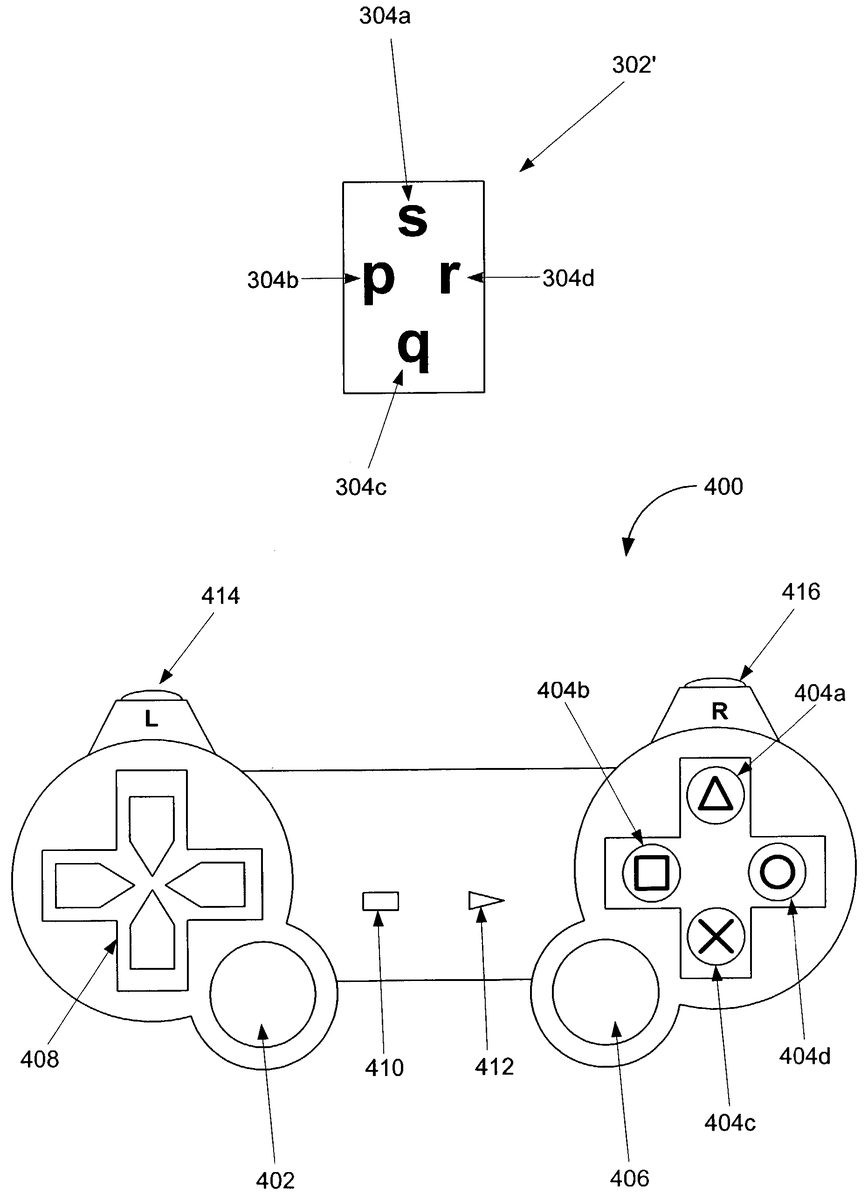
Selection of a particular character is performed using an input device, such as a game controller.FIG. 4is an illustration of an exemplary game controller400. The exemplary game controller400includes a joystick402and a plurality of selection buttons404a–404d. Also included on the exemplary game controller400is a second joystick406, a plurality of directional control buttons408, a “select” button410, and a “start” button412. Additional buttons also may be present on the game controller400, such as an “L1” button414and an “R1” button416. Further control is provided by allowing the joysticks402and406to be depressed, thus functioning as “L3” and “R3” buttons respectively.
Embodiments of the present invention utilize the joystick402and the selection buttons404a–404dto select alphanumeric characters for data entry. It should be noted that the other game controller configurations can be utilized with the embodiments of the present invention. In addition, the key usage described in the present description can be varied, yet still fit within the spirit and scopre of the present invention. For example, the diretional control buttons408can be utilized in lieu of, or in addition to, the joystick402. Moreover, embodiments of the present invention can be utilized with any kind of input device. For example, embodiments of the present invention can be utilized with cell phones, personal digital assistants, car navigation systems, and audio/video players, such as CD players, MD players, and DVD players.
Referring back toFIG. 3, the user selects a particular cell302by moving the joystick402in the direction of the desired cell302. In one embodiment, when the joystick402is at rest, the selection cursor returns to the central starting position cell306. Hence, because all the cells302are at most one cell302away from the central starting position cell306, the user advantageously begins the selection process at most one cell302away from the desired cell302. However, in an additional embodiment, the selection cursor does not return to the central starting position cell306when the joystick is at rest. In this manner, a user can operate the input device with one hand. That is, the user can first select the desired cell, then release the joystick, and thereafter select the desired character within the cell as described below. This configuration can be advantageous for users unfamiliar with the input device, wherein the users may have difficulty performing two commands together.
The characters in each cell are positioned to correspond to the positions of the selection buttons on the game controller. For the exemplary game controller400illustrated inFIG. 4, the characters within each cell302are positioned to match the locations of the selection buttons404a–404d. Referring toFIG. 3, for example, each cell302includes a top character position304acorresponding to selection button404aofFIG. 4and a bottom character position304ccorresponding to selection button404cofFIG. 4. Similarly, each cell302includes a left character position304bcorresponding to selection button404bofFIG. 4and a right character position304dcorresponding to selection button404dofFIG. 4.
Hence, to select the character “r” the user first positions the selection cursor over the lower left cell302′, thereby indicating that the selection buttons404a–404dof the game controller400will correspond to the characters “p,” “q,” “r,” and “s.” In particular, when cell302′ is selected, selection button404awill correspond to the “s” character position304aand selection button404bwill correspond to the “p” character position304b. In addition, selection button404cwill correspond to the “q” character position304cand selection button404dwill correspond to the “r” character position304d. Continuing with the above example, once the cell302′ is selected, the user depresses selection button404d, which corresponds to the “r” character position304d, to select the “r” character. When a character position does not include a character, selecting the character position will insert a “space” character. For example, in the cell302having the characters “a,” “b,” “c,” selecting selection button404awill select the top character position, which in this case is a “space” character.
As described above, conventional on-screen keyboards required the user to physically see a depiction of the entire keyboard on the screen for the user to properly enter data. This is because the user is required to visually identify where their starting position is on the on-screen keyboard. Advantageously, embodiments of the present invention utilize the central starting position cell306, which allows the user to always know exactly where the selection cursor will be when starting the data entry process for each character.
In addition, the user must determine which controller moves are necessary to traverse to the desired key when using a conventional on-screen keyboard, which further requires visual analysis. Using the embodiments of the present invention, the user advantageously is always one “click” or move away from the desired cell. For example, using the exemplary on-screen keypad arrangement300illustrated inFIG. 3, each cell302is at most one cell away from the starting position cell306. Hence, embodiments of the present invention allow the user to enter data by touch, without physically viewing the entire on-screen keypad arrangement300on the screen, as will be described in greater detail below.
In addition to the character set illustrated inFIG. 3, embodiments of the present invention allow other characters to be accessed and utilized. For example, different character sets can be accessed by pressing a particular key on the game controller, such as the select key410. With each key press of the select key410, the specific characters available within each cell302can be changed. In this manner, the user can, for example, use the select key410to change a lower case character set to an upper case character set, or to a numerical character set. Although the above description is in terms of the select key410, it should be noted that any means can be utilized to select different character sets. For example, other keys of the game controller, and/or controls located on the game console can be used for character set selection.
It should be further noted that the alphanumeric on-screen keypad arrangement of the embodiments of the present invention is not limited to a three by three grid as illustrated inFIG. 3. That is, additional cells can be added, for example, to facilitate character sets having more than twenty-six characters. For example,FIG. 5is a diagram showing an on-screen keypad arrangement500for a Japanese hiragana character set, in accordance with an embodiment of the present invention. Similar to above, the on screen keypad arrangement500includes a plurality of cells302configured in a three by three arrangement. In addition, side cell302″ is included to one side of the three by three grid arrangement. Each cell302includes a plurality of hiragana characters. Although the exemplary alphanumeric on-screen keypad arrangement500includes between three to five characters per cell, it should again be noted that the number of characters per cell302can vary depending on the application and character set used.
Similar toFIG. 3, the starting position for the selection cursor is located in a central starting position cell306. As mentioned above, having the starting position in the central starting position cell306allows the user to always know where the selection cursor is before selecting a new character. In addition, the central starting position cell306is at most one “click” or movement away from the desired cell.
The Japanese hiragana character set includes forty-six characters. To fully accommodate the full character set, embodiments of the present invention utilize the side cell302″. Since the side cell302″ is outside the three by three grid, a button press can be used to access the side cell302″ instead of joystick directional movement. For example, one embodiment utilizes the “L3” button to access the side cell302″. As mentioned above, depressing joystick402on the game controller400actuates the “L3” button. As above, it should be noted that any mechanism can be utilized to access the side cell302″. Preferably, the side cell302″ is accessed using a button or other single movement. In this manner, the user does not have to visually examine the keypad arrangement500to find a particular cell.
As above, selection of a particular character is performed using the game controller. The user selects a particular cell302by moving the joystick402in the direction of the desired cell302. To select the side cell302″, in the example ofFIG. 5, the user presses the “L3” button on the game controller400. When the joystick402is at rest, the selection cursor returns to the central starting position cell306. Hence, because all the cells302are at most one cell302, or one “click” of the “L3” button, away from the central starting position cell306, the user advantageously is always begins the selection process at most one cell302, or one “click,” away from the desired cell302.
Also as above, the characters in each cell are positioned to correspond to the positions of the selection buttons on the game controller. In the example ofFIG. 5, the characters within each cell302/302″ are positioned to match the locations of the selection buttons404a–404dand “R1”416of the game controller400. Referring toFIG. 5, for example, each cell302/302″ includes a first top character position516corresponding to the “R1” button, a second top character position304acorresponding to selection button404aofFIG. 4, and a bottom character position304ccorresponding to selection button404cofFIG. 4. Similarly, each cell302/302″ includes a left character position304bcorresponding to selection button404bofFIG. 4and a right character position304dcorresponding to selection button404dofFIG. 4. AlthoughFIG. 5illustrates using a single side cell302″, it should be noted that any number of side cells can be utilized to accommodate characters with the embodiments of the present invention.
As mentioned above, a user generally is not required to view the entire on-screen keypad arrangement on the screen to enter alphanumeric characters using the embodiments of the present invention. As a result, screen space can be saved and/or utilized to display other information or graphics. For example,FIG. 6Ais an illustration showing a method for entering alphanumeric characters using a single cell302′, in accordance with an embodiment of the present invention.
In the example ofFIG. 6A, a user is entering the word “sports” into the computer system. Having a rudimentary knowledge of the keypad layout300ofFIG. 3, the user can determine which direction to move the joystick to obtain the appropriate cell having the desired next character. For example, referring back toFIG. 3, cell302′ includes the character “s.” Since cell302′ is located diagonally left and below of the central position cell306, the user moves the joystick402of the game controller402diagonally left and below to select cell302′.
With this in mind, referring back toFIG. 6A, the user can move the joystick of the game controller diagonally left and below to select cell302′, which is displayed for example at the lower right corner of the screen. In this manner, only the selected cell302′ is displayed on the screen at any particular time. Thus, to enter the character “s” at location600on the computer screen, the user moves the joystick diagonally left and below to select cell302′, which is then displayed for example at the lower right corner of the screen. The user then presses key404aon the game controller400, which selects the top character position304aof cell302′, which is the character “s.”
FIG. 6Bis an illustration showing a further method for entering alphanumeric characters using a cell cursor602, in accordance with an embodiment of the present invention. Similar to above, the example ofFIG. 6Billustrates a user entering the word “sports” into the computer system. As described previously, with a rudimentary knowledge of the keypad layout300ofFIG. 3, the user can determine which direction to move the joystick to obtain the appropriate cell having the desired next character. The cell cursor602is utilized both as a cursor to indicate the position of the next character in the text on screen, and as a display of the currently selected cell302.
Thus, the user can move the joystick of the game controller diagonally left and below to select cell302′ ofFIG. 3, which is displayed on the cell cursor602. In this manner, only the selected cell302′ is displayed on the cell cursor602at any particular time. As above, to enter the character “s” at location at the end of the word “sport” inFIG. 6B, the user moves the joystick diagonally left and below to select cell302′, which is then displayed on the cell cursor602. The user then presses key404aon the game controller400, which selects the top character position304aof the cursor cell602, which is the character “s.” In this manner, the user can focus attention on the location where the data they are entering is located, while still having visual confirmation of which character will be displayed with each key404a–404dpress on the game controller400.
To further assist in efficient data entry, embodiments of the present invention can perform dictionary-based word completion. However, unlike conventional dictionary-based word completion, embodiments of the present invention utilize user specific data programming to better estimate the correct word completion. By way of background, conventional dictionary-based word completion uses an ordinary dictionary to complete words based on the characters already entered into the system, typically in alphabetical order. For example, when a user enters an “a,” a conventional dictionary-based word completion system may attempt to complete the word by printing out the next word in the dictionary alphabetically. That is, if “ace” is the next word alphabetically in the dictionary, the conventional dictionary-based word completion system will add the letters “ce” to the letter “a.”
However, unlike conventional dictionary-based word completion systems, embodiments of the present invention program the completion system with words having a higher likelihood of being correct based on the particular user.FIG. 7is an illustration showing a method700for using user specific data programming for word completion, in accordance with an embodiment of the present invention. As shown inFIG. 7, instead of using an alphabetically ordered dictionary, embodiments of the present invention utilize articles702written by human writers as the bases for programming. In particular, embodiments of the present invention obtain articles and/or word lists regarding fields related to the user of the software on the game console706. For example, if sports software is to be executed on the game console706, articles regarding sports can be analyzed.
The articles and/or word lists can be associated with software, such as game software, obtained via a network connection such as the Internet, or by any other means appropriate to the specific application. Further, when obtaining articles and/or word lists using a network connection, the articles and/or word lists can be stored, for example, using a memory card, hard drive, or other computer storage device. In this manner, the user can specify particular stored articles and word lists to utilize when inputting data using the embodiments of the present invention. Further, the articles and word lists can be selected automatically based on the user's preferences, actions, or other indicators.
Once an article702is obtained, the article702is analyzed to determine the frequency with which various words are used. The words then are sorted into a list704based on the usage frequency. Generally, the method700orders words in a different order than a dictionary. For example, many article writers use the word “but” far more than they use the word “bay.” As a result, the sorted word list704of the embodiments of the present invention generally would list the word “but” before the word “bay,” even though “bay” comes before “but” alphabetically. The sorted word list704can then be used for word completion in the game console706.
FIGS. 8A and 8Billustrate word completion using user specific data programming, in accordance with an embodiment of the present invention. As shown inFIG. 8A, once a user enters a character embodiments of the present invention estimate the entire word based on the sorted word list704ofFIG. 7. For example, inFIG. 8Athe user enters the character “c” by moving the joystick of the game controller upward to select the cell302having the characters “a,” “b,” and “c,” and then pressing key404don the game controller. In response, the systems inserts an estimation extension802after the letter “c” by examining the sorted word list704ofFIG. 7to determine the first listed word starting with the character “c.” In this example, the first listed word is “could,” thus the system inserts the estimation extension802comprised of the letters “ould” after the letter “c.” One embodiment also allows the user to search through the sorted list by pressing a particular key on the game controller. With each key press the system displays the next word on of the sorted list704that could complete the word. However, once the user enters a new character, the system inserts a new estimation extension, as shown inFIG. 8B.
As shown inFIG. 8B, once a user enters a new character embodiments of the present invention estimate the entire word based on the combination of the characters entered by the user and the sorted word list704ofFIG. 7. For example, inFIG. 8Bthe user enters the character “a” after the character “c” by moving the joystick of the game controller upward to select the cell302having the characters “a,” “b,” and “c,” and then pressing key404bon the game controller. In response, the systems inserts a new estimation extension802after the letters “ca” by examining the sorted word list704ofFIG. 7to determine the first listed word starting with the characters “ca.” In this example, the first listed word is “came,” thus the system inserts the estimation extension802comprised of the letters “me” after the letters “ca.” Again, one embodiment can allow the user to search through the sorted list by pressing a particular key on the game controller. Of course, it should be appreciated that the new estimation extension802can be the same as the prior estimation extension if the user enters a character that still fulfils the prior extension. This continues for each subsequent character the user enters. In this manner, embodiments of the present invention increase data entry efficiency, thus allowing faster and more accurate data entry.
In addition, embodiments of the present invention further customize the sorted list to a particular user by updating the sorted list704based on what the user enters. That is, the system also records the frequency with which the particular user utilizes words. For example, if a particular user uses the word “same” often, embodiments of the present invention will increase the frequency status of the word “same” in the sorted list. If the word “same” is utilized more than a higher ordered word on the sorted list, the sorted list is modified to list the word “same” higher than its current position.
Although the foregoing invention has been described in some detail for purposes of clarity of understanding, it will be apparent that certain changes and modifications may be practiced within the scope of the appended claims. Accordingly, the present embodiments are to be considered as illustrative and not restrictive, and the invention is not to be limited to the details given herein, but may be modified within the scope and equivalents of the appended claims.
Claims
- A method for character selection, comprising the operations of: providing a plurality of cells, each cell including a plurality of characters;receiving a first command to select a particular cell of the plurality of cells, the first command being initiated through a directional control that enables the selection of the particular cell;and receiving a second command to select a particular character of the plurality of characters within the selected cell, the second command being initiated by a specific button of a set of buttons, each of the set of buttons corresponds to specific ones of the plurality of characters contained within the selected cell so that the second command that is initiated by the specific button defines the selection of one character;whereby the directional control is different from the set of buttons.
- A method as recited in claim 1 , wherein the second command is received from an input device that includes the set of buttons.
- A method as recited in claim 1 , wherein a portion of the plurality of cells are arranged in a three by three grid.
- A method for character selection, comprising the operations of: providing a plurality of cells, each cell including a plurality of characters;receiving a first command to select a particular cell of the plurality of cells, the first command being initiated through a directional control that enables the selection of the particular cell;and receiving a second command to select a particular character of the plurality of characters within the selected cell, the second command being initiated by a specific button of a set of buttons, each of the set of buttons corresponding to specific ones of the plurality of characters within the selected cell so that the second command that is initiated by the specific button defines the selection of one character;selecting a center cell of a three by three grid prior to receiving the first command;whereby the directional control is a separate control from the set of buttons.
- A method as recited in claim 4 , wherein the first command indicates a move to a cell at most one cell away from the center cell.
- A method as recited in claim 3 , wherein the plurality of cells further includes at least one side cell, the side cell being outside the three by three grid.
- A method as recited in claim 6 , wherein the side cell is accessed using a button.
- A system for character selection, comprising: logic that provides a plurality of cells, each cell including a plurality of characters;and an input device having a plurality of controls, wherein the plurality of controls include a plurality of control buttons, each control button corresponding to a particular character of the plurality of characters within a cell, wherein the input device is capable of transmitting a first command to select a particular cell of the plurality of cells, the first command being initiated through a directional control of the input device that enables the selection of the particular cell, and wherein the input device is further capable of sending a second command using a control button to select a corresponding character of the plurality of characters within the selected cell, such that initiation of the control button causes the corresponding character to be selected;wherein the directional control is different from the control button.
- A system as recited in claim 8 , wherein a portion of the plurality of cells are arranged in a three by three grid.
- A system as recited in claim 9 , wherein a center cell of the three by three grid is selected prior to receiving the first command.
- A system as recited in claim 10 , wherein the first command indicates a move to a cell at most one cell away from the center cell.
- A system as recited in claim 9 , wherein the plurality of cells further includes at least one side cell, the side cell being outside the three by three grid, wherein the side cell is accessed using a button.
- A system as recited in claim 8 , further comprising logic that inserts an estimation extension after each character entered, the estimation extension including a plurality of characters that forms a word when combined with the characters previously entered.
- A system as recited in claim 13 , wherein the estimation extension is generated by examining a sorted list having a plurality of words sorted based on usage frequency.
- A system as recited in claim 14 , wherein the usage frequency refers to word occurrence frequency in selected articles.
- A system as recited in claim 15 , wherein the selected articles are related to a particular subject.
- A computer program embodied on a computer readable medium for character selection, comprising: program instructions that provide a plurality of cells, wherein each cell includes a plurality of characters;program instructions that receive a first command to select a particular cell of the plurality of cells, the first command being initiated through a directional control that enables the selection of the particular cell;and program instructions that receive a second command to select a particular character of the plurality of characters within the selected cell, the second command being initiated by a specific button of a set of buttons, each of the set of buttons corresponding to specific ones of the plurality of characters within the selected cell so that the second command that is initiated by the specific button defines the selection of one character;whereby the directional control is different from the set of buttons.
- A computer program as recited in claim 17 , wherein the second command is received from the set of buttons of an input device, and the first command is received from a joystick of the input device, the joystick providing the directional control.
- A computer program as recited in claim 17 , wherein a portion of the plurality of cells are arranged in a three by three grid.
- A computer program as recited in claim 19 , further comprising program instructions that select a center cell of the three by three grid prior to receiving the first command.
- A computer program as recited in claim 20 , wherein the first command indicates a move to a cell at most one cell away from the center cell.
- A computer program as recited in claim 19 , wherein the plurality of cells further includes at least one side cell, the side cell being outside the three by three grid.
- A computer program as recited in claim 22 , wherein the side cell is accessed using a button.
- A computer program as recited in claim 17 , further comprising program instructions that insert an estimation extension after each character entered, the estimation extension including a plurality of characters that forms a word when combined with the characters previously entered.
- A computer program as recited in claim 24 , wherein the estimation extension is generated by examining a sorted list having a plurality of words sorted based on usage frequency.
- A computer program as recited in claim 25 , wherein the usage frequency refers to word occurrence frequency in selected articles.
- A computer program as recited in claim 26 , wherein the selected articles are related to a particular subject.
- A system for enabling character selection, comprising: a display screen, the display screen presenting a three-by-three grid of cells that includes the characters necessary for character selection, each cell of the three-by-three grid of cells including two or more characters;an input device for providing commands that are executed and presented on the display screen, the input device including, a directional control for enabling selection of one cell of the three-by-three grid of cells, the direction control initiating selection from a central starting position that is a center cell in the three-by-three grid of cells;and a set of buttons, each of the set of buttons having an arrangement location that corresponds to an arrangement location of the two or more characters in a cell of the thee-by-three grid of cells, and selection of one of the set of buttons initiates selection of one character that is part of the cell;whereby directional selection of any one of the cells in the three-by-three grid of cells is at most one cell away from a cell of the central starting position.
- The system of claim 28 , wherein the directional control is one of a joystick or second set of buttons, and the set of buttons are arranged in a set four, the set of four having a top button, a bottom button, a left button, and a right button.
- The system of claim 28 , wherein the three-by-three grid of cells includes one or more side cells.
- The system of claim 30 , wherein the characters necessary for character selection of a particular language are displayed within the three-by-three grid of cells or within three-by-three grid of cells plus the one or more side cells.
- The system of claim 28 , wherein the input device is a controller for interfacing with a computing device.
- A method for character selection to compose one or more characters or words of a language, comprising the operations of: (a) displaying a plurality of cells, each cell including a two or more characters and the plurality of cells containing a listing of characters for the language;(b) enabling a first command to select a particular cell of the plurality of cells;and (c) enabling a second command to select a particular character of the plurality of characters within the selected cell, the second command being initiated by a specific button that corresponds to the particular character within the selected cell;and (d) repeating (b) and (c) until one or more characters or words of the language are input.
Disclaimer: Data collected from the USPTO and may be malformed, incomplete, and/or otherwise inaccurate.