U.S. Pat. No. 7,128,649
GAME MACHINE, GAME PROCESSING METHOD AND INFORMATION STORAGE MEDIUM
AssigneeKonami Corporation; KCE Tokyo, Inc.
Issue DateAugust 17, 2001
Illustrative Figure
Abstract
A music-oriented game machine with a feature to increase a feeling of competitiveness between players. Based on an evaluation of a performance of the first and second players based on their steps, the number of times step timing is presented as guidance is varied. Specifically, while reference arrows (46, 48) are displayed, a plurality of timing guidance arrows (50, 62) approaching the reference arrows (46, 48) are also displayed on a game screen image (40). As a result, guidance as to where step timing is arriving is shown to the player. Then, a speed at which the reference arrows (46, 48) approach the timing guidance arrows (50, 62), respectively, is changed from a default speed to speeds of half, twice, and three-times the default speed based on the result of evaluation on the respective player's stepping performances, to thereby change the guidance level.
Description
PREFERRED EMBODIMENTS OF THE PRESENT INVENTION The entire disclosure of the corresponding Japanese application 2000-262553 filed on Aug. 31, 2000 including specification, claims, drawings and summary, is incorporated herein by reference. In the following, preferred embodiments of the present invention will be described in detail with reference to the accompanying drawings. FIG. 1is a diagram showing a structure of a game machine according to a preferred embodiment of the present invention. The game machine10shown inFIG. 1comprises a DVD25, or an information storage medium, mounted on a home-use game machine11, which is connected to a monitor18and a speaker22. Here, a game program and game data for a music-oriented game having a match play mode is stored in the DVD25, and controllers32a,32b, which serve as dedicated controllers, are connected so that two players can enjoy a music-oriented game in a match play mode. Note that whereas a DVD25is used here to supply a game program and game data to the home-use game machine11, any other information storage media, such as a CD-ROM or a ROM card, may be used instead. Alternatively, a game program and game data may be remotely supplied to the home-use game machine11via a communication network. A home-use game machine11comprises a microprocessor14, an image processing section16, a main memory26, and an input/output processing section30, mutually connected via a bus12for data exchange, with the input/output processing section30being further connected to the controllers32a,32b, an audio processing section20, and a DVD reproduction section24. The respective elements of the home-use game machine11other than the controllers32a,32bare all accommodated in a predetermined single housing. By way of example, the monitor18may be a home TV receiver, and the speaker22may be a speaker incorporated into the home TV receiver. The microprocessor14controls the respective elements of the home-use game machine11based on an operating system stored in a ROM, ...
PREFERRED EMBODIMENTS OF THE PRESENT INVENTION
The entire disclosure of the corresponding Japanese application 2000-262553 filed on Aug. 31, 2000 including specification, claims, drawings and summary, is incorporated herein by reference.
In the following, preferred embodiments of the present invention will be described in detail with reference to the accompanying drawings.
FIG. 1is a diagram showing a structure of a game machine according to a preferred embodiment of the present invention. The game machine10shown inFIG. 1comprises a DVD25, or an information storage medium, mounted on a home-use game machine11, which is connected to a monitor18and a speaker22. Here, a game program and game data for a music-oriented game having a match play mode is stored in the DVD25, and controllers32a,32b, which serve as dedicated controllers, are connected so that two players can enjoy a music-oriented game in a match play mode. Note that whereas a DVD25is used here to supply a game program and game data to the home-use game machine11, any other information storage media, such as a CD-ROM or a ROM card, may be used instead. Alternatively, a game program and game data may be remotely supplied to the home-use game machine11via a communication network.
A home-use game machine11comprises a microprocessor14, an image processing section16, a main memory26, and an input/output processing section30, mutually connected via a bus12for data exchange, with the input/output processing section30being further connected to the controllers32a,32b, an audio processing section20, and a DVD reproduction section24. The respective elements of the home-use game machine11other than the controllers32a,32bare all accommodated in a predetermined single housing. By way of example, the monitor18may be a home TV receiver, and the speaker22may be a speaker incorporated into the home TV receiver.
The microprocessor14controls the respective elements of the home-use game machine11based on an operating system stored in a ROM, not shown, and a game program read from the DVD25. The bus12is used for exchanging addresses and data among the respective elements of the home-use game machine11. The main memory26is used for storing game programs and game data read from the DVD25as necessary. A graphics processing unit16, which has a structure comprising a VRAM, receives image data from the microprocessor14, and draws a game screen image on the VRAM based on the received input data. The image processing section16, moreover, converts the content of the image data into a video signal, and outputs the signal to the monitor18at a predetermined timing.
The input/output processing section30serves as an interface for relaying data communication between the controllers32a,32b, the audio processing section20, the DVD reproduction section24, and the microprocessor14. The controllers32a,32beach serve as input means via which a player operates a game. Two controllers are provided so that a match game can be played. The input/output processing section30periodically (for example, every 1/60 seconds) scans the operation state of the various buttons of the controllers32a,32b, and supplies an operation signal indicative of a scanning result to the microprocessor14via the bus12. The microprocessor14knows the kind of game operation conducted by the player and a time at which the player conducted the game operation. The audio processing section20, which has a structure comprising a sound buffer, reproduces music data, game sound effects, and so on, which were read from the DVD25and temporarily stored in the sound buffer, and outputs them via the speaker22. The DVD reproduction section24reads data, including a game program and game data, from the DVD25in response to a command from the microprocessor14.
FIG. 2is a diagram showing an example of controllers32a,32b. The controllers32a,32bhave identical shapes and structures. A controller32is shown inFIG. 2as an example of such controllers32a,32b. The controller32shown is a controller dedicated particularly to playing of a music-oriented game. The controller32is made of a mat-like member having a size appropriate for use as a dance stage. When a player steps on the controller32, operation signals indicative of the positions of the player's feet are sent to the home-use game machine11. As shown, a substantially round central segment34C is provided at the center on the surface of the controller32, and direction button input segments34U,34D,34L,34R are provided above, below, to the left of, and to the right of the central segment34C, respectively. Further, to the right and to the left of the direction button input segment34U there are provided an O button input segment38A and an X button input segment38B, respectively. Moreover, a start button input segment36A is provided above the O button input segment38A, while a selection button input segment36B is provided above the X button input segment38B. A rightward arrow, a leftward arrow, an upward arrow, and a downward arrow are attached on the direction button input segments34R,34L,34U,34D, respectively. An O mark is attached (printed) on the surface of the O button input segment38A, and an X mark is attached on the surface of the X button input segment38B. A label “START” is attached on the start button input segment36A, and a label “SELECT” is attached on the selection button input segment36B.
Sensors are embedded under the direction button input segments34U,34D,34L,34R, the O button input segment38A, the X button input segment38B, the start button input segment36A, and the selection button input segment36B, so that, when the player puts their foot/feet on the respective segments, an operation signal indicative of the player's foot being placed on the segment is sent to the home-use game machine11. The direction button input segments34U,34D,34L,34R are used mainly to input dance steps as well as to make various menu selections. The start button input segment36A is used to start a game as well as to make various decisions. The selection button input segment36B is used mainly to retrieve various menu screen images. The O button input segment38A is used mainly to make various decisions. The X button input segment38B is used mainly to apply various cancellations and to forcibly end the game.
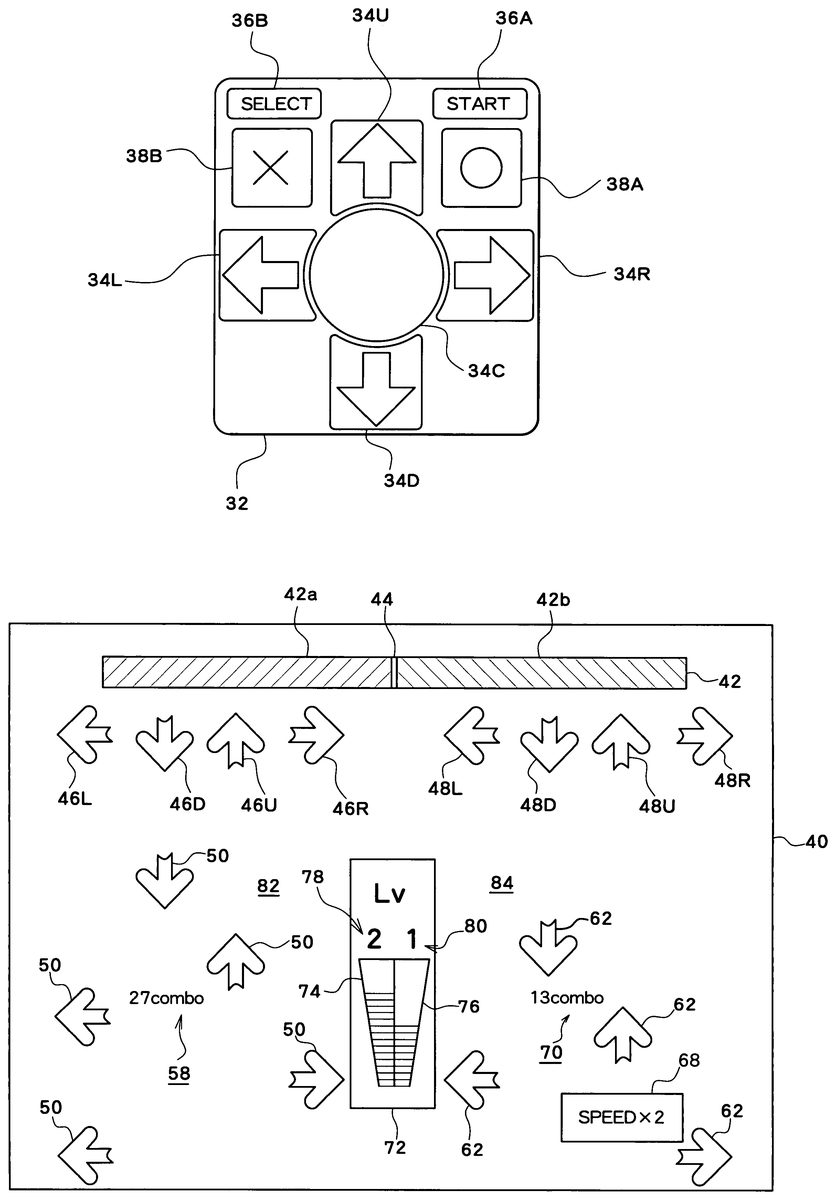
FIG. 3is a diagram showing an exemplary game screen image prepared and shown on the monitor18based on a game program and game data read from the DVD-ROM25. In the shown game screen image40, a background image, not shown, is displayed over the entire screen. A first player screen image area82and a second player screen image area84are provided on the left and right halves, respectively, of the game screen image40. The first player screen image area82is a display area for, displaying step timing mainly for a first player, while the second player screen image area84is a display area for displaying step timing mainly for a second player.
Reference arrows (first operation timing instruction images)46L,46D,46U,46R in a horizontal alignment are shown on the upper portion in the first player screen image area82, and a plurality of timing guidance arrows (second operation timing instruction images)50, which will move upwards as time elapses, are shown below the reference arrows46. A combo number58is shown around the middle portion of the screen82. Likewise, reference arrows (first operation timing instruction images)48L,48D,48U,48R in a horizontal alignment are shown on the upper portion of the second player screen image area84, and a plurality of timing guidance arrows (second operation timing instruction images)62, which will move upwards as time elapses, are shown below the reference arrows48. A combo number70is shown around the middle portion of the screen84, and an effect banner68is shown on the lower portion of the screen84. The combo numbers58,70indicate the number of successive game operations conducted by the respective players at exact timing as prompted, which corresponds to “PERFECT”, described later, or at closer timing, which corresponds to “GREAT”, described later. The effect banner68describes a change of timing guidance currently imposed on a corresponding player. That is, in this music-oriented game, which is played by two players, timing guidance to be presented to a player inferior in step performance of the two players is subjected to change of timing guidance, and the content of the change is represented by the effect banner68. In this drawing, an effect banner68is shown only for the second player. This banner means that the timing guidance arrow62scrolls at a speed twice as fast as that for the first player. In the case where such a change for timing guidance is also imposed on the first player, an effective banner would also be shown for the first player.
The arrows46L,48L are correlated with the direction button input segments34L. The arrows46D,48D are correlated with the direction button input segments34D. The arrows46U,48U are correlated with the direction button input segments34U. The arrows46R,48R are correlated with the direction button input segments34R. The first player can obtain a higher score by stepping on one of the direction button input segments34L,34D,34U,34R at time when corresponding timing guidance arrow50overlaps with a corresponding one of the reference arrows46L,46D,46U,46R, and the first dance gauge42athus extends. Likewise, the second player can obtain a higher score by stepping on one of the direction button input segments34L,34D,34U,34R at a time when a corresponding timing guidance arrow62overlaps with a corresponding one of the reference arrows48L,48D,48U,48R, and the second dance gauge42bthus extends. This drawing shows the state in which the first player is required to step sequentially on the direction button input segment34D,34U,34L,34R, while the second player is required to step sequentially on the direction button input segment34D,34U,34L,34R. Every time the players are required to step, their stepping performance is evaluated, and corresponding evaluation messages are displayed below the reference arrows46,48. Specifically, according to an extent of coincidence between a position and time at which the player is required to step on and those at which the player actually did step on, suitable messages are displayed, including “PERFECT”, “GREAT”, “BOO”, and so on, for the best to the worst in this order.
It should be noted that a player does not always have to operate the controller32at very exact timing when the timing guidance arrows50,62fully overlap with the corresponding reference arrows46,48, respectively, in order to get a positive evaluation. A player can get a score which takes into consideration the extent of coincidence between the time at which the timing guidance arrows50,62overlaps with the corresponding reference arrows46,48, respectively, and the time at which the player actually operates the controller32. Note that the timing guidance arrows50,62are displayed based on the step data, described later.
The timing guidance arrows50,62are specifically displayed as follows. That is, after game music reproduction begins, the microprocessor14reads data on step timing within a guidance presentation range from the step data, and generates image data for timing guidance arrows50,62based on the step data. Note that a guidance presentation range is determined here as a range covering two bars subsequent to the current point in time. Image data is configured such that a timing guidance arrow relative to the nearest step timing be displayed in the uppermost portion of the timing guidance arrow display area, with those relative to farther step timing displayed in a lower portion accordingly. This processing is repeated in a predetermined cycle.
In displaying the arrows,, for example, the timing guidance arrow50indicative of a time at which the player is required to step on the direction button input segment34L is shown below the reference arrow46L. Similarly, the timing guidance arrow50indicative of a time at which the player is required to step on the direction button input segment34D is shown below the reference arrow46D; the timing guidance arrow50indicative of a time at which the player is required to step on the direction button input segment34U is shown below the reference arrow46U; and the timing guidance arrow50indicative of a time at which the player is required to step on the direction button input segment34R is shown below the reference arrow46R. Likewise, for example, the timing guidance arrow62indicative of a time at which the player is required to step on the direction button input segment34L is shown below the reference arrow48L. Similarly, the timing guidance arrow62indicative of a time at which the player is required to step on the direction button input segment34D is shown below the reference arrow48D; the timing guidance arrow62indicative of a time at which the player is required to step on the direction button input segment34U is shown below the reference arrow48U; and the timing guidance arrow62indicative of a time at which the player is required to step on the direction button input segment34R is shown below the reference arrow48R.
The head of each guidance presentation range, namely, a position in the vertical direction with respect to the screen where the reference arrows46,48are displayed, corresponds to a part of the game music, which is then being played. The head of the guidance presentation range shifts from the beginning of the music toward the end thereof by a predetermined amount for each processing cycle. Accordingly, the timing guidance arrows50,62gradually move upward as the music progresses. As the timing guidance arrows50,62are displayed gradually approaching the reference arrow46,48, respectively, the player can easily ascertain the arrival of step timing by referring to the game screen image40.
In the upper portions of the first player screen image area82and the second player screen image area84, there is shown a dance gauge42indicating the better of the two players. Between the first player screen image area82and the second player screen image area84, there is shown a combo gauge72. The dance gauge42comprises a first player gauge42aand a second player gauge43bshown on the left and right halves thereof, respectively, with a separation image44in between. Supposing that a first player is better than a second player, the first dance gauge42aextends rightward and the second dance gauge42bcontracts accordingly, causing the separation image44to move rightward. Supposing that a second player is better than a first player, on the other hand, the second dance gauge42bextends leftward and the first dance gauge42acontracts accordingly, causing the separation image44to move leftward. In this manner, the first and second players can know whether or not he himself is better than the other player with reference to the position of the separation image44.
The combo gauge72comprises a first combo gauge74, a second combo gauge76, and level indicators78,80for indicating the current gauge levels for the respective players. Moreover, a combo number58, or the number of successively displayed messages “GREAT” or “PERFECT”, described above, is shown in the middle portion of the first player screen image area82. Increase of the combo number58causes extension of the first combo gauge74. Similarly, a combo number70is shown in the middle portion of the second player screen image area84. Increase of the combo number70causes increase of the second combo gauge76.
When the first combo gauge74becomes full, the level indicator78increases by one with the first combo gauge74becoming zero or disappearing altogether. Then, it is possible to apply a change to the timing guidance for the second player. Specifically, any of the changes, including increase of the timing guidance arrows62, change of the speed of the arrows62, change of the direction of the arrows62, change of the brightness of the arrows62, can be imposed to the second player. Specific content of the change is determined according to the current gauge level, indicated by the level indicator78, and the type of player character selected at that time. Generally, a change of timing guidance which is more effectively disturbing the competitor player is applied when a gauge level becomes higher when the first or second combo gauge75,76becomes full. Note that the gauge level varies from the first to third steps.
Among various kinds of changes of timing guidance, increase of timing guidance arrow62is a change such that the number of timing guidance arrows62, namely, the number of steps presented to the player increases exceeding that which is originally defined by the step data (the number of times at which the player is required to step (or to operate the game) according to the step data). Variation of step (arrow) addition will be described later. A change of a speed is a change such that a timing guidance arrow62moves upward faster or slower. Here, three types of speed change, namely, half, twice, and three times the speed, are available. Therefore, the guidance level for step timing is changed. Specific processing for speed change will be described later. A change of direction is a change such that a timing guidance arrow62changes to direct in a different direction. Three types of direction change are available here, namely “mirror”, in which the arrow changes to direct in an opposite direction, “left”, in which the arrow rotates leftward by 90 degrees, and “right”, in which the arrow rotates rightward by 90 degrees. A change of brightness is a change such that a semi-translucency rate at which a timing guidance arrow62is superimposed on the game screen image40in a semi-translucent manner is changed so that the timing guidance arrow62appears or disappears while it moves upward. This can also cause a change of guidance level for step timing. Here, four kinds of brightness change are available, namely “hidden”, in which the arrow disappears halfway the path along which the arrow moves upwards on the second player screen image area84, “super hidden”, in which the arrow disappears immediately after it has appeared on the second player screen image area84, “sudden”, in which the arrow suddenly appears halfway along the path, and “super sudden”, in which the arrow suddenly appears near the reference arrow48.
As described above, every time the first combo gauge74becomes full, the game for the second player becomes more difficult as a result of a change of a guidance level for step timing or increase of the number of required steps. Likewise, when the second combo gauge76becomes full, the level indicator80increases by one with the second combo gauge76becoming zero, and similar change of guidance timing is applied to the first player.
When successive display of messages “PERFECT” or “GREAT” on the first player screen image area82discontinues, the combo number58disappears with the level display78returning to one and the first combo gauge74returning to zero. Likewise, when successive display of messages “PERFECT” or “GREAT” on the second player screen image area84discontinues, the combo number70disappears with the level indicator80returning to one and the second combo gauge76becoming zero. The combo number58,70reappears when the corresponding player obtains “PERFECT” or “GREAT” messages five or more successive times.
Here, data stored in a DVD-ROM25will be described. The DVD-ROM25stores game music data in order to cause a home-use game machine11to operate as a music-oriented game, as well as a game program, various game effect sound data, and various game image data.
FIG. 4is a diagram describing game music data corresponding to some game music, which is recorded in a DVD-ROM25. As shown, game music data contains original music data, step data, a timing table, and background image data. Original music data is data concerning general popular music, for example, stored as original music in a predetermined stream data format. The DVD reproduction section24, which reads original music data in response to a command from the microprocessor14, can process the data, if necessary, and supply the data directly, i.e., without passing through the bus12, to the audio processing section20. The audio processing section20, after receiving the data directly from the DVD reproduction section24, converts the data into analogue data, and supplies the converted data to the speaker22.
Step data is data defining a time at which a player is required to step, or to operate a game, while corresponding game music is being reproduced. Step data is configured according to the rhythm of corresponding music data. Two or more sets of step data may be prepared for a single set of game music data so that a desirable set of step data may be selected according to a difficulty level, a play mode, and so on. Step data specifies which of the buttons of the controller32should be stepped on at which beat when bars of corresponding game music are dissolved into blocks according to a predetermined beat number such as four beats or eight beats.
A timing table is prepared for matching timing between game music and step data. With reference to the timing table, the microprocessor14can specify the step data corresponding to the particular section of game music currently being played. Background image data, either motion or still image data, represents an image shown as background in the game screen image40, shown inFIG. 3, for example. A background image suitable for the atmosphere of game music is selected for every piece of game music to therewith visually stimulating the player. Note that any image, such as an image of a game character selected by a user, other than a background image based on the background image data, may be displayed overlapping with the background.
Here, a process for displaying timing guidance arrows50,62based on step data and a process for changing the scroll speed of the timing guidance arrows50,62will be described.FIG. 5is a diagram showing an example of step data. The format of step data is determined such that step data designates step timing in units of 1/256 bar. Here, however, for brevity, one bar is divided into sixteen parts, as shown in the drawing, so that step timing is designated in units of 1/16 bar. A step at each moment in time is specified by data of four bits. That is, each bit corresponds to each of the direction button input segments34, wherein “0” prompts not to step on the corresponding direction button input segment34, and “1” prompts to step on the corresponding direction button input segment34. In the case where a default guidance presentation range is of one bar, display positions of timing guidance arrows50,62are determined such that successive steps in one bar are shown in the full length of the respective first and second player screen image areas82,84, and the images of the timing guidance arrows50,62are superimposed to be displayed in the first and second player screen image areas82,84, respectively. For a player for whom the timing guidance arrows50,62must scroll at a double speed, the display positions of the timing guidance arrows50,62are determined such that successive steps in a half bar are shown in the full length of the first or second player screen image area82,84. Likewise, for a player for whom the timing guidance arrows50,62must scroll at a half speed, successive steps in two bars are shown in the full length of the first or second player screen image area82,84. For a player, for whom the timing guidance arrows50,61must scroll at three times the speed, successive steps in one third of a bar are shown in the full length of the first or second player screen image area82,84. As described above, a guidance level for the first or second player can be changed by changing the speed at which the timing guidance arrows50,62approach the reference arrows46,48, respectively. That is, when the first combo gauge74for the first player, for example, becomes full, the scroll speed for the timing guidance arrow62for the second player, and thus the guidance level for the second player, is changed. This can resultantly increase a feeling of competitiveness between the first and second players. Note that, preferably, the scroll speed is changed in a stepwise manner. Specifically, when doubling the scroll speed, preferably, the scroll speed is changed by a few steps from a standard speed to a double speed, so that the player is not excessively bothered by a change of the scroll speed.
Next, addition of a timing guidance arrow50,60will be described. As described above, when the first player accumulates the combo pieces until the first combo gauge74becomes full, or when the second player accumulates the combo pieces until the second combo gauge76becomes full, the number of timing guidance arrows50or62for the first or second player is increased according to the gauge level or the selected game character, upon which the number of steps required to the corresponding player is increased.FIGS. 6A to 10Bare diagrams explaining manners of addition of a timing guidance arrow50,62. Six manners of addition are available here. Which manner will actually be employed may be determined according to a random number.
According to a first manner, one step is inserted randomly between steps. Here, the length of one beat divided into n pieces is referred to as “n divided length”. In this manner of addition, one step is randomly inserted in units of sixteen divided length between steps which are separated from each other by an extent of two divided length or longer.
According to a second manner, steps are added such that the player is always required to step with his two feet. Specifically, at a time at which the player is originally required to make a single step, another step, or a step in the opposite direction from the original step, is added.FIGS. 6A and 6Bare diagrams explaining step addition according to this manner, in which the four lateral lines each correspond to each of the direction button input segments34with an index given thereto for every bar. An outlined arrow stands for an original step time at which a player is required to step on a corresponding direct button input segment34according to step data, while a black arrow stands for a step time at which the player is additionally required to step as a result of addition of steps in this manner. InFIG. 6A, it is learnt that a player is required to make a single step, that is, only a single arrow is allocated, at each of the beginnings of the second, third, fourth, and fifth bars. Therefore, at the beginning of the second bar, for example, where the player is required to step on the direction button input segment34D, another arrow concerning a direction button input segment34in the opposite direction, namely, the direction button input segment34U here, is added, as shown inFIG. 6B. Likewise, at the beginning of the third,bar,,where the player is required to step on the direction button input segment34U, another arrow concerning a direction button input segment34in the opposite direction, namely, the direction button input segment34D here, is added. In this manner, an arrow concerning a direction button input segment34in the opposite direction from that of the original arrow is added at the beginning of each of the fourth and fifth bars.
According to a third manner, a step, or an arrow, is added such that a player is required to step as if he skips. As shown inFIGS. 7A and 7B, a step having a twelve divided length is added immediately before the latter one of two steps which are separated from each other by an extent equal to one beat. This addition is applied only when a single arrow is allocated to the first step of the two steps, and the direction of the added arrow is the same as that of the first step. Referring toFIGS. 7A to 10B, an outlined circle stands for a time at which a player is originally required to step according to step data, while a black circle stands for a time at which a player is additionally required to step as a result of addition of steps in this manner.
According to a fourth manner, a step, or an arrow, is added such that a player is required to make successive steps each having eight divided length. As shown inFIGS. 8A and 8B, as many steps as possible, each of eight divided length, are inserted between steps. Only a single arrow is added to each time, and the direction of an arrow to be added is determined randomly.
According to a fifth aspect, a back beat step is added. As shown inFIGS. 9A and 9B, a step of eight divided length is inserted into a back beat position between steps which are separated from each other by an extent equal to four divided length or longer. Only a single arrow is added to each time, and the direction of an arrow to be added is determined randomly.
According to a sixth aspect, a step is added such that a player is required to step on a triplet. As shown inFIGS. 10A and 10B, a step of a six divided length is inserted between steps which are separated from each other by an extent of two divided length or longer. Only a single arrow is added to each time, and the direction of an arrow to be added is determined randomly.
As described above, when one player steps well, the other player is required to make an increased number of steps so that the game with the other player becomes more difficult. This resultantly increases a feeling of competitiveness between the players. Moreover, when the other players copes well with the newly added steps, the first or second combo gauge74,76or the first or second dance gauge42a,42bfor that player extends faster than the other player, and finally becomes better than the one player.
Here, game program processing executed by a home-use game machine11will be described.FIGS. 11 and 12are flowcharts describing processing according to a game program stored in the DVD-ROM25. When the player inserts a DVD-ROM25in the DVD reproduction section24and turns on the power of the home-use game machine11, an operating system stored in the ROM, not shown, is executed, causing various initialization operations to be carried out. In the operation, only a part of the game program necessary for the present processing is loaded from the DVD-ROM25to the main memory26. According to the game program, a game title, and so on is displayed on the monitor18, and a main menu is thereafter displayed either automatically or under the control of the controller32. When the player selects a “match mode”, game processing in the “match mode” begins.
In this process, a selection screen image, not shown, where a game character and so on is selected, is displayed on the monitor18. Each game character stands for each type of timing guidance change, which can be imposed on a competitor player. On the selection screen image, game characters are displayed together with the descriptions of the type of changes allocated thereto. While this screen image is being displayed, the microprocessor14monitors whether or not the player has instructed to return to the main menu or selected a game character and so on (S101). A player who is the first to step on the start button input segment36A is entitled to act as an active player, leaving the other player to act as a non-active player. When the active player steps on an X button input segment38B with the game character selection screen image being displayed, the match play mode is cancelled and the main menu is retrieved. Note that, when one player steps on the start button input segment36A and, thereafter, selects a character before the other player steps on the start button input segment36A, the game machine10itself is brought to serve as a non-active player, so that the player plays the game against the computer. After the selection of a character and so on, a screen image for selection of music and difficulty is then displayed, prompting the player to select music and difficulty (S102).
After the player selected music and difficulty using the controller32, game music data of the selected music is loaded(S103). Specifically, a group of data, shown inFIG. 4, is loaded. Among the grouped data, original music data is directly supplied from the DVD reproduction section24to the audio processing section20, which promptly begins music reproduction (S104). Other data is loaded to the main memory26.
Next, the microprocessor14generates image data for step guidance, as shown inFIG. 3, for example, based on the step data among the game music data read, and outputs the resultant image data to the monitor18to update the step guidance (S105). In this process, the microprocessor14determines correlation between the step data and the original music data with reference to the timing table. Note that the step data and the timing table used here are those which correspond to the music and difficulty selected by the player at S102.
In the above, referring to change flags, stored in advance in the main memory26so as to correspond to each player, the microprocessor14determines whether or not any change of timing guidance has been imposed on each player. Should it have been imposed, the microprocessor14determines the type of the change imposed, and generates image data for step guidance according to the type of change imposed.
Thereafter, performance of the players are evaluated (S106).FIG. 12is a flowchart explaining play evaluation process. Specifically, as shown, whether or not the current play position falls within an evaluation period is initially determined based on the current play position and step data (S200). Note that an evaluation period is a period during which the player's step timing is compared with corresponding timing defined by the step data and, specifically, consists of a predetermined amount of preceding and subsequent time periods with respect to a certain point defined as step timing by step data.
When a current play position falls within an evaluation period, the operation states of the controllers32a,32bof the respective players are determined (S201), and the respective players'stepping performances are evaluated based on the states (S202). That is, reference to step data makes it possible to ascertain to which of the direction button input segments34L,34U,34D,34R the step position currently within an evaluation period relates. Then, it is determined as to whether or not a direction button input segment which is then to be evaluated among the direction button input segments34L,34U,34D,34R was actually stepped. If it was, an extent of a difference between the time at which the player actually stepped on and the time defined by the step data is determined. A user who has stepped on with a smaller timing difference obtains a higher evaluation. Specifically, the maximum score may be given for no timing difference. Also, zero may be given for a maximum difference, and even a negative score may be given for stepping on a wrong direction button input segment34or not stepping at all. Note that in the case where steps on two or more direction button input segments34are subjected to evaluation at the same time, evaluation may be made for every direction button input segment34.
Based on the evaluation result, the state of displaying of the dance gauge42is updated. For example, a difference in evaluation between the two players is determined so that one of the first and second player gauges42a,42b, which corresponds to a superior player of the two, is extended while that to the other player is contracted. Also, a message, such as “PERFECT”, “GREAT”, and so on, may be displayed below corresponding reference arrows46,48according to the evaluation obtained at step S202. Here, a combo number accumulated thus far for each player is stored in the main memory26. When an evaluation “PERFECT” or “GREAT” is obtained for the latest step, the combo number58,70, as well as that stored in the main memory26, is increased by one. For an evaluation “GOOD” or worse obtained for the latest step, the combo number58,70, as well as that which is stored in the main memory26, is removed or reset to zero. According to the combo number58,70, displaying of the combo gauge72is updated. When either one of the first and second combo gauges74,76becomes full, a change of timing guidance is imposed on the player other than the player with the full combo gauge74,76. Specifically, a timing guidance change is set to a change flag, which is stored in the main memory26so as to correspond to the other player. Specific content of the change may be determined based on the game character selected by the player with the full combo gauge and his current gauge level.
Referring again toFIG. 11, the microprocessor14determines whether or not the game play satisfies game end conditions (S107). The game play will end when the player continuously presses the start button input segment36A of the controller32over a predetermined time period (in this case, the ongoing game play is “suspended”, and the process returns to displaying of a screen image for character selection and so on) or when the music has finished playing. Alternatively, the game play may end when either the first or second dance gauge42a,42bhas extended to the maximum (100%), while the other player's has been removed (0%). Note that when “an endless mode” is designated by operating the controller32in a predetermined manner, the game play will continue as long as either the first or second dance gauge42a,42bremains.
In the case where the game play end condition is satisfied, a winner and a loser are determined based on the evaluation result of each player, stored in the main memory26, and displayed respectively (S108). Specifically, a player with a longer dance gauge42is determined to be a winner. Thereafter, it is determined as to whether or not the player has instructed, using the controller32, continuation of the game play with the same game character (S109). In the case where he has, the process returns to step S103. In the case where he has not, on the other hand, the process returns to step S101. Meanwhile, when it is determined at Step S107that the game play end condition is not satisfied, the process returns to S105.
According to the game machine10described above, a level for timing guidance (a guidance level) can be changed based on the result of evaluation on each player's stepping step performance. Alternatively, a higher number of step times than that which the player is originally required by step timing may be presented to a player to request him to step more. As described above, a feeling of competitiveness between the players can be increased.
Further, besides the reference arrows46,48, a plurality of timing guidance arrows50,62gradually approaching the reference arrows46,48, respectively, are displayed, whereby the state in which step timing is gradually arriving is presented to the player. This allows the player to easily ascertain step timing. Further, the speed at which the timing guidance arrows50,62approach the reference arrows46,48can be changed from a default speed to a speed of a half, twice, or three times the default speed. This makes a variable guidance level for enhancement of attractiveness of the game. This is applicable when the game machine10is not used as a match type game machine.
It should be noted that the present invention is not limited to the above.
For example, whereas the present invention is applied to a home-use game machine11in the above, the present invention can be similarly applied to a business use game machine. In this case, preferably, a faster storage device than a DVD-ROM25and a built-in monitor18and speaker22may be used.
Further, whereas a DVD25storing a game program and game data is used in a home-use game machine11in the above, any computer, such as a personal computer, and so on, which can read the content of an information storage medium storing a game program and game data and carry out information processing based on the read content, may be used.
Still further, whereas the present invention is applied to a game machine10allowing the player to enjoy the sense of dancing in the above, the present invention can similarly be applied to various types of games, including a drum playing game, in which the player beats a drum pad-shaped controller with a drum stick, a piano playing game, in which the player plays a piano-shaped controller, a guitar playing game, in which the player operates a guitar-shaped controller, a samba dance game, in which the player plays a maraca-shaped controller, and a dance game, in which the player's movement of his arms and hands is evaluated using a controller.
Also in these cases, when the game machine is constructed has an arrangement in which timing at which the player is required to operate the game may be presented as a guidance and the guidance level can be changed according to the result of evaluation of the player's performance in game operation, a feeling of competitiveness between the players can be increased. In addition, increase or decrease of the number of times at which each player is required to operate the game based on the result of evaluation on his operation can increase a feeling of match competition between players of other kinds of games.
Whereas a guidance level for an inferior player is changed in the above, that for a superior player may be changed instead. Specifically, a guidance level for a better player himself may be increased so that his game becomes easier. This arrangement can also arouse a feeling of match competition.
Whereas a game program and game data are provided from a DVD-ROM25, or an information storage medium, to a home-use game machine11in the above, a game program and game data may be distributed through a communication network to each home.
Claims
- A game machine for providing each of a first player and a second player with a game allowing a player to enjoy operation of the game using a controller according to game music, comprising: timing acquisition means for acquiring game operation timing at which each of the first player and the second player operates the game;timing guidance means for presenting game operation timing at a predetermined guidance level to each of the first player and the second player;game operation evaluation means for verifying the game operation timing acquired by the timing acquisition means with the game operation timing presented by the timing guidance means to evaluate game operation by each of the first player and the second player;and guidance level changing means for changing the predetermined guidance level with respect to at least one of the first player and the second player, based on a result of evaluation made by the game operation evaluation means, said changing with respect to the first player being based on a result of evaluation of the second player's game operation and said changing with respect to the second player being based on a result of evaluation of the first player's game operation.
- A game machine according to claim 1 , wherein the timing guidance means shows each of the first player and the second player a first operation timing instruction image and a plurality of second operation timing instruction images gradually approaching the first operation timing instruction image displayed on a display screen, to thereby show a state in which game operation timing is arriving, and the guidance level changing means changes a speed at which the plurality of operation timing instruction images approach the first operation timing instruction image to thereby change the predetermined guidance level.
- The game machine as recited in claim 1 wherein said game operation evaluation means is operative to generate a cumulative result of an evaluation of at least one of said first and second player and said guidance level changing means is operative to change the predetermined guidance level based on said cumulative result.
- The game machine as recited in claim 1 , further comprising: a relative performance display, said display being operative to provide a continuous display identifying in first and second display portions, respectively, the relative performance of said first and second players, and wherein said guidance level changing means is operative to change the predetermined guidance level consistent with said display of relative performance.
- A game method for providing each of a first player and a second player with a game allowing a player to enjoy operation of the game using a controller according to game music, comprising: a timing acquisition step of acquiring game operation timing at which each of the first player and the second player operates the game;a timing guidance step of presenting game operation timing at a predetermined guidance level to each of the first player and the second player;a game operation evaluation step of verifying the game operation timing acquired at the timing acquisition step with the game operation timing presented at the timing guidance step to evaluate game operation by each of the first player and the second player;and a guidance level changing step of changing the predetermined guidance level with respect to at least one of the first player and the second player, based on a result of evaluation on the game operation evaluation step, said changing with respect to the first player being based on a result of evaluation of the second player's game operation and said changing with respect to the second player being based on result of evaluation of the first player's game operation.
- The game method as recited in claim 5 , further comprising a generating step of generating a cumulative result of an evaluation of at least one of said first and second player, and wherein, said guidance level changing step further comprises changing the predetermined guidance level based on said cumulative result.
- The game method as recited in claim 5 , further comprising a displaying step of displaying a continuous display identifying in first and second display portions, respectively, the relative performance of said first and second players, and wherein, said guidance level changing step further comprises changing the predetermined guidance level consistent with said display of relative performance.
- An information storage medium storing a program for providing each of a first player and a second player with a game allowing a player to enjoy operation of the game using a controller according to game music, the program causing a computer to execute: a timing acquisition step of acquiring game operation timing at which each of the first player and the second player operates the game;a timing guidance step of presenting game operation timing at a predetermined guidance level to each of the first player and the second player;a game operation evaluation step of verifying the game operation timing acquired at the timing acquisition step with the game operation timing presented at the timing guidance step to evaluate game operation by each of the first player and the second player;and a guidance level changing step of changing the predetermined guidance level with respect to at least one of the first player and the second player, based on a result of evaluation on the game operation evaluation step, said changing with respect to the first player being based on a result of evaluation of the second player's game operation and said changing with respect to the second player being based on a result of evaluation of the first player's game operation.
- The information storage medium as recited in claim 8 , further comprising a generating step of generating a cumulative result of an evaluation of at least one of said first and second player, and wherein, said guidance level changing step further comprises changing the predetermined guidance level based on said cumulative result.
- The information storage medium as recited in claim 8 , further comprising a displaying step of displaying a continuous display identifying in first and second display portions, respectively, the relative performance of said first and second players, and wherein, said guidance level changing step further comprises changing the predetermined guidance level consistent with said display of relative performance.
Disclaimer: Data collected from the USPTO and may be malformed, incomplete, and/or otherwise inaccurate.