U.S. Pat. No. 7,115,034
INFORMATION PROCESSING SYSTEM THAT SEAMLESSLY CONNECTS REAL WORLD AND VIRTUAL WORLD
AssigneeSony Interactive Entertainment Inc; Sony Network Entertainment Platform Inc
Issue DateMay 3, 2002
Illustrative Figure
Abstract
A player moves point value in virtual world into an IC card and a service center updates the point value stored in the IC card based on a result of an event which the player performed in real world. As a result, information concerning the play of the player in the virtual world is updated based on the player's acts in the real world and a part of the virtual world is created based on the acts, which allows seamlessly connecting between the virtual world and the real world.
Description
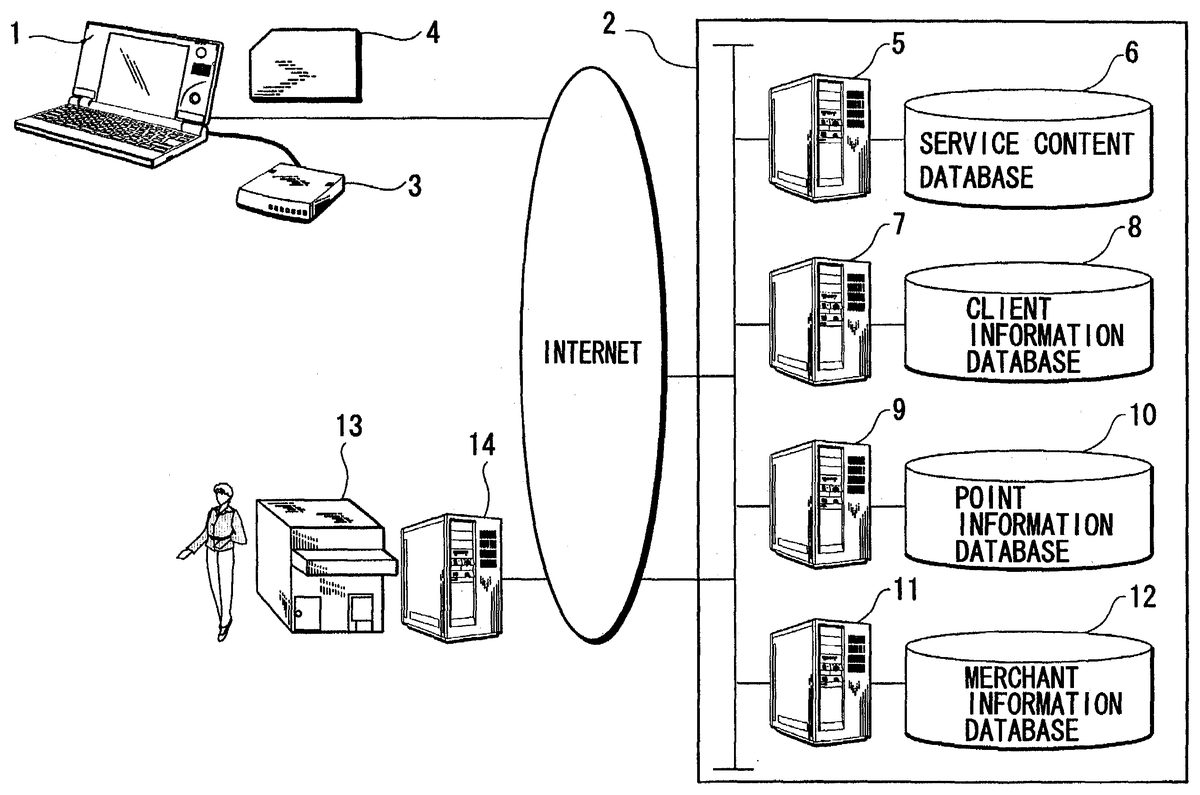
DETAILED DESCRIPTION OF THE PREFERRED EMBODIMENTS Various embodiments of the present invention will be described with reference to the accompanying drawings. It is to be noted that the same or similar reference numerals are applied to the same or similar parts and elements throughout the drawings, and the description of the same or similar parts and elements will be omitted or simplified. The present invention is applicable to a role-playing game system for connecting between virtual world created on a client terminal device and a store in real world through point value of a player in the virtual world which is stored in a IC card, as shown inFIG. 1. Configuration of Role-Playing Game System Firstly, the entire configuration of the role-playing game system which is an embodiment of the present invention will be described referring toFIG. 1. As shown inFIG. 1, in this entertainment system, the client terminal device1, a service center2and a merchant terminal device14provided at a store13in the real world are mutually connected via a predetermined network such as Internet so as to transmit and receive information therebetween. As the client terminal device1, a personal computer or a video game machine having communication function, PDA (Personal Digital Assistant), a portable telephone, an information communication terminal or the like can be applied. The client terminal device1creates the virtual world by executing the role-playing game program and proceeds with the role-playing game according to an instruction from a player. The client terminal device1is connected with a controller through which the player instructs various processing to the client terminal device1. In the case that the client terminal device1is the personal computer, input devices such as an input key, a keyboard or a mouse are used as the controller. The client terminal device1is further connected with a reader-writer3used for reading and ...
DETAILED DESCRIPTION OF THE PREFERRED EMBODIMENTS
Various embodiments of the present invention will be described with reference to the accompanying drawings. It is to be noted that the same or similar reference numerals are applied to the same or similar parts and elements throughout the drawings, and the description of the same or similar parts and elements will be omitted or simplified.
The present invention is applicable to a role-playing game system for connecting between virtual world created on a client terminal device and a store in real world through point value of a player in the virtual world which is stored in a IC card, as shown inFIG. 1.
Configuration of Role-Playing Game System
Firstly, the entire configuration of the role-playing game system which is an embodiment of the present invention will be described referring toFIG. 1.
As shown inFIG. 1, in this entertainment system, the client terminal device1, a service center2and a merchant terminal device14provided at a store13in the real world are mutually connected via a predetermined network such as Internet so as to transmit and receive information therebetween.
As the client terminal device1, a personal computer or a video game machine having communication function, PDA (Personal Digital Assistant), a portable telephone, an information communication terminal or the like can be applied. The client terminal device1creates the virtual world by executing the role-playing game program and proceeds with the role-playing game according to an instruction from a player.
The client terminal device1is connected with a controller through which the player instructs various processing to the client terminal device1. In the case that the client terminal device1is the personal computer, input devices such as an input key, a keyboard or a mouse are used as the controller.
The client terminal device1is further connected with a reader-writer3used for reading and writing information from/to an IC chip which is embedded in an IC card4owned by the player.
The IC card4may be whatever types, such as a contacted type, un-contacted type, and magnetic card, as long as the reader-writer3is capable of reading and writing. Moreover, any type of medium, a portable telephone or a memory card as example, can be applied as long as the IC chip is embedded in.
In the IC chip of the IC card4, information concerning game-play obtained by a player through playing the role-playing game is stored. In this embodiment, point value such as electric money or point value and information on the event instructed to player (flag information described later) is stored in the IC chip.
Game programs executed on the client terminal device1are those stored on a storing device in the client terminal device1, besides those downloaded via the Internet or stored in a storage medium such as a CD-ROM or DVD-ROM. In the case where a game program to be executed is stored in the storage medium, the client terminal device1reads the game program through the use of a predetermined reading device to execute the program sequentially.
As for executing the game program, not the client terminal device1, but a server machine may execute with the client terminal device1being connected via the Internet to the server machine provided at remote place, for example (so-called “a network game”). In this case, the client terminal device1displays the result of the program executed by the server machine on an output device.
In this embodiment, although the client terminal device1and the reader-writer3are configured independently, functions of the reader-writer3can be incorporated into the client terminal device1as example.
The service center2has a content server5, an IC card identification server7, a point server9and a store identification server11, all of which are connected with the client terminal device and the merchant terminal device14via the Internet.
The content server5has a service content database6which stores various contents downloaded by the player via the Internet and download log of the player. The contents stored in the database6are items in virtual world, such as arms used in the role-playing game. Each item is stored into the database6in data format, which includes information such as name of an item, item information (in the case that the item is an arm, its performance for example), points required to purchase items, as shown inFIG. 2.
The IC card identification server7has a client information database8which stores information to identify a player who possesses the IC card4. In the database8, various information such as a player ID of each player, password for identifying, IC card number or attribute information (sexuality, blood type, date of birth, address and the like) is stored, as shown inFIG. 3.
The point server9has a point information database10which stores information regarding the point value of each player. In the database10, information of a player's ID, IC card number, point updated log and current point value is stored for every player, as shown inFIG. 4.
The store identification server11has a merchant information database12which identifies the merchant terminal device14. In the database12, information of a store ID, password, ID number of the merchant terminal device14, and attribute information of stores (ex. address, category of business) is stored for every store, as shown inFIG. 5.
The merchant terminal device14is composed of general computer systems and designed to connect to the service center2via the Internet. The merchant terminal device14is connected with the reader-writer for the IC card4as in the case of the client terminal device1to thereby read and write information from/to the IC card4which is brought with the player. The functions of the reader-writer can be incorporated into the merchant terminal device14.
Thus, the role-playing game system is configured so that the point value obtained in the virtual world created on the client terminal device1can be updated on the merchant terminal device14provided at the store13in the real world under control of the service center2.
Operation of the Role-Playing Game System
Next, the flow of seamlessly connecting between the virtual world created on the client terminal device and the store13in the real world (such flow will be referred to as seamless connection processing hereinafter) utilizing the role-playing game system, will be described referring toFIG. 6.
The flow of the flowchart shown inFIG. 6is started where an event instruction to visit the store13in the real world is output according to a scenario while a player proceeds with the role-playing game on the client terminal device1, and the processing advances to S1. It is noted that information output for the player can be those corresponding to events which the player performs in the real world, the information including a map of the store13, contents of the events to be performed (for example, “Purchase items at the store13”) and the like.
In step S1, the player inserts the IC card4into the reader-writer3, and instructs the client terminal device1by operating a controller to transfer the player's points of the virtual world into the IC card4. In accordance with such instruction, the client terminal device1controls the reader-writer3to write the player's points of the virtual world into the IC card4, and then the processing proceeds to step S2from step S1.
It is to be understood here that how many points to be transferred into the IC card4may be specified by the player, or the client terminal device1may collectively transfer all the points of the player into the IC card4in accordance with the instruction from the player.
In addition, in the processing of step S1, role-playing game program may store information on the event instructed to player as flag information in the IC card4. According to such flag information, when the player visit the specified store13with IC card4, merchant terminal device14or service center2can recognize contents of the event the player should perform, and determine whether the player cleared the event.
In step S2, the player visits, with the IC card4in which the points are stored, the specified store13referring to the information (a map of the store13and the like) which is output from the client terminal device1. Then, the processing proceeds to step S3from step S2.
In the case, the client terminal device1is a portable information processing device which has a storage medium, the player can store the points and the flag information into the storage medium, and visit the specified store13with the device body.
In step S3, the player inserts the IC card4into the reader-writer which is provided at the store13. When the IC card4is inserted into the reader-writer, the merchant terminal device14connects to the service center2via the Internet. Then, the processing proceeds to step S4from step S3.
In step S4, the store identification server11requests the merchant terminal device14connected therewith to input a store ID and password for identifying the store13. After input of the store ID and password by the merchant terminal device14, the store identification server11determines whether the input is correct by referring to the merchant information database12, thereby identifying the store13. Then, the processing proceeds to step S5from step S4.
In step S5, the IC card identification server7requests input of the player ID and the password for identifying the IC card4. After input thereof by the merchant terminal device14, IC card identification server7identifies the player who brought the IC card4by referring to the client information database8. Then, the processing proceeds to step S6from step S5.
In step S6, the player performs events directed in virtual world such that he or she carries out a conversation with a salesclerk of the store13or purchases the specified goods or items at the store13, in accordance with the information output from the client terminal device1. After the player clearing the events, the merchant terminal device14notifies the service center2of the effect that the player cleared the events. Then, the seamless connecting processing proceeds to step S7from step S6.
In step S7, the point server9extracts point information of the player from the point information database10to change or update the points of the player responsive to contents of the events which the player cleared, and then the processing proceeds to step S8from step S7.
In step S8, the point server9transmits the updated result of the points to the merchant terminal device14, and then the processing proceeds to step S9from step S8.
In step S9, the merchant terminal device14changes the point value stored in the IC chip of the IC card4in accordance with the information which is transmitted from the point server9by controlling the reader-writer3. Then, the processing proceeds to step S10from step S9.
In the case the flag information is stored in the IC card4, the merchant terminal device14stores clear-information which shows the player cleared the event by controlling the reader-writer3. The clear-information can be stored in the client information database8.
In step S10, the player inserts the point updated IC card4into the reader-writer3which is connected to the client terminal device1, thereafter requesting the client terminal device1through the controller to connect with the service center2. Upon receiving the connection request from the player, the client terminal device1connects to the service center2.
After completion of the connection between the client terminal device1and the service center2, the player connects the client terminal device1with the content server by operating the controller to transmit a request for downloading a desired item referring to the service content database6. Then, the processing proceeds to step S11from step S10.
In step S11, IC card identification server7requests input of the player ID and the password to the player. After the input thereof, IC card identification server7determines whether the player ID and the password are correct with reference to the client information database8, thereby identifying the player. Then, the processing proceeds to step S12from step S11.
In step S12, the content server5executes download processing of item data into the client terminal device1in response to the completion of the authentication of the player by the IC card certification server7so as to update the download log of the player. The point server9subtracts the points corresponding to items downloaded by the player from the points currently possessed, referring to the service contents database6.
Thereafter, the player plays again in the virtual world using the downloaded items, and then a series of the processing ends.
In the above embodiment, the player purchases items from the client terminal device1, however, in the case where the specified event is to purchase the items at the store13, the items can be purchased from the service content database6by connecting to the service center2via the merchant terminal device14at the store13. In such case, the player executes the processes from S10to S12while operating the merchant terminal device14.
Further, in the above embodiment, although the merchant terminal device14modified the point value stored in the IC card4, the point server9may hold the updated point value in the point information database10, and modify the point value when the player connected the client terminal device1with the service center2.
As is clear from the foregoing description, a role-playing game system according to this embodiment allows a player to bring point value out from virtual world to real world, in which the point value in the virtual world is updated depending on an event-executed result of the player in the real world. Thereby, a part of scenario in virtual world is created based on the player's acts, and the gap between virtual world and real world can be eliminated.
Other Embodiments
Although the present invention has been described through its preferred embodiment, it is to be understood that the present invention is not intended to be limited to the above-described embodiment and drawings, and various changes or modifications may be made therein without departing from the scope and the technical sprit of the present invention.
For example, although the player brings the point value out from the virtual world to the real world in the above embodiments, the player may also bring out a virtual racing car tuned up in a racing game to the real world, which means allowing the player to utilize various information generated in the virtual world in the real world.
As another example, a reader writer for an IC card4can be provided at a concert hall, and the program may instruct a musician fan to go to the concert hall as an event to execute in the real world. In such case, the program stores the flag information that instructs the musician fan to go to the concert hall in the IC card4. And, in case the musician fan inserts the IC card4into the reader-writer provided at the concert hall, the reader-writer stores the clear-information which shows the musician fan cleared the event into the IC card4referring with the stored flag information. Then, when the musician fan inserts the IC card4brought back from the concert hall into a reader-writer at home, the program allows to reproduce information (additional images) which the musician fan who cleared the specified event can only enjoy, such as concert images in a DVD.
As yet another example, a reader writer for an IC card4can be provided in an autograph session for a TV personality who released an image DVD, and the program may instruct a fan of the TV personality to go to the autograph session as an event to execute in the real world. In such case, the program stores the flag information that instructs the fan to go to the autograph session in the IC card4. And, in case the fan inserts the IC card4into the reader-writer provided at the autograph session, the reader-writer stores the clear-information which shows the fan cleared the event into the IC card4referring with the stored flag information. Then, when the fan inserts the IC card4brought back from the autograph session into a reader-writer at home, the program allow to disclose information which the fan who cleared the specified event can only enjoy, such as images of the TV personality.
As still yet another example, a reader writer for an IC card4can be provided in an autograph session for an author of an electronic book written with text data, and the program may instruct a reader of the book to go to the autograph session as an event to execute in the real world. In such case, the program stores the flag information that instructs the reader to go to the autograph session in the IC card4. And, in case the reader inserts the IC card4into the reader-writer provided at the autograph session, the reader-writer stores the clear-information which shows the reader cleared the event into the IC card4referring with the stored flag information. Then, when the reader inserts the IC card4brought back from the autograph session into a reader-writer at home, the program allow to disclose information which the reader who cleared the specified event can only enjoy, such as an epilogue of the book.
It is to be understood that operation of the role-playing game of the embodiment can be programmed and stored in a recording medium capable of being read by computer. On execution of the operation, a computer system reads the recording medium, stores the program into a storage area such as a memory in the computer system and executes the program by an operation unit. This realizes a video game system according to the embodiment of the present invention. It is noted here that the recording medium includes a computer-readable recording medium such as a semiconductor memory, magnetic disk, optical disk, magnet-optical disk, and magnetic tape.
Claims
- An information processing system comprising: a first terminal device provided at a user side, for executing predetermined information processing including a process for causing a user to execute a predetermined event in the real world;portable storage means for storing a unique storage means identifier;a second terminal device placed in a predetermined place, the second terminal device being assigned a unique second device identifier and having means;and a server device connected to the first terminal device and the second terminal device via a predetermined network, the server device having certifying means and generating means, wherein: the input/output means of the second terminal device reads our the storage means identifier front the portable storage means;the second terminal device sends the second terminal device identifier and the storage means identifier to the server device;the certifying means of the server, including a database having pre-stored information that includes the storage means identifier and the second terminal device identifier, certifies the second terminal device identifier and the storage means identifier sent by the server device by referencing the pre-stored information in the database;and the generating means of the server device generates event completion information upon receiving a certification of the second terminal device identifier and the storage means identifier from the certifying means and an event completion notification from the second terminal device indicating that the user has executed the predetermined event.
- The information processing system according to claim 1 , wherein the predetermined information processing executed by the first terminal device is concerned with a video game.
- The information processing system according to claim 2 , wherein the predetermined event to be executed by the user is instructed while the user plays the video game on the first terminal device.
- The information processing system according to claim 2 , further comprising: modifying means for modifying information stored in the portable storage means in accordance with a result of the predetermined event;and controlling means provided at the user side, for controlling the information processing executed on the first terminal device based on the modified information stored in the portable storage means;wherein the modified information stored in the portable storage means represents a point value obtained by the user through playing the video game.
- The information processing system according to claim 4 , wherein the controlling means adds points to the point value stored in the portable storage means when the user clears the predetermined event.
- The information processing system according to claim 4 , wherein the controlling means subtracts points corresponded to a virtual item purchased by the user from the point value stored in the storage means when the user purchases the virtual item within the video game at an existing store with the point value stored in the storage means.
- The information processing system according to claim 1 , wherein the portable storage means is portable by the user.
- An information processing method comprising the steps of: executing predetermined information processing by a first terminal device at a user side, the predetermined information processing including a process for causing a user to execute a predetermined event in the real world;storing a unique storage means identifier in a portable storage means;reading out the storage means identifier from the portable storage means by an input/output means of a second terminal device;sending the storage means identifier and a second terminal device identifier to a server device by a second terminal device;wherein the server device is connected to the first terminal device and the second terminal device via a predetermined network and includes certifying means and generating means: the certifying means of the server, including a database having pre-stored information that includes the storage means identifier and the second terminal device identifier, certifies the second terminal device identifier and the storage means identifier sent by The server device by referencing the pre-stored information in the database;and the generating means of the server device generates event completion information upon receiving a certification of the second terminal device identifier and the storage means identifier from the certifying means and an event completion notification from the second terminal device indicating that the user has executed the predetermined event.
- The information processing method according to claim 8 , further comprising the steps of: modifying information stored in the portable storage means in accordance with a result of the predetermined event;and controlling the information processing executed on the first terminal device based on the modified information stored in the portable storage means.
- The information processing method according to claim 9 , wherein the predetermined information processing executed by the first terminal device is concerned with a video game.
- The information processing method according to claim 10 , wherein the predetermined event to be executed by the user is instructed while the user plays the video game on the first terminal device.
- The information processing method according to claim 10 , wherein the modified information stored in the portable storage device represents a point value obtained by the user through playing the video game.
- The information processing method according to claim 12 , wherein the modifying step comprises a step of adding points to the point value when the user clears the predetermined event.
- The information processing method according to claim 12 , wherein the modifying step comprises a step of subtracting points corresponded to a virtual item purchased by the user from the point value when the user purchases the virtual item within the video game at an existing store with the point value.
- A computer-readable storage medium having recorded therein an information processing program to be executed on a computer, wherein the information processing program performs the steps of: executing predetermined information processing by a first terminal device at a user side, the predetermined information processing including a process for causing a user to execute a predetermined event in the real world;storing a unique storage means identifier in a portable storage means;reading out the storage means identifier from the portable storage means by an input/output means of a second terminal device;sending the storage means identifier and a second terminal device identifier to a server device by a second terminal device;wherein The server device is connected to the first terminal device and the second terminal device via a predetermined network and includes certifying means and generating means: the certifying means of the server, including a database having pre-stored information that includes the storage means identifier and the second terminal device identifier, certifies the second terminal device identifier and the storage means identifier sent by the server device by referencing the pre-stored information in the database;and the generating means of the server device generates event completion information upon receiving a certification of the second terminal device identifier and the storage means identifier from the certifying means and an event completion notification from the second terminal device indicating that the user has executed the predetermined event.
- The computer-readable storage medium according to claim 15 , wherein the information processing program further comprises the steps of: modifying information stored in the portable storage means in accordance with a result of the predetermined event;and controlling the information processing executed on the first terminal device based on the modified information stored in the portable storage means of the information processing.
- The computer-readable storage medium according to claim. 16 , wherein the predetermined information processing executed by the first terminal device is concerned with a video game.
- The computer-readable storage medium according to claim 17 , wherein the predetermined event to he executed by the user is instructed while the user plays the video game on the terminal device.
- The computer-readable storage medium according to claim 17 , wherein the modified information stored in the portable storage device represents a point value obtained by the user through playing the video game.
- The computer-readable storage medium according to claim 19 , wherein the information processing program further comprises the step of: adding points to the point value when the user clears the predetermined event.
- The computer-readable storage medium according to claim 19 , wherein the information processing program further comprises the step of: subtracting points corresponded to a virtual item purchased by the user from the point value when the user purchases the virtual item within the video game at an existing store with the point value.
- An information processing system comprising: a first terminal device provided at a user side, for executing predetermined information processing including a process for causing a user to execute a predetermined event in the real world;a portable storage unit for storing a unique storage means identifier;a modifying unit for modifying information stored in the portable storage unit in accordance with a result of the predetermined event;and a controlling unit provided at the user side, for controlling the information processing executed on the first terminal device based on the modified information stored in the portable storage unit;wherein the modifying unit modifies the information stored in the portable storage unit upon receiving event completion notification from a server device connected to the modifying unit via a predetermined network.
- An information processing method comprising the steps of: executing, a: a firs;terminal device provided at a user side, predetermined information processing including a process for causing a user to execute a predetermined even: in the real world;storing a unique storage means identifier in a portable storage unit;modifying information stored by the portable storage unit in a modifying unit, in accordance with a result of the predetermined event;and controlling the information processing executed on the first terminal device in a controlling unit provided at the user side, based on the modified information stored in the portable storage unit;wherein the modifying unit modifies the information stored in the portable storage unit upon receiving event completion notification from a server device connected to the modifying unit via a predetermined network.
Disclaimer: Data collected from the USPTO and may be malformed, incomplete, and/or otherwise inaccurate.