U.S. Pat. No. 7,115,031
GAME SYSTEM DISPLAYING A GAME WORLD ON A COMMON DISPLAY AND AN INDIVIDUAL DISPLAY
AssigneeNintendo Co., Ltd.
Issue DateMay 1, 2002
Illustrative Figure
Abstract
A game system includes a plurality of game machines each of which has an LCD. A game world in which a plurality of characters individually operated by the plurality of game machines appear is displayed on a CRT as a common display and on the LCD as an individual display of each of players. Specifically, a game world having a fixed viewpoint capable of viewing the plurality of characters is displayed on the CRT, and a three-dimensional game world having a viewpoint with reference to one's character is displayed on the LCD. One of the CRT or one's LCD is changeably selected as an operation screen. When a direction instructing key is operated, a moving direction of one's character is determined with reference to the operation screen, and one's character is moved to the determined moving direction.
Description
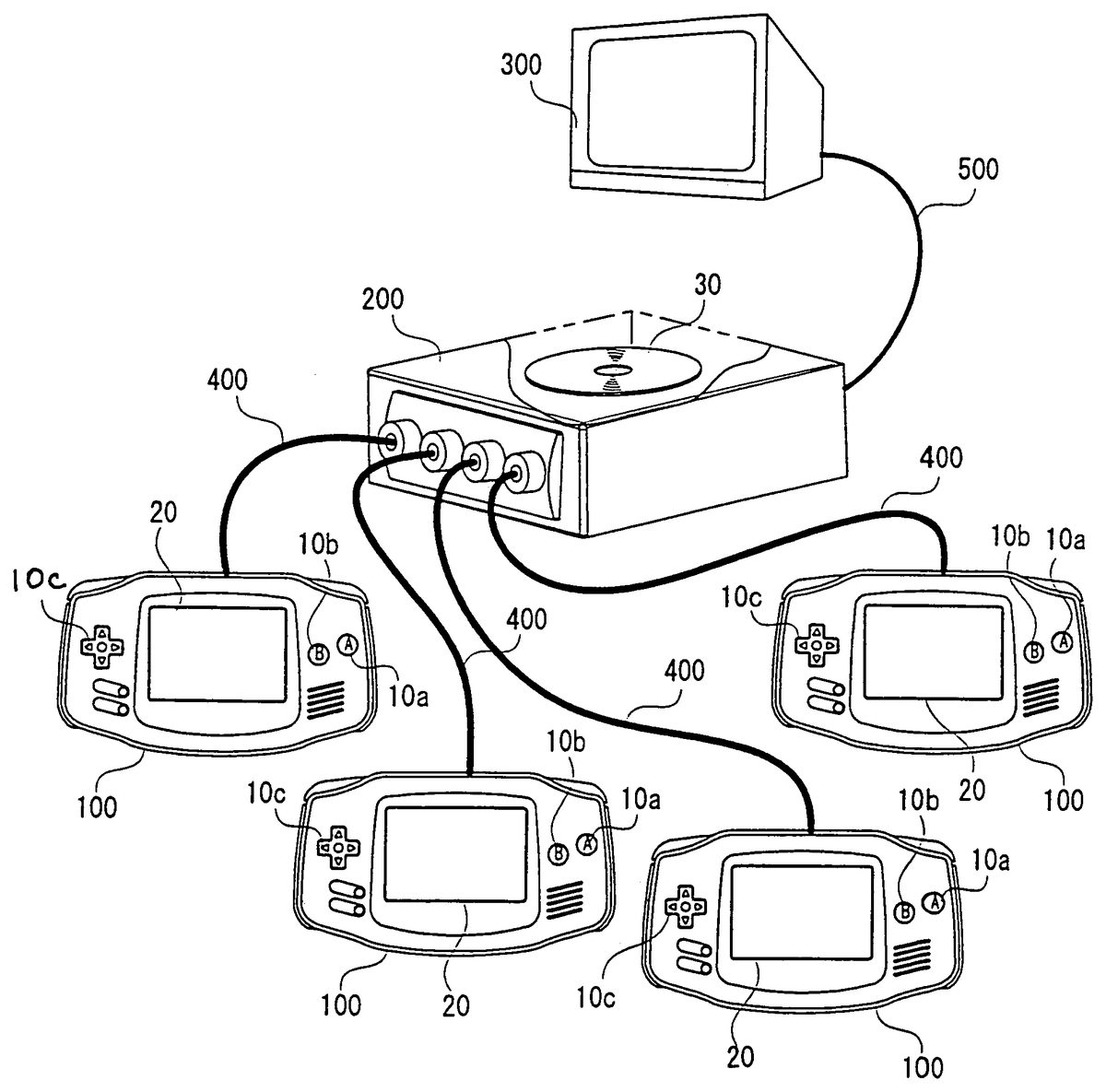
DETAILED DESCRIPTION OF THE PREFERRED EMBODIMENTS Referring toFIG. 1, a game system of this embodiment includes a plurality of portable game machines100,100, . . . (four in this embodiment) and one video game machine200. The video game machine200is individually connected to the portable game machines100,100, . . . using connection cables400,400, . . . and is connected to a CRT300using a video cable500. A DVD-ROM30stored with a game program is attached to the video game machine200. The game program is executed by the video game machine200and each portable game machine100, whereby a predetermined game world is provided to players. Each game machine100is utilized as a game controller, and each player performs a game operation by one's portable game machine100. It is noted that in this exemplary embodiment the video game machine200and the portable game machine100are respectively game machines “NINTENDO GAME CUBE (trademark)” and “GAME BOY ADVANCE (trademark)” manufactured and sold by the applicants' assignee of the present invention. The game world is displayed on an LCD20provided on each portable game machine100and the CRT300. Each LCD20is displayed with a different game world (individual game screen) every player, and the CRT300is displayed with a common game world (common game screen) common to each player. That is, the LCD20functions as an individual display, the CRT300functions as a common display, and therefore, each player executes a game viewing the CRT300and one's LCD20. A plurality of player characters Ch1to Ch4appear in a three-dimensional space shown inFIG. 2in the game of this embodiment (hereinafter “player character” is referred merely to as “character”). The characters Ch1to Ch4are operatively assigned to the respective portable game machines100,100, . . . one by one, and each player moves one's character to an arbitrary direction utilizing a direction instructing key (cross key)10cprovided on the portable game machine100. The common game screen ...
DETAILED DESCRIPTION OF THE PREFERRED EMBODIMENTS
Referring toFIG. 1, a game system of this embodiment includes a plurality of portable game machines100,100, . . . (four in this embodiment) and one video game machine200. The video game machine200is individually connected to the portable game machines100,100, . . . using connection cables400,400, . . . and is connected to a CRT300using a video cable500. A DVD-ROM30stored with a game program is attached to the video game machine200. The game program is executed by the video game machine200and each portable game machine100, whereby a predetermined game world is provided to players. Each game machine100is utilized as a game controller, and each player performs a game operation by one's portable game machine100.
It is noted that in this exemplary embodiment the video game machine200and the portable game machine100are respectively game machines “NINTENDO GAME CUBE (trademark)” and “GAME BOY ADVANCE (trademark)” manufactured and sold by the applicants' assignee of the present invention.
The game world is displayed on an LCD20provided on each portable game machine100and the CRT300. Each LCD20is displayed with a different game world (individual game screen) every player, and the CRT300is displayed with a common game world (common game screen) common to each player. That is, the LCD20functions as an individual display, the CRT300functions as a common display, and therefore, each player executes a game viewing the CRT300and one's LCD20.
A plurality of player characters Ch1to Ch4appear in a three-dimensional space shown inFIG. 2in the game of this embodiment (hereinafter “player character” is referred merely to as “character”). The characters Ch1to Ch4are operatively assigned to the respective portable game machines100,100, . . . one by one, and each player moves one's character to an arbitrary direction utilizing a direction instructing key (cross key)10cprovided on the portable game machine100.
The common game screen displayed on the CRT300is formed by a two-dimensional space shown inFIG. 3. That is, a plane image based on a viewpoint (second viewpoint) viewing the three-dimensional space shown inFIG. 2from directly above is displayed on the CRT300, and therefore, where the characters C1to C4exist can be recognized by this plane image. On the other hand, the three-dimensional space based on a viewpoint (first viewpoint) viewing from a rear oblique upper position of one's character is displayed on the LCD20of the portable game machine100. Specifically, the three-dimensional space extending forward one's character is displayed on the individual game screen. Accordingly, when the character Ch1is moved in order of position a→position b→position c, a display of the LCD20of the portable game machine100which operates the character Ch1is changed as shown in a manner ofFIG. 4(A)→FIG. 4(B)→FIG. 4(C).
Where each player operates an A button10aor a B button10bprovided on the portable game machine100, the operation screen is switched between the common game screen and one's individual game screen. Specifically, where the A button10ais selected, the common game screen is selected as the operation screen, and where the B button10bis selected, one's individual game screen is selected as the operation screen. An operation required to move the character Ch1from the position a to the position c is different between the case the common game screen is selected as the operation screen and the case one's individual game screen is selected as the operation screen.
In a case the common game screen is the operation screen (referring toFIG. 3), the character Ch1is moved from the position A to the position B by operating the direction instructing key10cin order of right→right→right→upper→left. Furthermore, the character Ch1is moved from the position B to the position C by operating the direction instructing key10cin order of left→upper. On the other hand, in a case one's individual game screen is the operation screen (referring toFIG. 4(A)toFIG. 4(C)), the character Ch1is moved from the position A to the position B by operating the direction instructing key10cin order of upper→upper→upper→left→left. Furthermore, the character Ch1is moved from the position B to the position C by operating the direction instructing key10cin order of upper→right.
A map M simplifying the game world is also displayed on the individual game screen. The map M is displayed at the same viewpoint as the plane image shown inFIG. 3, and all characters Ch1to Ch4also appear on the map M. A display manner of the map M is switched betweenFIGS. 4(A) to4(C) andFIG. 5in accordance with the setting of the operation screen. That is, where the individual game screen is the operation screen, the map M is displayed in a reduced manner at the upper of the screen as shown inFIG. 4(A) toFIG. 4(C), and where the common game screen is the operation screen, the map M is displayed in an enlarged manner at the center of the screen as shown inFIG. 5. Such the emphasis or non-emphasis of the map M allows the operator to smoothly progress the game with viewing only the individual game screen.
The portable game machine100and the video game machine200are specifically constructed as shown inFIG. 6. The portable game machine100is provided with a connector12, and the video game machine200is provided with a plurality of connectors34,34, . . . . The connector12is connected to a CPU16via an I/O interface14, and the connector34is connected to a CPU38via an I/O interface36. Connectors400aand400bprovided at both ends of the connector400are connected to the connectors12and34, respectively, and therefore, communication between the CPU16and the CPU38can be established.
The I/O interface36of the video game machine200is connected with a DVD drive32. The DVD ROM30is stored with game program/data for the video game machine200and game program/data for the portable game machine100as shown inFIG. 7, and these program/data are read out by the DVD drive32.
Referring toFIG. 7, the game program/data for the video game machine200includes a program for program transfer PGC1, a display control program PGC2, a key information receiving program PGC3, a position information renewal program PGC4, a position information transmitting program PGC5, game world data DGC1, character data DGC2, and etc. Furthermore, the game program/data for the portable game machine100includes a display control program PGB1, a key information transmitting program PGB2, a position information receiving program PGB3, a position information renewal program PGB4, game world data DGB1, map data DGB2, character data DGB3, and etc.
The program for program transfer PGC1is a program for transferring the game program/data for the portable game machine100to each portable game machine100. The display control program PGC2is a program for displaying the common game screen shown inFIG. 3on the CRT300on the basis of the game world data DGC1, the character data DGC2and the position information. The key information receiving program PGC3is a program for receiving key information (A button data, B button data or direction data) transmitted from the portable game machine100. The position information renewal program PGC4is a program for renewing the position information of the characters Ch1to Ch4according to the received key information. The position information transmitting program PGC5is a program for transmitting the renewed position information to each portable game machine100.
The game world data DGC1is data for reproducing the game world on the CRT300and is, for example, drawn in a two-dimensional manner as shown inFIG. 8(A).
The character data DGC2is data for reproducing the characters Ch1to Ch4in the game world and is, for example, drawn in a three-dimensional manner as shown inFIG. 8(B).
Returning toFIG. 7, the display control program PGB1included in the game program/data for the portable game machine100is a program for displaying the individual game screen shown inFIGS. 4(A) to4(C) orFIG. 5on one's LCD20on the basis of the game world data DGB1, the map data DGB2, the character data DGB3, and the position information. The key information transmitting program PGB2is a program for transmitting, to the video game machine200, the key information indicative of which one of the A button10a, the B button10band the direction instructing key10cis operated. The position information receiving program PGB3is a program for receiving the position information transmitted from the video game machine200. The position information renewal program is a program for renewing current position information by the received position information.
The game world data DGB1is data for reproducing the game world on one's LCD20and is drawn in the three-dimensional manner as shown inFIG. 9(A). The map data DGB2is data for displaying the map of the game world on one's LCD20and is drawn in the two-dimensional manner as shown inFIG. 9(B). The viewpoint of the map based on the map data is the same as the viewpoint of the game world based on the game world data shown inFIG. 8(A). The character data DGB3is data for reproducing the characters Ch1to Ch4in the game world or the map, and is drawn in the three-dimensional manner as shown inFIG. 9(C).
Returning toFIG. 6, the game program/data for the video game machine200is stored in a RAM40. The RAM40is also formed with a table40aholding the position information of the characters Ch1to Ch4and an operation screen flag for determining the operation screen of each portable game machine100. According toFIG. 10, the position information is constructed by posture data (moving direction data) and location data of the characters. Furthermore, where the operation screen flag is set, the CRT300is determined to be the operation screen, and where the operation screen flag is reset, one's LCD20is determined to be the operation screen.
The CPU38executes the program for program transfer PGC1and transfers the game program/data for the portable game machine100to each portable game machine100. When the game is started, the CPU38executes the above-described programs PGC2to PGC5. First, the CPU38requests an image processing unit42to execute image processing so as to display on the CRT300the common game screen in an initialized state. When the key information is received from the portable game machine100, the CPU38renews the position information or the operation screen flag of the table40aaccording to the key information. When the position information is renewed, the CPU38transmits the renewed position information to each portable game machine100, and requests the image processing unit42to renew any one position of the characters Ch1to Ch4.
The image processing unit42draws the game world in a VRAM44on the basis of the game world data DGC1stored in the RAM40and draws the characters Ch1to Ch4in the VRAM44on the basis of the character data DGC2stored in the RAM40and the position information of the table40a. Herein, each of the characters Ch1to Ch4is disposed at a position indicated by the location data and directed to a direction indicated by the posture data.
An encoder46reads out image data formed by the game world and the characters Ch1to Ch4from the VRAM44, and converts the read image data to a composite image signal. The converted composite image signal is applied to the CRT300via the video cable500, and whereby, the common game screen shown inFIG. 3is displayed on the CRT300.
The game program/data for the portable game machine100transmitted to the portable game machine100is stored in a RAM18by the CPU16. The RAM18is also formed with a table18aas shown inFIG. 11. According toFIG. 11, the position information of the characters Ch1to Ch4is held in the table18a.
When the game is started, the CPU18requests the image processing unit22to execute image processing so as to display on the LCD20the individual game screen in an initial state. When any one of the A button10a, the B button10band the direction instructing key10cis operated, the CPU18transfers the key information to the video game machine200. Furthermore, in receiving the position information from the video game machine200, the CPU18rewrites the position information of the table18aby the received position information, and requests the image processing unit22to renew the image.
The image processing unit22draws an image of three-dimensional space viewed from a rear oblique upper position of one's character and a map image in a VRAM24on the basis of the game world data DGB1, the map data DGB2and the character data DGB3stored in the RAM18, and the position information of one's character stored in the table18a. At this time, where the operation screen is the CRT300, the reduced map image is drawn, and where the operation screen is the LCD20, the enlarged map image is drawn. An LCD driver26drives the LCD20in accordance with the image data drawn in the VRAM24, and therefore, the individual game screen shown inFIGS. 4(A) to4(C) orFIG. 5is displayed on the LCD20.
Specifically, the CPU38of the video game machine200and the CPU16of the portable game machine100process flowcharts shown inFIG. 12toFIG. 17. It is noted that processing of the CPU38is executed according to the game program/data for the video game machine, and processing of the CPU16is executed according to the game program/data for the portable game machine.
Referring toFIG. 12first, the CPU38of the video game machine200performs initializing processing in a step S101, and performs a negotiation for establishing communication between respective portable game machines100,100, . . . in a step S103. When the communication is established, the game program/data for the portable game machine is transmitted to each portable game machine100in a step S105, and after completion of the transmitting processing, a game process is executed in a step S107. When a power off operation is performed in the middle of the game process, the process is completed.
The CPU16of the portable game machine100also performs the initializing processing in a step S201, and performs the negotiation processing between the video game machine200in a step S203. When the communication is thus established, the process proceeds to a step S205, and then, receiving processing of the game program/data transmitted from the video game machine200is performed. After completion of the receiving processing, the game process is performed in a step S207, and when the power off operation is performed in the middle of the game process, the process is completed.
The game process in the step S107complies with subroutines shown inFIG. 13toFIG. 16. First, all operation screen flags held in the table40ashown inFIG. 10are set in a step S111, and all position information held in the same table40aare initialized in a step S113. Setting the operation screen flag allows each of the portable game machines100,100, . . . to select the LCD20for the operation screen. Furthermore, the initialization of the position information allows each of the characters Ch1to Ch4to be directed to a predetermined direction at a predetermined position. A processing requirement is applied to the image processing unit42so as to display the common game screen on the CRT300in a step S115. The CRT300is displayed with the common game screen shown inFIG. 3.
It is determined whether or not the A button data is received in a step S117, it is determined whether or not the B button data is received in a step S123, and it is determined whether or not the direction data are received in a step S129. When the A button data is received, “YES” is determined in the step S117, and it is specified that from which portable game machines100,100, the A button data is transmitted in a step S119(specification of the transmission source). In a following step S121, the table40ashown inFIG. 10is accessed, and the operation screen flag assigned to the portable game machine100of the transmission source is set. When the A button data is transmitted from the portable game machine100operating the character Ch1, the operation screen flag of the character Ch1is set.
When the B button data is received, the process proceeds from the step S123to a step S125so as to specify the transmission source of the B button data. In a step S127, the operation screen flag assigned to the portable game machine100of the transmission source is reset contrary to the step S121. Where the operation screen flag is set, the CRT300functions as the operation screen, and where the operation screen flag is reset, one's LCD20functions as the operation screen.
When the direction data is received, the process proceeds from the step S129to a step S131so as to specify the transmission source of the direction data as above-described manner. In a step S133, the position information assigned to the portable game machine100of the transmission source is renewed in accordance with the subroutines shown inFIG. 15andFIG. 16. After completion of the renewal processing, the renewed position information is transmitted to each portable game machine100in a step S135. In a following step S137, so as to renew the common game screen according to the renewed position information, a corresponding processing request is applied to the image processing unit22. A character, i.e. an operation object of the portable game machine100of the transmission source is moved to the direction according to the renewed position information. It is determined whether or not a power off operation is performed in a step S139, and if “No” is determined, the process returns to the step S117, however; if “YES” is determined, the process is restored to a hierarchical upper level of a routine.
Referring toFIG. 15andFIG. 16, the renewal processing of the position information will be described. In a step S141first, the table40ashown inFIG. 10is accessed and a state of the operation screen flag assigned to the transmission source of the direction data is determined. If the operation screen flag is in a reset state (i.e. the LCD20is the operation screen), processes from steps S143to S161are executed, however; if the operation screen flag is in a set state (i.e. the CRT300is the operation screen), processes from steps S163to S183are executed.
A direction indicated by the direction data is determined in the steps S143, S145and S147. If the direction data indicates “left direction (left side of the direction instructing key10c)”, “YES” is determined in the step S143, and the position information assigned to the transmission source is renewed in respective steps S151and S153. A direction or posture indicated by the position information (moving direction) is rotated 90 degrees in a counterclockwise direction in the step S151, and a location indicated by the position information (a coordinate value) is renewed according to the renewed moving direction in the step S153. For example, when the direction data indicative of the “left direction” is received from the portable game machine100operating the character Ch1in a state (a state A) that the direction data and the location data of the position information of the character Ch1indicate “X” and (x, y)=(0, 0), respectively, the direction data is renewed form “x” to “y” and the location data is renewed to (x, y)=(0, 1).
When the direction data indicates “right direction (right side of the direction instructing key10c)”, “YES” is determined in the step S145, and the direction data indicated by the position information is rotated 90 degrees in a clockwise direction in the step S155. Then, the location data indicated by the position information is renewed according to the renewed moving direction in the step S157. When the direction data indicative of “right direction” is received from the portable game machine100operating the character Ch1in the above described state A, the direction data and the location data (x, y) indicated by the position information of the character Ch1are renewed from “x” to “−y” and from (0, 0) to (0, −1), respectively.
When the direction data indicates “rear direction (lower side of the direction instructing key10c)”, “YES” is determined in the step S147, the direction data indicated by the position information is inverted 180 degrees in the step S159, and the location data indicated by the position information is renewed in accordance with the renewed moving direction in the step S161. When the direction data indicative of “rear direction” is received from the portable game machine100operating the character Ch1in the above described state A, the direction data and the location data (x, y) indicated by the position information of the character Ch1are renewed from “x” to “−x” and from (0, 0) to (−1, 0), respectively.
When the direction data indicates “forward direction (upper side of the direction instructing key10c)”, the process proceeds from the step S147to the step S149, and the location data indicated by the position information is renewed in accordance with a current moving direction. When the direction data indicative of “forward direction” is received from the portable game machine100operating the character Ch1in the above described state A, the position data (x, y) is renewed from (0, 0) to (1, 0) without renewing the direction data.
The individual game screen displayed on one's LCD20is changed according to the moving of one's character. Accordingly, where the individual game screen is the operation screen, the renewed moving direction is determined with reference to the current moving direction of the character. Furthermore, which one of “x” or “y” forming the location data is to be renewed is determined depending on x/y of the renewed direction data, and whether “1” is added or subtracted is determined depending on +/−of the renewed direction data. After completion of the step S153, S157, S161, or S149, the process is restored to the hierarchical upper level of the routine.
A direction indicated by the direction data is also determined in steps S163, S165and S167shown inFIG. 16. If the direction data indicates “right direction (right side of the direction instructing key10c)”, “YES” is determined in the step S163, the direction data indicated by the position information is set into “x” in the step S169, and the location data “x” indicated by the position information is renewed by “1” to the plus (+) side in the step S171. When the direction data indicative of “right direction” is received from the portable game machine100operating the character Ch1at a time the direction data and the location data (x, y) included in the position information of the character Ch1indicates “x” and (0, 0), respectively, such as the above-described state A, the direction data indicated by the position information is not renewed, and the location data (x, y) is renewed from (0, 0) to (1, 0).
If the direction data indicates “left direction (left side of the direction instructing key10c)”, “YES” is determined in the step S165, the direction data indicated by the position information is set to “−x” in the step S173, and the location data “x” indicated by the position information is renewed by “1” to the minus (−) side in the step S175. When the direction data indicative of “left direction” is received from the portable game machine100operating the character Ch1in the above-described state A, the direction data and the location data (x, y) indicated by the position information of the character Ch1are renewed from “x” to “−x” and from (0, 0) to (−1, 0), respectively.
If the direction data indicates “upper direction (upper side of the direction instructing key10c)”, “YES” is determined in the step S167, the direction data indicated by the position information is set to “y” in the step S177, and the location data “y” indicated by the position information is renewed by “1” to the plus (+) side in the step S179. When the direction data indicative of “upper direction” is received from the portable game machine100operating the character Ch1in the above-described state A, the direction data and the location data (x, y) indicated by the position information of the character Ch1are renewed from “x” to “y” and from (0, 0) to (0, 1), respectively.
If the direction data indicates “lower direction (lower side of the direction instructing key10c)”, “NO” is determined in the step S167, the direction data indicated by the position information is set to “−y” in the step S181, and the location data “y” indicated by the position information is renewed by “1” to the minus (−) side in the step S183. When the direction data indicative of “lower direction” is received from the portable game machine100operating the character Ch1in the above-described state A, the direction data and the location data (x, y) indicated by the position information of the character Ch1are renewed from “x” to “−y” and from (0, 0) to (0, −1), respectively.
Since the CRT300is displayed with the common game screen at the fixed viewpoint, when the CRT300is the operation screen, a character is moved to a direction indicated by the direction data. After completion of the step S171, S175, S179or S183, the process is restored to the hierarchical upper level of the routine.
The game process (step S207inFIG. 12) of the portable game machine100complies with a subroutine shown inFIG. 17. First, whole position information held in the table18ashown inFIG. 11is initialized in a step S211. A processing request for displaying the map M in a reduced manner on the LCD20is applied to the image processing unit22in a step S213, and a processing request for displaying the game world at the viewpoint with reference to one's character on the LCD20is applied to the image processing unit22in a following step S215. Thus, the individual game screen of an initialized state shown inFIG. 4(A) is displayed on the LCD20of the portable game machine100operating the character Ch1.
Successively, an operation state of an operation device10is determined in each of steps S217, S223, and S229, it is determined whether or not the position information is received in a step S233, and it is determined whether or not the power off operation is performed in a step S237.
Where the A button10ais pressed, “YES” is determined in the step S217, the A button data is transmitted to the video game machine200in a step S219, and the processing request for displaying the map M in an enlarged manner is applied to the image processing unit22in a step S221. After completion of the step S221, the process returns to the step S215. Where the B button10bis pressed, the process proceeds from the step S223to a step S225so as to transmit the B button data to the video game machine200. A processing request for displaying the map M in a reduced manner is applied to the image processing unit22in a following step S227.
Accordingly, when the A button10ais pressed in a state the individual game screen shown inFIG. 4(A) is displayed on the LCD20, a display of the LCD20is renewed fromFIG. 4(A) toFIG. 5. When the B button10bis pressed in a state the individual game screen shown inFIG. 5is displayed, the display of the LCD20is returned fromFIG. 5toFIG. 4(A).
When the direction instructing key10cis pressed, “YES” is determined in the step S229, and the direction data is transmitted to the video game machine200in a step S231. The direction data indicative of “right direction” is transmitted when “right” is instructed by the direction instructing key10c, the direction data indicative of “left direction” is transmitted when “left” is instructed, the direction data indicative of “upper direction” is transmitted when the “upper” is instructed, and the direction data indicative of “lower direction” is transmitted when the “lower” is instructed. After completion of the step S231, the process returns to the step S215.
When the position information is received form the video game machine200, the process proceeds from the step S233to a step235so as to rewrite the position information. Specifically, the table18ashown inFIG. 11is accessed, and the current position information is rewritten by the received position information. Where the position information is returned in response to an operation of the direction instructing key10cprovided on one's portable game machine100, the position information of one's character is rewritten by the returned position information. On the other hand, where the position information is transmitted in response to an operation of the direction instructing key10cprovided on another portable game machine100, the position information corresponding to the portable game machine100is rewritten by the transmitted position information. After completion of the step S235, the process returns to the step S215.
Accordingly, when one's portable game machine100is operated utilizing the direction instructing key10cin order of “upper”→“upper”→“upper”→“right” →“right” at a time the individual game screen shown inFIG. 4(A) is displayed, the display of the LCD20is shifted fromFIG. 4(A) toFIG. 4(B).
When the power off operation is performed, “YES” is determined in a step S237, and the process is restored to the hierarchical upper level of the routine.
As understood from the above description, the RAM18(first memory) provided on the portable game machine100is stored with the position information of the characters Ch1to Ch4(S211). The RAM40(second memory) provided on the video game machine200is also stored with the position information of the characters Ch1to Ch4(S113). The LCD20of the portable game machine100(individual display) is displayed with the game world based on the first viewpoint with reference to one's character on the basis of the position information stored in the RAM18(S215). On the other hand, the CRT300(common display) is displayed with the game world based on the second viewpoint capable of viewing the characters Ch1to Ch4on the basis of the position information stored in the RAM40(S115, S137).
The portable game machine100is provided with the A button10aand the B button10b(switching instructing key) for switching the operation screen between the CRT300and the LCD20, and the direction instructing key10cfor instructing one's character to move to an arbitrary direction. The A button data (switching instructing information) is transmitted to the video game machine200when the A button10ais operated (S219), the B button data (switching instructing information) is transmitted to the video game machine200when the B button10bis operated (S215), and the direction data (direction instructing information) is transmitted to the video game machine200when the direction instructing key10cis operated (S231).
The video machine200, when the A button data or the B button data is received (S117, S137), switches a setting of the operation screen of the portable game machine100of the transmission source according to the received data (S121, S127). Furthermore, the video game machine200, when the direction data is received (S129), renews the position information of the character operated by the transmission source on the basis of the direction data and the setting of the operation screen by the transmission source (S133). The renewed position information is transmitted to the portable game machine100(S135). In the portable game machine100, the position information stored in the RAM18is rewritten by the position information received from the video game machine200(S235). Thus, one's character displayed on the CRT300and one's LCD20is moved to a direction corresponding to the viewpoint of the game world displayed on the operation screen. The setting of the operation screen can be arbitrarily switched, and therefore, it is possible to improve an operationality of the game utilizing the direction instructing key.
The LCD20is also displayed with the map of the game world capable of viewing positions of the characters Ch1to Ch4in a reduced manner (S213). The map is enlarged in response to an operation of the A button10a(S221) and is reduced in response to an operation of the B button10b(S227). Accordingly, it is possible to progress the game with continuously viewing one's LCD, and therefore, the operationality is improved at this point.
It is noted that although the map on the individual game screen is enlarged/reduced in accordance with the setting of the operation screen in this embodiment, in place of this, a display of the map may be turned on/off, or a color of the game world displayed in a three-dimensional manner and a color of the map may be relatively changed. In the former case, there is a need to omit the process in the step S213shown inFIG. 17, to execute a display processing of the map in place of the enlargement display processing of the map in the step S221and to execute non-display processing of the map in place of the reduction display processing of the map in the step S227. Furthermore, in the latter case, there is a need to perform a reduction processing of the color of the map in the step S213and step S227and to perform an emphasis processing of the color of the map in the step S221.
Furthermore, although the two-dimensional game world shown inFIG. 3is displayed on the CRT in this embodiment, the three-dimensional game world shown inFIG. 18may be alternatively displayed on the CRT. In addition, if the game world viewed from a front oblique upper position is displayed as shown inFIG. 19, the operability is more improved.
Furthermore, although this embodiment is described with utilizing the game moving the plurality of characters Ch1to Ch4in the game world shown inFIG. 2, it is needless to say that the present invention can be applied to the racing game shown inFIG. 21.
Although the present invention has been described and illustrated in detail, it is clearly understood that the same is by way of illustration and example only and is not to be taken by way of limitation, the spirit and scope of the present invention being limited only by the terms of the appended claims.
Claims
- A game system displaying a game world in which a plurality of characters including a player character operated by a direction instructing key appear on a common display device and an individual display device assigned to a player, comprising: a first display processing mechanism for displaying on said individual display device the game world from a first viewpoint with reference to the player character;a second display processing mechanism for displaying on said common display device the game world from a second viewpoint capable of viewing a plurality of the characters;a selection key for selecting one of said common display device and said individual display device as an operation display device;a switching mechanism for switching said operation display device between the common display device and the individual display device in response to an operation of said selection key;and a character moving processing mechanism for moving the player character on said operation display device to a direction coincident with an operating direction of said direction instructing key, and moving the player character on a display device other than said operation display device in accordance with a moving of the player character on said operation display device.
- A game system according to claim 1 , wherein said character moving processing mechanism includes a first determination mechanism for determining a direction of player character movement based on the first viewpoint and the direction indicated by the direction instructing key when said individual display is switched as said operation display, and a second determination mechanism for determining a direction of player character movement on the basis of the second viewpoint and a direction indicated by said direction instructing key when said common display device is switched as said operation display device.
- A game system according to claim 1 , further comprising a memory for storing position information of the player character, wherein said first display processing mechanism displays the game world with reference to a position according to the position information, said second display processing mechanism displays the game world so that the player character exists at a position according to the position information, and said character moving processing mechanism includes a renewal mechanism for renewing the position information on the basis of a direction of player character movement.
- A game system according to claim 1 , further comprising a third display device processing mechanism for displaying on said individual display device a map of the game world capable of viewing at least a position of the player character at the second viewpoint.
- A game system according to claim 4 , further comprising a first control mechanism for controlling display/non-display of the map in accordance with a switching state of said operation display device.
- A game system according to claim 4 , further comprising a control mechanism for controlling emphasis/non-emphasis of the map in accordance with a switching state of said operation display device.
- A game system according to claim 6 , wherein said control mechanism enlarges the map when said common display device is switched as said operation display device and reduces the map when said individual display device is switched as said operation display device.
- A game system according to claim 6 , wherein said control mechanism colors the map more than it colors the game world when said common display device is switched as said operation display device, and colors the game world more than it colors the map when said individual display device is switched as said operation display device.
- A game system according to claim 1 , comprising a plurality of the individual display devices, a plurality of the direction instructing keys and a plurality of the selection keys respectively assigned to a plurality of the player characters, wherein said first display processing mechanism displays the game world from the first viewpoint with reference to each of the player characters on each of the individual display device, said switching mechanism switches a switching state of each of the operation display devices in response to the operation of each of the selection keys, and said character moving processing mechanism moves each of the player characters to a direction based on the viewpoint of the game world displayed on each of the operation displays and a direction indicated by each of the direction instructing keys when each of the direction instructing keys is operated.
- A game system including a video game machine connected to a common display device and a portable game machine having an individual display device and a direction instructing key, said game system displaying a game world in which a plurality of characters including a player character operated by said portable game machine appear on said common display device and said individual display device, wherein said portable game machine comprises: a first display processing mechanism for displaying on said individual display device the game world from a first viewpoint with reference to the player character;a selection key for selecting one of said common display device and said individual display device as an operation display device;and a first character moving mechanism for moving the player character in a first moving direction based on a viewpoint of a game world displayed on said operation display device and a direction instructed by said direction instructing key when said direction instructing key is operated, said video game machine comprises: a second display processing mechanism for displaying on said common display device the game world from a second viewpoint capable of viewing a plurality of the characters;a switching mechanism for switching said operation display device between the common display device and the individual display device in response to an operation of said selection key;and a second character moving mechanism for moving the player character to a second moving direction based on a viewpoint of the game world displayed on said operation display device and a direction instructed by said direction instructing key when said direction instructing key is operated.
- A game system according to claim 10 , wherein said portable game machine comprises: a direction data transmitting mechanism for transmitting direction data to said video game machine in response to an operation of said direction instructing key;and a first memory for storing position information of the player character, and said video game machine comprises: a second memory for storing the position information of the player character;and a position information transmitting mechanism for transmitting position information stored in said second memory to said portable game machine when the position information is renewed, wherein said first character moving mechanism renews the position information stored in said first memory by the position information transmitted from said video game machine, and said second character moving mechanism renews the position information stored in said second memory on the basis of the direction data transmitted form said portable game machine.
- A game system according to claim 11 , wherein said first display processing mechanism displays the game world with reference to a position according to the position information stored in said first memory, and said second display processing mechanism displays the game world such that the player character exists at a position according to the position information stored in said second memory.
- A game system according to claim 10 , wherein said portable game machine further comprises a third display processing mechanism for displaying from the second viewpoint a map of the game world capable of viewing at least a position of the player character on said individual display device.
- A game system according to claim 13 , wherein said portable game machine further comprises a first control mechanism for controlling display/non-display of the map in accordance with a switching state of said operation display device.
- A game system according to claim 13 , wherein said portable game machine further comprises a control mechanism for controlling emphasis/non-emphasis of the map in accordance with a switching state of said operation display device.
- A game system according to claim 15 , wherein said control mechanism enlarges the map when said common display device is switched as said operation display device and reduces the map when said individual display device is switched as said operation display device.
- A game system including a video game machine connected to a common display device and a portable game machine provided with an individual display device, and said game system displaying a game world in which a plurality of characters including a player character operated by said portable game machine appear on said common display device and said individual display device, wherein said portable game machine comprises: a first memory for storing position information of the player character;a first display processing mechanism for displaying the game world on said individual display device from a first viewpoint with reference to the player character on the basis of the position information stored in said first memory;a switching instructing key for instructing a switch of an operation display device between said common display device and said individual display device;a direction instructing key for instructing a moving of the player character in a selected direction;a switching instructing information transmitting mechanism for transmitting switching instructing information to said video game machine when said switching instructing key is operated;a direction instructing information transmitting mechanism for transmitting direction instructing information to said video game machine when said direction instructing key is operated;a position information receiving mechanism for receiving position information of the player character from said video game machine;and a rewriting mechanism for rewriting the position information held in said first memory by the received position information, and said video game machine comprises: a second memory for storing position information of the player character;a second display processing mechanism for displaying the game world on said common display device from a second viewpoint capable of viewing a plurality of the characters including the player character on the basis of the position information stored in said second memory;a switching instructing information receiving mechanism for receiving the switching instructing information from said portable game machine;a direction instructing information receiving mechanism for receiving the direction instructing information from said portable game machine;a switching mechanism for switching said operation display device between the common display device and the individual display device according to the received switching instructing information;a renewal mechanism for renewing the position information of the player character held in said second memory on the basis of the received direction instructing information and a switching state of said operation display device, and a position information transmitting mechanism for transmitting the renewed position information to said portable game machine.
- A game system according to claim 17 , wherein said renewal mechanism renews the position information such that the player character moves to a moving direction based on a viewpoint of the game world displayed on said operation display device and a direction indicated by the direction instructing information.
- A game system according to claim 17 , comprising a plurality of the portable game machines which respectively operates a plurality of the player characters, wherein the first memory of each of the portable game machines is stored with position information of the player characters, the first display processing mechanism of each of the portable game machines displays the game world on one's individual display device at the first viewpoint with reference to one's player character, the position information receiving mechanism of each of the portable game machines receives the position information of the player characters from the video game machine, the second memory of the video game machine is stored with the position information of the player characters, the second display processing mechanism of the video game machine displays the game world at the second viewpoint capable of viewing the player characters, the switching mechanism of the video game machine switches a state of an operation display device of a transmission source of the received switching instructing information, the renewal mechanism of the video game machine renews, on the basis of the received direction instructing information and a switching state of the operation display device of the transmission source of the direction instructing information, the position information of the player character operated by the transmission source of the direction instructing key, and the position information transmitting mechanism transmits the renewed position information to each of the portable game machines.
- A computer readable memory medium encoded with a game program which is executed by a game system including a video game machine connected to a common display device and a portable game machine provided with an individual display device, said game system displaying a game world in which a plurality of characters including a player character operated by said portable game machine appear on said common display device and said individual display device, wherein steps executed by said portable game machine includes a step for storing position information of the player character in a first memory, a step for displaying the game world on said individual display device from a first viewpoint with reference to the player character on the basis of the position information stored in said first memory, a step for accepting an operation of a switching instructing key for instructing switching of an operation display device between said common display device and said individual display device, a step for accepting an operation of a direction instructing key for instructing moving of the player character in a selected direction, a step for transmitting switching instructing information to said video game machine when said switching instructing key is operated, a step for transmitting direction instructing information to said video game machine when said direction instructing key is operated, a step for receiving position information of the player character from said video game machine, and a step for rewriting the position information held in said first memory by the received position information, and steps executed by said video game machine includes a step for storing position information of the player character in a second memory, a step for displaying the game world on said common display device from a second viewpoint capable of viewing a plurality of the characters including the player character on the basis of position information stored in the second memory, a step for receiving the switching instructing information from said portable game machine, a step for receiving the direction instructing information from said portable game machine, a step for switching said operation display device between the common display device and the individual display device according to the received switching instructing information, a step for renewing the position information of the player character held in said second memory on the basis of the received direction instructing information and a switching state of said operation display device, and a step for transmitting the renewed position information to said portable game machine.
- A game system which displays on a first display device and a second display device a three-dimensional game world in which a player character is moved in response to an operation of a direction instructing key, comprising: a first display processing mechanism for displaying on said first display device the game world in a three-dimensional view which views a moving direction of the player character;a second display processing mechanism for displaying on said second display device the game world in a two-dimensional view which views the player character from above;a switching mechanism for switching an operation display device which is referred to for operating said direction instructing key between said first display device and said second display device;and a changing mechanism for changing in accordance with a switching by said switching mechanism the moving direction of the player character corresponding to the operation of said direction instructing key.
- A game system according to claim 21 , further comprising: a memory for storing direction information indicating a direction of the player character;and a renewal mechanism for renewing the direction information stored in said memory in response to the operation of said direction instructing key, wherein said first display processing mechanism determines the view based on the direction information stored in said memory.
- A game system according to claim 21 , further comprising: a first determining mechanism for determining the moving direction based on a direction of the player character and an operating manner of said direction instructing key when said first display device is the operation display device;and a second determining mechanism for determining the moving direction based on only the operating manner of said direction instructing key when said second display device is the operation display device.
- A game method of a game system which displays on a first display device and a second display device a three-dimensional game world in which a player character is moved in response to an operation of a direction instructing key, comprising the steps of: (a) displaying on said first display device the game world in a three-dimensional view which views a moving direction of the player character;(b) displaying on said second display device the game world in a two-dimensional view which views the player character from above;(c) switching an operation display device which is referred to for operating said direction instructing key between said first display device and said second display device;and (d) changing in accordance with a switching in said step (c) the moving direction of the player character corresponding to the operation of said direction instructing key.
- A computer readable memory medium encoded with a game program executed by a game system which displays on a first display device and a second display device a three-dimensional game world in which a player character is moved in response to an operation of a direction instructing key, wherein said game program comprising the steps of: (a) displaying on said first display device the game world in a three-dimensional view which views a moving direction of the player character;(b) displaying on said second display device the game world in a two-dimensional view which views the player character from above;(c) switching an operation display device which is referred to for operating said direction instructing key between said first display device and said second display device;and (d) changing in accordance with a switching in said step (c) the moving direction of the player character corresponding to the operation of said direction instructing key.
- A game system which displays on a first display device and a second display device a three-dimensional game world in which a player character is moved in response to an operation of a direction instructing key, comprising: a first display processing mechanism for displaying on said first display device the game world in a dynamic view which changes in response to a moving of the player character;a second display processing mechanism for displaying on said second display device the game world in a static view without regard to the moving of the player character;a switching mechanism for switching an operation display device which is referred to for operating said direction instructing key between said first display device and said second display device;and a changing mechanism for changing in accordance with a switching by said switching mechanism the moving direction of the player character corresponding to the operation of said direction instructing key.
- A game system according to claim 26 , further comprising: a memory for storing direction information indicating a direction of the player character;and a renewal mechanism for renewing the direction information stored in said memory in response to the operation of said direction instructing key, wherein said first display processing mechanism determines the view based on the direction information stored in said memory.
- A game system according to claim 26 , further comprising: a first determining mechanism for determining the moving direction based on a direction of the player character and an operating manner of said direction instructing key when said first display device is the operation display device;and a second determining mechanism for determining the moving direction based on only the operating manner of said direction instructing key when said second display device is the operation display device.
- A game method of a game system which displays on a first display device and a second display device a three-dimensional game world in which a player character is moved in response to an operation of a direction instructing key, comprising the steps of: (a) displaying on said first display device the game world in a dynamic view which changes in response to a moving of the player character;(b) displaying on said second display device the game world in a static view without regard to the moving of the player character;(c) switching an operation display device which is referred to for operating said direction instructing key between said first display device and said second display device;and (d) changing in accordance with a switching in said step (c) the moving direction of the player character corresponding to the operation of said direction instructing key.
- A computer readable memory medium encoded with a game program executed by a game system which displays on a first display device and a second display device a three-dimensional game world in which a player character is moved in response to an operation of a direction instructing key, wherein said game program comprising the steps of: (a) displaying on said first display device the game world in a dynamic view which changes in response to a moving of the player character;(b) displaying on said second display device the game world in a static view without regard to the moving of the player character;(c) switching an operation display device which is referred to for operating said direction instructing key between said first display device and said second display device;and (d) changing in accordance with a switching in said step (c) the moving direction of the player character corresponding to the operation of said direction instructing key.
- A game system displaying a game world in which a plurality of characters including a player character operated by a direction instructing key appear on a common display device and an individual display device assigned to a player, comprising: a first display processing mechanism for displaying on said individual display device the game world from a first viewpoint with reference to the player character;a second display processing mechanism for displaying on said common display device the game world from a second viewpoint capable of viewing a plurality of the characters;a selection key for selecting one of said common display device and said individual display device as an operation display device;a switching mechanism for switching said operation display device between the common display device and the individual display device in response to an operation of said selection key;and a character moving processing mechanism for moving the player character on said operation display device to a direction coincident with an operating direction of said direction instructing key, and moving the player character on a display device other than said operation display device in accordance with a moving of the player character on said operation display device, wherein the direction coincident with the operating direction of the direction instructing key changes when the selection of the operation display device via the selection key changes.
- A game system displaying a game world in which a plurality of characters including a player character operated by a direction instructing key appear on a common display device and an individual display device assigned to a player, comprising: a first display processing mechanism for displaying on said individual display device the game world from a first viewpoint with reference to the player character;a second display processing mechanism for displaying on said common display device the game world from a second viewpoint capable of viewing a plurality of the characters;a selection key for selecting one of said common display device and said individual display device as an operation display device;a switching mechanism for switching said operation display device between the common display device and the individual display device in response to an operation of said selection key;and a character moving processing mechanism for moving the player character on said operation display device to a direction coincident with an operating direction of said direction instructing key, and moving the player character on a display device other than said operation display device in accordance with a moving of the player character on said operation display device so that moving the player character between two points in the game world require different operation on the direction instructing key when the common display device is selected as the operation display device and when the individual display device is selected as the operation display device.
- A game method of a game system which displays on a common display device and an individual display device a game world in which a player character is moved in response to an operation of a direction instructing key, the method comprising: (a) displaying on said individual display device the game world in a view which views a moving direction of the player character;(b) displaying on said common display device the game world in a view which views the player character and which is capable of viewing at least another character;(c) switching an operation display device which is referred to for operating said direction instructing key between said individual display device and said common display device;and (d) moving the player character on said operation display device to a direction coincident with an operating direction of said direction instructing key, and moving the player character on a display device other than said operation display device in accordance with a moving of the player character on said operation display device so that moving the player character between two points in the game world require different operation on the direction instructing key when the common display device is selected as the operation display device and when the individual display device is selected as the operation display device.
- A game system according to claim 1 , wherein the individual display device simultaneously displays on a same screen both the game world from the first viewpoint and a view of the game world at least resembling the view of the game world from the second viewpoint.
- A game system according to claim 10 , wherein the portable game device simultaneously displays on a same screen both the game world from the first viewpoint and a view of the game world at least resembling the view of the game world from the second viewpoint.
- A game system according to claim 21 , wherein the first display processing mechanism simultaneously displays on the first display device both the three-dimensional view and a view at least resembling the two-dimensional view.
- A game method according to claim 24 , wherein the first display processing mechanism simultaneously displays on the first display device both the three-dimensional view and a view at least resembling the two-dimensional view.
Disclaimer: Data collected from the USPTO and may be malformed, incomplete, and/or otherwise inaccurate.