U.S. Pat. No. 7,104,885
SYSTEMS AND METHODS WHEREIN A RECONFIGURATION RULE IS NOT INDICATED DURING AT LEAST A PORTION OF GAME PLAY
AssigneeWalker Digital LLC; Skillgames Inc
Issue DateMarch 27, 2001
Illustrative Figure
Abstract
Systems and methods are provided wherein a reconfiguration rule is not indicated to a player during at least a portion of game play. According to one embodiment, a game board having a plurality of game icons is displayed to a player, and it is arranged for the player to make a series of game moves. In particular, each game move comprises: (i) receiving a player input, (ii) removing at least one game icon from the game board based on the player input, and (iii) reconfiguring the game board according to one of a plurality of reconfiguration rules. Moreover, a reconfiguration rule to be applied during a game move is not indicated to the player during at least a portion of the game play.
Description
DETAILED DESCRIPTION Embodiments of the present invention are directed to systems and methods wherein a “game display” is provided to a player. As used herein, the phrase “game display” may refer to any information that is provided to a player during game play. The game display may comprise, for example, a game board having a number of text-based or graphical game icons (e.g., colored balloons, tiles with symbols, or pictures of famous people). Game System Overview Turning now in detail to the drawings,FIG. 1is a block diagram of a game system100according to one embodiment of the present invention. The game system100includes a game controller600in communication with a number of remote player devices400. As used herein, devices (such as the player devices400and the game controller600) may communicate, for example, via a communication network, such as a Local Area Network (LAN), a Metropolitan Area Network (MAN), a Wide Area Network (WAN), a proprietary network, a Public Switched Telephone Network (PSTN), a Wireless Application Protocol (WAP) network, a cable television network, or an Internet Protocol (IP) network such as the Internet, an intranet or an extranet. Moreover, as used herein, communications include those enabled by wired or wireless technology. Note that although a single game controller600is shown inFIG. 1, any number of game controllers600may be included in the game system100. Similarly, any number of the other devices described herein may be included in the game system100according to embodiments of the present invention. In one embodiment, a player device400communicates with a remote, Web-based game controller600(e.g., a server) via the Internet. Although some embodiments are described with respect to information exchanged via a game provider's Web site, according to other embodiments information is instead exchanged, for example, via: a telephone, an Interactive Voice Response Unit (IVRU), electronic mail, a WEBTV® interface, a cable network interface, ...
DETAILED DESCRIPTION
Embodiments of the present invention are directed to systems and methods wherein a “game display” is provided to a player. As used herein, the phrase “game display” may refer to any information that is provided to a player during game play. The game display may comprise, for example, a game board having a number of text-based or graphical game icons (e.g., colored balloons, tiles with symbols, or pictures of famous people).
Game System Overview
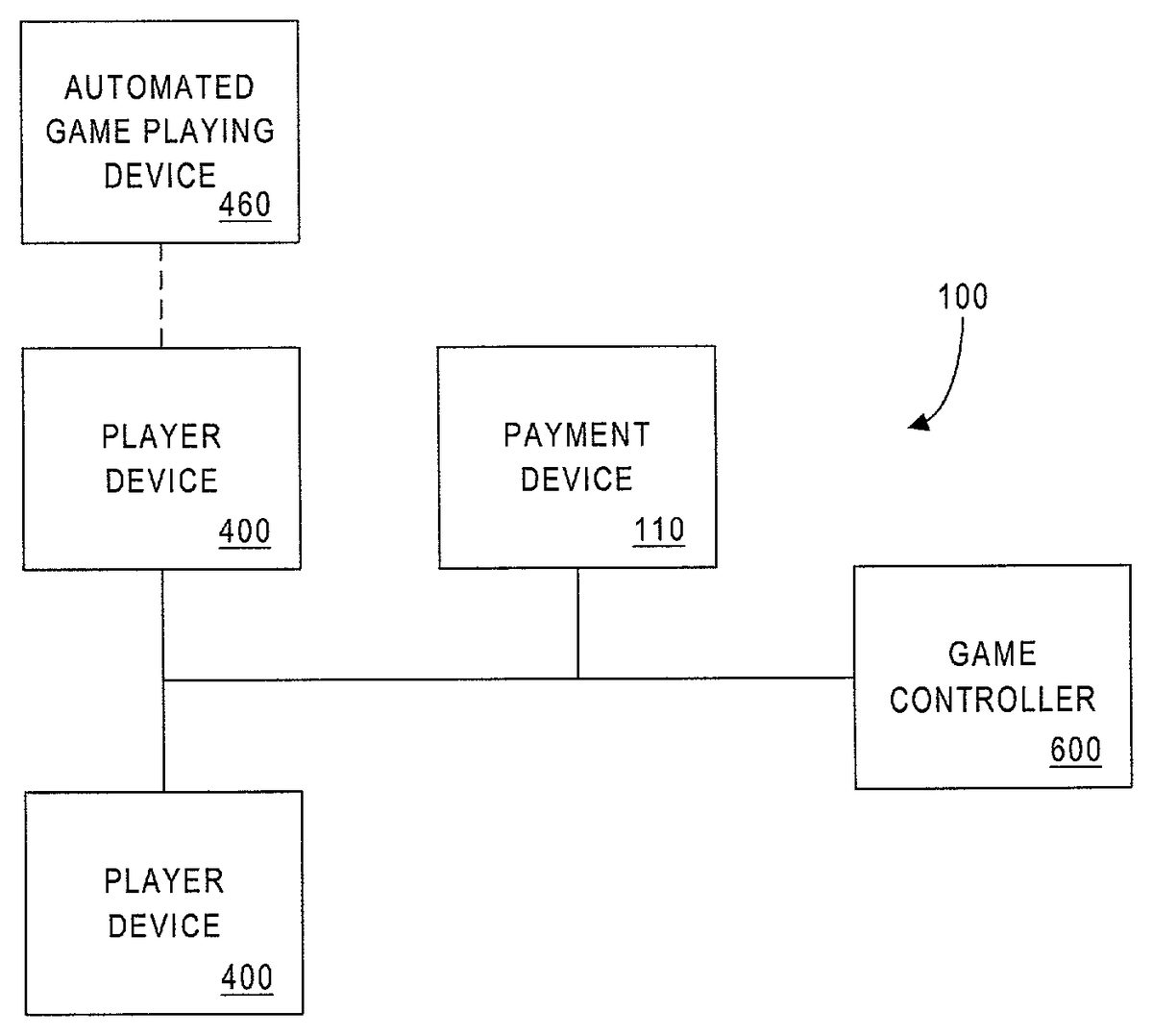
Turning now in detail to the drawings,FIG. 1is a block diagram of a game system100according to one embodiment of the present invention. The game system100includes a game controller600in communication with a number of remote player devices400. As used herein, devices (such as the player devices400and the game controller600) may communicate, for example, via a communication network, such as a Local Area Network (LAN), a Metropolitan Area Network (MAN), a Wide Area Network (WAN), a proprietary network, a Public Switched Telephone Network (PSTN), a Wireless Application Protocol (WAP) network, a cable television network, or an Internet Protocol (IP) network such as the Internet, an intranet or an extranet. Moreover, as used herein, communications include those enabled by wired or wireless technology. Note that although a single game controller600is shown inFIG. 1, any number of game controllers600may be included in the game system100. Similarly, any number of the other devices described herein may be included in the game system100according to embodiments of the present invention.
In one embodiment, a player device400communicates with a remote, Web-based game controller600(e.g., a server) via the Internet. Although some embodiments are described with respect to information exchanged via a game provider's Web site, according to other embodiments information is instead exchanged, for example, via: a telephone, an Interactive Voice Response Unit (IVRU), electronic mail, a WEBTV® interface, a cable network interface, and/or a wireless communication system.
The player device400and the game controller600may be any devices capable of performing various functions described herein. The player device400may be, for example: a PC, a portable computing device such as a Personal Digital Assistant (PDA), a wired or wireless telephone, a one-way or two-way pager, a kiosk (e.g., a game kiosk located at an airport terminal), an interactive television device, a game terminal (e.g., a SONY PLAY STATION® video game terminal), or any other appropriate storage and/or communication device.
Note that the devices shown inFIG. 1need not be in constant communication. For example, the player device400may only communicate with the game controller600via the Internet when appropriate (e.g., when attached to a “docking” station or “cradle” coupled to the player's PC). The player device400may also communicate with the game controller600via an infrared device when near a game kiosk.
A player can use a player device400to receive information associated with game play. For example, a player may view a puzzle game board via the player device400. The player device400may also be used to provide or generate player inputs during game play. For example, a player may use a keyboard or mouse coupled to his or her PC to select one or more game icons in a puzzle game board.
As shown inFIG. 1, a player may also attempt to use an automated game playing device460to help him or her during game play. The automated game playing device460may be, for example, a modified game program or a separate software program that is being executed on the player device400. For example, a player may create an automated game playing device460that analyzes puzzle information received by, or stored at, the player device460in order to generate or suggest an optimal solution to the puzzle (e.g., which game icons should be selected by the player).
FIG. 2is a flow chart of a method for facilitating game play according to an embodiment of the present invention. The flow charts inFIG. 2and the other figures described herein do not imply a fixed order to the steps, and embodiments of the present invention can be practiced in any order that is practicable. Moreover, the methods may be performed by any of the devices described herein. The method shown inFIG. 2may be performed, for example, by the game controller600.
At202, a game board with a number of game icons is displayed to a player. The game board may comprise, for example, an array of differently colored balloons (e.g., red, green, blue, and yellow balloons). As will be explained, at least one reconfiguration rule to be applied during game play is not indicated to the player. For example, the player may be told that balloons will be shifted “up” during his or her first move without being told how the balloons will be shifted later in the game (i.e., during his or her third and fourth moves).
At204, a player input is received, and one or more game icons are removed from the game board at206. For example, a player may select one or more balloons from the game board. In this case, the selected balloon or balloons are removed from the game board along with any neighboring balloons of the same color, and the player's score is increased based on the number of balloons that are removed (e.g., based on the length of the “chain” of neighboring balloons of the same color).
Note that the reconfiguration rule applied during a game move is not indicated to the player during at least a portion of the game play. For example, a player may never be told which reconfiguration rule will be applied during any give move. In this case, however, the game may be considered a game of chance as (e.g., gambling) opposed to a game of skill. According to another embodiment, a reconfiguration rule is indicated to the player prior to a move even though it is not indicated during at least a portion of the game play. For example, a player may only be told the next two reconfiguration rules that will be applied during game play. That is, by indicating some (but not all) of the reconfiguration rules to be applied during game play, the game may still be considered a game of skill as opposed to a game of chance. Moreover, the ability of an automated game playing device460to calculate the configuration and/or patterns that may emerge in a game board beyond that point will still be hindered. According to one embodiment, the reconfiguration rules are not transmitted from the game controller600to the player device400during at least a portion of the game to prevent an automated game playing device460from detecting the rules (e.g., by intercepting a communication or by examining a memory location).
At208, the game board is reconfigured according to one of a number of different reconfiguration rules. For example, one reconfiguration rule may indicate that balloons will be shifted “up” to fill-in any holes created after balloons are removed. Other reconfiguration rules may indicate that balloons will be shifted “left,” “right,” or “down.” Note that balloons may shift in more than one direction during a reconfiguration. For example, balloons may shift “up” and to the “left” to fill-in any holes in the game board.
If the game is not over at210, another player input is received at204and the process continues. If the game is over at210, a game result is determined at212. For example, a game may be over when no more balloons can be removed, all of the balloons have been removed, a predetermined number of moves have been made, and/or a predetermined period of time expires. A game result may indicate, for example, a player's total score and/or a prize that the player has won based on his or her performance during game play.
By way of example, consider the first game display310shown inFIG. 3. In this case, a game board includes an array of game icons312each associated with an icon type (represented by the letters “A,” “B,” “C,” and “D”). The first game display310also includes an indication314of the next two reconfiguration rules that will be applied during game play. In particular, the indication314shows that the game icons312will be shifted: (i) to the right after the player's next move, and (ii) down after the following move. According to the present invention, the indication314does not show how the game icons312will be reconfigured after every move during game play (e.g., at least some of the reconfiguration rules that will be applied during game play are not indicated to the player).
As shown in the first game display310, the player has selected four neighboring “A” type game icons312to be removed (represented by bold characters). The second game display320illustrates the game board after these selected game icons312are removed and the game board is reconfigured. In particular, the game icons312have been shifted to the right to fill-in the holes that were created when the selected game icons312were removed. According to one embodiment, the player's score is adjusted based on the number of game icons312that were removed from the game board.
The game controller600may determine which reconfigure rule will be applied during a particular game move in a number of different ways. For example, the game controller600may randomly select a reconfiguration rule or retrieve a pre-stored indication of a reconfiguration rule from a database. Moreover, the series of reconfiguration rules that are applied during game play may be associated with a particular game played by a player, a plurality of games, and/or a plurality of players.
According to one embodiment, it is arranged for the player to provide payment in exchange for game play. For example, the game controller600may arrange for the player to provide payment via a payment identifier associated with a credit card account, a debit card account, a bank account, and/or a digital payment protocol. The game controller600may also arrange for a player to receive a prize (e.g., payment of a prize amount) based on a game result. As shown inFIG. 1, a payment device110can be used to arrange for the player to provide or receive payment (e.g., payment of a monetary amount or an alternate currency amount such as a gift certificate).
As described above, the present invention may be directed to a game of skill (i.e., a game in which a game result is determined predominately by skill as opposed to chance), such as an arcade-style game in which a player removes game icons from a game board.
Player Device
FIG. 4illustrates a player device400that is descriptive of the device shown inFIG. 1according to an embodiment of the present invention. The player device400comprises a processor410, such as one or more INTEL® Pentium® processors, coupled to a communication device420configured to communicate via a communication network (not shown inFIG. 4). The communication device420may be used to communicate, for example, with the game controller600and/or the payment device110.
The processor410is also in communication with an input device440. The input device440may comprise, for example, a keyboard, a mouse or other pointing device, a microphone, a knob or a switch (including an electronic representation of a knob or a switch), an infrared port, a docking station, and/or a touch screen. Such an input device440may be used, for example, to provide player inputs (e.g., by manipulating a pointer associated with a computer-based puzzle game).
The processor410is also in communication with an output device450. The output device440may comprise, for example, a display (e.g., a computer monitor), a speaker, and/or a printer. The output device450may be used, for example, to provide game information to a player (e.g., by displaying a game board to the player).
The processor410is also in communication with a storage device430. The storage device430may comprise any appropriate information storage device, including combinations of magnetic storage devices (e.g., magnetic tape and hard disk drives), optical storage devices, and/or semiconductor memory devices such as Random Access Memory (RAM) devices and Read Only Memory (ROM) devices.
The storage device430stores a program415for controlling the processor410. The processor410performs instructions of the program415, and thereby operates in accordance with the present invention. For example, the processor410may receive from a remote game controller600an indication of a first game rule (e.g., a reconfiguration rule) to be applied during game play without receiving an indication of a second game rule to be applied during play. The processor410may also display the indication of the first game rule to a player.
As used herein, information may be “received” by or “transmitted” to, for example: (i) the player device400from the game controller600; or (ii) a software application or module within the player device400from another software application, module, or any other source.
FIG. 12illustrates a PC402displaying a computer-based puzzle game according to an embodiment of the present invention. The PC402includes a keyboard442A and a mouse442B which can be used by a player to provide player inputs (e.g., game icon selections). The PC402also includes a computer display452A and speakers452B which can be used, for example, to provide a game board to a player along with an indication of one or more reconfiguration rules.
FIG. 13illustrates a PDA404displaying a computer-based puzzle game according to another embodiment of the present invention. The PDA404includes an input device444and an output device454(e.g., a display screen) that may be used by a player during game play. Similarly,FIG. 14illustrates a wireless telephone406including an input device446and an output device456displaying a computer-based puzzle game.
As shown inFIG. 4, the storage device430also stores a game play database500. An example of a game play database500will now be described in detail with respect toFIG. 5. The illustrations and accompanying descriptions of the databases presented herein are exemplary, and any number of other database arrangements could be employed besides those suggested by the figures.
Game Play Database
Referring toFIG. 5, a table represents the game play database500that may be stored at a player device400according to an embodiment of the present invention. The table includes an entry identifying a game that is being played by a player via the game system100. The table also defines fields502,504,506,508for the entry. The fields specify: a game identifier502, a player identifier504, next reconfiguration rules506, and a current score508. The information in the game play database500may be created and updated, for example, as a player plays a game via the game system100.
The game identifier502may be, for example, an alphanumeric code associated with a game that is being played via the game system100. The player identifier504represents a player who is playing the game.
The next reconfiguration rules506indicate which reconfiguration rules will be applied during a portion of game play. Note that, according to one embodiment, each reconfiguration rule is associated with a discrete move during game play. According to another embodiment, each reconfiguration rules is associated with a period of time or some other game information. For example, a reconfiguration rule may be applied for30seconds or until a player selects a particular type of game icon (e.g., a game icon having a hidden function that alters the reconfiguration rule that will be applied). Note that a limited number of reconfiguration rules may be stored in the game play database500and/displayed to the player.
The current score508may represent, for example, how many points a player has scored in a particular game.
Game Controller
FIG. 6illustrates a game controller600that is descriptive of the device shown inFIG. 1according to an embodiment of the present invention. The game controller600comprises a processor610, such as one or more INTEL® Pentium® processors, coupled to a communication device620configured to communicate via a communication network (not shown inFIG. 6). The communication device620may be used to communicate, for example, with one or more player devices400and/or the payment device110.
The processor610is also in communication with a storage device630. The storage device630may comprise any appropriate information storage device, including combinations of magnetic storage devices (e.g., magnetic tape and hard disk drives), optical storage devices, and/or semiconductor memory devices such as RAM devices and ROM devices.
The storage device630stores a program615for controlling the processor610. The processor610performs instructions of the program615, and thereby operates in accordance with the present invention. For example, the processor610may display to a player a game board having a plurality of game icons. The processor610may also arrange for the player to make a series of game moves. In particular, the processor610may receive a player input and remove at least one game icon from the game board based on the player input. According to an embodiment of the present invention, the processor610also reconfigures the game board according to one of a plurality of reconfiguration rules, wherein a reconfiguration rule to be applied during a game move is not indicated to the player during at least a portion of the game play.
According to another embodiment, the processor610arranges for a player to provide payment in exchange for game play and displays via a remote player device400a game board having a plurality of game icons. The processor610indicates to the player at least one reconfiguration rule to be applied during game play, wherein at least one reconfiguration rule to be applied during game play is not indicated to the player during at least a portion of the game play. The processor610also arranges for the player to make a series of game moves and determines a game result based on the series of game moves. The processor610may then arrange for the player to receive payment of a monetary amount based on the game result.
According to still another embodiment, the processor610arranges for the player to make a series of game moves, and a game rule to be applied during a game move is not indicated to the player during at least a portion of the game play.
The program615may be stored in a compressed, uncompiled and/or encrypted format. The program615may furthermore include other program elements, such as an operating system, a database management system, and/or device drivers used by the processor610to interface with peripheral devices.
As used herein, information may be “received” by or “transmitted” to, for example: (i) the game controller600from the player device400; or (ii) a software application or module within the game controller600from another software application, module, or any other source.
As shown inFIG. 6, the storage device630also stores a player database700(described with respect toFIG. 7), a game database800(described with respect toFIG. 8), and a reconfiguration rule database900(described with respect toFIG. 9). Examples of databases that may be used in connection with the game controller600will now be described in detail with respect toFIGS. 7 through 9.
Player Database
Referring toFIG. 7, a table represents the player database700that may be stored at the game controller600according to an embodiment of the present invention. The table includes entries identifying players who may play games via the game system100. The table also defines fields702,704,706,708,710for each of the entries. The fields specify: a player identifier702, a name704, contact information706, a payment identifier708, and an account balance710. The information in the player database700may be created and updated, for example, based on information received from player when he or she registers with the game controller600. The information in the player database700may also be based on, for example, information generated as the player plays games via the game system100.
The player identifier702may be, for example, an alphanumeric code associated with a player who has registered to use the game system100. The player identifier702may be generated by, for example, the game controller600or the player (e.g., when he or she provides a user name and password) and may be based on, or associated with, the player identifier504stored in the game play database500. The player database700also stores the name704and contact information706(e.g., a postal address, an electronic mail address, an IP address, or a telephone number) associated with each player.
The payment identifier708may comprise, for example, a credit card, debit card or bank account number (e.g., a checking account number) or digital payment protocol information. The account balance710may represent, for example, an amount that a player owes to a game provider or an amount that the game provider owes to the player. The payment identifier708and the account balance710may be used, for example, by the game controller600to arrange for the player to provide or receive payment (e.g., based on game play).
Game Database
Referring toFIG. 8, a table represents the game database800that may be stored at the game controller600according to an embodiment of the present invention. The table includes entries identifying games that are being (or have been) played via the game system100. The table also defines fields802,804,806,808for each of the entries. The fields specify: a game identifier802, a player identifier804, indicated reconfiguration rules806, and non-indicated reconfiguration rules808. The information in the game database800may be created and updated, for example, as players play games via the game system100.
The game identifier802may be, for example, an alphanumeric code associated with a game that is being (or has been) played via the game system100. The game identifier802may be based on, or associated with, the game identifier502stored in the game play database500. The player identifier804represents a player who is playing the game and may be based on, or associated with, the player identifier702stored in the player database700and/or the player identifier504stored in the game play database500.
The indicated reconfiguration rules806are associated with reconfiguration rules that are being displayed to a player and/or have been transmitted to a remote player device400. The non-indicated reconfiguration rules808are associated with reconfiguration rules that will be applied during game play but that have not yet been displayed to a player and/or transmitted to a remote player device400. Note that the fourth entry shown inFIG. 8illustrates how other types of reconfiguration rules806,808cam be used according to embodiments of the present invention.
Reconfiguration Rule Database
Referring toFIG. 9, a table represents the reconfiguration rule database900that may be stored at the game controller600according to an embodiment of the present invention. The table includes entries associated with reconfiguration rules that may be applied during game play. The table also defines fields902,904for each of the entries. The fields specify: a reconfiguration rule identifier902and a description904. The information in the reconfiguration rule database900may be created and updated, for example, by the game controller600.
The reconfiguration rule identifier902may be, for example, an alphanumeric code associated with a reconfiguration rule that may be applied during game play. Note that the reconfiguration rule identifier902may be based on, or associated with, the next reconfiguration rules506stored in the game play database500and/or the indicated reconfiguration rules806and non-indicated reconfiguration rules808stored in the game database800. The description904indicates how the reconfiguration rule will be applied during game play. For example, the description904may indicate that game icons (e.g., balloons) will be shifted to the left during a game move.
Methods that may be used in connection with the game system100according to some embodiments of the present invention will now be described in detail with respect toFIGS. 9 and 10.
Game System Methods
FIG. 10is a flow chart of a computer-implemented method for facilitating game play at a game controller600. In this case, game play is associated with a game of skill in which a player removes game icons from a game board. At1002, it is arranged for the player to provide a payment in exchange for playing a game. For example, the game controller600may transmit a payment identifier708to a payment device110to arrange for the player to provide a payment of one dollar in exchange for game play (and the account balance710stored in the player database700may be updated accordingly).
At1004, a game board having a plurality of game icons is displayed to the player. For example, the game controller600may transmit information to a remote player device400enabling the player device400to display an array of colored balloons to the player.
At1006, at least one reconfiguration rule is indicated to the player without indicating at least one other reconfiguration rule that will be applied during game play. For example, the game controller600may transmit an indication of only the next two reconfiguration rules that will be applied during game play. According to one embodiment, the game controller600transmits to the player device400the indicated reconfiguration rules806stored in the game database800without transmitting the non-indicated reconfiguration rules808. The player device400may then store the next reconfiguration rules506in the game play database500.
At1008, it is arranged for the player to make a series of game moves. For example, each game move may comprise: (i) receiving from the player a selection of a game icon, (ii) removing at least one game icon from the game board based on the selected game icon and an associated icon type, and (iii) reconfiguring the game board according to one of a plurality of reconfiguration rules. According to one embodiment, the game board is reconfigured as defined by the appropriate rule in the reconfiguration rule database900.
At1010, a game result is determined based on the series of moves made by the player and it is arranged for the player to receive payment of a monetary amount based on the game result at1012. The game controller600may also update the account balance710stored in the player database700.
FIG. 11is a flow chart of a method that may be performed by a player device400according to an embodiment of the present invention. At1102, the player device400receives from a remote game controller600an indication of a first game rule without receiving an indication of a second game rule that will be applied during game play. For example, the player device400may only receive an indication of which reconfiguration rules will be applied after each of the player's next four moves. According to one embodiment, the player device400stores the next reconfiguration rules506in the game play database500.
At1104, the player device400displays the indication of the first game rule to the player. The player device400may also receive from the player a player input and arrange (e.g., directly or via the game controller600) for a game board to be reconfigured based on the player input in accordance with the first game rule, wherein the game board has a plurality of game icons that may be removed by the player.
Additional Embodiments
The following illustrates various additional embodiments of the present invention. These do not constitute a definition of all possible embodiments, and those skilled in the art will understand that the present invention is applicable to many other embodiments. Further, although the following embodiments are briefly described for clarity, those skilled in the art will understand how to make any changes, if necessary, to the abovedescribed apparatus and methods to accommodate these and other embodiments and applications.
Although some embodiments of the present invention have been described with respect to a game rule comprising a reconfiguration rule, the present invention is also applicable with other types of game rules. Consider, for example, a maze game in which portions of the maze (or item within the maze) shift during game play. In this case, the game rule may comprise a time and/or direction of such a shift. According to another embodiment, a game rule may be associated with how a game icon will be added to a game board.
As described herein, a game controller600may transmit an indication of a first reconfiguration rule to a player device400without transmitting an indication of a second reconfiguration rule. According to another embodiment, the game controller600instead transmits an encrypted version of both reconfiguration rules to the player device400. In this case, the game controller600transmits additional information (e.g., decryption keys) during game play enabling the player device400to decrypt additional reconfiguration rules as appropriate.
Although most of the embodiments described herein are associated with a game controller600transmitting indications of reconfiguration rules to a player device400, according to another embodiment this function is instead performed by a player device400. Consider, for example, a game in which a first player at a first player device400plays against a second player at a second player device400. In this case, the first player device400may transmit only a limited amount of information associated with reconfiguration rules to the second player device400. Similarly, although most of the embodiments described herein are associated with a game played by a single player, the present invention can also be used with respect to games involving multiple players (e.g., teams of players).
The present invention has been described in terms of several embodiments solely for the purpose of illustration. Persons skilled in the art will recognize from this description that the invention is not limited to the embodiments described, but may be practiced with modifications and alterations limited only by the spirit and scope of the appended claims.
Claims
- A method, comprising: providing a game board to a player, wherein the game board defines a game boundary;providing a first game rule to the player, wherein the first game rule indicates how removal of a game icon from within the game boundary will cause remaining game icons to shift within the game boundary;receiving a first game input from the player, wherein the first game input is associated with a first game icon displayed within the game boundary;removing a first set of icons that are at least adjacent to the first game icon, wherein the removal of the first set of icons defines a second set of icons that remain within the game boundary;shifting at least a portion of the second set of game icons that remain within the game boundary, wherein the shifting is based on the first game rule;and revealing, after receiving the first game input, a second game rule to the player, wherein the second game rule indicates how removal of a game icon from within the game boundary will cause remaining game icons to shift within the game boundary, and wherein the second game rule is different from the first game rule.
- The method of claim 1 , wherein the first set of game icons are associated with an icon type equivalent to an icon type associated with the first game icon.
- The method of claim 1 , further comprising: adjusting a game score, after receiving the first game input, based on a number of game icons comprising the first set of game icons.
- The method of claim 1 , wherein the second game rule is determined via at least one of: (i) a random selection, and (ii) a retrieval of a pre-stored indication.
- The method of claim 1 , further comprising: receiving payment from the player.
- The method of claim 5 , wherein the receiving of payment from the player comprises at least one of: (i) receiving a payment identifier, (ii) charging a credit card account, (iii) charging a debit card account, (iv) receiving currency, and (v) charging a bank account.
- The method of claim 1 , further comprising: awarding, in the case that all game icons are cleared from the game board, a prize to the player.
- The method of claim 7 , wherein the prize comprises payment of at least one of: (i) a monetary amount, and (ii) an alternate currency amount.
- The method of claim 1 , wherein the receiving of the first game input comprises receiving player input from a remote player device via a communication network.
- A computer-readable medium containing instructions configured to direct a processor to: provide a game board to a player, wherein the game board defines a game boundary;provide a first game rule to the player, wherein the first game rule indicates how removal of a game icon from within the game boundary will cause remaining game icons to shift within the game boundary;receive a first game input from the player, wherein the first game input is associated with a first game icon displayed within the game boundary;remove a first set of icons that are at least adjacent to the first game icon, wherein the removal of the first set of icons defines a second set of icons that remain within the game boundary;shift at least a portion of the second set of game icons that remain within the game boundary, wherein the shifting is based on the first game rule;and reveal, after receiving the first game input, a second game rule to the player, wherein the second game rule indicates how removal of a game icon from within the game boundary will cause remaining game icons to be shift within the game boundary, and wherein the second game rule is different from the first game rule.
- An apparatus, the apparatus comprising: a processor;and memory in communication with the processor, the memory storing instructions directing the processor to: provide a game board to a player, wherein the game board defines a game boundary;provide a first game rule to the player, wherein the first game rule indicates how removal of a game icon from within the game boundary will cause remaining game icons to shift within the game boundary;receive a first game input from the player, wherein the first game input is associated with a first game icon displayed within the game boundary;remove a first set of icons that are at least adjacent to the first game icon, wherein the removal of the first set of icons defines a second set of icons that remain within the game boundary;shift at least a portion of the second set of game icons that remain within the game boundary, wherein the shifting is based on the first game rule;and reveal, after receiving the first game input, a second game rule to the player, wherein the second game rule indicates how removal of a game icon from within the game boundary will cause remaining game icons to shift within the game boundary, and wherein the second game rule is different from the first game rule.
- A method, comprising: providing a game board to a player, wherein the game board defines a game boundary;providing a first game rule to the player, wherein the first game rule is selected randomly from a plurality of available game rules that each indicate how removal of a game icon from within the game boundary will cause remaining game icons to be reconfigured within the game boundary;receiving a first game input from the player, wherein the first game input is associated with a first game icon displayed within the game boundary;removing a first set of icons that are at least adjacent to the first game icon, wherein the removal of the first set of icons defines a second set of icons that remain within the game boundary;reconfiguring at least a portion of the second set of game icons that remain within the game boundary, wherein the reconfiguration is based on the first game rule;and revealing, after receiving the first game input, a second game rule to the player, wherein the second game rule is selected randomly from the plurality of available game rules.
- The method of claim 12 , further comprising: receiving, after the revealing, a second game input from the player, wherein the second game input is associated with a second game icon displayed within the game boundary;removing a third set of icons that are at least adjacent to the second game icon, wherein the removal of the third set of icons defines a fourth set of icons that remain within the game boundary;and reconfiguring at least a portion of the fourth set of game icons that remain within the game boundary, wherein the reconfiguration is based on the second game rule.
- A computer-readable medium containing instructions configured to direct a processor to: provide a game board to a player, wherein the game board defines a game boundary;provide a first game rule to the player, wherein the first game rule is selected randomly from a plurality of available game rules that each indicate how removal of a game icon from within the game boundary will cause remaining game icons to be reconfigured within the game boundary;receive a first game input from the player, wherein the first game input is associated with a first game icon displayed within the game boundary;remove a first set of icons that are at least adjacent to the first game icon, wherein the removal of the first set of icons defines a second set of icons that remain within the game boundary;reconfigure at least a portion of the second set of game icons that remain within the game boundary, wherein the reconfiguration is based on the first game rule;and reveal, after receiving the first game input, a second game rule to the player, wherein the second game rule is selected randomly from the plurality of available game rules.
- An apparatus, the apparatus comprising: a processor;and memory in communication with the processor, the memory storing instructions directing the processor to: provide a game board to a player, wherein the game board defines a game boundary;provide a first game rule to the player, wherein the first game rule is selected randomly from a plurality of available game rules that each indicate how removal of a game icon from within the game boundary will cause remaining game icons to be reconfigured within the game boundary;receive a first game input from the player, wherein the first game input is associated with a first game icon displayed within the game boundary;remove a first set of icons that are at least adjacent to the first game icon, wherein the removal of the first set of icons defines a second set of icons that remain within the game boundary;reconfigure at least a portion of the second set of game icons that remain within the game boundary, wherein the reconfiguration is based on the first game rule;and reveal, after receiving the first game input, a second game rule to the player, wherein the second game rule is selected randomly from the plurality of available game rules.
Disclaimer: Data collected from the USPTO and may be malformed, incomplete, and/or otherwise inaccurate.