U.S. Pat. No. 7,101,284
OBJECT DISPLAY SYSTEM IN A VIRTUAL WORLD
AssigneeSony Interactive Entertainment Inc; Sony Network Entertainment Platform Inc
Issue DateOctober 31, 2002
Illustrative Figure
Abstract
An apparatus for displaying an object such as a billboard in a virtual world is provided. An input history of a user's operation for moving a character in the virtual world is obtained. The movement track of the character in the virtual world is also obtained. The position and direction of the billboard are changed according to the input history and the movement track so that the billboard is visible to the user. For instance, on a street where the user is expected to move at a high speed, the direction of the billboard is changed so that its display surface can face the front of the character and the billboard is displayed in a position far away from the user's viewing position.
Description
DETAILED DESCRIPTION OF THE INVENTION The invention will now be described by reference to the preferred embodiments. This does not intend to limit the scope of the present invention, but to exemplify the invention. The present invention may be applied to a network game system in which the players enjoy video games by controlling objects such as characters in a virtual world formed within a game server unit on a designated network like the Internet. It is to be noted that hereafter the present invention will be described as a network game system in which the players control objects such as characters in a virtual world, however, the present invention may be applied to a network game system in which the characters to be controlled by the players do not currently exist, but where the display images in the virtual world may be changed by an input device controlled by the players. Embodiment 1 System Configuration FIG. 1is a block diagram of a network game system according to Embodiment 1 of the present invention. As shown inFIG. 1, a network game system according to Embodiment 1 includes, for example, a designated network1such as the Internet, client terminals2of multiple players which can be connected to the network1, and a game server3which is connected to the network1and provides a designated virtual world through the client terminals2of respective players. For a client terminal2, for example, a video game unit may be used. If a video game unit is used as a client terminal2, a controller4will be used as the input device and a monitor5will be used as the display device. In addition, other terminal units, such as personal computers may be used as a client terminal2. When using a personal computer, the keyboard and mouse will be used as input devices. The game ...
DETAILED DESCRIPTION OF THE INVENTION
The invention will now be described by reference to the preferred embodiments. This does not intend to limit the scope of the present invention, but to exemplify the invention.
The present invention may be applied to a network game system in which the players enjoy video games by controlling objects such as characters in a virtual world formed within a game server unit on a designated network like the Internet.
It is to be noted that hereafter the present invention will be described as a network game system in which the players control objects such as characters in a virtual world, however, the present invention may be applied to a network game system in which the characters to be controlled by the players do not currently exist, but where the display images in the virtual world may be changed by an input device controlled by the players.
Embodiment 1
System Configuration
FIG. 1is a block diagram of a network game system according to Embodiment 1 of the present invention. As shown inFIG. 1, a network game system according to Embodiment 1 includes, for example, a designated network1such as the Internet, client terminals2of multiple players which can be connected to the network1, and a game server3which is connected to the network1and provides a designated virtual world through the client terminals2of respective players.
For a client terminal2, for example, a video game unit may be used. If a video game unit is used as a client terminal2, a controller4will be used as the input device and a monitor5will be used as the display device.
In addition, other terminal units, such as personal computers may be used as a client terminal2. When using a personal computer, the keyboard and mouse will be used as input devices.
The game server3includes: a database for data such as polygon data and texture data which is necessary for drawing objects such as virtual worlds and characters; an advertisement information database6(hereafter referred to as the “advertisement information DB”) for advertisement information related to the sponsors of such a network game system to advertise such things as enterprises, merchandise, and services; and a player profile database7(hereafter referred to as the “player profile DB”) for player profiles which consists of data such as the movement track of each player in the virtual world and the operation history of the controller4.
Further, a game server3includes a player information database8(hereafter referred to as the “player information DB”) for player information which consists of information indicating preferences such as hobbies and tastes of each player, and information indicating the stores and places in the virtual world where the players visited; and a group name database9(hereafter referred to as the “group name DB”) for group names, which are registered when a group of players logs into the virtual world simultaneously.
Controller Configuration
FIG. 2shows an example of a controller4with which a player controls the characters in the virtual world. As shown inFIG. 2, the controller4includes two grippers,10R and10L, which a player holds with their right and left hands, respectively.
On the controller4, the first and second operation units,11and12, and the analog operation units,13R and13L, are configured to be in positions where a player can operate them with the respective thumbs while gripping each gripper10R and10L with right and left hands.
On the first operation unit11, an upward directional-command button11awhich controls upward movement of a character or visual point, a downward directional-command button11bwhich controls downward movement of a character or visual point, a rightward directional-command button11cwhich controls rightward movement of a character or a visual point, and a leftward directional-command button11dwhich controls leftward movement of a character or visual point, are installed.
Directional-command buttons,11athrough11d, are configured to digitally move characters and visual points in a general direction such as moving upward, downward, leftward, rightward, diagonally to the upper left or right, and diagonally to the lower left or right.
On the second operation unit12, there is a button12amarked with a triangle-shaped symbol, a button12bmarked with a cross-shaped symbol, a button12C marked with a circle-shaped symbol, and a button12dmarked with a square-shaped symbol. A player controls functions such as a character's activities by operating buttons12athrough12d.
The home position of analog operation units,13R and13L, is the vertical upright position in relation to the controller4(position with no tilt) when no tilting is being done, and it is from this home position that the control by tilting at a designated angle and the control by turning on the spindle in a rotating axis are possible.
Analog operation units,13R and13L, are for controlling the movement of characters and visual points with more precise movements than those possible by the directional-command buttons,11athrough11d, for moving upward, downward, leftward, and rightward.
Further, the controller4includes a start button14to initiate the start of a game, a select button15to select a designated item, and a mode selection switch16to select analog mode or digital mode. When the analog mode is selected with the mode selection switch16, a light-emitting diode17is instructed to stay lighted and the analog operation units,13R and13L, becomes operational.
When the digital mode is selected with the mode selection switch16, the light-emitting diode17is instructed to stay off and the analog operation units,13R and13L become non-operational. In this case, the movement of a character and visual point is conducted by operating the respective directional-command buttons,11athrough11d,for moving upward, downward, leftward, and rightward, as described above.
Further, on the controller4, a right button18and left button19are configured to be in positions where a player can operate them with the respective index fingers or middle fingers while holding grippers10R and10L with right and left hands. Button18includes the first right button18R1and second right button18R2. Button19includes the first left button19L1and second left button19L2. These buttons are aligned vertically one above the other from the base the controller4.
When moving a character and visual point with the controller4, a player operates the respective directional-command buttons,11athrough11d, for moving upward, downward, leftward, and rightward, or the analog operation units,13R and13L, as described above. When the respective directional-command buttons,11athrough11d, for moving upward, downward, leftward, and rightward, are operated, the controller4provides a client terminal2with the coordinate value on the X-Y coordinate according to the “Direction” and “Length of Time Button is Pressed” of the directional-command buttons. When the analog operation units,13R and13L, are tilted, the controller4provides a client terminal2with the coordinate value on the X-Y coordinate according to the “Tilt Amount” and “Tilt Direction” from the home position as described above.
FIG. 3shows a structure of the client terminal2. A coordinate value obtaining unit20inputs the coordinate value provided by the controller4and a communication unit26provides the game server3with the coordinate value via the network1. The communication unit26receives from the game server3the image information of the virtual world and characters corresponding to the coordinate values, and a display unit22displays on the screen of the monitor5connected to the client terminal2the images of the virtual world and characters in accordance with commands given through the directional-command buttons,11athrough11d,for moving upward, downward, leftward, and rightward, or the analog operation units,13R and13L.
It is not always necessary to receive the image information of the virtual world and characters from the game server3via the network1, and the image information of the virtual world and characters may be updated in accordance with commands given through the controller4. In this case, the display unit22stores the object data of the virtual world and characters in an object storing unit24and updates the image information based on the coordinate value given by the coordinate obtaining unit20, and then displays the updated image on the monitor5.
FIG. 4shows a structure of the game server3according to Embodiment 1. The figure shows functions in blocks and these functional blocks can be realized by various modes such as hardware only, software only or a combination thereof. Hereafter referring to this block diagram, the processes on the game server3are explained.
Recording Movement Track and Input History
While a player can move a character and visual point in the virtual world by operating the controller4, a communication unit30of the game server3receives from the client terminal2the coordinate value of the controller4. For each player a movement track obtaining unit36detects the “movement track” which is the track of a player's character's movement in the virtual world resulting from the operation of the controller4, and stores the movement track data52in the player profile DB7. An input history obtaining unit32detects the “input history” which is a history of the operation positions of the respective directional-command buttons,11athrough11d, for moving upward, downward, leftward, and rightward, or the analog operation units,13R and13L, and stores the input history data50in the player profile DB7.
FIG. 5shows an example of a “movement track” corresponding to the movement of Player A's character with commands given by the analog operation units,13R and13L, and the “input history” of the analog operation units,13R and13L.FIG. 6shows an example of a “movement track” corresponding to the movement of Player B's character, with commands given by the analog operation units,13R and13L, and the “input history” of the analog operation units,13R and13L.
In the examples in FIG.5andFIG. 6, the upper left diagram shows the “movement track” of a character, the lower left diagram shows the “input history” of analog operation unit13L, and the lower right diagram shows the “input history” of analog operation unit13R.
The diagram of a “movement track” represents the entire area of the virtual world, and the movement track obtaining unit36stores in the player profile DB7the movement track data52, which indicates the respective movement positions along the track on which the character moved, that is, according to the movement of analog operation units,13R and13L.
As described above, with the analog operation units,13R and13L, tilting and rotating from the home position are possible, and the input history obtaining unit32of the game server3stores in the player profile DB7the history of the operation position data as the input history data50, which indicates the tilting and rotating positions of the analog operation units,13R and13L.
Thus, when the “movement track” and “input history” are stored for each player, it is possible to know the tendency of each player's “range of movement” and “speed of movement” in the virtual world. As described below, in the case of a network game system according to this embodiment, each player's “range of movement” and “speed of movement” are determined based on the “movement track” and “input history” stored in the player profile DB7, and then the installation position and direction of a billboard object, on which such items as advertising of enterprises, etc. or important information from the system administrator is written, are adjusted to be displayed in the virtual world.
Billboard Display
The flowchart inFIG. 7shows the flow of a billboard display process in a network game system according to Embodiment 1 (hereafter referred to as billboard display process). The billboard display process starts and proceeds to S1when a virtual world and character images provided by the game server3are displayed on the monitor5connected to a player's client terminal2after a communication line between the player's client terminal2and the game server3is established.
In Step S1, the game server3determines the “initial display position” and “initial display direction” to display a billboard on which advertisement information stored in the advertisement information DB6or information from the system administrator to the player is to be written. Then, this billboard display process proceeds to Step S2.
In Step S2, the game server3stores the current position of the character in the virtual world or the position of a visual point. Then, this billboard display process proceeds to Step S3.
When the player moves a character in the virtual world by operating the directional-command buttons,11athrough11d, for moving upward, downward, leftward, and rightward, or the analog operation units,13R and13L, on the controller4, the coordinate values are supplied to the game server3from the controller4via the client terminal2. In Step S3, a character display control unit48of the game server3calculates the “direction of movement,” “speed of movement,” and “amount of movement” of the character based on the coordinate values which are received as input from the controller4.
Specifically, the tilt direction of the analog operation units,13R and13L, indicates the “direction of movement” of a character, and the tilt amount of the analog operation units,13R and13L, indicates the “speed of movement” of a character. For example, when the tilt amount of the analog operation units,13R and13L increases, the speed of movement of a character increases.
The character display control unit48of the game server3calculates the “amount of movement” of a character based on the “direction of movement” and “speed of movement” which are determined by the tilt direction and tilt amount of the analog operation units,13R and13L. It then forms image information about a character's movement based on “direction of movement,” “speed of movement,” and “amount of movement,” and the communication unit30sends it back to the client terminal2. This results in a moving character being displayed on the player's monitor5based on the operation of the player's controller4.
Next, in Step S4, the discriminating unit38of the game server3refers to the “movement track” and “input history” of the player stored in the player profile DB7, and in Step S5, determines whether or not the current position moved to by a player's character and the input state of the controller4reflect the “movement track” and “input history” of the player found in the player profile DB7.
In other words, in Step S5, the discriminating unit38determines whether or not a character is moving along the “movement track” of the player stored in the player profile DB7, and whether or not the controller4is being operated in a manner consistent with the “input history.”
If a character is following a movement track which is different from the “movement track” of the player stored in the player profile DB7, and the controller4is being operated in a manner which is inconsistent with the “input history,” an advertisement display control unit40of the game server3, in Step S8, displays a billboard advertisement of enterprises, etc. stored in the advertisement information DB6at the “initial display position” and in the “initial display direction,” which were determined in Step S1as described above.
On the other hand, the discriminating unit38determines that a character is moving along the “movement track” of the player stored in the player profile DB7, and the controller4is being operated in a manner consistent with the “input history,” the display position moving unit42of the game server3, in Step S6, displays a billboard by moving the billboard to a position which corresponds to the “movement track” of the player's character stored in the player profile DB7, and then adjusts the display direction so that in all probability it will be clearly visible from the position where the player is.
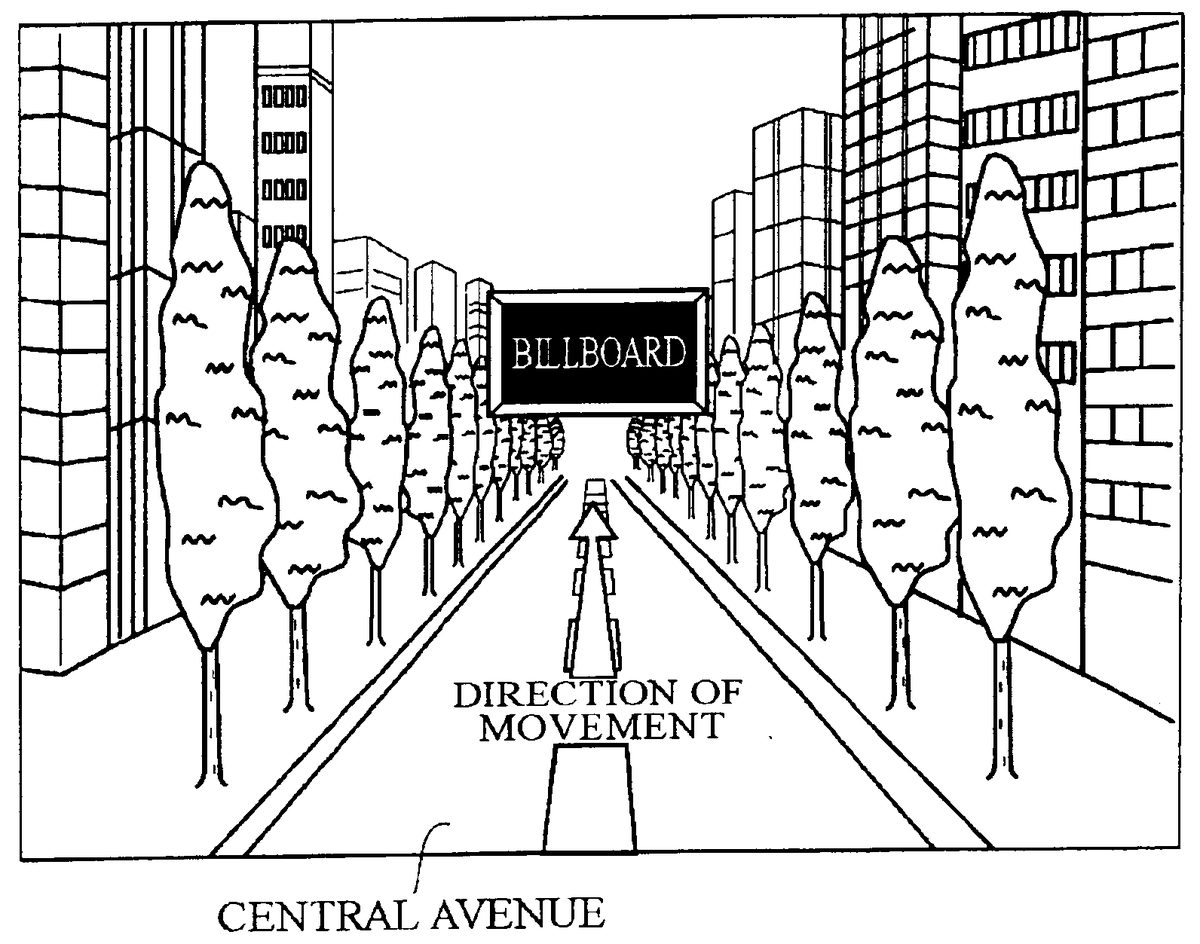
For example, in the diagram of the “movement track” of Player A shown inFIG. 5, when “Central Avenue” in the virtual world exists along the movement track which goes straight through approximately the mid-area of this diagram, it can be deduced that Player A often passes through “Central Avenue.”
Further, as described above, the tilt amount of the analog operation units,13R and13L, on the controller4determines the speed of movement of a player's character, and in the diagram of the “input history” of Player A shown inFIG. 5the input history is formed in circular shapes. This indicates that the analog operation units,13R and13L, have been tilted to the maximum amount. In other words, Player A's character frequently moves in the virtual world at a high speed.
From the above, it can be deduced that Player A frequently moves through “Central Avenue” in the virtual world at a high speed. Therefore, as shown inFIG. 9, the advertisement display control unit40of the game server3will display a billboard in a position along the direction of movement of Player A's character and in such a way that the information display surface faces the direction of movement of the player's character. This billboard was initially planned to be displayed along Central Avenue in the “initial display position” and “initial display direction,” which is shown in FIG.8.
The billboard will in all probability be displayed in a position where Player A's character will pass by. Further, normally, the direction of a player's gaze is the same as the direction of movement of the character moving in the virtual world. Therefore, by controlling the display of a billboard in such a way that the display surface is facing the direction of movement of the player's character, the display contents displayed on the billboard will in all probability be viewable to the player.
InFIG. 6, with the approximate center of this diagram being the “Downtown Area” of the virtual world, from the diagram of the “movement track” of Player B, it can be deduced that Player B frequently moves around in a section away from the “Downtown Area.”
Further, from the diagram of the “input history” of Player B shown inFIG. 6, it can be seen that the “input history” is concentrated in the center section. This indicates that the degree of tilt of analog operation units,13R and13L, is small and that Player B's character frequently moves in the virtual world at a low speed.
From the above, it can be deduced that Player B frequently moves around in a section away from the “Downtown Area” in the virtual world at a low speed. Therefore, in this case, the advertisement display control unit40of the game server3will display a billboard in a position away from the “Downtown Area” in the virtual world and in such a way that the information display surface is parallel to the direction of movement of Player B's character. This billboard was initially planned to be displayed in the “initial display position” and “initial display direction,” as described above. In all probability the billboard will be displayed in a position where Player B's character will pass by and in all probability the display contents displayed on the billboard will be viewable to the player.
Such control of the display position and display direction of a billboard are repeatedly conducted in Step S7of the flowchart shown inFIG. 7until the game server3determines the video game to be complete.
In the case just described, the display position of an object like a billboard has been configured to reflect the “movement track” and “input history,” however, it may be configured to reflect either only the “movement track” or only the “input history.”
Display Change of Contents
The displayed contents of a billboard may be common among respective players, or, in the case of a network game system according to this embodiment, the displayed contents of a billboard can be varied according to various criteria such as a player's preference, a player's purpose of logging on the virtual world, or based on the area of the virtual world.
Changing the Contents to be Displayed According to a Player's Preference
When changing the contents to be displayed on a billboard based on a player's preference, the game server3checks the information each player submitted when they registered. This information will have been obtained via a web based questionnaire, a paper questionnaire, a telephone questionnaire, etc. The game server3further determines each player's preference from the movement track of each player in the virtual world and the trend of each player such as what stores in the virtual world have been visited. The preference information56which indicates each player's preference will have been stored as a piece of player information in the player information DB8.
In addition, the game server3may be configured to store in the player information DB8the player information as the preference information56, which indicates the advertisement contents designated by the player after the advertisement contents to be displayed in the virtual world is designated by the player via the network1.
When a player logs into the virtual world, the advertisement selecting unit46of the game server3reads out the player information of this player from the player information DB8, and reads out from the advertisement information DB6the advertisement information which corresponds to the player's preference which is indicated by the player information. Then, the advertisement display control unit40changes the contents of an object like a billboard, which is in the range viewable from the current position of the player, to correspond to the player's preference which was read out from the advertisement information DB6by the advertisement selecting unit46and displays them.
FIG.10andFIG. 11show an example of a streetscape in the virtual world displayed when Player A and Player B, who is independent from Player A, look in the same direction from the same position in the virtual world. For example, if Player A has a preference for “movie related” and Player B has a preference for “sports related,” each player's preference will be reflected on the displayed contents of an object like a billboard, and as a result, on the billboard in the virtual world seen by Player A, a “movie related” advertisement will be displayed as shown inFIG. 10, and on the billboard in the virtual world seen by Player B, a “sports related” advertisement will be displayed as shown in FIG.11.
Thus, by varying the advertisement contents to be displayed based on each player's preference, it is possible for each player to receive useful information which corresponds to their own preference from the advertisement on an object like a billboard in the virtual world.
Changing the Contents to be Displayed According to a Player's Purpose
When displaying on a billboard information such as an advertisement corresponding to a player's purpose of logging into the virtual world, the game server3displays on the monitor5via the player's client terminal2an input screen with an input field for the player's purpose when the player logs into the virtual world.
The player inputs in this field his/her login purpose such as “shopping”, “participating in an event to be held in the virtual world”, “meeting a friend's character”, and so on. When the purpose is input, the game server3obtains the player's login purpose from the data input in the field and stores the purpose information54, which indicates the player's login purpose, in the player profile DB7.
When the player logs into the virtual world, the advertisement selecting unit46reads out the advertisement information corresponding to the player's purpose from the advertisement information DB6, and the advertisement display control unit40displays the advertisement information on a billboard which is installed in a position close to the player in the virtual world.
Thus, it is possible to display a useful advertisement fit for the player's login purpose and thereby a product and an invent can be efficiently advertised to only players who might take an interest in such information.
In addition, the game server3charges the advertiser a higher advertisement fee than usual when selectively displaying an advertisement for a player. In this case, because a player who sees the advertisement will take an interest in the advertisement, the advertiser can attain significant advertising impact consistent with the charged advertisement fee.
It is to be noted that the game server3displays a predefined advertisement when the player's login purpose cannot be obtained and charges on the displayed advertisement.
Changing the Contents to be Displayed According to an Area
The example given above was an example of changing the contents to be displayed on an object like a billboard based on a player's preference. It is also possible to have the contents to be displayed on an object like a billboard changed based on the area in the virtual world.
More specifically, in this case, the advertisement selecting unit46of the game server3virtually divides the entire virtual world into separate areas, and distributes the advertisement contents to be displayed on the billboards installed in each area. For example, if there are many movie related businesses such as movie theaters and character good stores in Area No.1, an advertisement with movie related contents is displayed, and if there are many sports related businesses in Area No.2, an advertisement with sports related contents is displayed.
The discriminating unit38of the game server3monitors the current position of the player who logged into the virtual world. If the discriminating unit38determines that the player moves to Area No.1, the advertisement selecting unit46selects a movie related advertisement on the billboard as shown in FIG.10and the advertisement display control unit40controls displaying the advertisement on the client terminal2. If the discriminating unit38determines that the player moves to Area No.2, the advertisement selecting unit46selects a sports related advertisement on the billboard as shown in FIG.11and the advertisement display control unit40controls displaying the advertisement.
In this case, players who are in the same area will see an advertisement with the same contents regardless of their preference. However, by standardizing the advertisement contents for each area, it is possible to have players recognize the characteristics of an area like there being many sports related businesses in the area.
Changing the Contents to be Displayed According to the Time of Day
In the cases above, it has been described how the advertisement contents to be displayed on a billboard can be changed according to either a player's preference or based on the area in the virtual world where a player is. It is also possible to vary advertisement contents on an object like a billboard based on “Time.” For example, a sports related advertisement will be displayed from 8:00 a.m. to 11:00 a.m., a food related advertisement will be displayed from 11:00 a.m. to 2:00 p.m., and a movie related advertisement will be displayed from 2:00 p.m. to 6:00 p.m.
Thus, even within the same area in the virtual world, the advertisement contents displayed on an object like a billboard will be changed based on the time, which provides the players with additional fun in exploring the virtual world.
Display Control of Such Information as an Advertisement Targeting a Group of Players
With a network game system according to this embodiment, as described above, it is possible to display an object like a billboard with various advertisement information tailored for respective players. However, if the advertisement information is varied per player when multiple players have simultaneously logged into the virtual world as a group, even when the players in the group look at the same billboard in the virtual world, each player will see different information.
FIG. 12is a two-dimensional diagram which shows the current positions of Players A through C in the virtual world and the position where a billboard is installed or the position of an advertisement from a bird's-eye view looking down upon the entire virtual world. The entire virtual world is divided equally into 4 sections, Area No.1through No.4, by 2 straight streets which are laid out to each run through the center of the virtual world and run at right angles to one another. The ranges of the respective areas No.1through No.4are described with square-shaped symbols which represent buildings, and circle-shaped symbols placed along the sides of a street represent boulevard trees. At the center of the intersection, a billboard displaying an advertisement with designated contents is installed.
In the example inFIG. 12, Player A and Player B have logged into the virtual world as a group. If Player A's current position is in Area No.4and Player B's current position is in Area No.2, and they communicate with each other by each looking at and referring to the billboard installed at the intersection, they will end up having a disjointed conversation, with for example, Player A saying “There is a billboard with sports related information, isn't there?” and Player B responding “No, isn't it a billboard with movie related information?”
Therefore, in a network game system according to this embodiment, when multiple players log into the virtual world as a group, by displaying billboards with common contents for the players who form a group, regardless of each player's preference or the area they are in, the kind of problem mentioned above of having a disjointed conversation can be prevented.
Logging into the Virtual World as a Group
Here, while making reference to the flowchart shown inFIG. 13, the operation of the game server3, when a group of players log into the virtual world, will be described. When a player attempts to access the game server3, a select screen to log into the virtual world either as an individual or as a group is sent from the game server3to the player's client terminal2. If the player selects “login as a group” on the select screen, the process described in the flowchart shown inFIG. 13starts and the group login process proceeds to Step S11.
In Step S11, since the player has selected the group login, the game server3displays a select screen with options to login by registering a new group name or to login with a registered group name on the player's client terminal2. In Step S12, the game server3determines whether or not login has taken place by registering a new group. If login by registering a new group name has been selected, the login process proceeds to Step S20. If login with a registered group name has been selected, the login process proceeds to Step S13.
When the login process proceeds to Step S20, the game server3displays a screen to input the group name to be newly registered on the player's client terminal2and, in Step S21, waits for a group name to be newly registered to be input. When a group name to be newly registered is input, the login process proceeds to Step S22. In Step S22, the group name input is stored in the group name DB9, and the login process proceeds to Step S18.
If in Step S12“login with a registered group name” is selected, the login process proceeds to Step S13, and the game server3displays on the monitor5connected to the player's client terminal2a screen with two input fields: one for a registered group name and the other for a registered group name for which a search is required. In Steps S14and S15, the game server3determines which of the two fields has been used to input a registered group name. If the filed for a registered group name has been used, the login process proceeds to Step S23, and if the field for a registered group name to be searched is used, the login process proceeds to Step S16.
In Step S23, the game server3collates the registered group name input with the group names registered in the group name DB9shown. In Step24the game server3determines whether a corresponding group name exists or not. When the registered group name input is found in the group name DB9, the login process proceeds to Step S18. When the registered group name input is not found in the group name DB9, it proceeds to Step S25, and an error message like “The group name input is not found,” is displayed on the monitor5connected to a player's client terminal2, and the login process is terminated.
In Step S16, the advertisement selecting unit46of the game server3searches for a group name in the group name DB9for which a search request has been made. In Step S17, the advertisement selecting unit46determines whether or not the corresponding group name searched for exists among the group names registered in the group name DB9. If a corresponding group name is found, the login process proceeds to Step S18. If no corresponding group name is found it proceeds to Step S26, and an error message like “The group name which corresponds to the group name input is not registered,” is displayed on the monitor5connected to the player's client terminal2and the login process is terminated.
Next, once the game server3registers in the group name DB9a new group name input in Step S22, or detects that the group name input in Step S24exists in the group name DB9, or detects that the group name to be searched for exists in the group name DB9, in Step S18, the game server3stores in a storage media like semiconductor memory or hard disk the group name to be used for the player to log into the virtual world. In Step S19, the game server3allows the player to login by this group name stored in the storage media, and the login process is complete.
Thus, when multiple players who form a group, login to the virtual world, the game server3monitors the action of each player in this group based on the group name stored in the storage media mentioned above, and the advertisement selecting unit46selects billboard contents so that there will be no inconsistency arising among the players who belong to the same group and the advertisement display control unit40controls display of the selected contents on the client terminal2.
For example,FIG. 14is a diagram showing a how a billboard installed at an intersection is seen by Player A from Area No.4in the virtual world.FIG. 15shows a diagram of how the same billboard installed at the intersection is seen by Player B from Area No.2in the virtual world. Players A and B belong to a group as previously described when explaining FIG.12.FIG. 16is a diagram of how the billboard installed at the same intersection is seen by Player C from Area No.1. Player C logged into the virtual world independently.
As shown in FIG.14andFIG. 15, the advertisement display control unit40controls the display of the billboard contents to be consistent between Player A and Player B who logged into the virtual world as a group. In this example, a billboard with sports related information is displayed. Meanwhile, as shown inFIG. 16, for Player C who logged into the virtual world as a player of a different group or independently, the advertisement selecting unit46selects the billboard contents to correspond to that player's preference as described above and the advertisement display control unit40controls display of the billboard contents on the client terminal2. In this example, a billboard with movie related information is displayed.
While the basic configuration is to have the contents of a billboard advertisement reflect an individual player's preference, in the case of a group it is possible to display a billboard with the same contents. In this way, when the players who belong to the same group are looking at the same billboard, such an inconvenience as the occurrence of a disjointed conversation regarding the contents of that billboard can be prevented.
In addition, as described with reference to the flowchart inFIG. 13, group registration can be done beforehand upon logging into the virtual world, however, it is also possible for group registration be done after players have logged into the virtual world, so that players who are acquainted with one another in the virtual world can form a group and explore the virtual world as a group. Further, in regard to a group name, the same group name may be repeatedly used, or a group name may be changed every time when logging into the virtual world. The group name can also be changed after logging into the virtual world.
As seen in the above explanation, in a network game system according to Embodiment 1, the “movement track” of each character in the virtual world and the “input history” of the controller4are stored for each player, and by referencing the “movement track” and “input history” the display position and display direction of an object like a billboard in the virtual world can be determined so that there is the highest probability that a player will view the displayed contents of an object like a billboard in the virtual world.
When the basic configuration is to have the contents of a billboard advertisement reflect an individual player's preference, by displaying a billboard with the same contents for the respective players who belong to the same group, when the respective players who belong to the same group are looking at the same billboard, an inconvenience such as the occurrence of a disjointed conversation regarding the contents of that billboard can be prevented.
Embodiment 2
Next, a network game system according to Embodiment 2 of the present invention will be described. In the description of Embodiment 1 as described above, the display position and display direction of an object like a billboard are to reflect the “movement track” and “input history” of each player. Meanwhile, a network game system according to Embodiment 2 is configured so that the “movement track” of each player is statistically evaluated and based on that the value each player would give for the land in the virtual world is determined.
This is the only point of difference between Embodiment 1 previously described and Embodiment 2. Therefore, hereafter, only the differences between these two embodiments will be described and repetitive descriptions will be omitted.
FIG. 17is a block diagram of the game server3according to Embodiment2. Hereafter referring to this block diagram, the processes on the game server3are explained.
General Concept in Regard to Land Value
First,FIG. 18, just asFIG. 12, is a diagram of a bird's-eye view when looking down upon the entire virtual world. The concentric circles shown inFIG. 18, which expand outward from the center intersection, indicate land value ranges. Generally, as seen by these circles, the land value increases in the central area of town, which in this example is the vicinity of the intersection where the level of human traffic and the number of businesses are higher which enhances the convenience. The land value gradually decreases when getting farther away from the central area.FIG. 19is a graph of the value distribution of such land values.
Sense of Land Values which Varies by Player
The sense of land value varies by player. InFIG. 20the circles with diagonal lines inside indicate the movement track of Player A. FromFIG. 20, it can be deduced that Player A frequently visits certain parts of Area No.1in the virtual world. Therefore, the part of Area No.1indicated by the circles inFIG. 20can be judged to be valuable land to Player A.
FIG. 21is a graph of the value distribution corresponding to the sense of land value by Player A. In the graph inFIG. 21, the vertical axis indicates the land value and horizontal axis indicates the distance from the central area of town. The peak land value falls in Area No.1where Player A frequently comes and goes.
Determining the Land Value per Player by Taking into Account their Movement Track
When receiving a request from a player, for example, “I want to open a store in the virtual world” or “I want to build some architectural structure such as a house or building,” the land value setting unit60of the game server3references the movement track of the player making the request in the player profile DB7and levies a fee upon the player's store or building, etc. by applying a value distribution which is based on a combination of the value distribution of general land values described in FIG.19and the value distribution of player's land values with reference to FIG.21.
FIG. 22is a graph showing the relationship between location and fee amount in regard to Player A.FIG. 23is a pattern diagram from a bird's-eye view looking down upon the virtual world. InFIG. 23, the large circle, with the central area of the virtual world as its center, indicates the general movement range of players and the circles with diagonal lines inside in Area No.1indicate the range of the area which Player A frequently visits.
In the case of Player A shown inFIG. 23, the range of movement is concentrated in a certain range in Area No.1of the virtual world. Generally, the movement track of most players is concentrated in the vicinity of the central area of the virtual world, and for such players the land around the vicinity of the central area is judged to be of higher value. However, when looking at the movement track of Player A, it is clear that Player A judges the land in Area No.1, within the area of the circles with diagonal lines inside to be of higher value.
Therefore, the charging unit62of the game server3determines the fee amount for Player A so that the fee amount on stores and buildings increases when getting closer to Area No.1as shown in FIG.22. In this way, it is possible to levy an appropriate fee on a store or building for each player according to each player's sense of land value in the virtual world.
In addition, while in the above example, a fee amount is determined for each player by using a combination of the value distribution of general land values and the value distribution of each player's land values, a fee amount may also be determined by using only the value distribution of each player's land values.
For example, in an area in the virtual world where there are few architectural structures in a vast extent of land, there are few or no structures such as businesses and stations for use in calculating the fee amount as described above, which makes it difficult to determine an appropriate fee amount.
Since each player's movement track reflects each player's sense of value for various areas, by calculating a fee amount as described above, based on the player's movement track, it is possible to determine an appropriate fee amount for an area where determination of an amount is difficult. In this case, the fee amount may also be determined by combining the general land value with each player's movement track if necessary.
Further, the general land value of respective areas of the virtual world is calculated based on the structures such as businesses, architectural structures, and stations. However, by taking into account statistics of each player's movement track, a land value calculated based on such statistics may also be used as a general land value. In this way, land values appropriate for all the players can be determined.
Further, the land value of each corresponding player may also be determined by readjusting the general land value calculated based on the statistics of each player's movement track using each player's movement track. In this case, the land value can be determined more appropriately for each player.
It is also possible to arbitrarily determine the general land value in the virtual world. For example, the game server3can be configured to arbitrarily reduce the value of land in a certain area from what it previously was for a certain period of time. In this way, use of this land is promoted for players to open a business or build an architectural structure.
Embodiment 3
Next, a network game system according to Embodiment 3 of the present invention will be described. In Embodiment 2 as described above, it was configured to determine a land value for each player according to such data as the “movement track” of each player. However, in this Embodiment 3, it is configured to determine an advertisement rate for an object like a billboard based on the statistics of the “movement track” of multiple players.
FIG. 24is a block diagram of the game server3according to Embodiment 3. Hereafter referring to this block diagram, the processes on the game server3are explained.
Statistics of the Movement Track of Each Player
The statistical processing unit66of the game server3compiles statistics from data of each player's movement track stored in the player profile DB7, for example, by hours, day, week, month, season, or year, and based on the results of such statistics, the advertisement fee setting unit68determines an advertisement rate for the installation position of a billboard, that is location of the advertisement and stores it as advertisement fee information72in the advertisement information DB6.
FIG. 25is a diagram showing an example of how an advertisement rate is determined based on such statistics. Generally, since human traffic is heaviest and many businesses are located in the central area of town, which is in the vicinity of the intersection, the installation position of a billboard with the highest advertisement rate is the vicinity of the central area of town. However, as a result of taking statistics of each player's movement track, if many players, in fact, tend to gather in the areas away from the central area of town as shown by the circles with diagonal lines inFIG. 25, advertising impact will be greater by installing a billboard at a position away from the central area of town, where, in fact, many players gather, instead of installing a billboard in the central area of town.
Therefore, if a player who wants a billboard installed wishes to have the billboard installed in the central area of town as shown inFIG. 25, it means that the billboard will be installed at a position where less players gather, and as a result, the advertisement fee setting unit68of the game server3will charge a lower advertisement fee.
In contrast, if a player who wants a billboard installed wishes to have the billboard installed in the area indicated by the circles with diagonal lines inFIG. 25, where the players actually gather, it means that the billboard will be installed at a position where more players gather, and as a result the advertisement fee setting unit68will charge an advertisement fee consistent with the advertising impact. In other words, the advertisement rate increases, as the proximity of the advertisement gets closer to where people actually gather.
By determining the advertisement rate based on the statistics of each player's movement track in the virtual world, it is possible to charge an appropriate advertisement fee consistent with the advertising impact. In addition, the advertisement rate may be determined by averaging each player's land value, or by taking into account the advertisement rate determined for each player.
Moving a Billboard
The areas where the players gather can vary by, for example, hours, day, week, month, season, and year. Therefore, the display position moving unit42of the advertisement display control unit40, based on a request from the player having a billboard installed, moves the billboard or only the advertisement contents to the position where players gather and displays it.
In this case, the statistical processing unit66monitors each player's movement track and compiles statistics, and as shown by the circles with diagonal lines inFIG. 26, the display position moving unit42displays the billboard by moving it to a position where the players are currently gathering or the players are expected to gather.
In this way, a billboard is displayed in whatever area the players are gathering and as a result, the advertiser can attain significant advertising impact and the system administrator can charge this advertiser an advertisement fee appropriate to the impact.
In addition, while in the above example, the billboard itself is moved, it is also possible to configure the system so that only the billboard contents is moved to be displayed on a billboard installed at a position where the players are gathering.
Varying Control of the Direction of a Billboard
The area where the players gather as previously described, may vary by, for example, hours, day, week, month, season, and year. Therefore, the display direction changing unit44of the advertisement display control unit40, based on a request from the player having a billboard installed, varies the direction of a billboard so that the display surface for an item such as an advertisement will face the direction where the players gather.
In this case, the statistical processing unit66monitors each player's movement track and compiles statistics, and as shown by the circles with diagonal lines inFIG. 27, the display direction changing unit44varies the direction of a billboard so that the billboard display surface will face the area where the players are currently gathering or the players are expected to gather.
Since the display surface for such an item as an advertisement is displayed facing the area where the players gather, the result will be that a large majority of players will view the contents of the advertisement and the advertiser can attain significant advertising impact. Also, the system administrator can charge this advertiser an advertisement fee appropriate to the impact.
In addition, while in the above example, the direction of a billboard is varied so that it faces the area where the players gather, it may be configured so that the direction of a billboard is varied for each player so that the display surface for such an item as an advertisement will face each player. Further, while in the above description, only the direction of a billboard is changed, the direction of a billboard can be changed after moving the billboard itself to a position where the players gather.
Furthermore, it may be configured so that, after moving the billboard itself to a position where the players gather, the direction of a billboard will be varied for each player so that the display surface for such an item as an advertisement will face each player. In this case, most players will view the billboard, and as a result, the advertiser can attain significant advertising impact.
Display Position Control of a Billboard Taking into Account the Recognition Range
In this network game system, a player moves a character in the virtual world while looking at the display screen of the monitor5connected to the client terminal2, and there is a high probability that the direction of this movement corresponds to the direction of the gaze of the player who is looking at the monitor5.
Further, when a character is moved, blur is displayed in the background through motion blur processing by the game server3based on the speed of movement of a character. The amount of motion blur added by motion blur processing gradually increases as the character's movement speed increases, and as a result, it becomes harder for a player who is looking at the monitor5to recognize the billboard, background, etc. when the character's movement speed becomes fast. Thus, a character's movement speed by the player's operation corresponds to the angle of the player's visibility.
When a character is moved via the controller4, the visibility range judging unit70of the discriminating unit38determines the direction of the player's gaze based on the data indicating the operation direction of the controller4, and also determines the angle of the player's visibility corresponding to the speed of movement of a character based on the data indicating the continuous operation time for each operation direction of the controller4. The visibility range judging unit70judges the range that the player can view (hereafter also referred to as recognition range) by the direction of the gaze and the angle of visibility of the player. The advertisement display control unit40varies the billboard position and the direction of the display surface for an advertisement on the billboard so that it will be positioned within the visibility range.
FIGS. 28aand28bexplains how a billboard is installed within the visibility range when the movement speed is different.FIG. 28ashows the case of the low movement speed v. The angle of visibility is large and the visibility range82widens to the left and right from the viewing direction. The billboard84can be installed within a surrounding area and along the viewing direction, so that it cannot be a hindrance to the player's view and the player can see an advertisement on the billboard84when the player takes an interest in the advertisement.FIG. 28bshows the case of the high movement speed v. The angle of visibility is small and the visibility range82narrows toward the viewing direction. The surrounding areas80aand80bblur by the effect of motion blur. In this case, the billboard84is installed far ahead facing the front of the player so that it cannot be affected by motion blur. Thereby the player can see the advertisement of the billboard84even when moving to the viewing direction at a high speed.
Thus, when a character's movement speed is fast, a larger amount of blur is added by motion blur to the objects which are closer to the character, and a smaller amount of blur is added by motion blur to the objects which are farther away from the character. Therefore, the display position moving unit42of the advertisement display control unit40displays an object like a billboard at a position distant from the character. Since a smaller amount of blur is added to the billboard distant from the character, it is easier for a player to recognize an object like a billboard. The fee of the advertisement thus installed within the visibility range is set higher. As the length of time the visibility range is maintained becomes large, the fee of the advertisement installed within the visibility range may increase.
As seen in the above explanation, in a network game system according to Embodiment 3, the areas in the virtual world where the players gather are determined based on the statistics of each player's movement track, and based on the result of this determination, the installation position and direction of an object like a billboard are varied. Further, the recognition range of the players is determined and the installation position of an object such as a billboard is varied so that the position of the object can be located within the recognition range. Since the probability of the billboard being recognized by the players increases, the advertiser can attain high advertising impact.
Embodiment 4
Next, a network game system according to Embodiment 4 of the present invention will be described. In Embodiment 3 as described above, the varying of the installation position of an object like a billboard to be located within the recognition range of each player was described. In a network game system according to Embodiment 4, it is configured so that the land value and advertisement rate are determined by taking into account the statistics of the recognition range of the players.
Detection of the Recognition Range
In Embodiment 4, when a character is moved via the controller4, the visibility range judging unit70of the discriminating unit38determines the direction of the player's gaze and the angle of the player's visibility and judges the range that the player sees, in other words, the recognition range, as in Embodiment 3. Further, the visibility range judging unit70of Embodiment 4 counts the length of time this recognition range was maintained continuously or intermittently. For each player the visibility range judging unit70stores in the player profile DB7the information which indicates the recognition range and the length of time the recognition range was maintained.
In addition, with regard to the information to be stored in the player profile DB7, which indicates the recognition range and the length of time the recognition range was maintained continuously or intermittently, the system may be configured so that only when the recognition range was maintained for a predetermined length of time or longer, will it be saved in the player profile DB7, for example, the information will be stored in the player profile DB7only when a recognition range was maintained continuously or intermittently for 3 seconds or longer. Thereby, the visibility range judging unit70can obtain as a user's visibility range the visibility range which was maintained for a predetermined length of time or longer.
Determination of an Advertisement Rate and Land Value According to the Recognition Range
When the visibility range judging unit70thus determines the recognition range and the time it was maintained, the advertisement fee setting unit68determines a revised advertisement rate based on the advertisement rate which was determined based on each player's movement track as described above and taking into account the recognition range and time it was maintained. In addition, the visibility range judging unit70may be also provided in Embodiment 2 so that the land value can be set based on the recognition range and a revised land value can be determined based on the length of time the recognition range was maintained.
Specifically, as described above, the advertisement rate and land value in the areas where the players gather become higher, however, even in those areas where the players gather, there are areas which are clearly in the recognition range of the players and areas which are not clearly in the recognition range of the players.
Therefore, even among those areas where the players may gather, the game server3determines the advertisement rate and land value based on the recognition range and time it was maintained as described above: the advertisement rate and land value for the areas which are clearly in the recognition range of the players are set higher than those for the other areas, and the advertisement rate and land value for the areas which are not clearly in the recognition range of the players are set lower than those for the other areas.
The advertisement rates and land values in the entire virtual world can be determined in detail, which makes it possible to charge an appropriate advertisement fee and levy a fee for the land to the player who will be an advertiser or the player who will open a business or build an architectural structure in the virtual world.
Although the present invention has been described by way of exemplary embodiments, it should be understood that many changes and substitutions may be made by those skilled in the art without departing from the scope of the present invention which is defined by the appended claims. Some such alterations are stated as follows.
A part of the functional blocks of the game server3may be provided in the client terminal2. For instance, the input history obtaining unit32, the movement track obtaining unit36, the discriminating unit38, and the player profile DB7may be provided in the client terminal2, and the client terminal2may store the user profile and judge whether the user profile needs to be applied or not. When applying the user profile, the advertisement display control unit40of the game server3may display the display object on the client terminal2after changing its display condition according to the user's input history and the movement track. Furthermore, many other configurations can be considered in which the functional blocks are distributed in the client terminal2and the game server3in various ways. For instance, the functional blocks are duplicated in the client terminal2and the game server3so that the operation can continue only in the client terminal2in case the network1is in bad condition.
Although in the above explanation, the discriminating unit38of the game server3determines whether or not the user profile needs to be applied, the user may determine the timing of reflecting the user profile and instruct to apply the user profile by pressing a button on the controller4of the client terminal2.
Claims
- An object display apparatus comprising: an input history obtaining unit which obtains an input history of a user's operation for moving an operational object in a virtual world and stores the input history as a user profile;a discriminating unit which examines whether or not a current operation of the user for moving the operational object reflect the stored input history and thereby determines whether the user profile needs to be applied or not;and a display control unit which displays a display object on which information is displayed to be recognized by the user in the virtual world in such a manner that the display object is visible to the user according to speed of movement of the operational object which is judged from the input history, when the discriminating unit determines that the user profile needs to be applied.
- The apparatus of claim 1 , wherein the display control unit adjusts a distance between a display position of the display object and a view position of the user according to the speed of movement.
- The apparatus of claim 2 , wherein the display control unit adjusts a direction of the display object toward a view direction of the user according to the speed of movement.
- The apparatus of claim 1 , wherein the display control unit adjusts a direction of the display object toward a view direction of the user according to the speed of movement.
- The apparatus of claim 1 , further comprising a selecting unit which selects the information to be displayed on the display object according to a preference of the user.
- The apparatus of claim 1 , further comprising a selecting unit which selects the information to be displayed on the display object according to a purpose of the user's exploring the virtual world.
- The apparatus of claim 1 , further comprising a selecting unit which selects different information to be displayed on the display object according to areas in the virtual world or according to time when a user explores the virtual world.
- The apparatus of claim 1 , further comprising a selecting unit which selects same information to be displayed on the display object for each of users who explore the virtual world as a same group.
- The apparatus of claim 1 , further comprising a visibility range judging unit which judges a range of visibility of a user who sees the virtual world based on a direction of movement and a speed of movement of the operational object which the user operates in the virtual world, and wherein the display control unit displays the display object within the judged visibility range.
- The apparatus of claim 1 , further comprising a land value setting unit which sets for each user a land value for an area in the virtual world based on the movement track of the operational object of the user.
- The apparatus of claim 10 , wherein the land value setting unit sets for each user a temporary land value for the area in the virtual world based on the movement track of the operational object of the user, and then sets a land value to be charged to each user based on the temporary land value and a general land value for the area in the virtual world.
- The apparatus of claim 10 , further comprising a visibility range judging unit which judges a range of visibility of a user who sees the virtual world based on a direction of movement and a speed of movement of the user in the virtual world, and wherein the land value setting unit sets for each user a land value for an area in the virtual world based on the movement track and the visibility range of the user.
- The apparatus of claim 10 , further comprising an advertisement fee setting unit which determines an advertisement fee when a user displays an advertisement in an area by averaging the land values of the area set for respective users.
- An object display apparatus comprising: a movement track obtaining unit which obtains a movement track of an operational object which can be operated by a user in a virtual world and stores the movement track as a user profile;a discriminating unit which examines whether or not the operational object is moving along the stored movement track and thereby determines whether the user profile needs to be applied or not;and a display control unit which displays a display object on which information is displayed to be recognized by the user in the virtual world in such a manner that the display object is visible to the user based on the movement track of the operational object, when the discriminating unit determines that the user profile needs to be applied.
- The apparatus of claim 14 , wherein the display control unit changes a display position of the display object based on the movement track.
- The apparatus of claim 15 , wherein the display control unit changes a display direction of the display object based on the movement track.
- The apparatus of claim 14 , wherein the display control unit changes a display direction of the display object based on the movement track.
- The apparatus of claim 14 , further comprising a selecting unit which selects the information to be displayed on the display object according to a preference of the user.
- The apparatus of claim 14 , further comprising a selecting unit which selects the information to be displayed on the display object according to a purpose of the user's exploring the virtual world.
- The apparatus of claim 14 , further comprising a selecting unit which selects different information to be displayed on the display object according to areas in the virtual world or according to time when a user explores the virtual world.
- The apparatus of claim 14 , further comprising a selecting unit which selects same information to be displayed on the display object for each of users who explore the virtual world as a same group.
- The apparatus of claim 14 , further comprising a visibility range judging unit which judges a range of visibility of a user who sees the virtual world based on a direction of movement and a speed of movement of the operational object which the user operates in the virtual world, and wherein the display control unit displays the display object within the judged visibility range.
- The apparatus of claim 14 , further comprising a land value setting unit which sets for each user a land value for an area in the virtual world based on the movement track of the operational object of the user.
- The apparatus of claim 23 , wherein the land value setting unit which sets for each user a temporary land value for the area in the virtual world based on the movement track of the operational object of the user, and then sets a land value to be charged to each user based on the temporary land value and a general land value for the area in the virtual world.
- The apparatus of claim 23 , further comprising a visibility range judging unit which judges a range of visibility of a user who sees the virtual world based on a direction of movement and a speed of movement of the user in the virtual world, and wherein the land value setting unit sets for each user a land value for an area in the virtual world based on the movement track and the visibility range of the user.
- The apparatus of claim 23 , further comprising an advertisement fee setting unit which determines an advertisement fee when a user displays an advertisement in an area by averaging the land values of the area set for respective users.
- An object display apparatus comprising: a movement track obtaining unit which obtains a plurality of movement tracks each of which is a movement track of an operational object which each of a plurality of users operates in a virtual world and determines an area where the operational objects operated by the plurality of the users gather;a visibility range judging unit which judges a range of visibility of a user who sees the virtual world based on a direction of movement and a speed of movement of the operational object which the user operates in the virtual world;and a display control unit which displays a display object on which information is displayed to be recognized by a user in such a manner that the display object lies within the range of visibility judged for each user who comes into the area in the virtual world where the operational objects gather.
- The apparatus of claim 27 , wherein the display control unit moves the display object from a predetermined initial display position to the area in the virtual world where the operational objects gather.
- The apparatus of claim 27 , further comprising an advertisement fee setting unit which sets a fee for an advertisement to be displayed in an area in the virtual world, based on a result of taking statistics of the movement tracks of the operational objects of the respective users.
- The apparatus of claim 29 , wherein the advertisement fee setting unit sets a temporary fee for the advertisement to be displayed in the area in the virtual world based on the result of taking statistics of the movement tracks of the operational objects of the respective users, and then sets an advertisement fee to be charged based on the temporary fee and a general advertisement fee of the area in the virtual world.
- The apparatus of claim 29 , wherein the advertisement fee setting unit adds a prescribed additional fee to the fee for the advertisement when the display control unit changes a direction of the advertisement so that a display surface of the advertisement can face the area where the operational objects gather.
- The apparatus of claim 29 , wherein the advertisement fee setting unit adds a prescribed additional fee to the fee for the advertisement when the display control unit displays the advertisement after moving the advertisement to the area where the operational objects gather.
- The apparatus of claim 29 , further comprising a visibility range judging unit which judges a range of visibility of a user who sees the virtual world based on a direction of movement and a speed of movement of the user in the virtual world, and wherein the advertisement fee setting unit adds a prescribed additional fee to the fee for the advertisement when the display control unit displays the advertisement within the visibility range.
- The apparatus of claim 33 , wherein the visibility range judging unit detects a length of time a same visibility range is maintained continuously by a user and obtains the range as a visibility range of the user if the length of time exceeds a prescribed value.
- An object display system comprising a terminal and a server which are connected to a network, wherein the terminal comprises: an obtaining unit which obtains data of a user's operation for moving an operational object in a virtual world;a communication unit which sends the data of the operation to the server and receives from the server data of an object in the virtual world corresponding to the operation;and a display unit which displays an image of the virtual world using the data of the object, and wherein the server comprises: an input history obtaining unit which obtains an input history of a user's movement operation from the data of the operation received from the terminal and stores the input history;and a display control unit which displays on the terminal a display object on which information is displayed to be recognized by the user in the virtual world in such a manner that the display object is visible to the user according to speed of movement of the operational object which is judged from the input history.
- An object display method comprising: detecting a speed of movement of an operational object which a user can operate in a virtual world;judging a range of visibility of a user who sees the virtual world based on a direction of movement and the speed of movement of the operational object which the user operates in the virtual world;and displaying a display object on which information is displayed to be recognized by the user in the virtual world in such a manner that a display position and a display direction of the display object are adjusted within the judged range of visibility according to the detected speed of movement.
- An object display method comprising: detecting a movement track of an operational object which a user can operate in a virtual world;judging a range of visibility of a user who sees the virtual world based on a direction of movement and a speed of movement of the operational object which the user operates in the virtual world;and displaying a display object on which information is displayed to be recognized by the user in the virtual world in such a manner that a display position of the display object is changed from a predefined initial display position to within the judged range of visibility and a display direction of the display object is changed from a predefined initial display direction according to the detected movement track.
- An object display method comprising: detecting a movement track of an operational object which a user can operate in a virtual world;determining an area in the virtual world where a plurality of the operational objects gather based on the movement tracks of a plurality of users;judging a range of visibility of a user who sees the virtual world based on a direction of movement and a speed of movement of the operational object which the user operates in the virtual world;and displaying a display object on which information is displayed to be recognized by a user in such a manner that the display object lies within the range of visibility judged for each user who comes in the area where the plurality of the operational objects gather.
- A method for setting an advertisement fee in a virtual world comprising: detecting movement tracks of a plurality of users who explore the virtual world;taking statistics of the detected movement tracks of the plurality of the users;setting an advertisement fee of an area in the virtual world based on the statistics of the movement tracks of the plurality of the users;and judging a range of visibility of each user who sees the virtual world based on a direction of movement and a speed of movement for the user in the virtual world;and adding a prescribed additional fee to a fee for an advertisement when an advertisement is displayed within the judged visibility range.
Disclaimer: Data collected from the USPTO and may be malformed, incomplete, and/or otherwise inaccurate.