U.S. Pat. No. 7,066,817
A VIDEO GAME WITH A SPECIFIC POINT OF VIEW SELECTION DEVICE BASED ON A PARAMETER
AssigneeKabushiki Kaisha Square Enix
Issue DateOctober 4, 2001
Illustrative Figure
Abstract
Game scenes are flexibly switched to different points of view selected according to character status and game progress, thereby preventing a loss of interest in the game. A specified hit count HPX and threshold value T1 are compared, and if HPX>T1, control data is generated to display image X1 from a particular perspective. If (HPX>T1) is not true, HPX is compared with threshold value T2 (T1>T2>0). If HPX>T2, control data is generated to display image X2 from a particular perspective. If (HPX>T2) is not true, the maximum decrease D possible in the next attack is subtracted from HPX to calculate inferred value HP′, which is then compared with 0. If (HP′<=0) is not true, control data is generated to display image X3 from a particular perspective, but if HP′<=0, control data is generated to display image X4 from a particular perspective.
Description
DESCRIPTION OF THE PREFERRED EMBODIMENTS A preferred embodiment of the present invention as used in a home video game machine is described below with reference to the accompanying figures.FIG. 1is a block diagram showing the overall configuration of a video game machine according to this preferred embodiment. A video game machine in this first embodiment of the invention is described first. Referring toFIG. 1, the video game machine10has a game console11and a keypad50connected to an input jack on the game console11. A TV set100with speakers and a CRT (Cathod Ray Tube) typically is connected to an output jack of the game console11. The game console11has a CPU (Central Processing Unit)12, ROM (Read Only Merory)13, RAM (Random Access Memory)14, hard disk drive15, graphics processor16, sound processor17, disk drive18, communications interface19, memory card reader/writer20, input interface21, and a bus22interconnecting the various components. The game console11is connected through the input interface21to the keypad50, which is the game control unit used by the player. The keypad50has a cross-shaped control cursor51and a button group52. The button group52includes anbutton52a,an X button52b,a Δ button52c,and a □ button52d.A select button55is provided on the part between the base of the control cursor51and the base of the button group52. A group of buttons including R1button56and L1button53is also provided on a side of the keypad50. The keypad50further has switches linked to the control cursor51,button52a,X button52b,Δ button52c,□ button52d,select button55, R1button56, and L1button53. These switches turn on when the corresponding button is pressed. The keypad50generates detection signals corresponding to the on/off state of each switch. The detection signals generated by the keypad50are passed to the input interface21of the game console11. When a detection signal from the keypad50passes the input interface21, it becomes detection information indicating whether a particular button on the keypad50is on. Control commands input by the user from the keypad50are thus ...
DESCRIPTION OF THE PREFERRED EMBODIMENTS
A preferred embodiment of the present invention as used in a home video game machine is described below with reference to the accompanying figures.FIG. 1is a block diagram showing the overall configuration of a video game machine according to this preferred embodiment.
A video game machine in this first embodiment of the invention is described first. Referring toFIG. 1, the video game machine10has a game console11and a keypad50connected to an input jack on the game console11. A TV set100with speakers and a CRT (Cathod Ray Tube) typically is connected to an output jack of the game console11.
The game console11has a CPU (Central Processing Unit)12, ROM (Read Only Merory)13, RAM (Random Access Memory)14, hard disk drive15, graphics processor16, sound processor17, disk drive18, communications interface19, memory card reader/writer20, input interface21, and a bus22interconnecting the various components. The game console11is connected through the input interface21to the keypad50, which is the game control unit used by the player.
The keypad50has a cross-shaped control cursor51and a button group52. The button group52includes anbutton52a,an X button52b,a Δ button52c,and a □ button52d.A select button55is provided on the part between the base of the control cursor51and the base of the button group52. A group of buttons including R1button56and L1button53is also provided on a side of the keypad50.
The keypad50further has switches linked to the control cursor51,button52a,X button52b,Δ button52c,□ button52d,select button55, R1button56, and L1button53. These switches turn on when the corresponding button is pressed. The keypad50generates detection signals corresponding to the on/off state of each switch.
The detection signals generated by the keypad50are passed to the input interface21of the game console11. When a detection signal from the keypad50passes the input interface21, it becomes detection information indicating whether a particular button on the keypad50is on. Control commands input by the user from the keypad50are thus supplied to the game console11.
The CPU12centrally controls the video game machine by running an operating system stored to ROM13, and runs the video game program stored to the program area of RAM14. The CPU12also monitors the operation of the keypad50through the input interface21, runs the video game program stored to the program area of the RAM14as necessary, and stores data generated as the game progresses to a specific area in RAM14as needed. The ROM13includes an EEPROM (Electrically Erasable and Programmable Read Only Memory). Specific data in the RAM14that should be stored even when the power is turned off is stored to the EEPROM before the power is turned off.
RAM14has a primarily program area, an image data area, a sound data area, and an area for storing other data. Program data, image data, sound data, and other data read from a disk30, such as, for example, a DVD or CD-ROM disk, by the disk drive18is stored to the respective areas by the disk drive18.
RAM14is also used as a work area, and data produced by the progress of the game is stored to the area for storing other data. It should be noted that the program data, image data, audio data, and other data read from disk30could be stored to, for example, the hard disk drive15, with the program data, image data, audio data, and other data stored to the hard disk drive15being transferred as needed to the RAM14. Data produced by the progress of the game and buffered to RAM14could likewise be transferred to and stored on hard disk drive15.
The graphics processor16has a frame buffer in VRAM23as a buffer memory for storing image data. The graphics processor16generates a video signal based on the image data stored to the frame buffer according to control data from the CPU12in conjunction with the program execution, and outputs the video signal to the TV set100. The image data stored in the frame buffer is thus presented on the display screen101of the TV set100.
The sound processor17functions to generate sounds, such as, for example, background music, conversations between the characters, sound effects, and other audio signals. Based on data stored to RAM14, the sound processor17outputs sound signals including voice and audio signals to the speaker102of the TV set100according to control data from the CPU12in conjunction with program execution.
The TV set100has a display screen101and speaker102for presenting video (images) and sound, respectively, according to the video game content based on the video and sound signals from the game console11.
The disk drive18enables a disk recording medium30such as, for example, a DVD or CD-ROM disk, to be loaded and unloaded as desired, and reads the program data, image data, audio data, and other data of the video game program stored to the disk30.
The communications interface19is connected to a network110, enabling communication with the data storage devices and data processors of a server in a different location. It should be noted that the program data, image data, audio data, and other data of the video game program read from disk30and stored to RAM14can be obtained via the network110and communications interface19.
A memory card31can be freely loaded and unloaded from the memory card reader/writer20, and is used to write relatively small amounts of data that should be saved to the memory card31. This data includes video game settings and data enabling a game to be resumed when a game is not played to the end.
A data storage medium according to a first embodiment of the invention, that is, disk30, records a video game program for displaying multiple characters, including a player character and enemy character, on screen and controlling battles between the characters. The video game program can be read by a computer (CPU12and peripheral devices). The computer executes a first step comparing parameters determining the action capabilities of the characters participating in the battle with specific threshold values, and then executes a perspective-changing step for changing the image to an image providing a specific point of view according to the result of the comparison in the first step. The image is selected from among multiple images providing different perspectives of the battle.
The computer also compares a parameter determining the action capabilities of the player character and a parameter determining the action capabilities of the enemy character so that the step of changing the perspective to an image providing a specific point of view, selected from among multiple views, can be chosen and presented after additionally considering the result of this second comparison step.
The computer can yet further execute a step inferring that the parameter determining character capabilities will be below a bottom limit as a result of a next attack. In this case the step changing the perspective to an image providing a specific point of view selected from among multiple views can be chosen and presented after additionally considering the result of this inference.
Yet further, the computer can execute a step for determining the progress of the game. In this case the step changing the perspective to an image providing a specific point of view selected from among multiple views can be chosen and presented after additionally considering game progress.
Yet further, the computer can also execute a step for determining whether to enable a specific dialogue according to the result of the first comparison step.
Therefore, in addition to the functions needed to achieve a conventional video game through a software process run by a CPU12based on data stored to various memory units, a game console11according to the present invention has a first comparison function for comparing parameters determining the capabilities of the characters participating in the battle with specific threshold values, and a perspective-changing function for changing the displayed image to an image providing a specific point of view according to the result passed from the first comparison function. The image is selected from among multiple images providing different perspectives of the battle.
The game machine11also preferably has a second comparison function for comparing a parameter determining the capabilities of the player character and a parameter determining the capabilities of the enemy character, a function for inferring that the parameter determining character capabilities will be below a bottom limit as a result of a next attack, and a function for determining the progress of the game.
Yet further preferably, the game machine11also has a function for enabling a specific dialogue according to the result from the first comparison function.
It is therefore possible to provide a video game that can flexibly switch the game scene to an image providing a specific different point of view selected according to the character status and game progress, thereby preventing a loss of interest in the game. It will also be noted that these functions can be achieved through applying specific hardware rather than as software processes.
The operation of the first embodiment of the present invention configured as described above is described below.FIG. 2is a flow chart of an exemplary overall process achieving the operation described above. Reference numerals S1to S11inFIG. 2indicate the steps in this process.
Although not shown inFIG. 2, when the power is turned on, a startup program is first read and run to initialize the system and run the processes needed to start the game. More specifically, the program data, image data, audio data, and other data stored to disk30(DVD or CD-ROM, for example) is read by the disk drive18and stored to RAM14. As may be necessary, data stored to a writable nonvolatile memory such as the ROM13EEPROM, hard disk drive15, or memory card31is also read and stored to RAM14. Game play then advances to a movement scene, battle scene or other scene, and the game program advances to step S1.
Step S1determines whether the scene is a movement scene. If not (step S1returns no)), the procedure advances to step S2to determine if a battle scene was selected. If not (step S2returns no), the procedure advances to step S3to determine if another scene (such as dialogue, shopping, or picking something up) was entered. If not (step S3returns no), the procedure loops back to S1and steps S1to S3repeat in a standby state.
If step S1detects a movement scene, the procedure advances to step S4and character movement commands are accepted. A movement process corresponding to the movement command is then executed. When the movement process ends, the procedure advances to step S5and movement information is generated based on player character location information, which is derived from the movement process. This movement information includes information indicating a zone setting in the virtual space in which the player character is currently located. The procedure advances to step S9after the movement information is generated.
If step S2detects a battle scene, the procedure advances to step S6and battle commands are accepted. A battle process corresponding to the battle command is then executed. When the battle process ends, the procedure advances to step S7and battle information is generated. The battle information includes the name of the opposing enemy character, how the battle proceeded and the outcome of the battle, and a numeric parameter determining the act capabilities of the player character. Note that this parameter determines the act capabilities of the player character and is referred to below as the “hit count.” The procedure advances to step S9after the battle information is generated.
If step S3detects another scene (such as dialogue, shopping, or picking something up), the procedure advances to step S8, a process corresponding to that scene is executed, information derived from that process is generated, and the procedure advances to step S9.
The current location of the player character is continuously updated by storing the movement information to a specific area in the RAM14in step S9. The battle information and other information is also stored for each zone setting to a specific area in RAM14. As a result, a history of player character movement is stored by zone setting in memory.
An action evaluation process based on the player character movement history buffered to RAM14is executed in step S10. More specifically, information that must be expressed numerically is converted using predefined conversion tables, information that must be weighted is multiplied by a specific coefficient, and the values are totalled to obtain a score. This score is added to the previous score stored at a specific address in RAM14, and the sum is stored to the specific memory address so that the score is continually updated for use as evaluation data.
When the action evaluation process ends, the procedure advances to step S11. Whether the game is over is determined in step S11. If the game is not over, the procedure loops back to step S1and steps S1to S10repeat.
Although not shown inFIG. 2, if the game is determined to have ended in step S11, the player character movement history, evaluation data, and player character capability settings stored to a specific address in RAM14are read from RAM14and stored with other data to writable nonvolatile memory such as the ROM13EEPROM, hard disk drive15, or memory card31. After other processes associated with ending the game are executed, the power supply is turned off and the game ends. By saving data to a nonvolatile memory before the power supply is turned off, the saved data can be read from the memory when the power is turned on the next time and restored to the same areas in RAM14where the data was stored before the power turned off.
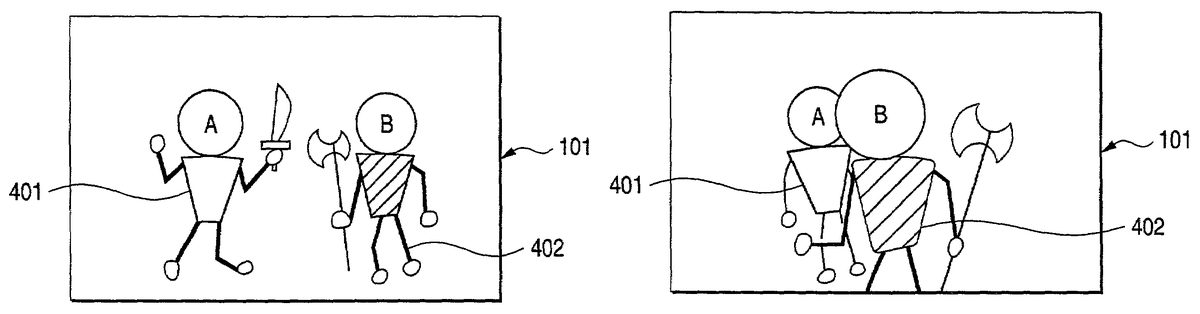
FIG. 3is a flow chart of the process for controlling an image selection in the process accepting battle commands and processing the battle scene (step S6inFIG. 2).FIGS. 4A,4B,4C,4D show some images associated with this image control process.
The process for accepting battle commands and processing the battle scene is described below with reference toFIG. 3andFIGS. 4(A) to 4(D). Reference numerals S21to S43inFIG. 3indicate the steps in this process. Shown inFIGS. 4A,4B,4C,4D are the player character401participating in the battle and the opposing enemy character402.
When the process for accepting battle commands and processing the battle scene starts (step S6inFIG. 2), a screen enabling the player to select a specific character action (input a command) is presented and the processor waits for command input (step S21). When the player makes a selection and the action is determined, the procedure advances to step S22.
The player character hit count HPA and enemy character hit count HPB are then obtained (step S22) and compared (step S23). If step S23determines that HPA>HPB, the procedure advances to step S24, the image control parameter X is set (X=B) and the process variable HPX is set to (HPX=HPB). If step S23detects that (HPA>HPB) is not true, the procedure advances to step S25, the image control parameter X is set to (X=A), and the process variable HPX is set to (HPX=HPA).
Once the process variable HPX is set, the procedure advances to step S26and HPX is compared with a specific threshold value T1. If (HPX>T1), the procedure advances to step S30and the CPU12generates information for displaying image X1from a specific perspective. The procedure then advances to step S34from step S30.
If in step S26(HPX>T1) is not true, the procedure advances to step S27and HPX is compared with a specific threshold value T2(where T1>T2>). If (HPX>T2), the procedure advances to step S31and the CPU12generates information for displaying image X2from a specific perspective. The procedure then advances to step S34from S31.
If in step S27(HPX>T2) is not true, the procedure advances to step S28. HPX is then decreased by the maximum decrement D possible in the next attack, and HP′ (=HPX−D) is calculated as the inferred value for the next attack. Then, in step S29HP′ is compared with the condition for ending the battle, that is, 0. If (HP′≦0) is not true, the procedure advances to step S33and the CPU12generates information for displaying image X3from a specific perspective. The procedure then advances to step S34from S33. If in step S29(HP′≦0), the procedure advances to step S32and the CPU12generates information for displaying image X4from a specific perspective. The procedure then advances to step S34from S32.
If any of steps S30to S33advance to step S34, the player character attacks the enemy character according to the action command input by the user, and depending upon the success of the attack, the enemy character hit count HPB is decreased. The enemy character also attacks the player character as necessary according to the internally processed game content, and the player character hit count HPA is similarly decreased depending on the success of the attack.
When an attack between the characters ends, the procedure advances to step S35to determine whether the battle is over. More specifically, the process variable HPX and the condition for determining the end of the battle (0) are compared. If (HPX>0) the battle is not over, the procedure loops back to step S21, and steps S21to S35repeat. Only if (HPX>0) is not true in step S35is the battle determined to have ended and the procedure advances to step S36.
As a result of this process, an image from a perspective showing both characters is presented on the display at the beginning of a battle by supplying specific control data generated by the CPU12in step S30to the graphics processor16, so that the condition of both characters can be easily determined, as shown inFIG. 4A. As the battle progresses, an image from a perspective different from image X1clearly showing both characters is presented as shown inFIG. 4Bby supplying specific control data generated by the CPU12in step S31to the graphics processor16.
At the end of the game, specific control data generated by the CPU12in step S33is supplied to the graphics processor16to display an image from a perspective different from that of both images X1and X2. In addition, a close-up image from a perspective different from that of images X1, X2, and X3enabling the condition of the losing character to be easily confirmed is displayed just before the end of the battle by supplying specific control data generated by the CPU12in step S32to the graphics processor16.
If in step S35the game has not ended (HPX>0 is not true), the procedure advances to step S36and it is determined if the image control parameter X is set to (X=B). If (X=B), the image control parameter X is set to (X=A), and the process variable HPX becomes (HPX=HPA). If (X=B) is not true in step S36, the image control parameter X is set to (X=B) at step S38, and the process variable HPX becomes (HPX=HPB).
When HPX is set, the procedure advances to step S39and HPX is compared with a specific threshold value T3. If (HPX>T3), the procedure advances to step S41, where CPU12generates control data for displaying image X5from a specific perspective, and the sequence of battle events ends.
If in step S39(HPX>T3) is not true, the procedure advances to step S40, where HPX is compared with a specific threshold value T4(where T3>T4>). If (HPX>T4), the procedure advances to step S42, where CPU12generates control data for displaying image X6from a specific perspective, and the sequence of battle events ends.
If in step S40(HPX>T4) is not true, the procedure advances to step S43, CPU12generates control data for displaying image X7from a specific perspective (step S43), and the sequence of battle events ends.
As a result of this process, an image from a specific perspective is displayed immediately after the battle ends according to the hit count of the winner. For example, if (HPX>T3), CPU12generates control data for displaying image X5from a specific perspective due to step S41, and this control data is passed to the graphics processor16. If the player character is the winner, a close-up showing the condition of the player character401, the winner, is displayed on screen as shown inFIG. 4C. However, if the enemy character is the winner, a close-up showing the condition of the enemy character402, the winner, is displayed on screen as shown inFIG. 4D.
FIG. 5shows an example of the relationship between hit counts and threshold values in this embodiment of the invention.FIG. 6shows the concept of image data in this embodiment of the invention. Image control in the steps of the battle process shown inFIG. 3is described next with reference toFIG. 5andFIG. 6.
As shown inFIG. 5, the upper limit HPmax is 1.0 and the lower limit HPmin is 0 for both player character hit count HPA and enemy character hit count HPB. Threshold values T1and T3(T1=T3) are set to 0.7, and threshold values T2and T4(T2=T4) are set to 0.3. As shown inFIG. 6, player character401image data A1to A7for generating images from seven different perspectives, and enemy character402image data B1to B7for generating images from seven different perspectives, are stored in RAM14.
If both player character hit count HPA and enemy character hit count HPB are 1.0 when the battle process starts, image control parameter X is set to (X=A), and the screen image is generated with image data A1at the start of the battle. If the player character401gains superiority as the battle progresses so that (HPA>HPB), the display is generated using image data B1.
If the game advances with the player character401retaining superiority, the enemy character hit count HPB is decreased at the end of each attack between the players until the player character401wins. In this case the display is generated using image data B1at the beginning of the battle as long as enemy character hit count HPB is (1.0>HPB>0.7), but when hit count HPB decreases to (0.7>=HPB>0.3) in mid battle, the display is updated using image data B2.
At the end of the battle when hit count HPB decreases to (0.3>=HPB>D) where D is a maximum decrease at the next attack, the display is updated again with image data B3. Just before the end of the battle when (D>=HPB>0), the display is updated again using image data B4. The battle is thus presented using images from four different perspectives. Immediately after the battle ends the display is updated again with an image from a perspective determined by the hit count HPA of the winner. For example, if (HPA>0.7), image data A5is used to generate the display.
Although not shown inFIG. 3, an audio control step for determining whether to enable a specific dialogue is provided before or after a certain step from steps S30to S33and steps S41to S43, so that in conjunction with the change of perspective one or more characters voices, a specific dialogue linked to information associated with each zone setting or other information. Images and dialogue thus progress together, thus improving game realism.
The preferred embodiment of the invention described above offers the following benefits.
First, loss of interest in the game can be prevented because the images continually change to a particular perspective according to character status, character type, and game progress.
Second, realism is improved because in addition to changing the display to present images from multiple different perspectives until the battle is decided, just before the battle is decided another specific image is displayed.
Third, it is possible to increase realism and prevent a loss of interest because the characters speak a specific dialogue appropriate to the game in conjunction with image changes.
An alternative embodiment of this invention is described below. While the preceding embodiment describes a game in which one player character and one enemy character battle, the present invention can also be applied to battles between three combatants (characters). In this case, images are prepared from different perspectives for each of the enemy (or ally) characters, hit counts are tallied or averaged by enemy character to determine a total hit count used to change to an image from a particular perspective.
Alternatively, images of different perspectives can be prepared for each of the ally characters, the hit counts of the enemy characters compared with each other and with a threshold values, and the result used to change the image to a particular perspective.
Further alternatively, the image perspective can be determined using only the enemy hit count.
It will also be noted that the above embodiment describes using a parameter determining the action capabilities of the characters, that is, the hit count, to determine the image perspective. However, if character action capabilities are determined using plural parameters, these parameters can be weighted as necessary and totalled or averaged to derive a single parameter used to determine the image perspective.
Although the present invention has been described in connection with the preferred embodiments thereof with reference to the accompanying drawings, it is to be noted that various changes and modifications will be apparent to those skilled in the art. For example, the order of the steps in the above described method of the invention can be changed without departing from the scope of the invention.
The same element in the accompanied drawings is denoted by the same reference number.
It will be known from the preceding description that this invention can flexibly change to an image from a specific perspective according to character status and game progress, and can thus prevent a loss of interest in the game.
Claims
- A computer-readable data recording medium that stores a video game program for displaying a plurality of characters, including a player character and enemy character, on screen and controlling a battle between the characters, the program causing a computer to: compare a parameter determining an action capability of a character participating in the baffle with a specific threshold value;and change to an image from a specific point of view selected from among a plurality of points of view according to a result of the comparison.
- A computer-readable data recording medium as described in claim 1 , wherein N (where N is a natural number) mutually different numeric values other than a maximum value and a minimum value of the parameter determining an action capability are usable as the specific threshold value, one said numeric value being set to be close to a minimum parameter value, a point of view being changed in (N+1) stages.
- A computer-readable data recording medium as described in claim 1 , wherein the stored program additionally causes: a comparison of a parameter determining an action capability of the player character and a parameter determining an action capability of the enemy character, wherein an image is changed from the specific point of view selected from among the plurality of points of view according to a result of the parameter comparison.
- A computer-readable data recording medium as described in claim 1 , wherein the stored program additionally causes: an inferring that the parameter determining action capability will be at least equal to a minimum value as a result of a next attack, wherein an image is changed from the specific point of view selected from among a plurality of points of view according to a result of the parameter inferring.
- A computer-readable data recording medium as described in claim 1 , wherein the stored program additionally causes: an evaluation game progress, wherein an image is changed from the specific point of view selected from among the plurality of points of view according to a result of the evaluation.
- A computer-readable data recording medium as described in claim 1 , wherein the stored program additionally causes execution of: determining whether to enable a specific dialogue according to the result of the comparison.
- A video game program for displaying a plurality of characters, including a player character and enemy character, on a screen, and controlling a battle between the player character and the enemy character, the program causing a computer to: compare a parameter determining an action capability of a character, of the plurality of characters, participating in the battle with a specific threshold value;and change to an image from a specific point of view selected from among a plurality of points of view according to a result of the comparison.
- A video game program as described in claim 7 , wherein N (where N is a natural number) mutually different numeric values other than a maximum value and a minimum value of the parameter determining an action capability are usable as the specific threshold value, one said numeric value being set to be close to a minimum parameter value, a point of view being changed in (N+1) stages.
- A video game program as described in claim 7 , further executing: a comparison of a parameter that determines an action capability of the player character and a parameter determining an action capability of the enemy character, wherein an image is changed from the specific point of view selected from among the plurality of points of view according to a result of the parameter comparison.
- A video game program as described in claim 7 , further executing: an inferring that the parameter determining action capability will be at least equal to a minimum value as a result of a next attack, wherein an image is changed from the specific point of view selected from among the plurality of points of view according to a result of the inference.
- A video game program as described in claim 7 , further executing: evaluating a game progress, wherein an image is changed from the specific point of view selected from among the plurality of points of view according to a result of the evaluation.
- A video game program as described in claim 7 , further executing: determining whether to enable a specific dialogue according to the result of the parameter determining comparison.
- A video game processing method for a video game for displaying a plurality of characters, including a player character and enemy character, on a screen, and controlling a battle between the characters, the video game processing method comprising: comparing a parameter determining an action capability of a character, from among the plurality of characters, participating in the battle with a specific threshold value;and changing to an image from a specific point of view selected from among a plurality of points of view according to a result of the parameter determining comparison.
- A video game processing method as described claim 13 , wherein N (where N is a natural number) mutually different numeric values other than a maximum value and a minimum value of the parameter determining an action capability are usable as the specific threshold value, one said numeric value being set to be close to a minimum parameter value, a point of view being changed in (N+1) stages.
- A video game processing method as described claim 13 , further comprising: examining a parameter determining an action capability of the player character and a parameter determining an action capability of the enemy character, wherein an image is changed from the specific point of view selected from among the plurality of points of view according to a result of the examination.
- A video game processing method as described in claim 13 , further comprising: inferring that the parameter determining action capability will be at least equal to a minimum value as a result of a next attack, wherein an image is changed from the specific point of view selected from among the plurality of points of view according to a result of the inferring.
- A video game processing method as described in claim 13 , further comprising: evaluating a game progress, wherein an image is changed from the specific point of view selected from among the plurality of points of view according to a result of the evaluation.
- A video game processing method as described in claim 13 , further comprising: determining whether to enable a specific dialogue according to a result of the parameter determining comparison.
- A video game processing apparatus, comprising: a storage device that stores a video game program for displaying a plurality of characters, including a player character and enemy character, on a screen, and controlling a battle between the characters;a computer that executes a program read from the storage device;and an image display device disposed as an output means of the computer, wherein the computer executes the program to compare a parameter determining an action capability of a character participating in the battle with a specific threshold value, and changes to an image from a specific point of view selected from among a plurality of points of view according to a result of the comparison.
- A video game processing apparatus as described in claim 19 , wherein N (where N is a natural number) mutually different numeric values other than a maximum value and a minimum value of the parameter determining an action capability are usable as the specific threshold value, one said numeric value being set to be close to a minimum parameter value, a point of view being changed in (N+1) stages.
- A video game processing apparatus as described in claim 19 , wherein the computer further judges a parameter determining an action capability of the player character and a parameter determining an action capability of the enemy character, and changes to an image from the specific point of view selected from among the plurality of points of view according to a result of the judgment.
- A video game processing apparatus as described in claim 19 , wherein the computer further infers that the parameter determining action capability will be at least equal to a minimum value as a result of a next attack, and changes to an image from the specific point of view selected from among the plurality of points of view according to a result of the inference.
- A video game processing apparatus as described in claim 19 , wherein the computer further evaluates a game progress, and changes to an image from the specific point of view selected from among the plurality of points of view according to a result of the evaluation.
- A video game processing apparatus as described in claim 19 , wherein the computer further determines whether to enable a specific dialogue according to a result of the parameter determining comparison.
Disclaimer: Data collected from the USPTO and may be malformed, incomplete, and/or otherwise inaccurate.