U.S. Pat. No. 7,063,619
METHOD AND APPARATUS FOR IDENTIFYING GAME PLAYERS AND GAME MOVES
AssigneeMind Fusion LLC; Interactive Telegames LLC; New Illuminations LLC
Issue DateMarch 29, 2001
Illustrative Figure
Abstract
A method and apparatus is disclosed for simultaneously indicating on each of a plurality of communication terminals, instructions transmitted by each terminal and the identity of the respective terminals that transmitted the instructions. Such a feature can be used to indicate the moves of parties playing a game over a telephone line. Once a communications link is established between two or more parties, their terminals are placed in a game mode which activates inband signal detection and player identification circuitry located within the terminals. Multi-colored indicators and player identification displays at each terminal are activated, their color being dependent upon the source of received instructions. In one embodiment, player identification indicators may be incorporated into a touch tone keypad located on the terminals. The keypad's touch tone keys are modified such that each key has two or more color coded indicators incorporated within, each color representing a particular player's move.
Description
DETAILED DESCRIPTION OF THE INVENTION The present invention is an apparatus and method for simultaneously indicating on each of a plurality of communication terminals, game move selections transmitted by each terminal and the identity of the respective terminals and/or players that transmitted the game move selections. Further, the present invention tracks and indicates whose turn it is to input a game move selection. In the following detailed description, numerous specific details are set forth in order to provide a thorough understanding of the present invention. However, it will be apparent to one of ordinary skill in the art that these specific details need not be used to practice the present invention. In other instances, well known structures, interfaces, and processes have not been shown in detail in order not to unnecessarily obscure the present invention. Referring now toFIG. 1, a speakerphone terminal100with its game mode deactivated in accordance with the present invention is illustrated. Speakerphone terminal100includes a handset135, an external speaker activator150and an external speaker155, such that a user can carry out a conversation with another party without having to hold handset135. Speakerphone terminal100is capable of placing telephone calls by using keypad140to dial telephone numbers, and is also capable of receiving telephone calls in a manner known to one of ordinary skill in the art. Once a communications link with another party has been established, the user of speakerphone terminal100can activate a game mode at any time. In accordance with the present invention, speakerphone terminal100comprises a game mode activator105and game mode state display110, which are shown in a deactivated (off) state. Further, speakerphone terminal100includes player identification displays115and120, and game player key identifier125. The player identification displays115and120comprise LCDs. The game player key identifier125comprises a plurality of color coded LEDs. When speakerphone terminal100is first installed at a particular location, the telephone number ...
DETAILED DESCRIPTION OF THE INVENTION
The present invention is an apparatus and method for simultaneously indicating on each of a plurality of communication terminals, game move selections transmitted by each terminal and the identity of the respective terminals and/or players that transmitted the game move selections. Further, the present invention tracks and indicates whose turn it is to input a game move selection. In the following detailed description, numerous specific details are set forth in order to provide a thorough understanding of the present invention. However, it will be apparent to one of ordinary skill in the art that these specific details need not be used to practice the present invention. In other instances, well known structures, interfaces, and processes have not been shown in detail in order not to unnecessarily obscure the present invention.
Referring now toFIG. 1, a speakerphone terminal100with its game mode deactivated in accordance with the present invention is illustrated. Speakerphone terminal100includes a handset135, an external speaker activator150and an external speaker155, such that a user can carry out a conversation with another party without having to hold handset135. Speakerphone terminal100is capable of placing telephone calls by using keypad140to dial telephone numbers, and is also capable of receiving telephone calls in a manner known to one of ordinary skill in the art. Once a communications link with another party has been established, the user of speakerphone terminal100can activate a game mode at any time. In accordance with the present invention, speakerphone terminal100comprises a game mode activator105and game mode state display110, which are shown in a deactivated (off) state. Further, speakerphone terminal100includes player identification displays115and120, and game player key identifier125. The player identification displays115and120comprise LCDs. The game player key identifier125comprises a plurality of color coded LEDs. When speakerphone terminal100is first installed at a particular location, the telephone number to be associated with speakerphone terminal100is permanently stored in memory by the user until the number is changed (e.g., due to relocation). Memory storage key130is activated to enable storage of the terminal's telephone number. Some or all of the keys in keypad140contain game move indicators145consisting of a plurality of color coded LEDs. When the game mode is off, displays115and120are deactivated, as well as the game player key identifiers125and all game move indicators. The game playing circuitry of the present invention may be powered by a battery within speakerphone terminal100, an external power source (e.g., AC power), or powered from the telephone line. Because not all established calls will be for the purpose of playing games, the game mode feature has been incorporated as a way of conserving power.
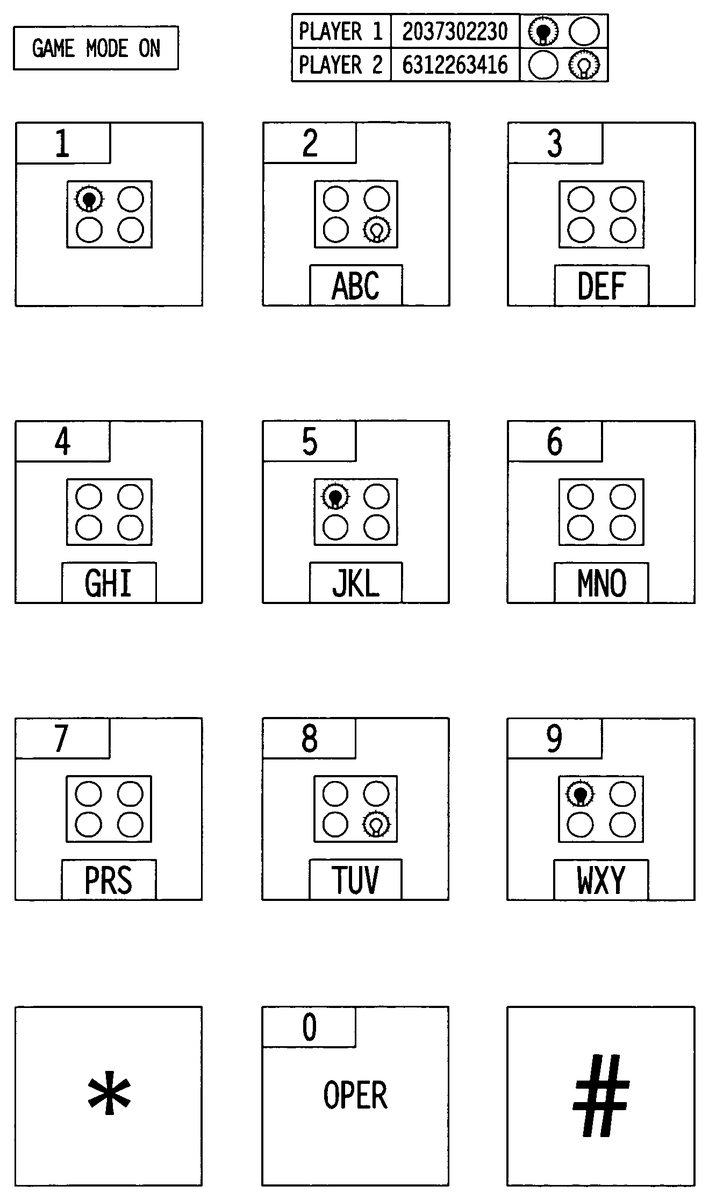
Referring now toFIG. 2, a speakerphone terminal200with its game mode activated in accordance with the present invention is illustrated. Speakerphone terminal200comprises a game mode activator205and game mode state display210, which are shown in an activated (on) state. Speakerphone terminal200includes player identification displays215and220which contain game player telephone numbers and game player key identifier225. After a communications link with another terminal is established, the user of speakerphone terminal200depresses game mode activator205. Assuming that the other party of the communications link has similar gaming apparatus, the game mode of the other party's terminal may be activated in response to an inband signal transmitted in response to depressing activator205, or both player's may both activate their game modes. One player is identified as “Player1”, telephone number 2037302230 and assigned a first color (e.g., red) by game player key identifier225. The other player is identified as “Player2”, telephone number 6312263416 and assigned a second color (e.g., blue). Telephone numbers could be automatically translated into player names by scanning a translation database, if such a feature was desired by a designer of the terminal. As an optional embodiment, one or more special feature buttons235can be depressed to change (swap) player, color identifiers and to override player move authorizations regarding which player goes first. Once the game mode is activated, one of the player's is authorized to make the first game move as indicated by which colored LED of the game player key identifier225is sequentially turning on and off (e.g., blinking). The authorized player then inputs a game move by depressing one or more keys on the player's terminal keypad. As shown, the results of a completed game of tic-tac-toe are displayed on each terminal user's keypad. Note that player1won because keys1,5and9were selected, thus completing a diagonal on a three by three matrix (keypad keys1through9). The winner may be indicated by causing the three illuminated LEDs on the diagonal to blink on and off.
Referring now toFIG. 3, a cellular (wireless) telephone is illustrated in accordance with the present invention. In this configuration, the identities of the players, their associated telephone numbers and their assigned colors are conveyed on a single display.
Referring now toFIG. 4, wireless communication between two players is illustrated in accordance with the invention. The features afford compact and portable game playing features. For example, Scott calls his 10 year old son Bobby and informs Bobby that he will have to work late. Both Scott and Bobby are equipped with a wireless communication terminal in accordance with the present invention. During their conversation, Scott asks Bobby, “would you like to play a game of tic-tac-toe?” Bobby agrees. Scott and/or Bobby energize a “game mode” button on their devices. Before doing so, the devices performed as standard cellphones. Upon activating the game mode, an LCD displays the telephone numbers of Scott (player1) and Bobby (player2) and assigns colors (identifiers) used to differentiate between each player (e.g., red for Scott and blue for Bobby). The flashing of a red colored LED next to Scott's telephone number on each device indicates that it is Scott's turn to go first. Scott enters a game move by depressing one or more push buttons on his terminal. Thus he conveys one or more instructions to both terminals. The instructions are processed in each of Scott's and Bobby's devices by pre-programmed microprocessors (e.g., CPUs) which control all functions of each terminal's game mode. Scott and Bobby continue playing the game by taking turns inputting game moves (instructions) until the game ends.
Referring now toFIGS. 5A and 5B, auxiliary game cards/modules can be inserted into a wireless communication terminal in accordance with the present invention. Auxiliary game cards provide additional software, features and functions that go beyond the capabilities of the base communication terminal.
Referring now toFIG. 6, a terminal containing multiple game boards inserted into its base is illustrated in accordance with the present invention. The game boards can be pulled out as desired, or they can be spring loaded and pop out when a button on the game is depressed. Ribbon cable can be used to connect the circuitry from the individual game boards to the terminal. Each of these game boards provide specialized software and functions to play a particular game.
Referring now toFIG. 7, the logic for displaying player IDs at each player's terminal is illustrated. Each terminal contains three memory locations dedicated to storing the telephone number of the user's terminal (memory storage location #1), the dialed telephone number (memory storage location #2) and the caller ID of another player's terminal (memory storage location #3). If a player originates a communications link to another player (placed an outgoing call), the telephone numbers in memory storage locations #1and #2are promptly displayed on each terminal once a game mode is activated. If a player receives a call, the telephone numbers in memory storage locations #1and #3are promptly displayed on each terminal once a game mode is activated.
Referring now toFIG. 8A, a flow chart of a method implemented by the present invention is illustrated. The method is initiated at step805. When a terminal incorporating the features of the present invention is first used, the user is instructed to store the terminal's telephone number in a first memory location within the terminal (step810). As long as the terminal's telephone number remains unchanged, the first memory location retains the telephone number. The terminal operates as a complete communications device, whether it be a cellular phone, a speakerphone, a telephone or a computer. When a communication is established over a common communications link (wired or wireless) with another terminal, a determination is made as to whether the terminal initiated the communication (e.g., such as by placing an outgoing telephone call) or received the communication (such as by receiving an incoming telephone call) (step815). If it is determined that the communication was initiated by the terminal, the address used to initiate the communication (e.g., dialed number) is stored in a second memory location (step820). If it is determined that the communication was initiated by a different terminal, the address of the different terminal is determined (e.g., such as by using caller ID or manually inputting identifying information) and stored in a third memory location (step825). Other terminals connected to the communications link do not need to incorporate the features of the present invention in order to carry out communication between the terminals. However, if the terminals incorporate the features of the present invention, the users of the terminals may spontaneously decide to play a game at any time during an ongoing conversation by having one or more of the users activate a “Game Mode” option on their terminals (step830). Upon such activation, the addresses of terminals communicating over the communications link are promptly displayed on each terminal (step835). The terminals may be programmed to always designate the original calling (initiating) party as “Player1” and designate the called (receiving) party as “Player2”. Identifiers are then defined for each terminal by assigning a color to represent their upcoming game move selections, and to differentiate between the different players' moves (step840).
Referring now toFIG. 8B, a colored LED is illuminated next to Player1's telephone number, and a second colored LED is illuminated next to Player2's telephone number on each player's terminal (step845). A determination is then made as to which player goes first (step850). Such a determination can be based upon which player placed the call (Player1would go first), or by providing an input means for selecting which player goes first. Upon determining which player goes first, one of the illuminated LEDs (player identifiers) on each terminal flashes next to the Player's ID in response to a “turn flash” instruction (step855). It would then be Player1's turn to input a game move selection on his or her terminal. Upon Player1's input, an instruction indicating a game move selection is received at both terminals (step860). Upon receipt of the instruction, the flashing LED ceases to flash and a determination is made as to which terminal sent the instruction (step865). Then Player1's move is represented by illuminating a color coded LED corresponding to the move on a game board incorporated at each player's terminal (step870). A determination is then made as to whether the game is over (e.g., did a player win?) (step875). If it is determined that the game is not over, a determination is made as to which player is to make the next move (step880). Upon such determination, again one of the illuminated LEDs on each terminal flashes next to the next Player's ID in response to another “turn flash” instruction (back to step885). The game proceeds in such a fashion until it is determined that the game is over (step875). An indication of the winner is conveyed on both terminals (step890). The game then ends (step895).
FIG. 9illustrates terminal circuitry used to implement the present invention. Upon initial use of the terminal, the user is instructed to input the terminal's address (e.g., telephone number) on keypad970. Via path965, the address is received by CPU945and permanently stored in a first memory location950. When a communication is initiated by the user, the user inputs a called terminal's address on keypad970. Via path965, the address is received by CPU945and temporarily stored in a second memory location955. The call is placed by instruction signal generator/dialer circuit988which receives dialing instructions from CPU945via path982. A communication is then established over common communications link990with another terminal. When a communication is received from a different terminal via communications link990, the address of the other terminal is processed by caller ID circuit992, forwarded to CPU945via path994and temporarily stored in third memory location960. During an ongoing conversation, one of the users may activate a “Game Mode” option on their terminals which causes game mode activation circuit935to instruct CPU965via path940to activate Player1and Player2ID displays905and910via path920, and to change game mode display915to visually indicate that the game mode is activated. Upon such activation, the addresses of terminals communicating over the communications link are retrieved from memories950,955and/or960and are promptly displayed. Additionally, color coded player ID key and turn indicator circuit925is activated by CPU945via path930, which illuminates a first colored LED next to Player1's address and a second colored LED next to Player2's address on each player's terminal. One of the illuminated LEDs (player identifiers) on each terminal flashes next to the Player's ID in response to a “turn flash” instruction generated by CPU945. All game move signals received from another terminal are received over communications link990and are processed by instruction signal receiver/decoder circuit986and forwarded to CPU945via path984. The CPU945keeps track of whether the terminal within which the CPU945resides sent a game move, or whether an external terminal sent a game move. The instruction signal receiver/decoder circuit is controlled by CPU945such that it only processes signals received from outside the terminal. CPU outputs game moves via path980to game status display circuit975, and to keypad970if the game moves are to be displayed on the keys of keypad970.
Referring toFIG. 10, a keypad layout in accordance with the present invention is illustrated. Each key position numbered1through9can contain up to four different colored LEDs. Only one LED in each key can be illuminated at a time.
Referring toFIG. 11, another embodiment of a keypad layout in accordance with the present invention is illustrated. Each key position numbered1through9can contain an LCD which displays the number of the key when the game mode is off.
Referring toFIG. 12, the key displays shown inFIG. 11go blank when the game mode is activated, and as a game progresses, game pieces are displayed on the keys. In the case of tic-tac-toe, X's and O's are displayed in accordance with the players inputs.
It should be noted that the method and apparatus described herein has been illustrated as supporting communications and game play between only two game players. However, it is understood that the invention can be dimensioned to concurrently support more than two players.
An apparatus and method for simultaneously indicating on each of a plurality of communication terminals, instructions transmitted by each terminal and the identity of the respective terminals that transmitted the instructions is described herein. These specific arrangements and methods described herein are merely illustrative of the principles of the present invention. Numerous modifications in form and detail may be made by those of ordinary skill in the art without departing from the spirit and scope of the present invention. Although this invention has been shown in relation to a particular embodiment, it should not be considered so limited. Rather, the present invention is limited only by the scope of the appended claims.
Claims
- A method of identifying game players and game moves, comprising: in a first communication terminal having a first and a second memory location, storing a telephone number of said first communication terminal in said first memory location;in a second communication terminal having a third memory location and a fourth memory location, storing a telephone number of said second communication terminal in said third memory location;dialing at said first communication terminal, a telephone number of said second communication terminal;storing said dialed telephone number in said second memory location;establishing a communications link between said first and second communication terminals;determining, at said second communication terminal, the telephone number of said first communication terminal;storing said telephone number of said first communication terminal in said fourth memory location;displaying at each of said terminals, said telephone number of said first terminal retrieved from said first and fourth memory locations;displaying at each of said terminals, said dialed telephone number retrieved from said second and third memory locations while said telephone number of said first terminal is being displayed;activating at each of said communication terminals, a game mode to play a game between a first player associated with said first communication terminal and a second player associated with said second terminal;defining a plurality of identifiers used to differentiate between said first and second players;activating a first indicator representing said first player;activating a second indicator representing said second player;indicating at each of said communication terminals, which player is currently authorized to send a game move instruction;receiving said move instruction from said authorized player;and displaying at each of said communication terminals, a game move and identifier associated with said received move instruction.
- The method of claim 1 , wherein said game move and identifier are displayed on one or more keys of a keypad used to dial said dialed telephone number.
- The method of claim 1 , wherein the step of receiving said move instruction from said authorized player comprises receiving from said authorized player at least one dual tone multi-frequency (DTMF) signal.
- The method of claim 1 , wherein the step of indicating at each of said communication terminals comprises sequentially activating and deactivating one of said first and second indicators at each of said communication terminals.
- The method of claim 1 , wherein the steps of activating the first and second indicators comprises activating color coded light emitting diodes (LEDs).
- A method of identifying game players and game moves, comprising: in a first communication terminal having a first and a second memory location, storing a telephone number of said first communication terminal in said first memory location;in a second communication terminal having a third memory location and a fourth memory location, storing a telephone number of said second communication terminal in said third memory location;receiving at said second communication terminal, a telephone number of said first communication terminal;storing said received telephone number in said fourth memory location;establishing a communications link between said first and second communication terminals;storing a telephone number of said second communication terminal in said second memory location;activating at each of said communication terminals, a game mode to play a game between a first player associated with said first communication terminal and a second player associated with said second communication terminal;displaying at each of said communication terminals, said received telephone number;displaying at each of said communication terminals, said telephone number of said second communication terminal while said received telephone number is being displaved;defining a plurality of identifiers used to differentiate between said first and second players;activating a first indicator representing said first player;activating a second indicator representing said second player;indicating at each of said communication terminals, which player is currently authorized to send a game move instruction;receiving said move instruction from said authorized player;and displaying at each of said communication terminals, a game move and identifier associated with said received move instruction.
- The method of claim 6 , wherein said game move and identifier are displayed on one or more keys of a keypad used to dial telephone numbers.
- The method of claim 6 , wherein the step of receiving said move instruction from said authorized player comprises receiving from said authorized player at least one dual tone multi-frequency (DTMF) signal.
- The method of claim 6 , wherein the step of indicating at each of said communication terminals comprises sequentially activating and deactivating one of said first and second indicators at each of said communication terminals.
- The method of claim 6 , wherein the steps of activating the first and second indicators comprises activating color coded light emitting diodes (LEDs).
- Apparatus for identifying game players and game moves, comprising: a first communication terminal having a first and a second memory location, wherein said first memory location stores a telephone number of the first communication terminal;a second communication terminal having a third and a fourth memory location, wherein said third memory location stores a telephone number of the second communication terminal;means for dialing, at the first communication terminal, a telephone number of the second communication terminal;means for storing said dialed telephone number in said second memory location;means for establishing a communications link between said first and second communication terminals;means for storing said telephone number of said first communication terminal in said fourth memory location;means for activating at each of said communication terminals, a game mode to play a game between a first player associated with said first communication terminal and a second player associated with said second communication terminal;means for displaying at each of said communication terminals, said telephone number of said first communication terminal;means for displaying at each of said communication terminals, said dialed telephone number while said telephone number of said first communication terminal is being displayed;means for defining a plurality of identifiers used to differentiate between said first and second players;means for activating a first indicator representing said first player;means for activating a second indicator representing said second player;means for indicating at each of said communication terminals, which player is currently authorized to send a game move instruction;means for receiving said move instruction from said authorized player;and means for displaying at each of said communication terminals, a game move and identifier associated with said received move instruction.
- The apparatus of claim 11 , wherein said game move and identifier are displayed on one or more keys of a keypad used to dial said dialed telephone number.
- The apparatus of claim 11 , wherein said received move instruction comprises at least one dual tone multi-frequency (DTMF) signal.
- The apparatus of claim 11 , wherein said authorized player is indicated by sequentially activating and deactivating one of said first and second indicators at each of said communication terminals.
- The apparatus of claim 11 , wherein said first and second indicators comprise color coded light emitting diodes (LEDs).
- Apparatus for identifying game players and game moves, comprising: a first communication terminal having a first and a second memory location, wherein said first memory location stores a telephone number of the first communication terminal;a second communication terminal having a third and a fourth memory location, wherein said third memory location stores a telephone number of the second communication terminal;means for receiving, at the second communication terminal, a telephone number of said first communication terminal;means for storing said received telephone number in said fourth memory location;means for establishing a communications link between said first and second communication terminals;means for storing a telephone number of said second communication terminal in said second memory location;means for activating at each of said communication terminals, a game mode to play a game between a first player associated with said first communication terminal and a second player associated with said second communication terminal;means for displaying at each of said communication terminals, said received telephone number;means for displaying at each of said communication terminals, said telephone number of said second communication terminal while said received telephone number is being displayed;means for defining a plurality of identifiers used to differentiate between said first and second players;means for activating a first indicator representing said first player;means for activating a second indicator representing said second player;means for indicating at each of said communication terminals, which player is currently authorized to send a game move instruction;means for receiving said move instruction from said authorized player;and means for displaying at each of said communication terminals, a game move and identifier associated with said received move instruction.
- The apparatus of claim 16 , wherein said game move and identifier are displayed on one or more keys of a keypad used to dial telephone numbers.
- The apparatus of claim 16 , wherein said received move instruction comprises at least one dual tone multi-frequency (DTMF) signal.
- The apparatus of claim 16 , wherein said authorized player is indicated by sequentially activating and deactivating one of said first and second indicators at each of said communication terminals.
- The apparatus of claim 16 , wherein said first and second indicators comprise color coded light emitting diodes (LEDs).
- A method of identifying game players and game moves, comprising: in a first communication terminal having a first memory location and a second memory location, storing a telephone number of said first communication terminal in said first memory location;in a second communication terminal having a third memory location and a fourth memory location, storing a telephone number of said second communication terminal in said third memory location;storing the telephone number of said second communication terminal in said second memory location;at said first communication terminal, dialing the telephone number of said second communication terminal to place a first telephone call to said second communication terminal;receiving the first telephone call at said second communication terminal and establishing a communications link between said first and second communication terminals;receiving caller ID signals associated with the first telephone call at said second communication terminal;obtaining the telephone number of said first communication terminal from the caller ID signals received at said second communication terminal;storing the telephone number of said first communication terminal obtained from the caller ID signals in said fourth memory location;at said first communication terminal, retrieving said telephone number of said first communication terminal from said first memory location and displaying the telephone number of said first communication terminal retrieved from said first memory location;at said first communication terminal, retrieving said telephone number of said second communication terminal from said second memory location and displaying the telephone number of said second communication terminal retrieved from said second memory location;at said second communication terminal, retrieving said telephone number of said second communication terminal from said third memory location and displaying the telephone number of said second communication terminal retrieved from said third memory location;at said second communication terminal, retrieving said telephone number of said first communication terminal from said fourth memory location and displaying the telephone number of said first communication terminal retrieved from said fourth memory location, wherein said telephone numbers of said first and second communication terminals are displayed concurrently at said first and second communication terminals at least for a first period of time;activating, at each of said terminals, a game mode to play a game between a first player associated with said first communication terminal and a second player associated with said second communication terminal;defining a plurality of identifiers used to differentiate between said first and second players;activating a first indicator representing said first player;activating a second indicator representing said second player;determining, based on which player placed the first telephone call, whether the first player or the second player is authorized to send a first game move instruction;indicating at each of said communication terminals, which player is currently authorized to send a game move instruction;receiving said move instruction from the authorized player;and displaying at each of said terminals, a game move and identifier associated with the received move instruction.
- The method of claim 21 , further comprising enabling at least one of the first and second players to change which player is authorized to send the first game move instruction.
- A method of identifying game players and game moves, comprising: in a first communication terminal having a first memory location and a second memory location, storing a telephone number of said first communication terminal in said first memory location;in a second communication terminal having a third memory location and a fourth memory location, storing a telephone number of said second communication terminal in said third memory location;storing the telephone number of said second communication terminal in said second memory location;at said first communication terminal, dialing the telephone number of said second communication terminal to place a first telephone call to said second communication terminal;receiving the first telephone call at said second communication terminal and establishing a communications link between said first and second communication terminals;storing the telephone number of said first communication terminal in said fourth memory location;at said first communication terminal, retrieving said telephone number of said first communication terminal from said first memory location and displaying the telephone number of said first communication terminal retrieved from said first memory location;at said first communication terminal, retrieving said telephone number of said second communication terminal from said second memory location and displaying the telephone number of said second communication terminal retrieved from said second memory location;at said second communication terminal, retrieving said telephone number of said second communication terminal from said third memory location and displaying the telephone number of said second communication terminal retrieved from said third memory location;at said second communication terminal, retrieving said telephone number of said first communication terminal from said fourth memory location and displaying the telephone number of said first communication terminal retrieved from said fourth memory location;and determining, based on which player placed the first telephone call, whether the first player or the second player is authorized to send a first game move instruction;wherein said telephone numbers of said first and second communication terminals are displayed concurrently at said first and second communication terminals at least for a first period of time.
- The method of claim 23 , further comprising enabling at least one of the first and second players to change which player is authorized to send the first game move instruction.
- Apparatus for identifying game players and game moves, comprising: a first communication terminal comprising a first memory location, a second memory location, a dialer circuit, and a display, the first memory location being capable of storing a telephone number of the first communication terminal;a second communication terminal having a third memory location, a fourth memory location, a display, and a caller ID circuit, the third memory location being capable of storing a telephone number of the second communication terminal, and the fourth memory location being capable of storing the telephone number of the first communication terminal received from the caller ID circuit;wherein: the dialer is capable of dialing the telephone number of the second communication terminal to establish a communications link between said first and second terminals;the second memory location is capable of storing the telephone number of the second communication terminal;the first and second communication terminals are capable of entering a game mode to play a game between a first player associated with said first communication terminal and a second player associated with said second communication terminal;the display of the first communication terminal displays the telephone numbers of the first and second communication terminals at the same time as the display of the second communication terminal displays the telephone numbers of the first and second communication terminals;and the first and second communication terminals are capable of determining, based on which player dials a telephone number to establish the communications link, whether the first player or the second player is authorized to send a first game move instruction.
- The apparatus of claim 25 , wherein at least one of the first and second communication terminals comprises an input capable of receiving a direction causing the apparatus to change which player is authorized to send the first game move instruction.
Disclaimer: Data collected from the USPTO and may be malformed, incomplete, and/or otherwise inaccurate.