U.S. Pat. No. 7,001,271
VIDEO GAME WITH QUICK ALTERNATION OF PLAYER CHARACTERS
AssigneeKabushiki Kaisha Square Enix
Issue DateSeptember 28, 2001
Illustrative Figure
Abstract
Player characters can participate, quickly as alternated, in a battle while simplifying the alternating procedure. At the instant of a transfer to an acceptance of decisions on the player characters and actions, a standby state continues until a button is pushed, until an X-button is pushed, or until the actions for the player characters to execute are selected. When the button is pushed, a list of standby player characters is displayed to display the character names and characteristics of the characters. When the selections of the relief characters are received and selected by the player, the characters are alternated. When the X-button is pushed, the character alternations are restored. When the actions for the player characters to execute are selected, moreover, the operations for executing the decided actions are executed to end a series of player characters and the acceptance of the action decisions.
Description
DESCRIPTION OF THE PREFERRED EMBODIMENTS With reference to the accompanying drawings, a first embodiment in which the invention is applied to a home video game machine is described.FIG. 1is a block diagram showing the entire construction of the video game machine according to the first embodiment of the invention. First described is the video game machine according to the first embodiment of the invention. The video game machine10is constructed, as shown inFIG. 1, to include a game machine body11and a keypad50connected with the input side of the game machine body11. A TV set100including a CRT (Cathode Ray Tube) and a speaker, etc. is connected with the output side of the game machine body11. The game machine body11includes a CPU (Central Processing Unit)12, a ROM (Read Only Memory)13, a RAM (Random Access Memory)14, a hard disk drive15, a graphics processing unit16, a sound processing unit17, a disk drive18, a communications interface unit19, a memory card reader/writer20and an input interface unit21, and further includes a bus22connecting those components. The game machine body11is also connected through the input interface unit21with the keypad50acting as an operation input unit. On the upper face of the keypad50, there are arranged a cross key51and a button group52, which is equipped with an O button52aand an X-button52b. Multiple button groups are arranged on the side portion of the keypad50, and an L1button53and an L2button54are vertically arranged on the side portion of the cross key51. Keypad50is equipped with switches which are associated individually with the cross key51, the L1button53, the L2button54and the button group52. When these individual buttons are pushed, the corresponding switches are turned ON. The keypad50creates a detection signal corresponding to the ON/OFF of each of those switches. The detection signal created in the keypad50is fed to the input interface unit21, through which it becomes detection information ...
DESCRIPTION OF THE PREFERRED EMBODIMENTS
With reference to the accompanying drawings, a first embodiment in which the invention is applied to a home video game machine is described.FIG. 1is a block diagram showing the entire construction of the video game machine according to the first embodiment of the invention.
First described is the video game machine according to the first embodiment of the invention. The video game machine10is constructed, as shown inFIG. 1, to include a game machine body11and a keypad50connected with the input side of the game machine body11. A TV set100including a CRT (Cathode Ray Tube) and a speaker, etc. is connected with the output side of the game machine body11.
The game machine body11includes a CPU (Central Processing Unit)12, a ROM (Read Only Memory)13, a RAM (Random Access Memory)14, a hard disk drive15, a graphics processing unit16, a sound processing unit17, a disk drive18, a communications interface unit19, a memory card reader/writer20and an input interface unit21, and further includes a bus22connecting those components. The game machine body11is also connected through the input interface unit21with the keypad50acting as an operation input unit.
On the upper face of the keypad50, there are arranged a cross key51and a button group52, which is equipped with an O button52aand an X-button52b. Multiple button groups are arranged on the side portion of the keypad50, and an L1button53and an L2button54are vertically arranged on the side portion of the cross key51. Keypad50is equipped with switches which are associated individually with the cross key51, the L1button53, the L2button54and the button group52. When these individual buttons are pushed, the corresponding switches are turned ON. The keypad50creates a detection signal corresponding to the ON/OFF of each of those switches.
The detection signal created in the keypad50is fed to the input interface unit21, through which it becomes detection information indicating what button on the keypad50is turned ON. Thus, an operation command given to the keypad50by the user is fed to the game machine body11.
The CPU12executes an operating system stored in the ROM13, to control the entire game machine centrally, and executes the programs of the video game stored in the program region of the RAM14. Furthermore, the CPU12monitors the operation state of the keypad50through the input interface21, to execute, if necessary, the program of the video game stored in the program region of the RAM14, and to store, if necessary, a predetermined region of the RAM14with the various data which have developed in the progress of the game. The ROM13includes an EEPROM (Electrically Erasable and Programmable Read Only Memory) which is stored, at a stage before the power is cut off, with such predetermined data of the RAM14as have to be stored and hold even when the power is cut off.
The RAM14includes a program region, an image data region and a voice data region mainly and a region for storing other data. These individual regions are stored with the program data, the image data, the voice data and the remaining data, which are read out from a disk30such as a DVD or a CD-ROM by the disk drive18, respectively.
Furthermore, the RAM14is used as a work area, too, and its region for storing the remaining data is stored with the various data which have developed in the progress of the game. Here, the program data, the image data, the voice data and the remaining data, as read out from the disk30, can be stored in the hard disk drive15so that the program data, the image data, the voice data and the remaining data once stored in the hard disk drive15may be transferred, if necessary, to the RAM14, or so that the various data once stored in the RAM14and having developed in the progress of the game may be transferred to and stored in the hard disk drive15.
The graphics processing unit16includes a frame buffer as a buffer memory for storing the image data in a VRAM23, to create a video signal on the basis of the image data stored in the frame buffer by the control information from the CPU12in accordance with the program execution and to output the video signal to the TV set100. As a result, a screen by the image data stored in the frame buffer is displayed in a screen display unit101of the TV set100.
The sound processing unit17has a function to create a voice signal such as background music (BGM), a conversation between characters and an effect sound, etc. The sound processing unit17is caused, by the control information from the CPU12in accordance with the program execution, to output a sound signal including the voice signal to a speaker102of the TV set100on the basis of the data stored in the RAM14.
The TV set100includes the screen display unit101and the speaker102, and performs the graphics (image) display and the voice output according to the content of the video game on the basis of the video signal (graphics signal) and the sound signal from the game machine body11.
The disk drive18is so constructed that it can set the disk (DVD or CD-ROM)30or the recording medium removably, and reads the program data, the image data, the voice data and the remaining data of the video game, as stored in the disk30.
The communications interface unit19is connected with a network110so that it acquires various data by performing data communications, if necessary, with the data storage or information processor of the server of the game server group8or another server or the like. Here, the program data, the image data, the voice data and the remaining data of the video game, as read out from the disk30and stored in the RAM14, may be acquired through the network110and the communications interface unit19.
The memory card reader/writer20is so constructed that it can set a memory card removably, and save data of a relatively small capacity such as progress data of the video game or environment setting data of the video game are written in the memory card.
In the recording medium, i.e., the disk30according to the first embodiment of the invention, there is recorded the program of the video game for controlling a battle scene between multiple player characters and at least one enemy character on the screen. The program can be read out by a computer (the CPU12and its peripheral units). This computer is enabled by the program read in: to cause some of the player characters to participate in the battle scene; to display a list of standby player characters, who do not participate in the battle scene, in a subscreen in response to the operation of the player while any of the player characters participating in the battle scene is awaiting a command input; to select any from the player characters displayed in the subscreen, in response to the operation of the player; and to substitute the optionally selected player character for the player character awaiting the command input in exchanging their standpoints of the participation in and the standby for the battle.
This computer is further enabled after the player characters have alternated to return the alternated positions of the characters between the participation in and the standby player characters for the scene such as a battle scene to the original ones in response to the operation of the player, and to enable the player having participated in the scene by the alternation to act. The computer is further enabled to display the action orders of all characters including the player characters and the enemy character participating in the scene.
Therefore, the game machine body11is provided, by the software processing of the CPU12and based on the data stored in the individual memories, with not only the function necessary for executing the video games of the prior art but also: the function to display the list of the standby player characters not participating in the battle screen in the subscreen in response to the operation of the player; the function to substitute the positions of a predetermined player character for the player characters awaiting the command input in exchanging the participation in and the standby player characters for the battle in response to the operation of the player; and the function to return the positions of the characters between the participation in and the standby for the battle in response to the operation of the player after the player characters are alternated.
The game machine body11is further provided with: the function to enable the player characters allowed to participate in the scene such as a battle scene by the alternation to act after the completion of the alternation of the player characters; and the function to display the action orders of all the player characters including the player characters and the enemy character participating in the scene.
Therefore, it is possible to realize the video game in which the standby player character can participate in the scene instantly as the player character and the standby player character are exchanged and in which the operation procedure of the alternation is so simple that it will not deteriorate the player's interest. Here, these functions may be realized not by the software processing, but by providing a dedicated hardware.
Here will be described the actions of the first embodiment thus constructed.FIG. 2is a schematic flow chart showing one example of an overall processing routine of the actions of the aforementioned embodiment. Here, the individual steps inFIG. 2are designated by Step S1to Step S11as reference characters.
First, when the power is turned ON, although omitted fromFIG. 2, the boot program is read out to initialize the individual units so that the processing is executed to start the game. By the disk drive18, specifically, the program data, the image data, the voice data and the remaining data of the video game, as stored in the disk (DVD or CD-ROM)30are read out and stored in the RAM14. Prior to the actual progress of the game, the various settings are made to cause a game progressing state. When the game is progressed in this state, a battle scene or another scene is established to transfer the routine to Step S1.
At Step S1, it is decided whether or not the scene is the battle scene. If not the battle scene, the routine transfers to Step S2, at which it is decided whether or not the scene is another (movements, conversations or shoppings). If not another scene, the routine is again returned to Step S1, and the operations of Step S1and Step S2are repeated for a standby state.
If it is decided at Step S1that the scene is the battle scene, moreover, the routine transfers to Step S3, at which predetermined information to be used for action order decisions are acquired. As the predetermined information to be used for the action order decisions, specifically, there are acquired: information preset according to the actions for the player characters to execute; information preset according to the characteristics given to the individual characters in the screen being displayed; and information preset according to the individual statuses of the characters, as having developed in the game progress.
When the predetermined information to be used for those action order decisions are acquired, the action orders are decided at Step S4. Specifically, the operations are executed using the predetermined information acquired; the action orders of the multiple characters in the screen being displayed, are decided on the basis of the operation results; and the decision results are stored and held in the RAM14. When the action order decisions are completed at Step S4, the routine transfers to Step S5, at which individual windows for battles are displayed.
Then, the routine transfers to Step S6, at which time the decisions on the player characters and actions are accepted. If the player characters have to be alternated, they are alternated, and actions (or commands) to be executed by the player characters in accordance with the selecting operation of the player are decided. When the play characters and actions are decided, the routine transfers to Step S7, at which actual actions (or commands) are executed. When the actions are executed, the routine transfers to Step S8, at which it is decided whether or not the battle is ended. If it is decided at Step S8that the battle is not ended because all the enemy characters could not be knocked down by this attack, the routine is returned again to Step S3so that the aforementioned operations of Step S3to Step S8are repeated.
If it is decided at Step S8that the battle is ended because all the enemy characters could be knocked down by this attack, the routine transfers to Step S9, at which time the individual window displays for the battle are erased, and further to Step S11. If it is decided at Step S2that the scene is another, on the other hand, the routine transfers to Step S10, at which processings corresponding to the individual scenes are executed, and further to Step S11. At Step S11, it is decided whether or not the game is ended. If it is decided that the game is not ended, the routine is returned again to Step S1, and the aforementioned operations of Step S1to Step S11are repeated. If it is decided at Step S11that the game is ended, moreover, the various operations accompanying the game end are done, and the game is ended.
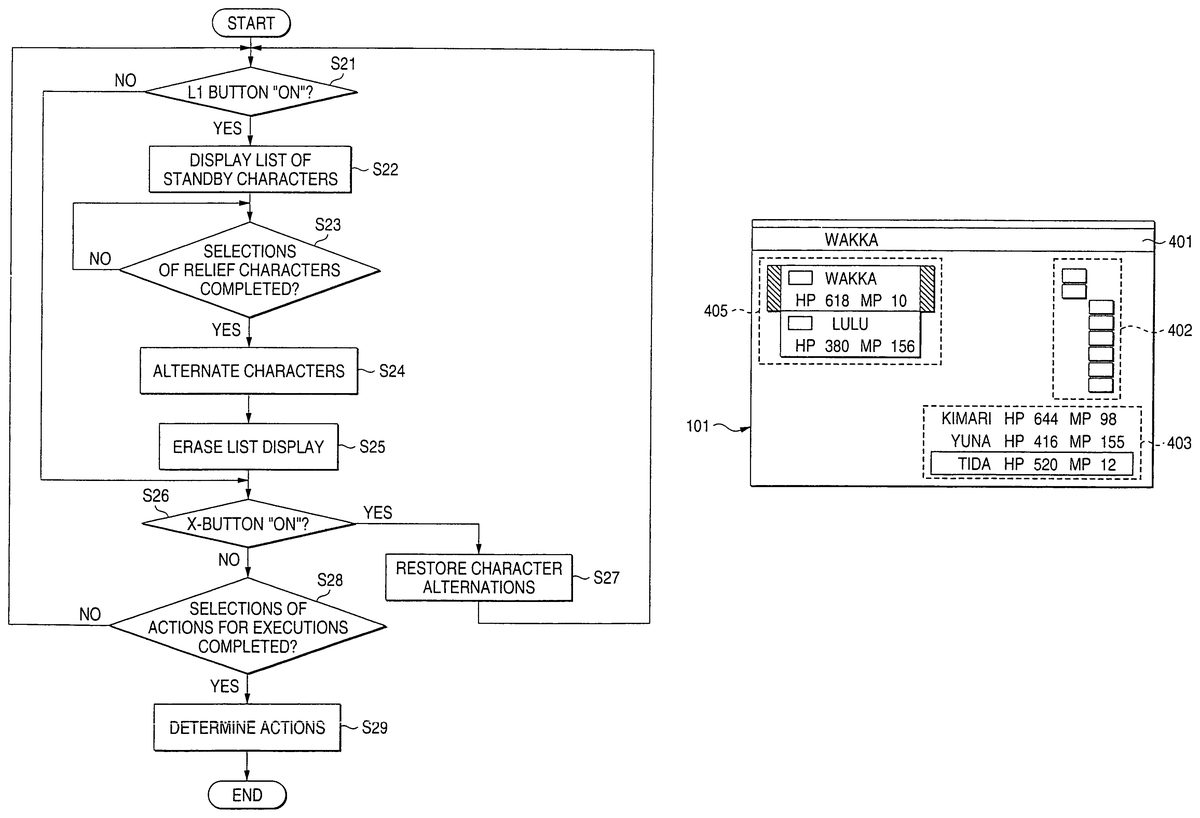
FIG. 3is a schematic flow chart showing one example of a processing routine of accepting the decisions (Step S6) on the player characters and actions in the first embodiment thus far described. Here, the individual steps inFIG. 3are designated by Step S21to Step S29as reference characters.
FIGS. 4A,4B and4C show specific examples of the display screens in the acceptances of the decisions on the player characters and actions. Regarding the operation indications, there are used the L1button53and the X-button52bof the aforementioned keypad50. The L1button53functions as a button for the procedure to alternate the player characters whereas the X-button52bfunctions as a button for canceling the alternation.
At first, it is assumed that, at the stage before the transfer to the acceptance of the decisions on the player characters and actions, as has been described herein before, the individual windows for the battle are displayed, as shown inFIG. 4A. Here inFIG. 4A, numeral401designates a window for displaying a message, and numeral402designates a window for displaying an action order. InFIG. 4A, moreover, numeral403designates a window for displaying the character data, and numeral404designates a window for displaying a command menu.
When the routine transfers to the step of accepting the decisions on the player characters and actions, moreover, it is decided at Step S21whether or not the L1button53is pushed. If it is decided that the L1button53is not pushed, the routine transfers to Step S26, at which it is decided whether or not the X-button52bis pushed. If it is decided that the X-button52bis not pushed, the routine transfers to Step S28, at which it is decided whether or not the selections of the actions to be executed by the player characters being manuplated are completed. If it is decided whether or not the selections of the actions to be executed by the player characters are not completed, the routine is returned again to Step S21, and the operations of Step S21, Step S26and Step S28are repeated to a standby state.
In this state, the L1button53is pushed; the X-button52bis pushed; or the actions to be executed by the player characters are selected. If it is decided at Step S21that the L1button53is pushed, moreover, the routine transfers to Step S22, at which a list of the standby player characters is displayed, as shown inFIG. 4B. As shown inFIG. 4B, specifically, there are displayed in a window405the names of the standby player characters, and corresponding information (e.g., the numerical values indicating a bodily power (HP) or a magical power (MP)) indicating the characteristics of the characters.
When the list display is completed, the routine transfers to Step S23, at which it is decided whether or not the selection operations of relief characters are completed. When the cursor is moved when the cross key51is moved so that the O button52ais pushed, for example, the routine transfers, while assuming that the selections of the relief characters are ended, to Step S24. At this time, the player characters are alternated, and the information indicating the characters alternated are stored and held in the predetermined region of the RAM14. Specifically, the play character now playing is changed to a relief one, and the play character in relief is changed to the play one and is stored and held. Here inFIG. 4B, it is indicated that the “TIDA” in the lowermost step is playing and that the “WAKKA” is being selected as the relief player from the standby player characters.
When the alternations of the characters are completed, the routine transfers to Step S25, at which the display of the list of standby player characters is erased, as shown inFIG. 4C, and it is indicated the present player character is the “WAKKA”. When the erasure of the list table is completed, the routine transfers to Step S26, at which time the L1button53is pushed, the X-button52bis pushed, or the standby state is continued until the selection of the actions for the player characters is executed.
If it is decided at Step S26that the X-button52B is pushed, moreover, the routine transfers to Step S27, at which time the characters are alternated. Specifically, there are read out the information indicating the relations of the changed characters which are stored and held in the predetermined data region of the RAM14and which are alternated at this time. On the basis of this information, the play characters having been alternated by the character alternation are returned to the original state.
In the case shown inFIG. 4C, specifically, the “WAKKA” or the player character to be alternated at this time is returned to the relief, and the “TIDA” is returned to the player character to restore the state shown inFIG. 4A. When the character alternations are completed, the routine is returned to Step S21, at which time the L1button53is pushed, the X-button52bis pushed, or the standby state continues until the selections of the actions for the player characters execute.
If it is decided at Step S28that the selections of the actions for the player characters being manipulated to execute are completed, the routine transfers to Step S29. Here, it is decided, when the cursor is moved by the cross key51so that the O button52ais pushed, that the selections of actions are completed, and the routine transfers to Step S29. At Step S29, the processing for executing the determined actions (or commands) is made to end the series of decision acceptances of the play characters and actions.
In other words, at the instant the routine transfers to the acceptances of decisions on the player characters and actions, there prevails the standby state in which the operations of Step S21, Step S26and Step S28are repeated until the L1button53is pushed, until the X-button52bis pushed or until the actions for the player characters to execute are selected. The routine does not transfer to the individual steps before any operation is done.
After the completion of the alternations of the player characters, the characters are instantly enabled to participate in the battle by doing predetermined actions or to restore their relations by alternating themselves. At the player character alternating time, moreover, there are displayed on the common screen the action orders of the individual characters, the data of the playing characters, the names of the standby player characters, and the data of the characters. Therefore, the player can make proper decisions on the selections of the player characters to be alternated, from the various data presented.
Therefore, the first embodiment thus far described has the following effects. According to the first effect, the procedure to alternate the player characters in the state awaiting the command input is accepted. After the character alternations, a shift is made to the state in which the actions of the player characters can be executed so that the characters can instantly participate in the battle to prevent a player's interest from lessening.
Moreover, the actions for the individual player characters to execute can be selected to perform in a more detailed setting and systematic battle.
Furthermore, the character names of the standby characters and the information indicating the characteristics of the characters are displayed in a list so that the player can confirm the states of the player characters easily and quickly.
Still moreover, the predetermined buttons can function as those to alternate and cancel the characters so that the procedure to alternate the characters can be smoothly and easily done.
While grasping the future development on the basis of the display of the action orders, the player characters are enabled to act smoothly and strategically by making the best use of the individual features of the multiple player characters.
Here, the foregoing first embodiment has been described on the case in which there are accepted the operation commands to determine the actions of the player characters and the action orders by using the cursor key51, the O button52a, the X-button52band the L1button53of the keypad50. However, it is acceptable to use other buttons. Also described is the case in which the operation commands are accepted by monitoring only the timings to push the O button52a, the X-button52band the L1button53. However, it is acceptable to accept the operation commands by using the OFF timing of the switch associated with a predetermined button and to accept the operation commands by monitoring and combining both the ON and OFF timings of the switch associated with a predetermined button. It is further acceptable to allow acceptance of the operation commands setting the alternating time periods for which the switch associated with a predetermined button is ON and OFF.
With reference to the accompanying drawings, here will be described a second embodiment in which the invention is applied to a game system including a game server and a video game machine.FIG. 5is an explanatory diagram showing the entire construction of a game system according to the second embodiment of the invention.
First of all, is described the game system according to the second embodiment of the invention. Numeral110inFIG. 5designates a network including the internet. With the network110, as shown inFIG. 5, there are connected a server group601of an internet service provider (as will be simply abbreviated into the “ISP”) and video game machines10,10a,10b,10c, . . . , and so on. Here, the video game machine10is the video game machine of the foregoing first embodiment.
The server group601of the ISP is constructed to include: an authentication server group603for account administrations for user authentications; a contents server group604for providing perusal services of contents such as voices or motion pictures; a message server group605for providing environments of chats or messengers; a mail server group606for providing services of electronic mails; a profile server group607for administrating profiles of users; and a game server group608for providing game environments. These server groups603to608are individually connected with one another through a LAN609.
Where the video game machine is to be connected with a predetermined server of the server group601of the ISP thus constructed, an access is made from the video game machine through the network110to the authentication server group603by internet protocols so that a menu screen is received by acquiring the authentication of the principal. When the player on the side of the video game machine selects the individual services displayed in the menu screen, moreover, the video game machines10,10a,10b,10c, . . . , and so on are individually connected with the server groups matching the services so that the various services can be provided.
Specifically, the game server group608includes a game progressing server618for progressing the online game. This server618is connected, when the game start is selected, with an arbitrary one of the video game machines10,10a,10b,10c, . . . , and so on so that a game screen is displayed in the display unit on the side of the video game machine with which the server618is connected. Then, the game is progressed while processing the demands in parallel from the individual video game machines connected. In this game progressing state, there is displayed in the screen not only the player character of the player himself or herself but also the character of another player who simultaneously participates in the game.
The video game machines10,10a,10b,10c, . . . , and so on thus constructed and the server618connected through the network can be individually deemed as one video game processing apparatus, so that their memory regions can be freely shared and used and so that their share of the individual CPUs can be combined in any manner by the programs read out.
In the recording medium according to the second embodiment of the invention, there are recorded the program of the video game, in which the multiple players can participate through the network so that the battle scene between the multiple player characters and at least one enemy character is controlled on the screen and which can be read out by the computer (i.e., the composite of the individual CPUs of the video game machines10,10a,10b,10c, . . . , and so on, the CPU of the server618and their peripheral circuits).
The computer is enabled, according to the program to allow some of player characters to participate in a battle scene. The program also enables the computer to display a list of standby player characters not participating in a scene such as a battle scene, in a subscreen in response to the individual operations of the multiple players while any of the player characters having participated in the scene is awaiting a command input; to select any of the player characters displayed in the subscreen, in response to the individual operations of the multiple players; and to substitute the optionally selected player character for the player characters awaiting the command input in exchanging the participation in and the standby for the scene.
The computer is further enabled to restore the positions of the alternated characters between the participation in and the standby player characters for the scene such as a battle scene in response to the individual operations of the multiple players after the play characters were alternated, and to allow the actions of the player alternated to participate in the scene, when the alternations of the player characters are completed. The computer is further enabled to display the action orders of all the characters including the player characters and the enemy character participating in the scene. Therefore, the computer has functions similar to those of the foregoing embodiment 1 and attains effects similar to those of the first embodiment even in the video game in which the multiple players participate through the network.
Here, it is apparent that the invention should not be limited to the aforementioned individual embodiments but could be suitably modified in individual embodiments within the scope of the technical concept thereof. Moreover, the common components in the individual Figures are designated by the identical reference numerals.
According to the invention, as has been described hereinbefore, the battling player character and the standby character can participate instantly as they are alternated, and the operations of the alternating procedure can be so simple as to prevent the interest from lowering.
Claims
- A computer-readable recording medium having such a program of a video game recorded to control a battle scene on a screen between a plurality of player characters and at least one enemy character, wherein said program causes the computer: to allow at least one of said player characters to participate in the battle scene;to display a list of standby player characters not participating in the battle scene, in a subscreen in response to only a single step operation of a player when a player character participating in said battle scene is awaiting a command input;to select any of the player characters displayed in the subscreen, in response to the operation of the player;and to substitute an optionally selected player character and said player character awaiting the command input.
- The computer-readable recording medium according to claim 1 , wherein in said battle scene, the player characters accept the command input in accordance with action orders and in response to the operation of the player.
- The computer-readable recording medium according to claim 1 , wherein the information of the player characters are displayed in a list on said subscreen.
- The computer-readable recording medium according to claim 3 , wherein the information of the player characters displayed in the list on said subscreen comprise player character names and bodily powers and magical powers of the player characters.
- The computer-readable recording medium according to claim 1 , wherein said program further causes said computer to restore the positions of the alternated characters between the participating and the standby player characters for said battle in response to the operation of the player after said alternations.
- The computer-readable recording medium according to claim 1 , wherein said recorded program further causes said computer to allow the actions of the player character participating in the battle by said alternations, when said alternations are completed.
- The computer-readable recording medium according to claim 1 , wherein said recorded program further causes said computer to display the action orders of all the characters including the player characters and the enemy character participating in the battle.
- A program of a video game for controlling a battle scene on a screen between a plurality of player characters and at least one enemy character, wherein said program causes a computer: to allow at least one of said player characters to participate in the battle scene;to display a list of standby player characters not participating in the battle scene, in a subscreen in response to only a single step operation of a player when a player characters participating in said battle scene is awaiting a command input;to select any of the player characters displayed in the subscreen, in response to the operation of the player;and to substitute an optionally selected player character for said player character awaiting the command input.
- The program according to claim 8 , wherein in said battle scene, the player characters accept the command input in accordance with action orders and in response to the operation of the player.
- The program according to claim 8 , wherein the information of the player characters are displayed in a list on said subscreen.
- The program according to claim 10 , wherein the information of the player characters displayed in the list on said subscreen comprise player character names and bodily powers and magical powers of the player characters.
- The program according to claim 8 , wherein said program further causes said computer to restore the positions of the alternated characters between the participating and the standby player characters for said battle in response to the operation of the player after said alternations.
- The program according to claim 8 , wherein said program further causes said computer to allow the actions of the player having participated in the battle by said alternations, when said alternations are completed.
- The program according to claim 8 , wherein said program further causes said computer to display the action orders of all the characters including the player characters and the enemy character participating in the battle.
- A video game processing method for controlling a battle scene on a screen between a plurality of player characters and at least one enemy character, comprising: allowing at least one of said player characters to participate in the battle scene;displaying a list of standby player characters not participating in the battle scene in a subscreen in response to only a single step operation of a player when a player characters participating in said battle scene is awaiting a command input;selecting any of the player characters displayed in the subscreen, in response to the operation of the player;and substituting said optionally selected player character for said player character awaiting the command input.
- The video game processing method according to claim 15 , wherein in said battle scene, the player characters accept the command input in accordance with action orders and in response to the operation of the player.
- The video game processing method according to claim 15 , wherein the information of the player characters is displayed in a list on said subscreen.
- The video game processing method according to claim 17 , wherein the information of the player characters displayed in the list on said subscreen comprises player character names and bodily powers and magical powers of the player characters.
- The video game processing method according claim 15 , further comprising: restoring the positions of the alternated characters between the participating and the standby player characters for said battle in response to the operation of the player after said alternations.
- The video game processing method according to claim 15 , further comprising: allowing the actions of the player having participated in the battle by said alternations, when said alternations are completed.
- The video game processing method according to claim 15 , further comprising: displaying the action orders of all the characters including the player characters and the enemy character participating in the battle.
- A video game processing apparatus comprising: a storage system that stores a program of a video game to control a battle scene on a screen between a plurality of player characters and at least one enemy character;a computer that executes the program read from said storage system;and a display unit provided as the output of said computer for the screen display, wherein said computer executes said program: to allow at least one of said player characters to participate in the battle scene;to display a list of standby player characters not participating in the battle scene, in a subscreen in response to only a single step operation of a player when a player characters participating in said battle scene is awaiting a command input;to select any of the player characters displayed in the subscreen, in response to the operation of the player;and to substitute an optionally selected player character for said player character awaiting the command input.
- The video game processing apparatus according to claim 22 , wherein in said battle scene, the player characters accept the command input in accordance with the action orders and in response to the operation of the player.
- The video game processing apparatus according to claim 22 , wherein the information of the player characters are displayed in a list on said subscreen.
- The video game processing apparatus according to claim 24 , wherein the information of the player characters displayed in the list on said subscreen comprise player character names, bodily powers, and magical powers of the player characters.
- The video game processing apparatus according to claim 22 , wherein said computer further executes said program to restore the positions of the alternated characters between the participating and the standby player characters for said battle in response to the operation of the player after said alternations.
- The video game processing apparatus according claim 22 , wherein said computer further executes said program to allow the actions of the player having participated in the battle by said alternations, when said alternations are completed.
- The video game processing apparatus according to claim 22 , wherein said computer further executes said program to display the action orders of all the characters including the player characters and the enemy character participating in the battle.
- A computer-readable recording medium having a program of a video game recorded to allow a plurality of players to participate in the video game through a network and to control a battle scene on a screen between a plurality of player characters and at least one enemy character, wherein said program causes the computer: to allow at least one of said player characters to participate in the battle scene;to display a list of standby player characters not participating in the battle scene, in a subscreen in response to only a single step operations of one of the players when a player characters participating in said battle scene is awaiting a command input;to select any of the player characters displayed in the subscreen, in response to the operations of the players;and to substitute an optionally selected player character for said play character awaiting the command input.
- A program of a video game for allowing a plurality of players to participate in the video game through a network and for controlling a battle scene on a screen between a plurality of player characters and at least one enemy character, wherein said program causes a computer: to allow at least one of said player characters to participate in the battle scene;to display a list of standby player characters not participating in the battle scene, in a subscreen in response to only a single step operation of one of the multiple players when a player character participating in said battle scene is awaiting a command input;to select any of the player characters displayed in the subscreen, in response to the individual operations of the multiple players;and to substitute an optionally selected player character for said player character awaiting the command input.
- A video game processing method that allows a plurality of players to participate in the video game through a network and for controlling a battle scene on a screen between a plurality of player characters and at least one enemy character, comprising: allowing at least one of said player characters to participate in the battle scene;displaying a list of standby player characters not participating in the battle scene, in a subscreen in response to only a single step operation of one of the multiple players when a player character participating in said battle scene is awaiting a command input;selecting any of the player characters displayed in the subscreen, in response to the individual operations of the multiple players;and substituting an optionally selected player character for said player character awaiting the command input.
- A video game processing apparatus comprising: a storage system that stores a program to allow a plurality of players to participate in a video game through a network and to control a battle scene on a screen between a plurality of player characters and at least one enemy character;a computer for executing a program read from said storage system;and a display unit provided as an output system of said computer for the screen display, wherein said computer executes said program: to allow at least one of said player characters to participate in the battle scene;to display a list of standby player characters not participating in the battle scene, in a subscreen in response to only a single step operation of one of the multiple players when a player character participating in said battle scene is awaiting a command input;to select any of the player characters displayed in the subscreen, in response to the individual operations of the multiple players;and to substitute an optionally selected player character for said player character awaiting the command input.
Disclaimer: Data collected from the USPTO and may be malformed, incomplete, and/or otherwise inaccurate.