DESCRIPTION OF EXEMPLARY EMBODIMENT OF THE INVENTION FIG. 2is a simplified block diagram of a system200for providing user input for animated character display according to one embodiment of the present invention. InFIG. 2, system200illustrated as operatively coupled to an Animation Display System (ADS) configured to receive skeletal animation data and a Skeletal Display System (SDS) configured to receive skeletal vertex mapping data from the ADS. It should be apparent thatFIG. 2is a high-level system description of a preferred embodiment and that many other approaches to character animation and control can be used. In general, any suitable system providing user interface, control, animation and display functions, or portions thereof, can be suitable for use with the present invention. Examples of such systems include general purpose computers such as personal computers, workstations, etc.; game consoles, handheld computing devices, arcade games, simulators, etc. Such systems can be standalone or networked. Various hardware architectures such as multiprocessing, distributed processing, dedicated logic, etc., can be used. Various software approaches can be employed including compiled or interpreted code, firmware, microcode, etc. Functions of the invention can be performed in hardware or software, as desired. For ease of illustration, aspects of the present invention are described with respect to an animated golfer. However, it should be apparent that the present invention can be used to provide user input for the display of any animated character, including two-dimensional and three-dimensional animated characters such as in sports or athletic events. Other applications are possible as where a system is used to study anatomy, physical kinematics, to develop models or animation sequences, for simulation purposes, etc. System200includes analog input module202, control state machine module204and animation state machine module (206). Analog input module202is configured to receive user analog input. As used in the present application, “analog input” refers to time-based or ...
DESCRIPTION OF EXEMPLARY EMBODIMENT OF THE INVENTION
FIG. 2is a simplified block diagram of a system200for providing user input for animated character display according to one embodiment of the present invention. InFIG. 2, system200illustrated as operatively coupled to an Animation Display System (ADS) configured to receive skeletal animation data and a Skeletal Display System (SDS) configured to receive skeletal vertex mapping data from the ADS. It should be apparent thatFIG. 2is a high-level system description of a preferred embodiment and that many other approaches to character animation and control can be used.
In general, any suitable system providing user interface, control, animation and display functions, or portions thereof, can be suitable for use with the present invention. Examples of such systems include general purpose computers such as personal computers, workstations, etc.; game consoles, handheld computing devices, arcade games, simulators, etc. Such systems can be standalone or networked. Various hardware architectures such as multiprocessing, distributed processing, dedicated logic, etc., can be used. Various software approaches can be employed including compiled or interpreted code, firmware, microcode, etc. Functions of the invention can be performed in hardware or software, as desired.
For ease of illustration, aspects of the present invention are described with respect to an animated golfer. However, it should be apparent that the present invention can be used to provide user input for the display of any animated character, including two-dimensional and three-dimensional animated characters such as in sports or athletic events. Other applications are possible as where a system is used to study anatomy, physical kinematics, to develop models or animation sequences, for simulation purposes, etc.
System200includes analog input module202, control state machine module204and animation state machine module (206). Analog input module202is configured to receive user analog input. As used in the present application, “analog input” refers to time-based or time-changing signals that are more continuous than discrete. For example, an analog joystick might use potentiometers to output a voltage level that is converted to a digital number via an analog-to-digital converter. Thus, the x-y position of the joystick is represented by numbers that can change continuously in real time. This is distinguished from an instantaneous type of input, such as a switch or button, that merely indicates one of two states. Other types of analog inputs can be pressure sensitive (e.g., a resistive or capacitive load cell), distance or position detection using infrared, acoustic, radio frequency or other methods, image sensing, etc.
A preferred embodiment of the invention normalizes the user analog input. For example, joystick movement can be calibrated so that the full extent of a vertical motion is determined and used to set upper and lower bounds for vertical position values. For example, analog input module202can receive user analog input (i.e., values) from a user analog control stick and then pass the values through a filter function to normalize the values. In a preferred embodiment, analog input module202is configured such that the receiving and normalization is conducted in real-time, as is known in the art.
If desired, analog input module202can also be configured to model and/or filter the values to, for example, compensate for poor quality of the user analog input. Furthermore, the analog user input can pass the values through a calibration routine. Other processing, calibration or conditioning of the input signals or values can be performed, as desired.
The preferred embodiment uses the display “base frame rate” (BFR) as a timing reference. The BFR is usually the rate at which frames are displayed to a user on a display device. For example, in video-based systems the BFR is near 30 frames per second (fps). It can be desirable to operate the analog input module at a BFR of the associated animation display system, as this will avoid potential problems with time-based controller aliasing causing unwanted artifacts elsewhere in the system or in the associated analog display system. Alternatively, an interpolator function running at the BFR, but separated from a base analog input module thread, can be used for receiving the analog user input.
Control state machine module204is configured to receive normalized user analog input from analog input module202and create a time-based state based on the received normalized analog input. Control state machine module204creates the time-based state such that it models the intent of the user with respect to an animated character being displayed by the animation display system.
In the golf game example a user may provide input related to (i) a neutral swing position of the animated golfer; (ii) a back swing of the animated golfer associated with a user pulling back an analog joystick; and (iii) a forward swing of the animated golfer associated with the user pushing the analog joystick forward. Since there is no physical concept of a forward swing without a back swing, the control state machine module can be configured, for example, to analyze a user's back and forward movements of the analog joystick over time to determine if they correspond to a complete swing, and if so, to pass a corresponding time-based state data to animation state machine206. For instance, if the user pushes forward on the analog joystick without pulling back first, the control state machine module can disregard the normalized user analog input created from such a user's input. If, however, the user pulls all the way back on the analog joystick and then returns the analog stick to the neutral position, the control state machine module can consider that the user's intention is a test swing and will send the appropriate time-based state to the animation state machine module.
In the embodiment ofFIG. 2, control state machine module204is configured to operate at the BFR of the associated animation display system and therefore updates the animation state (i.e., the time-based state) at the same frequency as the animation display system. Control state machine module204can also be configured such that “external factors” are incorporated in the time-based state. For instance, for an animated golfer in a video golf game, the choice of club may be handled automatically by the programmed game logic. When the user's ball is on the tee, then the game logic will automatically select a driver. However, when the user's ball is on the green, the game logic may select a putter. This is an example of an external input—the user will still be moving the stick back and forth to simulate a golf swing, but the Control state machine will ensure that the user's animated golfer either swings with a driver or putts correctly, depending on the circumstance.
Animation state machine module206is configured to receive the time-based state from the control state machine module, to create a list of animations and a blending percentage used for combing the list of animations based on the time-based state and to provide the list of animations and blending percentage to the analog display system for use in character animation.
For example, in the circumstance that system200is providing user input to an animated golfer, animation state machine module206can create, based on the time-based state, an animation list that includes a single back swing animation and a single forward swing animation each blended (i.e., combined) at 100%. Alternatively, animations state machine206can create an animation list that includes a plurality of animations, each with its own relative blending percentage. This is an advantage because the variety of user inputs far outweighs the ability to provide a unique animation for each one. By using a subset of animations representing the limits of the required animation range and a percentage blending factor between each range, an limited set of animations can cover the entire range of user input, For example, an animated golfer from a golf simulation video game, the animation state machine module may create a list of animations that includes a hook animation (A) and a slice animation (B) and a blending percentage (n). By blending those animations together using the equation:
A*n+B*(1−n)
where n is the blending percentage, the animation state machine module can provide for numerous variations between a hook and a slice in the character animation. If n is set to 0 then the user will hook the shot, if n is set to 1 then the user will slice and if n is set to 0.5, then the user will hit a straight shot. The ability to provide numerous variations (based on a list of animations and a blending percentage(s)) that model a user's intention in real-time provides a user with an exceptional level of control and feeling of feedback with respect to the character's animation.
In the embodiment ofFIG. 2, animation state machine206is also configured to track the system's position in an animation cycle. Such tracking is beneficial since control state machine module204can cause non-linear time changes in the animation (e.g., when a user moves a joystick faster or slower to simulate different swing speeds of an animated golfer). Since, animation display system systems are time-based systems, where the next frame to be displayed is displayed n time units from the current one, the ability to move forward or backward during character animation requires that system200have the ability to track the current position in the animation so it can pass the correct time-period for the next frame. This non-linear aspect of system200allows system200to provide an extremely accurate modeling of user intent.
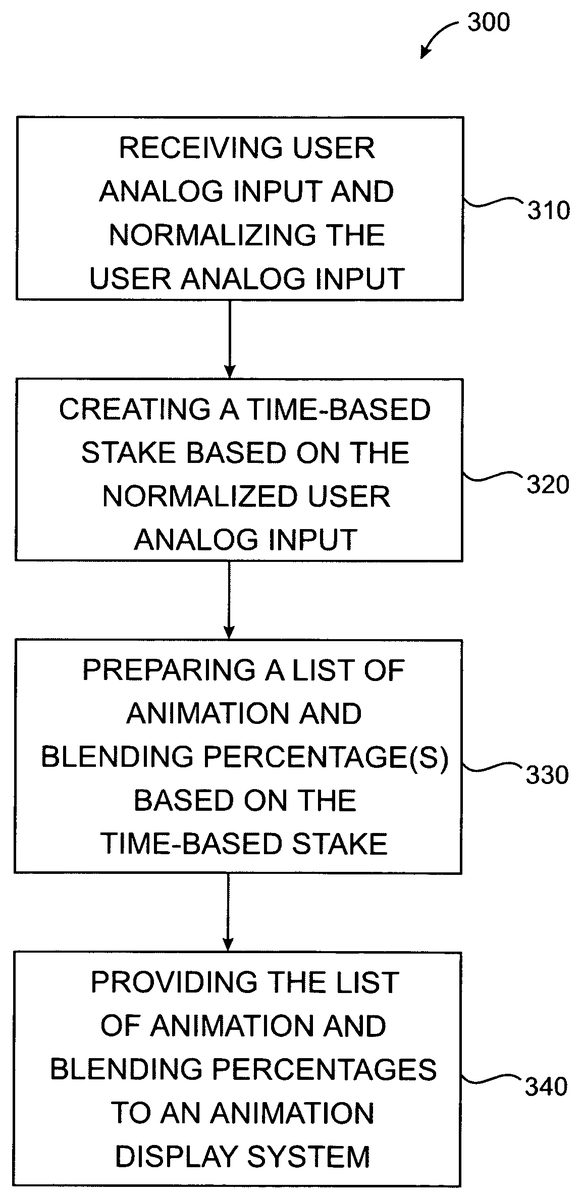
FIG. 3is a flow chart, respectively, illustrating a sequence of steps in a process300according to one exemplary embodiment of the present invention providing user input for animated character display on an animation display system (e.g., a video game display system or a three-dimensional animation display system). The process includes first receiving user analog input related to animated character display and normalizing the user analog input, thereby creating normalized user analog input (see step310ofFIG. 3). The user analog input can be received from, for example, an analog joystick and the receiving and normalization can proceed at a BFR of the animation display system.
Subsequently, a time-based state is created based on the normalized user analog input, as noted at step320ofFIG. 3. This time-based state models an intent of the user with respect to the animated character. Referring top step330, a list of animations and a blending percentage(s) for combining the list of animations based on the time-based state is then prepared. At step340, the list of animations and blending percentage(s) are then provided to an animation display system for controlling character animation. The animation display system can employ a skeletal display system, bones, joints, and skeletal vertex mapping along with the list of animations and blending percentages when during character animation display.
Methods according to the present invention can be implemented, for example, on system200described above or other suitable systems. Furthermore, each of the receiving, creating, preparing and providing steps can be created at a BFR or a multiple of a BFR of the animation display system.
It should be understood that various alternatives to the embodiments of the invention described herein may be employed in practicing the invention. For example, although the invention has been discussed primarily with respect to a joystick user input device, any type of user input device can be used such as a keyboard or keypad, digitizing tablet, trackball, touch-screen, light pen, motion or position sensing, etc.
It is intended that the following claims define the scope of the invention and that structures and methods within the scope of these claims and their equivalents be covered thereby.