U.S. Pat. No. 6,976,918
VIDEO GAME THAT INTERPOLATES BETWEEN ANIMATED SEGMENTS TO CREATE NEW SEGMENTS
AssigneeKonami Corporation
Issue DateJanuary 23, 2001
Illustrative Figure
Abstract
A video game device is provided with a recording medium 122 storing a first image data group including a plurality of frames of image data for displaying a running action and a second image data group including a plurality of frames of image data for displaying a goal finishing action which successively follows the running action; a character display control unit 201e for reading the first and second image data group from the recording medium 122 and displaying motions of a play character based on the read image data, and a switch control unit 201h for switching the first image data group to the second image data group such that the running action and the goal finishing action are successively displayed without any discontinuity when the play character reaches a predetermined position by repeatedly displaying the running action. With such a video game device, an increase in production costs can be effectively suppressed, and a game player is prevented from having a feeling of incongruity while viewing displayed images.
Description
DETAILED DESCRIPTION OF THE PREFERRED EMBODIMENTS OF THE INVENTION FIG. 1is a diagram showing the schematic construction of a video game system (video game device)10to which a character action setting method according to one embodiment of the present invention is applied. InFIG. 1, the video game system10is provided with a memory unit12, an image display unit14, a sound output unit16, an operation input unit18and a control unit20. The units12,14,16and18are connected with each other via a bus22including address buses, data buses and control buses connected with a CPU201of the control unit20to be described later. In the memory unit12are stored game data comprised of image data, sound data and program data. The memory unit12includes a recording medium (also referred to as a recording medium)122connected with the bus22via an interface circuit121and a RAM123for temporarily storing the game data read from the recording medium122. The recording medium122is, for example, a so-called ROM cassette in which a ROM or like recording medium storing game data and program data of an operating system is accommodated in a plastic casing, an optical disk, or a flexible disk. The image display unit14is adapted to display various game images in accordance with the progress of the game and includes a digital-to-analog (D/A) Converter142connected with the bus22via an interface circuit141and a television monitor (video monitor)143including a CRT, a liquid crystal display or the like connected with the D/A converter142. The sound output device16is adapted to output a game music, sound effects, etc. in accordance with the progress of the game and is provided with a D/A converter162connected with the bus22via an interface circuit161, an amplifying circuit163connected with the D/A converter162, and a loudspeaker164for outputting sounds in accordance with an output signal from the amplifying circuit163. The operation input unit18is adapted to output operation signals to the control unit20and is provided ...
DETAILED DESCRIPTION OF THE PREFERRED EMBODIMENTS OF THE INVENTION
FIG. 1is a diagram showing the schematic construction of a video game system (video game device)10to which a character action setting method according to one embodiment of the present invention is applied. InFIG. 1, the video game system10is provided with a memory unit12, an image display unit14, a sound output unit16, an operation input unit18and a control unit20. The units12,14,16and18are connected with each other via a bus22including address buses, data buses and control buses connected with a CPU201of the control unit20to be described later.
In the memory unit12are stored game data comprised of image data, sound data and program data. The memory unit12includes a recording medium (also referred to as a recording medium)122connected with the bus22via an interface circuit121and a RAM123for temporarily storing the game data read from the recording medium122. The recording medium122is, for example, a so-called ROM cassette in which a ROM or like recording medium storing game data and program data of an operating system is accommodated in a plastic casing, an optical disk, or a flexible disk.
The image display unit14is adapted to display various game images in accordance with the progress of the game and includes a digital-to-analog (D/A) Converter142connected with the bus22via an interface circuit141and a television monitor (video monitor)143including a CRT, a liquid crystal display or the like connected with the D/A converter142.
The sound output device16is adapted to output a game music, sound effects, etc. in accordance with the progress of the game and is provided with a D/A converter162connected with the bus22via an interface circuit161, an amplifying circuit163connected with the D/A converter162, and a loudspeaker164for outputting sounds in accordance with an output signal from the amplifying circuit163.
The operation input unit18is adapted to output operation signals to the control unit20and is provided with an operational information interface circuit182connected with a bus22via an interface circuit181, and a controller183connected with the operational information interface circuit182. The controller183includes a start button183a,an A-button183b,a B-button183c,a cross-shaped key183d,a stick-shaped controller183e,a C1-button183h,a C2-button183i,a C3-button183jand a C4-button183kprovided on the front surface of a casing CA, a left trigger button183fand a right trigger button183gprovided on the upper surface of the casing CA, and a Z-button183mprovided on the rear surface of the casing CA.
The stick-shaped controller183ehas substantially the same construction as a joystick. Specifically, the controller183ehas a standing stick (operation bar), which can be inclined to front, back, left, right or in any direction in a 360° range about a specified point of the stick as a supporting point. According to the direction and angle of inclination of the stick, an X-coordinate along transverse direction and a Y-direction along forward/backward direction in coordinate systems having the standing position of the stick as an origin are sent to the control unit20via the interface circuits182and182.
The control unit20is adapted to control the progress of the game, and is comprised of the CPU201connected with the bus22, a signal processor202and an image processor203. The signal processor202mainly performs calculation of image data in a three-dimensional (3D) space, calculation for transforming a position in the 3D space to a position in a simulated 3D space, a light source calculation, and generation and processing of sound data. The image processor203writes an image data to be displayed in the RAM123based on the calculation results in the signal processor202. For example, the image processor202writes a texture data in an area of the RAM123specified by a polygon.
The video game system10, thus constructed takes different modes according to its application. Specifically, in the case that the video game system10is constructed for business use, all the elements shown inFIG. 1are, for example, contained in one casing. In the case that the video game system10is constructed for home use, the television monitor143, the amplifying circuit163and the loudspeaker164are separate from a main game unit.
Here, the main game unit is, for example, comprised of the interface circuit121connected with the CPU201, the RAM123, the interface circuit141, the D/A converter142, the interface circuit161, the D/A converter162, the interface circuit181, the operational information interface circuit182, the controller183, the signal processor202and the image processor203. This main game unit is constructed by accommodating the respective elements in a casing made of a synthetic resin, and the recording medium122is detachably mounted in a mounting portion formed in this casing. The controller183is connected with a connector provided in the casing via a communication cable or the like.
In the case that the video game system10is constructed with a personal computer or a workstation as a core, for example, the television monitor143corresponds a computer display, the image processor203corresponds to part of the game program data stored in the recording medium122or hardware on an extension board mounted on an extension slot of the computer, and the interface circuits121,141,161,181, the D/A converters142,162, and the operational information interface circuit182correspond to hardware on the extension board mounted on the extension slot of the computer.
A case where the video game system10is constructed for home use is described below.
Next, the operation of the video game system10is summarily described. First, when an unillustrated power switch is turned on to activate the video game system10, the CPU201reads image data, sound data and dame program data from the recording medium122in accordance with the operating system stored in the recording medium122, and all or part of the read image data, sound data and same program data are stored in the RAM123. Thereafter, a specified game is proceeded by the CPU201in accordance with the game program data stored in the RAM123and contents of instructions given by a game player via the controller183.
Specifically, commands as tasks for forming images and outputting sounds are generated in accordance with contents of instructions given by a game player via the controller183. The signal processor202performs calculation of display positions of characters in the 3D space (of course the same applies for a two-dimensional space), a light source calculation, generation and processing of sound data, etc. in accordance with these commands.
Data of images to be formed are written in the RAM123by the image processor203based on the calculation results. The image data written in the RAM123are fed to the D/A, converter142via the interface circuit141, and fed to the television monitor143after being converted into analog video signals in the D/A converter142, thereby being displayed as game images on a display surface of the television monitor143.
On the other hand, the sound data outputted from the signal processor202are fed to the D/A converter162via the interface circuit161and outputted as sounds from the loudspeaker164via the amplifying circuit163after being converted into analog sound signals in the D/A converter162.
Next, contents of the game executed in the video game system10are summarily described. In this video game system10, one game can be selected from a plurality of competition gas by operating the start button183a.Here, a 100M dash game which is a field and track game in which six play characters as runners compete a 100M dash on a track for competition.
In this embodiment, this 100M dash game is played by one to four game players; the running speeds of the number of the play characters corresponding to that of the game players are controlled by operation of the game players; the motions of the remaining play characters are controlled based on data set in advance and ranking is determined based on the order of reaching the finishing line.
The play character who comes in first raises his hands as a victory pose immediately before reaching the goal. In this occasion, the motion of the arms during running is smoothly successively transitioned to that of the victory position without causing the game play to have any feeling of incongruity.
Next, a display example of a game screen when the 100M dash game is executed is described with reference toFIG. 2. The game screen shown inFIG. 2is one screen at an intermediate stage of the actual 100M dash game. Specifically, in this game screen, six play characters MA running on the respective courses of a track TR are displayed in the middle, and runner columns KS for introducing the play characters MA operated by the game players are displayed at the bottom end of the game screen.
The runner columns KS are set in correspondence with four game players, and as many runner columns KS as the game participants are displayed. Here is shown a case where the game is played by one game player. “1P” representing the first play character MA and “national flag of the USA” representing the nation to which the play character MA belongs are displayed at the upper part of the runner column KS at the left end, and “Blade” as the name of the player character MA is displayed at the lower part.
The play character MA is generated as one animated model including all motions including those of a head, a trunk, legs and arms; its motions (poses) are displayed by giving an animation display timing; and movements of its position are displayed by giving a transport data. Here, the animated model is a model generated by polygons and displayed in the game space, and includes motion data (animation data) along a time axis. Specifically, by giving an arbitrary time (animation display timing) to the animated model, a motion in conformity with the animation display timing is displayed, and a series of animation is configured by successively increasing motions. The transport data is a relative position information of XYZ-coordinates given to the animated model. The animated model can be displayed in any arbitrary position of the game space by giving this transport data to the animated model.
A power display column (power meter) PD for displaying “running power” is so displayed as to extend obliquely upward to the right from the right end of the runner column KS. The “running power” is increased when the game player alternately and continuously turns on two operable members of the controller183such as the C1-button183hand the C2-button183i(continuous hitting). The higher the displayed level of the running power, the faster the play character MA can run.
The level of the running power is displayed by coloring the power display column PD in chromatic colors, and the colored area is increased as the level increases. The power display column PK is first colored in a cold color (e.g. blue), and the color tone changes toward a warm color (e.g. red) as the running power increases. In the already colored area as well, the color tone gradually changes toward a warm color. InFIG. 2, the level of the running power is displayed in dots.
FIG. 3is a diagram showing, an image of the play character MA posing a start on the game screen, in which both hands and the right knee are on the ground.FIGS. 4 to 20are diagrams showing images of the running action of the play character MA on the game screen after a series of motions made to stand up from the starting pose. In other words, a looped running animation is shown inFIGS. 4 through 20. The looped animation is an animation which returns to the starting motion by resetting the animation display timing to 0 upon reaching the end. A smooth and continuous animation can be obtained by repeatedly reproducing the looped animation.
FIG. 4shows a state where the right log is brought forward by kicking the ground by the left leg, the left arm is pushed upward to the front while being bent substantially at 90°, and the right arm is pulled back.FIG. 5shows a state following the state ofFIG. 4, where the right leg brought forward touches the ground, and the left arm is pushed further upward to the front.
FIG. 6shows a state following the state ofFIG. 5, where the right leg brought forward touches the ground while substantially stretched out, and the left arm is pushed even further upward to the front.FIG. 7shows a state following the state ofFIG. 6;FIG. 8shows a state following the state ofFIG. 7;FIG. 9shows a state following the state of FIG8;FIG. 10shows a state following the state ofFIG. 9;FIG. 11shows a state following the state ofFIG. 10; andFIG. 12shows a state following the state ofFIG. 11.
FIG. 13shows a state following the state ofFIG. 12. InFIG. 13, the left leg is bought forward while being bent by kicking the ground by the right leg, the left arm is pulled down to the back, and the right is pushed up forward while being bent substantially at 90°.FIG. 14shows a state following the state ofFIG. 13, where the left leg brought forward touches the ground, and the right arm is pushed further upward to the front.FIG. 15shows a state following the state ofFIG. 14, where the left leg brought forward touches the ground while substantially stretched out, and the right arm is pushed even further upward to the front.FIG. 16shows a state following the state ofFIG. 15, andFIG. 17shows a state following the state ofFIG. 16.
FIG. 18shows a state following the state ofFIG. 17, andFIG. 19shows a state following the state ofFIG. 18.FIG. 20shows a state following the state ofFIG. 19, where the left leg kicks the ground, the right leg brought forward is almost touching the ground, and the left arm is pushed forward while being bent substantially at 90°. A series of running motions can be displayed by returning to the state ofFIG. 4from the state ofFIG. 20. In other words, a running action corresponding to an arbitrary distance can be displayed by repeatedly displaying a group of images (looped running animation) as one unit comprised of 17 frames of images. In this embodiment, a running distance (moved amount) of the play character MA reached when 17 frames of images are displayed once is set at a constant value regardless of the running speed.
FIGS. 21 through 39are diagrams showing a goal finishing action which follows the running action shown inFIGS. 4 through 20. For example, a series of motions for the goal finishing action are constituted by 19 frames of images. In other words, a goal finishing animation is constituted by images ofFIGS. 21 through 39.FIG. 21shows a state following the state ofFIG. 4, where the right leg is almost touching the ground, and the raised left arm starts moving downward.FIG. 22shows a state where the right leg touches the ground, the left arm is being moved downward, and the right arm is pulled back.
FIG. 23shows a state following the state ofFIG. 22;FIG. 24shows a state following the state ofFIG. 23; andFIG. 25shows a state following the state ofFIG. 24, where the right leg kicks the ground, the left arm is pushed slightly forward, and the right arm is pulled back.FIG. 26shows a state following the state ofFIG. 25, andFIG. 27shows a state following the state ofFIG. 26, where the left leg touches the ground, and both arms are pulled back to be raised.FIG. 28shows a state following the state ofFIG. 27, where the pulled-back arms start being raised.
FIG. 20shows a state following the state ofFIG. 28, andFIG. 30shows a state following the state ofFIG. 29, where the both arms are gradually raised.FIG. 31shows a state following the state ofFIG. 30, where the chest starts being stuck out forward while the arms are further being raised.FIG. 32shows a state following the state ofFIG. 31, where the chest is further stuck out forward immediately before the play character MA reaches the goal.FIG. 33shows a state following the state ofFIG. 32, where the goal is reached with the chest stuck out, and both arms are further raised.
FIG. 34shows a state following the state ofFIG. 33, where the play character MA stretches both hands sideways and raises slightly up after passing the goal.FIG. 35shows a state following the state ofFIG. 34;FIG. 36shows a state following the state ofFIG. 35;FIG. 37shows a state following the state ofFIG. 36; andFIG. 38shows a state following the state ofFIG. 37.FIG. 39shows a state following the state ofFIG. 38and corresponding to the final frame of the goal finishing action. InFIGS. 37 to 39, the play character M shows a victory pose by raising his hands up.
Image data for displaying images showing the starting action shown inFIG. 3and the running action shown inFIGS. 4 through 20(looped running animation) and the goal finishing action shown inFIGS. 21 through 39are stored in the recording medium122.
FIG. 40is a block diagram showing function realizing means of the CPU201when the 100M dash game is executed, the recording medium122, the RAM123, the television monitor143and the controller183(start button183a,A-button183b,C1-button183hand C2-button183i). Here, the interface circuits and buses are not shown in order to facilitate the description.
Specifically, the CPU201, is provided with the respective function realizing means as a start button operation detecting unit201a,an A-button operation detecting unit201b,a C1-button operation detecting unit201c,a C2-button operation detecting unit201d,a character display control unit201e,a runner column display unit201f,a running power display unit201gand a switch control unit201h.The switch control unit201his provided with respective function realizing means as a character speed detecting unit201i,a Δa calculating unit201j,a Δν calculating unit201k,an animation display timing setting unit201m,a transport data setting unit201n,an arrival detecting unit201p,an end animation detecting unit201q,an animation display timing subtracting unit201rand an animation switching unit201s.
The start button detecting unit201adiscriminates whether the start button183ahas been turned on or off in accordance with an operation signal from the start button183a.A specified game is selected when the start button183ais turned on. The A-button operation detecting unit201bdiscriminates whether the A-button183bhas been turned on or off in accordance with an operation signal from the A-button183b.The start of the game is enabled when the A-button183bis turned on.
The C1-button operation detecting unit201cdiscriminates whether the C1-button183hhas been turned on or off in accordance with an operation signal from the C1-button183h.The C2-button operation detecting unit201ddiscriminates whether the C2-button183ihas been turned on or off in accordance with an operation signal from the C2-button183i.In other words, every time the C1-button183hand the C2-button183iare alternately and continuously turned on/off, the running power changes according to an operation amount per unit time.
The character display control unit201econtrols the display of the play character MA as the game is proceeded, and reads game screens corresponding to the game content from the RAM123and outputs them to the television monitor143. The character display control unit201eis also provided with functions of generating now image data for interpolating successive frames using image data (used to display images shown inFIGS. 4 through 20) prepared beforehand and constituting the looped running animation if necessary, and displaying the images based on the generated image data.
The runner column display unit201fdisplays contents corresponding to the play character in the runner column KS. The power display unit201gdisplays the running power generated according to the operated amounts of the C1-button183hand the C2-button183ievery time these buttons are alternately and continuously turned on and off by coloring the power display column PD in chromatic colors.
The switch control unit201hswitches a first image data group (looped running animation) to a second image data group (goal finishing animation) such that the running action (first action) and the goal finishing action (second action) are successively displayed without any discontinuity (i.e. the running action is smoothly transitioned to the goal finishing action) when the play character MA reaches a specified position set beforehand. Specifically, if the play character MA is a first runner when arriving the predetermined position before the goal (e.g. 2 m before the goal), he is displayed to start taking a victory pose by raising both hands. In this case, the switch control unit201hexecutes such a switch control that the motions of the legs and arms of the play character MA are continuous when the running action is transitioned to the goal finishing action. The goal finishing action for the play characters MA other than the first runner stops when they pass the goal.
The character speed detecting unit201idiscriminates the running speed of the play character MA in accordance with the number of signals outputted from the controller183since the running speed changes according to the operated amount of the controller183by the game player (the less operated amount, the slower, whereas the more operated amount, the faster).
The Δa calculating unit201jcalculates a change amount of animation “Δa” defined as how much an animation data of the motion along the time axis of the play character MA (animated model) advances within a predetermined period ( 1/60 sec.). In other words, the delta animation “Δa” can be defined as an amount of change of animations from a previous animation frame at a certain time (t) to an animation to be shown at a given time incremented with a predetermined time (t+Δt). Where “Δt” can be any given set time period such as 1/60 seconds but not limited thereto. Specifically, the running speed (moving speed) of the play character MA changes according to the operated amount of the controller183by the game player. However, if a plurality of frames of image data prepared at first for displaying the running action are used as they are, no smooth motion corresponding to a change of the running speed cannot be displayed. Thus, the delta animation Δa is used to generate new image data by interpolation based on the image data (image data used for displaying the images ofFIGS. 4 through 20) prepared beforehand. This delta animation Δa is calculated by multiplying the level of the running power given according to the operated amount of the controller183by a predetermined coefficient (this coefficient is set when the game is designed).
The running action of the play character MA is executed at a basic speed set in advance even if the operated amount of the controller183is zero. On the other hand, when the controller183is operated, a running speed corresponding to the operated amount is added to the basic speed and the running action of the play character MA is executed at the resulting speed. Although all the frames set at first are used in the looped running animation in the case that the running action of the play character MA is executed at the basic speed, the number of frames constructing the looped running animation is reduced as the running speed is accelerated.
The Δv calculating unit201kcalculates a moved amount (transport data) Δv of the play character MA within the time period corresponding to the time period during which the change of delta animation Δa takes place. This Δv is calculated as follows. A coefficient Δav of Δv corresponding to the game content is set in view of Δa when the game is designed, and Δv is calculated by Δv=Δa×Δav based on the newly calculated Δa.
The coefficient Δav is set as follows.
Now, it is assumed that A denotes the last animation display timing of the looped running animation. L denotes a distance over which the looped running animation is repeated (i.e. a distance from a reference position which is a position where the first frame of the looped running animation is displayed to the predetermined position before the goal), and n (integer) denotes the number of times the looped running animation is repeated over the distance L, a distance l (i.e. unit moved distance) the play character MA runs by executing (reproducing) the looped running animation once is l=L/n.
This distance l is obtained by multiplying A by a certain coefficient, which is set at Δav. In other words, since l=A×Δav, the coefficient Δav is calculated by Δav=l/A=(L/n)/A.
It should be noted that the distance l (unit moved distance) is set at a constant value regardless of the running speed of the play character MA, and the distance between the reference position and the predetermined position (e.g. 2 m before the goal) is set at a multiple of the distance l (unit moved distance).
The animation display timing setting unit201madds Δa calculated by the Δa calculating unit201jto the initially set animation display timing, and saves the thus obtained value in the RAM123as a new animation display timing. Specifically, if the initially set animation display timing is, for example, “15” and the newly calculated Δa is “0.3”, “15.3” is used as the new animation display timing. In this way, an image data is generated to, for example, display a now image corresponding to the (15.3)thframe between the image data representing the 15thframe and the image data representing the 16thframe based on these image data.
This image data can be obtained by, for example, storing apex coordinate data, angle data and line data of a plurality of polygons whose movements are linked with the movements of the respective skeletons forming the play character MA (animation) in a table in correspondence with the respective skeletons and calculating the positions and orientations of the polygons in the space coordinate systems as the space coordinate systems and amounts of rotation of the respective skeletons are determined.
The transport data setting unit201nadds the newly calculated Δv to the transport data when Δv is calculated by the Δv calculating unit201k,and saves the thus obtained value in the RAM123as a new transport data. In this way, coordinate data for the new image, e.g., corresponding to the (15.3)thframe are given. The animation display timing setting unit201mand the transport data setting unit201nconstruct an image data generating unit for generating an image data newly required by changing the running speed.
The arrival detecting unit201pdiscriminates whether the play character MA has reached the predetermined position away from the starting position by a specified distance, i.e. whether the play character MA has reached a position immediately before the goal of the 100M dash (e.g. 2 m before the goal) where he starts taking a victory pose. This discrimination is made to determine a timing at which the image data group (looped running animation) displaying the running action is switched to the image data group (goal finishing animation) displaying the goal finishing action.
The end animation detecting unit201gdiscriminates whether the presently displayed image is an animation display timing corresponding to the image at the end of the looped running animation. In other words, it is discriminated whether the image of the play character MA presently displayed is the last image of the image data group (looped running animation) displaying the running action.
The animation display timing subtracting unit201rsubtracts the animation display timing corresponding to the last image from the present animation display timing in a series of images (looped running animation) displaying the running action. Specifically, in the case that the animation display timing (present animation display timing) of the image presently displayed exceeds the animation display timing (last animation display timing) of the last image in the looped running animation (i.e. in the case that the last image becomes, for example, (17.3)thframe by changing the running speed of the play character MA when the last one of the initially set images is, for example, the 17thframe), an animation display timing for an image to be displayed next is calculated (i.e. 0.3 obtained by subtracting 17 from 17.3 is an animation time for the image to be displayed next).
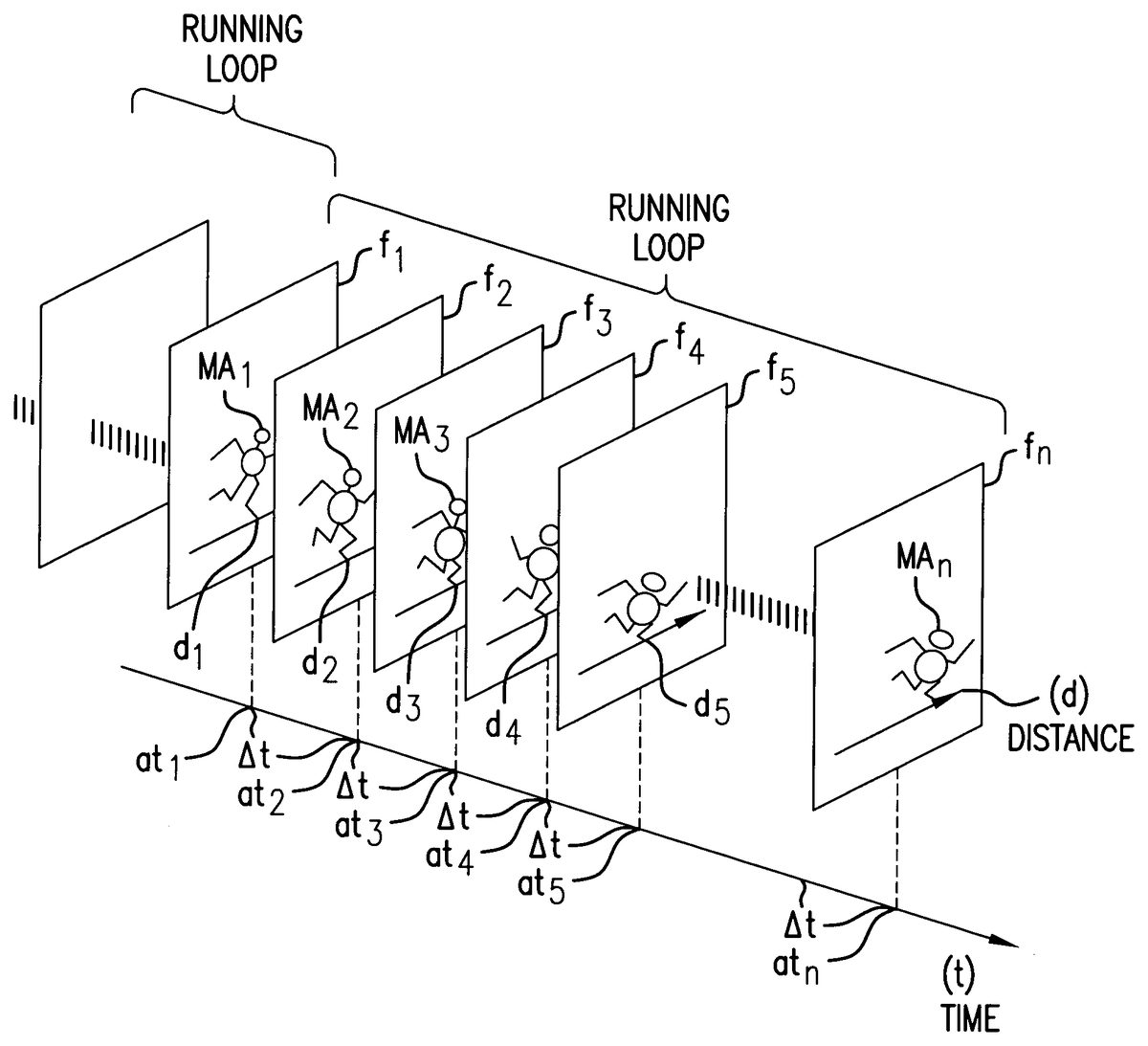
In order to clarify and sum up the aforementioned terminology,FIGS. 45A,45B, and45C are prepared. As previously defined, the terms used to describe the movement of the playing character MA according to the embodiments of the present application, but not limited thereto, are as follows.
“at(1)” through “at(n)”: animation displaying timings corresponding to each frame carrying an image of play character MA;
delta animation “Δa”: an amount of change of animations from a previous animation frame at a certain time (t) to an animation to be shown at a given time incremented with a predetermined time (t+Δt).
“Δt”: any given set time period such as 1/60 seconds but not limited thereto;
“Δv”: a moved amount (transport data) Δv of the play character MA within the time period corresponding to the time period during which the change of delta animation Δa takes place.
FIG. 45Ais an explanatory diagram illustrating a series of change of frames along a time line when the operation controller183is not operated. As can be seen, each of all the frames “f1” through “fn” is sequentially displayed at a time interval Δt. Noted with “d1” through “dn” are respective positions of the play character MA in each of the frames, “f1” through “fn”, along a distance line (d). It should be noted that the moved amount of the play character MA in a single running loop, i.e., an amount corresponding to “dn−d1” is set at a constant value.
FIG. 45Bis also an explanatory diagram illustrating a single segment of the change of succeeding frames along a time line (t) when the operation controller183is operated. The 15thframe “f15” is displayed at a time “t”; however, 16thframe “f16” is no longer displayed at time “t+Δt” because of the operation of the operation controller183. Instead, 15.3th frame needs to be displayed at time “t+Δt”. This small change, “15.3th frame”−“15thframe” is called delta animation Δa.
FIG. 45Cis also an explanatory diagram illustrating a moved amount (transport data) Δv of the play character MA within the time period corresponding to the time period during which the change of delta animation Δa takes place. As can be seen in theFIG. 45C, a small change between d15 position and d15.3 position along a line (distance) d corresponds to Δv of the play character MA.
The animation switching unit201sswitches the image data group (looped running animation) for displaying the images representing the running action to the image data group (goal finishing animation) for displaying the images representing the goal finishing action.
Next, the operation of the video game system10is described with reference to a flow chart shown inFIG. 41and game screens shown inFIGS. 42 to 44. Here, it is assumed that a single-player game is executed. Accordingly, running of the player character MA on the first course at the innermost side of the track TR is controlled by the game player, but running of the remaining five play characters MA is controlled by the preset data.
First, when the 100M dash game is selected by turning the start button183aon, a demonstration screen is displayed (Step ST1). The A-button operation detecting unit201bthen discriminates whether the A-button183bhas been turned on (Step ST3). The game is started (Step ST5) if the discrimination result in Step ST3is affirmative, and six play characters MA get ready at the starting line to initiate the starting action. At this time, “SET” is displayed in the middle of the game screen. Thereafter, “SET” disappears and “GO” is displayed instead, thereby entering a state where the operation signals from the C1-button183hand the C2-button183ican be received. This routine waits on standby until the A-button183bis turned on if the discrimination in Step ST3is negative. It should be noted that the same may be started by turning the start button183aon again.
Subsequently, the C1-button and C2-button operation discrimination unit201d,201ediscriminate whether the C1-button183hand the C2-button183iare being continuously hit (Step ST7). If the discrimination in Step ST7is affirmative, the respective play characters MA dash off from the starting line to start running at once. Specifically, a continuos animation (not shown) from the starting animation displaying a series of motions at the time of the start to the looped running animation displaying a series of running motions is displayed (step ST9). The running power is generated by continuously hitting the C1-button183hand the C2-button183i,and the generated running power is displayed in the power display column PD by the running power display unit201g.
Subsequently, the looped running animation, i.e. a series of images shown inFIGS. 4 through 20are successively displayed, for example, every 1/60 sec. by the character display control unit201e(Step ST11) and simultaneously the delta animation Δa and the transport data Δv are calculated by the Δa calculating unit201jand the Δv calculating unit201hand saved in the RAM123by the animation display timing setting unit201mand the transport data setting unit201n,respectively (Step ST13). Specifically, the images of the looped running animation are successively displayed, e.g. every 1/60 sec. by calculating the delta animation Δa and the transport data Δv, saving them in the RAM123every time one frame of image is displayed (e.g. every 1/60 sec.), determining an animation display timing for an image to be displayed next based on the calculated delta animation Δa and the transport data Δv, and giving coordinate values to the image corresponding to the determined animation display timing. A series of images shown inFIGS. 4 through 20and the images (images interpolating the successive frames of the images shown inFIGS. 4 through 20) based on the image data newly generated by changing the running speed of the play character MA are successively displayed, and this series of images (looped running animation) are repeatedly displayed until the play character MA reaches the predetermined position (e.g. 2 m before the goal). The game screen ofFIG. 2is displayed based on the looped running animation.
Subsequently, the arrival detecting unit201pdiscriminates whether the play character MA has reached the predetermined position immediately before the goal (Step ST15). The end animation detecting unit201qdiscriminates whether the animation display timing corresponding to the last image has been exceeded (Step ST17) if the discrimination result in Step ST15is negative. If the discrimination result in Step ST17is affirmative, the animation display timing subtracting unit201rsubtracts the last animation display timing corresponding to the last image from the present animation display timing corresponding to the presently displayed image (Step ST19). In this way, an animation display timing for an image to be displayed next is obtained.
This routine then returns to Step ST11to repeat the subsequent operations. By repeating the operations from Steps ST11to ST19, when the play character MA having started running from the starting position reaches the predetermined position (e.g. 2 m before the goal), the last image corresponding to the lest animation display timing or an image corresponding to an animation display timing approximate to the last animation display timing (i.e. an image newly generated between the first image and the succeeding image) is constantly set even if the running speed is changed through operation of the controller183by the game player. Thus, the action can be smoothly switched from the looped running animation to the goal finishing animation without any discontinuity.
When the discrimination result in Step ST17is negative, this routine returns to Step ST11to repeat the subsequent operations. Further, if the discrimination result in Step ST15is affirmative, the end animation detecting unit201qdiscriminates whether the last animation display timing has been exceeded (Step ST21). If the discrimination result in Step ST21is affirmative, the animation switching unit201sswitches the looped running animation to the goal finishing animation to display the goal finishing, action (Step ST23)FIG. 43shows a state immediately after the first runner passed a goal line GL, andFIG. 44shows a state where the first runner raises both hands to pose for victory. The motions for this victory pose are started at the predetermined position immediately before the goal as described above.
If the discrimination result in Step ST21is negative, the images of the looped running animation (a series of images shown inFIGS. 4 through 20and the images newly generated between successive frames) are then successively displayed by the character display control unit201e(Step ST25) and simultaneously the delta animation Δa and the transport data Δv are calculated by the Δa calculating unit201jand the Δv calculating unit201has in Step ST13(Step ST27). Then, this routine returns to Step ST21to repeat the subsequent operations. The operations after Step ST25in the case that the discrimination result in Step ST21is negative are mainly executed to correct calculation errors in Step ST13and other Steps.
As described above, according to this embodiment, the first image data group (looped running animation) comprised of a plurality of frames of image data for displaying the running action as the first action and the second image data group (goal finishing animation) comprised of a plurality of frames of image data for displaying the goal finishing action as the second action are prepared, and the first image data group is so switched to the second image data group that the goal finishing action smoothly successively follows the running action without any discontinuity when the player character reaches the predetermined position by repeatedly displaying the first action. Accordingly, the play character can be moved by a desired distance by the running action as the first action only by repeatedly displaying the first image data group (looped running animation), and images displayed on the game screen cause the game player to have no feeling of incongruity since the running action and the goal finishing action are smoothly successively displayed to switch without any discontinuity. Thus, a memory capacity can be saved, and a time required for the development of a program can also be saved, thereby effectively suppressing an increase in production costs.
The present invention is not limited to the foregoing embodiment, and may take various embodiments as described below.
(1) In the foregoing embodiment, the running distance (basic moved distance) of the play character MA by one reproduction of the looped running animation is set at a constant value even if the running speed (moving speed) of the play character MA is changed according to the operated amount of the controller183by the game player. However, according to the present invention, the running distance (basic moved distance) of the play character MA per looped running animation may be changed as the running speed (moving speed) of the play character MA is changed.
(2) Although the distance from the reference position to the predetermined position is set at a multiple of the unit moved distance by the first action (i.e. moved distance by one reproduction of the looped running animation) in the foregoing embodiment, it may be not necessarily set at a multiple, but may be arbitrarily set according to the present invention. In such a case, when the play character MA reaches the predetermined position, the image data of a specified frame of the first image data group other than the last frame or a frame near the last frame may, for example, be switched to the image data of the frame of the second image data group relating to the image data of the specified frame of the first image data group.
(3) In the foregoing embodiment, a new image data is generated by interpolation based on the initially set image data to smoothly display the running action in the case that the running speed of the play character MA is changed. However, according to the present invention, a multitude of frames of image data may be initially prepared, and necessary image data may be suitably selected from these image data to smoothly display a specific action.
(4) Although the 100M dash game is described as a field and track game to be executed in the foregoing embodiment, the present invention is also applicable to various other games. For instance, the present invention is applicable to short-distance running games other than the 100M dash game or long-distance running games such as a marathon game as field and track games. In other words, the present invention is applicable to any game in which the first action and the second action which successively follows the first action are prepared, and the images displayed on a game screen need to be such that the motions thereof do not cause the game player to have any feeling of incongruity when the first action is switched to the second action. For example, the present invention is also applicable to a swimming game. In the running game, a swimming action to a turning point corresponds to the running action of the 100M dash game, and a turning action which is started at a predetermined position immediately before the turning point corresponds to the goal finishing action of the 100M dash game.
As described above, according to the present invention, the first image data group comprised of a plurality of frames of image data for displaying the first action relating to the moving action and the second image data group comprised of a plurality of frames of image data for displaying the second action are prepared, and the first image data group is so switched to the second image data group that the second action successively follows the first action without any discontinuity when the player character reaches the predetermined position by repeatedly executing the first action.
Accordingly, the play character can be moved by a desired distance through repeated execution of the first action by repeatedly displaying the images based on the plurality of frames of image data, and the images displayed on the game screen cause the game player to have no feeling of incongruity since the first action relating to the moving action and the second action are smoothly successively displayed without any discontinuity. Thus, a memory capacity can be saved, and a time required for the development of a program can also be saved, thereby effectively suppressing an increase in production costs.
Further, according to the present invention, a specified frame of image data of the first image data group may be switched to a frame of image data of the second image data relating the specified frame when the play character reaches the predetermined position. By doing so, the game player is caused to have no feeling of congruity upon viewing the successive images of the first action relating to the moving action and the second action which are displayed on the game screen.
Further, according to the present invention, the specified frame may be the last frame of the first image data group or a frame relating to the last frame, and the frame of the second image data group relating to the specified frame may be the first frame thereof. This securely prevents a feeling of incongruity from being caused when the game player views the successive images of the first action relating to the moving action and the second action.
Further, according to the present invention, the first image data group may include image data generated between successive frames using the image data prepared beforehand. Then, minimally necessary image data can be set for displaying the first action, which enables a further reduction of the memory capacity. As a result, an increase in production costs can be effectively suppressed.
Further, according to the present invention, the moving speed of the play character by the first action may vary according to the operated amount of the operation member, the unit moved amount of the play character by the first action may be set at a constant value regardless of the moving speed of the play character, and the distance of the predetermined position from the reference position may be a multiple of the unit moved amount.
With this arrangement, the switching position of the first and second actions can be set beforehand. This results in easier designing of the game and reduction of burdens on the CPU by reducing calculation steps.
This application is based on Japanese application serial no. 2000-15103 filed on Jan. 24, 2000, the contents of which are hereby incorporated by reference.
As this invention may be embodied in several forms without departing from the spirit of essential characteristics thereof, the present embodiment is therefore illustrative and not restrictive, since the scope of the invention is defined by the appended claims rather than by the description preceding them, and all changes that fall within metes and bounds of the claims, or equivalence of such metes and bounds are therefore intended to embraced by the claims.
Claims
- A video game device for displaying a play character on a game screen displayed on a monitor, comprising: an operation member for moving the play character from a reference position to a predetermined position in a game space, a storage unit arranged to store a first image data group including a plurality of frames of image data which provide a display of a first action relating to the moving action of the play character and a second image data group including a plurality of frames of image data which provide a display of a second action of the play character different from the first action, a display control unit for reading the first and second image data groups from the storage unit and displaying the action of the play character based on the read frames of image data, the display control unit being arranged to consecutively display the frames of image data at a constant time interval, and a switch control unit for switching the first image data group to the second image data group such that the first action and the second action are smoothly successively displayed without any discontinuity when the play character reaches the predetermined position by repeatedly displaying the first action, the display control unit being coupled to the operation member and being arranged to sequentially display an image corresponding to each of the plurality of frames of the image data for the first action repeatedly sequenced at a base rate corresponding to the constant time interval and related to the moving action of the play character stored in the storage unit when the operation member is not operated and during the movement of the play character from the reference position to the predetermined position such that the same moving action of the play character is repeatedly displayed when the operation member is not operated, when the operation member is being operated, the display control unit being arranged to generate new image data for a new frame to be created between successive frames stored in the storage unit by interpolation between the successive frames repeatedly sequenced at a rate differing from said base rate based on a repetition rate of the operation of the operation member and then to display the newly generated image data to present the first action at said rate differing from said base rate.
- A video game device according to claim 1 , wherein a specified frame of image data of the first image data group is switched to a frame of image data of the second image data related to the specified frame when the play character reaches the predetermined position.
- A video game device according to claim 1 , wherein the specified frame is the last frame of the first image data group or a frame relating to the last frame, and the frame of the second image data group relating to the specified frame is the first frame thereof.
- A video game device according to claim 1 , wherein the moving speed of the play character displayed on the monitor by the first action varies according to the repetition rate of the operation of the operation member, the unit moved amount of the play character by the first action being defined as a distance of the movement of the play character in said plurality of frames of image data for the first action and being set at a constant value regardless of the moving speed of the play character, and the distance of the predetermined position from the reference position is a multiple of the unit moved amount.
- A video game device according to claim 1 , wherein when the operation member is being operated, the display control unit is arranged to display the newly generated image data such that the number of frames displayed in a predetermined time is reduced when the operation member is operating in comparison to when the operation member is not operated.
- A video game device according to claim 1 , wherein the play character is human, the first action is a running action of the human and the second action is an action performed by a human after reaching a finish line of an athletic competition.
- The video game device according to claim 1 , wherein the operation of the operating member includes alternate operation of at least two operating members.
- A video game device according to claim 1 , wherein the repetition rate of the operation of the operation member is multiplied by a predetermined coefficient set for the game to obtain a delta animation value, the display control unit being arranged to generate the new image data for the new frame to be created between successive frames stored in the storage unit by interpolation between the successive frames based on the delta animation value.
- A character action setting method in a video game in which a play character is displayed on a game screen on a monitor and moved from a reference position to a predetermined position in a game space by operating an operation member, the method comprising the steps of: preparing a first image data group including a plurality of frames of image data for displaying a first action relating to the moving action of the play character and a second image data group including a plurality of frames of image data for displaying a second action different from the first action;consecutively displaying a frame of image data at a constant time interval, said step of displaying a frame of image data comprising the steps of sequentially displaying an image corresponding to each of the plurality of frames of the image data for the first action repeatedly sequenced at a base rate corresponding in to the constant time interval and related to the moving action of the play character when the operation member is not operated and during the movement of the play character from the reference position to the predetermined position such that the same moving action of the play character is repeatedly displayed when the operation member is not operated, and upon operation of the operation member, generating new image data for a new frame to be created between successive frames by interpolation between the successive frames repeatedly sequenced at a rate differing from said base rate based on a repetition rate of the operation of the operation member, and displaying the newly generated image data to present the first action at said rate differing from said base rate;and switching the first image data group to the second image data group such that the first action and the second action are smoothly successively displayed without any discontinuity when the play character reaches the predetermined position by repeatedly displaying the first action.
- A character action setting method according to claim 9 , wherein a specified frame of image data of the first image data group is switched to a frame of image data of the second image data related to the specified frame when the play character reaches the predetermined position.
- A character action setting method according to claim 9 , wherein the specified frame is the last frame of the first image data group or a frame relating to the last frame, and the frame of the second image data group relating to the specified frame is the first frame thereof.
- A character action setting method according to claim 9 , wherein the moving speed of the play character displayed on the monitor by the first action varies according to the repetition rate of the operation of the operation member, further comprising the steps of defining a unit moved amount as a distance of the movement of the play character in the plurality of frames of image data for the first action and setting the unit moved amount of the play character by the first action at a constant value regardless of the moving speed of the play character, and the distance of the predetermined position from the reference position is a multiple of the unit moved amount.
- A character action setting method according to claim 9 , wherein the newly generated image data is displayed such that the number of frames displayed in a predetermined time is reduced when the operation member is operating in comparison to when the operation member is not operated.
- A character action setting method according to claim 9 , wherein the play character is human, the first action is a running action of the human and the second action is an action performed by a human after reaching a finish line of an athletic competition.
- The method according to claim 9 , wherein the operation of the operating member includes alternate operation of at least two operating members.
- A computer-readable recording medium storing a character action setting program in a video game in which a play character is displayed on a game screen on a monitor and moved from a reference position to a predetermined position within a game space by operating an operation member, the character action setting program comprising the steps of: preparing a first image data group including a plurality of frames of image data for displaying a first action relating to the moving action of the play character and a second image data group including a plurality of frames of image data for displaying a second action different from the first action;consecutively displaying a frame of image data at a constant time interval, said step of displaying a frame of image data comprising the steps of sequentially displaying an image corresponding to each of the plurality of frames of the image data for the first action repeatedly sequenced at a base rate corresponding to the constant time interval and related to the moving action of the play character when the operation member is not operated and during the movement of the play character from the reference position to the predetermined position such that the same moving action of the play character is repeatedly displayed when the operation member is not operated, and upon operation of the operation member, generating new image data for a new frame to be created between successive frames by interpolation between the successive frames repeatedly sequenced at a rate differing from said base rate based on a repetition rate of the detected operation of the operation member, and displaying the newly generated image data to present the first action at said rate differing from said base rate;and switching the first image data group to the second image data group such that the first action, and the second action are smoothly successively displayed without any discontinuity when the play character reaches the predetermined position by repeatedly displaying the first action.
- A computer-readable recording medium according to claim 16 , wherein a specified frame of image data of the first image data group is switched to a frame of image data of the second image data related to the specified frame when the play character reaches the predetermined position.
- A computer-readable recording medium according to claim 17 , wherein the specified frame is the last frame of the first image data group or a frame relating to the last frame, and the frame of the second image data group relating to the specified frame is the first frame thereof.
- A computer-readable recording medium according to claim 16 , wherein the moving speed of the play character displayed on the monitor by the first action varies according to the repetition rate of the operation of the operation member, further comprising the steps or defining a unit moved amount as a distance of the movement of the play character in the plurality of frames of image data for the first action and setting the unit moved amount of the play character by the first action at a constant value regardless of the moving speed of the play character, and the distance of the predetermined position from the reference position is a multiple of the unit moved amount.
- A computer-readable recording medium according to claim 16 , wherein the newly generated image data is displayed such that the number of frames displayed in a predetermined time is reduced when the operation member is operating in comparison to when the operation member is not operated.
- A computer-readable recording medium according to claim 16 , wherein the play character is human, the first action is a running action of the human and the second action is an action performed by a human after reaching a finish line of an athletic competition.
- The recording medium according to claim 16 , wherein the operation of the operating member includes alternate operation of at least two operating members.
- A video game device for displaying a human play character on a game screen displayed on a monitor, comprising: an operation member for moving the human play character from a reference position to a predetermined position in a game space, a storage unit for storing a first image data group including a plurality of frames of image data for displaying a first action relating to the moving action of the play character and a second image data group including a plurality of frames of image data for displaying a second action, a display control unit for reading the first and second image data groups from the storage unit and displaying the action of the play character based on the read frames of image data, the display control unit being arranged to consecutively display the frames of image data at a constant time interval, said display control unit being arranged such that the moving speed of the play character displayed on the monitor by the first action varies according to the operated amount of the operation member, the unit moved amount (l) being defined as a distance of the movement of the play character in said plurality of frames of image data for the first action and being set at a constant value regardless of the moving speed of the play character, and the distance (L) of the predetermined position from the reference position is a multiple of the unit moved amount (l) and a switch control unit for switching the first image data group to the second image data group such that the first action and the second action are smoothly successively displayed without any discontinuity when the play character reaches the predetermined position by repeatedly displaying the first action, the display control unit being coupled to the operation member and being arranged to sequentially display an image corresponding to each of the plurality of frames of the image data for the first action stored in the storage unit when the operation member is not operated, when the operation member is being operated, the display control unit being arranged to generate new image data for a new frame to be created between successive frames stored in the storage unit by interpolation between the successive frames based on the operation of the operation member and then to display the newly generated image data.
- A video game device according to claim 23 , wherein the first action is a running action of the human and the second action is an action performed by a human after reaching a finish line of an athletic competition.
- The video game device according to claim 23 , wherein: the display control unit consecutively displays the frames of image data at the constant time interval so as to display the play character moving at a base rate speed;and said display control unit is arranged such that the moving speed of the play character displayed on the monitor by the first action varies from the base rate according to a repetition rate of the operated amount of the operation member.
- The video game device according to claim 25 , wherein the operation of the operating member includes alternate operation of at least two operating members.
- A character action setting method in a video game in which a human play character is displayed on a game screen on a monitor and moved from a reference position to a predetermined position in a game space by operating an operation member, the method comprising the steps of: preparing a first image data group including a plurality of frames of image data for displaying a first action relating to the moving action of the play character and a second image data group including a plurality of frames of image data for displaying a second action;consecutively displaying a frame of image data at a constant time interval, said step of displaying a frame of image data comprising the steps of sequentially displaying an image corresponding to each of the plurality of frames of the image data for the first action when the operation member is not operated, and upon operation of the operation member, varying the moving speed of the play character displayed on the monitor by the first action according to the operated amount of the operation member, defining a unit moved amount(l) as a distance of the movement of the play character in the plurality of frames of image data for the first action;setting the unit moved amount (l) of the play character by the first action at a constant value regardless of the moving speed of the play character, setting the distance (L) of the predetermined position from the reference position as a multiple of the unit moved amount (l), generating new image data for a new frame to be created between successive frames by interpolation between the successive frames based on the operation of the operation member, and displaying the newly generated image data such that the number of frames for the first action displayed in a predetermined time is reduced when the operation state of the operation member is changed;and switching the first image data group to the second image data group such that the first action and the second action are smoothly successively displayed without any discontinuity when the play character reaches the predetermined position by repeatedly displaying the first action.
- A character action setting method according to claim 27 , wherein the first action is a running action of the human and the second action is an action performed by a human after reaching a finish line of an athletic competition.
- The method according to claim 27 , wherein: said sequentially displaying an image corresponding to each of the plurality of frames of the image data for the first action when the operation member is not operated displays the play character moving at a base rate speed;and said varying the moving speed of the play character displayed on the monitor by the first action according to the operated amount of the operation member varies the moving speed from the base rate according to a repetition rate of the operated amount of the operation member.
- The method according to claim 29 , wherein the operation of the operating member includes alternate operation of at least two operating members.
- A computer-readable recording medium storing a character action setting program in a video game in which a human play character is displayed on a game screen on a monitor and moved from a reference position to a predetermined position within a game space by operating an operation member, the character action setting program comprising the steps of: preparing a first image data group including a plurality of frames of image data for displaying a first action relating to the moving action of the play character and a second image data group including a plurality of frames of image data for displaying a second action;consecutively displaying a frame of image data at a constant time interval, said step of displaying a frame of image data comprising the steps of sequentially displaying an image corresponding to each of the plurality of frames of the image data for the first action when the operation member is not operated, and upon operation of the operation member, varying the moving speed of the play character displayed on the monitor by the first action according to the operated amount of the operation member, defining a unit moved amount(l) as a distance of the movement of the play character in the plurality of frames of image data for the first action;setting the unit moved amount (l) of the play character by the first action at a constant value regardless of the moving speed of the play character, setting the distance (L) of the predetermined position from the reference position as a multiple of the unit moved amount (l), generating new image data for a new frame to be created between successive frames by interpolation between the successive frames based on the detected operation of the operation member, and displaying the newly generated image data such that the number of frames for the first action displayed in a predetermined time is reduced when the operation state of the operation member is changed;and switching the first image data group to the second image data group such that the first action, and the second action are smoothly successively displayed without any discontinuity when the play character reaches the predetermined position by repeatedly displaying the first action.
- A computer-readable recording medium according to claim 31 , wherein the first action is a running action of the human and the second action is an action performed by a human after reaching a finish line of an athletic competition.
- The computer-readable recording medium according to claim 31 , wherein: said sequentially displaying an image corresponding to each of the plurality of frames of the image data for the first action when the operation member is not operated displays the play character moving at a base rate speed;and said varying the moving speed of the play character displayed on the monitor by the first action according to the operated amount of the operation member varies the moving speed from the base rate according to a repetition rate of the operated amount of the operation member.
- The computer-readable recording medium according to claim 33 , wherein the operation of the operating member includes alternate operation of at least two operating members.
Disclaimer: Data collected from the USPTO and may be malformed, incomplete, and/or otherwise inaccurate.