U.S. Pat. No. 6,964,610
VIDEO GAME DEVICE, TECHNIQUE SETTING METHOD IN VIDEO GAME, AND COMPUTER READABLE RECORDING MEDIUM STORING TECHNIQUE SETTING PROGRAM
AssigneeKonami Corporation
Issue DateJanuary 16, 2001
Illustrative Figure
Abstract
A video game device allows a game player to set a degree of difficulty of a technique to be performed by a play character by continuously hitting a pair of buttons in a controller. A command guiding unit guides the input of a command which causes the play character to perform a technique corresponding to the set degree of difficulty, and a stick-shaped controller allows the game player to input commands in accordance with the guide given by the command guiding unit. Upon completion of the performance of the technique by the play character, an evaluating unit evaluates the technique performed in accordance with the commands inputted by the game player.
Description
DETAILED DESCRIPTION OF THE PREFERRED EMBODIMENTS OF THE INVENTION FIG. 1is a diagram showing the schematic construction of a video game system (video game device)10to which a technique setting method according to one embodiment of the present invention is applied. InFIG. 1, the video game system10is provided with a memory unit12, an image display unit14, a sound output unit16, an operation input unit18and a control unit20. The units12,14,16and18are connected with each other via a bus22including address buses, data buses and control buses connected with a CPU201of the control unit20to be described later. In the memory unit12are stored game data comprised of image data, sound data and program data. The memory unit12includes a storage medium122connected with the bus22via an interface circuit121and a RAM123for temporarily storing the game data read from the storage medium122. The storage medium122is, for example, a so-called ROM cassette in which a ROM or like storage medium storing game data and program data of an operating system is accommodated in a plastic casing, an optical disk, or a flexible disk. The image display unit14is adapted to display various game images in accordance with the progress of the game and includes a digital-to-analog (D/A) converter142connected with the bus22via an interface circuit141and a television monitor (video monitor)143including a CRT, a liquid crystal display or the like connected with the D/A converter142. The sound output device16is adapted to output a game music, sound effects, etc. in accordance with the progress of the game and is provided with a D/A converter162connected with the bus22via an interface circuit161, an amplifying circuit163connected with the D/A converter162, and a loudspeaker164for outputting sounds in accordance with an output signal from the amplifying circuit163. The operation input unit18is adapted to output operation signals to the control unit20and is provided with an operational information interface circuit182connected with a ...
DETAILED DESCRIPTION OF THE PREFERRED EMBODIMENTS OF THE INVENTION
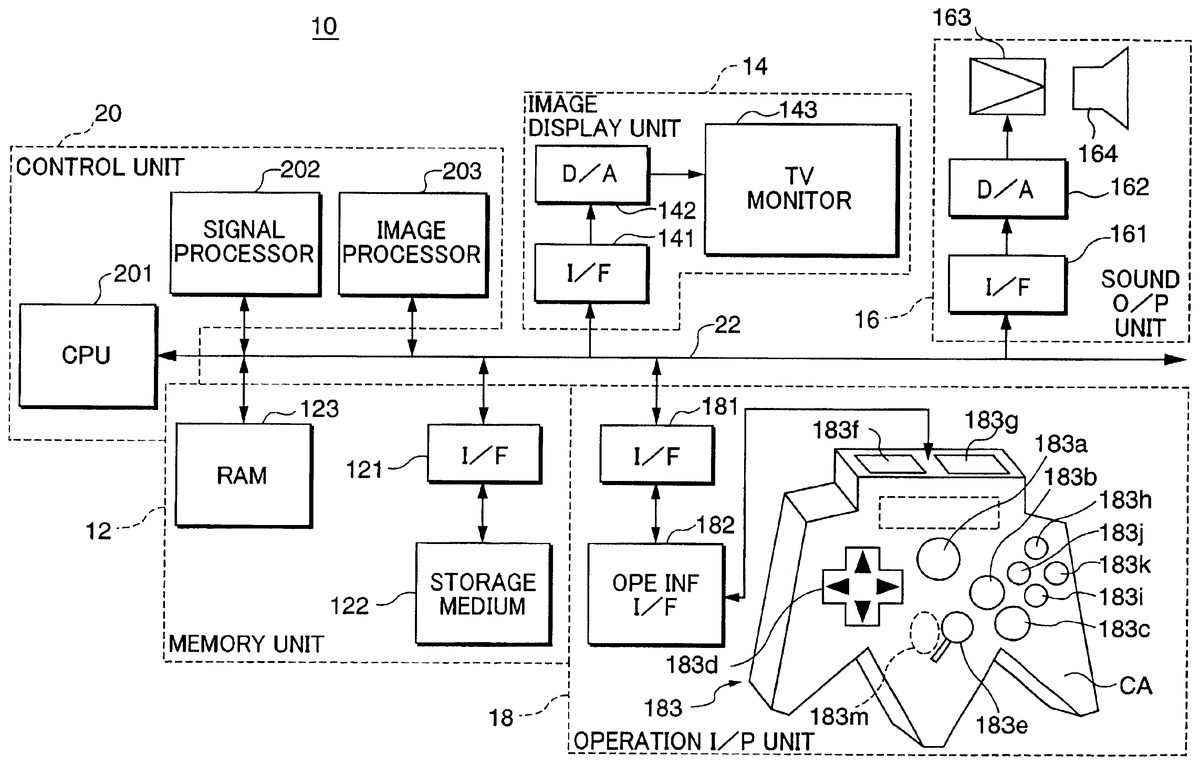
FIG. 1is a diagram showing the schematic construction of a video game system (video game device)10to which a technique setting method according to one embodiment of the present invention is applied. InFIG. 1, the video game system10is provided with a memory unit12, an image display unit14, a sound output unit16, an operation input unit18and a control unit20. The units12,14,16and18are connected with each other via a bus22including address buses, data buses and control buses connected with a CPU201of the control unit20to be described later.
In the memory unit12are stored game data comprised of image data, sound data and program data. The memory unit12includes a storage medium122connected with the bus22via an interface circuit121and a RAM123for temporarily storing the game data read from the storage medium122. The storage medium122is, for example, a so-called ROM cassette in which a ROM or like storage medium storing game data and program data of an operating system is accommodated in a plastic casing, an optical disk, or a flexible disk.
The image display unit14is adapted to display various game images in accordance with the progress of the game and includes a digital-to-analog (D/A) converter142connected with the bus22via an interface circuit141and a television monitor (video monitor)143including a CRT, a liquid crystal display or the like connected with the D/A converter142.
The sound output device16is adapted to output a game music, sound effects, etc. in accordance with the progress of the game and is provided with a D/A converter162connected with the bus22via an interface circuit161, an amplifying circuit163connected with the D/A converter162, and a loudspeaker164for outputting sounds in accordance with an output signal from the amplifying circuit163.
The operation input unit18is adapted to output operation signals to the control unit20and is provided with an operational information interface circuit182connected with a bus22via an interface circuit181, and a controller183connected with the operational information interface circuit182. The controller183includes a start button183a, an A-button183b, a B-button183c, a cross-shaped key183d, a stick-shaped controller183e, a C1-button183h, a C2-button183i, a C3-button183jand a C4-button183kprovided on the front surface of a casing CA, a left trigger button183fand a right trigger button183gprovided on the upper surface of the casing CA, and a Z-button183mprovided on the rear surface of the casing CA.
The stick-shaped controller183ehas substantially the same construction as a joystick. Specifically, the controller183ehas a standing stick (operation bar), which can be inclined to front, back, left, right or in any direction in a 360° range about a specified point of the stick as a supporting point. According to the direction and angle of inclination of the stick, an X-coordinate along transverse direction and a Y-direction along forward/backward direction in coordinate systems having the standing position of the stick as an origin are sent to the control unit20via the interface circuits182and182.
The control unit20is adapted to control the progress of the game, and is comprised of the CPU201connected with the bus22, a signal processor202and an image processor203. The signal processor202mainly performs calculation of image data in a three-dimensional (3D) space, calculation for transforming a position in the 3D space to a position in a simulated 3D space, a light source calculation, and generation and processing of sound data. The image processor203writes an image data to be displayed in the RAM123based on the calculation results in the signal processor202. For example, the image processor202writes a texture data in an area of the RAM123specified by a polygon.
The video game system10thus constructed takes different modes according to its application. Specifically, in the case that the video game system10is constructed for business use, all the elements shown inFIG. 1are, for example, contained in one casing. In the case that the video game system10is constructed for home use, the television monitor143, the amplifying circuit163and the loudspeaker164are separate from a main game unit.
Here, the main game unit is, for example, comprised of the interface circuit121connected with the CPU201, the RAM123, the interface circuit141, the D/A converter142, the interface circuit161, the D/A converter162, the interface circuit181, the operational information interface circuit182, the controller183, the signal processor202and the image processor203. This main game unit is constructed by accommodating the respective elements in a casing made of a synthetic resin, and the storage medium122is detachably mounted in a mounting portion formed in this casing. The controller183is connected with a connector provided in the casing via a communication cable or the like.
In the case that the video game system10is constructed with a personal computer or a workstation as a core, for example, the television monitor143corresponds a computer display, the image processor203corresponds to part of the game program data stored in the storage medium122or hardware on an extension board mounted on an extension slot of the computer, and the interface circuits121,141,161,181, the D/A converters142,162, and the operational information interface circuit182correspond to hardware on the extension board mounted on the extension slot of the computer.
A case where the video game system10is constructed for home use is described below.
Next, the operation of the video game system10is summarily described. First, when an unillustrated power switch is turned on to activate the video game system10, the CPU201reads image data, sound data and game program data from the storage medium122in accordance with the operating system stored in the storage medium122, and all or part of the read image data, sound data and game program data are stored in the RAM123. Thereafter, a specified game is proceeded by the CPU201in accordance with the game program data stored in the RAM123and contents of instructions given by a game player via the controller183.
Specifically, commands as tasks for forming images and outputting sounds are generated in accordance with contents of instructions given by a game player via the controller183. The signal processor202performs calculation of display positions of characters in the 3D space (of course the same applies for a two-dimensional space), a light source calculation, generation and processing of sound data, etc. in accordance with these commands.
Data of images to be formed are written in the RAM123by the image processor203based on the calculation results. The image data written in the RAM123are fed to the D/A converter142via the interface circuit141, and fed to the television monitor143after being converted into analog video signals in the D/A converter142, thereby being displayed as game images on a display surface of the television monitor143.
On the other hand, the sound data outputted from the signal processor202are fed to the D/A converter162via the interface circuit161and outputted as sounds from the loudspeaker164via the amplifying circuit163after being converted into analog sound signals in the D/A converter162.
Next, contents of the game executed in the video game system10are summarily described. In this video game system10, one game can be selected from a plurality of competition games by operating the start button183a. Here, such an apparatus gymnastic game is executed that a play character which is a gymnast is caused to perform specified techniques using an apparatus such as a vaulting horse or a horizontal bar, and ranking is contended based on evaluation points given according to the degree of difficulty and the degree of success of the techniques performed.
This apparatus gymnastic game is played by one to four game players in this embodiment. As many play characters as the game players are caused to successively appear on the game screen image, the respective play characters perform specified techniques in turn, and ranking (victory) is contended based on the given evaluation points. For example, in the case of the vaulting horse, ranking is determined based on average points of the respective evaluation points obtained for two performances. In the case of the horizontal bar, ranking is determined based on total points of the respective evaluation points obtained for eight performances. In the memory unit12are stored score data of play characters who do not appear on the game screen. Ranking is determined for both the play characters who appear on the game screen and those who do not. Therefore, a single game player can also play this game.
Next, a display example of the game screen in the case that a vaulting horse game is executed is described with reference to FIG.2. The game screen shown inFIG. 2shows one scene which comes up while the vaulting horse game is actually executed. Specifically, on this game screen, a play character MA which is a gymnast who started an approach run is displayed in the middle, a degree of difficulty setting section NS for setting a degree of difficulty of a technique to be performed by the play character MA is laterally displayed at the bottom left side, and a command input section YC is laterally displayed at the right side of the setting section NS. Below the command input section YC, a time display section TD for displaying a command input permitting time is laterally displayed in proximity to the command input section YC.
Further, a landing setting section CS for causing the play character MA to land upon the completion of the performance is vertically displayed at the right end of the game screen, and a player column TS for displaying an appearing order of the play character MA, a national flag of her nation and her name is set at the bottommost of the game screen. Here, ΠLAYER1″ which means a player who appears in the first place, the national flag of the USA and the name “Blade” of the play character MA are displayed.
A foul display column FD for displaying “FAUL” when the controller183is not operated for a predetermined time despite the fact that the game was already started is laterally displayed at the right side of the bottommost of the game screen. For example, “TIME10” is displayed in the foul display column FD when the controller183is not operated for a predetermined time, and the displayed numerical value is counted down every second and “FOUL” is displayed upon the lapse of 10 sec.
FIG. 3is a diagram showing the construction of the degree of difficulty setting section NS, the command input section YC and the time display section TD in detail in the vaulting horse game as shown in FIG.2. The degree of difficulty setting section NS constructs a power gauge and is comprised of a strip-shaped power storing area30for displaying a technique power corresponding to the degree of difficulty, and a level display section32formed at the upper end of the right half of the power storing area30for discriminating the level of the stored technique power.
This technique power serves as an index (i.e. mark) indicating a degree of difficulty of a technique performed by the play character MA, and is increased (i.e. the mark enlarges in shape) when the game player alternately and continuously operates (continuously hits) two operable members of the controller183such as the C1-button183hand the C2-button183ion and off within a predetermined period. The more the operable members are operated to enhance the level of the stored technique power, the higher degree of difficulty the technique performed by the play character MA can have. In this way, the play character MA can have a higher evaluation point.
The level of the stored technique power is displayed by coloring the power storing area30in a chromatic color and increasing the colored area as the reached level is increased, and can be discriminated based on the position of the leading end of the colored area (the colored area is shown in dots). Specifically, the level display section32is constructed by a wave-shaped gauge having ridges and valleys, level marks321,322,323,324,325are given at the left end positions of the respective valleys, zones are set between adjacent level marks: A-zone between the level marks321and322, B-zone between the level marks322and323, C-zone between the level marks323and324, D-zone between the level marks324and325, and E-zone between the level mark325and a succeeding level mark. Widths of the respective zones are gradually narrower from the A-zone toward the E-zone.
A degree of difficulty A is set in the case that the leading end position of the colored area (indicated in dots inFIG. 3) is located in the A-zone; a degree of difficulty B is set in the case that it is located in the B-zone; a degree of difficulty C is set in the case that it is located in the C-zone; a degree of difficulty D is set in the case that it is located in the D-zone; and a degree of difficulty E is set in the case that it is located in the E-zone. Since the leading end position of the colored area is located in the E-zone inFIG. 3, the degree of difficulty E is set. The set degree of difficulty is also displayed in the form of A to E in the degree of difficulty setting section34provided adjacent to the right end of the power storing area30. A mark “×” is displayed in the degree of difficulty display section34until the degree of difficulty is confirmed.
In this embodiment, the power storing area30is first colored in a cold color (e.g. blue), and the color tone changes toward a warm color (e.g. light red) as the stored technique power increases. In the already colored area as well, the color tone gradually changes toward a warm color (e.g. light red). When the entire power storing area30is colored (degree of difficulty E at this stage) and the technique power is further on the increase, the color tone of the power storing area30gradually changes toward scarlet from the right end toward the left end. In this state, a highest degree of difficulty F is set although it is not shown in the degree of difficulty display section34, and the play character MA on an approach run makes a turn before reaching a springboard provided in front of the vaulting horse, so that a higher evaluation point is given.
The command input device YC is used to input a command to cause the play character MA to perform a technique corresponding to the degree of difficulty set in the degree of difficulty setting section NS. This command is given by a combination of six arrow icons AR facing to left, right, up or down. The command input section YC is provided with a command display area36having six icon display regions361,362,363,364,365,366. The arrow icons AR are not displayed in the respective icon display regions361to366of the command display area36while the degree of difficulty is not confirmed yet. A combination of the arrow icons AR facing some directions and corresponding to the degree of difficulty are displayed in a chromatic color (e.g. yellow) after the degree of difficulty is confirmed.
When the colored arrow icons AR (initial state) are displayed, the game player successively inclines the stick-shaped controller183e(may be the cross-shaped key183d) in the directions of the arrow icons AR from the one displayed in the first icon display region361to the one displayed in the last icon display region366, thereby inputting a command. The directions of the arrow icons AR are set in such a combination that the operation of the controller183acorresponds to the set degree of difficulty. For example, the higher the degree of difficulty, the more time is taken to input the command. This enables the operating ability of the game player to be reflected on the evaluation, thereby making the game more interesting.
The command input is set such that it must be performed within a predetermined period (e.g. about 5 sec.), the arrow icons AR in accordance with which the stick-shaped controller183ehas been inclined become achromatic (e.g. black) when the command input is completed, making the completion of the command input distinguishable. In other words, the displayed state of each arrow icon AR changes after the stick-shaped controller183eis inclined, and has functions of urging the game player to input a command and guiding the command input before the stick-shaped controller183eis inclined.
When the stick-shaped controller183eis not inclined in the direction of the corresponding arrow icon AR, the input is invalidated to display a mark “×” on this arrow icon AR and give a warning sound, thereby notifying the game player that the command input was invalid. At this time, the game player cannot operate the stick-shaped controller183efor the next arrow icon AR unless inclining the stick-shaped controller183ein the right direction of the preceding arrow icon AR to which an erroneous operation was made.
The time display section TD is adapted to display a command input permitting time, and a remaining time display area38for displaying a remaining permitting time is set therein. The remaining time display area38is entirely colored in a chromatic color (e.g. yellow) when the arrow icons AR are displayed in the command input section YC, the colored range gradually decreases from the right end as the input permitting time decreases. The game player inputs the command while viewing the remaining time display area38. In this embodiment, even for the same technique, the more the remaining permitting time (i.e. the shorter the command input completion time), the higher the evaluation point. This enables the operating ability of the game player to be reflected on the evaluation, thereby making the game more interesting.
FIG. 4is a diagram showing the construction of the landing setting section CS in detail. Specifically, the landing setting section CS forms a landing gauge and is provided with a landing setting display area40which is in the form of a strip extending along vertical direction. A landing success zone42is set in a specified position of the lower half of the landing setting display area40. The landing success zone42is comprised of a first zone421fixed in a specified position and having a short vertical dimension, second zones422,423provided above and below the first zone421and having a longer vertical dimension, and third zones424,425provided outside the second zones422,423and having a vertical dimension shorter than second zones422,423.
For example, the first zone421is displayed in yellow, the second zones422,423are displayed in light orange, and the third zone424,425are displayed in deep orange. At the right end of the first zone421is provided an emphasis mark44indicating the first zone421and displayed in red.
The first zone421, the second zones422,423and the third zones424,425are adapted to display areas where landing is finished by such a posture to which the evaluation of the first place is given, where landing is finished by such a posture to which the evaluation of the second place is given, and where landing is finished by such a posture to which the evaluation of the third place is given, respectively. Although the vertical dimension of the first zone421is fixed, those of the second and third zones422,423,424,425changes according to the set degree of difficulty.
Specifically, the vertical dimensions of the second and third zones422,423,424,425become gradually narrower as the degree of difficulty gets higher from A toward E, and disappear when the entire power storing area30is chromatic and when the degree of difficulty F not indicated in the degree of difficulty display section34is set. In such a case, only the first zone421is displayed.
In the landing setting display area40is also displayed a landing mark46in the form of a line movable from the upper end position to the bottom end position. The landing mark46is displayed in, e.g. red and white lines48,50are provided above and below it. The landing mark46is so displayed as to move at such a speed that it starts descending from the upper end position when the play character MA starts jumping from the vaulting horse and performing a technique in the air and reaches the bottom end position when landing is completed. The movement of the landing mark46is stopped by turning the Z-button183on. Thus, the game player can cause the play character MA to land by turning the Z-button183mon to stop the play character MA within the landing success zone42while the play character MA is still performing a technique and the landing mark46is moving within the landing success zone42.
When the landing mark46is so stopped as to coincide with the first zone421, landing is finished in a most preferable posture and an evaluation of the first place is given. When the landing mark46is so stopped that the play character MA lands within the second zone422or423, landing is finished in a more preferable posture and an evaluation of the second place is given. When the landing mark46is so stopped that the play character MA lands within the third zone424or425, landing is finished in a preferable posture and an evaluation of the third place is given. The play character MA fails to land when the landing mark46is stopped outside the landing success zone42, and this landing serves as minus points. This enables the operating ability of the game player to be reflected on the evaluation, thereby making the game more interesting.
FIG. 5is a block diagram showing function realizing unit of the CPU201in the case that the vaulting horse game is executed, the storage medium122, the RAM123, the television monitor143and the controller183(start-button183a, A-button183b, stick-shaped controller183e, C1-button183h, C2-button183iand Z-button183m). The interface circuits, buses, etc. are not shown inFIG. 5in order to simplify the description.
Specifically, the CPU201is provided with the respective function realizing unit as a start button operation discriminating unit201a, an A-button operation discriminating unit201b, a stick-shaped controller operation discriminating unit201c, a C1-button operation discriminating unit201d, a C2-button operation discriminating unit201e, a Z-button operation discriminating unit201f, a character display control unit201g, a degree of difficulty setting unit201h, a command setting unit201i, a landing setting unit201jand an evaluating unit201k.
The degree of difficulty setting unit201his provided with the respective function realizing unit as a power storing area setting unit201m, a mark changing unit201n, an input possibility discriminating unit201oand a level discriminating/setting unit201p. The command setting unit201iis provided with the respective function realizing unit as a command display area setting unit201q, an arrow icon display unit201r, an input permitting time setting unit201s, a lapse of permitting time discriminating unit201tand an input discriminating unit201u. The landing setting unit201jis provided with the respective function realizing unit as a landing setting area setting unit201v, a landing success zone setting unit201w, a landing mark movement display unit201xand a coincidence discriminating unit201y.
The start button operation discriminating unit201adiscriminates whether the start button182ahas been turned on or off in accordance with an operation signal from the start button183a. One game is selected from a plurality of games when the start button183ais turned on. The A-button operation discriminating unit201bdiscriminates whether the A-button182bhas been turned on or off in accordance with an operation signal from the A-button183b. The start of the game is enabled when the A-button183bis turned on.
The stick-shaped controller operation discriminating unit201cdiscriminates whether the stick-shaped controller183ehas been inclined to specified four positions: to up, down, left and right which are set beforehand by rotating it while maximally inclined. The C1-button operation discriminating unit201ddiscriminates whether the C1-button182hhas been turned on or off in accordance with an operation signal from the C1-button183h. The C2-button operation discriminating unit201ediscriminates whether the C2-button182ihas been turned on or off in accordance with an operation signal from the C2-button183i. In other words, every time the C1-button183hand the C2-button183iare alternately and continuously turned on/off, the technique power is stored, for example, by “1”.
The Z-button operation discriminating unit201fdiscriminates whether the Z-button183mhas been turned on or off in accordance with an operation signal from the Z-button183m. When the Z-button183mis turned on while the landing mark46is moving within the landing success zone42, landing is set. The character display control unit201gcontrols the display of the play character MA as the game progresses. A game screen corresponding to a game content is read from the RAM123and outputted to the television monitor143.
The degree of difficulty setting unit201hcontrols the display in the degree of difficulty setting section NS, and the power storing area setting unit201msets and displays the power storing area30in the specified position of the game screen. The mark changing unit201ngradually increases the colored area of the power storing area30as the stored technique power is increased every time the C1-button183hand the C2-button183iare alternately and continuously turned on/off. The input possibility discriminating unit201odiscriminates whether the C1-button183hand the C2-button183iare in an input enabling state. The level discriminating/setting unit201pdiscriminates which one of the A- to E-zones (seeFIG. 3) in the level display section32the level of the stored technique power has reached, and the degree of difficulty of the technique to be performed by the play character MA is set based on this discrimination result.
The command setting unit201icontrols the display of the command input section YC, and the command display area setting unit201qsets and displays the command display area36in the specified position of the game screen. The arrow icon display unit201rsets and displays the arrow icons AR in their initial states in the command display area36when the degree of difficulty is set by the degree of difficulty setting unit201h. In other words, the arrow icon display unit201rconstructs a command guiding unit since the arrow icons AR in their initial states have a function of guiding the game player to input the command.
The input permitting time setting unit201scontrols the display of the time display section TD and displays a remaining permitting time as the input permitting time decreases while displaying the remaining time display area38. This remaining permitting time continues to be displayed until the performance of the technique by the play character MA is completed even after completion of the command input. The lapse of permitting time discriminating unit201tdiscriminates whether the command input permitting time has already elapsed.
The input discriminating unit201udiscriminates whether the stick-shaped controller183ehas been successively inclined in the directions of the arrow icons AR and also discriminates whether the controller183ehas been precisely inclined in accordance with all the arrow icons AR within a predetermined period (e.g. about 5 sec.). Unless the controller183eis inclined in the direction of the arrow icon AR, a mark “×” is displayed on this arrow icon AR and a warning sound is given. On the other hand, unless the inclining operation of the controller183ehas completed within the predetermined period, a landing failing operation is executed so as to cause the play character MA to land in an unstable posture or fall down during landing while the play character MA is caused to perform a technique having a set degree of difficulty.
The landing setting unit201jcontrols the display of the landing setting section CS, and the landing setting area setting unit201vsets and displays the landing setting display area40in the specified position of the game screen. The landing success zone setting unit201wsets and displays the landing success zone42corresponding to the degree of difficulty set by the degree of difficulty setting unit201hin the specified position of the landing setting display area40.
The landing mark movement display unit201xmovingly displays the landing mark46in the landing setting display area40, and the coincidence discriminating unit201ydiscriminates whether the Z-button183mhas been turned on while the landing mark46is moving in any one of the first to third zones421,422,423,424,425within the landing success zone42. If the Z-button183mis turned on while the landing mark46is moving in any one of the zones, the coincidence discriminating unit201ycauses the play character MA to land in a manner corresponding to this zone.
The evaluating unit201kgives an evaluation point to the technique performed by the play character MA. The evaluating unit201kmakes an evaluation based on the degree of difficulty of the technique set by the degree of difficulty setting unit201h, the remaining permitting time for the command input in the command setting unit201i, and the landing set by the landing setting unit201j, etc., and gives an evaluation point set beforehand in correspondence with the evaluation made.
Next, the operation of the video game system10in the case that the vaulting horse game is executed is described with reference to a flow chart shown in FIG.6and game screens shown inFIGS. 7to13. First, when the vaulting horse game is selected by turning the start button183aon, a demonstration screen is displayed (Step-ST1) and then the A-button operation discriminating unit201bdiscriminates whether the A-button183bhas been turned on (Step ST3). The game is started (Step ST5) if the discrimination result in Step ST3is affirmative, and the play character MA starts an approach run from the starting position as shown in FIG.7. At this time, the power storing area30, the command display area36and the remaining time display area38are displayed at the bottom of the game screen by the power storing area setting unit201m, the command display area setting unit201gand the input permitting time setting unit201s. Simultaneously, at the right end of the game screen, the landing setting display area40is displayed by the landing setting area setting unit201vand the landing success zone42is displayed within the landing setting display area40by the landing success zone setting unit201w. The landing success zone42displayed at this time is the widest zone set when the degree of difficulty A is set. It should be noted that this routine waits on standby until the A-button183bis turned on if the discrimination in Step ST3is negative.
Subsequently, the C1-button and C2-button operation discrimination unit201d,201ediscriminate whether the C1-button183hand the C2-button183iare being continuously hit (Step ST7). If the discrimination in Step ST7is affirmative, the level of the stored technique power is displayed to gradually increase in the power storing area30by the mark changing unit201n(Step ST9). The input possibility discriminating unit201othen discriminates whether an input enabling state by the C1-button183hand the C2-button183ihas been competed (Step ST11). Specifically, in this embodiment, the input by the C1-button183hand the C2-button183iis possible until the play character MA reaches the springboard provided before the vaulting horse. Thus, the discrimination in Step ST11can be made, for example, based on whether a preset time required for the play character MA to reach the springboard from the starting position or based on whether the coordinate values of the play character MA and those of the springboard have coincided.
If the discrimination result in Step ST11is affirmative, the degree of difficulty of the technique is set by the level discriminating/setting unit201p(Step ST13), and the arrow icons AR are then displayed in their initial states in the command display area36by the icon display unit201r(Step ST15).FIG. 8shows a game screen of this state where the play character MA is about to jump up from the springboard and the degree of difficulty of the technique is set at E. The arrow icons AR in their initial state are displayed in the command display area36, and the narrow landing success zone corresponding to the degree of difficulty E is displayed in the landing setting display area40. If the discrimination result in Step ST11is negative, this routine returns to Step ST7to repeat the succeeding operations.
Subsequently, the command is inputted by successively inclining the stick-shaped controller183e(Step ST17).FIG. 9shows a game screen of this state where the play character MA just jumped from the springboard and three of the arrow icons AR are still left in their initial states.
Subsequently, the lapse of permitting time discriminating unit201tdiscriminates whether the preset input permitting time has elapsed (Step ST19). If the discrimination result in Step ST19is negative, the input discriminating unit201udiscriminates whether the command input has been completed (Step ST21). If the discrimination result in Step ST21is affirmative, the play character MA is caused to perform the set technique (Step ST23).FIG. 10shows a game screen of this state where the play character MA is somersaulting after jumping up from the vaulting horse. If the discrimination result in Step ST21is negative, this routine returns to Step ST19to repeat the succeeding operations.
Subsequently, the coincidence discriminating unit201ydiscriminates whether the landing mark46has stopped in any one of the first to third zones421,422,423,424,425of the landing success zone42while the play character MA is performing the technique (Step ST25). This landing mark46is stopped by turning the Z-button183mon while the play character MA is performing the technique. Unless the Z-button183mis turned on while the play character MA is performing the technique, processing is continued assuming that the landing mark46has not stopped within the landing success zone42.
If the discrimination result in Step ST25is affirmative, landing of a level corresponding to the zone where the landing mark46stopped is performed when the performance of the technique by the play character MA is completed (Step ST27). Specifically, the play character MA lands in such a position to which the first place is given when the landing mark46stopped within the first zone421; lands in such a position to which the second place is given when the landing mark46is stopped within the second zone422or423; and lands in such a position to which the third place is given when the landing mark46is stopped within the third zone424or425.FIGS. 11 and 12show game screens of this state.
FIG. 11shows a state immediately after landing, andFIG. 12shows a state where the play character MA turns by 90° to face judges after completing landing. InFIG. 11, “GREAT” corresponding to the position of the landing mark46is displayed, which indicates that the landing mark46stopped within the first zone421. “GOOD” is displayed when the landing mark46stopped within the second zone422or423; “POOR” is displayed when it stopped within the third zone424or425; and “BAD” is displayed when it stopped beyond the landing success zone42. In this way, the respective displays are made in accordance with the position of the landing mark46. The game can be made highly interesting by displaying the evaluation on the landing setting. This evaluation can be made by providing the CPU201with a function realizing unit as a landing setting evaluating unit.
If the discrimination result in Step ST25is negative (i.e. unless the landing mark46stopped within the landing success zone42), a landing failing operation is performed to, for example, cause the play character MA to fall down upon completing the performance of the technique (Step ST29). If the discrimination result in Step ST19is affirmative (i.e. if the command input has not been completed despite the lapse of the command input permitting time), the technique having a degree of difficulty set by the degree of difficulty setting unit201his performed in this embodiment (Step ST31) and then this routine returns to Step ST29.
Finally, the technique performed by the play character MA is evaluated based on the degree of difficulty of the technique, the remaining permitting time during the command input, the landing level, etc., and a specified evaluation point is given to the play character MA (Step ST33).FIG. 13shows a game screen showing this state.FIG. 13shows that the evaluation point given to the first technique is 9.99 points. It should be noted that the respective play characters perform twice, and ranking is determined based on the average values of the evaluation points given to the first and second performances.
Next, a display example of the game screen in the case that a horizontal bar game is executed in the video game system10is described with reference to FIG.14. The game screen shown inFIG. 14is the one which comes up while the horizontal bar game is actually played. Specifically, a play character MA which is a gymnast hanging down from a horizontal bar TB is displayed in the middle of this screen, and a degree of difficulty setting section NS for setting a degree of difficulty of a technique to be performed by the play character MA is laterally displayed at the bottom left side of the screen, and a command input section YC is laterally displayed at the right side of the setting section NS. A time display section TD for displaying a command input permitting time is laterally displayed in proximity to the command input section YC.
Further, a player column TS for displaying an appearing order of the play character MA, a national flag of his nation and his name is set at the bottommost of the game screen. Here, ΠLAYER1″ which means a player who appears in the first place, the national flag of the USA and the name “Blade” of the play character MA are displayed.
A foul display column FD for displaying “FAUL” when the controller183is not operated for a predetermined time despite the fact that the game was already started is laterally displayed at the right side of the bottommost of the game screen. For example, “TIME10” is displayed in the foul display column FD when the controller183is not operated for a predetermined time, and the displayed numerical value is counted down every second and “FOUL” is displayed upon the lapse of 10 sec. In this horizontal bar game, the landing setting unit201jof the previous vaulting horse game is not provided.
Since the construction and function of the degree of difficulty setting section NS in this horizontal bar game are basically same as in the case of the vaulting horse game shown inFIG. 3, description is made with reference to the construction and reference numerals shown in FIG.3. Specifically, technique power in the horizontal bar game serves as an index (i.e. mark) indicating a degree of difficulty of a technique performed by the play character MA. Although the stored technique power is gradually increased by alternately and continuously hitting the C1-button183hand the C2-button183iin the case of the vaulting horse game, it is automatically increased in the horizontal bar game as time elapses after the game is started.
The power storage area30is first colored in red, and becomes yellow as the stored technique power increases. When the game is started, a specified zone is designated from the degrees of difficulty A to E in the level display section32of the power storing area30, and the game player needs to stop the increase of the stored technique power within the zone corresponding to the designated degree of difficulty by turning the Z-button183mon. The zone can be designated by displaying the designation zone such that, for example,7colors successively change from the top to the bottom.
Since the construction and function of the degree of command input section YC in this horizontal bar game are also basically same as in the case of the vaulting horse game shown inFIG. 3, description is made with reference to the construction and reference numerals shown in FIG.3. Specifically, the command input section YC in this horizontal bar game differs in that five arrow icons AR are displayed in the command display area36. Further, since the construction and function of the time display section TD in this horizontal bar game are basically same as in the case of the vaulting horse game shown inFIG. 3, description is made with reference to the construction and reference numerals shown inFIG. 3if necessary.
FIG. 15is a block diagram showing function realizing unit of a CPU201in the case that the horizontal bar game is executed, a storage medium122, a RAM123, a television monitor143and a controller183(start-button183a, A-button183b, stick-shaped controller183e, and Z-button183m). In this block diagram, no detailed description is given on the same function realizing unit as those of the previous vaulting horse game by identifying them by the same reference numerals.
Specifically, the CPU201in the horizontal bar game is provided with the respective function realizing unit as a start button operation discriminating unit201a, an A-button operation discriminating unit201b, a stick-shaped controller operation discriminating unit201c, a Z-button operation discriminating unit201f, a character display control unit201g, a degree of difficulty setting unit201h, a command setting unit201iand an evaluating unit201k.
The degree of difficulty setting unit201his provided with the respective function realizing unit as a power storing area setting unit201m, a mark changing unit201n′, a level designating unit201o′ and a level coincidence discriminating unit201p′. The command setting unit201iis provided with the respective function realizing unit as a command display area setting unit201q, an arrow icon display unit201r, an input permitting time setting unit201s, a lapse of permitting time discriminating unit201tand an input discriminating unit201u.
The mark changing unit201n′ of the degree of difficulty setting unit201hincreases the technique power by, e.g. “1” every time a predetermined time elapses after the start of the game, thereby automatically increasing the degree of difficulty of the technique, and successively increases a chromatically colored area of the power storing area30as the stored technique power increases. In other words, the technique power serves as an index (i.e. a mark) indicating a degree of difficulty of a technique to be performed by the play character MA, and the mark thereof changes as time elapses.
The level designating unit201o′ of the degree of difficulty setting unit201hdesignates the degree of difficulty of the technique to be performed by the play character MA, and displays the designated degree of difficulty in the level storing area30. The level coincidence discriminating unit201p′ discriminates whether the degree of difficulty designated by the level designating unit201o′ and the degree of difficulty of the technique when the Z-button183mwas turned on coincide.
Next, the operation of the video game system10in the case that the horizontal bar game is executed is described with reference to a flow chart shown in FIG.16and game screens shown inFIGS. 17to21. First, when the horizontal bar game is selected by turning the start button183aon, a demonstration screen is displayed (Step ST51) and then the A-button operation discriminating unit201bdiscriminates whether the A-button183bhas been turned on (Step ST53).
The game is started (Step ST55) if the discrimination result in Step ST53is affirmative. At this time, the power storing area30, the command display area36and the remaining time display area38are displayed at the bottom of the game screen by the power storing area setting unit201m, the command display area setting unit201gand the input permitting time setting unit201sas shown in FIG.14. If the discrimination result in Step ST53is negative, this routine waits on standby until the A-button183bis turned on.
Subsequently, the degree of difficulty of the technique is designated in the power storing area30by the level designating unit201o′, and the technique power is gradually stored in the power storing area30by the mark changing unit201n′ (Step ST57), and the degree of difficulty is set by turning the Z-button183mon (Step ST59). Specifically, the designated degree of difficulty is set by turning the Z-button183mon when the level of the stored technique power displayed to automatically increase reaches the designated degree of difficulty. In this way, a high evaluation is given to the technique to be performed. The Z-button183mcan be effectively operated between a substantially upper upright position reached by the play character MA making a half-turn while holding onto a horizontal bar and a substantially lower upright position reached by the play character MA making another half-turn.
Subsequently, the arrow icons AR are displayed in their initial states in the command display area36by the arrow icon display unit201r(Step ST61).FIG. 17shows a game screen in a state from Steps ST57to ST61, in which the degree of difficulty of the technique is set at C and the arrow icons AR are displayed in their initial states in the command display area36. A remaining permitting time for the command input is displayed in the remaining time display area38. The arrow icons AR are displayed even in the case that the designated degree of difficulty is missed due to an operation failure of the Z-button183m, so that the command input can be made. However, such a case leads to minus points in making the evaluation.
Subsequently, the command is inputted by successively inclining the stick-shaped controller183e(Step ST63). Then, the lapse of permitting time discriminating unit201tdiscriminates whether the preset input permitting time has elapsed (Step ST65). If the discrimination result in Step ST65is negative, the input discriminating unit201udiscriminates whether the command input has been completed (Step ST67). If the discrimination result in Step ST67is affirmative, the play character MA is caused to perform the set technique (Step ST69).FIG. 18shows a game screen in which the play character MA is performing the technique by making a turn.
Upon completion of one technique, an evaluation is made for this technique (Step ST71). This evaluation is made based on the set degree of difficulty, the remaining permitting time for the command input, etc., but is not displayed on the game screen every time one technique is performed, and a total point is displayed after eight techniques are performed. If the discrimination result in Step ST67is negative, this routine returns to Step ST65to repeat the succeeding operations. If the discrimination result in Step ST65is affirmative (i.e. if the command input has not been completed despite the lapse of the command input permitting time), the play character MA only makes a turn without performing the technique of the degree of difficulty set by the degree of difficulty setting unit201h(Step ST73) and then this routine returns to Step ST71. Even in the case of making only a turn, this performance is evaluated, but a low point is given.
Since eight techniques are continuously performed in the horizontal bar game, this routine returns to Step ST57after one technique is completed and evaluated, and the same operations are repeated thereafter. Landing of a preset content is finished upon completion of the eighth technique, and a total evaluation point for the eight techniques are displayed on the game screen upon completion of landing.FIGS. 19to21are game screens showing this state.FIG. 19shows a state immediately after the play character MA starts landing after performing the eight techniques, andFIG. 20shows a state where landing has been completed. InFIG. 21is displayed a total evaluation point for the eight techniques, which is 9.87 points.
As described above, according to this embodiment, the degree of difficulty of the technique to be performed by the play character is set; the inputting operation of the command for causing the play character MA to perform the technique corresponding to the set degree of difficulty is guided; the command is inputted by operating the stick-shaped controller183ein accordance with the guide; and the technique performed in this way is evaluated.
Thus, the game player is required to, e.g. set the degree of difficulty and input the command, which causes the operating ability of the game player to be reflected on the evaluation of the game result, and the evaluation differs depending on the remaining permitting time for the command input, or other factor. Therefore, a highly interesting and ingenuous video game can be realized.
The present invention is not limited to the foregoing embodiment, and it may take various embodiments described below.
(1) Although the landing setting unit201his provided in the case of the vaulting horse game in the foregoing embodiment, landing may be automatically finished in a preset posture. Further, although landing is automatically finished in a preset posture in the case of the horizontal bar game, the landing setting unit201hmay be provided as in the case of the vaulting horse game.
(2) Although the level of the stored technique power is displayed by chromatically coloring the power storing area30in the foregoing embodiment, it may be displayed by coloring the power storing area30in achromatic colors such as gray and black. In the case of chromatic coloring, the power storing area30may be colored in a single color. Further, even in the case that the tone of the chromatic color is changed, it may be changed from warm color to cold color or different chromatic colors may be randomly given to the power storing area30.
(3) Although the level of the stored technique power is displayed by chromatically coloring the power storing area30in the foregoing embodiment, it may be displayed in numerical values or animated images (marks) which changes according to the reached level. The degree of difficulty setting section NS may be comprised only of the degree of difficulty display section34where the degree of difficulty is displayed in any of marks A to E. In other words, it is sufficient to display the mark representing the corresponding degree of difficulty.
(4) Although the “vaulting horse game” and the “horizontal bar game” are described as gymnastic games to be executed in the foregoing embodiment, the present invention is also applicable to any other apparatus gymnastic game executed using an apparatus other than the vaulting horse and the horizontal bar, a rhythmic gymnastic game in which a play character repeatedly performs various techniques such as somersaults and turns within a specified field without using an apparatus, or a field athletic game such as the long jump or pole vault). In other words, the present invention is applicable to various games provided that they need preparation for a specified technique before performing it.
As described above, in the inventive video game executed by displaying the play character on the game screen image displayed on the monitor and causing the play character to perform a plurality of techniques having different degrees of difficulty and prepared in advance by operating the operation unit, the degree of difficulty of the technique to be performed by the play character is set; the inputting operation of the command for causing the play character to perform the technique corresponding to the set degree of difficulty is guided; and the technique performed by inputting the command through operation of the first operable member provided in the operation unit in accordance with the guide is evaluated.
Thus, the game player is required to, e.g. set the degree of difficulty and input the command, which causes the operating ability of the game player to be reflected on the evaluation of the game result. This forces the game player to constantly tensely operate the operable member. As a result, a highly interesting and ingenuous video game which does not bore the game player can be realized.
According to the present invention, the marks corresponding to the degrees of difficulty may be changed as time elapses, and a specified one may be selected from the changing marks by operating the second operable member provided in the operation unit. This enables the game to smoothly proceed without giving the game player a big burden even in the case of repeatedly setting techniques as in the horizontal bar game.
According to the present invention, the marks corresponding to the degrees of difficulty may be changed by operating the third operable member. This enables the progress of the game to largely change by the operating ability of the game player, thereby realizing a highly interesting and ingenuous video game.
According to the present invention, the play character may be caused to finish the landing. This enables the game content to change, thereby realizing an even more interesting and ingenuous video game.
Further, according to the present invention, the landing setting display area for setting the landing of the play character may be set in a partial area of the game screen image; the landing success zone may be set in the landing setting display area and the landing mark may be movingly displayed; and landing may be enabled by operating the fourth operable member provided in the operation unit when the landing mark is located within the landing success zone. This requires the game player to set and operate for landing, which enables the operating ability of the game player to be reflected on the evaluation of the game result. This forces the game player to constantly tensely operate the operable member. As a result, a more highly interesting and ingenuous video game can be realized.
According to the present invention, the higher the degree of difficulty, the narrower the landing success zone may be set. This makes the setting operation for the landing difficult, and causes the progress of the game to largely change depending on the operating ability of the game player. As a result, a further highly interesting and ingenuous video game can be realized.
According to the present invention, the command input area may be set in a partial area of the game screen image, and the command may be displayed in this input area in the form of icons. Thus, the game player can be easily guided to perform the command inputting operation, enabling the game to smoothly proceed.
According to the present invention, the shorter time is required to input the command, the higher evaluation may be given. This causes the progress of the game to largely change % depending on the operating ability of the game player. As a result, a further highly interesting and ingenuous video game can be realized.
According to the present invention, when the input of the command is not completed within the predetermined time, the play character may be caused to perform an action different from the one performed when it is completed within the predetermined time. This enables the game to proceed even in the case of failing the command input. Therefore, even beginners can enjoy the game.
According to the present invention, if a high degree of difficulty is set, the play character is caused to perform a complicated technique. This causes the progress of the game to change depending on the operating ability of the game player. As a result, a further highly interesting and ingenuous video game can be realized.
This application is based on Japanese application serial no. 2000-11069 filed on Jan. 19, 2000, the contents of which are hereby incorporated by reference.
As this invention may be embodied in several forms without departing from the spirit of essential characteristics thereof, the present embodiment is therefore illustrative and not restrictive, since the scope of the invention is defined by the appended claims rather than by the description preceding them, and all changes that fall within metes and bounds of the claims, or equivalence of such metes and bounds are therefore intended to embraced by the claims.
Claims
- A video game device for displaying a play character on a game screen image displayed on a monitor and causing the play character to perform a plurality of techniques having different degrees of difficulty, comprising: a degree of difficulty setting unit for setting a degree of difficulty of a technique to be performed by the play character, said degree of difficulty setting unit including a mark changing unit for changing a size of a mark, said size of said mark being progressively increased in correspondence with a greater the degree of difficulty of the technique;a command setting unit for setting a series of commands in accordance with said set degree of difficulty, said series of commands requiring corresponding successive command inputs by the game player to guide the play character throughout the technique corresponding to the degree of difficulty set, a command guiding unit for guiding the game player, by displaying said series of commands, to input said successive command inputs for causing the play character to perform said technique corresponding to the set degree of difficulty, an operation unit for causing the play character to perform the technique according to the set degree of difficulty in accordance with said successive command inputs input by the game player throughout execution of said technique, the operation unit including: a first operable member, operated by the game player, for inputting the successive command inputs in accordance with the said series of commands displayed by the command guiding unit, and a second operable member, operated by the game player, for causing said mark changing unit to set the size of said mark in response to operations of said second operable member performed by the game player within a predetermined time period;an evaluating unit for evaluating the technique performed by the play character in accordance with the successive command inputs given by the first operable member.
- A video game device according to claim 1 , wherein the mark changing unit is further responsive to a third operable member provided in the operation unit.
- A video game device according to claim 1 , further comprising a landing setting unit for causing the play character to land.
- A video game device according to claim 1 , wherein a higher evaluation is given as a shorter time is required by the game player to input the successive command inputs.
- A video game device according to claim 1 , wherein when the input of the successive command inputs is not completed within a predetermined time, the play character is caused to perform an action different from one performed when said successive command inputs are completed within the predetermined time.
- A video game device according to claim 1 , wherein the play character is caused to perform a complicated technique when the set degree of difficulty is high.
- The video game device according to claim 1 , wherein said mark changing unit changes the size of the mark in accordance with the number of operations of the second operable member performed by the game player within the predetermined time period.
- The video game device according to claim 7 , wherein said size of the mark grows as the number of operations of the second operable member increases.
- The video game device according to claim 7 , wherein said second operable member is comprised of two operable buttons and the degree of difficulty of the technique to be performed by the play character is increased as the number of alternative on-and-off operations of the two operable buttons increases within the predetermined time period.
- A video game for displaying a play character on a game screen image displayed on a monitor and causing the play character to perform a plurality of techniques having different degrees of difficulty, comprising: a degree of difficulty setting unit for setting a degree of difficulty of a technique to be performed by the play character, said degree of difficulty setting unit including a mark changing unit for changing a size of a mark, said size of said mark corresponding to the degree of difficulty of the technique;a command guiding unit for providing a command input guide guiding the game player in command input for causing the play character to perform the technique corresponding to the set degree of difficulty, an operation unit for causing the play character to perform the technique according to the set degree of difficulty based on the command input executed by the game player, the operation unit including: a first operable member, operated by the game player, for inputting the command in accordance with the command input guide given by the command guiding unit, and a second operable member, operated by the game player, for causing said mark changing unit to set the size of said mark larger in response to a greater number of operations of said second operable member performed by the game player within a predetermined time period;an evaluating unit for evaluating the technique performed in accordance with the command given by the first operable member based on correspondence with said command input guide;and a landing setting unit for causing the play character to land, the landing setting unit setting a landing setting display area for setting the landing of the play character in a partial area of the game screen image, setting a landing success zone in the landing setting display area, displaying a landing mark which is movable, and enabling landing of the play character through operation of a fourth operable member provided in the operation unit when the landing mark is located within the landing success zone.
- A video game device according to claim 10 , wherein the landing success zone is set narrower as the degree of difficulty is set higher.
- A video game device according to claim 10 , wherein a command input area is set in a partial area of the game screen image, and the command input guide is displayed in the input area in the form of icons.
- A technique setting method for setting a technique in a video game for displaying a play character on a game screen image displayed on a monitor and causing the play character to perform a plurality of techniques having different degrees of difficulty and prepared in advance by operating an operation unit, the method comprising the steps of: progressively increasing a size of a mark in correspondence with a degree of difficulty of a technique in response to a game player input;setting the degree of difficulty of the technique to be performed by the play character in correspondence with a size of the mark;guiding inputting succesive operations of a first operable member in accordance with a command for causing the play character to perform a technique corresponding to the set degree of difficulty;controlling the play character to perform the technique based on the successive operations of the first operable member wherein the play character performs throughout execution of the technique in accordance with the successive operations;evaluating the technique performed by the name player by inputting the operations on the first operable member in accordance with the guiding based on the command;and wherein the step of progressively increasing the size of the mark includes the name player input being a number of operations of a second operable member by the game player and setting the size of said mark larger is in response to the number of operations of the second operable member by the game player within a predetermined time period to indicate the degree of difficulty is greater wherein the size of the mark is increased with increase in a total number of the number of operations.
- A technique setting method according to claim 13 , further comprising the step of changing said mark corresponding to the degree of difficulty through operation of a third operable member in conjunction with said second operational member.
- A technique setting method according to claim 13 , further comprising the step of causing the play character to land.
- A technique setting method for setting a technique in a video game for displaying a play character on a game screen image displayed on a monitor and causing the play character to perform a plurality of techniques having different degrees of difficulty and prepared in advance by operating an operation unit, the method comprising the steps of: changing a size of a mark in a manner corresponding to a degree of difficulty of a technique to be performed by the play character;setting the degree of difficulty of technique to be performed by the play character to correspond to the size of the mark;guiding an inputting successive operations by the player on a first operable member based on a command for causing the play character to perform the technique corresponding to the set degree of difficulty;controlling the play character to perform the technique with control of the play character throughout the technique based on correspondence of said successive operations with said command;evaluating the technique performed by inputting the successive operations in accordance with the command through operations of the first operable member;setting the size of said mark in response to operations of a second operable member by the game player within a predetermined time period wherein the size of the mark is increased with increase in a total of the number of operations;setting a landing setting display area for setting the landing of the play character in a partial area of the game screen image;setting a landing success zone in the landing setting display area;displaying a landing mark which is movable;enabling landing of the play character through operation of a fourth operable member provided in the operation unit when the landing mark is located within the landing success zone;and causing the play character to land.
- A computer readable recording medium storing a technique setting program in a video game for displaying a play character in a game screen image displayed on a monitor and causing the play character to perform a plurality of techniques having different degrees of difficulty and prepared in advance by operating an operation unit, the technique setting program comprising the steps of: progressively increasing a size of a mark in correspondence with a degree of difficulty of a technique in response to a game player input;setting the degree of difficulty of the technique to be performed by the play character in correspondence with a size of the mark;guiding an inputting operation of a series of commands requiring corresponding successive command inputs by the game player on a first operable member for causing the play character to perform a technique corresponding to the set degree of difficulty;receiving said successive command inputs from the first operable member operated by the game player;controlling the play character to perform the technique with control of the play character throughout the technique based on correspondence of said successive command inputs with said series of commands;evaluating the technique performed by the play character in response to the inputting of the successive command inputs based on correspondence of said successive command inputs with said series of commands;and wherein the step of progressively increasing the size of the mark includes setting the size of said mark in response to the game player input being a number of operations of a second operable member by the game player within a predetermined time period wherein the size of the mark is increased with increase in a total of the number of operations.
- A computer readable recording medium according to claim 17 , wherein the technique setting program further comprises a step of changing the mark corresponding to the degree of difficulty through further operation of a third operable member.
- A computer readable recording medium according to claim 17 , wherein the technique setting program further comprises the step of causing the play character to land.
- A computer readable recording medium according to claim 17 , wherein the guiding is conducted in a command input area set in a partial area of the game screen image, and the series of commands is displayed in the input area in the form of icons.
- A computer readable recording medium according to claim 17 , wherein a higher evaluation is given as a shorter time is required to input the successive command inputs.
- A computer readable recording medium according to claim 17 , wherein, when the input of the successive command inputs is not completed within a predetermined time, the play character is caused to perform an action different from one performed when said successive command inputs are completed within the predetermined time.
- A computer readable recording medium according to claim 17 , wherein the play character is caused to perform a complicated technique when the set degree of difficulty is high.
- A computer readable recording medium storing a technique setting program in a video game for displaying a play character in a game screen image displayed on a monitor and causing the play character to perform a plurality of techniques having different degrees of difficulty and prepared in advance by operating an operation unit, the technique setting program comprising the steps of: changing a size of a mark in a manner corresponding to the degree of difficulty of a technique in response to a game player input;setting a degree of difficulty of the technique to be performed by the play character in correspondence with the size of the mark;guiding an inputting operation of a series of commands requiring corresponding successive command inputs by the game player for causing the play character to perform the technique corresponding to the set degree of difficulty, receiving said successive command inputs from a first operable member operated by the game player;controlling the play character throughout the technique based on correspondence of said successive command inputs with said series of commands;evaluating the technique performed by the play character in response to the inputting of the successive command inputs based on correspondence of said successive command inputs with said series of commands;wherein the step of changing the size of the mark includes setting the size of said mark in response to a number of operations of a second operable member by the game player within a predetermined time period wherein the size of the mark is increased with increase in a total number of the number of operations;setting a landing setting display area for setting the landing of the play character in a partial area of the game screen image;setting a landing success zone in the landing setting display area;displaying a landing mark which is movable;enabling landing of the play character through operation of a fourth operable member provided in the operation unit when the landing mark is located within the landing success zone;and causing the play character to land.
- A computer readable recording medium according to claim 24 , wherein the landing success zone is set narrower as the degree of difficulty is set higher.
- A video game device for displaying a play character on a game screen image displayed on a monitor and causing the play character to perform a plurality of techniques having different degrees of difficulty, comprising: a degree of difficulty setting unit for setting a degree of difficulty of a technique to be performed by the play character, said degree of difficulty setting unit including a mark changing unit for changing a size of a mark, said size of said mark being progressively increased in correspondence with a greater the degree of difficulty of the technique;a command setting unit for setting a series of commands in accordance with said set degree of difficulty, said series of commands requiring corresponding successive command inputs by the game player to guide the play character throughout the technique corresponding to the degree of difficulty set, a command guiding unit for guiding the game player, by displaying said series of commands, to input said successive command inputs for causing the play character to perform said technique corresponding to the set degree of difficulty, an operation unit for causing the play character to perform the technique according to the set degree of difficulty in accordance with said successive command inputs input by the game player throughout execution of said technique, the operation unit including: a first operable member, operated by the game player, for inputting the successive command inputs in accordance with the said series of commands displayed by the command guiding unit, and a second operable member, operated by the game player, for causing said mark changing unit to set the size of said mark in response to operations of said second operable member performed by the game player within a predetermined time period;an evaluating unit for evaluating the technique performed by the play character in accordance with the successive command inputs given by the first operable member.
- A video game device for displaying a play character on a game screen image displayed on a monitor and causing the play character to perform a plurality of techniques having different degrees of difficulty, comprising: a degree of difficulty setting unit for setting a degree of difficulty of a technique to be performed by the play character, said degree of difficulty setting unit including a mark changing unit for changing a size of a mark, said size thereof corresponding to the degree of difficulty in such a manner that the larger the size thereof the higher the level of difficulty is;a command setting unit for setting a series of commands in accordance with said set degree of difficulty, said series of commands requiring corresponding successive command inputs by the game player to guide the play character throughout the technique corresponding to the degree of difficulty set;a command guiding unit for guiding the game player, by displaying said series of commands, to input said successive command inputs for causing the play character to perform said technique corresponding to the set degree of difficulty;an operation unit for causing the play character to perform the technique according to the set degree of difficulty in accordance with said successive command inputs input by the game player throughout execution of said technique, the operation unit including: a first operable member, operated by the game player, for inputting the successive command inputs in accordance with the said series of commands displayed by the command guiding unit, and an a second operable member, operated by the game player, for causing said mark changing unit to set the size of said mark in response to the operations thereof performed by the game player within a predetermined time period such that as a number of operations performed by the game player within the predetermined time period increases, the degree of difficulty set increases to a higher level;and an evaluating unit for evaluating the technique performed by the play character in accordance with the successive command inputs given by the first operable member.
Disclaimer: Data collected from the USPTO and may be malformed, incomplete, and/or otherwise inaccurate.