U.S. Pat. No. 6,948,083
GAME APPARATUS THAT VERIFIES A SECONDARY RESUME CONDITION TO TRANSITION FROM POWER SAVE MODE TO GAME PROCESSING MODE
AssigneeNintendo Co Ltd
Issue DateOctober 9, 2002
Illustrative Figure
Abstract
During a sleep mode, if an input made via operation switches matches a resume condition, a portable game apparatus cancels the sleep mode and generates a resume window. Next, a timer which counts down a predetermined length of time is set off, and the resume window is displayed on an LCD. Then, if an instruction from a user instructs a resume from the sleep mode, the resume window is erased, and game data and a game image which existed immediately before entering the sleep mode are restored, and the normal game processing is resumed. On the other hand, if inactivity for the predetermined length or longer with respect to the operation switches is detected, or if an option of not choosing to resume has been selected by the user, the sleep mode is again entered.
Description
DESCRIPTION OF THE PREFERRED EMBODIMENTS FIG. 1is a plan view of a portable game apparatus1according to an embodiment of the present invention. Note that the present invention is not limited to a portable game apparatus, but also is applicable to a non-portable type game apparatus. As shown inFIG. 1, the portable game apparatus1utilizes a cartridge2as an information storage medium for a game program or the like. When the cartridge2is mounted on the portable game apparatus1in an X direction shown inFIG. 1, a program ROM21and a back-up RAM22included in the cartridge2are electrically coupled to the portable game apparatus1. The portable game apparatus1includes a housing11, and a liquid crystal display (LCD) device12is formed in a central region of one of the principal faces (i.e., the face shown inFIG. 1) of the housing11. On the outer vacant regions neighboring the LCD12and on the side faces of the housing11, a loudspeaker13, and operation switches14ato14gare provided. The specific operation instructions which are executed as the operation switches14ato14gare activated may vary depending on the content of the game program which is processed by the portable game apparatus1. Typically, however, the operation switches14ato14cprovide instructions as to directions of movement; the operation switches14dand14eprovide operational instructions such as “START” and “SELECT”, respectively; and the operation switches14fand14gprovide operational instructions such as “A” and “B”, respectively. FIG. 2is a functional block diagram illustrating the portable game apparatus1and the cartridge2shown in FIG.1. As shown inFIG. 2, the portable game apparatus1includes the LCD12, the loudspeaker13, the operation switches14, a central processing unit (CPU)15, a power unit16, a working RAM17, and an interface (I/F)18. The CPU15includes a system clock generation circuit151, a sleep circuit152, an internal RAM153, a video RAM (VRAM)154, a peripheral circuitry155, a boot ROM156, a CPU core157, and an LCD controller158. The cartridge2includes the aforementioned program ROM21and back-up RAM22. The program ...
DESCRIPTION OF THE PREFERRED EMBODIMENTS
FIG. 1is a plan view of a portable game apparatus1according to an embodiment of the present invention. Note that the present invention is not limited to a portable game apparatus, but also is applicable to a non-portable type game apparatus. As shown inFIG. 1, the portable game apparatus1utilizes a cartridge2as an information storage medium for a game program or the like. When the cartridge2is mounted on the portable game apparatus1in an X direction shown inFIG. 1, a program ROM21and a back-up RAM22included in the cartridge2are electrically coupled to the portable game apparatus1. The portable game apparatus1includes a housing11, and a liquid crystal display (LCD) device12is formed in a central region of one of the principal faces (i.e., the face shown inFIG. 1) of the housing11. On the outer vacant regions neighboring the LCD12and on the side faces of the housing11, a loudspeaker13, and operation switches14ato14gare provided. The specific operation instructions which are executed as the operation switches14ato14gare activated may vary depending on the content of the game program which is processed by the portable game apparatus1. Typically, however, the operation switches14ato14cprovide instructions as to directions of movement; the operation switches14dand14eprovide operational instructions such as “START” and “SELECT”, respectively; and the operation switches14fand14gprovide operational instructions such as “A” and “B”, respectively.
FIG. 2is a functional block diagram illustrating the portable game apparatus1and the cartridge2shown in FIG.1. As shown inFIG. 2, the portable game apparatus1includes the LCD12, the loudspeaker13, the operation switches14, a central processing unit (CPU)15, a power unit16, a working RAM17, and an interface (I/F)18. The CPU15includes a system clock generation circuit151, a sleep circuit152, an internal RAM153, a video RAM (VRAM)154, a peripheral circuitry155, a boot ROM156, a CPU core157, and an LCD controller158. The cartridge2includes the aforementioned program ROM21and back-up RAM22.
The program ROM21stores a game controlling program which describes the content of a game to be played on the portable game apparatus1as well as image and audio data therefor. Based on this game controlling program, the CPU15operates in a game processing mode. Furthermore, in the case where the game controlling program supports a power save mode in which the portable game apparatus1operates with a reduced power consumption (hereinafter referred to as a “sleep mode”), the program ROM21stores a sleep mode management program describing the operation during the sleep mode. Specifically, the sleep mode management program contains a transition management program which describes the operation of entering the sleep mode and a resume management program which describes the operation of returning from the sleep mode to the game processing mode. Alternatively, the sleep mode management program may be stored in any storage medium other than the program ROM21included in the cartridge2. The sleep mode will be described in more detail later.
The CPU core157processes a boot program stored in the boot ROM156, operates in the game processing mode based on the game controlling program stored in the program ROM21, and also performs sleep mode processing based on the sleep mode management program. The CPU core157accesses the program ROM21via the I/F18. The CPU core157causes game images and images representing a sleep mode operation, based on the processing results of the aforementioned programs, to be displayed on the LCD12via the LCD controller158, and sounds and sound effects to be reproduced by the loudspeaker13. After the CPU core157has executed the boot program, the transition management program and the resume management program stored in the program ROM21are stored into the working RAM17, and a transition window image indicating that a transition to the sleep mode is in progress and a resume window image indicating that a resume from the sleep mode is in progress are stored in the VRAM154. While the CPU core157operates in the game processing mode, data for processing and register data are stored in the internal RAM153, and game images to be displayed on the LCD12are stored in the VRAM154.
The sleep circuit152continues processing during the sleep mode. If an input which is made via the operation switch14during the sleep mode matches a resume condition stored therein, the sleep circuit152sends a signal for canceling the sleep mode to the CPU core157. The resume condition may be written as an initial condition before the shipment of the portable game apparatus1, or may arbitrarily be set by the user.
The peripheral circuitry155handles sound processing, DMA (direct memory access), as well as processing related to a timer and input/output control. The power unit16supplies power to the aforementioned functional blocks under the control of the CPU15.
Next, an operation of the portable game apparatus1by which the portable game apparatus1enters a sleep mode will be described.FIG. 3is a flowchart illustrating an operation of the portable game apparatus1by which the portable game apparatus1enters a sleep mode.
Referring toFIGS. 2 and 3, while the CPU15is operating in the game processing mode, i.e., performing game processing based on the game controlling program (step S11), if a specific switch, e.g., a “SELECT” switch (as in the operation switch14e) is turned on (step S12) or if there has been two minutes of absence of inputs from any other operation switches14(step S13), then the sleep mode transition management program stored in the working RAM17is executed, and control proceeds to step S14. On the other hand, if the “SELECT” switch has not been turned on and there has been an input from another operation switch14during the last two minutes while the CPU15is operating in the game processing mode, control returns to step S11to continue game processing. The condition of step S12corresponds to a “primary transition condition” as defined under the present invention. The input from the specific switch (e.g., the operation switch14e) corresponds to a “third operation signal” as defined under the present invention.
Next, the CPU15saves (or stores) data present during game processing in the processing mode, such as game data in an internal register of the CPU core157, data present at a specific address of the internal RAM153, and data of the game image stored in the VRAM154, in the internal RAM153, the working RAM17, and in the other memory regions of the VRAM154(step S14). As a result, after returning from the sleep mode, it is possible to return to a particular point in the game progression which existed immediately before entering the sleep mode. In the VRAM154, the game image may be saved by simply switching the memory spaces used for displaying. Thereafter, control proceeds to the next step.
Next, as the CPU core157executes the transition management program, the CPU15generates a transition window for asking the user whether or not to enter the sleep mode, and stores the generated transition window in the VRAM154(step S15). Thereafter, control proceeds to the next step.
Next, the CPU15sets off a timer which counts down ten seconds, for example (step S16), and causes the transition window to be displayed on the LCD12via the LCD controller158(step S17).FIG. 4illustrates example transition windows which may be displayed on the LCD12. InFIG. 4, a game image GW which has been displayed on the LCD12during the game processing is replaced by a transition window SW as step S17is executed. In the case of the exemplary transition window SW shown inFIG. 4, the user is prompted to decide whether or not to enter the sleep mode based on a YES-NO selection of sleep mode transition. In the transition window SW, “enable sleep mode transition” (i.e., “YES”) is pointed to by default. The duration (e.g., ten seconds) of the timer which is set at step S16defines a period for waiting for the user to make a decision as to whether or not to enter the sleep mode based on the transition window SW which is continuously displayed on the LCD12during this period.
Referring back toFIGS. 2 and 3, if the user has not selected an option in the transition window SW displayed at step S17(step S18) and no input has been made via the operation switches14for ten seconds since the timer was set at step S16(step S19), or if it is determined that a “Yes” option has been selected in the transition window (step S24), then the CPU15proceeds to step S20to perform an operation for entering the sleep mode. On the other hand, if it is determined that a “No” option has been selected in the transition window (step S24), then the CPU15proceeds to step S25instead of entering the sleep mode.
As described above, when no input has been made via the operation switches14for ten seconds, or if it is determined that the “Yes” option has been selected in the transition window, the CPU15displays a blank image on the LCD12in order to erase the transition window from the LCD12(step S20). Although erasure of the display on the LCD12could instead be achieved by stopping the operation of the LCD controller158, it is preferable to display a blank image because, if the LCD controller158is stopped first, noise and the like may appear on the LCD12. Thereafter, control proceeds to the next step S21.
Before executing step S20, in order to present a procedure to resume from the sleep mode to the user (hereinafter referred to as a “resume procedure” (described later)), a window indicating a switch operation which is required to resume from the sleep mode may be displayed on the LCD12. For example, as shown inFIG. 4, in the case where a resume from the sleep mode is triggered by an input from (i.e., activation of) any arbitrary operation switch14, a window PW1indicating a resume procedure, e.g., “Press any button to exit sleep mode” may be displayed. In the case where a resume from the sleep mode is triggered by an input from (i.e., activation of) the operation switches14in a predetermined combination or order, a window PW2indicating a resume procedure in accordance with the required operation procedure for the operation switches14, e.g., “Press A, B, and L at the same time to exit sleep mode”, may be displayed. By controlling the CPU15so as to perform the process of step S20after displaying the window PW1or PW2indicating such a resume procedure on the LCD12for a predetermined period of time (e.g., ten seconds) or until activation of any arbitrary operation switch14, it can be ensured that the user surely understands the resume procedure from the sleep mode.
Next, the CPU15sets a condition for resuming from the sleep mode (hereinafter referred to as a “primary resume condition”) in the sleep circuit152(for example, data may be stored in a register which is referred to by the sleep circuit152) (step S21). The primary resume condition is a condition for, when a predetermined input is made to the sleep circuit152via the operation switch14of the portable game apparatus1during sleep mode operation, placing the portable game apparatus1out of the sleep mode into a preliminary resume state. In other words, when an operation that matches the primary resume condition is performed, the CPU15waits for an input that matches a secondary resume condition (described later), instead of resuming the game processing mode. For example, the primary resume condition may be defined as activation of any arbitrary operation switch14or activation of the operation switches14in a predetermined combination or order. In the case where activation of any arbitrary operation switch14is set as the primary resume condition, the length of time during which that operation switch14is continuously pressed may additionally be considered as a condition. For example, the primary resume condition may additionally stipulate that the time which lapses after the operation switch14is pressed and until it is released (i.e., after the operation switch14is turned on and until it is turned off) must be equal to or less than a predetermined period of time (e.g., 0.5 seconds or 1 second). By additionally considering such a condition, it becomes possible to distinguish whether an operation switch(es)14has been pressed down for a longer period of time or not, so that it is possible to more clearly distinguish an input which is meant as an instruction for canceling the sleep mode or not. The primary resume condition may be preset as part of the initial settings of the portable game apparatus1, or may arbitrarily be altered by the user.
Next, the CPU15commences the resume management program stored in the working RAM17(step S22) so that, after the CPU15has completely entered the sleep mode and taken a standby state based on a wait signal, the resume management program can be readily executed as soon as an input that matches the primary resume condition is made to the sleep circuit152.
Next, the CPU core157assumes a standby state based on a wait signal, and the system clock generation circuit151stops supplying a clock signal (step S23). As a result, the portable game apparatus1completely enters the sleep mode, and the flow of operation of entering the sleep mode is thus ended. Specifically, the portable game apparatus1enters the sleep mode as the CPU core157executes a system call “SWI” instruction (stop()). The states of the respective functional blocks during the sleep mode are as follows: the CPU core157is in a standby state based on the wait signal; the system clock generation circuit151is in a stop state; and the LCD12, the loudspeaker13, the I/F18, the peripheral circuitry155, and the LCD controller158are in a stopped state (because of no clock signal being supplied thereto). The contents of the respective RAMs will be retained because power is being supplied from the power unit16. In other words, the respective functional blocks during the sleep mode are in such states that only the sleep circuit152is in operation in order to determine whether an input made via the operation switches14matches the primary resume condition or not, while the other functional blocks are in a standby or stopped state. As a result, the power consumption can be substantially reduced.
On the other hand, if the user selects the “No” option in the transition window displayed on the LCD12at step S24, the CPU15erases the transition window from the LCD12(step S25), and reads the game data and game image saved in the RAM153and the VRAM154at step S14, thereby restoring the game data and the game image (step S26), and then returns to step S11to resume the normal game processing mode operation.
Next, an operation of the portable game apparatus1by which the portable game apparatus1resumes from the sleep mode will be described.FIG. 5is a flowchart illustrating the operation of the portable game apparatus1by which the portable game apparatus1resumes from a sleep mode.
Referring toFIGS. 2 and 5, as mentioned above, the respective functional blocks of the portable game apparatus1during the sleep mode are in such states that only the sleep circuit152is in operation in order to monitor an input made via the operation switches14. During the sleep mode, the sleep circuit152determines whether or not the primary resume condition which is set therewithin matches any input that is made via the operation switches14(step S31). For example, in the case where the primary resume condition is defined as activation of any arbitrary operation switch14, the sleep circuit152will determine activation of any operation switch14to be compliant with the primary resume condition. Furthermore, in the case where the resume condition additionally stipulates that a given operation switch14is continuously pressed for a period equal to or less than 0.5 seconds, the sleep circuit152will determine that the primary resume condition has been satisfied when any operation switch14is turned on and turned off within 0.5 seconds. In other words, the sleep circuit152in this case will determine that the primary resume condition has been not been satisfied if the operation switch14is continuously turned on for a longer period (i.e., the operation switch14stays pressed down). In the case where the primary resume condition is defined as activation of the operation switches14in a predetermined combination or order (e.g., simultaneously pressing the “A” button (the operation switch14f), the “B” button (operation button14g), and the “L” buttons (operation switch14b)), the sleep circuit152will determine that the primary resume condition has been satisfied if the prescribed operation switches14are turned on in a predetermined combination or order. Thereafter, while it is determined that the input made via the operation switches14does not match the primary resume condition, the sleep circuit152repeats step S31to continue in the sleep mode. On the other hand, once it is determined that the input made via the operation switches14matches the primary resume condition, the sleep circuit152proceeds to the next step S32. Step S31corresponds to a “first resume determination step” regarding the primary resume condition as defined under the present invention, and the input made via the operation switches14corresponds to a “first operation signal” as defined under the present invention.
Next, the sleep circuit152sends a flag indicating that the sleep mode is canceled to the CPU core157, thereby canceling the standby state of the CPU core157and the stoppage of clock supply from the system clock generation circuit151(step S32). As a result, the standby state of the CPU core157, the stopped state of the system clock generation circuit151, and the stopped state (because of no clock signal being supplied thereto) of the LCD12, the loudspeaker13, the I/F18, peripheral circuitry155, and the LCD controller158are all canceled. Thereafter, control proceeds to the next step.
Next, the CPU15begins executing the resume management program from the sleep mode, which was commenced at step S22, generates a resume window for allowing the user to confirm whether or not to resume from the sleep mode, and stores the generated resume window in the VRAM154(step S33). Thereafter, control proceeds to the next step.
Next, the CPU15sets off a ten-second timer (step S34), turns the LCD12on (step S35), and causes the resume window to be displayed on the LCD12via the LCD controller158(step S36).
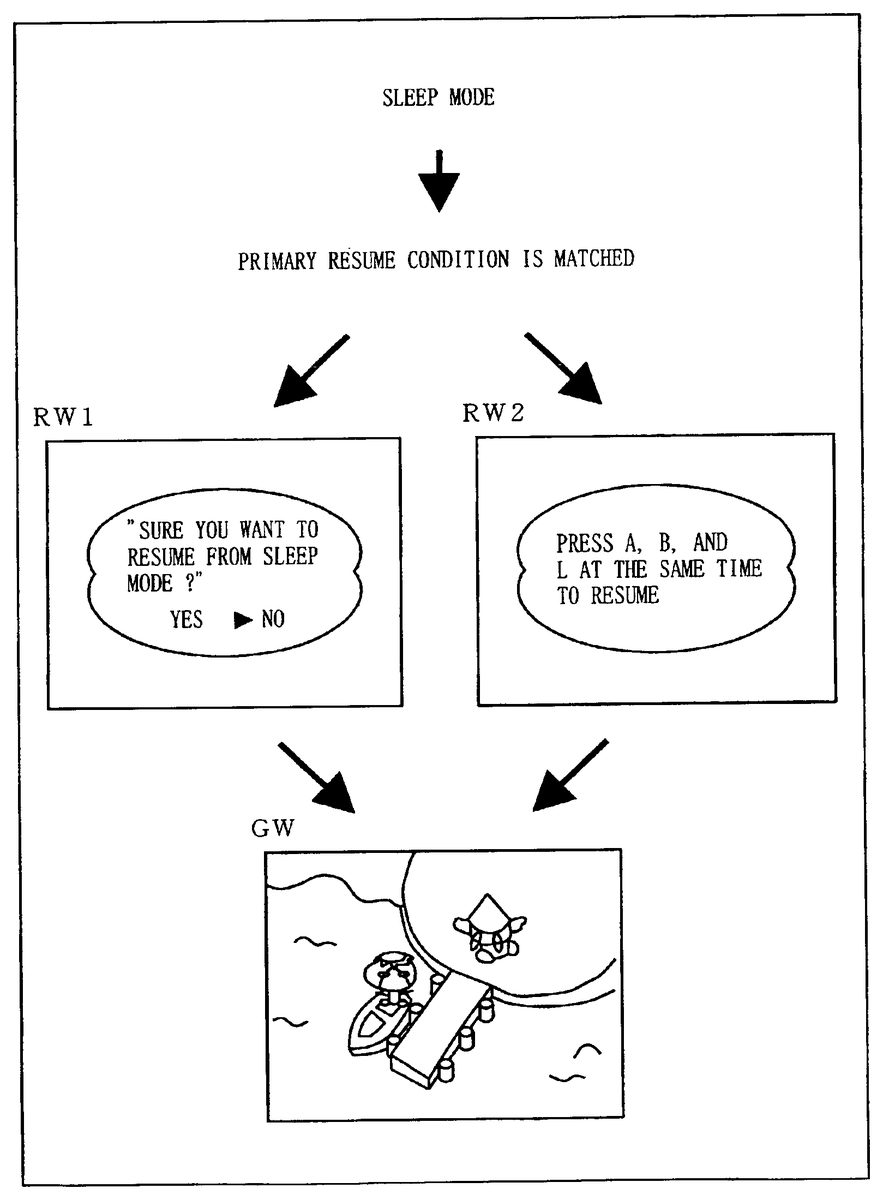
FIG. 6illustrates example resume windows which may be displayed on the LCD12. Referring toFIG. 6, when it is determined at step S31that an input satisfying the primary resume condition is made during the sleep mode, step S36is executed to display a resume window RW on the LCD12. The resume window RW displays a different image depending on the content of the secondary resume condition. For example, in the case where the secondary resume condition is of such a nature that it asks the user to select whether or not to resume from the sleep mode, a resume window RW1may be displayed on the LCD12. This exemplary resume window RW1displays “Sure you want to resume from sleep mode?” to ask the user whether or not to resume from the sleep mode based on a selection of “Yes” or “No”. In the resume window RW1, the option of not choosing to resume from the sleep mode (i.e., “No”) is pointed to by default. On the other hand, in the case where the secondary resume condition stipulates that a user must make an input via the operation switches14in a predetermined combination or order which is not likely to be fortuitously executed as a condition for resuming from the sleep mode, a resume window RW2may be displayed on the LCD12. The resume window RW2displays “Press A, B, and L at the same time to resume” to prompt the user to activate the operation switches14in a predetermined combination or order, thereby asking the user whether or not to resume from the sleep mode. The duration (e.g., ten seconds) of the timer which is set at step S34defines a period for waiting the user to make a decision as to whether or not to resume from the sleep mode based on the resume window RW which is continuously displayed on the LCD12during this period.
Next, the CPU15determines whether or not a decision concerning a resume from the sleep mode has been made by a user based on the inputs via the operation switches14(step S37). This determination is made based on whether: an input which is related to the secondary resume condition is made via the operation switches14; an input which is unrelated to the secondary resume condition is made via the operation switches14; or no input is made. The secondary resume condition allows the user to further confirm whether or not to return from the sleep mode to the game processing mode, in addition to the primary resume condition. In other words, when an input that matches the primary resume condition is made to the portable game apparatus1via the operation switches14during the sleep mode, the portable game apparatus1is placed out of the sleep mode into a preliminary resume state. As a further input that matches the secondary resume condition is made to the portable game apparatus1via the operation switches14, the portable game apparatus1completely returns from the sleep mode to the game processing mode (i.e., at a particular point in the game processing which existed immediately before entering the sleep mode).
For example, the secondary resume condition may stipulate that a user must choose to resume from among the options displayed on the LCD12, by making an appropriate input made via the operation switches14. In this case, if an input is made via the operation switches14that indicates an option has been selected, the CPU15determines at step S37that a decision concerning a resume from the sleep mode has been made, and proceeds to step S38. On the other hand, if an input that is unrelated to the options is made via the operation switches14or if no input is made via the operation switches14, the CPU15determines at step S37that a decision concerning a resume from the sleep mode has not been made, and proceeds to step S41.
Alternatively, the secondary resume condition may stipulate that a user must make an input via the operation switches14in a predetermined combination or order (which is not likely to be a result of fortuitous pressing) to instruct a resume from the sleep mode. In this case, if an input in the predetermined combination or order is made via the operation switches14, the CPU15determines at step S37that a decision concerning a resume from the sleep mode has been made, and proceeds to step S38. On the other hand, if an input is made via the operation switches14which does not conform to the predetermined combination or order, or if no input is made via the operation switches14, the CPU15determines at step S37that a decision concerning a resume from the sleep mode has not been made, and proceeds to step S41. The secondary resume condition may be preset as part of the initial settings of the portable game apparatus1, or may be arbitrarily altered by the user.
Next, if it is determined at step S37that a decision concerning a resume from the sleep mode has been made based on an input made via the operation switches14, the CPU15then determines whether the input is an instruction for a resume from the sleep mode or not (step S38). For example, in the case where the secondary resume condition stipulates that a user must choose to resume from among the options displayed on the LCD12by making an appropriate input made via the operation switches14, if the user selects the option of resuming from the sleep mode (i.e., “Yes” in the exemplary resume window RW1shown in FIG.6), the CPU15proceeds to step S39. On the other hand, if the user selects the option of not resuming from the sleep mode (i.e., “No” in the exemplary resume window RW1in FIG.6), the CPU15proceeds to step S42. In the case where the secondary resume condition stipulates that a user must make an input via the operation switches14in a predetermined combination or order to instruct a resume from the sleep mode, however, the CPU15does not need to perform step S38but may directly proceed to step S39because it has already been determined at step S37that an input in the predetermined combination or order has been made via the operation switches14. Steps S37and S38correspond to a “second resume determination step” regarding the secondary resume condition as defined under the present invention, and the input made via the operation switches14corresponds to a “second operation signal” as defined under the present invention.
Next, the CPU15erases the resume window which is currently displayed on the LCD12(step S39), and reads the game data and game image saved in the RAM153and the VRAM154at step S14, thereby restoring the game data and the game image which existed immediately before entering the sleep mode (step S40), and then returns to step S11to resume the normal game processing mode operation.
On the other hand, if it is determined at step S37that a decision concerning a resume from the sleep mode has not been made based on an input made via the operation switches14, the CPU15determines whether no input has been made via the operation switches14for ten consecutive seconds (step S41). If the period of inactivity concerning the operation switches14is less than 10 seconds, the CPU15returns to step S37to wait for the user to make a decision concerning resume. On the other hand, if the period of inactivity concerning the operation switches14has exceeded 10 seconds, the CPU15proceeds to step S42.
Next, the CPU15displays a blank image on the LCD12in order to erase the resume window from the LCD12(step S42). Although erasure of the display on the LCD12could instead be achieved by stopping the operation of the LCD controller158, it is preferable to display a blank image because, if the LCD controller158is stopped first, noise and the like may appear on the LCD12. Thereafter, control proceeds to the next step S43.
Next, the CPU core157assumes a standby state based on a wait signal, and the system clock generation circuit151stops supplying a clock signal (step S43). As a result, the portable game apparatus1again enters the sleep mode, and returns to step S31to wait for an input satisfying the aforementioned primary resume condition. That is, unless the secondary resume condition is satisfied, the portable game apparatus1does not return to the game processing mode for performing game processing, but instead enters the sleep mode again.
Thus, the portable game apparatus1is capable of operating in a power save mode (sleep mode) with a minimum power consumption. Since two resume conditions need to be satisfied in order to resume the game processing mode, the portable game apparatus1is prevented from inadvertently returning to the game processing mode in the absence of a proper user instruction. In other words, even when the portable game apparatus1comes in contact with surrounding objects as it is carried around by a user in a bag or a pocket while in the power save mode, the portable game apparatus1is prevented from inadvertently returning to the game processing mode due to the pressing of the protruding operation buttons, so that any unintended progress in the game can be forestalled. Furthermore, since a resume procedure for returning to the game processing mode is presented to the user, the user will find it easy to resume from the power save mode without having to remember the procedure, and the user is also not driven to turn off the entire game apparatus1by mistake.
The above embodiment illustrates an example where the portable game apparatus1is connected to the cartridge2to perform game processing, and can be carried around as such. However, as shown inFIG. 7, the present invention would be particularly useful in the case where the portable game apparatus1is connected to a non-portable type game apparatus3so as to allow a game program and the like to be downloaded from the non-portable type game apparatus3to the portable game apparatus1, which can then be disconnected so as to be carried around alone. Specifically, the portable game apparatus1is first connected to the non-portable type game apparatus3via a predetermined connection cord4or the like. Then, a game controlling program, image data, audio data, a sleep mode management program, and the like for the portable game apparatus1, which may be stored in a storage medium (e.g., DVD-ROM) within the non-portable type game apparatus3, are downloaded to the portable game apparatus1via the connection cord4. These programs and data are stored in the working RAM17within the portable game apparatus1, for example. Then, the connection cord4is detached from the portable game apparatus1, after which the user is capable of playing on the portable game apparatus1the game program which was stored in the non-portable type game apparatus3. Although the portable game apparatus1is operating without the cartridge2being connected thereto, the portable game apparatus1can operate in a manner similar to being connected to the cartridge2because the programs and data which are necessary for the operation are already stored in the portable game apparatus1. It will be appreciated that, since a sleep mode management program is previously stored in the portable game apparatus1, the sleep mode transition and resume from the sleep mode can occur in the manner described above. Since the portable game apparatus1which is operating in this state will lose all of the program stored in its RAM once the portable game apparatus1is turned off or the power runs out, the power save mode management program according to the present invention will be especially useful in allowing the user to enjoy the game for longer periods of time.
As described above, the portable game apparatus1is capable of operating in a power save mode (sleep mode) with a minimum power consumption also in the case where a game program previously stored in the non-portable type game apparatus3is downloaded thereto so that the portable game apparatus1is operated without the cartridge2being connected thereto. In the case where the portable game apparatus1is operated without the cartridge2being connected thereto, i.e., isolated from the back-up RAM22, it would not be practical to save the data in the middle of a game and turn off the portable game apparatus1. Instead, the above-described power save mode can be effectively utilized to temporarily save the data in the middle of a game, thereby enhancing the utility of the portable game apparatus1.
While the invention has been described in detail, the foregoing description is in all aspects illustrative and not restrictive. It is understood that numerous other modifications and variations can be devised without departing from the scope of the invention.
Claims
- A power save mode management program contained in a medium which is readable to a computer embodying game apparatus having a power save mode for minimizing internal power consumption, wherein the power save mode management program controls transition to the power save mode and resume from the power save mode, the program comprising: a first resume determination step of determining, during the power save mode, whether a first operation signal generated from an operation switch provided on the game apparatus matches a predetermined primary resume condition or not;a power save mode cancellation step of canceling the power save mode if the first resume determination step determines that the first operation signal matches the primary resume condition;a second resume determination step of determining, after the power save mode cancellation step cancels the power save mode, whether a second operation signal generated from the operation switch matches a predetermined secondary resume condition or not;and a game processing mode resume step of resuming a game processing mode being processed by the game apparatus immediately before entering the power save mode if the second resume determination step determines that the second operation signal matches the secondary resume condition.
- The power save mode management program according to claim 1 , further comprising a operation procedure displaying step of displaying an operation procedure for generating the second operation signal when the power save mode is cancelled by the power save mode cancellation step.
- The power save mode management program according to claim 2 , wherein the operation procedure displaying step comprises displaying a plurality of options, and the secondary resume condition is an option to resume from the power save mode selected by a user from among the options displayed by the operation procedure displaying step.
- The power save mode management program according to claim 2 , wherein the operation procedure displaying step comprises indicating a combination of a plurality of said operation switches, and the secondary resume condition is an operation signal generated corresponding to the combination of the plurality of said operation switches indicated by the operation procedure displaying step.
- The power save mode management program according to claim 1 , further comprising a power save mode re-transition step of again establishing the power save mode if the second operation signal is not generated within a predetermined period of time after the power save mode is canceled by the power save mode cancellation step.
- The power save mode management program according to claim 1 , wherein the primary resume condition is the first operation signal being generated during a period which is equal to or less than a predetermined period of time.
- The power save mode management program according to claim 1 , wherein the primary resume condition is an operation signal generated from a predetermined combination of a plurality of said operation switches.
- The power save mode management program according to claim 1 , further comprising an operation procedure displaying step of displaying an operation procedure for generating the first operation signal when entering the power save mode.
- The power save mode management program according to claim 1 , further comprising: a game data saving step of saving game data being used in the game processing mode upon determining that a third operation signal generated from the operation switch matches a predetermined primary transition condition or that no operation signal has been generated for a predetermined period of time during the game processing mode;and a power save mode transition step of, after the game data is saved, commencing the first resume determination step, and thereafter establishing the power save mode.
- The power save mode management program according to claim 9 , further comprising a transition window displaying step of displaying a transition window for allowing a user to confirm whether or not to enter the power save mode before the first resume determination step is commenced.
- A game apparatus having a power save mode for minimizing internal power consumption, comprising: an operation switch provided on a surface of a housing of the game apparatus for generating an operation signal in response to a user operation;a first resume determination section for determining whether a first operation signal generated from the operation switch during the power save mode matches a predetermined primary resume condition or not;a power save mode cancellation section for canceling the power save mode when the first resume determination section determines that the first operation signal matches the primary resume condition;a second resume determination section for determining whether a second operation signal generated from the operation switch after the power save mode is canceled by the power save mode cancellation section matches a predetermined secondary resume condition or not;and a game processing mode resume section for resuming the game processing mode being processed by the game apparatus immediately before entering the power save mode if the second resume determination section determines that the second operation signal matches the secondary resume condition.
- The game apparatus according to claim 11 , further comprising an operation procedure displaying section for displaying an operation procedure for generating the second operation signal when the power save mode is cancelled by the power save mode cancellation section.
- The game apparatus according to claim 12 , wherein the operation procedure displaying section displays a plurality of options, and the secondary resume condition is an option to resume from the power save mode selected by a user from among the options displayed by the operation procedure displaying section.
- The game apparatus according to claim 12 , wherein the operation procedure displaying section indicates a combination of a plurality of said operation switches, and the secondary resume condition is an operation signal generated corresponding to the combination of the plurality of said operation switches indicated by the operation procedure displaying section.
- The game apparatus according to claim 11 , further comprising a power save mode re-transition section for again establishing the power save mode if the second operation signal is not generated within a predetermined period of time after the power save mode is canceled by the power save mode cancellation section.
- The game apparatus according to claim 11 , wherein the primary resume condition is the first operation signal being generated during a period which is equal to or less than a predetermined period of time.
- The game apparatus according to claim 11 , wherein the primary resume condition is an operation signal generated from a predetermined combination of a plurality of said operation switches.
- The game apparatus according to claim 11 , further comprising an operation procedure displaying section for displaying an operation procedure for generating the first operation signal when entering the power save mode.
- The game apparatus according to claim 11 , further comprising: a game data saving section for saving game data being used in the game processing mode upon determining that a third operation signal generated from the operation switch matches a predetermined primary transition condition or that no operation signal has been generated for a predetermined period of time during the game processing mode;and a power save mode transition section for, after the game data is saved, commencing the first resume determination section, and thereafter establishing the power save mode.
- The game apparatus according to claim 19 , further comprising a transition window displaying section for displaying a transition window for allowing a user to confirm whether or not to enter the power save mode before commencing the first resume determination section.
Disclaimer: Data collected from the USPTO and may be malformed, incomplete, and/or otherwise inaccurate.