U.S. Pat. No. 6,935,954
SANITY SYSTEM FOR VIDEO GAME
AssigneeNintendo Co., Ltd.
Issue DateSeptember 3, 2002
United States Patent No. 6,935,954: Sanity System for Video Game
Issued August 30, 2005, to Nintendo of America, Inc.
Summary:
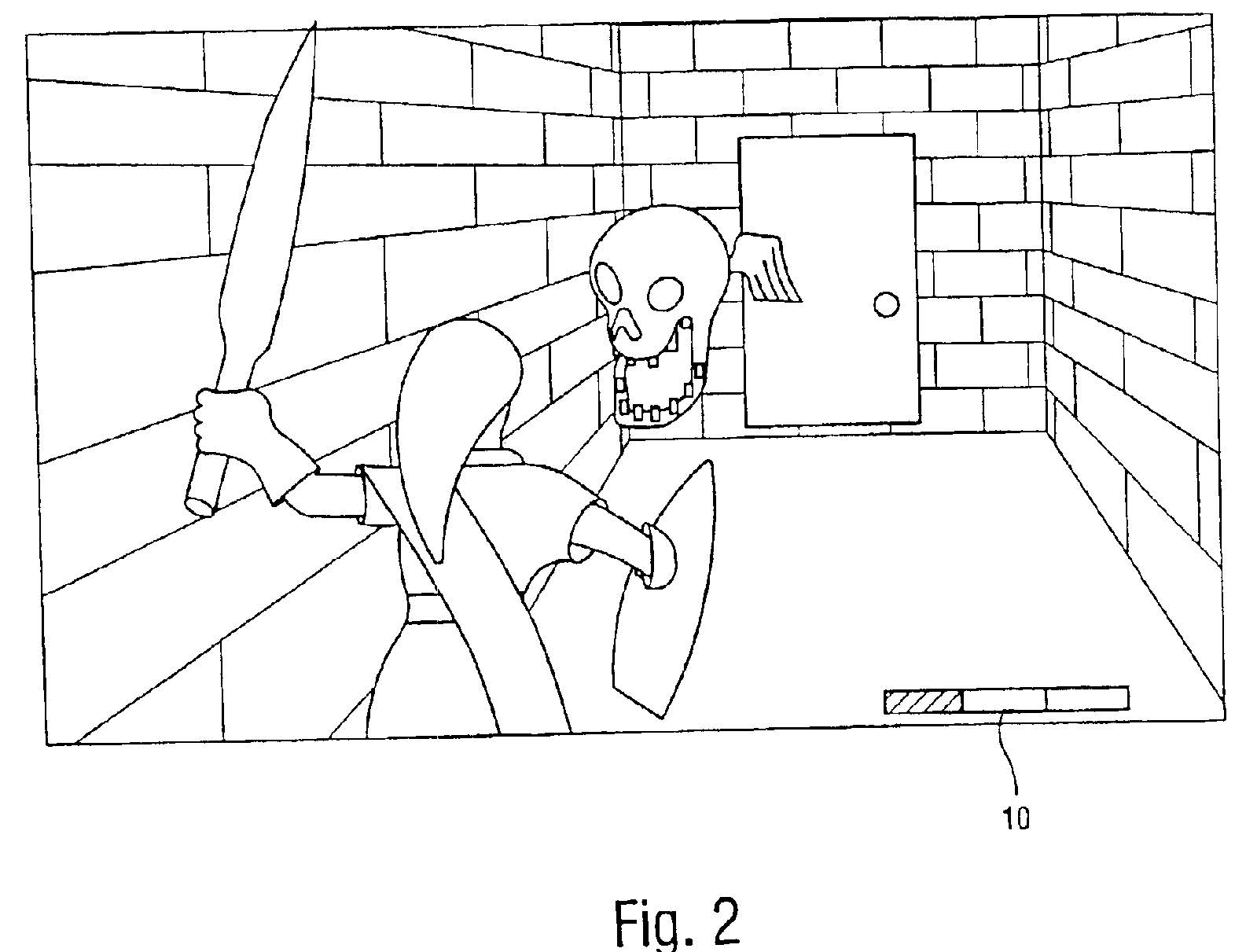
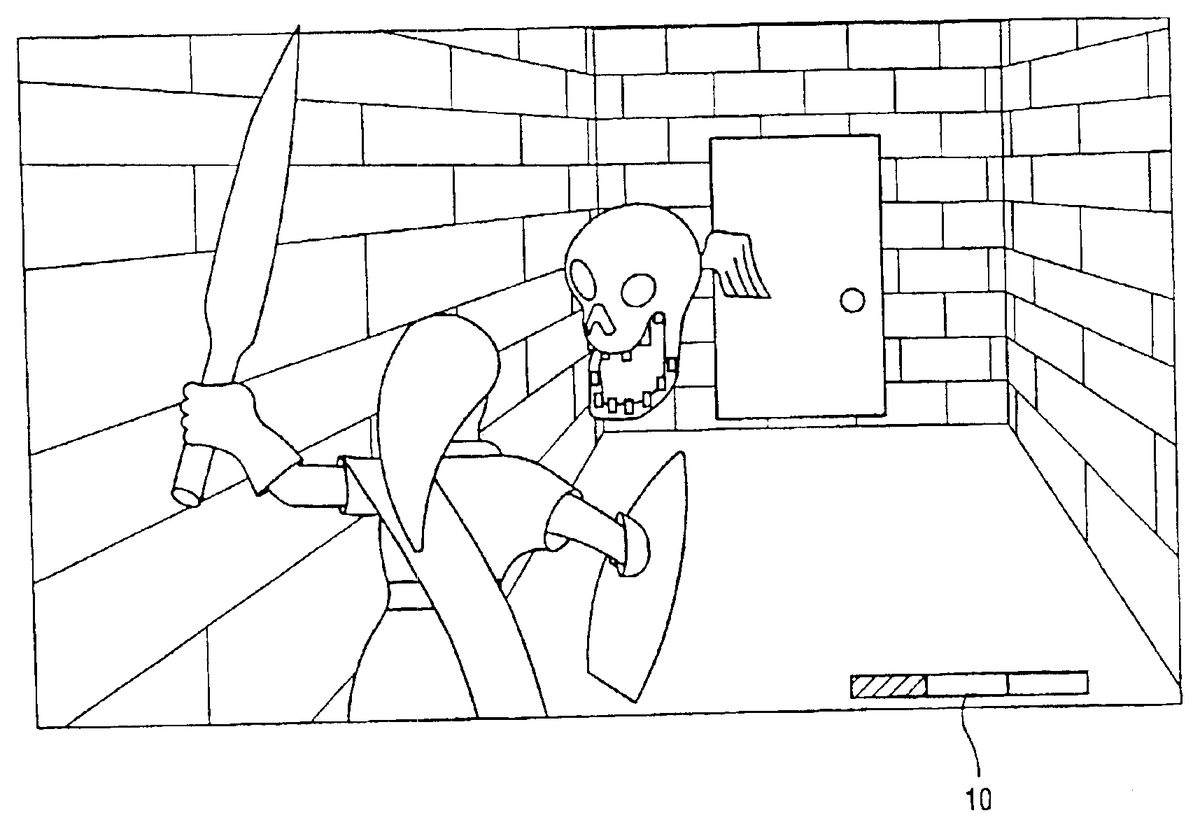
This patent by inventors from Nintendo of America Inc. discloses a video game system that modifies, monitors, and reacts to a game character’s sanity level. A character’s sanity level is modified by an amount based on the player character’s reaction to a particular occurrence or event in the game. In addition, game play and in-game effects may also change based upon a character’s sanity level. The sanity level of the suspicious Link-looking character in the figure, for example, may not be affected as much since a well-prepared warrior with shield and sword in tow will likely not be intimidated by an otherwise terrifying flying skull with bad teeth. Or the character may have been on the brink of insanity to begin with (after scouring Hyrule unsuccessfully for his lost princess) and the flying skull is actually part of his hallucinations. Now, if only people can monitor their sanity levels in real life…
Exemplary Claim:
A method of operating a video game including a game character controlled by a player, the method comprising:
a) setting a sanity level of the game character;
b) modifying the sanity level of the game character during game play according to occurrences in the game, wherein a modifying amount of is determined based on a character reaction and an amount of character preparation; and
c) controlling game play according to the sanity level of the game character, game play being controlled at least by varying game effects according to the game character sanity level.
Illustrative Figure
Abstract
A video game and game system incorporating a game character's sanity level that is affected by occurrences in the game such as encountering a game creature or gruesome situation. A character's sanity level is modified by an amount determined based on a character reaction to the occurrence such as taking a rest or slowing game progress and/or an amount of character preparation. That is, if a character is prepared for the particular occurrence, the occurrence may have little or no affect on the character's sanity level. As the character's sanity level decreases, game play is effected such as by controlling game effects, audio effects, creating hallucinations and the like. In this context. the same game can be played differently each time it is played.
Description
DETAILED DESCRIPTION OF PREFERRED EMBODIMENTS FIG. 3shows a game console system50that constitutes a suitable game machine for playing games incorporating the sanity feature of the present invention. The video game system50includes a main console52, a video game storage device54, and handheld controllers56aand56b(or other user input devices). Video game system50may be, for example, the Nintendo 64® video game system. Main console52is connected to a conventional home color television set58. Television set58displays three-dimensional (3-D) video game images on its television screen60and reproduces stereo sound through its speakers62aand62b. Video game storage device54is typically in the form of a replaceable memory cartridge insertable into a slot64on a top surface66of console52. A wide variety of alternative program storage media such as CD ROMs, DVDs, floppy disks, and the like may be utilized. Video game storage device54may, for example, comprise a plastic housing68encasing a printed circuit board70. Printed circuit board70has an edge72defining a number of electrical contacts74. When the video game storage device54is inserted into main console slot64, the cartridge electrical contacts74mate with corresponding “edge connector” electrical contacts within the main console. This action electrically connects the storage device printed circuit board70to the electronics within main console52. At least a memory76is disposed on printed circuit board70within storage device housing68. Memory76includes a read only memory (ROM) and possibly a read/write memory (e.g., an EEPROM). The ROM stores instructions and other information pertaining to a particular video game. The ROM of a memory76for one game cartridge storage device54may, for example, contain instructions and other information for an adventure game while the ROM of a memory76of another storage device54may contain instructions and information to play a car race game, an educational game, etc. To play one game as opposed to another game, the user of video game system50need only plug the appropriate storage device54into main console slot64—thereby connecting the ...
DETAILED DESCRIPTION OF PREFERRED EMBODIMENTS
FIG. 3shows a game console system50that constitutes a suitable game machine for playing games incorporating the sanity feature of the present invention. The video game system50includes a main console52, a video game storage device54, and handheld controllers56aand56b(or other user input devices). Video game system50may be, for example, the Nintendo 64® video game system. Main console52is connected to a conventional home color television set58. Television set58displays three-dimensional (3-D) video game images on its television screen60and reproduces stereo sound through its speakers62aand62b.
Video game storage device54is typically in the form of a replaceable memory cartridge insertable into a slot64on a top surface66of console52. A wide variety of alternative program storage media such as CD ROMs, DVDs, floppy disks, and the like may be utilized. Video game storage device54may, for example, comprise a plastic housing68encasing a printed circuit board70. Printed circuit board70has an edge72defining a number of electrical contacts74. When the video game storage device54is inserted into main console slot64, the cartridge electrical contacts74mate with corresponding “edge connector” electrical contacts within the main console. This action electrically connects the storage device printed circuit board70to the electronics within main console52. At least a memory76is disposed on printed circuit board70within storage device housing68. Memory76includes a read only memory (ROM) and possibly a read/write memory (e.g., an EEPROM). The ROM stores instructions and other information pertaining to a particular video game. The ROM of a memory76for one game cartridge storage device54may, for example, contain instructions and other information for an adventure game while the ROM of a memory76of another storage device54may contain instructions and information to play a car race game, an educational game, etc. To play one game as opposed to another game, the user of video game system50need only plug the appropriate storage device54into main console slot64—thereby connecting the storage device's memory76(and any other circuitry it may contain) to console52. This enables a computer system embodied within console52to access the information contained within the ROM of memory76, which information controls the console computer system to play the appropriate video game by displaying images and reproducing sound on color television set58as specified under control of the ROM game program information.
Data may be written to and read from a read/write memory of memory76by the computer system embodied within console52. This data may include, but is not limited to, game scores and game levels.
The user may connect up to four controllers to corresponding connectors (sockets)80a-80don main unit front panel82. Two controllers56aand56bare shown in FIG.3. Controllers56aand56bmay take a variety of forms. For example, each of controllers56aand56bshown inFIG. 3include various function controlling push buttons such as84a-cand an X-Y switch86used, for example, to specify the direction (up, down, left or right) that a player-controllable character displayed on television screen60should move. Other controller possibilities include joysticks, nice pointer controls and a wide range of other conventional user input devices.
In use, a user selects a storage device54containing a desired video game, and inserts that storage device into console slot64(thereby electrically connecting memory76and other cartridge electronics to the main console electronics). The user then operates a power switch88to turn on the video game system50and operates controllers56aand/or56bto provide inputs to console52and thus control video game play. For example, depressing one of push buttons84a-cmay cause the game to start playing. Moving directional switch86may cause animated characters to move on the television screen60in controllably different directions. Depending upon the particular video game stored within the storage device54, these various controls84a-cand86on the controllers56aand56bcan perform different functions at different times. If the user wants to restart game play from the beginning, or alternatively with certain game programs reset the game to a known continuation point, the user can press a reset button90.
Additional details of game system50may be found in U.S. Pat. No. 6,022,274 the contents of which are incorporated herein by reference.
Certain of the above-described system components could be implemented as other than the home video game console configuration described above. For example, one could run graphics application or other software written for system50on a platform with a different configuration that emulates system50or is otherwise compatible with it. If the other platform can successfully emulate, simulate and/or provide some or all of the hardware and software resources of system50, then the other platform will be able to successfully execute the software.
As one example, an emulator may provide a hardware and/or software configuration (platform) that is different from the hardware and/or software configuration (platform) of system50. The emulator system might include software and/or hardware components that emulate or simulate some or all of hardware and/or software components of the system for which the application software was written. For example, the emulator system could comprise a general-purpose digital computer such as a personal computer, which executes a software emulator program that simulates the hardware and/or firmware of system50. The DSP processing of the above-described audio system could be emulated on a personal computer.
Some general purpose digital computers (e.g., IBM or MacIntosh personal computers and compatibles) are now equipped with 3D graphics cards that provide 3D graphics pipelines compliant with DirectX or other standard 3D graphics command APIs. They may also be equipped with stereophonic sound cards that provide high quality stereophonic sound based on a standard set of sound commands. Such multimedia-hardware-equipped personal computers running emulator software may have sufficient performance to approximate the graphics and sound performance of system50. Emulator software controls the hardware resources on the personal computer platform to simulate the processing, 3D graphics, sound, peripheral and other capabilities of the home video game console platform for which the game programmer wrote the game software.
FIG. 4Aillustrates an example overall emulation process using a host platform1201, an emulator component1303, and a game software executable binary image provided on a storage medium1062. Host1201may be a general or special purpose digital computing device such as, for example, a personal computer, a video game console, or any other platform with sufficient computing power. Emulator1303may be software and/or hardware that runs on host platform1201, and provides a real-time conversion of commands, data and other information from storage medium1062into a form that can be processed by host1201. For example, emulator1303fetches “source” binary-image program instructions intended for execution by system50from storage medium1062and converts these program instructions to a target format that can be executed or otherwise processed by host1201.
As one example, in the case where the software is written for execution on a platform using an IBM PowerPC or other specific processor and the host1201is a personal computer using a different (e.g., Intel) processor, emulator1303fetches one or a sequence of binary-image program instructions from storage medium1062and converts these program instructions to one or more equivalent Intel binary-image program instructions. The emulator1303also fetches and/or generates graphics commands and audio commands intended for processing by a graphics and audio processor, and converts these commands into a format or formats that can be processed by hardware and/or software graphics and audio processing resources available on host1201. As one example, emulator1303may convert these commands into commands that can be processed by specific graphics and/or or sound hardware of the host1201(e.g., using standard DirectX, OpenGL and/or sound APIs).
The emulator1303used to provide some or all of the features of the video game system described above may also be provided with a graphic user interface (GUI) that simplifies or automates the selection of various options and screen modes for games run using the emulator. In one example, the emulator1303may further include enhanced functionality as compared with the host platform for which the software was originally intended.
FIG. 4Billustrates an emulation host system1201suitable for use with emulator1303. System1201includes a processing unit1203and a system memory1205. A system bus1207couples various system components including system memory1205to processing unit1203. System bus1207may be any of several types of bus structures including a memory bus or memory controller, a peripheral bus, and a local bus using any of a variety of bus architectures. System memory1207includes read only memory (ROM)1252and random access memory (RAM)1254. A basic input/output system (BIOS)1256, containing the basic routines that help to transfer information between elements within personal computer system1201, such as during start-up, is stored in the ROM1252. System1201further includes various drives and associated computer-readable media. A hard disk drive1209reads from and writes to a (typically fixed) magnetic hard disk1211. An additional (possible optional) magnetic disk drive1213reads from and writes to a removable “floppy” or other magnetic disk1215. An optical disk drive1217reads from and, in some configurations, writes to a removable optical disk1219such as a CD ROM or other optical media. Hard disk drive1209and optical disk drive1217are connected to system bus1207by a hard disk drive interface1221and an optical drive interface1225, respectively. The drives and their associated computer-readable media provide nonvolatile storage of computer-readable instructions, data structures, program modules, game programs and other data for personal computer system1201. In other configurations, other types of computer-readable media that can store data that is accessible by a computer (e.g., magnetic cassettes, flash memory cards, digital video disks, Bernoulli cartridges, random access memories (RAMs), read only memories (ROMs) and the like) may also be used.
A number of program modules including emulator1303may be stored on the hard disk1211, removable magnetic disk1215, optical disk1219and/or the ROM1252and/or the RAM1254of system memory1205. Such program modules may include an operating system providing graphics and sound APIs, one or more application programs, other program modules, program data and game data. A user may enter commands and information into personal computer system1201through input devices such as a keyboard1227, pointing device1229, microphones, joysticks, game controllers, satellite dishes, scanners, or the like. These and other input devices can be connected to processing unit1203through a serial port interface1231that is coupled to system bus1207, but may be connected by other interfaces, such as a parallel port, game port Fire wire bus or a universal serial bus (USB). A monitor1233or other type of display device is also connected to system bus1207via an interface, such as a video adapter1235.
System1201may also include a modem1154or other network interface means for establishing communications over a network1152such as the Internet. Modem1154, which may be internal or external, is connected to system bus123via serial port interface1231. A network interface1156may also be provided for allowing system1201to communicate with a remote computing device1150(e.g., another system1201) via a local area network1158(or such communication may be via wide area network1152or other communications path such as dial-up or other communications means). System1201will typically include other peripheral output devices, such as printers and other standard peripheral devices.
In one example, video adapter1235may include a 3D graphics pipeline chip set providing fast 3D graphics rendering in response to 3D graphics commands issued based on a standard 3D graphics application programmer interface such as Microsoft's DirectX 7.0 or other version. A set of stereo loudspeakers1237is also connected to system bus1207via a sound generating interface such as a conventional “sound card” providing hardware and embedded software support for generating high quality stereophonic sound based on sound commands provided by bus1207. These hardware capabilities allow system1201to provide sufficient graphics and sound speed performance to play software stored in storage medium1205.
During video game play, a game character may be exposed to many horrific scenes such as one or more game creatures or a gruesome situation that affect a game character's sanity. Referring toFIG. 1, in accordance with a preferred embodiment of the invention, at the start of a level, the game character will have a set amount of sanity (step S1), which can be visually represented by a bar graph or percentage as shown at10in FIG.2. In step S2, the game progresses according to the game character's sanity level. In this context, as the game character's sanity level decreases, the game character becomes less sane and more susceptible to game effects as further discussed below. As the player encounters a creature or a gruesome situation (step S3), the system determines an affect on sanity level in step S4, and the game character's sanity level is modified in step S5.
For example, a predetermined or relevant amount of sanity may be temporarily lost. The system then returns the process to step S2to continue with the game. When a situation occurs that detrimentally affects the game character's sanity level, if the player presses on without resting or without the proper preparation, he or she may lose all sanity, which affect is determined in step S4. If the player goes insane, the player will have to deal with the repercussions of their condition. The effects could range from something as simple as being stunned temporarily all the way to extreme shell shock. However, both of these conditions under desperate situations could spell certain doom for the player.
In accordance with the invention, generally the character's sanity is more of an atmospheric element, and the character animation will change showing the progressive states of uneasiness experienced by the character as it loses sanity. Pacing oneself through the carnage of the game is one of many possible methods that can be used to keep the character sane during gameplay.
In accordance with the invention, another method to help the character's mental state is research and knowledge. In other words, if the character knows exactly what is to be faced, the effect on the character's sanity may be reduced. In this context, the game may include a practice area with game creatures the same as or similar to those to be encountered during game play. Practicing against such creatures will reduce the affect on the character's sanity when the same or similar character is encountered during game play. The game program may also provide mind aids including, for example, items such as herbs, elixirs, medallions, Magicks, etc. that can aid the mind of the player against the darkest evil and reduce the sanity loss.
Preferably, levels of insanity will be sliding scale. The more severe the insanity (i.e., the lower the character's sanity level), the more player's control animation and targeting system will be affected. In addition, the more extreme the insanity the more hallucinations the character will experience. There may be a certain number, such as three, distinct levels of sanity loss.
The game designers incorporating this sanity feature may layout points of interest by way of markers. These markers will allow the game to cause the character to, for example, focus on strange and eerie parts of the game while insane. Such sanity markers will cause the player to look at specific areas and receive different effects corresponding to the current sanity level.
The targeting system may also be affected when the character is insane. For example, the game may be programmed to cause the character to arbitrarily lock onto non-targets to cause confusion and build on player anxiety. The character may be caused to lock onto markers in its forward and peripheral vision areas. In particular, the character may automatically lock onto and shoot out a light source (like a candle or lantern) to cause adhoc havoc in the gameplay as a result of the current level of sanity for the character.
As noted, the character may experience hallucinations as a result of the sanity level. Hallucinations may occur in the following exemplary forms:Wall carvings coming to life and reaching out for the characterSomething in wall or under floor moving by the character (Frighteners type of thing)Statue watching the character (Head tracking)Suit of armor moving (Relaxed to on guard stance)Static statue or object that appears to follow the character when they're not lookingFalse doors that appear and disappear when the attempt to open is madeGlowing eyes blinking in the darkness, yet when the area is illuminated they disappearPainting that shifts and changes along with its meaningPoints of interest markers that the character's head will watch
In addition to the visual effects, the game may also be programmed to cause audio effects as a result of the current level of sanity of the character. For example, the character and thus the player may experience the following audio effects:Ambient environmental sounds that get amplified or distortedHeartbeat of character increases (May also be synchronized with Rumble Pak, a product offered by Nintendo)WindLighteningCavern/damp-dripping sewer soundCreatures soundsFootstepsEarth rumbles (e.g. great beast foot steps, may also be synchronized with Rumble Pak and camera shake)Loud noises coming from beyond a doorway, but when opened there is only silenceWhispering sounds coming from random locations that fade in and out
In addition to the visual and audio effects described above, the game may also be programmed to cause miscellaneous effects as a result of the sanity level, such as:Hallucination: lights go out, and a creature appears as lights come on, then the lights go back off, then the light comes back on and the creature is goneStretching walls and corridors so they require more time to traverseBleeding wallsEnormous roar that emits from a tiny rodent (Mouse or rat)Dripping water from above, but when the character takes a second look it is now bloodShadows that appear to shift and changeCharacter's torch mysteriously blows out, loud noise then it is once again litFaint maniacal laughter (That gets louder and louder as the character draws deeper into insanity)Ambient audio, such as a water drip could become louder as insanity increases, so a really insane character will occasionally have this irritating dripping sound to distract himLagging shadow (the character's shadow appears to follow the character)
In accordance with the instant invention, the sanity feature can be programmed into any suitable video game using known programming techniques for the purpose of enhancing gameplay. As explained above, the sanity of the player's character will be affected by decisions made, enemies faced, as well as any other suitable occurrence that may relate to sanity. As the character loses sanity, the environment will change in a way that hinders the character's and player's progress through the game. The instant invention provides an added challenge and enables multiple possible scenarios, so that playing of the game may be different each time the game is played. It is noted that the invention is particularly suited for implementation in action/adventure/RPG games, but that it may be used in any suitable video game or the like.
While preferred embodiments of the instant invention have been described herein, it is noted that various changes and modification may be made, as one skilled in the art will readily understand from the description of the invention herein. Thus, the description of the invention herein is not meant to be limiting to the true scope of the invention.
Claims
- A method of operating a video game including a game character controlled by a player, the method comprising: (a) setting a sanity level of the game character;(b) modifying the sanity level of the game, character during game play according to occurrences in the game, wherein a modifying amount of is determined based on a charater reaction and an amount of character preparation;and (c) controlling game play according to the sanity level of the game character, game play being controlled at least by varying game effects according to the game charater sanity level.
- A method according to claim 1 , wherein step (b) is practiced by reducing the sanity level of the game character upon encoutering a game creature or a gruesome situation.
- A method according to claim 2 , wherein the modifying amount is reduced if the game character has been prepared for the respective game creature or a gruesome situation.
- A method according to claim 2 , wherein the modifying amount is reduced if the game character is rested after encountering the respective game creature or gruesome situation.
- A method according to claim 1 , wherein step (b) is practiced by increasing the sanity level of the game character if the game character locates a mind aid during game play.
- A method according to claim 1 , wherein step (c) is practiced by detrimentally affecting game character reactions to player commands with decreasing sanity.
- A method according to claim 1 , wherein step (c) is practiced by causing the game character to hallucinate with decreasing sanity.
- A method according to claim 7 , wherein step (c) is further practiced by providing markers that draw the game character's attention during game play, and by subjecting the markers to different effects corresponding to the sanity level of the game character.
- A method according to claim 1 , wherein step (c) is practiced by varying game audio effects according to the sanity level of the game character.
- A method according to claim 1 , further comprising displaying a sanity meter that displays the sanity level of the game character.
- A video game system including a control processor for playing a video game including a game character controlled by a player, the video game system comprising a setting unit communicating with the control processor that sets a sanity level of the game character, wherein the sanity level of the game character is modified during game play according to occurrences in the game, and wherein a modifying amount is determined based on a character reaction and an amount of character preparation, the control processor controlling game play according to the sanity level of the game character, wherein game play is controlled at least by varying game effects according to the game character sanity level.
- A video game according to claim 11 , wherein the sanity level of the game character is reduced upon encountering a game creature or a gruesome situation.
- A video game according to claim 12 , wherein the modifying amount is reduced if the game character has been prepared for the respective game creature or gruesome situation.
- A video game according to claim 12 , wherein the modifying amount is reduced if the game character is rested after encountering the respective game creature or gruesome situation.
- A video game according to claim 11 , wherein the sanity level of the game character is increased if the game character locates a mind aid during game play.
- A video game according to claim 11 , wherein game character reactions to player commands are detrimentally affected with decreasing sanity.
- A video game according to claim 11 , wherein the game character is caused to hallucinate with decreasing sanity.
- A video game according to claim 17 , wherein markers are provided that draw the game character's attention during game play, and wherein the markers are subjected to different effects corresponding to the sanity level of the game character.
- A video game according to claim 11 , wherein game audio effects are varied according to the sanity level of the game character.
- A video game according to claim 12 , further comprising a sanity meter that displays the sanity level of the game character.
- A video game system including a control processor for playing a video game including a game character controlled by a player, the video game system comprising means for setting a sanity level of the game character;means for modifying the sanity level of the game character during game play according to occurrences in the game, wherein a modifying amount is determined based on a character reaction and an amount of character preparation;and means for controlling game play according to the sanity level of the game character, game play being controlled at least by varying game effects according to the game character sanity level.
Disclaimer: Data collected from the USPTO and may be malformed, incomplete, and/or otherwise inaccurate.